Wholesale Trade Shows: A Complete Exhibitor’s Guide

Wholesale trade shows usually hit your calendar long before they hit your budget. First you reserve space. Then come freight questions, labor forms, graphics deadlines, power orders, product samples, staff schedules, lead capture, and the quiet worry that after all that work your booth might still look like everyone else’s.

That’s why wholesale trade shows reward operators, not just exhibitors. The brands that get results usually aren’t the ones with the biggest footprint. They’re the ones that choose the right event, build a booth around a clear sales goal, and remove enough on-site friction that their team can focus on conversations instead of troubleshooting.

What Are Wholesale Trade Shows and Why Do They Matter

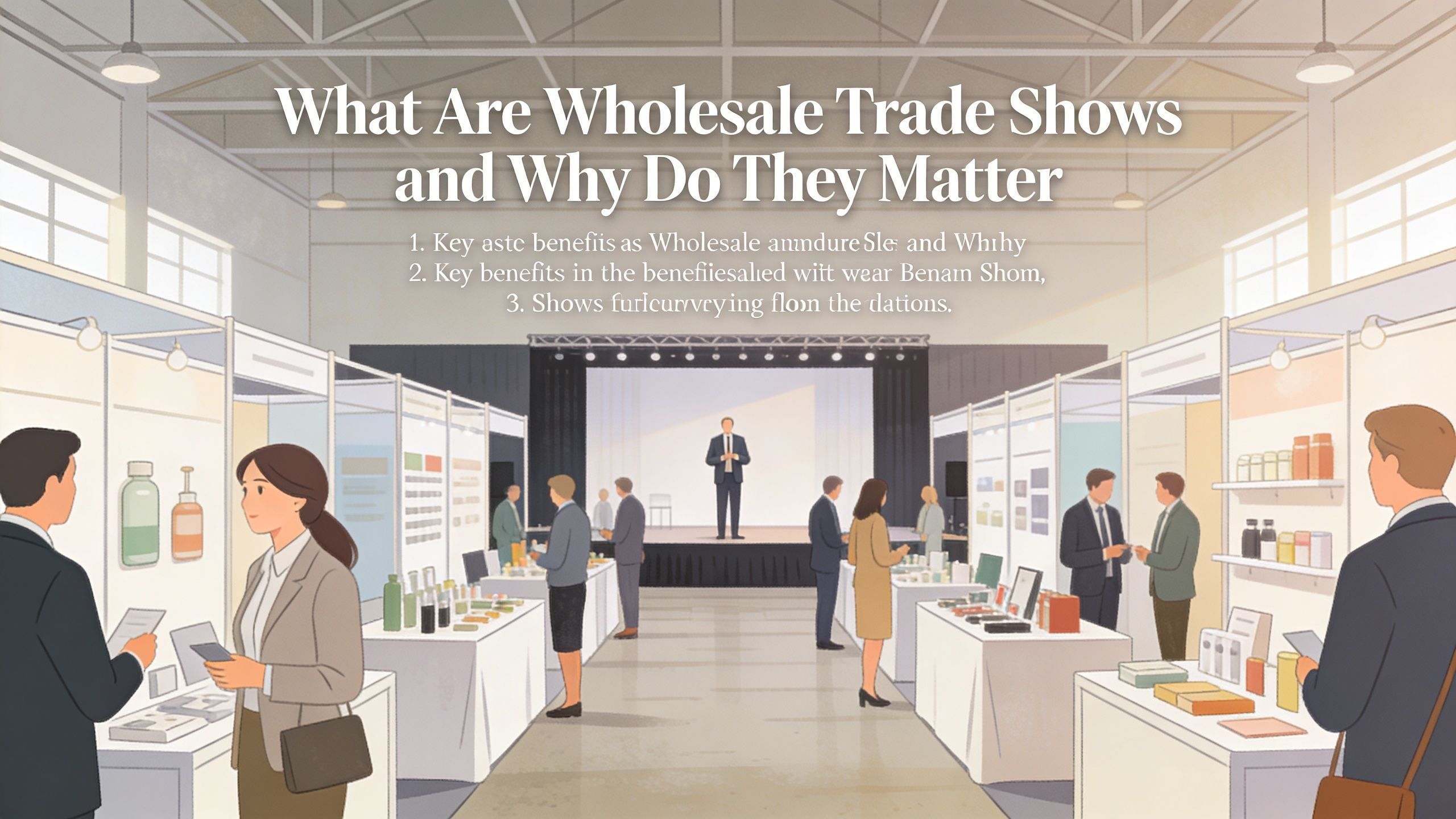
Wholesale trade shows are business-to-business buying events. They’re built for manufacturers, importers, distributors, retailers, and brand teams that need to place orders, source products, compare vendors, and build supply relationships. That makes them very different from consumer expos, where the goal is often awareness or direct retail sales.

A simple way to think about it is this. A consumer expo is like a storefront with foot traffic. A wholesale trade show is like a live marketplace for channel sales. The people walking the aisle aren’t casual browsers. They’re often there to evaluate lines, compare suppliers, and decide what goes into stores, catalogs, or distribution networks.
wholesale trade shows

The scale matters. The global exhibitions industry generates an estimated $50.6 billion annually, and the U.S. B2B trade show market reached $15.8 billion in 2024 and is projected to exceed $17.3 billion by 2028. The same industry snapshot notes that 82% of attendees hold buying authority and spend an average of 8.3 hours on the show floor, which is why these events still matter even when digital sourcing is easier than ever. Those figures come from this history and market overview of trade shows.

Why face-to-face still wins in wholesale

Buyers can review catalogs online. They can schedule video calls. They can compare prices in a spreadsheet. What they can’t do online as well is assess product presentation, ask layered questions in real time, and judge whether your team looks prepared to support a wholesale account.

Practical rule: If your sales process depends on trust, product nuance, or channel fit, a live show compresses months of back-and-forth into one meeting.

That’s also why event selection matters so much. A crowded calendar isn’t a strategy. A targeted one is. If you’re mapping upcoming dates, cities, and venue cycles, a practical starting point is this Las Vegas trade shows calendar, especially if your team exhibits in multiple categories throughout the year.

Why exhibitors keep investing

Wholesale trade shows have been doing this job for a long time. The format has evolved, but the core reason they persist is simple. Buyers and suppliers want efficient, high-trust conversations in one place.

For brands launching products, entering new regions, or trying to open more accounts, few channels combine visibility, relationship building, and sales opportunity as efficiently.

How to Find the Right Wholesale Trade Shows for Your Brand

The wrong show can drain a budget fast. You can have a polished booth, solid messaging, and a good team, then still walk away with weak leads because the audience wasn’t right. That’s why show selection should start with buyer fit, not prestige.

A lot of exhibitors default to the biggest event in their category. That’s not always the smart move. Large national shows can give you volume and visibility, but they also bring more noise, more competition, and more pressure on booth execution.

Start with buyer intent, not event size

Build your shortlist around four filters:

  • Channel fit: Are the attendees the kinds of buyers you sell to, such as distributors, specialty retail, mass retail, or regional chains?
  • Product fit: Does the event have a clear category lane, or will your offer feel buried among unrelated exhibitors?
  • Geographic fit: Are you trying to expand in a specific region, support reps in a territory, or meet national accounts?
  • Sales cycle fit: Does your product need hands-on demos and in-person discussion, or can buyers evaluate it quickly?

Then look at prior exhibitor lists, attendee descriptions, floor plans, and educational sessions. Those details often tell you more than the event’s homepage.

Regional shows deserve a harder look

Many brands overlook regional markets because they assume bigger attendance means better outcomes. That’s often false for niche products.

According to this regional wholesale trade show analysis, over 50% of U.S. wholesale trade shows occur in tier 2 and 3 regional markets, and those smaller shows can yield 25% higher close rates for niche products because competition is lighter. For small and mid-sized exhibitors, that can be the difference between being one of many and being remembered.

If your product needs a conversation more than a spectacle, a regional floor can outperform a major show.

A practical way to qualify your shortlist

Don’t ask, “Is this a big show?” Ask these instead:

  1. Who writes orders there
  2. What competing brands already exhibit
  3. How crowded your category feels
  4. Whether your current booth format fits the venue and audience
  5. What success would look like after the show

That fifth point matters. If your goal is distributor recruitment, your target show list may look very different than if you’re launching a new product line or trying to deepen retail relationships.

For teams in the promotional products space, this PPAI trade shows overview is a useful example of how to evaluate category-specific events instead of relying on broad convention searches.

What usually works and what usually doesn’t

Approach What happens
Choose by buyer type Better lead quality and clearer staff conversations
Choose by event reputation alone Strong branding opportunity, but mixed sales outcomes
Target niche regional events More focused meetings and less booth competition
Exhibit everywhere Budget spreads thin and follow-up quality drops

The best event is rarely the loudest one. It’s the one where your ideal buyer can understand your offer fast, and your team can have enough of the right conversations to justify the trip.

Your Planning Blueprint for Wholesale Trade Shows

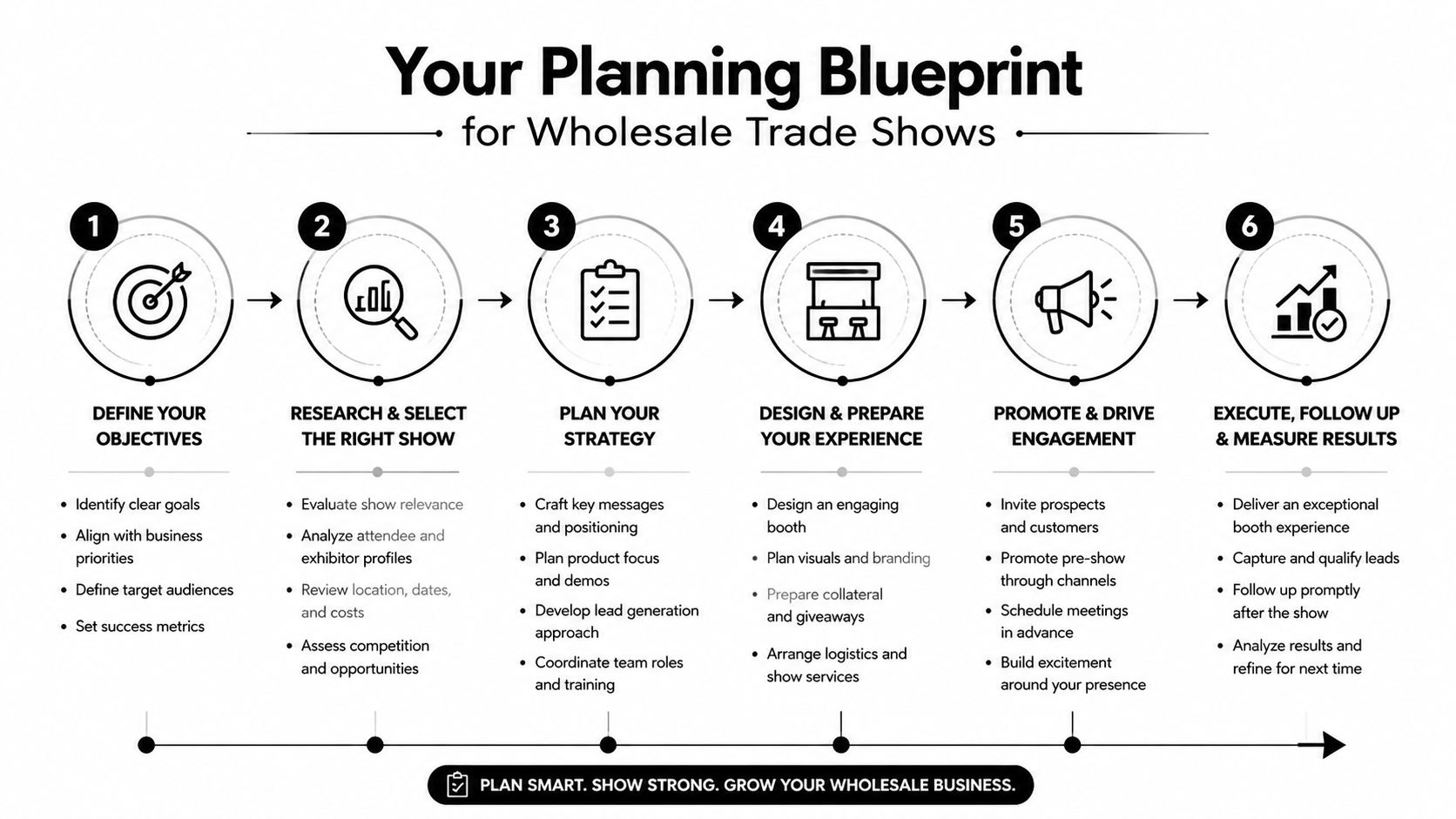
Most poor show results can be traced back to planning mistakes made long before move-in. The booth is only one part of the outcome. The rest comes from goal setting, budget control, logistics, staffing, and lead capture discipline.

At wholesale trade shows, 81% to 82% of attendees hold buying authority, and 92% are actively seeking new products. The same data set notes that 14% of Fortune 500 participants report a 5:1 ROI, and attendees spend an average of 5.5 to 8.3 hours on the show floor. That’s why structure matters. You’re not preparing for random traffic. You’re preparing for long, decision-oriented conversations with people who can buy. Those figures appear in this U.S. wholesale and trade show data reference.
wholesale trade shows

Set one primary goal and two secondary ones

Exhibitors get into trouble when they try to make one event do everything. Decide what the show is really for.

Your primary goal might be:

  • Open new wholesale accounts
  • Launch a product line
  • Meet current buyers in person
  • Recruit distributors or reps

Then choose two secondary goals. Maybe you want press exposure, market feedback, or retailer education. That keeps your booth, staffing, and content aligned.

Build the budget from the floor up for wholesale trade shows

The line items that surprise newer exhibitors aren’t glamorous. They’re labor, drayage, electrical, installation timing, and freight handling. Those can reshape your economics faster than most branding decisions.

Use a budget with separate buckets for:

  • Space costs
  • Booth structure and graphics
  • Shipping and material handling
  • Electrical and show services
  • Travel and staffing
  • Samples, literature, and giveaways
  • Lead capture and follow-up

If you’re sourcing branded handouts or leave-behinds for buyers, this guide to Dirt Cheap Product bulk buying tips is useful because it focuses on purchasing practical promotional items in volume instead of buying too many novelty pieces that won’t support follow-up.

Design for traffic flow, not just looks

A booth can be attractive and still fail. The usual reason is that it doesn’t help people move naturally from attention to conversation.

A practical layout includes:

  • A clear visual hook: Buyers should understand what you sell within seconds.
  • An open front edge: Don’t block entry with counters unless they serve a purpose.
  • A demo or discussion zone: Keep selling interactions out of the aisle.
  • A back-of-house plan: Samples, literature, chargers, and personal items need a hidden home.

The best booth layouts reduce decision fatigue. Buyers know where to look, where to stand, and who to talk to.

Train the team on booth behavior

Booth staff often know the product well and still underperform at shows. Usually the problem isn’t knowledge. It’s posture, timing, and qualification.

Train your team to:

  1. Greet quickly without pouncing.
  2. Ask what kind of buyer they are.
  3. Adjust the conversation based on channel and need.
  4. Record key details before the next conversation starts.
  5. End with a clear follow-up commitment.

A booth full of people staring at phones can sink a good event. So can a team that talks too long to low-fit visitors while qualified buyers pass by.

Treat shipping as part of strategy

Shipping mistakes create expensive on-site decisions. Late freight, poor packing, unlabeled crates, and missing setup instructions turn a normal install into a scramble.

That’s why exhibitors should decide early whether their booth system is labor-heavy or labor-light, modular or custom, and fragile or forgiving. This trade show shipping guide is helpful if you’re planning freight, timelines, and show-floor logistics with less guesswork.

Lead capture needs a plan before the show opens

Don’t rely on business cards in a fishbowl and memory after the event. Define the fields your team must capture, how leads will be scored, and what follow-up happens by segment.

A simple lead form should answer:

  • Who is this person
  • What do they want
  • How soon are they buying
  • What did they react to
  • What next step was promised

That’s the difference between “we met a lot of people” and “we can work this list on Monday.”

Maximizing Booth Impact at Wholesale Trade Shows

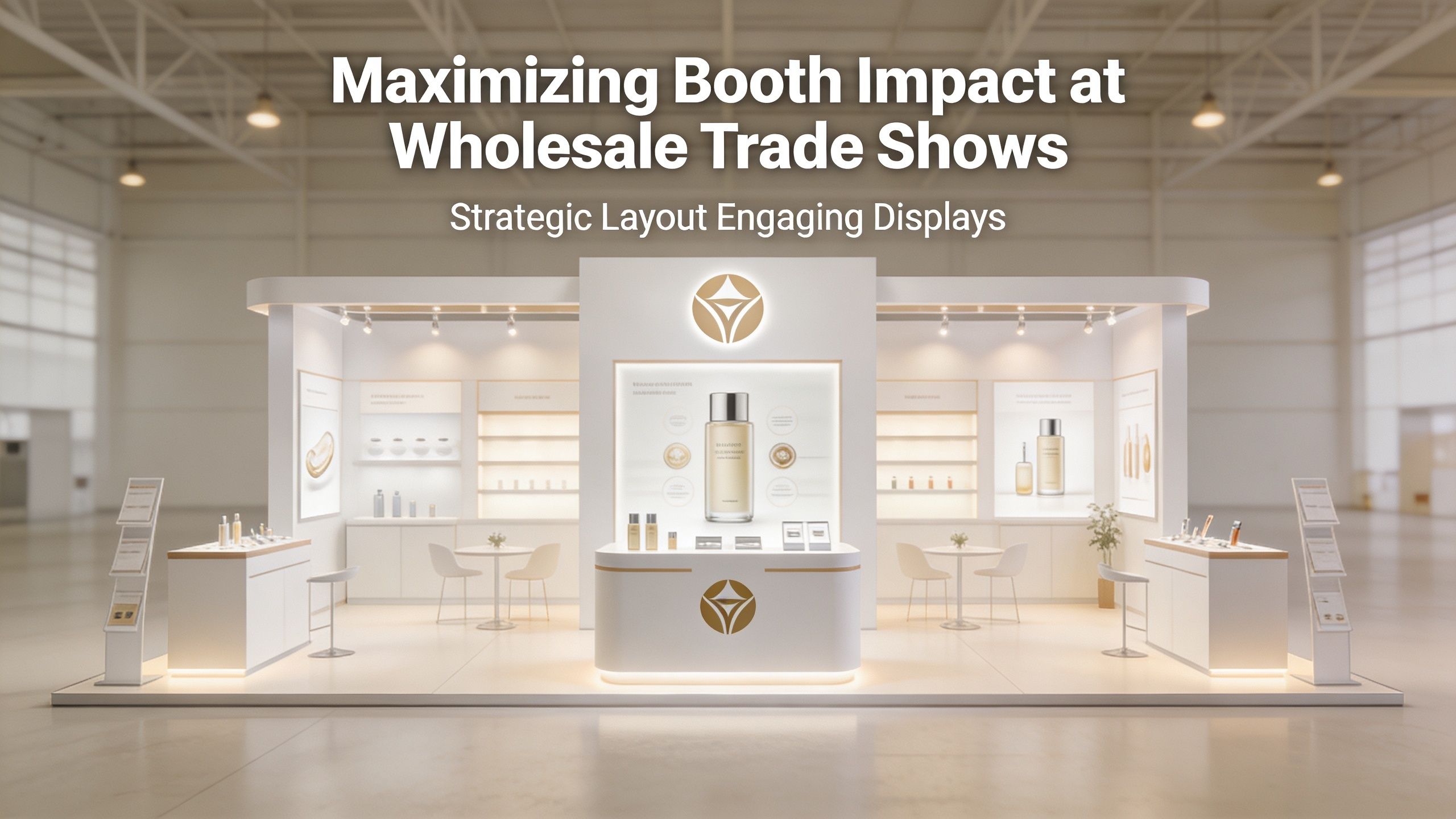
Most exhibitors don’t lose attention because their products are weak. They lose attention because the booth asks too much of the attendee. Static walls, cluttered graphics, seam-heavy monitor arrays, and awkward layouts make buyers work too hard to understand the offer.

That’s where immersive systems change the equation. According to this trade show technology overview, exhibitors using immersive elements such as uninterrupted video walls can increase engagement dwell time by up to 45%. The same source notes that AI-powered business card scanning exceeds 95% accuracy for major languages, and QR code interactions have grown 45% year over year. Done well, that combination helps exhibitors attract attention and qualify leads faster.
wholesale trade shows

What works better than stacked screens

A common mistake is building a booth around multiple monitors and trying to fake immersion. The seams break the image. The cables complicate setup. The hardware starts dictating the design.

A purpose-built LED structure works differently. Walls, columns, counters, and arches can all become one visual system instead of separate pieces fighting each other.

What we’ve seen work on crowded floors:

  • Motion with restraint: Short content loops beat long brand films.
  • One dominant message: Buyers should know category, value, and use case fast.
  • Integrated capture tools: QR codes and scan prompts should feel native to the display, not taped on as an afterthought.
  • Space for conversation: Attention is only step one. The booth still needs room to sell.

The operational trade-off most buyers miss

Higher visual impact often brings more install complexity. That’s the trap. A booth can look advanced and still become a logistics problem if it requires too many parts, too much labor, or too much troubleshooting.

One option in this category is LED Exhibit Booths, which builds exhibit structures from LED video tiles rather than separate monitors. In practical terms, that means the booth itself becomes the display surface. Their systems use 1.9 pitch, while many competitors use 2.5 pitch, so the image appears sharper at close viewing distances. The pricing model also matters operationally. Everything is included except charges billed directly by the show, such as electricity and material handling. They also provide white-glove, turnkey service and keep an audiovisual technician onsite during open show hours so exhibitors can call or text for fast issue resolution.

A booth that looks impressive but needs constant babysitting is a staffing problem disguised as a design choice.

How to think about impact realistically

If your event strategy depends on demos, launch messaging, or high buyer throughput, immersive display systems can make sense. If your product needs tabletop explanation and low-volume meetings, a simpler booth may be enough.

The key is matching the booth system to the job:

  • Need broad aisle visibility: Large-format motion and continuous surfaces help.
  • Need detailed product explanation: Pair visuals with trained staff and concise demos.
  • Need low-stress execution: Favor systems with fewer tools, fewer parts, and clear support.
  • Need faster lead qualification: Connect display content to scanning, QR engagement, and immediate notes.

A better booth isn’t just more visible. It removes friction for the buyer and for your team.

How to Measure Your Wholesale Trade Show ROI

If you can’t explain the return, the next show budget gets harder to defend. “We had great traffic” isn’t enough. Leadership wants to know what the event produced, what it cost, and whether the booth strategy improved the outcome.

The useful part of ROI measurement is that it forces honesty. It separates activity from contribution. It also exposes whether the booth worked as a sales tool or just as a backdrop.
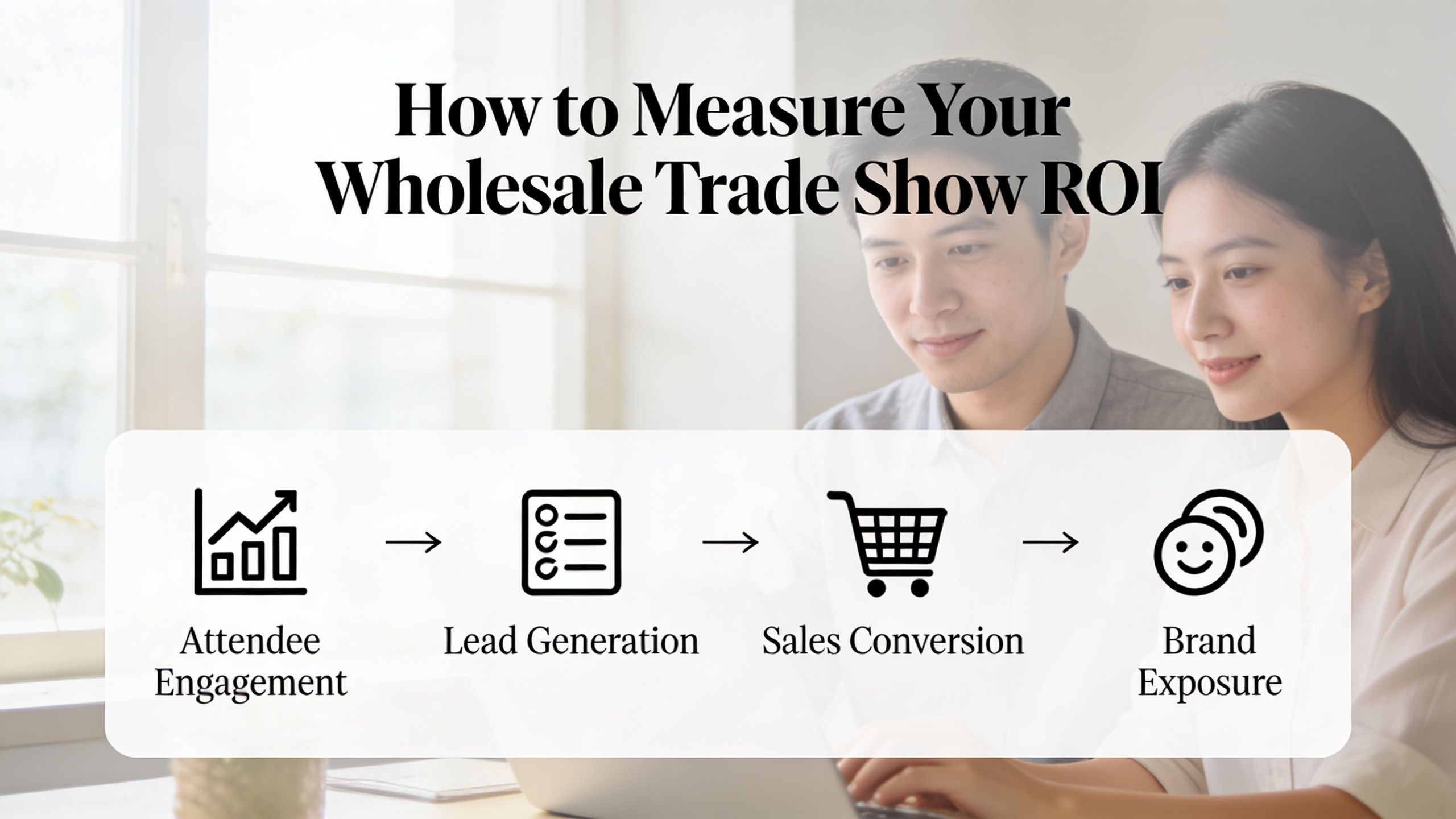
Two people working on a laptop while reviewing a process flow for measuring wholesale trade show ROI.

Track the metrics that connect to revenue

Start with a small set of numbers your sales and marketing teams can use:

KPI What it tells you
Total qualified leads Whether the show attracted the right buyers
Cost per qualified lead How efficiently you converted spend into opportunities
Meetings held Whether pre-show outreach and booth execution worked
Follow-up completion rate Whether the team acted while interest was still fresh
Opportunities created How many leads turned into real pipeline
Revenue influenced What business can be tied back to the event

That’s enough to evaluate most wholesale trade shows without drowning in vanity metrics.

Use a simple ROI formula

A practical formula is:

ROI = (Revenue influenced by the show – Total show cost) / Total show cost

If your team prefers a simpler view, calculate:

  • total spend
  • qualified leads
  • opportunities created
  • closed business tied to the event

That gives finance a clean story and gives marketing something they can improve next time.

Booth design affects both sides of the formula

Many exhibitors fail to understand a critical aspect: Booth choice impacts not only lead volume, but also lead quality and total event cost.

According to this analysis of visual technology and trade show ROI, exhibitors using integrated video walls and similar advanced visual systems see 45% higher attendee dwell time and 28% more qualified leads. The same source states that lightweight systems can reduce drayage and shipping costs by up to 50%. That means the booth can improve the numerator by helping create better opportunities and improve the denominator by reducing logistics spend.

Better ROI usually comes from two levers at once. More qualified conversations and less operational waste.

Don’t wait until after the show to measure

Post-show analysis is necessary, but on-site visibility matters too. Teams should know what they’re tracking before doors open, who owns lead review each day, and how they’ll flag high-priority prospects for immediate follow-up.

For a closer look at how booth format influences outcomes, this guide on how LED exhibit booths can increase ROI at trade shows is useful because it connects exhibit design choices to business results instead of treating the booth as a separate branding decision.

What a healthy review sounds like

A useful debrief sounds like this:

  • We met the right buyer types.
  • Our message landed fast.
  • The booth supported demos instead of slowing them down.
  • Our team captured usable notes.
  • Follow-up happened while conversations were still fresh.

A weak debrief usually sounds like this:

  • Traffic felt strong.
  • People liked the booth.
  • We need to sort the leads.

Only one of those is easy to turn into pipeline.

The Ultimate Wholesale Trade Show Checklist

The easiest way to miss something important is to keep the plan in five different documents. A single checklist keeps sales, marketing, operations, and booth vendors aligned.

Use this as a working document, not a one-time read. Assign names. Add deadlines. Update status every week as the show gets closer.

Exhibitor’s Wholesale Trade Show Checklist

Timeline Task Status (To Do / In Progress / Complete)
6 plus months out Define the primary event goal and secondary goals To Do / In Progress / Complete
6 plus months out Confirm target buyer profiles and success criteria To Do / In Progress / Complete
6 plus months out Reserve booth space and review show rules To Do / In Progress / Complete
4 to 6 months out Finalize booth concept, layout, and messaging To Do / In Progress / Complete
4 to 6 months out Approve budget for booth, travel, freight, and show services To Do / In Progress / Complete
4 to 6 months out Book hotels, flights, and staff schedules To Do / In Progress / Complete
3 months out Plan product samples, literature, and giveaways To Do / In Progress / Complete
3 months out Set lead capture fields, scoring rules, and follow-up workflow To Do / In Progress / Complete
2 months out Train booth staff on greeting, qualifying, demos, and notes To Do / In Progress / Complete
1 month out Confirm shipping deadlines, labels, and packing lists To Do / In Progress / Complete
1 month out Launch pre-show outreach to buyers and existing accounts To Do / In Progress / Complete
2 weeks out Reconfirm all vendor orders and on-site contacts To Do / In Progress / Complete
Show week Check install status, test content, and verify lead capture tools To Do / In Progress / Complete
During show Review lead quality daily and adjust staffing or messaging if needed To Do / In Progress / Complete
Within 48 hours after show Send follow-up by lead priority and promised next step To Do / In Progress / Complete
Within 2 weeks after show Review ROI, pipeline impact, and lessons for the next event To Do / In Progress / Complete

Three checklist items that deserve extra attention

  • Ownership: Every task needs one owner. Shared ownership usually means no ownership.
  • Deadlines: Internal deadlines should land before official deadlines. That gives you room for corrections.
  • Setup planning: Don’t treat move-in as a surprise. Confirm labor assumptions, packing sequence, and install timing early. This trade show set up guide is a useful reference if your team wants a cleaner install process and fewer last-minute decisions.

Teams rarely fail because they forgot the big things. They fail because ten small tasks stayed unresolved until show week.

A tight checklist won’t make a weak strategy strong. It will make a strong strategy executable, and that’s what counts on a live show floor.


If you’re evaluating a video wall booth for upcoming wholesale trade shows, LED Exhibit Booths is worth reviewing for teams that want a turnkey exhibit structure built from continuous LED tiles instead of stacked monitors. The practical appeal is straightforward. The booth itself becomes the display surface, setup is designed to be simpler, and support stays close so your team can focus on buyers rather than booth issues.
Expert Guide to LED Screen for Stage

Trade show floors are crowded with safe choices. Printed backwalls. A looping monitor on a stand. Maybe a lightbox if the team pushed the budget. Most of those booths disappear the moment attendees walk past them. Naturally, an led screen for stage can make all the difference.

led screen for stage setups solve that problem when they’re planned correctly. They don’t just show content. They turn your booth into the content. That’s the difference between being seen and being remembered.

We’ve watched exhibitors make the same mistake over and over. They focus on the hardware first, then get surprised by setup complexity, hidden venue charges, weak content, or a screen that looked fine in a sales deck and underwhelming on the show floor. The smarter move is to treat the screen, the structure, the logistics, and the support model as one decision.

A strong LED wall can stop traffic, frame product launches, support demos, and clean up the whole look of your exhibit. A poorly planned one becomes an expensive troubleshooting project. That’s why the question isn’t just whether you should use LED. It’s how to do it without wasting money or creating more operational risk for your team.

Transform Your Booth with an LED Screen for Stage

Most booths ask for attention. A good LED booth holds it.

Walk a typical expo hall and you’ll see the same visual pattern repeating. Static graphics. Small monitors with bezels. Booth staff trying to create energy that the environment doesn’t support. Then you hit one exhibit where the entire structure moves with clean video, brand color, product visuals, and motion that pulls people in from the aisle. That booth changes the pace of foot traffic around it.

led screen for stage

That’s the practical value of an LED screen for stage use in trade shows. It gives you one uniform visual surface instead of a patchwork of screens, cables, and support hardware. If you want to see how that looks in practice, study these video wall booth examples. The pattern is obvious. The booths that feel modern don’t rely on more parts. They rely on fewer distractions.

What attendees notice first

Attendees don’t walk up thinking about pixel pitch, refresh rate, or panel design. They react to three things:

  • Motion: Content that moves cleanly catches the eye faster than static graphics.
  • Scale: A large visual field changes how people read your brand from the aisle.
  • Finish: Continuous surfaces look premium. Gaps, stands, and exposed hardware don’t.

A trade show booth has a few seconds to make its case. LED gives you a much stronger first impression than printed graphics alone.

The important part is execution. LED can make a small booth look bigger, a standard booth look custom, and a product launch feel like an event. But it only works when the specs fit the environment and the service model removes friction instead of adding it.

What Makes a High-Impact LED Screen for Stage

The biggest mistake buyers make is assuming all LED walls look roughly the same. They don’t. A high-impact wall comes down to the right pixel pitch, enough brightness, and a panel system that looks clean at trade show viewing distances.

led screen for stage

Pixel pitch decides whether your wall looks premium

Pixel pitch is the spacing between the LEDs. Smaller pitch means tighter spacing and a sharper image at close range. That matters on a trade show floor because people don’t stand far away. They walk right up to your booth.

For indoor LED screen for stage applications, a finer pitch like P1.9 to P3.9 keeps visuals sharp for attendees viewing from 2 to 5 meters, supports 140° viewing angles, and helps eliminate Moiré in photos, according to this LED stage screen guide from RTLED Solution.

Our view is simple. P1.9 is the better choice. Many competitors use P2.5, and that’s where you start seeing the difference between “good enough” and “crisp.” In a booth environment, that finer pitch gives you higher apparent resolution and a cleaner image when attendees are close, taking photos, or watching product demos.

The situation resembles the difference between an older TV and a sharper modern display. Both show the message. Only one looks expensive.

Brightness matters more than spec sheets suggest

A booth doesn’t exist in a controlled theater. It sits under venue lighting, aisle glare, overhead signs, and whatever lighting neighboring exhibitors brought with them.

Indoor screens generally need enough output to stay vivid under show lighting. The same RTLED source notes 1,200 nits as a practical indoor brightness level for stage use, while outdoor variants can reach much higher brightness for sunlight conditions. That’s why you shouldn’t buy on price alone. If the wall can’t hold color and contrast in the venue, the content falls flat.

Here’s a quick comparison buyers should keep in mind:

Spec Better choice for trade shows Why it matters
Pixel pitch P1.9 over P2.5 Sharper visuals at close viewing distances
Indoor brightness Properly matched for venue conditions Prevents washed-out content
Viewing performance Wide angle panels Keeps visuals clean from side traffic
Photo friendliness Panels that reduce Moiré Helps your booth look better on camera

A short demo makes these differences easier to spot:

The screen has to work as part of the booth

The wall itself isn’t the whole system. Mounting, alignment, content playback, and integration into the booth matter just as much. If you’re comparing panel systems, review real LED wall panel options for exhibit builds and ask how they behave in a finished booth, not just in a warehouse.

If you’re also evaluating venue infrastructure and efficiency, this overview of LED lighting advantages for your property is useful context. It’s not trade-show-specific, but it helps explain why LED technology keeps replacing older display and lighting approaches.

Practical rule: If attendees will stand close, photograph the booth, or watch detailed product visuals, don’t settle for coarse pitch just to shave the quote.

Choosing the Right Size and Shape for Your LED Screen

Most buyers ask for the biggest wall they can fit. That’s not the right question. The right question is what size and shape helps people see, understand, and remember your message from the way they move through the booth.

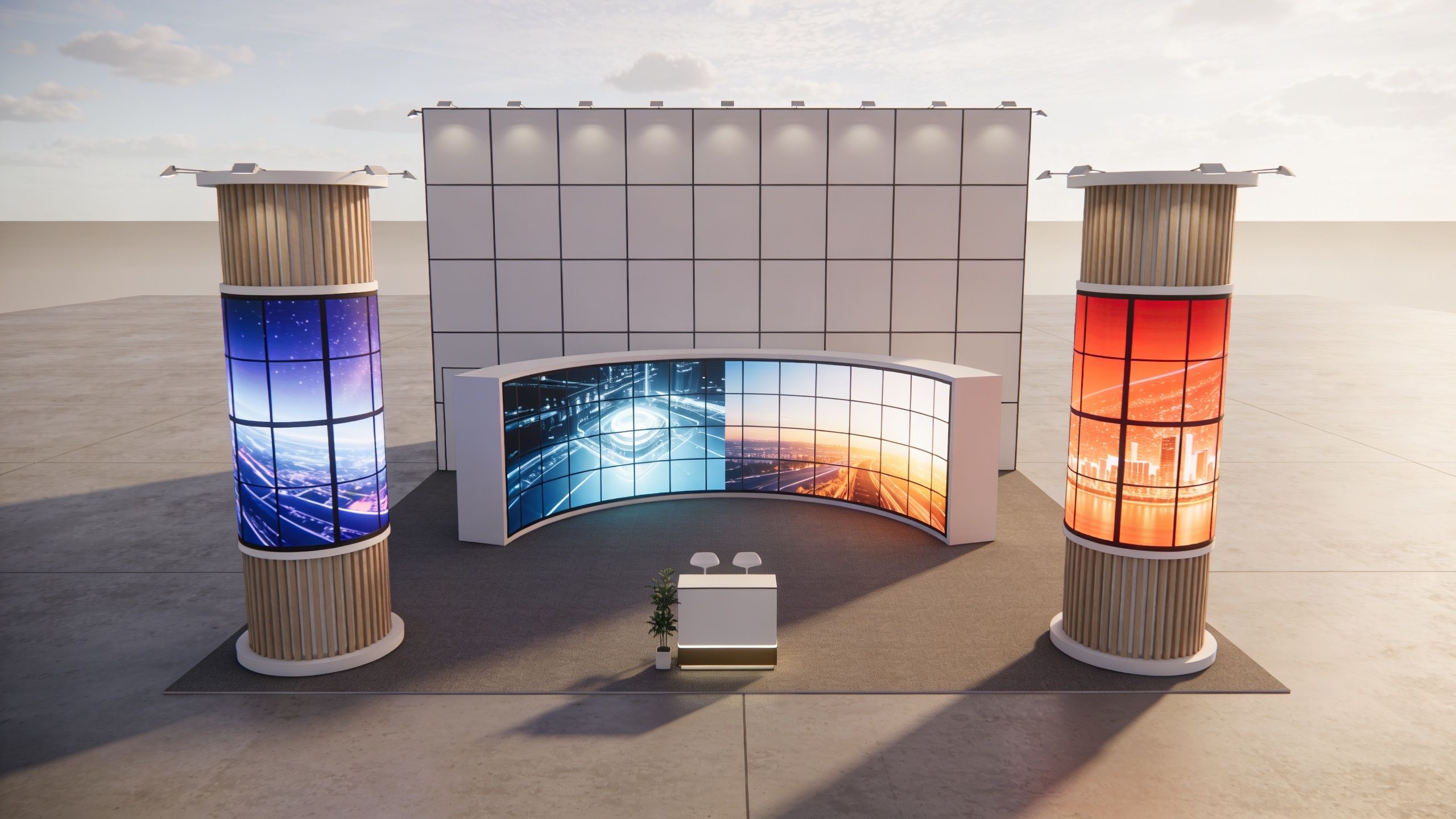
A professional trade show exhibition booth featuring large LED screens, curved digital displays, and a reception desk.

A useful rule from this stage LED screen size calculator is that screen height often follows a 1/6th rule, where the height is one-sixth of the distance to the furthest viewer. That’s a practical starting point because it ties the screen to sightlines, not guesswork.

The same source notes that a standard 7.32m x 2.74m screen can be built from 96 individual tiles and weigh 576kg without heavy steel frames, which matters for shipping and drayage planning.

Start with the viewing pattern

Before choosing dimensions, answer these questions:

  • Aisle visibility: Are you trying to pull attention from across a main aisle, or support conversations inside the booth?
  • Booth depth: A shallow booth usually benefits from a strong backdrop. A deeper footprint may support a wider or wrapped display.
  • Content type: Product reels, live demos, speaker support, and ambient motion all favor different aspect ratios.
  • Traffic direction: Island booths and corner booths often need different visual strategies.

If you’re comparing options, these video wall size examples make it easier to see what fits different footprints.

Flat isn’t your only option

Modular LED becomes much more interesting than a standard “screen rental.” You’re not limited to a rectangle on a truss.

A well-planned LED screen for stage can become:

  • A continuous backdrop behind presenters or product showcases
  • A curved feature wall that softens the booth and improves sightlines
  • A wrapped column that turns dead structural space into media
  • An arch or portal that pulls people into the exhibit
  • An island element visible from multiple approaches

Curved configurations deserve more attention than they usually get. They can create a stronger sense of immersion and help a booth feel custom instead of rented.

If your booth shape is unusual, that’s not a constraint. It’s often the best reason to use modular LED in the first place.

A simple decision checklist

Use this when narrowing the shape:

  1. Need brand visibility from distance? Prioritize height and bold content.
  2. Need product education at close range? Prioritize finer pitch and clean frontal viewing.
  3. Need to stand apart from neighboring booths? Consider curved or wrapped elements.
  4. Need easier logistics? Ask how the panel system affects freight, drayage, and install time.
  5. Need one screen to do several jobs? Design content zones instead of oversizing the wall.

Bigger helps only when the wall is matched to your layout. The best LED installations feel intentional, not oversized.

Renting vs Buying Your Trade Show LED Screen

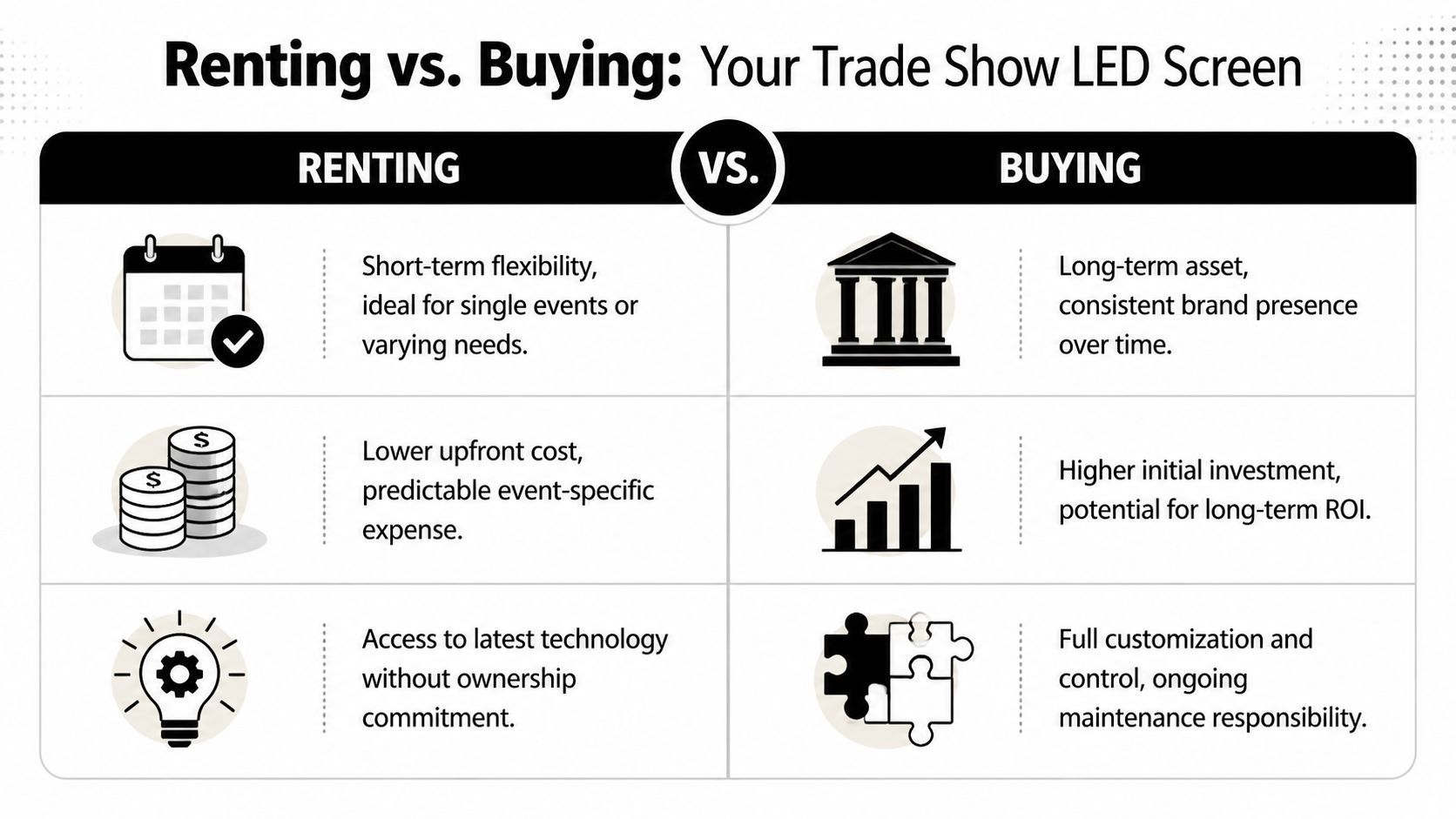
For most exhibitors, renting is the smarter decision. Buying only makes sense when your team uses the system often enough, stores it properly, maintains it well, and has people who can manage deployment without drama.

A comparison chart outlining the pros and cons of renting versus buying an LED screen for trade shows.

High-quality LED panels can last 100,000 hours of operation, which translates to over 10 years of reliable performance with proper maintenance, and many systems see continuous use for 6 to 8 years before replacement, according to this overview of stage LED screen durability. So yes, ownership can pay off for frequent exhibitors.

But longevity alone doesn’t make buying the right move.

When buying makes sense

Buying is worth considering if you:

  • Exhibit constantly: You use the system across many events every year.
  • Have internal operational support: Someone owns storage, maintenance, testing, and logistics.
  • Need fixed brand control: The same system appears repeatedly in the same format.
  • Can handle technical risk: If a panel issue shows up before a show, your team has a recovery plan.

Ownership gives you asset control. It also gives you responsibility for every detail people forget to budget time for.

Why renting usually wins

Renting suits how most marketing teams work. Campaigns change. Booth sizes change. Event goals change. Technology changes too.

Here’s the clean comparison:

Option Strongest advantage Main tradeoff
Renting Flexibility and lower upfront commitment You don’t own the asset
Buying Long-term control and repeat use value You own maintenance, storage, and refresh risk

If you’re weighing the two, this breakdown of owning vs renting an LED video wall is a useful reference.

Renting lets marketing teams stay focused on outcomes. Buying turns them into equipment managers unless the company has a strong support structure.

The other reason I lean toward renting for trade shows is simple. Most exhibitors want a result, not a warehouse problem. They want the wall to show up, look sharp, work all day, and disappear after the event without creating another internal process.

Why Our White-Glove Service Makes Your LED Screen Shine

This is the part most LED vendors underplay. The screen is only half the job. The other half is everything that can go wrong between the quote and the moment your booth opens.

Trade show LED projects get messy fast when multiple vendors touch different parts of the build. One group handles the structure. Another handles playback. Another handles install. Someone else is responsible for content formatting. Then the venue adds its own rules, labor windows, power requirements, and material handling process. If nobody owns the whole chain, your team ends up owning the stress.

We don’t think that model works.

What turnkey should actually mean

A proper white-glove, turnkey model should include everything needed to get the LED wall delivered, installed, operated, and removed cleanly. Our position is straightforward. If the show doesn’t bill you directly, it should already be in the price.

That means our pricing includes the moving parts buyers usually get surprised by later. Design coordination, equipment, setup, dismantle, and show support are covered. The exceptions are the charges the show itself bills directly, such as electricity and material handling.

That pricing structure matters because LED quotes can look artificially low when key services are excluded. A cheap number upfront often turns into a more expensive project once labor, support, and logistics are added back in.

The onsite technician is not optional

An LED wall at a trade show isn’t a “set it and forget it” item. Content needs to run properly. Playback systems need to stay stable. If something changes on site, somebody qualified needs to fix it quickly.

That’s why we leave an audiovisual technician onsite the entire time the trade show is open. If anything goes wrong, you text or call, and an AV technician is at the booth within minutes to solve the problem.

That’s not a luxury add-on. It’s the difference between a minor issue and a public failure.

The real value of LED support isn’t visible when everything works. It shows up the moment something doesn’t.

Better hardware still needs better execution

We also use P1.9 pitch as our standard, while many competitors still quote P2.5. That means the wall starts with a sharper image at the close viewing distances common on a convention floor. But superior panels only matter when the system around them is handled correctly.

That includes:

  • Pre-show planning: Matching wall size, shape, and playback needs to the booth
  • Installation discipline: Clean alignment, proper cabling, and polished finish
  • Operational support: Fast adjustments during show hours
  • Post-show teardown: Efficient dismantle without leaving your team exposed

Curved builds are a good example. According to this stage LED screen resource focused on curved configurations, integrated curved setups can outperform flat screens by 35% in viewer dwell time, and modern magnetic locking systems can assemble a 20m² curved wall in under an hour. That’s exactly why execution matters. The format is powerful, but only when the crew knows how to deploy it cleanly.

What this means for your team

Most exhibitors don’t want to manage AV. They want to meet customers, run demos, support sales, and protect the brand. That’s the right priority.

Here’s what a white-glove model changes in practice:

  • Fewer vendors to coordinate: One partner handles the moving parts.
  • Cleaner budgeting: Fewer surprise add-ons hiding outside the initial quote.
  • Less show-floor risk: Problems get solved immediately by a qualified technician.
  • Less internal distraction: Your team stays focused on attendees instead of troubleshooting.

The LED wall should be the easiest part of your event once the show opens. If your provider can’t make that true, keep shopping.

Creating Content That Captivates and Converts

A sharp wall with weak content is still a weak booth. The screen gets attention. The content decides whether people stop, understand what you do, and move into a real conversation.

The first rule is ruthless simplicity. Trade show attendees don’t stand still and read paragraphs. They glance, scan, and keep moving unless something earns another few seconds.

Build content for motion, not for a brochure

The best booth content usually does three jobs at once. It attracts from distance, explains quickly up close, and supports your staff while they talk to visitors.

Use this structure:

  • Ambient layer: Movement, brand color, and visual energy that catches attention from the aisle
  • Message layer: Short statements that explain the offer fast
  • Proof layer: Product visuals, interface footage, use cases, or demo support

If you need help generating short-form visual concepts quickly, tools like ShortGenius AI video ad maker can help marketing teams produce motion assets faster. You still need human judgment, but speed matters when event deadlines are tight.

For teams planning custom content, this guide to video wall video production for trade shows is a solid starting point.

Don’t treat the wall like a giant PowerPoint slide. Treat it like a moving storefront.

Keep text minimal and hierarchy obvious

Common booth content mistakes are predictable. Too much copy. Small text. Overstuffed layouts. Videos designed for desktop screens instead of large-format playback.

A better approach:

  1. Lead with one clear idea at a time. Don’t stack five messages on one loop.
  2. Use bold typography sparingly. People should understand the headline from the aisle.
  3. Show the product early. Don’t make viewers wait through a long animated intro.
  4. Design loops to operate without sound. Audio often isn’t practical on a busy floor.
  5. Plan for repetition. Attendees join the loop at random points.

Make sustainability and power part of the decision

LED content strategy also benefits from the technology’s efficiency. LED screens consume substantially less power than projectors and produce less heat, and high-end models can reach 5,000 to 10,000 nits of brightness, according to this analysis of LED stage screens and video walls. That same source notes this efficiency can reduce a booth’s overall electricity expenses by 15-20% or more.

That matters for two reasons. First, lower power demand can support tighter event budgets. Second, many brands now care how exhibit choices align with sustainability goals. LED helps on both fronts.

A practical content checklist

Before final export, check for these issues:

  • Resolution fit: Match files to the wall layout so playback stays clean
  • Readable pacing: Give headlines enough screen time to be understood while walking
  • Brand consistency: Keep colors, fonts, and transitions aligned with the campaign
  • Demo support: Include visuals that help staff explain the offer live
  • Photo value: Make sure the booth looks good in attendee and press photos

Content doesn’t need to be complicated. It needs to be intentional, fast to understand, and designed for the way people behave on a show floor.

Your Partner for an Unforgettable Event Presence

A strong LED exhibit comes down to three decisions. Choose the right specs. Choose the right size and shape. Choose a partner that removes complexity instead of adding it.

That’s why we push hard on details that many buyers overlook. P1.9 pitch matters because close-range booth viewing exposes weak resolution fast. Turnkey pricing matters because hidden exclusions distort the actual cost. Onsite technician support matters because trade shows don’t give you time to troubleshoot in public.

An LED screen for stage use should make your brand look sharper, your booth feel more modern, and your team’s job easier. If it creates stress, the service model is broken.

We believe the best trade show technology is the kind your attendees notice and your internal team barely has to think about. Clean visuals. Smart design. Fast support. No surprises beyond the direct show charges you already know the venue controls.

Choose the provider that gives you the finished result, not just the hardware list.


If you want a booth that looks sharper, runs smoother, and comes with true turnkey support, talk to LED Exhibit Booths. We provide P1.9 video wall booths, all-inclusive pricing except direct show charges like electricity and material handling, and white-glove service with an onsite AV technician throughout show hours so your team can focus on customers, not screens.

Your Guide to PPAI Trade Shows in 2026

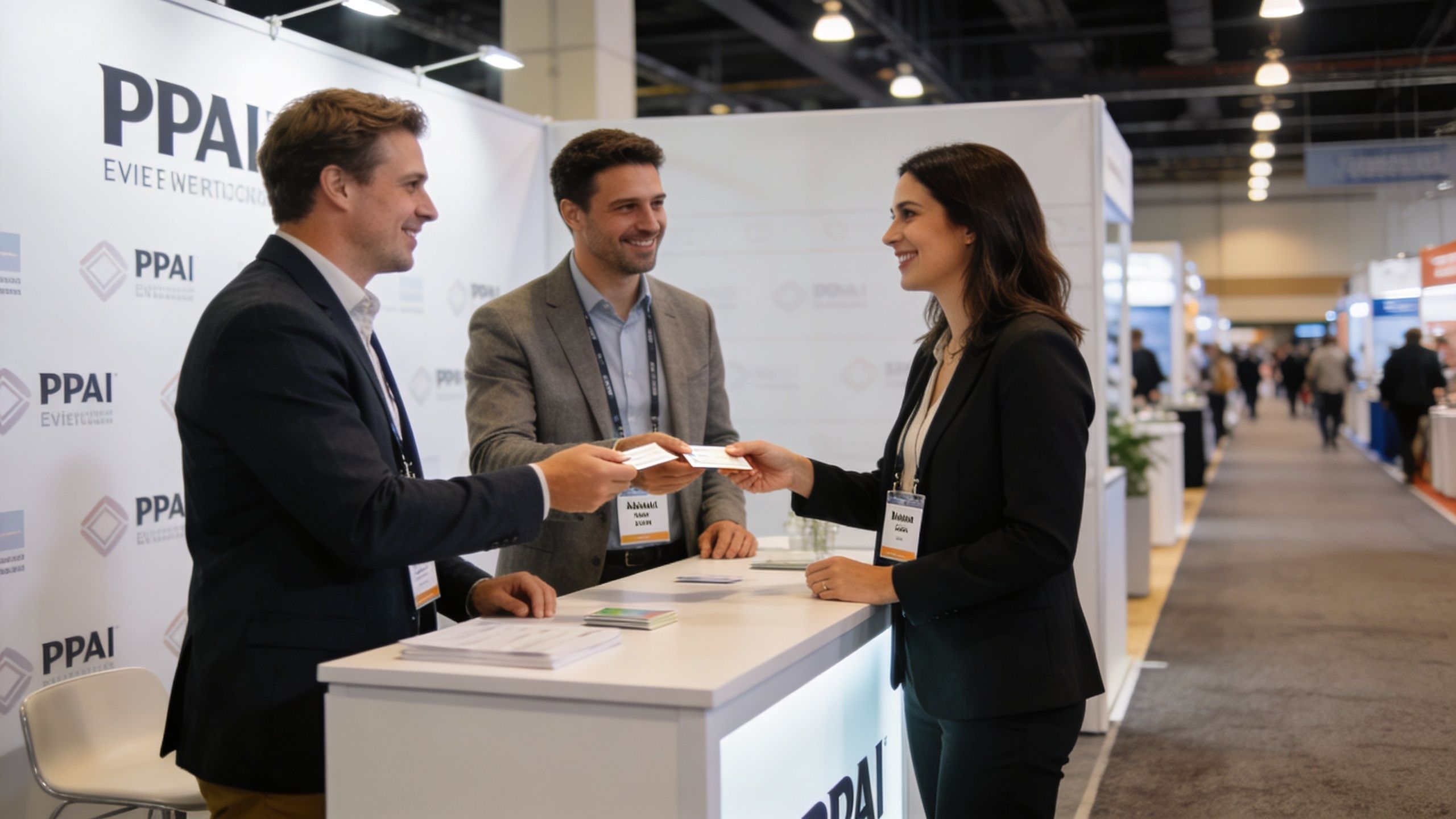
If you’re in the promotional products business, you already know PPAI trade shows are the main event. These aren’t just conferences; they’re the central hub where the entire branded merchandise industry comes together to connect, discover, and make deals happen.

Why PPAI Trade Shows Are a Must-Attend Event

Showing up to a PPAI event is about so much more than just having a booth. It’s about strategically placing your brand at the heart of the action and setting the stage for a successful year. This is where relationships are built, new products get their big break, and major deals are signed. You simply won’t find this concentration of qualified buyers and key decision-makers anywhere else.

Think about it. You get a direct line to thousands of potential clients who are actively looking for new products and partners. PPAI events create that exact environment. It’s your best chance to get instant feedback on your offerings, see where the industry is headed, and get a good look at what your competitors are bringing to the table.

ppai trade shows

The Scale of Opportunity in PPAI Trade Shows

The numbers speak for themselves. The attendance figures and economic impact show just how vital this marketplace is. If you’re not there, you’re missing out.

For example, a recent PPAI Expo was the largest in a decade, bringing in 12,400 distributor attendees from 4,550 companies. With 1,222 exhibiting companies and over 20,000 participants in total, the event generated an estimated $40 million in economic impact from visitor spending alone. You can dig into more details on the PPAI Expo’s impressive attendance growth.

This isn’t just another trade show. It’s the industry’s annual family reunion, business hub, and innovation showcase all rolled into one. Your most important customers, prospects, and partners are all there.

More Than Just a Booth

Exhibiting at PPAI is an investment that pays off in many ways beyond just scanning badges. The real value is much broader.

  • Brand Visibility: Being here cements your company’s status as a serious player in the promotional products market. It shows you’re committed.
  • Networking: This is where you connect with peers, form strategic partnerships, and build relationships that will benefit you for years to come.
  • Market Intelligence: You’ll get invaluable insights into new trends, technologies like AI-driven sourcing, and the shifts in what customers want.
  • Product Launches: There’s no better place to unveil your new products. You have a built-in, captivated audience that’s there specifically to find the next big thing.

Ultimately, having a strong presence at PPAI sends a clear message. It tells the industry your business is thriving, innovative, and ready to compete.

Designing a Booth That Stops Traffic

At a show as packed as a PPAI event, your booth has to do more than just show up. It needs to stop people dead in their tracks. The secret to pulling attendees out of the aisles and into your space is all about the visual experience you create.

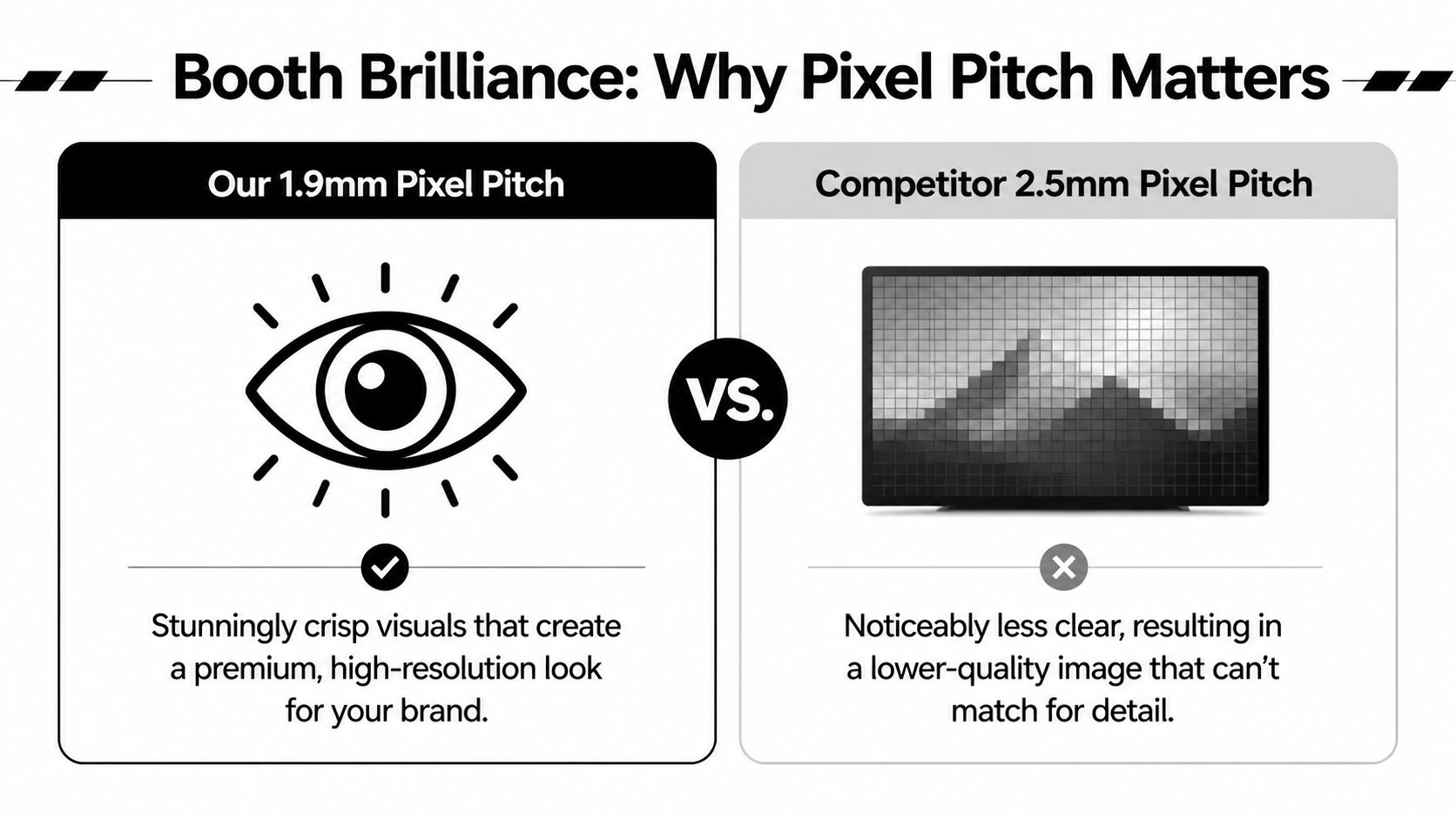
That’s why the technology you choose is so critical. A major factor is the clarity of your digital screens. We build our video walls with a 1.9mm pixel pitch. This just means the individual pixels are incredibly close together, creating a super sharp, high-resolution image that makes your brand look premium. Many competitors use a 2.5mm pitch, which simply can’t compete up close and can make visuals look blurry or cheap.

Our Transparent, All-Inclusive Approach

We know trade show logistics are a headache. That’s why we make it simple with our white glove, turnkey service. Our pricing is completely transparent.

When we give you a price, that’s the price. It covers everything we provide. The only other costs you’ll see are the ones billed directly by the show itself, like electricity and material handling (drayage). We take care of the rest.

This straightforward approach means you can actually budget without worrying about surprise fees popping up later. You can get more insights on this in our complete guide to trade show booth design. We handle the complicated stuff so you can focus on your customers.

On-Site Support for Total Peace of Mind

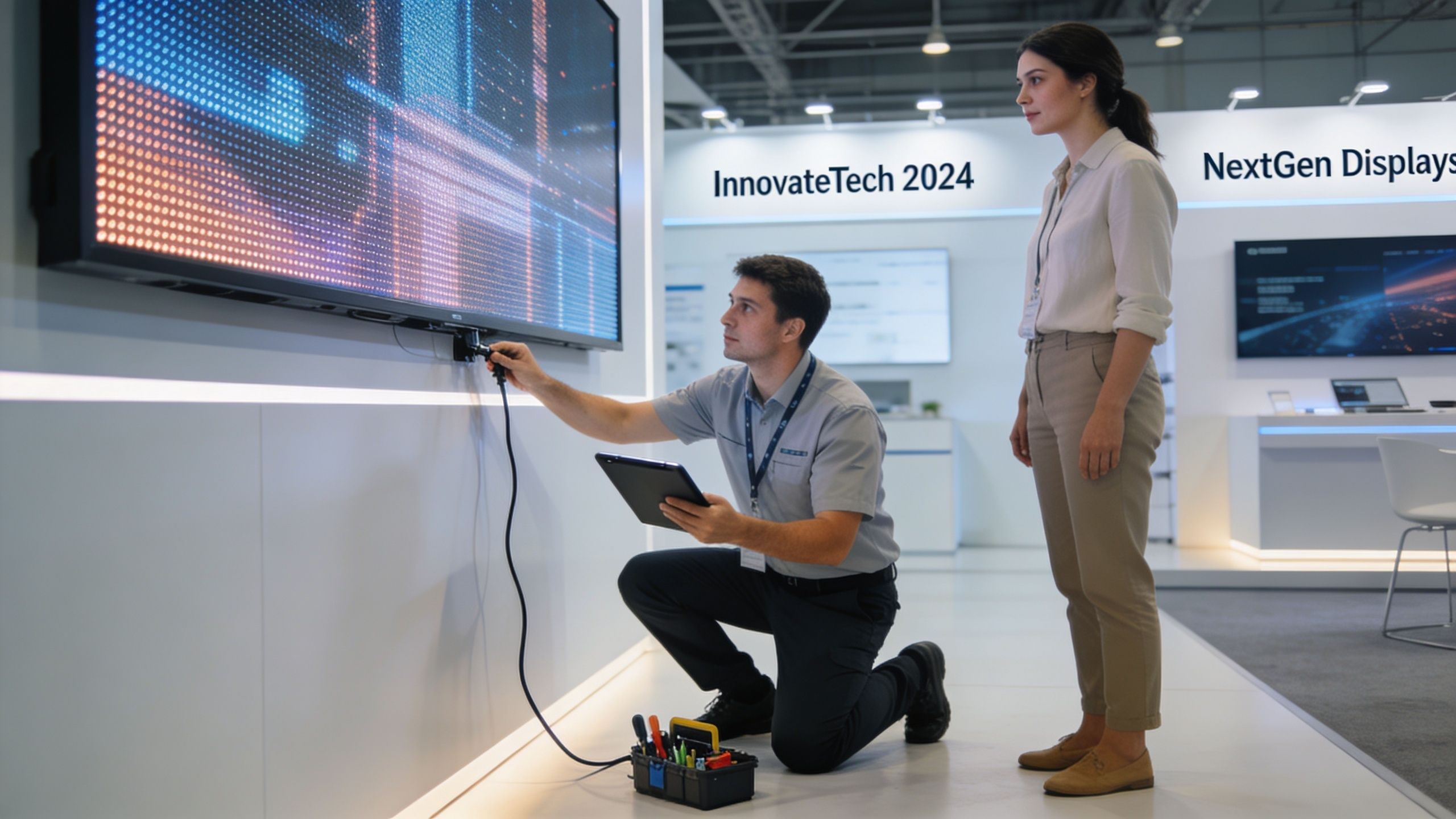
What if a screen glitches in the middle of the show? With us, you don’t have to worry about it. We have an audiovisual technician on-site for the entire time the show floor is open.

If any issue comes up, you have their direct number. A quick text or call, and they’ll be at your booth in minutes to get it fixed. This on-the-spot support guarantees your booth runs without a hitch, so you never miss a chance to connect with a potential client. Your job is to impress your visitors; our job is to make sure nothing gets in your way.

Decoding Your Booth Budget and Logistics


Let’s talk about the two things every exhibitor worries about: the budget and the logistics. Sorting out the costs for PPAI trade shows can feel like you’re trying to hit a moving target, but it doesn’t have to be that way. We’ve built our entire business around making this simple.

When we give you a price, that’s the price you pay for our services. No hidden fees, no last-minute surprises. That’s our white glove, turnkey service promise.

That single quote covers everything we provide: the complete LED wall system, its support structure, all the freight to get it to the venue, and the professional union labor for a perfect setup and a swift teardown. We handle the headaches so you can just show up and sell.

Understanding the Full Cost at PPAI Trade Shows

So, what’s not in our quote? The only other costs you’ll see are the ones billed directly by the show itself. These are mandatory charges you’d have to pay no matter what kind of booth you have.

  • Electricity: Powering up your brilliant LED display and any other electronics in your booth.
  • Material Handling (Drayage): The fee the venue charges to move your materials from the loading dock to your booth space and back out again.

Everything else is bundled into our straightforward, all-inclusive price. This kind of clarity is what lets you budget with confidence. If you’re still weighing different options, our guide on trade show booth cost dives even deeper into the numbers.

Our whole mission is to get the logistics out of your way. We want you to walk onto the show floor at the Mandalay Bay Convention Center, see your booth ready to go, and immediately start greeting customers.

And when you do, the quality of your display will speak for itself. It’s a technical detail, but it makes a huge difference on the floor.

ppai trade shows

This graphic says it all. Our standard 1.9mm pixel pitch screens deliver a much sharper, clearer, and more professional image than the 2.5mm screens many others use. It ensures your brand and products look absolutely pristine.

On-Site Support That Delivers Peace of Mind

Our service doesn’t stop once the booth is built. We station an expert audiovisual technician on-site for the entire duration of the show.

If any issue pops up—a small content glitch or a bigger technical problem—you just text or call. Within minutes, our tech is at your booth, fixing the problem. This guarantees you have zero downtime and can keep your focus where it belongs: on your customers.

Why On-Site Support Is a Must During the Show

When you’re at a packed event like a PPAI trade show, the last thing you can afford is a technical glitch. The floor is swarming with prospects, and a blank screen is more than just an inconvenience—it’s a disaster that can cost you thousands in lost opportunities. What’s your backup plan when the tech fails? Waiting around for a show-appointed technician is simply not an option.

This is where our full-service approach really makes a difference. Our white glove, turnkey service isn’t just about setting up your booth; it’s about giving you complete peace of mind. We take care of everything so you can just greet customers. That’s why we leave an audiovisual technician on-site the entire time the trade show is open.

ppai trade shows

Immediate Fixes for Zero Downtime

Imagine your worst-case scenario: a key piece of content isn’t playing right, or worse, a part of your video wall goes dark. Most people would panic. With our on-site support, the solution is immediate.

If anything goes wrong, you text or call and within minutes an AV Technician is at your booth to resolve the problem. This isn’t just a nice-to-have feature; it’s an insurance policy for your entire trade show investment.

Our all-inclusive price means we handle all logistics except for what the show bills you for directly, like electricity and material handling. But our true value is having an expert on standby, ensuring your booth runs flawlessly from start to finish.

This is a world away from the standard experience of submitting a help ticket and just hoping someone shows up eventually. Our team stays on-site specifically to guarantee you have zero downtime, so you never miss a chance to connect with a potential client. This is a key benefit when you look into our complete rentals for trade shows.

Of course, our superior technology—like the crisp 1.9mm pixel pitch on our video walls that makes competitors’ 2.5mm screens look dated—is a huge part of the equation. But backing that tech with a real, live expert is what delivers true value and lets you focus on what you do best: making connections and growing your business.

Turning Booth Buzz Into Measurable ROI

A show-stopping booth at a PPAI trade show is great for creating buzz, but let’s be honest—the real win is turning that attention into actual business. Blending in is simply not an option. The promotional products industry is booming, with sales hitting $26.78 billion in 2024. Your booth isn’t just an expense; it’s how you grab your piece of that pie.

Making an impact starts with your presentation. Our video walls use a stunningly crisp 1.9mm pixel pitch, which delivers a premium look that screens with a 2.5mm pitch just can’t compete with. That visual pop gets people to stop and talk, but you need a solid plan to turn those conversations into customers.

A professional business meeting where a man reviews lead and conversion statistics on a digital tablet.

From Conversation to Conversion

Every person you talk to on the show floor is a potential lead. The days of just scanning a badge and hoping for the best are over. Modern B2B lead generation software is essential for capturing and qualifying leads right there in your booth. For a deeper dive, check out these Formzz insights on lead capture to see how the right tech can completely streamline your follow-up.

Our white glove, turnkey service means everything is handled for you except for direct show bills like electricity and material handling. This frees you up to greet customers while an AV technician remains on-site, ready to resolve any issue within minutes.

After the show, it’s all about the follow-up. A quick, personal touch is what separates a closed deal from a missed opportunity. Your system for nurturing these new contacts is just as critical as the first impression you made. With the right strategy, you can draw a straight line from your booth’s traffic to your bottom line. We get into the specifics in our article about how LED exhibit booths can increase ROI at trade shows.

Frequently Asked Questions About Exhibiting in PPAI Trade Shows

Planning for a major event like a PPAI trade show brings up a lot of questions, especially when you’re looking to integrate a high-impact video wall. We get it. Here are the answers to some of the most common things people ask us, so you know exactly what to expect.

What Makes Your Video Wall Resolution Better?

It all comes down to the pixel pitch. Our LED video walls use a tight 1.9mm pixel pitch. Many competitors are still using a larger 2.5mm pitch, and while that doesn’t sound like a big difference, the visual result is night and day.

A smaller pitch means the individual pixels are packed much closer together. The result? A far higher-resolution image that’s sharp, vibrant, and looks absolutely flawless—even for attendees standing right at your booth’s edge. At a top-tier show like PPAI, you want your brand to look modern and professional, not pixelated.

What Does Your Turnkey Price Really Include?

Our white glove, turnkey service means the price we quote is the price you pay for everything we provide. It’s that simple. We’ve designed our service to eliminate the usual headaches and surprise fees.

Our pricing includes:

  • The complete LED video wall and its support structure
  • All the hardware and tech needed to run it
  • Transportation to and from the convention center
  • All professional labor for both setup and teardown

The only things you’ll pay for separately are the direct show services, like your electricity hookup and material handling (drayage). We handle the rest. You just show up to a stunning, fully operational booth, ready to greet customers.

Our all-inclusive price gives you total budget clarity. We manage the complex logistics so you can arrive stress-free to a booth that’s ready to make sales.

What Happens if There Is a Technical Problem at PPAI Trade Shows

?

We’ve built a safety net right into our service. A dedicated audiovisual technician stays on-site for the entire duration of the trade show, from the minute it opens until the doors close.

If you run into any issue at all, you just text or call your dedicated technician. They’ll be at your booth within minutes to get things sorted. This immediate, expert support means you never have to worry about downtime. You can stay focused on your visitors, confident that a pro has your back.

For more details on our tech, you can always check out our other common LED video wall FAQs.


Ready to make a real impact at your next PPAI trade show? At LED Exhibit Booths, we deliver stunning, high-resolution video walls with transparent pricing and unbeatable on-site support. Visit us at https://ledexhibitbooths.com to see how we can help you stop traffic and drive results.

Tradeshow TV Stand: The Complete 2026 Exhibitor’s Guide

Tradeshow tv stand buyers usually start with the wrong question. They ask which stand to buy, rent, or ship. The better question is what kind of on-booth video system will give the cleanest look, the least hassle, and the strongest return once the show is over.

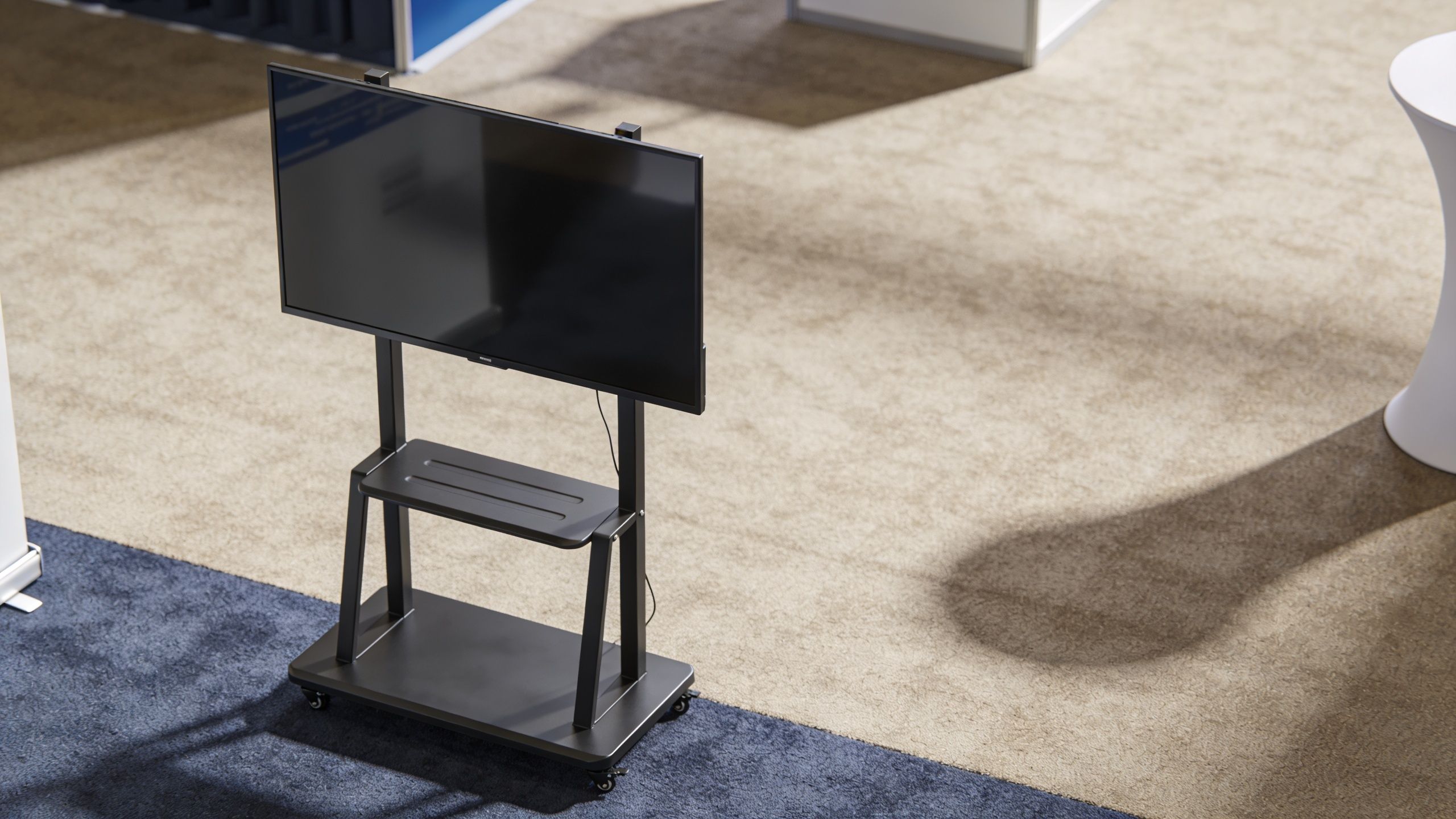
A tradeshow tv stand can absolutely work. We’ve used them, seen them used well, and know where they fit. But the popular advice around them is too narrow. Most content stops at wheels, VESA patterns, and height adjustment. It skips the expensive part: what happens when you try to make that separate screen feel like part of a premium booth.

That gap matters because trade show presentation is visual first. Buyers notice design before they notice your pitch. If your screen looks bolted on, your booth feels bolted on.

Rethinking the Standard Tradeshow TV Stand

Most exhibitors searching for a tradeshow tv stand want one thing. They want motion in the booth. That’s a smart instinct. Static graphics alone often can’t carry a launch, demo, or product story on a crowded floor.

The problem is that a standard stand solves only the mounting problem. It doesn’t solve the presentation problem.

Industry content still leans heavily toward standalone display stands, yet it often misses the bigger challenge of integrating screens into booth walls, counters, and architecture without distracting gaps, cables, or truss clutter. That blind spot leaves many exhibitors unaware of newer options such as modular LED walls, which can cut total exhibiting costs by up to 40% and draw 3x more foot traffic, according to American Image on trade show TV stands and digital displays.

What exhibitors think they’re buying with a tradeshow tv stand

On paper, a stand looks simple:

  • A screen holder: Put a TV at eye level.
  • A portable asset: Pack it, ship it, reuse it.
  • A low-cost visual upgrade: Add motion without redesigning the entire booth.

That logic makes sense, especially for smaller footprints or teams using pop-up display walls. But in practice, the stand itself becomes another object to hide, wire, stabilize, and design around.

Practical rule: If your video display looks like equipment instead of architecture, attendees will read it as equipment.

Why the old advice falls short

A separate monitor can show content. It usually can’t create an environment. That distinction matters more now because exhibitors are putting better content on screen. Teams using tools and AI workflows for video advertising can create polished loops, product animations, and promo edits faster than before. But polished content loses force when it’s framed by bezels, exposed cabling, and a black metal stand parked next to a branded wall.

That’s why the key decision isn’t “Which tradeshow tv stand is best?” It’s “Should the screen be a device in the booth, or should the booth itself become the screen?”

Understanding the Traditional Tradeshow TV Stand

The TV stand market is large and still growing. The broader market, which includes tradeshow tv stand solutions, was valued at $14.8 billion in 2025 and is projected to reach $24.6 billion by 2034, based on Dataintelo’s TV stand market report. That growth reflects strong demand for digital displays in busy environments, including exhibitions.

tradeshow tv stand

The main stand types exhibitors use

Most traditional tradeshow tv stand options fall into a few categories.

Freestanding portable stands are the common choice for simple booth demos. They usually use aluminum or steel, support a single monitor, and offer adjustable height. Some include casters. Some break down into compact cases for easier transport.

Heavy-duty monitor stands are built for larger screens or touch interaction. These tend to be sturdier, bulkier, and less forgiving to ship. They’re often the safer pick when the TV is large and attendees may interact with the screen directly.

Graphic-integrated monitor stands combine a TV mount with tension fabric or printed backdrops. These try to soften the look of a bare stand by adding branding around the screen. They’re a step up visually, but the monitor is still a separate object mounted in front of or inside a frame.

What matters when you spec a tradeshow tv stand

A good stand isn’t just about screen size. We look at a few practical details first.

  • VESA compatibility: If the mount pattern doesn’t match the monitor, setup stops fast.
  • Base stability: Trade show floors get bumped, and people lean where they shouldn’t.
  • Adjustable height: Sightlines matter more than often anticipated.
  • Case design: The stand may fit the booth, but the case still has to get there.
  • Cable routing: If power and HDMI hang loose, the booth instantly looks unfinished.

A strong stand is a logistics tool first, then a display tool.

Where traditional stands still make sense

There are situations where a standard tradeshow tv stand is the right answer.

A single product demo in a compact booth can work well. A staff-led presentation station can work well too. If the screen’s job is functional, not architectural, a stand is often enough.

What it doesn’t do well is disappear. Even the better models still read as hardware. That’s the core limitation.

The Hidden Headaches of a Separate TV Stand

The biggest problem with a tradeshow tv stand isn’t the sticker price. It’s everything wrapped around it after the purchase order.

tradeshow tv stand

Shipping looks simple until show services get involved

Portable stands with integrated fabric graphics that weigh under 25 lbs can cut labor by 60%, according to Anything Display’s modular monitor stand details. That’s the best-case version.

The trouble starts when exhibitors move up to heavier steel stands for larger screens. In major convention hubs, those can trigger drayage fees of $150 to $300 per event, and that’s before you count the monitor, case count, repacking time, and labor coordination from the dock to the booth.

For teams planning repeated events, it helps to understand the packing risk too. This practical guide on avoiding TV damage during moves is worth a read because a damaged screen can wipe out any savings you thought you gained by shipping your own setup.

If you’ve dealt with advance warehouses, forced freight deadlines, and floor paperwork, you already know the issue. A “simple stand” rarely travels alone. It travels with a monitor, cables, adapters, pads, cases, labels, and a growing set of small failure points. That’s why many exhibitors spend time planning trade show shipping and material handling long before they think about what content is going on the screen.

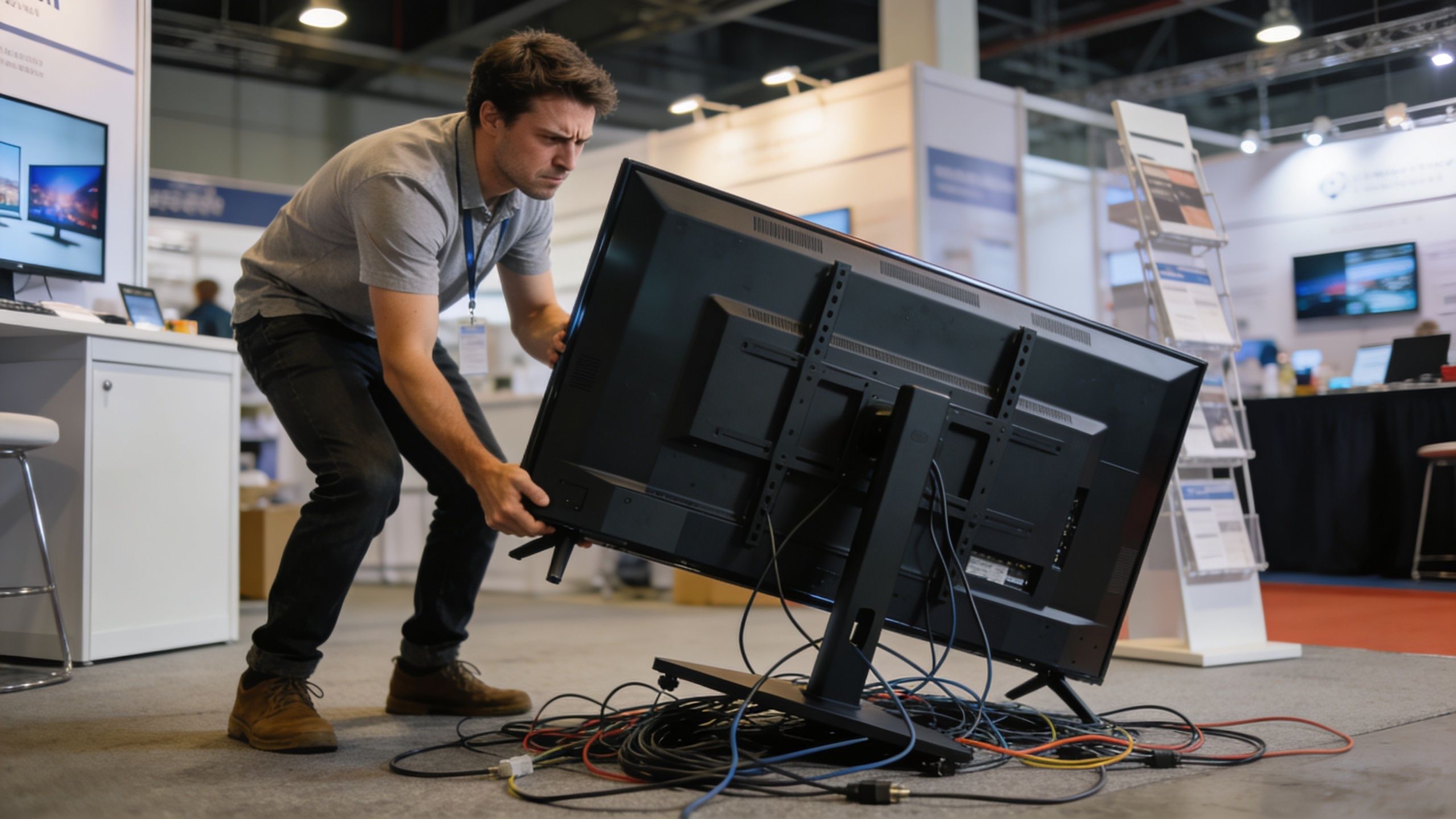
Setup gets messy fast

A separate stand adds one more build sequence to booth install. It has to be assembled, leveled, mounted, powered, tested, and then disguised as much as possible.

That sounds manageable until the floor opens in a few hours and someone realizes:

  • The HDMI run is visible: It cuts right across the cleanest side of the booth.
  • The power drop landed awkwardly: The stand wasn’t designed around the booth layout.
  • The screen height is wrong: Too low and people miss it. Too high and it feels detached.
  • The base plate is in the way: Staff keep stepping around it, and attendees notice.

Separate screens create separate problems. Every extra component adds another handoff, another cable, and another place for the booth to look unfinished.

The visual compromise is hard to hide

This is the part many buying guides don’t discuss clearly enough. Traditional TV stands often fight the booth design.

A luxury product brand doesn’t want a black rolling stand visible under a polished presentation. A software company launching a new platform doesn’t want two or three TVs lined up with thick bezels breaking the motion across each screen. Even when the content is good, the hardware announces itself.

The result is a booth that feels assembled instead of designed. Attendees may not say that out loud, but they feel it.

The Superior Alternative a Seamless LED Video Wall

The better move is to stop buying a screen and stand as separate parts of the booth. Treat the display as part of the booth architecture from the start, and the economics change.

tradeshow tv stand

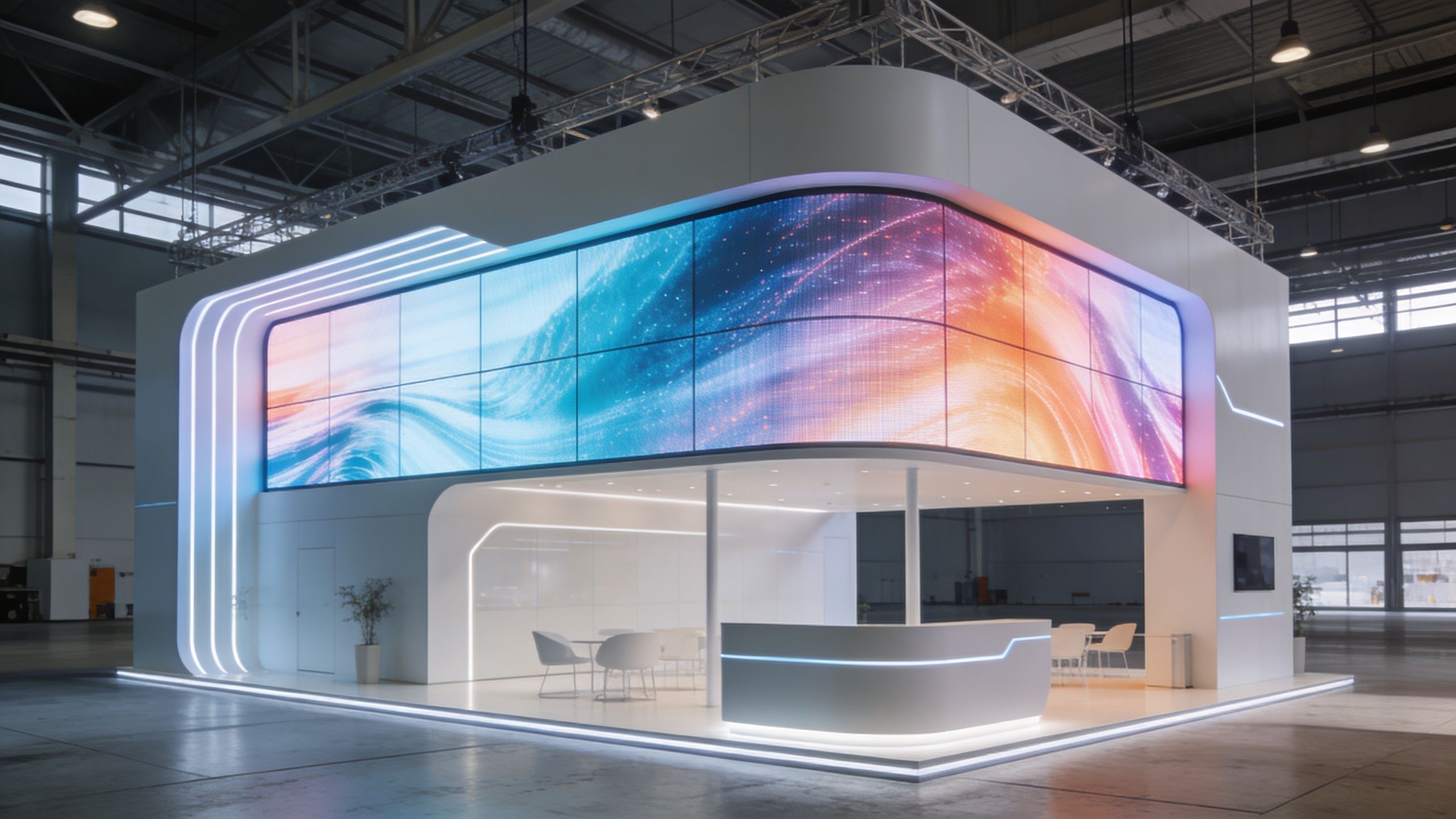
An integrated LED video wall changes the job completely. The wall, corner, arch, or counter becomes the display surface, so the visual system and the booth are working together. That gives exhibitors an image without bezel breaks and removes the floor-space penalty that comes with a separate stand base.

Why this format works better on the floor

An integrated LED wall draws people into the booth instead of asking them to look at a device parked in front of it.

That difference matters on a busy aisle. Content can wrap a corner, carry across a full backdrop, or support a product launch with motion that matches the booth shape. The result feels designed, not assembled in pieces after the fact.

For brands comparing display formats, video display wall options for trade show booths make more sense when the goal is stronger booth performance, not just basic playback.

Resolution and viewing distance matter

Not all LED walls are equal. Pixel pitch affects how sharp the display looks at the distances where attendees stand.

Many competitors use 2.5 pitch. Our preferred spec is 1.9 pitch, which delivers a cleaner image at closer viewing distances. That shows up fast in text, product renders, and motion graphics. If a booth sits on a crowded aisle, those details affect whether the display looks premium or rough.

Higher resolution changes the real attendee experience. A wall that looks crisp up close supports the brand. A wall that looks coarse undercuts it.

The cost picture is better than it first appears

A TV on a stand usually wins the sticker-price comparison. It often loses the total-cost comparison.

With an integrated LED booth, exhibitors are paying for a display system that also does design work. It can replace printed backdrops, reduce the need for extra monitor placements, and cut down the number of disconnected components that need to be shipped, assembled, dressed, and managed on site. That is where ROI improves. The spend is higher up front, but the booth often works harder and looks stronger at the same time.

The service model matters too. We structure projects so pricing covers the booth and display package, excluding only show-billed charges such as electricity and material handling. That gives teams a clearer number before the event instead of a low entry price followed by added AV labor, mounting, cabling, and troubleshooting.

White-glove support also changes the operating reality on site. An audiovisual technician is available during show hours, so your team is not burning selling time trying to fix a screen issue.

Here’s a quick look at how the display behaves in the field:

What exhibitors gain by replacing the tradeshow tv stand

A continuous LED wall improves more than appearance.

  • Stronger branding: The display supports the booth design instead of interrupting it.
  • More content flexibility: Graphics can span walls, curves, counters, and other built elements.
  • Cleaner presentation: The image holds together without bezel lines cutting through motion.
  • Better use of space: Staff and visitors move naturally because there is no separate stand footprint to work around.
  • Higher return from one display system: The video surface carries messaging, atmosphere, and visual impact at the same time.

Traditional tradeshow TV stands solve for screen placement. Integrated LED walls solve for booth performance.

How to Choose Your On-Booth Video Display

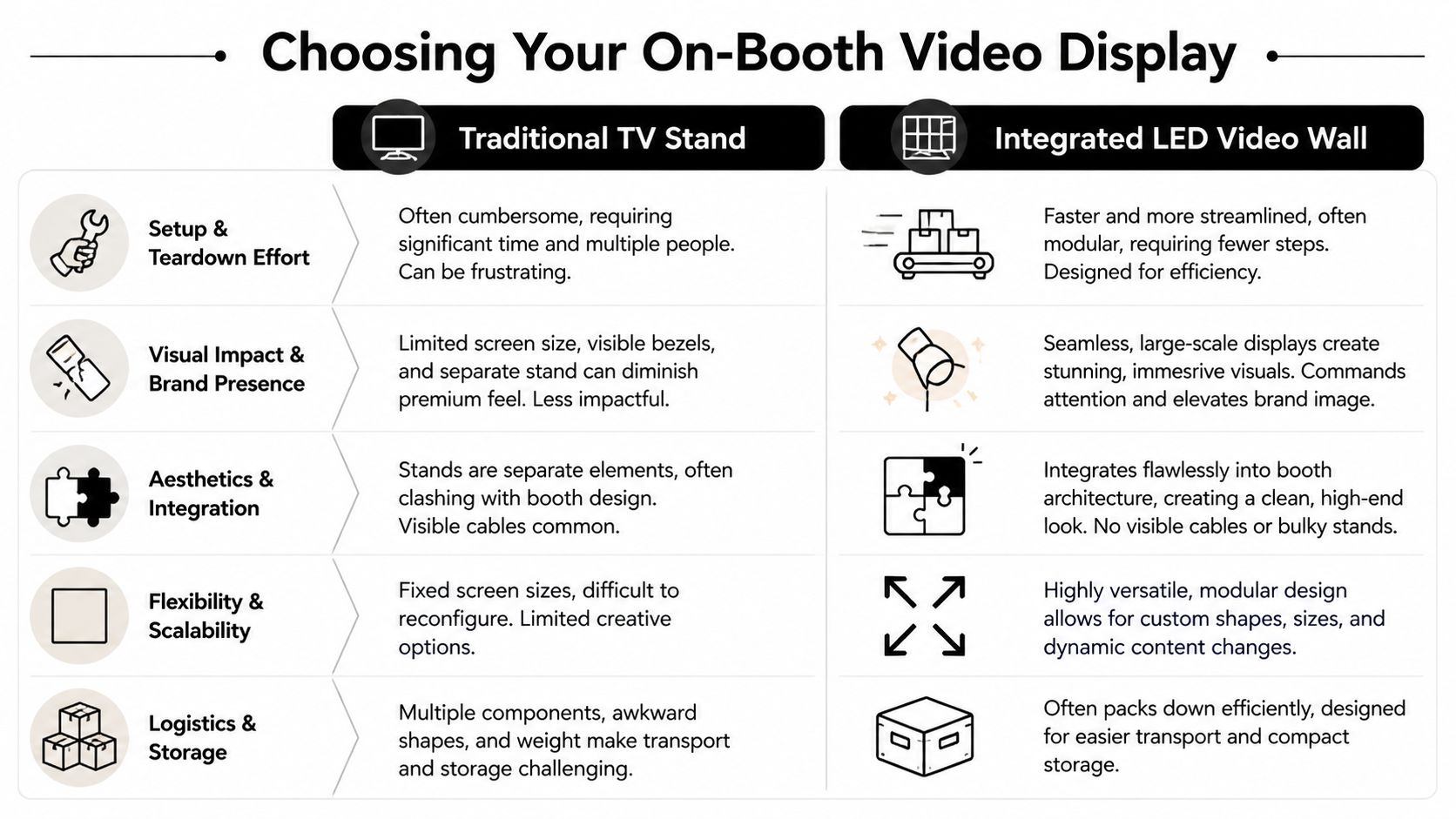
A tradeshow tv stand isn’t automatically wrong. It’s just often judged on the wrong criteria. Buyers compare purchase price and ignore ownership friction.

The better comparison is total event performance. That includes setup effort, freight reality, visual quality, and how well the display supports the rest of the booth.

A comparison chart highlighting the benefits of integrated LED video walls over traditional trade show TV stands.

Tradeshow TV Stand vs. LED Video Wall Comparison

Factor Traditional TV Stand Integrated LED Video Wall
Visual impact Single screen or separated screens with visible hardware Seamless architectural display integrated into the booth
Budget view Lower apparent entry cost, but extra logistics can build quickly Higher headline investment, often stronger value when judged on total booth effect
Setup and teardown More component-by-component assembly and cable management Streamlined modular install with the display built into the structure
Shipping and drayage Cases, monitors, stands, and accessories add handling complexity Fewer visible components on site and a more consolidated presentation system
Content flexibility Limited to screen dimensions and orientation Scales across walls, curves, counters, and larger creative layouts

Questions that usually decide it

Some teams need a quick answer. These questions usually sort the decision fast.

Is the screen just for demos?
If yes, a stand may be enough. If the display is there to create atmosphere, shape traffic, or define the brand presence, an integrated wall is stronger.

Does the booth need to look premium?
Luxury, enterprise, and launch-focused brands rarely benefit from visible support hardware.

Will the team reuse this across multiple show formats?
If your program changes booth sizes, content goals, or traffic patterns from event to event, a modular system gives you more room to adapt. That’s one reason many exhibitors look at LED video wall rental options instead of forcing the same monitor-and-stand package into every footprint.

The budget trap to avoid

The cheapest display line item can produce the more expensive event.

A tradeshow tv stand often looks economical because the stand itself is not expensive compared with larger digital systems. But exhibitors don’t attend line items. They attend shows. Once shipping, handling, labor coordination, stand placement, and aesthetic compromise are all part of the equation, the low-cost option may not be the low-cost outcome.

Buy based on total cost of ownership, not the cheapest object in the booth.

That’s the comparison that usually changes the decision.

Tips for Maximum Video Engagement at Your Booth

Good hardware won’t save weak content. A beautiful display showing a slow corporate reel still underperforms.

Design also matters more than many teams admit. 76% of attendees are drawn to a booth based on its design, interactive elements can boost engagement by 50%, and proper lighting can enhance visibility by 60%, according to Cvent’s trade show statistics overview. Video works best when it supports those fundamentals instead of trying to replace them.

Build for a no-audio environment

Trade show aisles are noisy, and many attendees won’t hear your soundtrack.

Use bold headlines, short phrases, and motion that reads from a distance. If the message only works with voiceover, it’s not ready for the floor.

Keep loops short and visual

Long brand films rarely perform well in a booth. Attendees join mid-stream and leave fast.

Use compact loops with one clear goal:

  • Stop traffic: Lead with motion and contrast.
  • Explain fast: Show the product or outcome immediately.
  • Support staff conversations: Give reps visuals they can point to while talking.

Let the content fit the structure

Integrated displays distinguish themselves from a tradeshow tv stand. A TV gives you a rectangle. A continuous wall lets the content interact with the booth.

Use corners, vertical formats, counters, and full-width scenic motion when the display allows it. Teams that need help creating those assets usually benefit from specialized video wall content production for trade shows, because booth content has different requirements than a website video or paid ad edit.

Make motion work from the aisle

The first job of booth video is attraction, not explanation.

Use clean movement, strong contrast, readable typography, and product visuals that make sense in a glance. Once people stop, your staff can do the deeper work.

If someone can’t understand the subject of your screen in a few seconds, the content is too complicated for the aisle.

Strong booth video does three things. It pulls attention, supports live conversation, and reinforces memory after the attendee walks away. The more unobtrusively the display is built into the environment, the easier it is to do all three well.


If you’re weighing a tradeshow tv stand against a more integrated video solution, LED Exhibit Booths can help you compare the practical trade-offs. We build cohesive video wall trade show displays with white-glove, turnkey service, clear project scope, and on-site AV support so your team can stay focused on customers instead of screen logistics.