

The cost of exhibiting at trade shows for a serious exhibitor can easily run from $30,000 to over $100,000 per show when you use the common rule of thumb that total costs are 3 to 5 times the floor space rental. If you’re budgeting only for booth space, you’re not building a real trade show budget.
You’re probably staring at a spreadsheet right now with one clean line item for floor space and a growing sense that the rest of the numbers are going to get ugly fast. That instinct is right. Most exhibitor budgets break down because they start with the visible invoice and ignore the expensive machinery behind it: fabrication, shipping, labor, drayage, electrical, internet, and the technology stack that turns a plain booth into something people stop for.
We’ve seen the same mistake over and over. Companies approve the footprint, add a rough line for graphics, and assume the rest can be managed later. Later is where budgets get wrecked.
Modern exhibits make this even harder. Traditional cost models were built for static walls, printed panels, and a few mounted screens. They don’t hold up when your booth includes video, demos, immersive content, or interactive display elements. The more technology you add without rethinking the structure behind it, the more disconnected vendors, labor hours, and hidden charges you invite.
The fix is simple, but it requires discipline. Budget the whole exhibit, not the square footage. Price the booth as a system, not a pile of parts. And wherever possible, eliminate variable costs before the show starts.
How to Accurately Budget for the Cost of Exhibiting at Trade Shows
You approve a 20×20 space because the floor plan price looks reasonable. Two months later, the full budget shows up. Freight, install and dismantle labor, electrical, rigging, internet, content production, and on-site tech support push the number far past the original estimate. That is how exhibitors lose control of the cost of exhibiting at trade shows.
The fix starts with one rule. Budget the exhibit as an operating system, not a floor plan.
Analysts at CEIR outline the primary cost areas exhibitors have to account for beyond raw space, including exhibit design, show services, staffing, shipping, and promotion in its exhibitor budgeting guidance from the Center for Exhibition Industry Research. That matters because older budgeting habits still assume a booth is mostly structure and graphics. Modern booths rarely work that way. Integrated LED walls, live demos, touchscreen content, and capture tools change the budget model because they affect power, labor, freight, programming, and support at the same time.

Start with the all-in number, not the booth space number
Floor space is the entry fee. It is not your working budget.
Build your first spreadsheet in this order:
- Confirm the footprint and required show services so you know the organizer-side costs first.
- Price the exhibit system including structure, graphics, storage, freight, installation, dismantle, and supervision.
- Add technology early. If your concept includes LED, get realistic pricing for the hardware, content formatting, and power requirements. Our guide to trade show video wall pricing helps set that number before it turns into a late-stage surprise.
- Separate fixed costs from variable costs so you can see where the budget can still move against you.
- Add a contingency line with a real dollar amount. If you leave it vague, it will not survive internal review.
That last point is where disciplined budgets win. A contingency line protects you from the charges that appear only after your design is approved and your deadline is too close to change course.
Traditional budgeting breaks when technology is bolted on late
Many exhibitors still budget in layers. Space first. Booth build second. Screens and digital features later.
That approach fails with modern exhibit technology.
An integrated LED wall is not just another accessory. It changes the booth structure, crate count, setup sequence, content workflow, electrical plan, and labor schedule. If those decisions are split across multiple vendors, costs spread into separate estimates and hidden markups. That is how a booth that looked efficient on paper becomes expensive on the show floor.
We recommend the opposite approach. Price the environment, content, and install plan together from the start. A turnkey model reduces budget risk because it replaces scattered vendor charges with a defined scope, clearer responsibility, and fewer labor variables on site.
Budget for performance
A low-cost booth that cannot support demos, meetings, or clean lead capture wastes money. A better budget supports the outcomes you want, qualified conversations, memorable presentations, and post-show follow-up your sales team can use.
That is why visitor flow, staff behavior, and engagement planning belong in the budget discussion early. This guide to optimizing trade show attendee engagement is a useful reference before you approve your layout and content plan.
Your first budget should include five line items at minimum:
- Organizer charges and mandatory services
- Exhibit structure, graphics, and storage
- Freight, material handling, and labor
- Technology, content, and on-site support
- Staff travel, lead follow-up, and post-show conversion
We tell clients the same thing every time. If a budget only works when labor comes in low, freight arrives clean, and technology installs without extra hours, it is not accurate. It is optimistic. A strong trade show budget removes that optimism and replaces it with fixed scopes, fewer vendors, and fewer chances for the venue to dictate your final spend.
Deconstructing the Total Cost of Exhibiting at Trade Shows
A team approves a booth because the space fee looks manageable. Then additional invoices hit. Freight climbs, material handling multiplies, labor runs long, and the technology package needs extra hands to make it work.
That is how budgets fail.
You control the cost of exhibiting at trade shows by separating the spend into the parts that drive it. We use four cost pillars with clients: floor space, booth build, logistics, and people. That framework exposes weak assumptions fast, especially when a booth includes LED, interactive content, or any custom AV.
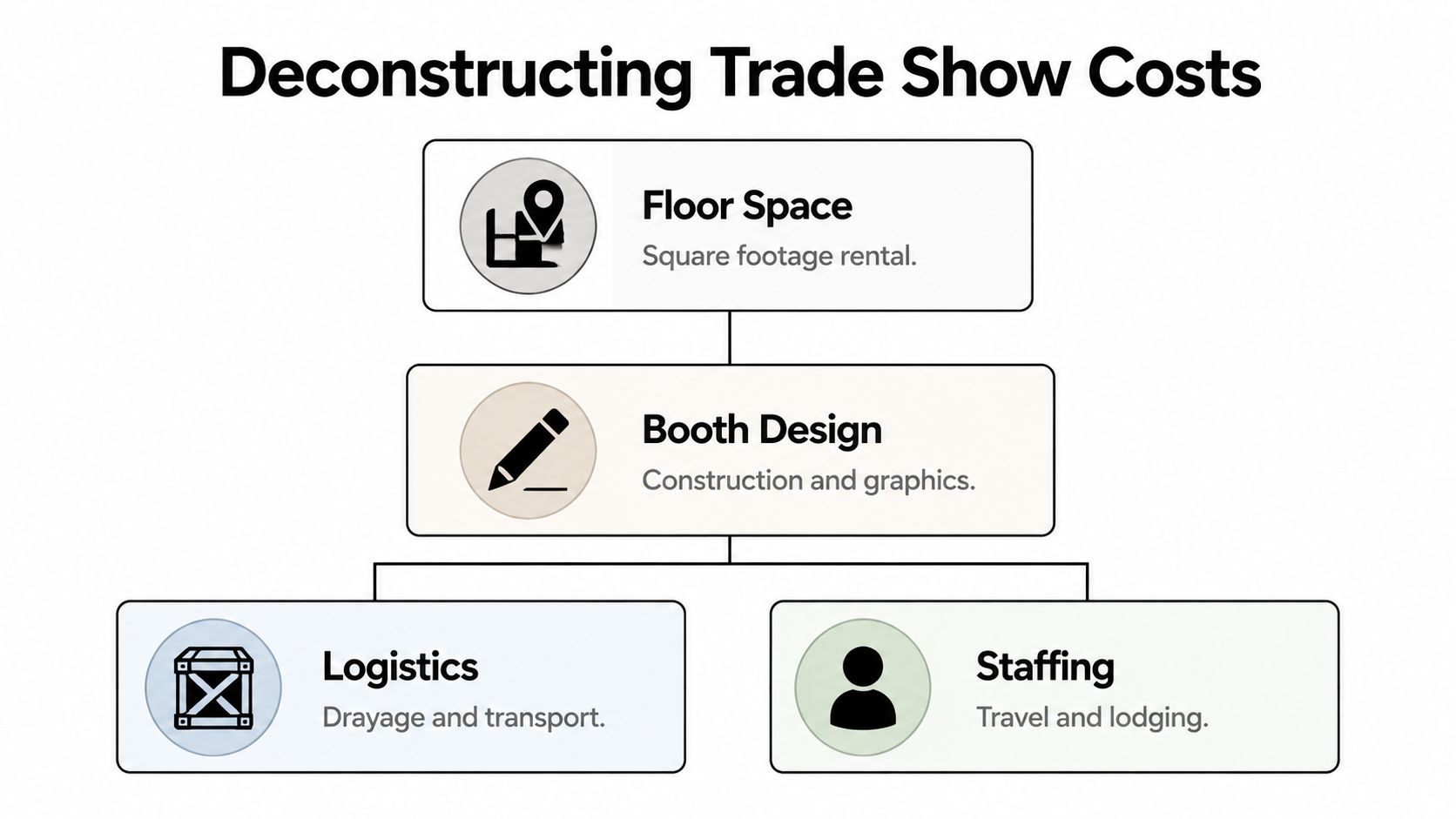
Floor space starts the spend
Show organizers invoice space first, so exhibitors fixate on it. That is a mistake.
Floor space only buys you access to the hall. It does not tell you what the exhibit will cost to fabricate, ship, install, power, support, dismantle, and store. A compact footprint can still produce a bloated budget if the structure is heavy, the graphics are custom, or the technology stack requires multiple vendors.
All-in pricing matters more than booth price
The Center for Exhibition Industry Research explains in its exhibitor benchmarks and performance research that exhibit programs should be evaluated as a full operating cost, not as a space or booth purchase in isolation. That is the right lens.
For most exhibitors, the useful question is not, “What does the booth cost?” It is, “What does this program cost once it is built, moved, installed, serviced, and reused?” If you are weighing display formats, our breakdown of video wall booth pricing gives a practical reference for technology-heavy builds.
Large exhibits often look more efficient on paper because fixed design costs spread across more square footage. That logic breaks down fast when you add stacked displays, support framing, separate playback systems, custom power distribution, and on-site technical labor. Modern exhibit technology does not fit neatly inside old per-square-foot assumptions.
What each cost pillar actually includes
| Cost pillar | What it covers | Where budgets go wrong |
|---|---|---|
| Floor space | Raw exhibit space, organizer fees tied to location or package level | Teams treat space as the main cost driver |
| Booth build | Structure, graphics, counters, storage, branded surfaces, fabrication choices | Teams approve the look without pricing the engineering and install complexity |
| Logistics | Crating, freight, advance warehouse charges, material handling, drayage | Teams underestimate how weight and piece count raise costs at every step |
| People | Travel, hotels, staffing time, supervision, installation coordination, on-site support | Teams budget airfare and rooms but miss labor hours and management time |
Traditional cost models fail when technology is bolted on
A simple fabric wall is predictable. A booth filled with rented monitors, mounts, truss, media players, switchers, power drops, and cabling is not.
Old budgeting models treat technology as an add-on line item. On the show floor, it behaves like a multiplier. It increases coordination, power planning, testing time, failure points, and labor exposure. That is why a booth that looked reasonable in revision three becomes expensive during install.
Integrated LED walls change that math. They combine structure and display into one system, which can reduce separate framing, simplify the parts list, and cut on-site labor variables. We push clients to evaluate that full cost profile, not just the screen rental number, because the budget risk usually sits in labor and handoffs.
Hardware rarely blows the budget by itself. Fragmented execution does.
Use a harder approval test
Before you approve any exhibit concept, ask these questions:
- How many vendors must coordinate to make this booth work?
- How much weight are you shipping and how many pieces are you sending?
- How many labor touchpoints are required on site, including electrical, setup, alignment, testing, and troubleshooting?
- Does the technology live inside the structure, or has it been added in layers?
We advise clients to reject designs that depend on perfect execution from too many parties. A turnkey model protects the budget because one team owns the structure, technology, content coordination, and install plan. That removes handoff risk, limits surprise labor, and gives you a truer picture of total exhibit cost before the show ever opens.
How Technology Impacts the Cost of Exhibiting at Trade Shows
You approve a booth rendering with a dramatic video wall, interactive touchscreens, and polished motion graphics. The estimate looks manageable. Then actual costs hit. Extra framing. Separate AV labor. More power. More testing. More points of failure. Technology did not just add a screen. It changed the build, the install plan, and the risk profile of the entire exhibit.
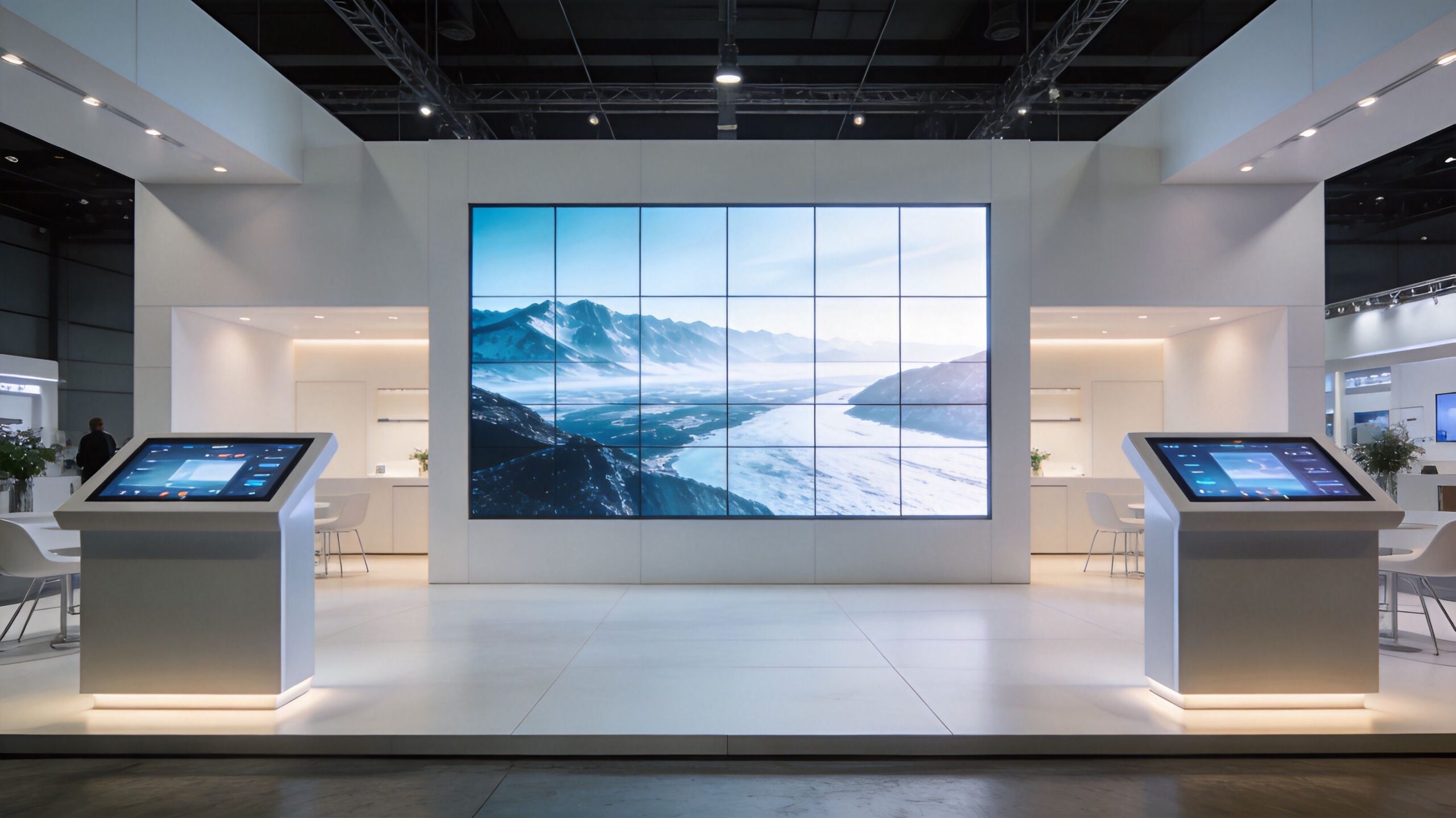
Traditional AV pricing misses the real cost
Old budget models treat screens as equipment. On the show floor, they act more like infrastructure. Once you add large-format displays to a conventional booth, you also add mounts, reinforcement, cabling, playback hardware, electrical coordination, content testing, and on-site troubleshooting. Every extra layer creates another invoice and another chance for something to go wrong.
That is why stacked-display builds often look cheaper early and cost more later.
Integrated LED walls change the equation because the display is part of the structure, not a separate package bolted on afterward. If you’re comparing formats, LED video wall rental options deserve a hard look because they can reduce shipping complexity, simplify install, and cut the labor hours tied to assembly and alignment.
The expensive part is usually labor, not the screen
Exhibitors fixate on hardware rental rates. That is the wrong place to focus.
The expensive part is the chain reaction behind the hardware. Larger or more complex technology setups increase the need for electricians, installers, AV techs, and show-floor testing. Freeman’s guidance on digital trade show displays makes the same point from a planning angle: digital elements affect power, internet, placement, and content requirements well beyond the display itself, which is why they need to be budgeted as part of the full exhibit system, not as a last-minute add-on (Freeman digital trade show display planning guide).
We tell clients to stop asking, “What does the screen cost?” Ask how many people, vendors, and labor hours the screen setup requires.
Resolution affects value
A video wall that looks rough up close wastes money. Trade show attendees stand a few feet away, read small text, and judge image quality fast.
That is why pixel pitch matters. We build around a 1.9 pitch, while many competitors use 2.5 pitch. The practical result is sharper text, cleaner product visuals, and better motion graphics at real viewing distances.
If attendees notice the pixel structure before they notice your message, the display spec was wrong.
Turnkey technology protects the budget
Modern exhibit technology works best when one team owns the structure, the LED system, the content coordination, and the install plan. That setup removes handoff gaps that create surprise labor and rushed fixes during move-in.
We recommend a turnkey model for one reason. It gives you a truer number before you commit. Integrated systems with defined scope are easier to price, easier to ship, and easier to install than booths assembled across multiple vendors with overlapping responsibilities.
Here’s a quick look at the type of booth experience buyers now expect:
What we recommend
Treat technology as part of the booth architecture from the first concept round.
Approve exhibit technology only if it does all three:
- Improves visual quality: Sharp content, clean presentation, and viewing performance at close range.
- Cuts setup complexity: Fewer separate components, fewer vendors, and fewer labor touchpoints.
- Reduces budget volatility: Less custom framing, less troubleshooting, and less dependence on perfect coordination between unrelated teams.
A booth can look advanced and still be built in an expensive, fragile way. We push clients toward integrated LED and turnkey execution because that is how you get impact without turning technology into a budget trap.
Uncovering the Hidden Fees and Surcharges
Most exhibitors don’t lose control of their budget on the obvious items. They lose it on the invoices they assumed would be minor.
The cost of exhibiting at trade shows gets distorted by venue rules, union labor, and show services that you often can’t avoid or negotiate. That’s why a booth that looked reasonable on paper can become painful once move-in starts.
Labor is where the surprise turns serious
In the U.S., trade show labor rates can exceed $90 per hour, and some major cities charge as much as $220 per hour. Once benefits are added, the effective cost to exhibitors can reach $114 to $256 per hour or more, according to this breakdown of U.S. trade show labor costs.
That’s before you get into overtime windows, strict work rules, or delays caused by other vendors missing deadlines.
The invisible stack of show-billed costs
These charges tend to arrive in clusters, not one at a time:
- Installation and dismantle labor: You pay for the crew, the clock, and the local rules.
- Material handling: Drayage often punishes heavy booths and inefficient packing.
- Electrical service: Power isn’t just power. It’s distribution, access, and show-floor pricing.
- Internet: Reliable connectivity on a show floor is rarely cheap or simple.
- Special rigging or hanging elements: Features like hanging signs for trade shows can add visibility, but they also introduce another layer of coordination and venue billing.
Why “hidden” isn’t the right word
These fees aren’t hidden. They’re just separated from the glamorous part of the exhibit buying process.
That separation is what catches people. Brands spend weeks debating graphics and almost no time studying service manuals, labor jurisdictions, or material handling rules. Then the show bills arrive and suddenly everyone acts shocked.
They shouldn’t be shocked.
The venue charges for access, time, weight, power, and exceptions. If your booth needs more of any of those, your budget goes up.
According to the same source, labor charges combined with drayage, electrical, and internet can consume 20 to 40 percent of a show budget even for mid-sized booths. That’s not a rounding error. That’s the part of the budget that decides whether your exhibit model is sustainable.
The blunt recommendation
Stop approving exhibit concepts that are fragile, heavy, and labor-hungry. Those designs don’t just cost more to build. They cost more every single time they touch a show floor.
If your budget depends on low service bills, then your booth must be engineered to avoid service complexity in the first place.
Smart Strategies to Reduce Your Exhibit Expenses
Cutting exhibit costs doesn’t mean shrinking your presence until nobody notices you. It means removing waste from the system.
The smartest exhibitors don’t chase the lowest quote. They chase the most predictable total cost.
Reduce moving parts, not just line items
A booth becomes expensive when too many vendors touch it. Design firm, fabricator, freight carrier, I&D labor, AV crew, content team, on-site support. Every handoff creates delay risk and billing ambiguity.
A better model is to simplify the chain:
- Rent when reuse is uncertain: Don’t buy a custom structure if your footprint, campaign, or show calendar may change.
- Favor modular systems: Lightweight, repeatable components usually create fewer logistics problems.
- Design for setup speed: If a booth needs specialist labor for every small adjustment, it’s inefficient by design.
- Ship less weight: If you want practical ideas to save big on shipping, focus on packing efficiency and eliminating bulky structural elements that don’t add visitor value.
Turn fixed scope into cost control
Turnkey service matters. Not because it sounds premium, but because it removes uncertainty.
We recommend choosing partners who bundle as much as possible into one scope of work. At LED Exhibit Booths, the price includes everything except the charges billed directly by the show, such as electricity and material handling. That structure matters because it limits the number of variable vendor invoices you’re exposed to while still giving you a full exhibit solution through trade show booth rental options.
That same model should also include true operational support, not just delivery. White-glove service matters because your staff should be selling, demoing, and meeting buyers, not managing booth assembly, playback issues, or last-minute AV problems.
Don’t ignore support during show hours
Too many exhibit plans assume that if the booth powers on at opening, the hard part is over. That’s amateur thinking.
Screens fail. Content needs adjustment. Cables loosen. Playback settings drift. If your booth relies on technology, support should be available when attendees are in front of it, not after a help ticket bounces around.
We strongly prefer exhibit setups that come with on-site AV coverage or immediate technician response during show hours. That turns technical failure from a public embarrassment into a manageable operational issue.
Buy less uncertainty. That’s usually the real savings.
The expense cuts that usually backfire
Some budget decisions look smart and end up costing more:
| Bad shortcut | Why it backfires |
|---|---|
| Choosing the cheapest structure | It often increases labor, freight, or setup problems |
| Using multiple specialist vendors | Coordination gaps become delay costs |
| Skipping on-site support | Small technical issues become show-floor failures |
| Overbuilding custom elements | You pay for complexity that doesn’t improve engagement |
The goal isn’t to spend less at any cost. The goal is to spend on the booth elements that buyers see and cut the infrastructure they don’t.
Building Your Budget and Calculating Trade Show ROI
You approve a booth budget in March. By show week, the final figure is nowhere close. The booth needs extra labor, the LED wall requires added support, freight runs higher than expected, and post-show follow-up was never budgeted at all.
That is how trade show budgets fail. They fail because the original model was incomplete.
A usable budget for the cost of exhibiting at trade shows should fit on one page and cover the full commercial picture. We recommend four lines of ownership: show-paid charges, exhibit partner charges, internal travel and staffing, and post-show revenue capture. If one of those buckets is missing, your ROI math is already wrong.
A budget format leadership can trust
Use ranges where the show controls pricing, and fixed numbers where your exhibit partner should commit scope. That matters even more now that integrated LED walls, media systems, and turnkey support are replacing older booth builds with a dozen separate vendors. Traditional cost models treat technology as an add-on. That is outdated. In a modern exhibit, technology affects structure, labor, content, support, and risk.
| Expense Category | What to Budget For | Budget Behavior |
|---|---|---|
| Floor space rental | Booth space, mandatory show fees, utilities | Mostly fixed by the organizer |
| Exhibit system | Structure, graphics, integrated LED, storage, packaging | Should be scoped clearly upfront |
| Shipping and material handling | Freight, drayage, warehouse timing, return shipping | Variable, often underestimated |
| Installation and dismantle | Labor crews, supervision, rigging if required, overtime exposure | Can swing hard if the booth is complex |
| Travel and staffing | Airfare, hotel, meals, staff scheduling, training | Internal teams often undercount this |
| Show operation | On-site tech support, content updates, lead capture tools | Directly affects performance during the event |
| Post-show conversion | Follow-up campaigns, sales outreach, meeting conversion, attribution | Frequently left out, which hides true ROI |
The key recommendation is simple. Push as many costs as possible from variable to defined. A turnkey exhibit model does that better than a fragmented vendor stack because it reduces change orders, coordination gaps, and labor surprises.
ROI starts with pipeline quality, not booth traffic
A busy booth can still produce weak returns. We care more about qualified conversations, booked follow-up meetings, and sourced pipeline than raw scans.
Track ROI in layers:
- Qualified pipeline: Which booth conversations became real opportunities
- Revenue attribution: Which deals were sourced or influenced by the event
- Sales efficiency: Whether the booth helped your team move deals faster
- Asset reuse: Whether booth content, demos, and video continued to support sales after the show
For teams that need a stronger attribution model, RepurposeMyWebinar’s framework for revenue attribution is a useful reference for connecting campaign activity to revenue outcomes.
Modern technology changes the ROI equation
Old budget models assumed technology was a rented screen on a stand. That assumption breaks fast with integrated LED environments.
An LED-driven booth can cost more upfront, but it often cuts waste in the places exhibitors miss. You can reduce printed graphics, simplify re-skins for future events, limit custom fabrication, and avoid some of the labor creep that comes with complicated multi-piece builds. You also get a stronger content engine. The same visual system can support live demos, motion branding, post-show sales meetings, and future events.
That is why we push clients to judge technology by total operating cost, not by line-item sticker shock.
Build the budget around outcomes
Budgeting and ROI should be tied together before the show, not patched together after it. Set target numbers for qualified meetings, follow-up speed, opportunity creation, and influenced revenue. Then assign owners to each stage.
If you need a practical model, our guide to measuring trade show ROI shows how to connect exhibit spend to business outcomes without stopping at traffic counts.
Trade shows are expensive. Poorly scoped exhibits are more expensive. Labor-heavy booths with unclear ownership are worse.
A well-scoped exhibit with integrated technology and turnkey delivery gives you something finance wants: fewer surprises, fewer variable labor charges, and a clearer path from booth spend to revenue.