Let’s make sense of video wall pricing. For instance, you open three quotes for what looks like the same trade show video wall and the spread is huge. One looks suspiciously low. One feels high. One is full of line items you do not recognize, and none of them make it easy to answer the only question that matters.
What will this cost me by the time the show opens?
That confusion is normal. Video wall pricing is rarely just the cost of screens. It is a mix of display technology, pixel pitch, processing, logistics, labor, show services, and support. The problem is not that pricing varies. The problem is that many quotes hide where and why it varies.
On a trade show floor, that matters more than most buyers realize. A wall that looks fine on paper can look soft up close. A “cheap” quote can become expensive once processors, setup, dismantle, freight, and troubleshooting are added back in. And if something fails during show hours, the savings disappear fast.
Why Is Video Wall Pricing So Complicated
The trade show buyer sees the same pattern. Two vendors promise an LED wall. Both show attractive renderings. Both claim a turnkey experience. Then the quotes arrive and the numbers are nowhere near each other.
That gap happens because the product is not just the wall. It is the wall, the control system, the mounting method, the content requirements, the crew, the shipping plan, and the level of support standing behind it. If even one of those is treated differently, the quote changes.
The category itself is expanding quickly. The global video wall market was valued at USD 10.23 billion in 2024 and is projected to grow at a CAGR of 11.7% to reach USD 20.37 billion by 2030, with North America accounting for over 35% of global revenue, according to Grand View Research’s video wall market report. Growth creates more options. More options create more pricing variation.
What buyers think they are comparing in video wall pricing
Most exhibitors think they are comparing screen size.
They are not. They are comparing different image resolutions, different panel quality levels, different processors, different rigging assumptions, different service models, and very different ideas of what “included” means.
A low quote often leaves out expensive pieces until later. A high quote sometimes includes those pieces from the start. Without reading scope carefully, the cheaper number can look better even when it carries more risk.
Why trade shows make pricing harder
Trade shows add pressure that permanent installs do not have.
You have fixed move-in windows, venue rules, power deadlines, freight handling, and no tolerance for downtime. If a boardroom display goes dark, people reschedule a meeting. If a trade show wall goes dark, it happens in front of prospects, partners, and your own team.
Practical takeaway: The right way to compare video wall pricing is not panel against panel. Compare full event delivery against full event delivery.
That means asking a harder question than “How much is the wall?” Ask, “What does it cost to have this wall working properly, on time, for the full run of the show?”
The Core Technology Drivers of Video Wall Cost
The single biggest driver in video wall pricing is pixel pitch. If you understand that, most of the quote starts to make sense.
Pixel pitch is the distance between LED pixels, measured in millimeters. Smaller pitch means tighter pixel spacing. Tighter spacing means a sharper image at close range. It also means higher cost because the display packs in more LEDs and requires more precise manufacturing.
Why pixel pitch changes the number in video wall pricing so much
Fine-pitch indoor displays in the P0.6 to P2.5 range can cost $2,000 to $2,500 per square meter, and halving the pixel pitch can double the cost because it requires far more LEDs per square meter, as explained in this LED video wall cost guide from Reiss Optoelectronics.
That is why a premium P1.9 wall and a more common P2.5 wall do not price the same, even if the footprint is similar.
For trade shows, that difference matters because most attendees stand close to the booth. They are not viewing from the back of an arena. They are often just a few feet away, reading text, watching product animation, or looking at a presenter standing in front of the screen.
Our standard pitch is 1.9, while many competitors quote 2.5. That means our walls deliver higher resolution for close viewing. On a crowded floor, that shows up in three places:
- Text clarity: Smaller pitch keeps headlines, UI elements, and product labels cleaner at short distance.
- Image smoothness: Gradients and fine edges look more refined instead of slightly blocky.
- Camera friendliness: Booth photography and recorded walkthroughs tend to look more polished.
For buyers comparing options, this page on LED panels for video walls is a useful reference point for how modular booth-integrated LED systems are built.
This video can help you decide if you should buy or rent a video wall for trade shows.
The hardware choices that also move cost of video wall pricing
Pixel pitch is the headline item, but not the only one.
Size and shape
A simple flat wall is easier to quote and deploy than a booth with columns, corners, arches, or wraparound surfaces. More structure means more engineering, more panels, and more coordination.
Panel quality
Not all panels perform the same under trade show conditions. Alignment, color consistency, and serviceability matter. A wall that is easy to assemble and fine-tune saves headaches during installation and reduces visible seams.
Processing
A wall is only as good as the system driving it. If content has to switch sources, scale cleanly, or look good on camera, processing quality matters. Cheap hardware can make an expensive wall look average.
Buyer tip: If your booth relies on close-range viewing, product demos, or live camera capture, do not let a vendor swap in a larger pixel pitch just to lower the quote.
What does not work well is buying the lowest pitch you can find without considering support, or buying the cheapest wall possible and hoping content will make up for weak resolution. It does not.
Renting vs Purchasing Your Video Wall A Financial Breakdown
The rent-versus-buy decision is less about ideology and more about show frequency, internal capability, and appetite for ownership headaches.
Some exhibitors should buy. Many should not.
Where renting makes more sense
If you exhibit occasionally, rent. If your booth sizes change from show to show, rent. If your team does not want to manage storage, maintenance, repairs, and logistics, rent.
As of 2026, hybrid rental models are becoming more common. For close-viewing booths, a P1.9 to P2.5 wall can be rented for $1,000 to $5,000 per day, and that pricing now includes processors and mounts, according to this 2026 video discussion on LED wall rental pricing.
That matters for small and mid-sized exhibitors because it makes good LED more accessible without forcing a capital purchase.
If you are evaluating short-term event use, LED video wall rental options are worth reviewing before you commit to ownership.
Where purchasing makes more sense
Buying starts to make sense when a company exhibits frequently, uses a fairly consistent footprint, and has the internal systems to manage the asset well.
Ownership can work for brands that:
- maintain a year-round events calendar
- reuse the same content formats
- have storage and freight processes already in place
- can support maintenance planning
What trips buyers up is that ownership is not just a hardware purchase. It becomes an operations project.
Video Wall Rental vs. Purchase Comparison
| Consideration | Renting | Purchasing |
|---|---|---|
| Upfront spend | Lower initial commitment | Higher initial capital outlay |
| Technology refresh | Easier to access newer display options | You own what you bought until you upgrade |
| Booth flexibility | Easier to scale for different events | Best when booth dimensions stay consistent |
| Storage and maintenance | Usually handled by provider | Your team handles storage, upkeep, and repairs |
| Logistics burden | Lower if the provider offers turnkey service | Higher, especially across multiple venues |
| Risk of obsolescence | Lower | Higher |
| Best fit | Occasional exhibitors, changing footprints, lean event teams | Frequent exhibitors with repeatable booth programs |
The Trade-Off in Video Wall Pricing
Renting is better for preserving flexibility and avoiding hidden ownership work.
Purchasing can lower long-term event costs for the right exhibitor, but only when the company is disciplined enough to manage the asset properly. A lot of buyers focus on “cost per show” and ignore everything that happens between shows. Storage, refurbishment, shipping coordination, and spare parts can turn an attractive ownership model into a burden.
What does not work is buying because it feels financially responsible, then discovering your team does not want to become a display logistics department.
Decoding the Quote The Power of Turnkey Service
Many buyers get misled here. They compare a turnkey quote against an a la carte quote as if both numbers represent the same thing.
They do not.
A panel-only or lightly bundled quote can look cheaper because it leaves out the expensive, annoying, failure-prone parts of the job. Those parts still exist. They just show up later.
What hides inside the lower quote in video wall pricing
Beyond the panels, video processing and system integration can account for 15 to 25% of total costs, and a processor capable of flicker-free broadcast can add $5,000 to $15,000 to a setup, according to Smart LED’s video wall pricing breakdown.
That is one of the most common quote traps.
A buyer sees a strong panel price and assumes the hard part is covered. Then the full scope emerges:
- processor
- sending equipment
- mounting hardware
- cable management
- setup crew
- dismantle crew
- on-site troubleshooting
- freight coordination
- testing and calibration
If those are not clearly included, they are risks.
What we include and what the show bills directly
Our pricing model is simple. Our price includes everything except the bills the show sends you directly.
That means we include the event-side delivery work needed to get the wall to your booth and operating properly. The show’s direct charges are separate. The clearest examples are electricity and material handling.
We also provide white glove, turnkey service. We handle the details so your team can focus on attendees, meetings, demos, and lead capture instead of trying to manage AV issues from the aisle.
For exhibitors comparing full-service partners, this trade show display company page shows the type of integrated booth delivery model that fits this approach.
Why on-site support matters more than people think
A quote is not only about equipment. It is also about response time when something goes wrong.
We leave an audiovisual technician onsite the entire time the trade show is open. If there is an issue, you call or text and an AV technician comes to the booth within minutes to resolve it. Naturally, it’s the same AV technician we use for conference audiovisual setups.
That is a different service model from a provider who installs the wall, leaves the hall, and hopes nothing fails.
Key question to ask every vendor: “Who is physically responsible for fixing the wall during show hours, and where will that person be when the floor is open?”
What works is predictable scope. What does not work is discovering, two days before move-in, that “turnkey” meant panels on pallets plus a few assumptions.
Navigating Hidden Show Floor Fees Drayage Electricity and Labor
Some costs are not controlled by your video wall vendor. They come from the show, the venue, or the general contractor. Buyers need to separate these from the display quote or they will budget incorrectly.
Frustration often starts here. A client thinks the vendor added surprise costs. In reality, the venue did.
Drayage is not shipping
The most misunderstood fee on a trade show floor is drayage, also called material handling.
Shipping gets your crates to the venue. Drayage is what the show contractor charges to receive those materials, move them to your booth, store empties, and return them after the show. It is a separate charge, and it can be painful if you did not plan for it.
Complete LED systems can range from $2,500 for small setups to over $100,000, but that often excludes mandatory show services. Installation can add $500 to $3,000, and shipping plus material handling can add 15 to 30% to total event expenditure if not budgeted properly, according to Vibo LED’s cost guide.
Electricity is a show order, not a vendor markup – It’s not included in our video wall pricing
LED walls need power, and the venue bills for it. That charge comes from the show service provider, not from the display company.
Order it early. Late orders often create avoidable stress, and under-ordering power can cause operational problems once the wall is installed and content starts running.
If your team needs a primer on freight planning around these event charges, this guide to shipping trade show materials is a practical place to start.
Labor rules can change what is possible
Venue and union rules affect who can move equipment, who can install it, and how long setup takes.
That does not mean every show becomes difficult. It means the provider needs to know the rules before move-in, not after. A good event plan accounts for them in advance.
Here is the cleanest way to think about show-floor fees:
- Vendor-managed scope: Equipment, prep, integration, booth-side AV execution, and support.
- Show-billed scope: Electricity, material handling, internet, and venue-mandated labor rules.
- Shared planning area: Scheduling, paperwork, delivery timing, and booth readiness.
Budgeting habit that saves pain: Build two columns in your event budget. One for vendor costs. One for show-billed costs. Do not mix them.
What does not work is blaming the wrong line item. When buyers separate vendor scope from show scope, video wall pricing becomes much easier to evaluate.
Smart Strategies to Maximize Your Video Wall Pricing Budget
A smart buyer does not chase the lowest quote. A smart buyer matches the wall to the job.
That starts with asking what the wall needs to do. Brand presence? Product storytelling? Live demos? A backdrop for presentations? Once that is clear, budget decisions get cleaner.
Match pitch to actual viewing distance
For close-viewing booths, a P1.9 to P2.5 rental can be the right fit, and the current rental market for those walls often falls in the $1,000 to $5,000 per day range with processors and mounts included, based on the 2026 rental trend discussion here.
That does not mean every booth needs the finest pitch available. It means you should choose the pitch that suits how attendees will view the content.
If your audience will stand close, cheaper larger-pitch walls often look worse than expected. If your audience views from farther away, you may not need to pay for extremely fine pitch.
Design the wall around the booth, not the other way around
Modular LED is most cost-effective when you use only as much display as the experience requires.
A few practical examples:
- A smaller inline booth may benefit more from one strong seamless canvas than from trying to wrap every surface in screen.
- An island exhibit may justify multiple faces or architectural shapes if they support traffic flow and storytelling.
- A product launch may need a wall optimized for motion graphics and timed demos, not a broadcast-grade configuration built for camera work.
For teams thinking about budget and booth performance together, this article on how LED exhibit booths can increase ROI at trade shows adds useful context.
Spend where attendees will notice
There are smart corners to cut and uninformed corners to cut in video wall pricing.
Smart:
- simplify content layouts
- use the right wall size for the space
- rent when your show calendar changes often
Uninformed:
- downgrade pitch too far for close viewing
- choose a wall without dependable support
- accept vague scope language in the quote
Keep the content realistic
A great LED wall cannot rescue weak content.
If the message is cluttered, the wall will display clutter beautifully. If the content is made for a different screen shape and stretched at the last minute, the booth will look improvised no matter how good the hardware is.
The best budgets put enough money into the screen, enough thought into the content, and enough discipline into the execution.
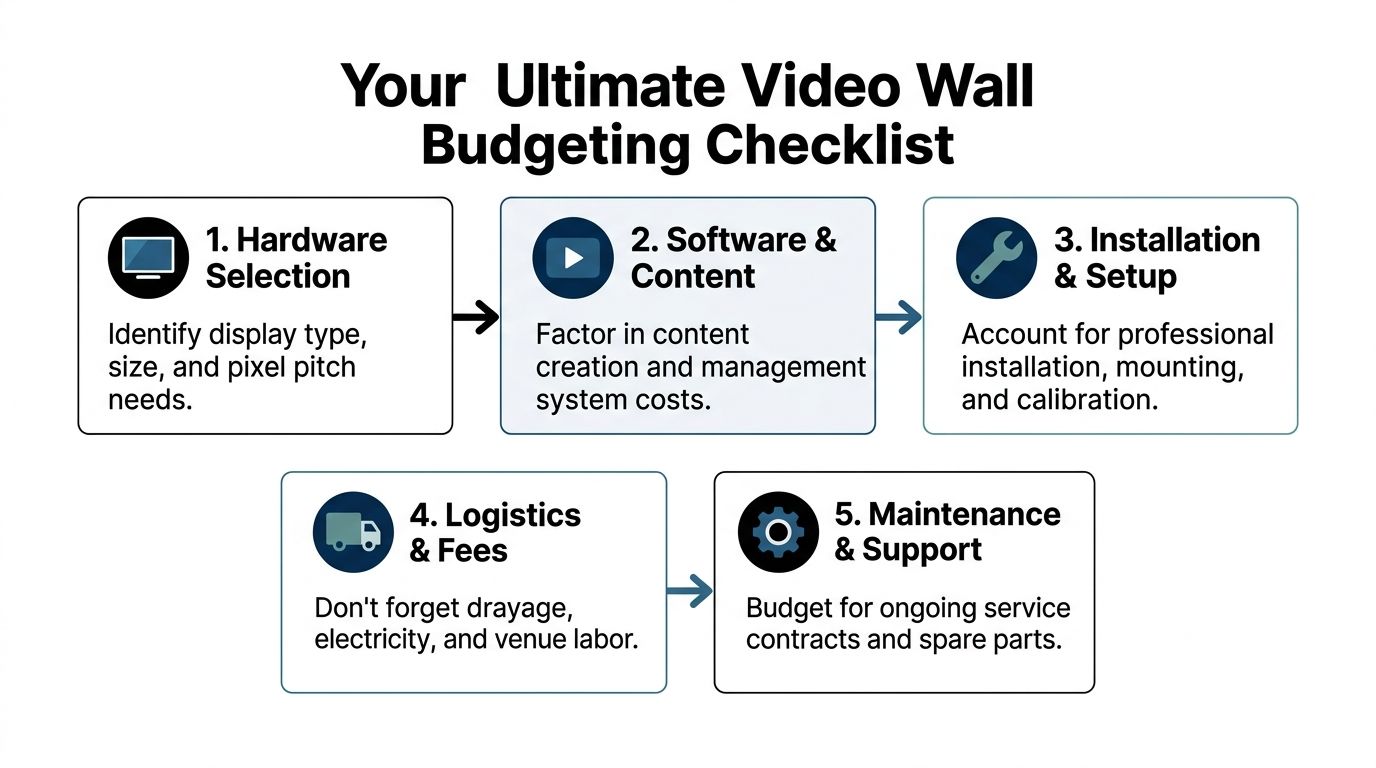
Your Ultimate Video Wall Pricing Budgeting Checklist
Most budgeting mistakes happen before the first quote arrives. The team has not defined priorities, has not separated vendor scope from show scope, and has not decided what the wall needs to accomplish.
Use this checklist before you approve a display concept or compare prices.

Start with the booth objective
If the wall is meant to stop traffic, the design approach will differ from a wall meant to support demos or presentations.
Ask:
- Is the goal brand impact, lead generation, product education, or all three?
- Will attendees view the wall from close range, aisle distance, or both?
- Does the wall need to support live presentations, multiple sources, or simple playback?
Define the technical requirements early
Do not request pricing without basic requirements.
Include:
- Booth size: Inline, peninsula, or island changes everything.
- Wall role: Hero backdrop, architectural element, demo canvas, or integrated booth structure.
- Viewing distance: This drives pitch selection.
- Content format: Static loops, motion graphics, live video, or presentations.
Ask for quote clarity in writing
Disciplined buyers protect themselves here.
Confirm these items:
- Hardware scope: Panels, processing, mounts, and all required accessories.
- Service scope: Delivery, setup, dismantle, testing, and show-hour support.
- Exclusions: Ask the vendor to state plainly what is not included.
- Failure response: Who fixes issues during live show hours?
Checklist rule: If a quote says “turnkey,” ask the vendor to define turnkey line by line.
Build a separate show-services budget
Do not assume your vendor controls venue billing.
Create a separate line for:
- Electricity
- Material handling
- Internet if needed
- Any show-specific labor or venue requirements
Review the final plan like an operator
Before sign-off, make sure someone on your team can answer these practical questions:
- Who is shipping what, and when?
- Who is the day-of-show contact?
- What content files are due, and by what date?
- What happens if a panel, processor, or source fails mid-show?
That final review catches the issues that become expensive.
Frequently Asked Questions About Video Wall Pricing
How much does a trade show video wall usually cost
There is no single honest answer without scope. Pricing depends on pitch, size, shape, processing, support model, and whether you are renting or buying.
At the broad market level, complete LED systems can range from small basic setups to very large high-resolution builds, but trade show buyers should be far more interested in what the quote includes than in any abstract starting number.
Why is one quote so much cheaper than another
Usually because the scopes are different.
The cheaper quote may use a larger pixel pitch, weaker processing, fewer included services, or limited support. It may also exclude items that are essential but easy to leave off the first version of a proposal.
Compare the full deliverable, not the headline number.
Is P1.9 really worth it over P2.5
For many trade show applications, yes.
If attendees will stand close to the wall, read text, watch product visuals, or take photos and video near the booth, the higher resolution of 1.9 pitch is noticeable. If the wall is viewed from farther away, the case becomes more situational.
Is content creation included in the price
Not automatically.
Vendors vary. Some provide guidance on formatting and playback requirements. Custom content creation is often a separate service unless the quote specifically includes it. Buyers should ask this early, because content decisions affect screen performance more than many people expect.
What happens if a panel or component fails during the show
This is one of the most important questions to ask.
Our model includes an AV technician onsite for the entire time the trade show is open. Naturally, we bring spare parts to every trade show. If something goes wrong, you call or text and the technician comes to the booth to resolve it. That is the difference between active show support and passive equipment rental.
Are electricity and drayage included in the video wall price
No, not if the show bills you directly.
Those are venue or show-contractor charges. A trustworthy vendor should tell you that clearly instead of burying the distinction.
How far in advance should I book a video wall
Earlier is better, especially for major shows and custom booth concepts. Of course, for a stress free show, we recommend booking us at least 3 months in advance.
Booking early gives your team more room for design coordination, content prep, logistics planning, and show paperwork. Last-minute bookings reduce options and increase pressure and stress. For instance, with early booking you’ll have plenty of time to design the graphics and video. Conversely, with last minute booking your designer is under pressure to design graphics fast.
Should I rent or purchase
Rent if you want flexibility, lower commitment, and fewer operational headaches.
Purchase if you exhibit frequently, have a stable booth program, and can support storage, maintenance, and logistics. The right answer depends less on preference and more on how disciplined your event operation is. Of course, we suggest that if you do 1-2 shows per year, rental is the way to go. However, when you do 4-6 shows per year you should consider buying. Naturally, when you are doing 6-10 shows per year, buying your own LED video wall booth is the way to go.
What is the biggest mistake buyers make with video wall pricing
Treating the display like a commodity.
A trade show video wall is not just a screen size and a price. It is a live event system with real operational consequences. Buyers who focus only on the cheapest number often end up paying for omissions, delays, stress, or weak on-floor performance.
If you want a quote that reflects the full event cost, not just a tempting partial number, talk with LED Exhibit Booths. We provide trade show video wall displays with an all-inclusive, white glove service model, including everything except the show bills you directly for, such as electricity and material handling.