

Measuring trade show roi starts the minute your team gets back from the show and somebody asks the only question that matters. Did this event make us money, or did we just buy an expensive few days of activity?
Most exhibitors don’t have a clean answer. They have badge scans, travel receipts, a few promising conversations, and a booth team that swears the show was busy. That isn’t enough. If you’re serious about event marketing, measuring trade show roi has to become a discipline, not a post-show guess.
The Post-Show Dilemma Why Measuring Trade Show ROI Matters
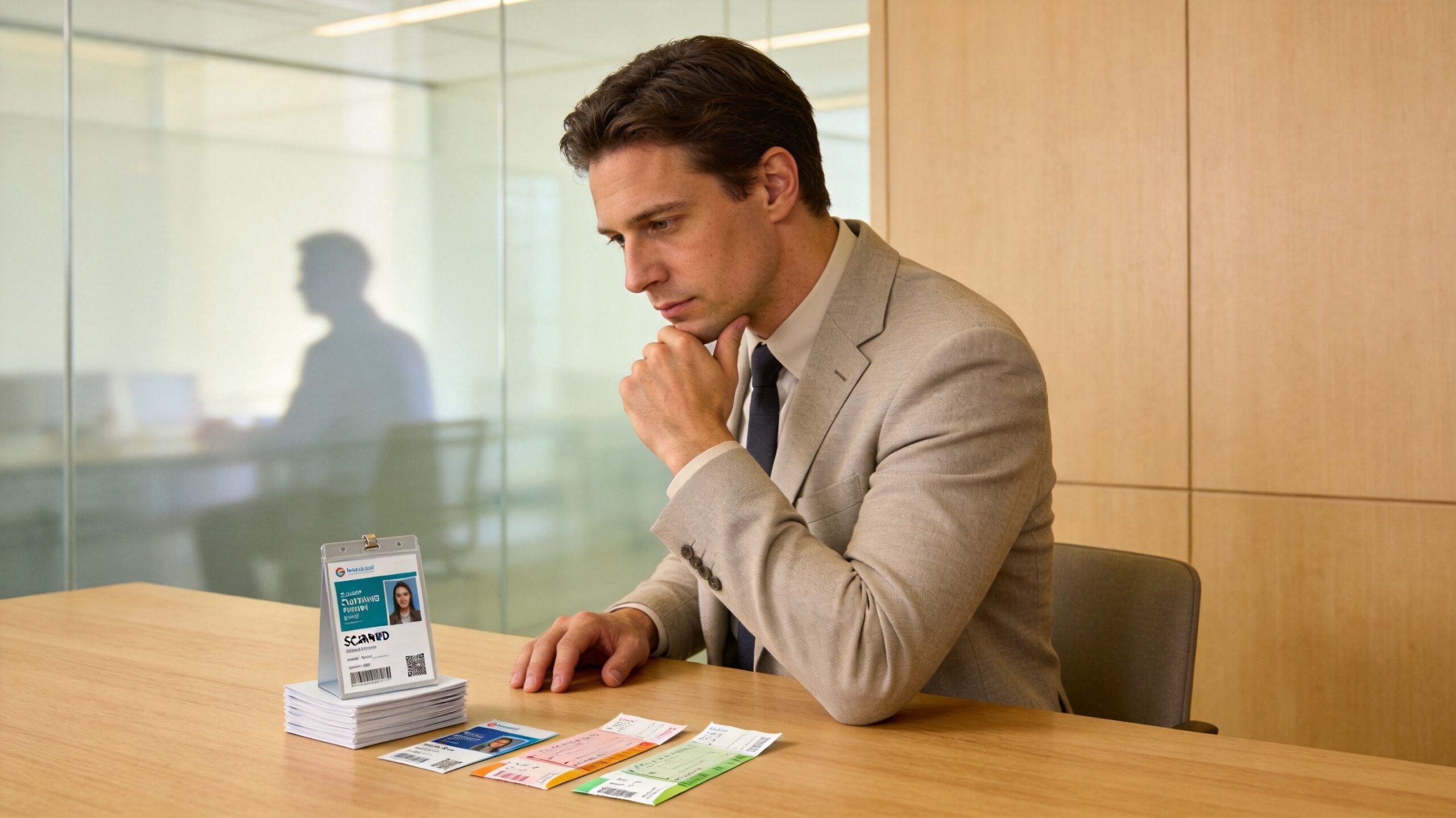
Your finance team sees invoices. Your sales team sees a pile of names. Your marketing team sees a booth that looked strong and felt successful. None of those views answers the same question.
The primary issue is cost. According to Clarity Quest on trade show ROI, the average cost per lead at trade shows can be around $811. That means 50 leads can put the direct marketing cost over $40,000 before you even start counting the full impact of sales follow-up and internal time. If you don’t measure quality, velocity, and revenue, you’re flying blind with expensive leads.
Why gut feel fails
I’ve seen this happen over and over. A team comes home energized because the booth was packed. Then the follow-up data comes in and most of the names were students, vendors, competitors, or people with no buying role. High activity is not the same thing as commercial value.
That’s why measuring trade show roi has to answer four practical questions:
- What did we spend: Include booth, space, travel, promotion, staff time, and show-serviced charges.
- What did we get: Count qualified leads, meetings, opportunities, influenced deals, and revenue.
- How fast did it move: Track how quickly leads become meetings and opportunities.
- What should we change next time: Use the data to decide whether to return, resize, or redesign.
Practical rule: If your post-show report doesn’t help you decide what to do at the next event, it isn’t an ROI report. It’s a recap.
A lot of teams also skip the hard pre-show review that would have exposed weaknesses before they spent the money. If you need a framework to evaluate booth performance, staffing, messaging, and follow-up discipline, a structured trade show audit is a useful place to start.
ROI is how you protect budget and improve performance
Measuring trade show roi isn’t only about defending spend to a CFO. It’s how you stop repeating weak event decisions. It forces you to compare shows, compare booth formats, and compare how well your team converts in-person attention into pipeline.
If your event program needs a stronger operational foundation, these experiential marketing best practices are worth reviewing before your next show cycle. The best exhibitors don’t just show up well. They track well.
Setting Clear Objectives to Define Your Return
If you can’t define the return, you can’t measure it. “Get leads” isn’t a serious trade show objective. It’s lazy, and it creates lazy reporting.
Start with the business result you care about. Revenue. Pipeline. Strategic meetings. Product launch traction. Channel partner conversations. Press exposure. Then decide which of those outcomes the show should produce.
What good objectives look like
Historically, some organizations have achieved as much as a 4:1 return from trade show participation, meaning they generated up to four dollars in attributable revenue for every dollar invested, as noted by Monster Displays in its trade show ROI benchmark discussion. That’s a strong benchmark, but it only matters if you’re aiming at a defined target.
Set a small number of primary objectives. Three to five is enough. More than that and your team loses focus on the floor.
Use a mix like this:
- Revenue objective: Tie the event to sourced deals and influenced opportunities.
- Pipeline objective: Set a target for qualified opportunities created after the show.
- Meeting objective: Track booked meetings with the right buyer profiles.
- Launch objective: Measure demo requests, follow-up interest, or partner conversations.
- Brand objective: Capture qualitative signals like stronger recall, media conversations, or repeat visits from target accounts.
Stop rewarding the wrong outcomes
A packed booth can hide weak performance. So can a huge badge count. If your team celebrates volume instead of fit, you’ll end up paying premium event costs for low-value names.
Use an objective screen before the show:
| Objective type | Strong version | Weak version |
|---|---|---|
| Lead generation | Qualified leads that match buyer profile | Total scans |
| Sales activity | Meetings booked with decision-makers | Casual booth chats |
| Revenue impact | Opportunities and attributed revenue | “Good show buzz” |
| Brand impact | Recall, press interest, partner traction | General visibility |
The best post-show conversations happen when sales, marketing, and leadership agreed on success before the booth ever opened.
Build goals your booth team can execute
Your on-site team needs objectives they can act on in real time. They should know who counts as a qualified lead, what questions to ask, when to route a visitor to a demo, and when to book a meeting on the spot.
That changes the entire show-floor behavior of your team. Staff stop chasing motion and start qualifying intent. That’s when measuring trade show roi gets easier, because the booth is producing cleaner data from the beginning.
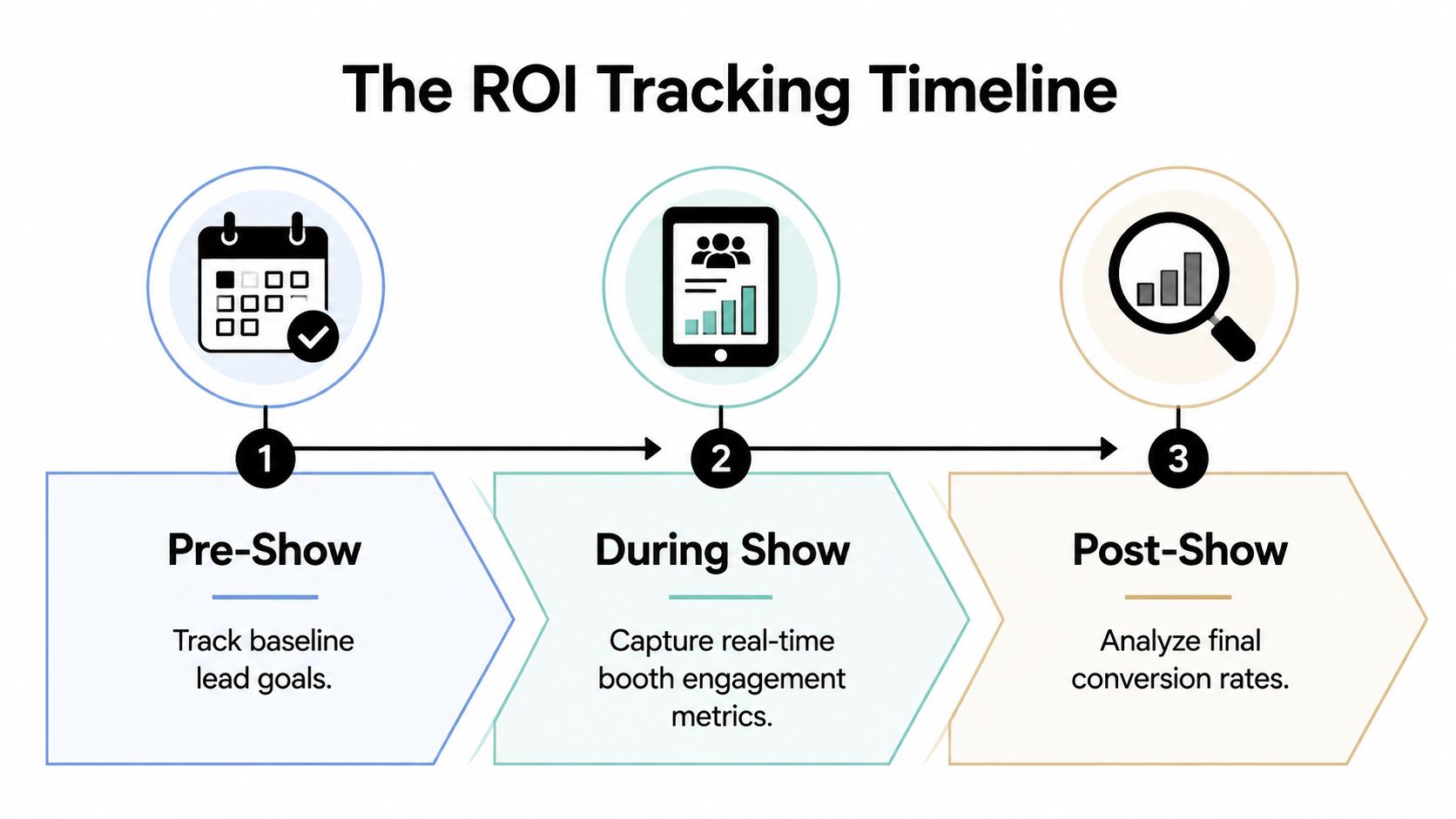
Capturing Metrics Before During and After the Show
Most ROI problems aren’t math problems. They’re data collection problems. Teams wait until after the event to think about measurement, and by then the information is already incomplete.
You need a timeline. Clean inputs produce useful ROI calculations. Messy inputs produce arguments.
Pre-show metrics that set the baseline
Before the event starts, lock down every cost category and every campaign touchpoint tied to the show. This includes booth fees, travel, sponsorships, pre-show outreach, content production, and any direct-show charges that come later.
Just as important, document your expected outcomes. If your team plans to use demos, interactive content, or product storytelling as traffic drivers, define what you’ll count. Demos given, meetings booked, scans captured, conversations with target accounts, and post-show follow-up commitments all need clear definitions.
This is also where booth strategy matters. Static displays make tracking shallow because visitors glance and leave. Immersive experiences create more measurable engagement moments. If you’re evaluating options, these interactive trade show displays show the kinds of booth elements that produce trackable actions instead of vague foot traffic.
During-show metrics that your staff must capture live
On the floor, speed matters. Nobody remembers details accurately at the hotel bar that night, and they definitely won’t remember them two weeks later.
Your booth staff should capture, at minimum:
- Lead source details: Badge scan plus notes on role, interest, and urgency.
- Conversation quality: Whether the attendee matches the target buyer profile.
- Engagement type: Demo viewed, product discussed, meeting requested, or partner inquiry.
- Next step: Follow-up email, sales call, quote request, or no action.
- Owner: Assign every serious lead to a specific person before the day ends.
Use CRM-connected scanners or lead capture apps if the event provides them. If not, use a shared form in HubSpot, Salesforce, or another tool your sales team already trusts. The exact platform matters less than consistency.
If your reps are scanning badges without adding qualification notes, you’re collecting names, not leads.
Post-show metrics that reveal actual performance
Post-show tracking is where weak event programs usually collapse. A team returns with enthusiasm, but nobody follows the leads by segment, owner, or promised next step.
Track the sales path in stages:
- Lead to follow-up: Did your team respond as promised?
- Follow-up to meeting: Which leads accepted the next conversation?
- Meeting to opportunity: Which ones became real pipeline?
- Opportunity to revenue: Which deals closed, and which remained influenced?
This is also where you should record qualitative lessons. Which content stopped people? Which questions surfaced repeatedly? Which parts of the booth created longer conversations? Those observations help improve performance at the next event and make your ROI model sharper over time.
Calculating Your True Trade Show ROI
The standard formula is straightforward. ROI = (Revenue − Cost) / Cost × 100. It’s useful, but on its own it can be too blunt for trade shows.
A lot of deals don’t close on the show floor. Some don’t close for months. Some are sourced elsewhere but influenced by the event. If you only count last-touch revenue, you’ll understate what the show contributed.
Start with the basic formula, then improve it
Use the simple model first because leadership wants a clean number. Then present a more realistic model that includes influenced revenue and customer lifetime value where your internal systems support it.
For attribution, a W-shaped multi-touch model for trade show ROI is far better than single-touch. In that model, 20% of conversion credit goes to pre-event marketing, 40% to the on-site immersive demo, and 40% to post-show follow-up. That’s a much better fit for real B2B buying journeys than pretending the final email or call did all the work.
Sample Trade Show ROI Calculation
| Metric | Value | Notes |
|---|---|---|
| Total show cost | Total event investment | Include booth, travel, promotion, staffing, and direct show-billed charges |
| Leads collected | Total scans with notes | Separate raw scans from qualified leads |
| Qualified leads | Sales-accepted event leads | Use your internal qualification standard |
| Meetings booked | Post-show meetings set | Good bridge metric between lead volume and pipeline |
| Pipeline created | Opportunity value tied to the show | Include sourced and influenced opportunities separately |
| Revenue closed | Closed-won value | Count direct attribution first |
| ROI | (Revenue − Cost) / Cost × 100 | Basic finance view |
| Weighted ROI | Multi-touch credited revenue minus cost, divided by cost | Better view for longer cycles |
The point of the table isn’t to force fake precision. It’s to keep finance, marketing, and sales looking at the same scorecard.
Why attribution discipline matters
Trade shows are rarely a one-touch channel. A buyer may see your pre-show outreach, visit the booth, watch a demo, take a follow-up call, and only then move into pipeline. If your reporting gives all the credit to the final touch, the event gets undervalued.
That same attribution logic shows up in other response-driven channels too. If you want a simple example of campaign measurement mechanics outside events, this guide to measuring results from ringless voicemail is useful because it focuses on tying response activity back to actual marketing effectiveness instead of surface-level activity.
Revenue attribution gets more accurate when you stop asking, “What was the last touch?” and start asking, “Which touches moved the deal forward?”
Keep the cost side honest
A surprising number of exhibitors distort ROI because they don’t track the full cost. They count the booth invoice and skip travel, sales time, pre-show promotion, and direct show charges.
Don’t do that. A clean ROI model needs a complete denominator. If you’re unsure what should be included, this trade show booth cost breakdown is a good checklist for building a more accurate event cost model.
How to Radically Improve Your Trade Show ROI
If you want better trade show ROI, stop obsessing over badge volume and fix the booth experience. That’s the most effective step most exhibitors can make.
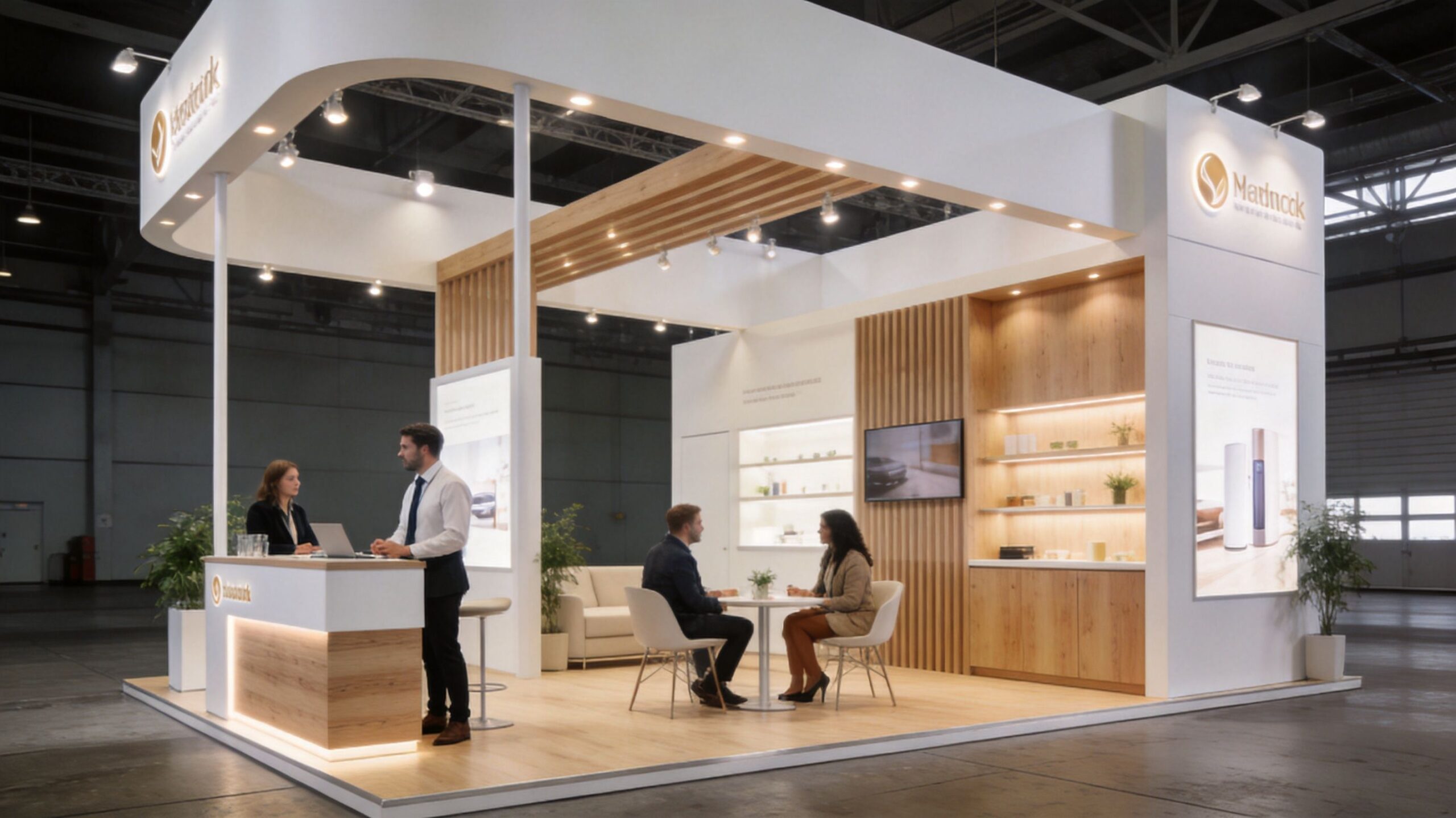
A weak booth lowers every downstream metric. It attracts the wrong people, shortens conversations, reduces demo quality, and gives your sales team less to work with. A strong booth does the opposite. It sharpens who stops, what they notice, and how long they engage.
Better booth experience means better lead quality
Bizzabo’s discussion of trade show ROI points to a common problem: many exhibitors face an engagement-quality gap, where high traffic doesn’t translate to viable leads. That’s exactly what we see in the field. Busy booths often underperform because they attract curiosity, not intent.
Immersive environments help close that gap. When visitors can immediately understand what you do through motion, scale, and clear product storytelling, your team spends less time re-explaining basics and more time qualifying real opportunities.
That doesn’t mean flashy for the sake of flashy. It means visual clarity, relevant content, and a booth layout that guides attention toward the conversation you want to have.
Resolution matters more than most buyers realize
This is one of those practical details people ignore until they see the difference on a crowded floor. A 1.9 pitch wall delivers higher resolution than the 2.5 pitch systems many competitors use. That means sharper imagery, cleaner text, and better-looking product visuals at closer viewing distances.
At a trade show, that matters. Attendees don’t stand at the perfect distance and admire your display like they’re in a showroom. They walk by fast, glance sideways, and decide in seconds whether your booth is worth entering. Sharper content helps your message land faster.
If you’re comparing concepts, this gallery of trade show booth design ideas is useful because it shows how design choices affect the actual visitor experience, not just the rendering.
The booth isn’t decoration. It’s the first filter in your lead qualification process.
Operational reliability improves ROI too
A lot of ROI leakage has nothing to do with messaging. It comes from execution failures. Delayed install. Last-minute technical problems. Staff distracted by logistics. Hidden fees that wreck the budget after the event.
That’s why turnkey execution changes the economics of a show. When pricing includes everything except the charges billed directly by the show itself, such as electricity and material handling, the cost side becomes more predictable. That gives your finance team a cleaner denominator and reduces ugly surprises after the event.
White-glove service matters for another reason. Your internal team should be talking to customers, not chasing cables, managing setup stress, or troubleshooting screens during show hours.
Here’s a quick visual example of what strong LED booth execution looks like in practice.
Downtime destroys opportunity
Most exhibitors underestimate risk. If your display goes dark, your demo crashes, or your content glitches, you don’t just lose aesthetics. You lose attention, conversation flow, and credibility.
Keeping an audiovisual technician onsite during all open show hours is one of the simplest ways to protect event ROI. If something goes wrong, your team shouldn’t become a support desk. They should keep selling while the issue gets fixed fast.
In practical terms, that means fewer lost conversations, more consistent demos, and less stress for the people representing your brand. That isn’t a soft benefit. It directly protects the value of the event window you already paid for.
Turning Your Trade Show From a Cost Center to a Revenue Driver
The exhibitors who win at events don’t treat ROI as a finance exercise they do after the show. They use it as an operating system before, during, and after every event.
The pattern is simple. Plan with clear objectives. Track the right metrics with discipline. Calculate ROI with honest cost accounting and realistic attribution. Improve the booth experience so better metrics become easier to produce.
That’s how trade shows stop feeling unpredictable. They become measurable. Then they become improvable.
The four-part discipline that works
- Plan: Define what return means before you commit budget.
- Track: Capture cost, engagement, qualification, and follow-up data in real time.
- Calculate: Use both direct revenue and influenced contribution where your systems allow it.
- Improve: Upgrade the booth experience and the delivery model, not just the post-show spreadsheet.
If your event program still treats booth spend as a one-off line item, you’re missing the full opportunity. A well-run trade show isn’t just a cost. It’s a channel. And like any serious channel, it should earn more budget when it performs and lose budget when it doesn’t.
For teams that want flexibility without carrying the full burden of ownership, rentals for trade shows can also make the ROI equation easier to manage while you test formats, footprints, and show fit.
When measuring trade show roi becomes standard practice, your next event decision gets easier. You know which shows deserve a bigger presence, which messages pulled qualified buyers in, and which booth choices improved the bottom line instead of just the visuals.
If you’re ready to turn your booth into a measurable revenue tool instead of an expensive guess, talk to LED Exhibit Booths. We help exhibitors build high-impact video wall booths with turnkey support, predictable pricing, and the kind of on-floor reliability that protects ROI when the hall opens.