
The show opens in an hour. Forklifts are still moving crates. The aisle looks exactly like every other aisle. A few booths have decent graphics, most have the same fabric backwall, and everyone is wondering the same thing: how do we get buyers to stop here instead of walking past us?
Experiential marketing best practices matter most in that moment. At a trade show, the difference between a booth people notice and a booth people remember usually comes down to one thing. You gave attendees something active to step into, not something passive to glance at.
That’s why LED video walls have become such a strong tool on the show floor. They turn the booth itself into the experience. Instead of hanging screens inside a structure, the structure becomes the screen. Walls, counters, columns, and overhead features can all carry one continuous story.
The market has moved in that direction for a reason. The global experiential marketing industry reached $128.35 billion in spending by the end of 2024, and 77% of marketers identify live experiences as their most effective marketing channel, according to these experiential marketing statistics. Brands aren’t treating live events like side projects anymore. They’re treating them like performance channels.
That shift also explains why exhibitors are studying stronger live concepts, including examples like REACH’s brand activation strategies, to understand what makes people stop, interact, and share.
The Modern Guide to Experiential Marketing Best Practices
Trade show exhibitors usually make the same early mistake. They think experiential means adding a giveaway, a game, or a flashy visual at the end of the process. In practice, the strongest booths work the other way around. The experience is the strategy, and every design, staffing, and content decision supports it.
What works on a crowded floor
A high-performing trade show experience does three jobs at once:
- Stops traffic: The booth has to interrupt aisle scanning from a distance.
- Rewards attention: Once people step in, the experience has to give them a reason to stay.
- Moves people forward: The interaction must lead naturally into a conversation, demo, scan, or follow-up.
Most booths only handle the first job. They might look good from twenty feet away, but they fall flat up close. A continuous LED environment solves that because it can shift from broad visual attraction to detailed product storytelling without changing hardware.
Why this format beats passive booth design
Static graphics lock you into one message. Stacked monitors create seams, cables, and dead zones. A continuous video wall gives you motion, scale, and flexibility in one system.
That matters because trade shows compress the buyer journey. A prospect may discover your brand, evaluate your product, and decide whether to talk to sales in a span of minutes. A booth that can adapt its content by audience, time of day, and conversation stage gives you a practical edge.
Practical rule: If the booth only broadcasts, it isn’t experiential. If it invites action, reaction, and conversation, you’re on the right track.
Foundational Experiential Marketing Best Practices Planning Your Experience
The best booth experience is usually won before the booth is built. Planning decides whether your activation feels tight and purposeful or expensive and unfocused.
Start with one commercial goal
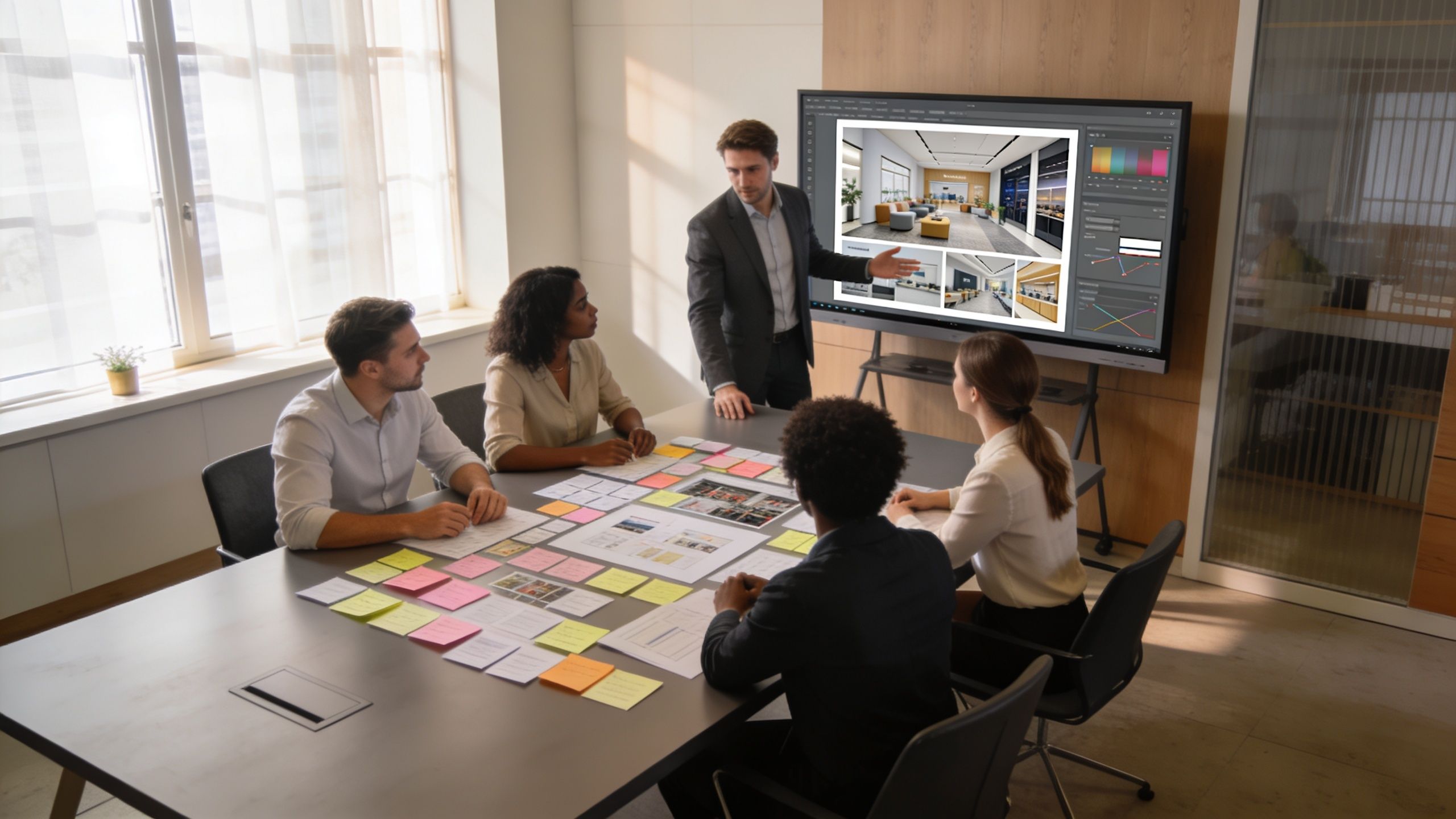
Don’t begin with visuals. Start with the business outcome. At trade shows, that usually means one of four priorities: launch a product, book qualified meetings, run live demos, or reposition the brand in a crowded category.
Once that priority is set, the rest gets easier. Your content style, booth layout, staffing plan, and lead capture method all become more obvious because they’re serving one job instead of five competing ones.
A useful gut check is simple: if your team can’t describe what a successful booth interaction looks like in one sentence, the experience isn’t defined well enough yet.
Build the booth around attendee behavior
Trade show attendees don’t move through a booth like website users. They scan from the aisle, test whether it’s worth stopping, then decide in seconds whether to step in farther. Good experiential marketing best practices respect that rhythm.
That’s why layout matters as much as graphics. Open sightlines, clear focal points, and space for conversation all influence whether the booth feels inviting or blocked. A practical starting point is to review strong trade show booth layout ideas and map where attraction, demo, and lead capture should happen physically.
Budget for clarity, not surprises
One of the biggest frustrations in exhibit planning is not the budget itself. It’s the uncertainty around what’s included.
We prefer a straightforward model because it makes planning cleaner. Everything is included in our price except what the show bills directly to the exhibitor. In most cases, that means items such as electricity and material handling. That distinction matters because it removes the fog around shipping, setup, dismantle, and production support.
Here’s the practical difference:
| Budget area | Best planning approach |
|---|---|
| Booth system | Lock scope early and avoid midstream redesigns |
| Show direct charges | Expect the venue to bill these separately |
| Content production | Decide which assets must sell and which only need to support |
| Staffing | Match booth roles to the interaction you want, not just badge count |
Decide what the attendee should do
An effective booth always asks the visitor to do something. Watch a demo. Scan a code. Trigger content. Compare options. Talk to a specialist. Without that next step, the booth becomes theater with no sales path.
That’s where many activations go off course. Teams spend heavily on appearance but leave the actual attendee journey vague.
A booth experience should feel simple to the attendee and tightly choreographed behind the scenes.
Use this pre-show checklist before approving the final concept:
- Define the primary conversion: Know whether success means scans, meetings, demos, or something else.
- Choose one hero story: Don’t load the wall with every message the company wants to say.
- Assign zones intentionally: Attraction at the perimeter, deeper conversation farther in.
- Prepare your staff cues: Decide what reps say when someone pauses, enters, or engages.
- Clarify budget boundaries: Separate venue-billed costs from everything your exhibit partner covers.
Designing an Immersive Storytelling Canvas
Most exhibitors hear technical specs and tune out. That’s understandable. Pixel pitch sounds like an engineering discussion when what you care about is whether the booth looks premium and whether the content holds up at close range.
Why pitch matters in real life
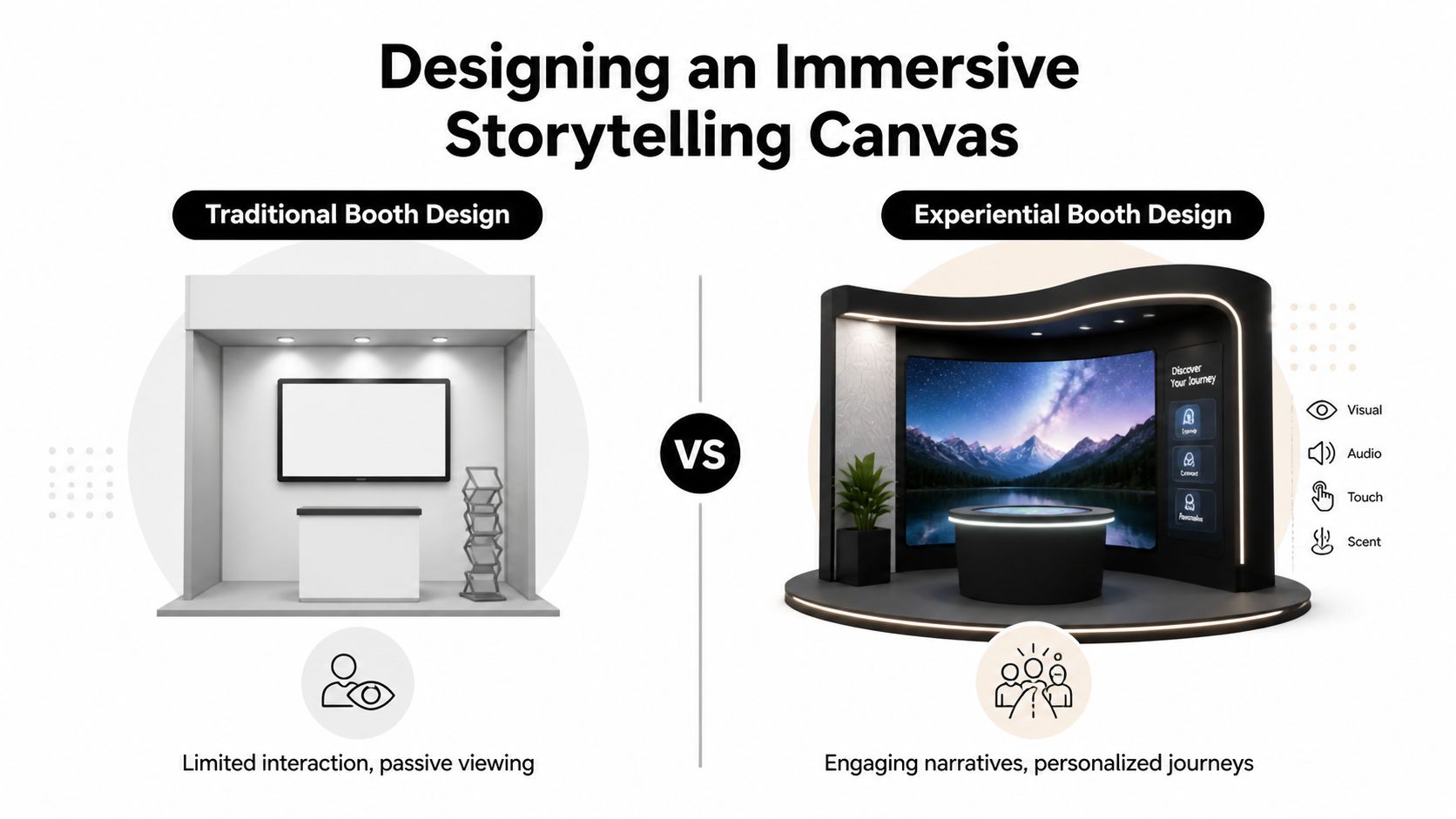
Our standard pitch is 1.9, while many competitors are still offering 2.5. The practical takeaway is simple. A lower pitch gives you higher resolution, so the wall looks sharper when attendees are standing close to it.
That matters a lot in trade show environments, especially in compact footprints. In a ten-foot space, people aren’t viewing your wall from across a stadium. They’re often just a few feet away. Fine text, product renders, interface visuals, and facial details need to stay crisp at that distance.
Consider print quality. Two brochures can use the same colors and the same brand, but the one with cleaner detail feels more expensive and more trustworthy. Video walls work the same way.
Seamless surfaces outperform stacked screens
Traditional monitor arrays create visual breaks. Bezels cut through the image. Mounting systems add bulk. Cabling and truss can make the whole setup feel temporary.
A continuous LED wall turns the exhibit itself into one visual surface. That changes how storytelling works because you’re no longer designing content screen by screen. You’re designing the environment.
For brands exploring more dynamic interactive trade show displays, that flexibility opens up better use of motion, product explainers, ambient brand visuals, and touch-driven content paths.
Better booth design doesn’t just look more modern. It removes friction between the story you want to tell and the way attendees actually see it.
Design content for distance and depth
The strongest content strategy uses layers. One layer pulls people in from the aisle. Another helps them understand what you do. A third supports the live conversation.
A simple booth content mix often works best:
- Ambient motion: Broad visuals that create energy and attract attention from a distance.
- Product moments: Clear demonstrations that show what the solution does.
- Interactive prompts: Touchpoints, QR paths, or live-trigger moments that turn viewers into participants.
- Support visuals: Diagrams, proof points, or workflows that help sales reps explain quickly.
Industry benchmarks show that visitors spending over 3 minutes at a booth convert to leads at a 47% higher rate than those who stay for less than 1 minute, according to Exposure Analytics on dwell time and experiential marketing. That’s why visual quality isn’t cosmetic. If better content and cleaner presentation keep people engaged longer, they improve the odds of a meaningful sales conversation.
Driving Traffic and Engaging Attendees Onsite
When the show opens, attendees make snap decisions. They don’t read your strategy deck. They react to motion, clarity, energy, and whether the booth feels alive.
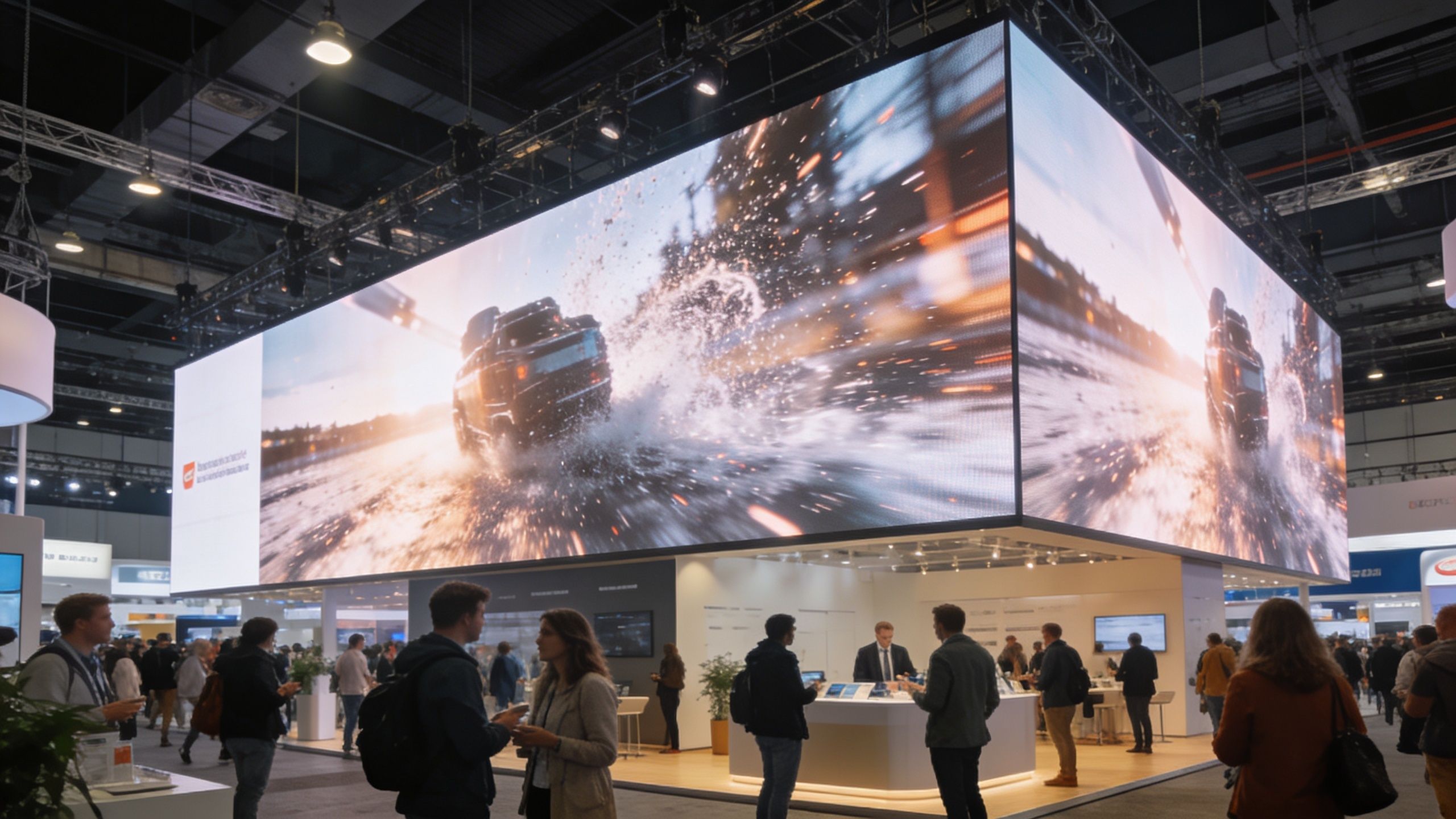
A strong onsite experience usually starts at the aisle edge. A passerby catches a moving visual that doesn’t look like another looping slide deck. The wall shifts from brand atmosphere into a product visual. A rep doesn’t pounce. They time the approach. The attendee slows down, looks up, and then steps in because the booth seems to be doing something, not just displaying something.
That first moment is where experiential marketing best practices either work or fail. If the booth asks too much too soon, people keep walking. If it creates curiosity first, engagement gets easier.
Match content to the traffic pattern
A good video wall program isn’t one loop running all day. Morning traffic, peak aisle congestion, and late-afternoon conversations require different pacing.
Here’s a practical way to think about the day:
| Show moment | Best content style |
|---|---|
| Opening hours | Bold motion and simple brand statements |
| Peak traffic | Fast visual hooks and short demo entries |
| Midday conversations | Deeper product content and comparison visuals |
| Late day | Meeting prompts, recap content, and follow-up cues |
That’s also where personalization pays off. Segmenting content by demographics on a video wall can cause a 28% higher interaction rate versus generic content loops, based on MC² guidance on experiential marketing measurement. In practice, that means the message for technical buyers shouldn’t look identical to the message for executive buyers if both audiences walk the same floor.
For teams planning more participatory experiences, these interactive booth ideas for trade shows are useful because they push the booth beyond passive viewing.
Create small moments of control
Attendees engage more when they can influence what happens next. That doesn’t always require a complex touchscreen build. It can be as simple as a product selector, a QR-triggered content path, or a visual that changes based on the demo topic.
These small choices do two things. They make the interaction feel personal, and they give your staff a natural way to begin a useful conversation.
A short product demo can help make that concrete:
What doesn’t work onsite
Some booths look impressive in renderings but underperform live. The usual problems are predictable:
- Overloaded motion: Too much animation creates noise instead of focus.
- Tiny text: If attendees need to stand still and squint, the wall is doing the wrong job.
- No staff choreography: Even great visuals stall when reps don’t know how to enter the interaction.
- One generic loop: Static repetition teaches attendees to ignore the screen.
If people stop but don’t engage, the booth has an attraction problem. If they engage but don’t convert, it has a journey problem.
The Turnkey Advantage Logistics and Flawless Support
A lot of exhibitors assume stress is just part of the trade show process. They accept that someone on their team has to chase shipping details, supervise install, troubleshoot screens, and manage teardown while still trying to host customers.
That assumption is outdated.
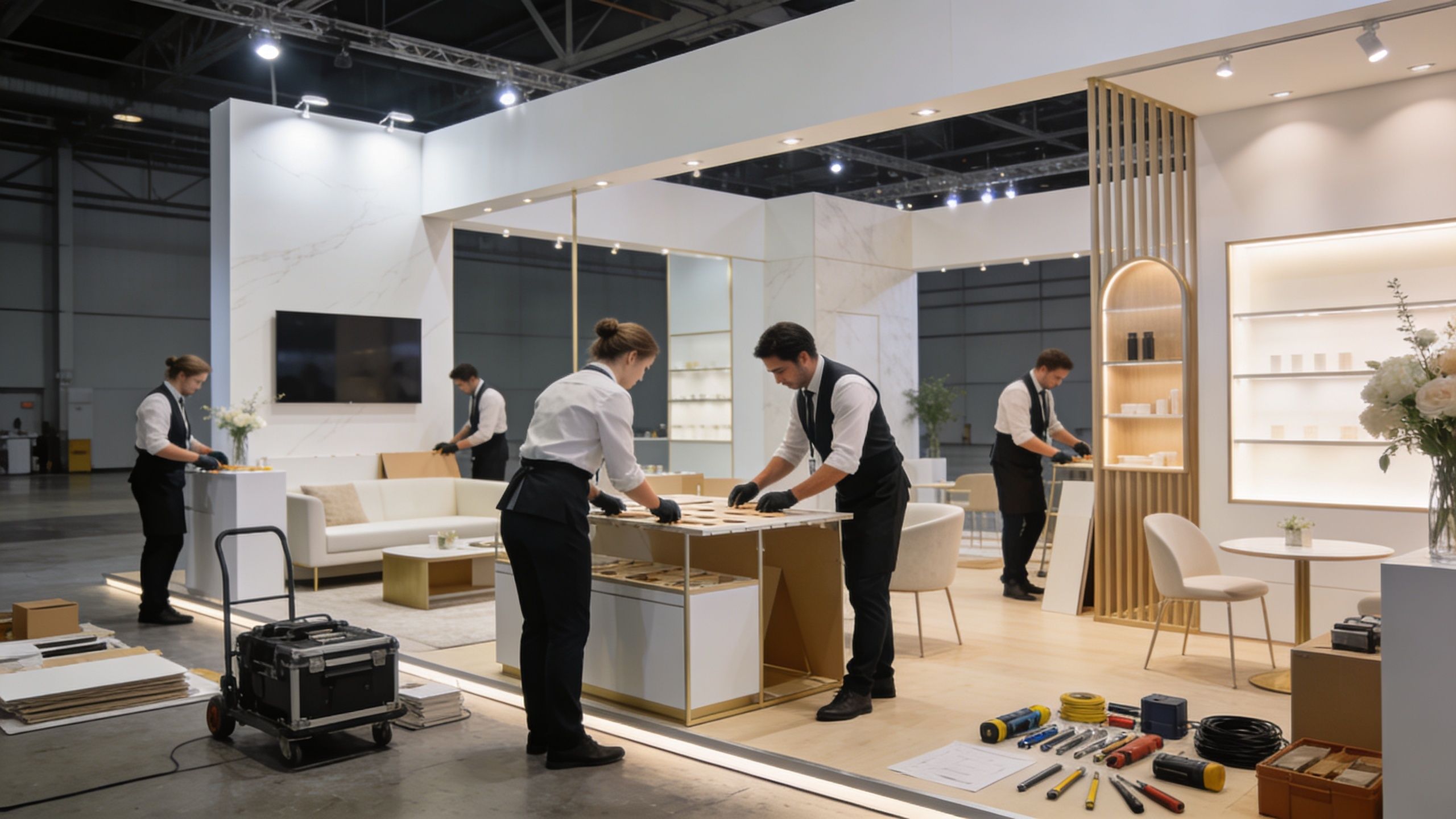
White glove means the exhibitor isn’t the project manager
At a practical level, turnkey service should remove operational burden from your internal team. That means one partner coordinates the booth build, delivery, setup, dismantle, and technical readiness so your staff can focus on customers.
We take that approach seriously. Our service is white glove and turnkey. We handle the details so the exhibitor can walk into the hall focused on meetings, demos, and conversations instead of freight paperwork and display troubleshooting.
That’s the true value of working with an experienced trade show display company. Not just hardware. Operational control.
The hidden risk in show-floor technology
High-impact technology creates a better booth experience, but only if someone owns the risk. That’s the part many vendors gloss over. They install the system, then disappear until teardown.
We don’t. We leave an audiovisual technician onsite the entire time the trade show is open. If anything goes wrong, you text or call, and an AV technician is at the booth within minutes to fix it.
That support model changes the exhibitor’s day. Your marketing team doesn’t need to become emergency tech support. Your sales team doesn’t have to apologize for a visual issue while trying to close conversations.
What exhibitors should ask before signing
Not every turnkey promise means the same thing. Ask specific questions before you commit.
- Who handles setup and dismantle: Don’t settle for vague language around “support.”
- Who is onsite during show hours: Installation support is not the same as active event support.
- What is included in the quoted price: Separate venue-billed charges from partner-managed costs.
- Who owns last-minute fixes: Content changes and hardware issues happen. Plan for them.
The easiest way to ruin a premium booth is to leave no one responsible for it once the show starts.
A trade show booth should reduce pressure on your team, not add another operating system they have to manage.
Measuring ROI to Prove Experiential Marketing Value
A trade show booth that looks busy can still underperform. Crowds, badge scans, and compliments do not prove revenue impact. ROI becomes measurable when the booth is set up to capture buyer behavior, not just booth traffic.
That starts before the show opens. Define what matters at each step. Then build the booth, content, and staffing plan around those signals.
Measure the booth as a funnel
On the show floor, attention moves in stages. Someone notices the LED wall from the aisle. They stop because the motion, brightness, and content are strong enough to pull them in. They interact with a demo, scan a code, request a meeting, or ask a technical question that signals real buying interest.
If your team only counts leads at the end, you miss what caused those leads to happen.
A better framework looks like this:
| Funnel stage | What to measure |
|---|---|
| Attraction | Traffic patterns around the booth |
| Engagement | Dwell time by zone or content segment |
| Action | QR scans, demo starts, form fills, content selections |
| Qualification | Notes from staff, meeting requests, priority tags |
| Revenue linkage | CRM progression after the event |
LED video walls help because they do more than decorate the booth. They can display timed calls to action, route visitors into product-specific content paths, and support interactive moments that show which messages effectively moved people closer to a sales conversation. Pixel pitch matters here too. A tighter pixel pitch gives you sharper visuals at close viewing distance, which means cleaner text, clearer product demos, and a better first impression when attendees are standing a few feet from the screen.
Connect show-floor behavior to sales outcomes
The post-show question that matters is simple. Which booth behaviors showed buying intent?
A contact who watched the full product sequence, scanned a solution-specific QR code, and booked a meeting is more valuable than someone who grabbed a giveaway and disappeared. Good analysis separates casual attention from sales intent.
Teams focused on increasing trade show ROI with LED exhibit booths should build around that distinction. We usually advise clients to map a few high-value actions before the event starts, then make sure every LED content segment, CTA, and staff handoff supports those actions. That keeps reporting tied to pipeline, not vanity metrics.
What to review after the show
Post-show review should stay practical.
- Which content kept people in the booth longer: Keep the visuals and demo sequences that led to real conversations.
- Where engagement dropped off: Check whether the issue was messaging, screen placement, staffing, or a weak CTA.
- Which audience segments responded to which content: Use that insight to tighten messaging for the next show.
- How fast follow-up happened: Even strong booth performance loses value when sales outreach lags.
- Which leads moved in CRM: Compare pipeline progression against the behaviors captured onsite.
The point of experiential marketing at a trade show is not spectacle by itself. The point is to use the booth to create better sales conversations, collect stronger buying signals, and prove what the investment produced.
If you want a trade show booth that presents sharply up close, reduces operating friction onsite, and lets your team stay focused on customers instead of troubleshooting, LED Exhibit Booths is built for that job. We provide integrated LED video wall booths, white glove execution, inclusive pricing except for direct show charges like electricity and material handling, and onsite AV technician support throughout show hours so your exhibit stays live, polished, and dependable.