
Trade show floors are crowded with safe choices. Printed backwalls. A looping monitor on a stand. Maybe a lightbox if the team pushed the budget. Most of those booths disappear the moment attendees walk past them. Naturally, an led screen for stage can make all the difference.
led screen for stage setups solve that problem when they’re planned correctly. They don’t just show content. They turn your booth into the content. That’s the difference between being seen and being remembered.
We’ve watched exhibitors make the same mistake over and over. They focus on the hardware first, then get surprised by setup complexity, hidden venue charges, weak content, or a screen that looked fine in a sales deck and underwhelming on the show floor. The smarter move is to treat the screen, the structure, the logistics, and the support model as one decision.
A strong LED wall can stop traffic, frame product launches, support demos, and clean up the whole look of your exhibit. A poorly planned one becomes an expensive troubleshooting project. That’s why the question isn’t just whether you should use LED. It’s how to do it without wasting money or creating more operational risk for your team.
Transform Your Booth with an LED Screen for Stage
Most booths ask for attention. A good LED booth holds it.
Walk a typical expo hall and you’ll see the same visual pattern repeating. Static graphics. Small monitors with bezels. Booth staff trying to create energy that the environment doesn’t support. Then you hit one exhibit where the entire structure moves with clean video, brand color, product visuals, and motion that pulls people in from the aisle. That booth changes the pace of foot traffic around it.
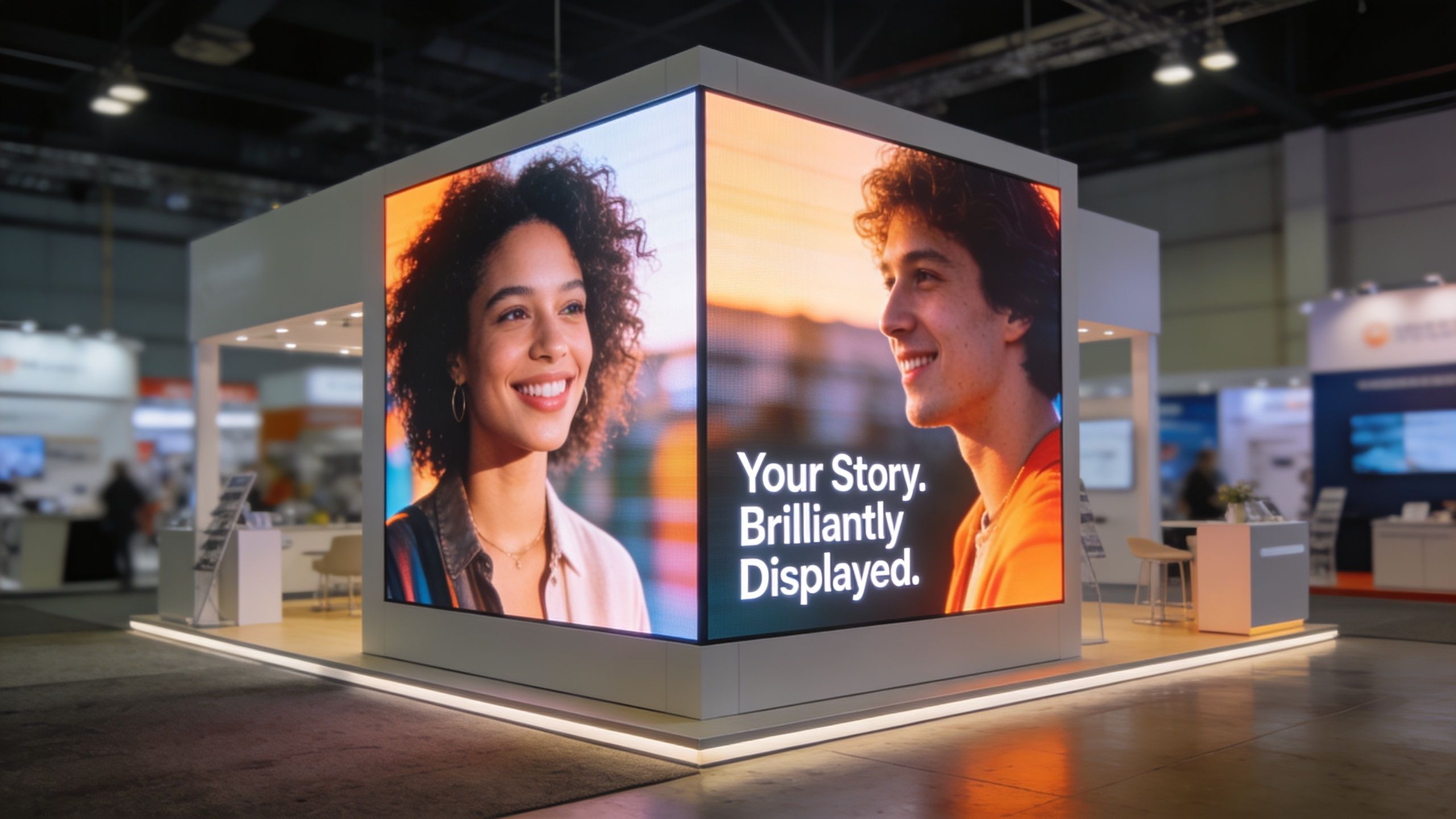
That’s the practical value of an LED screen for stage use in trade shows. It gives you one uniform visual surface instead of a patchwork of screens, cables, and support hardware. If you want to see how that looks in practice, study these video wall booth examples. The pattern is obvious. The booths that feel modern don’t rely on more parts. They rely on fewer distractions.
What attendees notice first
Attendees don’t walk up thinking about pixel pitch, refresh rate, or panel design. They react to three things:
- Motion: Content that moves cleanly catches the eye faster than static graphics.
- Scale: A large visual field changes how people read your brand from the aisle.
- Finish: Continuous surfaces look premium. Gaps, stands, and exposed hardware don’t.
A trade show booth has a few seconds to make its case. LED gives you a much stronger first impression than printed graphics alone.
The important part is execution. LED can make a small booth look bigger, a standard booth look custom, and a product launch feel like an event. But it only works when the specs fit the environment and the service model removes friction instead of adding it.
What Makes a High-Impact LED Screen for Stage
The biggest mistake buyers make is assuming all LED walls look roughly the same. They don’t. A high-impact wall comes down to the right pixel pitch, enough brightness, and a panel system that looks clean at trade show viewing distances.
Pixel pitch decides whether your wall looks premium
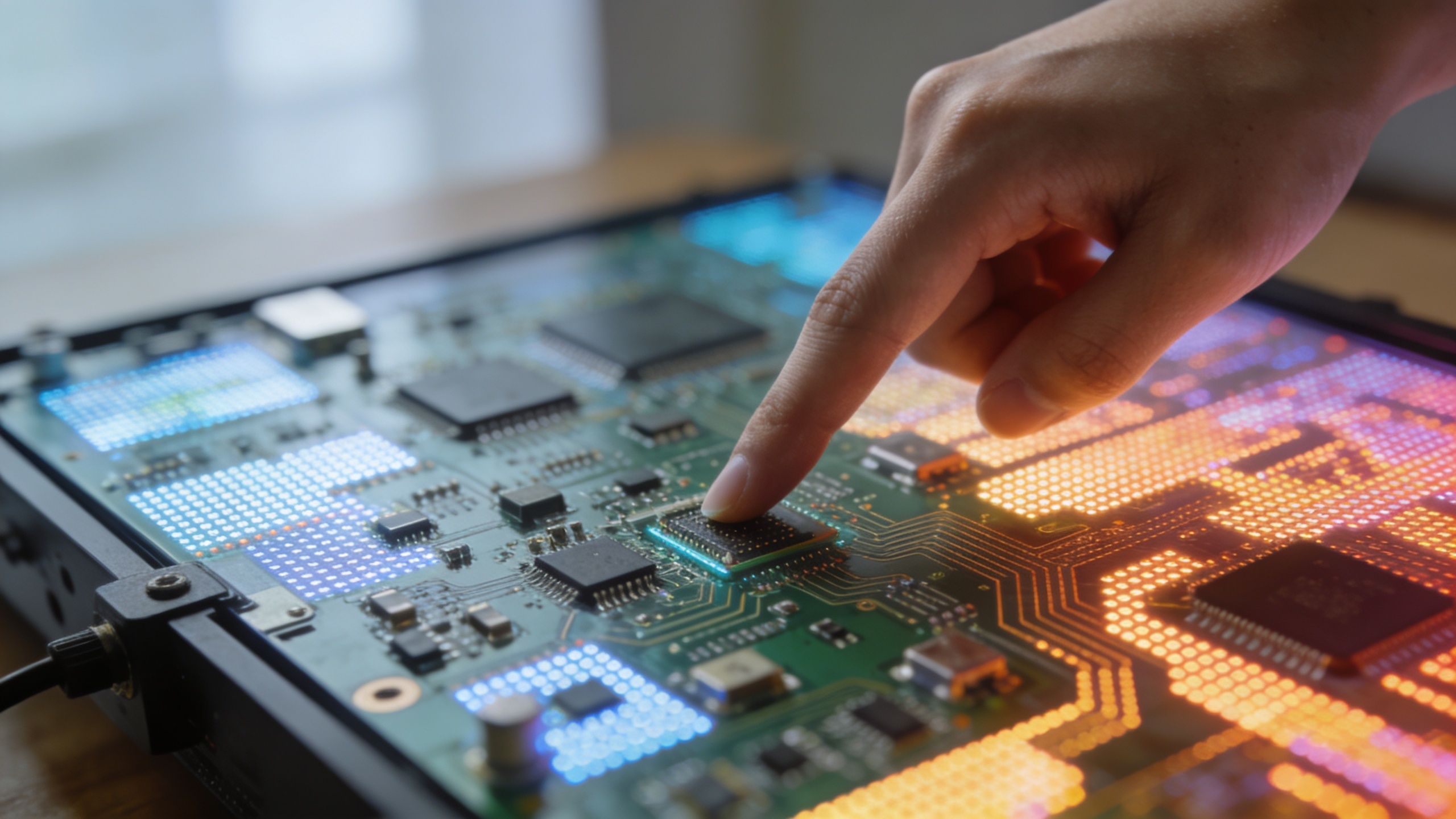
Pixel pitch is the spacing between the LEDs. Smaller pitch means tighter spacing and a sharper image at close range. That matters on a trade show floor because people don’t stand far away. They walk right up to your booth.
For indoor LED screen for stage applications, a finer pitch like P1.9 to P3.9 keeps visuals sharp for attendees viewing from 2 to 5 meters, supports 140° viewing angles, and helps eliminate Moiré in photos, according to this LED stage screen guide from RTLED Solution.
Our view is simple. P1.9 is the better choice. Many competitors use P2.5, and that’s where you start seeing the difference between “good enough” and “crisp.” In a booth environment, that finer pitch gives you higher apparent resolution and a cleaner image when attendees are close, taking photos, or watching product demos.
The situation resembles the difference between an older TV and a sharper modern display. Both show the message. Only one looks expensive.
Brightness matters more than spec sheets suggest
A booth doesn’t exist in a controlled theater. It sits under venue lighting, aisle glare, overhead signs, and whatever lighting neighboring exhibitors brought with them.
Indoor screens generally need enough output to stay vivid under show lighting. The same RTLED source notes 1,200 nits as a practical indoor brightness level for stage use, while outdoor variants can reach much higher brightness for sunlight conditions. That’s why you shouldn’t buy on price alone. If the wall can’t hold color and contrast in the venue, the content falls flat.
Here’s a quick comparison buyers should keep in mind:
| Spec | Better choice for trade shows | Why it matters |
|---|---|---|
| Pixel pitch | P1.9 over P2.5 | Sharper visuals at close viewing distances |
| Indoor brightness | Properly matched for venue conditions | Prevents washed-out content |
| Viewing performance | Wide angle panels | Keeps visuals clean from side traffic |
| Photo friendliness | Panels that reduce Moiré | Helps your booth look better on camera |
A short demo makes these differences easier to spot:
The screen has to work as part of the booth
The wall itself isn’t the whole system. Mounting, alignment, content playback, and integration into the booth matter just as much. If you’re comparing panel systems, review real LED wall panel options for exhibit builds and ask how they behave in a finished booth, not just in a warehouse.
If you’re also evaluating venue infrastructure and efficiency, this overview of LED lighting advantages for your property is useful context. It’s not trade-show-specific, but it helps explain why LED technology keeps replacing older display and lighting approaches.
Practical rule: If attendees will stand close, photograph the booth, or watch detailed product visuals, don’t settle for coarse pitch just to shave the quote.
Choosing the Right Size and Shape for Your LED Screen
Most buyers ask for the biggest wall they can fit. That’s not the right question. The right question is what size and shape helps people see, understand, and remember your message from the way they move through the booth.
A useful rule from this stage LED screen size calculator is that screen height often follows a 1/6th rule, where the height is one-sixth of the distance to the furthest viewer. That’s a practical starting point because it ties the screen to sightlines, not guesswork.
The same source notes that a standard 7.32m x 2.74m screen can be built from 96 individual tiles and weigh 576kg without heavy steel frames, which matters for shipping and drayage planning.
Start with the viewing pattern
Before choosing dimensions, answer these questions:
- Aisle visibility: Are you trying to pull attention from across a main aisle, or support conversations inside the booth?
- Booth depth: A shallow booth usually benefits from a strong backdrop. A deeper footprint may support a wider or wrapped display.
- Content type: Product reels, live demos, speaker support, and ambient motion all favor different aspect ratios.
- Traffic direction: Island booths and corner booths often need different visual strategies.
If you’re comparing options, these video wall size examples make it easier to see what fits different footprints.
Flat isn’t your only option
Modular LED becomes much more interesting than a standard “screen rental.” You’re not limited to a rectangle on a truss.
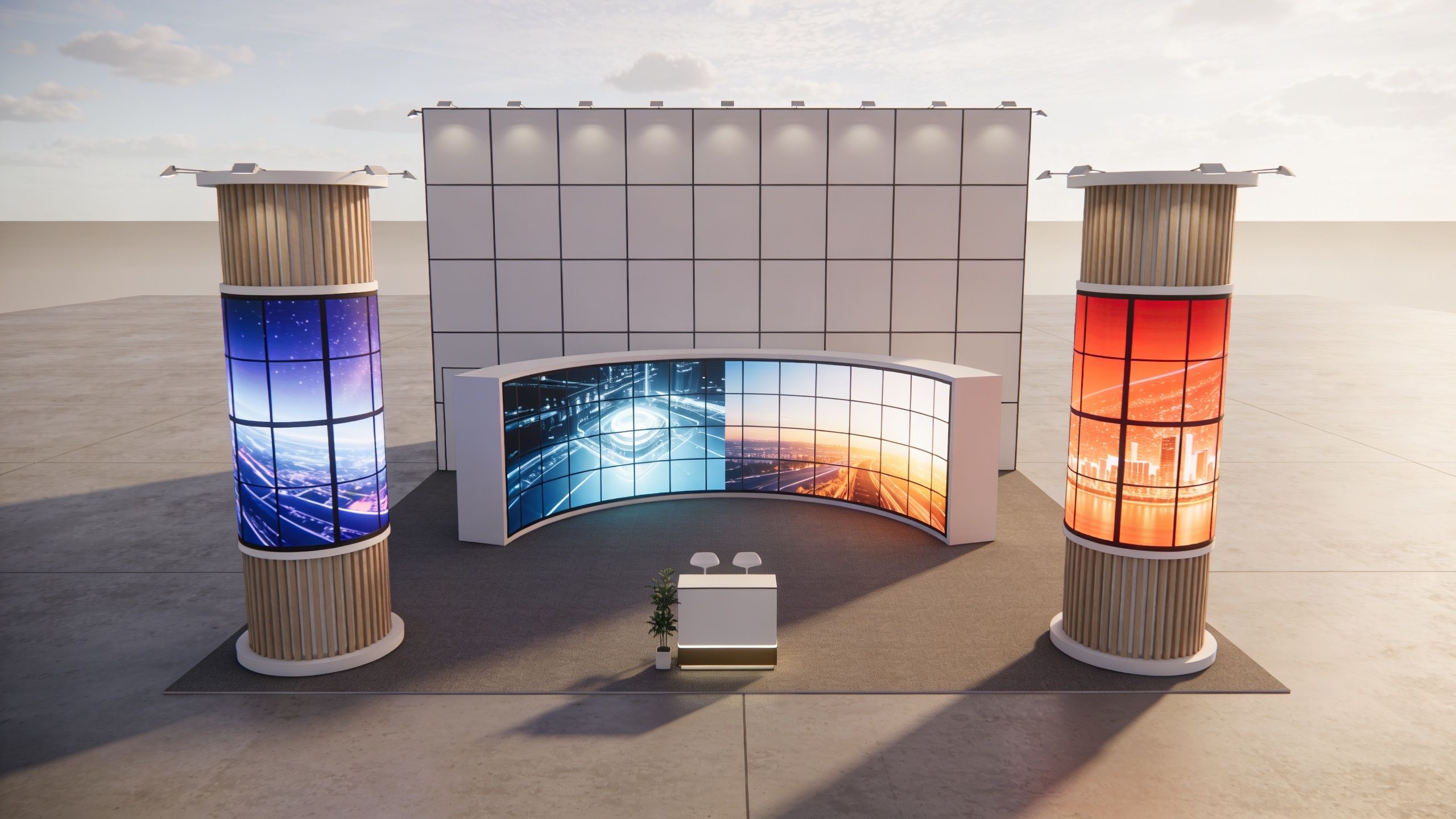
A well-planned LED screen for stage can become:
- A continuous backdrop behind presenters or product showcases
- A curved feature wall that softens the booth and improves sightlines
- A wrapped column that turns dead structural space into media
- An arch or portal that pulls people into the exhibit
- An island element visible from multiple approaches
Curved configurations deserve more attention than they usually get. They can create a stronger sense of immersion and help a booth feel custom instead of rented.
If your booth shape is unusual, that’s not a constraint. It’s often the best reason to use modular LED in the first place.
A simple decision checklist
Use this when narrowing the shape:
- Need brand visibility from distance? Prioritize height and bold content.
- Need product education at close range? Prioritize finer pitch and clean frontal viewing.
- Need to stand apart from neighboring booths? Consider curved or wrapped elements.
- Need easier logistics? Ask how the panel system affects freight, drayage, and install time.
- Need one screen to do several jobs? Design content zones instead of oversizing the wall.
Bigger helps only when the wall is matched to your layout. The best LED installations feel intentional, not oversized.
Renting vs Buying Your Trade Show LED Screen
For most exhibitors, renting is the smarter decision. Buying only makes sense when your team uses the system often enough, stores it properly, maintains it well, and has people who can manage deployment without drama.
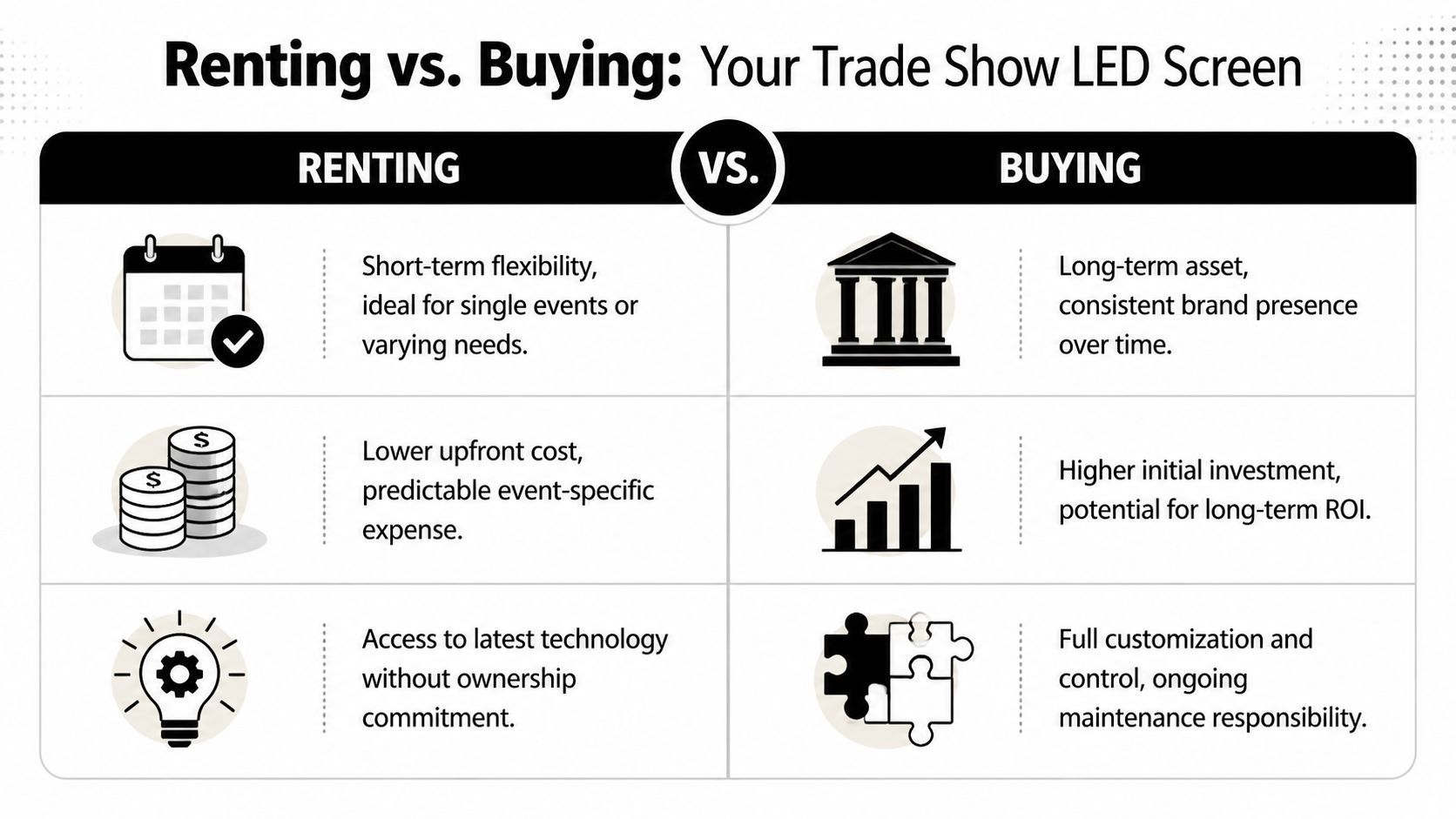
High-quality LED panels can last 100,000 hours of operation, which translates to over 10 years of reliable performance with proper maintenance, and many systems see continuous use for 6 to 8 years before replacement, according to this overview of stage LED screen durability. So yes, ownership can pay off for frequent exhibitors.
But longevity alone doesn’t make buying the right move.
When buying makes sense
Buying is worth considering if you:
- Exhibit constantly: You use the system across many events every year.
- Have internal operational support: Someone owns storage, maintenance, testing, and logistics.
- Need fixed brand control: The same system appears repeatedly in the same format.
- Can handle technical risk: If a panel issue shows up before a show, your team has a recovery plan.
Ownership gives you asset control. It also gives you responsibility for every detail people forget to budget time for.
Why renting usually wins
Renting suits how most marketing teams work. Campaigns change. Booth sizes change. Event goals change. Technology changes too.
Here’s the clean comparison:
| Option | Strongest advantage | Main tradeoff |
|---|---|---|
| Renting | Flexibility and lower upfront commitment | You don’t own the asset |
| Buying | Long-term control and repeat use value | You own maintenance, storage, and refresh risk |
If you’re weighing the two, this breakdown of owning vs renting an LED video wall is a useful reference.
Renting lets marketing teams stay focused on outcomes. Buying turns them into equipment managers unless the company has a strong support structure.
The other reason I lean toward renting for trade shows is simple. Most exhibitors want a result, not a warehouse problem. They want the wall to show up, look sharp, work all day, and disappear after the event without creating another internal process.
Why Our White-Glove Service Makes Your LED Screen Shine
This is the part most LED vendors underplay. The screen is only half the job. The other half is everything that can go wrong between the quote and the moment your booth opens.
Trade show LED projects get messy fast when multiple vendors touch different parts of the build. One group handles the structure. Another handles playback. Another handles install. Someone else is responsible for content formatting. Then the venue adds its own rules, labor windows, power requirements, and material handling process. If nobody owns the whole chain, your team ends up owning the stress.
We don’t think that model works.
What turnkey should actually mean
A proper white-glove, turnkey model should include everything needed to get the LED wall delivered, installed, operated, and removed cleanly. Our position is straightforward. If the show doesn’t bill you directly, it should already be in the price.
That means our pricing includes the moving parts buyers usually get surprised by later. Design coordination, equipment, setup, dismantle, and show support are covered. The exceptions are the charges the show itself bills directly, such as electricity and material handling.
That pricing structure matters because LED quotes can look artificially low when key services are excluded. A cheap number upfront often turns into a more expensive project once labor, support, and logistics are added back in.
The onsite technician is not optional
An LED wall at a trade show isn’t a “set it and forget it” item. Content needs to run properly. Playback systems need to stay stable. If something changes on site, somebody qualified needs to fix it quickly.
That’s why we leave an audiovisual technician onsite the entire time the trade show is open. If anything goes wrong, you text or call, and an AV technician is at the booth within minutes to solve the problem.
That’s not a luxury add-on. It’s the difference between a minor issue and a public failure.
The real value of LED support isn’t visible when everything works. It shows up the moment something doesn’t.
Better hardware still needs better execution
We also use P1.9 pitch as our standard, while many competitors still quote P2.5. That means the wall starts with a sharper image at the close viewing distances common on a convention floor. But superior panels only matter when the system around them is handled correctly.
That includes:
- Pre-show planning: Matching wall size, shape, and playback needs to the booth
- Installation discipline: Clean alignment, proper cabling, and polished finish
- Operational support: Fast adjustments during show hours
- Post-show teardown: Efficient dismantle without leaving your team exposed
Curved builds are a good example. According to this stage LED screen resource focused on curved configurations, integrated curved setups can outperform flat screens by 35% in viewer dwell time, and modern magnetic locking systems can assemble a 20m² curved wall in under an hour. That’s exactly why execution matters. The format is powerful, but only when the crew knows how to deploy it cleanly.
What this means for your team
Most exhibitors don’t want to manage AV. They want to meet customers, run demos, support sales, and protect the brand. That’s the right priority.
Here’s what a white-glove model changes in practice:
- Fewer vendors to coordinate: One partner handles the moving parts.
- Cleaner budgeting: Fewer surprise add-ons hiding outside the initial quote.
- Less show-floor risk: Problems get solved immediately by a qualified technician.
- Less internal distraction: Your team stays focused on attendees instead of troubleshooting.
The LED wall should be the easiest part of your event once the show opens. If your provider can’t make that true, keep shopping.
Creating Content That Captivates and Converts
A sharp wall with weak content is still a weak booth. The screen gets attention. The content decides whether people stop, understand what you do, and move into a real conversation.
The first rule is ruthless simplicity. Trade show attendees don’t stand still and read paragraphs. They glance, scan, and keep moving unless something earns another few seconds.
Build content for motion, not for a brochure
The best booth content usually does three jobs at once. It attracts from distance, explains quickly up close, and supports your staff while they talk to visitors.
Use this structure:
- Ambient layer: Movement, brand color, and visual energy that catches attention from the aisle
- Message layer: Short statements that explain the offer fast
- Proof layer: Product visuals, interface footage, use cases, or demo support
If you need help generating short-form visual concepts quickly, tools like ShortGenius AI video ad maker can help marketing teams produce motion assets faster. You still need human judgment, but speed matters when event deadlines are tight.
For teams planning custom content, this guide to video wall video production for trade shows is a solid starting point.
Don’t treat the wall like a giant PowerPoint slide. Treat it like a moving storefront.
Keep text minimal and hierarchy obvious
Common booth content mistakes are predictable. Too much copy. Small text. Overstuffed layouts. Videos designed for desktop screens instead of large-format playback.
A better approach:
- Lead with one clear idea at a time. Don’t stack five messages on one loop.
- Use bold typography sparingly. People should understand the headline from the aisle.
- Show the product early. Don’t make viewers wait through a long animated intro.
- Design loops to operate without sound. Audio often isn’t practical on a busy floor.
- Plan for repetition. Attendees join the loop at random points.
Make sustainability and power part of the decision
LED content strategy also benefits from the technology’s efficiency. LED screens consume substantially less power than projectors and produce less heat, and high-end models can reach 5,000 to 10,000 nits of brightness, according to this analysis of LED stage screens and video walls. That same source notes this efficiency can reduce a booth’s overall electricity expenses by 15-20% or more.
That matters for two reasons. First, lower power demand can support tighter event budgets. Second, many brands now care how exhibit choices align with sustainability goals. LED helps on both fronts.
A practical content checklist
Before final export, check for these issues:
- Resolution fit: Match files to the wall layout so playback stays clean
- Readable pacing: Give headlines enough screen time to be understood while walking
- Brand consistency: Keep colors, fonts, and transitions aligned with the campaign
- Demo support: Include visuals that help staff explain the offer live
- Photo value: Make sure the booth looks good in attendee and press photos
Content doesn’t need to be complicated. It needs to be intentional, fast to understand, and designed for the way people behave on a show floor.
Your Partner for an Unforgettable Event Presence
A strong LED exhibit comes down to three decisions. Choose the right specs. Choose the right size and shape. Choose a partner that removes complexity instead of adding it.
That’s why we push hard on details that many buyers overlook. P1.9 pitch matters because close-range booth viewing exposes weak resolution fast. Turnkey pricing matters because hidden exclusions distort the actual cost. Onsite technician support matters because trade shows don’t give you time to troubleshoot in public.
An LED screen for stage use should make your brand look sharper, your booth feel more modern, and your team’s job easier. If it creates stress, the service model is broken.
We believe the best trade show technology is the kind your attendees notice and your internal team barely has to think about. Clean visuals. Smart design. Fast support. No surprises beyond the direct show charges you already know the venue controls.
Choose the provider that gives you the finished result, not just the hardware list.
If you want a booth that looks sharper, runs smoother, and comes with true turnkey support, talk to LED Exhibit Booths. We provide P1.9 video wall booths, all-inclusive pricing except direct show charges like electricity and material handling, and white-glove service with an onsite AV technician throughout show hours so your team can focus on customers, not screens.