
Trade show booth engagement ideas usually fail for a simple reason. Exhibitors chase booth traffic instead of qualified buying conversations. Crowds are easy to attract. Buyer intent is harder, and that is what pays for the show.
We recommend a stricter standard. Every engagement tactic in your booth should do one of three jobs: qualify interest, clarify your offer, or move the attendee into a live sales conversation. Hands-on experiences do that better than passive displays. Freeman’s trade show research consistently points to interactive, immersive exhibits as a stronger way to hold attention and create memorable brand moments than static presentations.
That is exactly why high-end LED matters. A video wall should not sit in the booth as decoration. It should run the booth. With a video display wall built for trade show exhibits, you can turn product education, lead capture, demos, storytelling, and audience interaction into one coordinated system.
We build these programs around close-view performance, not showroom hype. Our P1.9 LED resolution gives exhibitors sharper visuals than the common P2.5 setup, which is the difference between content people glance at and content they read, compare, and act on from a few feet away. We also handle the full deployment, from design and delivery to install and teardown, with dedicated on-site tech support so your team can focus on prospects instead of troubleshooting.
That operating model changes the quality of engagement.
The ideas in this guide are built for exhibitors who want more than foot traffic. They are practical plans for using premium LED walls to guide attendee behavior, support sales conversations, and make the booth easier to run under real show conditions. If your booth setup includes live video feeds or remote content sources, your team should also understand basics like how to open RTSP video streams before show day.
1. Trade show booth engagement ideas with interactive video wall displays
Static loops waste premium booth space. Interactive LED walls give attendees a job to do the second they stop, and that first action matters because it turns passive traffic into qualified interest.
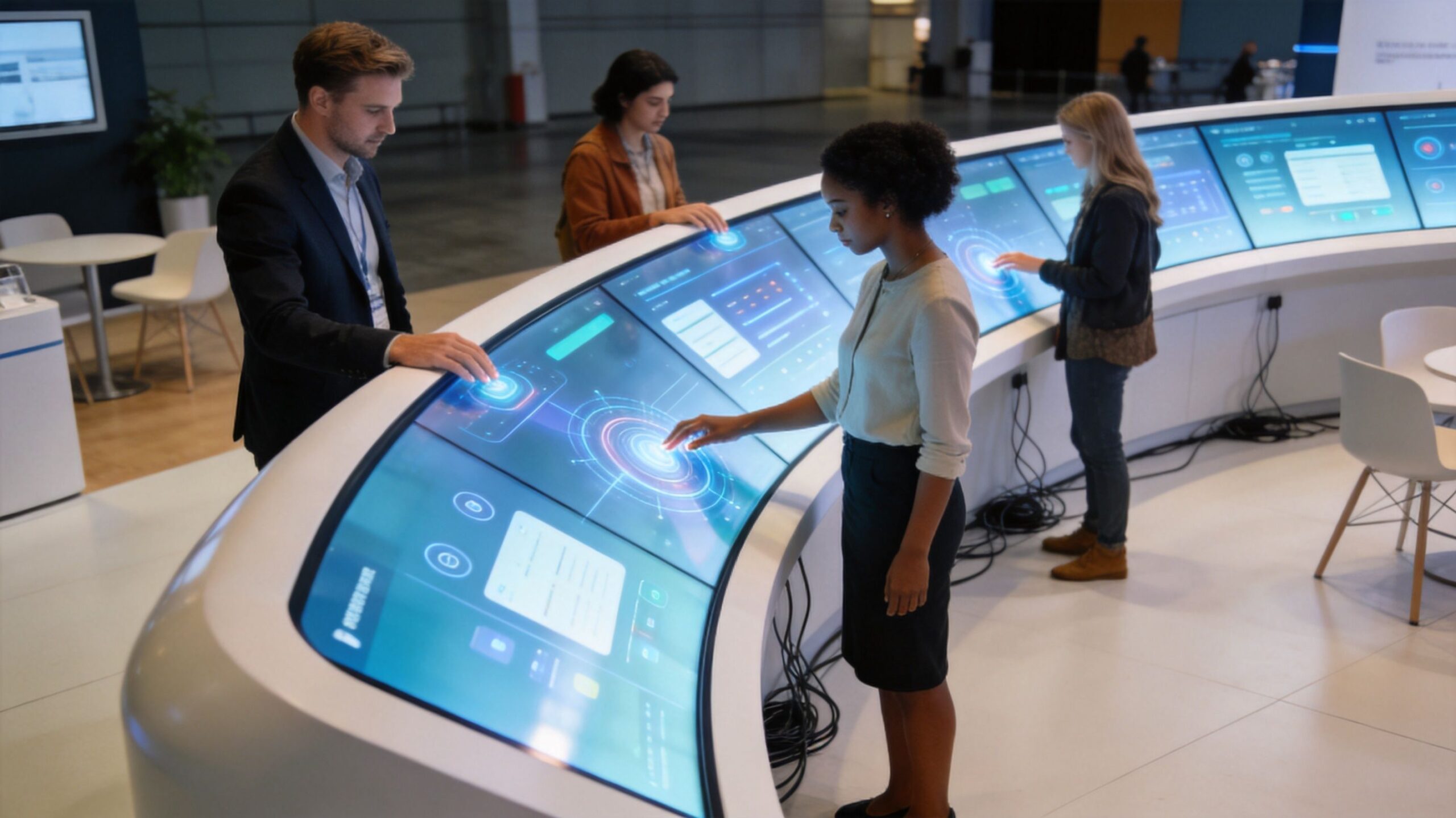
We recommend making the wall the working interface, not background decoration. With a video display wall built for trade show exhibits, attendees can sort by product line, compare use cases, answer qualification prompts, or trigger demos through touch, motion, or QR entry from their phones. That gives your booth structure before a rep ever steps in.
The screen quality has to support that job. Our P1.9 LED resolution is the right choice for close-view interaction because people stand a few feet away and read fine text, menus, pricing paths, diagrams, and product detail. P2.5 can look acceptable from a distance. It is the wrong standard for a booth experience built around tapping, reading, and deciding at arm’s length.
Use the wall for interactions that move buyers toward a conversation:
- Product finder: Ask visitors about industry, role, or problem, then display the right solution path.
- Guided configuration: Let attendees choose features, deployment options, or service levels and see the recommendation update in real time.
- Self-qualification flow: Capture a few practical inputs, then direct the attendee to the right specialist or meeting slot.
Keep the logic simple. Every tap should produce an immediate payoff, such as a clearer recommendation, a sharper comparison, or a live demo path. If people have to guess what to do next, the interaction is poorly designed.
Tracking should be built into the experience from day one. The Center for Exhibition Industry Research found exhibitors are increasing their use of event tech and digital tools to measure attendee behavior and improve follow-up quality, which is exactly why QR-triggered journeys, interaction logs, and rep handoff prompts belong inside the wall flow, not outside it in a separate system. Clean engagement data beats a stack of badge scans every time.
Execution decides whether this works on show day. We handle content mapping, delivery, install, teardown, and dedicated on-site tech support so your team can focus on buyers instead of screen issues, touch calibration, or playback problems. If your setup includes live feeds or remote sources, review the production basics in how to open RTSP video streams before the event.
2. Trade show booth engagement ideas with live thought leadership programming
A booth should do more than attract a glance. It should publish expertise on a schedule.
Live thought leadership programming works because it gives attendees a reason to stop that goes beyond swag, motion, or booth theater. If you have senior product people, engineers, strategists, or customers on site, put them on a visible agenda and make the booth feel like the smartest place in the hall. Buyers want access to people who can answer hard questions in public, with confidence, and with proof on screen.
Your LED wall is the difference between a casual booth talk and a professional program. Use a high-resolution P1.9 wall to show the speaker name, company, session title, supporting charts, product visuals, and live audience prompts without muddy text or pixelated graphics. That matters in a crowded aisle. If attendees cannot read the takeaway from ten feet away, the session is underproduced.
Run it like a broadcast schedule
Do not fill time with vague panel chatter. Build short sessions around specific buyer questions, then repeat the strongest ones throughout the day so traffic at different hours still gets the core message.
A schedule that works:
- Morning: Market shift briefing led by your internal expert.
- Midday: Technical use-case session with a solutions engineer.
- Afternoon: Customer interview focused on results, rollout, and objections.
- Late day: Fast recap covering the top questions your team heard on the floor.
Keep each segment tight. Ten to fifteen minutes is enough. End with one clear call to action such as book a deeper demo, scan for the session recap, or stay for the live product walkthrough.
Production quality decides whether this feels credible or amateur. We recommend branded lower-thirds, a countdown loop between sessions, a moderator to keep pacing sharp, and prepared visuals that support the speaker instead of competing with them. If you want a stronger framework for designing these live moments, review these experiential marketing best practices for trade shows.
Hybrid distribution still matters, but the booth program has to work for the in-person audience first. Record every session, stream the best ones if your team can support it, and cut the footage into post-show follow-up assets. That gives your booth a longer life without forcing your team to build a separate content campaign from scratch.
Execution has to be turnkey. Live programming adds timing, cueing, audio, playback, and speaker coordination problems that show-floor staff should not be solving between attendee conversations. We handle wall setup, content loading, show-day playback, and dedicated on-site tech support so your team can focus on the discussion instead of screen glitches, feed issues, or last-minute formatting fixes.
3. Trade show booth engagement ideas with immersive brand storytelling
Feature grids do not hold attention on a busy show floor. Story does.
A high-end LED wall gives you a better format for that story, but only if you use it with discipline. We recommend building one visual narrative that pulls attendees from problem recognition to solution fit to proof. With a P1.9 video wall, that narrative stays crisp at close viewing distance, so fine text, product UI, data visuals, and motion graphics all read clearly without turning into visual noise.
The booth design is critical because it influences whether people stop in the first place. Sharp motion, strong contrast, and a clear visual sequence help your booth earn that first look. Then the story has to do the rest.
Build one narrative, not ten disconnected screens
Treat the wall like a guided brand experience, not a digital wallpaper rotation. Start with the buyer’s problem. Show the cost of staying with the status quo. Then move into the operating change your product creates, using specific environments, workflows, and outcomes your audience recognizes.
A cybersecurity brand should show the progression from scattered alerts to centralized visibility and faster response. A manufacturer should show the shift from bottlenecks and downtime to a cleaner, more predictable production flow. The point is clarity. Attendees should understand the problem, the change, and the payoff within seconds.
Keep the arc tight:
- Start with the problem: Put the buyer’s pain on screen in plain terms.
- Show the transition: Use motion graphics, system views, or environment scenes to make the change visible.
- Finish with proof: End on customer results, a product interface, or a clear invitation to speak with your team.
Execution quality decides whether this feels premium or sloppy. We handle wall setup, content loading, logistics, deployment, and dedicated on-site tech support so your team can stay focused on conversations instead of playback problems or formatting fixes. If you want to pair storytelling with interactive moments that hold attention longer, review these interactive booth games and trade show engagement formats.
Keep the story short enough to loop cleanly, but strong enough that someone entering halfway still gets the point. That is how immersive storytelling turns an LED wall from expensive scenery into a working sales tool.
4. Trade show booth engagement ideas with gamification challenges
Games earn their floor space only when they qualify buyers. If the activity does not reveal pain points, priorities, or fit, it is booth entertainment, not booth strategy.
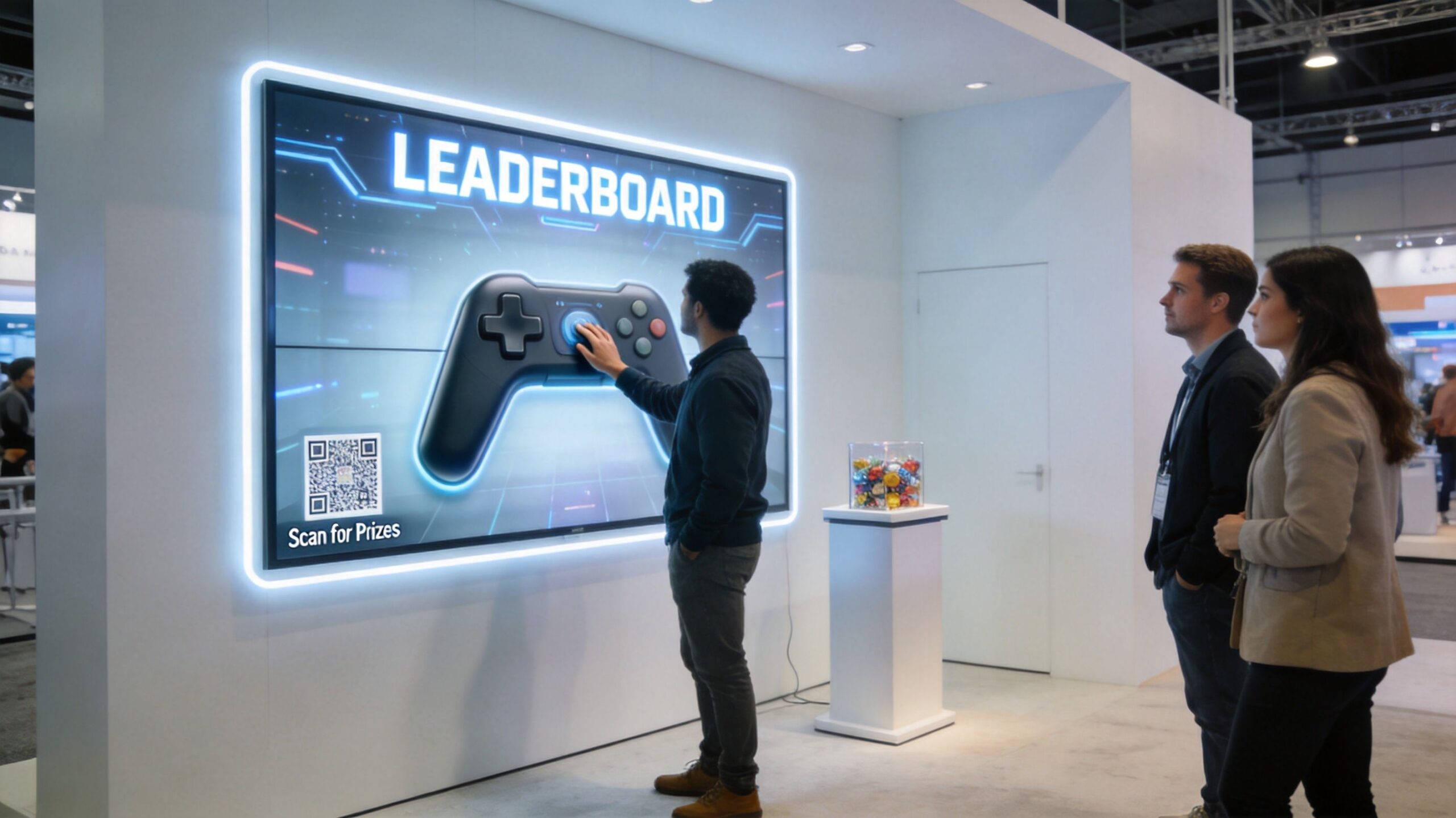
We recommend challenges built around real buying decisions. Use branded trivia for market education, timed problem-solving for workflow evaluation, or scenario-based contests that mirror the choices your customers make every day. On a high-end LED wall, these formats work better because attendees can read prompts, compare options, and track scores without crowding around a tablet. Our P1.9 resolution matters here. Fine text, dense interfaces, and small visual cues stay sharp even at close viewing distances.
Choose games that qualify, not distract
The best booth game produces sales intelligence in under two minutes. A logistics company can run a route-efficiency challenge. A SaaS exhibitor can ask visitors to spot the workflow bottleneck. A healthcare brand can present compliance scenarios with ranked response options. Each answer gives your team a better starting point for the next conversation.
Set the game up to capture something useful:
- Role-based paths: Ask whether the player works in procurement, operations, IT, or marketing, then tailor the questions.
- Pain-point selection: Let attendees choose the problem they want to solve before the challenge starts.
- Follow-up trigger: Route high-intent players to a custom demo, pricing conversation, or technical consult.
- Visible leaderboard: Use the LED wall to create crowd energy without turning the booth into a carnival.
We see stronger results when exhibitors pair the challenge with a clear handoff. If someone finishes a game about production delays, the rep should immediately continue with the exact product workflow that reduces those delays. Our interactive booth games and trade show engagement formats are strongest when they are built that way, with the game feeding the conversation instead of replacing it.
Measurement matters because booth teams often praise engagement and still leave without clear proof of lead quality. A 2025 Exhibitor Times report summarized by Padzilla says 68% of exhibitors fail to quantify interactivity ROI, resulting in 15% average lead waste. Track completion rate, dwell time, selected pain points, and post-game conversion to meetings. That gives you usable insight, not applause.
Execution decides whether this feels premium or sloppy. We handle content loading, wall setup, logistics, deployment, and dedicated on-site tech support, so your team can focus on qualifying visitors while the game runs cleanly all day.
5. Trade show booth engagement ideas with live product demonstrations
Fancy booth traffic means very little if buyers leave without seeing the product do real work. Live demonstrations close that gap fast because they let prospects evaluate fit, ask hard questions, and judge credibility on the spot.
We recommend treating the demo as the core event in the booth, not a side activity tucked onto a monitor. Put the product where a crowd can follow it. Show the interface, the hardware detail, the workflow, or the output on a large display that supports group viewing and real sales conversations.
Build the demo around one use case
Do not cram every feature into one presentation. Pick one buyer problem, show the exact task that solves it, and finish with the result. That structure keeps the demo sharp and gives your team a repeatable talk track.
A strong format looks like this. Open with the problem in plain language. Run the product action on screen. Pause on the outcome long enough for people to inspect it and ask questions.
Use the LED wall for:
- Fine-detail visibility: Magnify software screens, controls, product components, or technical visuals so attendees standing nearby can assess them.
- Process comparison: Show the current workflow next to the improved workflow to make the change obvious.
- Decision support: Keep implementation steps, proof points, or common objections visible while the presenter speaks.
Our interactive trade show display systems are especially effective for demos like this because high-resolution P1.9 panels hold up at close viewing distance. That matters when buyers are inspecting dense dashboards, CAD visuals, configuration screens, or small physical details on camera. If the image breaks down, confidence drops with it.
A booth demo should answer one buyer question completely.
Run the same demo on a visible schedule throughout the day. Consistency wins. Repetition sharpens the presenter, helps attendees plan around the session, and makes staffing easier. We also recommend posting the next demo time on the wall at all times so passersby know exactly when to stop.
Execution matters here more than creativity. Live demos fail when playback lags, content is loaded incorrectly, or the display team has no support once the floor opens. We handle wall setup, content preparation, logistics, deployment, and dedicated on-site tech support, so your team can focus on presenting the product and qualifying serious buyers.
6. Augmented reality magic mirror experiences
Static product shots waste premium booth space. If you want attendees to stop, participate, and remember what they saw, give them a live view of themselves using the product, standing inside the environment, or interacting with the result.
That is what a magic mirror does well.
An attendee steps in front of the display. A camera feed appears on the LED wall. The software adds a product, workspace, equipment setup, or branded environment over the live image in real time. Done right, the value is obvious in seconds. Safety brands can show protective gear on the attendee. Industrial exhibitors can place machinery into a plant setting. Enterprise tech companies can surround the visitor with a virtual operations center tied to their use case.
Speed matters more than novelty here. The experience should load fast, track accurately, and let the attendee change one or two variables without waiting for a staffer to explain every step. If the interaction drags, the line stalls and the booth loses momentum.
This format is also unforgiving on poor displays. Close-range AR overlays expose weak image quality fast. Edges look soft, text gets muddy, and the illusion breaks. Our interactive trade show display systems use high-resolution P1.9 LED panels that hold detail at short viewing distance, which matters when attendees are standing only a few feet from the wall and inspecting overlays closely.
Keep the front-end interaction simple. Build the operational support behind it. AR experiences depend on camera alignment, calibration, playback stability, and quick fixes during show hours. We handle the wall, setup, content coordination, deployment, and dedicated on-site tech support, so your team can focus on conversations instead of troubleshooting.
Use the mirror to answer one practical buyer question. How would this look on me? How would this fit in our facility? How would this system appear in our environment? Clear use cases outperform flashy effects every time.
7. Live data visualization dashboards
Busy LED walls often underperform because they entertain the wrong audience. Buyers with real budget want evidence. A live data dashboard gives them a reason to stop because it shows how your product behaves under pressure, how teams use it, and where business value shows up in the numbers.
Pick one business question and build the wall around it. Show uptime by region. Show transaction volume by hour. Show threat detection and response activity. Show production throughput against targets. If a metric does not help a rep answer a buying question, cut it.
This format works best in booths selling complex systems. Enterprise software, logistics, finance, cybersecurity, industrial tech, and healthcare all benefit from a visible proof layer that supports serious conversations instead of generic brand theater.
Our recommendation is simple. Build the dashboard for close viewing, not for screenshots. Fine text, dense charts, and layered labels fall apart fast on weak displays. High-resolution P1.9 LED matters here because attendees stand a few feet from the wall and try to read actual numbers, not broad visual shapes. If the display cannot hold detail at short distance, the dashboard fails its job.
A strong setup usually includes:
- Main wall: One primary live or simulated dashboard with a clear hierarchy and a single takeaway.
- Context panels: Supporting visualizations that explain trends, anomalies, or workflow impact.
- Rep prompts: On-screen questions tied to buyer pain points, such as downtime costs, staffing gaps, or compliance exposure.
Design matters as much as data selection. Our LED booth design ideas for high-resolution exhibits can help you structure the wall so the dashboard reads quickly instead of overwhelming the viewer.
Keep the operational side tight. Live dashboards depend on feeds, playback logic, screen zoning, and fast fixes during show hours. We handle the wall, setup, content coordination, and dedicated on-site tech support, so your team can focus on qualifying buyers and walking them through the numbers without dealing with technical issues.
Use the dashboard to prove one claim well. That wins more trust than filling the wall with every KPI your product can generate.
8. Trade show booth engagement ideas with branded photo and video capture stations
Photo booths are still effective. Weak execution is the problem.
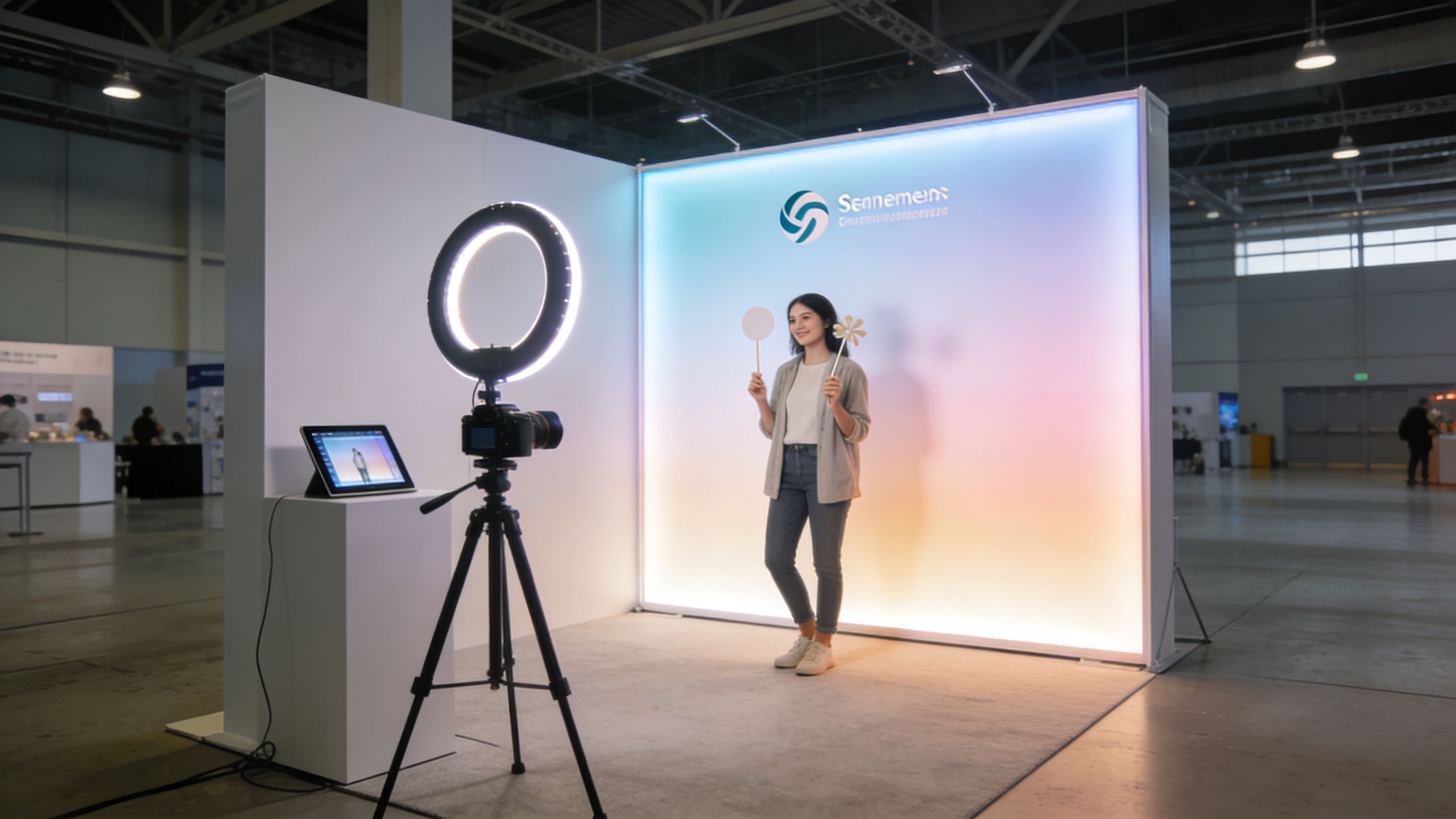
If you want this idea to produce real engagement, stop treating it like a side attraction with a printed backdrop and a ring light. Build the capture station into your LED wall so the content looks premium, branded, and worth sharing. That means animated backgrounds, motion graphics, timed visual effects, and campaign-specific scenes that change throughout the day. With a high-resolution P1.9 wall, the final photo or clip looks sharp even at close range, which matters because attendees notice bad pixels fast when they review content on their phones.
Design the capture station for brand recall
Pick one visual concept and commit to it. A cloud software company can place visitors inside a live data environment. A medical device brand can stage a clean, high-tech clinical setting. A sports brand can surround attendees with fast-cut highlight graphics. The goal is not decoration. The goal is instant recognition when that content gets shared after the show.
Your wall layout matters as much as the creative. Use LED booth design ideas for branded content capture experiences to shape the station so it feels built into the booth, not added as an afterthought.
Make the exchange useful. Give attendees a branded photo, short video clip, or custom social asset after they scan in and complete the experience. That gets you a cleaner lead capture flow than handing out random swag, and it gives them a branded asset they may keep.
Execution decides whether this works. You need the wall content timed correctly, the camera framing tested, the lighting balanced against the LED output, and someone on-site who can fix playback or sync problems fast. We handle the screen, setup, content coordination, and dedicated on-site tech support, so your team can keep the line moving and turn a simple photo moment into a branded lead-generation system.
9. Trade show booth engagement ideas with personalized content and AI recommendations
Personalization should not be optional in a high-value booth. If every attendee gets the same message, your team wastes time repeating basics to people with very different priorities.
Use your LED wall as a routing system. Let visitors choose an industry, role, pain point, or buying stage on-screen, then switch the content immediately. A CFO should see cost control, rollout risk, and total ownership. An operations leader should see process impact, staffing efficiency, and deployment timing. A technical evaluator should see architecture, integrations, and real use cases.
This works best when the screen is sharp enough to support close-up reading and side-by-side comparison. That is exactly why we recommend a high-resolution P1.9 video wall for this format. Fine text, UI views, and product details stay crisp at booth viewing distance, so personalized content feels premium instead of cramped or hard to follow.
Personalize fast and keep the handoff human
Do not let the interaction stop at the screen. The wall should tell your staff how to enter the conversation.
Train your team to respond to the attendee’s selection with a direct opening tied to what just appeared on screen. “You picked healthcare operations, so let’s look at staffing visibility and implementation time” is stronger than a generic opener and gets to a useful conversation faster.
Pre-show segmentation matters here too. If your team already tailors outreach by account type, role, or product interest, carry that same logic into the booth experience. The attendee should see continuity from the invitation to the wall content to the live discussion. That consistency builds trust.
Execution decides whether this idea produces qualified conversations or just looks smart on paper. You need the content logic mapped in advance, the transitions tested, the lead capture connected to the right profiles, and an on-site technician ready to fix issues fast if a trigger, playback sequence, or data input fails. We handle the display, setup, content coordination, and dedicated on-site tech support, so your team can focus on the buyer in front of them while the booth adapts in real time.
10. Trade show booth engagement ideas with transparent competitive comparison
Stop pretending buyers are not comparing you. They are. If your booth avoids the comparison, buyers will make it on their phones, with incomplete information and no help from your team.
Put the comparison on the wall and control the standard. The format should be factual, easy to scan, and specific to the buying decision. Show where you win on image quality, service coverage, support, setup burden, and total show execution. That approach works especially well on a high-resolution LED wall because fine text, side-by-side visuals, and feature tables stay readable at booth distance.
Compare the buying experience, not only the product
Specs matter. Procurement also cares about what it takes to get the booth live, keep it running, and avoid surprises on show day. Put that in plain view.
For exhibitors comparing LED display partners, we recommend a side-by-side comparison built around the issues buyers ask about:
- Resolution at close range: We use P1.9, which gives exhibitors sharper text, cleaner product visuals, and better clarity for side-by-side comparisons than the lower-resolution options often used for rental booths.
- What the quote covers: We price the project as a turnkey service package, with everything included except show-billed charges such as electricity and material handling. Buyers should not have to guess what gets added later.
- Support during show hours: We provide white glove setup and dedicated on-site tech support, so your team is not left troubleshooting playback, connections, or panel issues in front of prospects.
Keep the claims provable. Show the screen detail. Spell out the service scope. Name who is on site and what they handle. Transparent comparison lowers buyer resistance because it answers the uncomfortable questions before a prospect has to ask them.
That clarity also creates better booth conversations. An Aventri behavioral analytics study found that attendees who spent 15 to 30 minutes at a booth were 3.8x more likely to convert to qualified sales opportunities within 90 days than those who stayed under 5 minutes. A well-built comparison gives serious buyers a reason to stay, ask harder questions, and qualify themselves faster.
Top 10 Booth Engagement Ideas Comparison
| Idea | 🔄 Implementation Complexity | ⚡ Resource Requirements & Setup Speed | ⭐ Expected Outcomes | 📊 Expected Results (KPIs) | 💡 Ideal Use Cases / Key Advantages |
|---|---|---|---|---|---|
| Interactive Video Wall Displays | High, hardware + interactive software integration and testing | High, P1.9 LED, dev time, on-site AV; moderate setup time | Strong engagement and premium brand perception | Avg. dwell time ↑, Interaction rate, Leads captured | Product exploration, lead capture; exceptionally sharp visuals vs P2.5 |
| Live Thought Leadership Programming | High, scheduling, live production, multi-camera streaming | High, speakers, producer, cameras, lighting, streaming team | Authority building and long-lived content | Live attendance, Online viewership, Social mentions, Session leads | B2B thought leadership, PR, repurposable content |
| Immersive Brand Storytelling | Medium, cinematic content production and timed playback | Moderate, high-quality video, minimal live crew; turnkey reduces burden | Emotional connection and increased “stop-and-watch” behavior | Crowd density, Stop-and-watch rate, Qualified conversations | Brand positioning and awareness; turnkey simplifies logistics |
| Gamification Challenges | Medium, game design, scoring, real-time leaderboard | Moderate, game dev, prizes, Game Master staff; setup moderate | High engagement, competitive buzz and dwell time | Games played, Avg. dwell time, Lead conversion, Shares | Driving foot traffic and fun lead capture; great for interactive booths |
| Live Product Demonstrations | Low–Medium, scripted demos plus live camera feeds | Moderate, confident presenter, camera, wrangler; faster setup | Clear product understanding and demo-driven meetings | Audience size per demo, Meetings booked, Demo dwell time | Technical or visual products; sales enablement in-person demos |
| AR “Magic Mirror” Experiences | Very High, custom AR app, camera tracking, real-time overlays | High, AR dev agency, 3D models, hardware, AV technician | Memorable, highly shareable experiences | AR interactions, Leads captured, Social posts, Mentions | Consumer-facing, Instagrammable activations; futuristic brand appeal |
| Live Data Visualization Dashboards | Medium, BI integration and privacy/compliance work | Moderate, BI tools, engineer, live feeds; backup plans needed | Positions as data-driven leader; sparks analytical conversations | C-level/Director meetings, Dwell time, Requests for reports | B2B analytics, demonstrating value with live metrics |
| Branded Photo/Video Capture Stations | Low, photo system + LED backdrop and delivery pipeline | Low–Moderate, camera, lighting, props, digital delivery system | High social sharing and reliable lead capture | Photos taken, Email/lead capture rate, Social shares | Brand awareness, social amplification; easy to scale |
| Personalized Content with AI Recommendations | Very High, badge API, AI logic, content matrix and privacy controls | High, AI/content dev, badge integration, compliance; complex setup | Highly relevant interactions and higher-quality leads | Lead→meeting conversion, Engagement per persona, Feedback | Enterprise B2B personalization; maximizes relevance per visitor |
| Transparent Competitive Comparison | Medium, research, visual matrix and legal approval | Moderate, competitive research, design, legal review | Builds trust and accelerates informed buying decisions | Target-account conversations, Shorter sales cycles, Mentions | Competitive sales scenarios; clarifies differentiation objectively |
Your Turnkey Solution for Unforgettable Engagement
Ambitious booth concepts rarely fail at the idea stage. They fail on the floor. Screens stutter, content looks soft at close range, installs run late, and sales teams end up babysitting tech instead of talking to buyers. We built our service to prevent that.
The display quality has to hold up under scrutiny from three feet away. Our LED video walls use P1.9 pixel pitch, not the softer P2.5 spec that still shows up in plenty of rental inventories. That difference matters when your booth strategy depends on sharp product renders, readable charts, UI detail, side by side comparisons, or interactive content. On a crowded show floor, attendees do not stand twenty feet back and admire your wall from a distance. They walk right up to it.
Execution has to be turnkey, or your team pays for it in stress and lost selling time. We handle logistics, install, integration, and onsite coordination so your staff can focus on meetings, demos, and lead qualification. That is the standard exhibitors should demand, especially when the booth includes high-impact activations like live programming, AR, gamification, or personalized content.
We also keep pricing clear. Our quote includes everything except direct show charges such as electricity and material handling. That transparency matters because hidden booth costs wreck budgets and force bad compromises late in the process.
Support during show hours is the other requirement exhibitors should stop treating as optional. We keep an audiovisual technician onsite for the full event. If playback breaks, a feed drops, or an interactive element needs attention, help is already in the building and ready to respond fast. That gives you room to run more advanced engagement plans with less operational risk.
As noted earlier, exhibitors that promote the experience before the event tend to drive stronger booth traffic. We advise clients to treat engagement as one connected system. Pre-show outreach sets expectations, the video wall pulls people in, booth programming qualifies interest, and follow-up keeps momentum alive after the hall closes. That approach produces better conversations than a good-looking booth operating on its own.
Face-to-face product discovery still carries real weight, which is why passive booths underperform. Use the wall to explain something useful. Use the space to guide the conversation. Use every visual choice to help buyers reach a decision faster.
If you want a booth that looks premium, runs smoothly, and helps your team convert more of the right conversations, talk to LED Exhibit Booths. We build turnkey LED video wall trade show displays with sharper P1.9 resolution, all-inclusive pricing except direct show bills, and onsite AV support for the full event so you can focus on meeting buyers, not managing booth problems.