

Want a booth game that people can see from the aisle, understand in seconds, and remember after the show?
Then stop treating the game like a side monitor. Put it on the main stage of the booth.
The strongest games for booths use the LED wall as the experience itself. A high-resolution video wall can become the prize wheel, the live scoreboard, the motion-tracking playfield, the AR backdrop, the voice challenge display, or the branded photo moment. That is the difference between a booth that gets a few casual taps and a booth that pulls a crowd, starts conversations, and gives your team a reason to qualify leads on the spot.
We build these activations around unified LED displays because scale changes behavior. People notice movement across a full wall. They stop for big visuals, public competition, and live results they can read from a distance. Small tablet games rarely do that. Large-format digital play does.
Execution matters just as much as the idea. If the graphics look soft, the text is hard to read, or the system needs constant babysitting, your game becomes a liability. We use high-resolution P1.9 LED walls because they hold sharp text, clean animation, product visuals, and fast-moving game elements far better than larger-pitch alternatives. That matters for quizzes, timers, leaderboards, QR codes, and any game that asks attendees to react quickly.
We also handle the part exhibitors usually underestimate. Setup. Playback. On-site support. Show-floor troubleshooting. Our turnkey service includes the wall, media setup, engineering, and support so your team can focus on traffic and sales conversations instead of cables, content scaling, or broken interactions.
The eight ideas below are not generic booth games. Each one is built around what a large LED wall does best, strong visibility, vivid motion, real-time interaction, and branded impact at trade show scale.
1. Interactive Spin-the-Wheel game for booths
Spin-the-wheel still works. The problem is that most exhibitors execute it badly. They use a cheap physical wheel, make the prize reveal too small, and miss the chance to turn that moment into a crowd builder.
On an LED wall, the wheel becomes a full-scale visual event. The spin animation fills the backdrop, prize segments pulse with motion graphics, and the winner reveal becomes impossible to ignore from the aisle. We’ve seen this format work especially well for software companies, manufacturers, and service brands that need a fast hook before moving people into a real sales conversation.
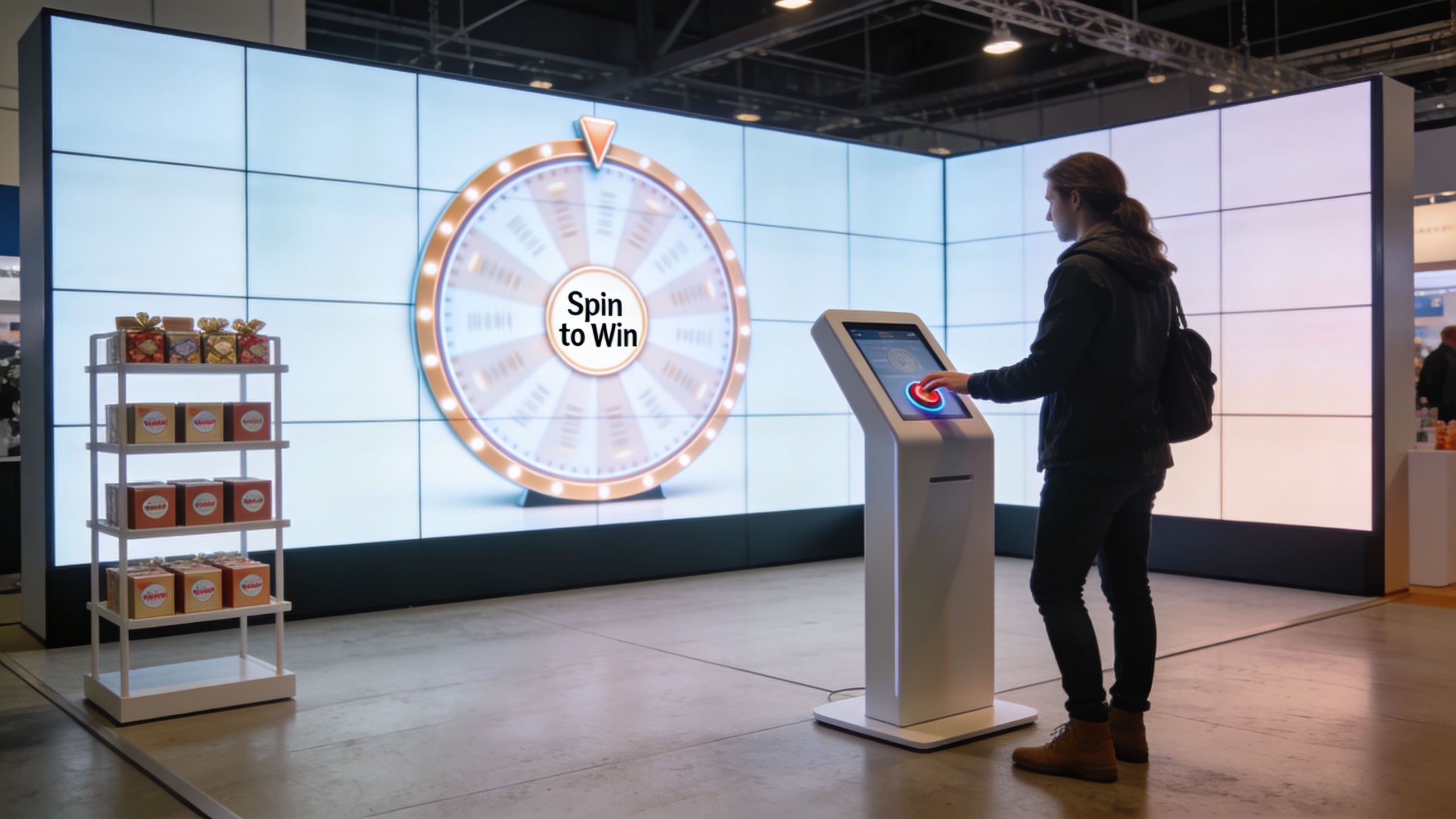
A digital wheel also cleans up operations. You can require contact capture before the spin, trigger a QR code after the result, and route winners to a product demo or meeting calendar. That turns a simple giveaway into a lead qualification tool instead of a random swag dispenser.
How we make the wheel pull leads, not just crowds
The strongest setup is simple. One staffer invites visitors in. One screen or tablet handles the form. The LED wall runs the wheel and the prize reveal. Your team then moves the attendee into the next step immediately.
Use rules like these:
- Gate the spin with contact capture: Ask for email, company, and role before the wheel starts.
- Tie prizes to sales motion: Use rewards like demo access, consultation slots, product bundles, or premium swag tied to key messaging.
- Show wins at full scale: Put the wheel and result on the main wall, not on a side monitor.
- Control prize inventory digitally: Adjust reward frequency so you don’t burn through premium items on day one.
Practical rule: If the wheel doesn’t feed your CRM or your sales team, it’s entertainment, not booth strategy.
Brands like IBM, Adobe, and Microsoft have all used spin-to-win style activations at events because the format is fast, familiar, and easy to explain. The LED version just makes it look like a major brand experience instead of a carnival prop.
2. Product Quiz Challenge game for booths
Want a booth game that does more than hand out swag?
A product quiz challenge earns its floor space because it teaches, qualifies, and routes people into the right sales conversation fast. For B2B exhibitors with layered offerings, that matters. We use quizzes to separate casual traffic from buyers with a real use case, then push the result to the screen so your team can act on it immediately.
This format works best when the LED wall carries the experience instead of serving as a backdrop. A large, bezel-free, high-resolution display lets attendees read the question from the aisle, watch answer timers count down, and see instant score changes without crowding around a small monitor. That visibility pulls in the next participant while the current one is still playing.
The quiz should stay short, sharp, and role-specific. An executive should not get the same path as an engineer. A prospect interested in compliance should not be dumped into generic product trivia. We build branching question flows so the game itself becomes a qualification tool, not a throwaway distraction.
Our display specs matter here. P1.9 LED is the right call for quiz interfaces because fine text, icons, and answer states stay crisp at close viewing distance. Many exhibitors settle for 2.5 pitch and then wonder why the screen looks soft when they add UI elements. If you want people to read, compare, and respond quickly, sharper pixel pitch solves that problem.
For input, we often pair the wall with touch screen tables for trade show interaction. The attendee answers on the table. The LED wall handles the countdown, animations, score reveal, and branded motion graphics. That split keeps the interaction easy while making the booth look polished from across the aisle.
Use these rules:
- Write question tracks by buyer type: Separate paths for decision-makers, technical evaluators, and users.
- Keep it to five to seven questions: Long quizzes kill throughput.
- Show instant feedback on the wall: Correct and incorrect states should be obvious.
- Tie the result to follow-up: High scorers get a premium demo, a meeting slot, or targeted content.
- Send response data to your CRM: Sales should see topic interest before the rep starts talking.
Audio matters too. A quiz without clean countdown sounds, answer confirms, and win cues feels flat. If you add custom audio, review the rules around licensing sound effects for video so your booth sounds professional and legally buttoned up.
Good quiz design gives your reps a better opening line before the attendee says a word.
We also handle the operational side that exhibitors usually underestimate. We build the game logic, map answer paths to lead tags, configure the wall and input devices, install everything on-site, and support the activation during the show. Your team should focus on conversations, not troubleshooting lag, screen scaling, or broken scoring logic.
And yes, people remember quizzes. They force a decision, reveal knowledge gaps, and attach your brand to a result on a screen big enough for everyone nearby to see. That is exactly why this format works so well on LED video walls. It turns product education into a visible, competitive moment instead of another passive demo loop.
3. Gesture-recognition immersive motion games for booths
If you want a crowd, motion works. People stop when they see another attendee controlling a giant screen with their body. They stop even faster when the game produces oversized reactions, score bursts, and obvious win-or-lose moments.
Gesture-based games are ideal for brands that want energy. We’ve seen concepts inspired by Google Cloud environments, athletic skill demos, and battery or hardware challenge formats perform well because there’s no controller to explain. The attendee steps into position and starts moving.
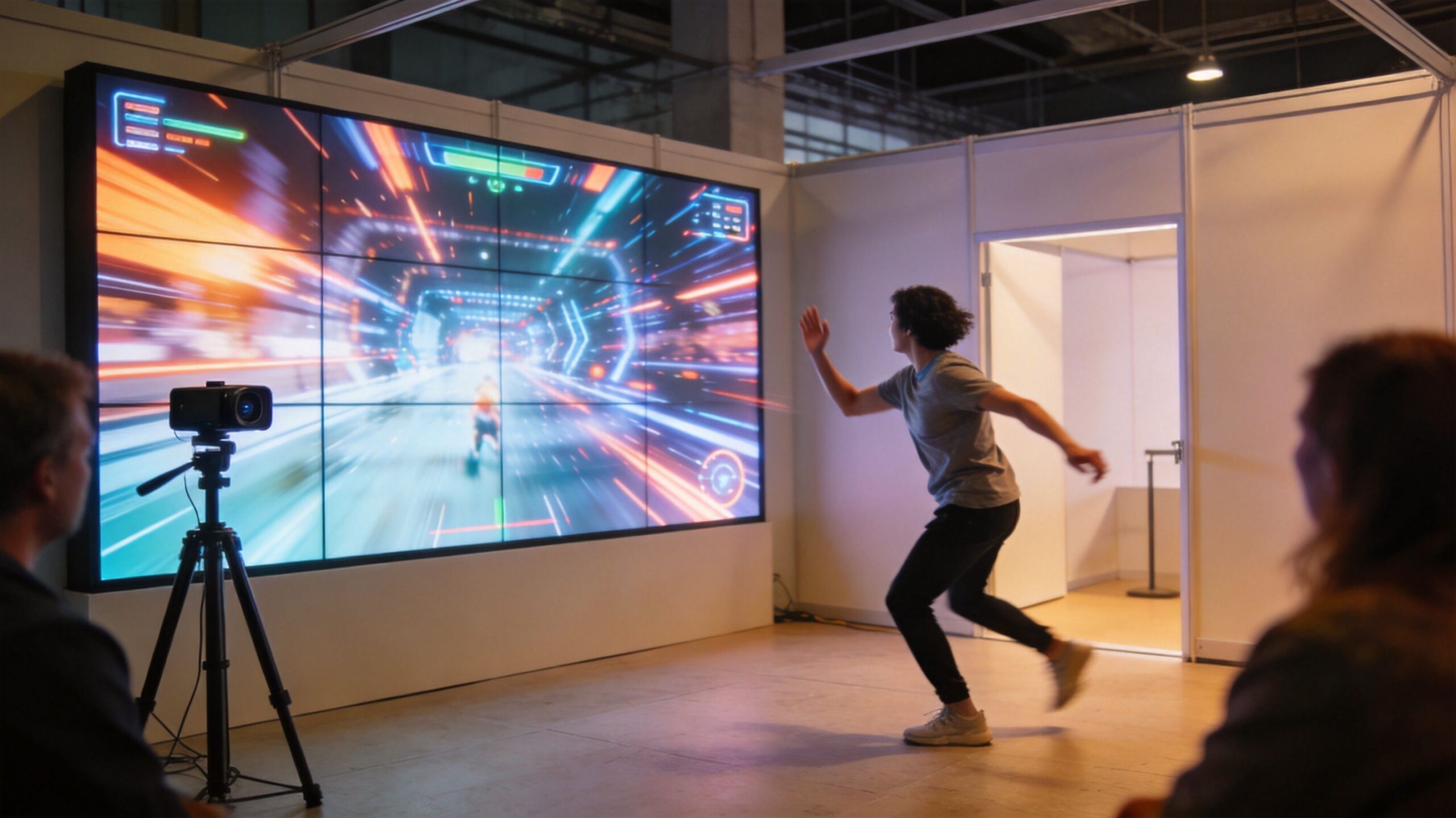
The LED wall matters more here than in almost any other format. Small displays make motion games feel cramped. An uninterrupted wall gives the player room to interact and gives the audience room to watch.
Why motion games belong on LED walls
Depth-sensing cameras and motion tracking need a clean play zone, but the visual payoff is what sells the experience. A large bezel-free wall lets us create obstacle courses, reaction challenges, branded catch games, or movement-based puzzles without breaking the illusion.
Resolution and refresh rate are paramount. Fast animation has to stay smooth. Fine visual targets have to stay visible. We build these games for high-traffic floors where lighting, distance, and constant movement can ruin lower-quality setups.
A strong motion setup usually includes:
- A clear player mark on the floor: People need to know where to stand immediately.
- Simple first actions: Swipe, reach, jump, or wave. Don’t make the first move complicated.
- A visible spectator score zone: The crowd should understand who’s winning from several feet away.
- A quick replay or highlight option: Great for social clips and booth recaps.
A broad industry summary from Brand Gaming notes that active booth games can boost dwell time by 3 to 5x and describes attendee demand outpacing exhibitor adoption. That gap is exactly why motion games still stand out on crowded floors.
Here’s a look at the kind of motion-driven booth energy brands aim for:
Keep sessions short. If each round lasts too long, the line becomes the experience instead of the game.
4. Augmented reality game for booths
AR works at trade shows when you treat it like a guided challenge, not a gimmick. Most bad AR activations fail because they load slowly, ask too much of the user, or don’t connect back to the product story.
The fix is simple. Use the LED wall as the launch surface and orienting screen. Put the QR code large on the wall, give a one-line instruction, and let the attendee use their own phone to access the experience. Once they’re in, make them do something purposeful. Rotate the product. Find a hidden feature. Solve a use-case problem. Trigger a layered animation.
That format is especially effective for brands with products that are complex, configurable, or difficult to display physically. Furniture, vehicles, equipment, medical devices, and enterprise systems all benefit from seeing a digital layer over the physical world.
Make the wall the director, not just the sign
We use the main display to guide the experience in real time. The wall can show scan instructions, a visual countdown, challenge prompts, and a live content loop that explains what users should be seeing on their phones. That keeps the activation from feeling isolated.
For exhibitors building a broader interactive environment, our interactive trade show displays page shows how these experiences fit into a full booth system instead of sitting as a disconnected tech demo.
Good AR booth games share a few traits:
- Fast launch: If the experience drags at startup, attendees bail.
- Clear challenge logic: Users need an obvious objective.
- Product-first interactions: Every action should reinforce a feature, benefit, or use case.
- Staff support nearby: One trained rep can save dozens of stalled scans.
The strongest AR setups also create a bridge back to sales. If an attendee spends time exploring a product variant, that should trigger a follow-up path. Your team should know whether they focused on design, performance, compliance, or customization.
Don’t make attendees admire the technology. Make them discover something useful with it.
5. Head-to-head competitive tournament game for booths
Competition changes booth behavior fast. A passive visitor becomes a participant. A participant becomes a repeat visitor. A repeat visitor brings coworkers back to watch the next round.
Tournament formats are some of the best games for booths when you need sustained traffic over multiple show days. They work because the experience evolves. Early rounds create noise. Bracket updates give people a reason to return. Final rounds pull in spectators who weren’t interested at first.
Intel, Red Bull Gaming, and Logitech have all used competitive gameplay logic in event settings because it naturally creates status, urgency, and audience engagement. You don’t need a full esports production to borrow that advantage. A reaction-time duel, memory challenge, puzzle sprint, or branded product game can do the job.
Build a bracket people can follow at a glance
The LED wall should display the tournament tree, current matchups, and winner animations in real time. That’s where a video display wall for trade show environments gives you a practical advantage over separate monitors. The bracket, game feed, and sponsor visuals can live on the same continuous surface without visual clutter.
Keep the format disciplined. Trade show tournaments collapse when rounds run long or the rules need explaining every time.
Use this structure:
- Short matches only: Keep rounds tight so people can rotate through.
- Simple win condition: Highest score, fastest time, or first to finish.
- Visible schedule: Post the next match time on the wall.
- Registration fields that matter: Collect name, company, title, and area of interest.
A benchmark cited by WizCommerce describes games for booths as producing 4x higher engagement metrics than static elements and notes that leaderboard formats can drive 2 to 3x repeat visits daily. That repeat behavior is the core value of the tournament model.
If attendees come back three times in one day to protect their position on a leaderboard, your booth has stopped being a stop and started being a destination.
6. Digital scavenger hunt with check-in points
Scavenger hunts are one of the most underused formats for B2B exhibiting because they solve a real problem. They get attendees to explore the entire booth instead of parking at the front counter.
This format works best in larger footprints, island booths, or multi-zone exhibits where you need visitors to discover more than one message. Each clue should force a useful interaction. Scan this code after watching the demo. Find the feature hidden on the wall. Answer the question after speaking with the rep at the product station.
The LED wall becomes the command center. It displays clues, confirms check-ins, shows progress, and celebrates completions. That keeps the hunt visible and gives bystanders a reason to join.
Design the hunt around conversations
Bad scavenger hunts reward movement. Good scavenger hunts reward understanding. If the clue can be solved without engaging your team or your product story, it’s wasted floor time.
For wayfinding, prompts, and real-time updates, we often tie the hunt into digital signage for trade shows. That helps different parts of the booth feel connected, especially when multiple screens or columns are involved.
A few rules keep the hunt practical:
- Place clues at strategic staff stations: Every check-in should create a natural conversation.
- Use progressive reveal logic: Don’t dump every clue at once.
- Reward completion with something meaningful: A premium giveaway, a custom consult, or entry into a bigger prize pool works better than random swag.
- Display progress publicly: Leaderboards and completion alerts pull in new participants.
An article from MVP Visuals points out a real gap in how exhibitors think about booth games and LED walls. It also cites 2025 CES data from Event Marketer reporting that immersive video walls boosted booth dwell time by 47% and lead capture by 32% compared with static displays. That’s exactly why scavenger hunts work better when the booth architecture itself is part of the game.
7. Voice-activated command challenge game for booths
Want your booth to stop looking like every other touchscreen demo on the floor?
A voice-activated challenge works best when your product already relates to AI, automation, smart devices, workflow control, or accessibility. In that setting, the game does more than entertain. It shows your product logic in action. Attendees speak, the system responds, and the LED wall turns that response into something big, bright, and impossible to miss.
That wall matters. A high-resolution LED video wall gives voice games the one thing small displays cannot. Clear, instant feedback at scale. When someone says the right command, the screen should react fast with large text, motion cues, product visuals, or a visible score jump. People across the aisle should understand what just happened without asking.
Keep the game structure tight. Good voice games use short commands, obvious prompts, and one clear objective. “Launch.” “Scan.” “Approve.” “Next.” If attendees need a script, you already lost them.
Build for noise, speed, and visibility
Trade show halls are loud, so setup decides whether this game feels polished or broken. Use directional microphones, keep the participant standing in a marked spot, and show real-time listening prompts on the wall. If recognition misses a command, the attendee needs an immediate retry cue, not awkward silence.
We usually set these up in three stages:
- Start with one simple command: Get the attendee a quick win in the first few seconds.
- Show instant confirmation on the LED wall: Use oversized text, color shifts, or animated product states.
- Add a second challenge only after success: Keep the flow moving and the crowd engaged.
- Include a backup input method: A button, tap screen, or staff trigger keeps traffic moving.
This format also gives your team a cleaner way to qualify visitors. Staff can frame the challenge around a product use case, then continue the conversation once the attendee completes it. If you want the game to support a larger booth strategy, our guide to experiential marketing best practices covers how to connect interaction design with lead capture and follow-up.
We handle the hard part for exhibitors. That includes wall sizing, microphone placement, playback logic, onsite testing, and live support during the show. If a voice game is part of a broader activation that also includes branded capture moments or sponsor tie-ins, partners offering interactive party photo booths can complement that experience without turning the booth into a disconnected mix of gadgets.
Use voice only when it fits your story. If your brand has nothing to do with spoken control or hands-free workflows, choose a different game. If it does fit, this is one of the clearest ways to use an LED wall to turn a product message into a live crowd draw.
8. Interactive photo booth with live digital effects
Want a booth game that pulls people in fast and keeps working after they walk away? Build a photo activation around the LED wall, not around a camera on a tripod.
The wall should do the heavy lifting. Use it to place attendees inside branded environments, trigger live overlays, add motion graphics, swap backgrounds in real time, and preview the final shot at full scale before capture. That is what makes this format stronger than a standard backdrop setup. The LED wall becomes the effect, the stage, and the crowd magnet all at once.
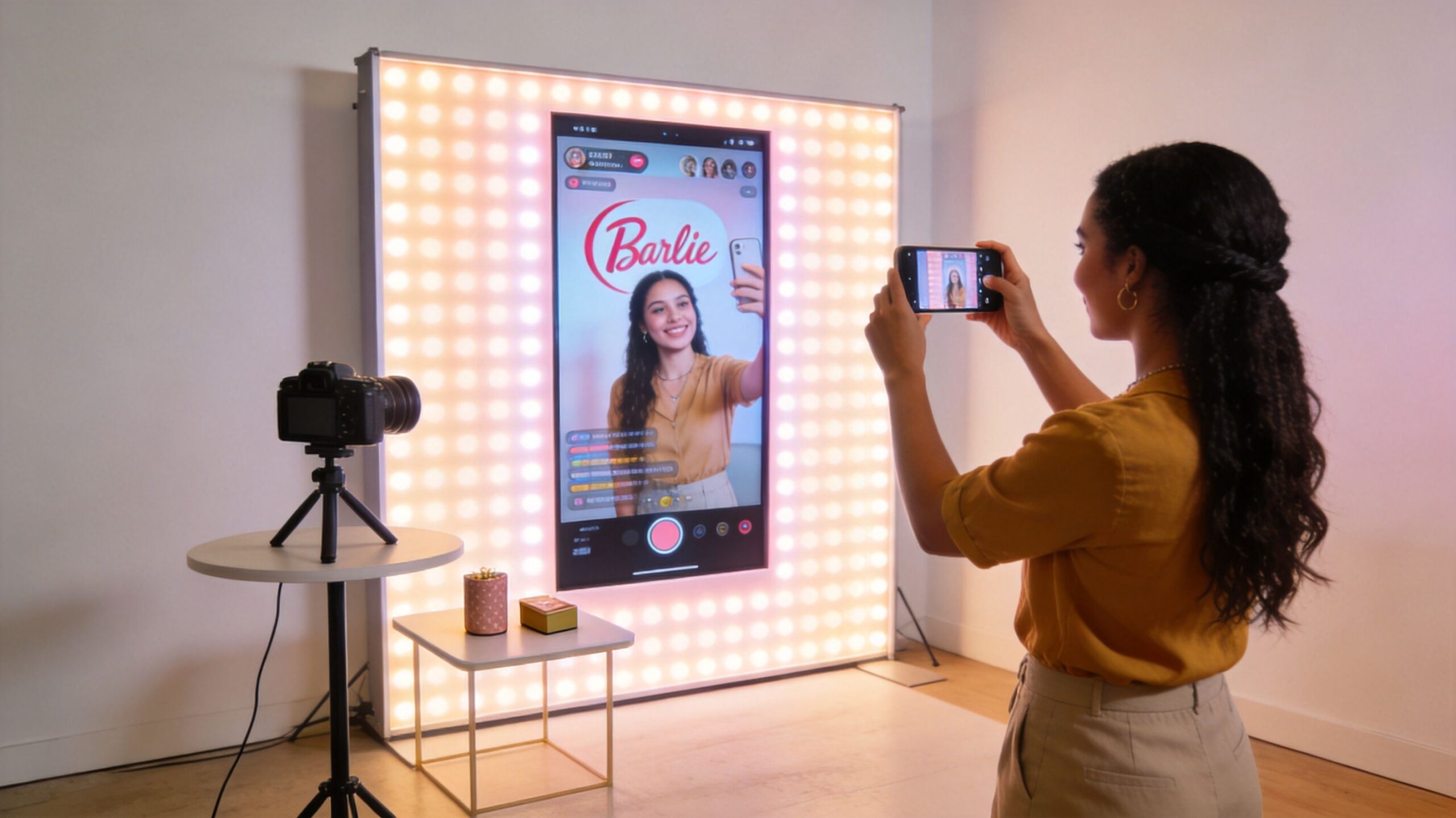
This format works especially well when you need three things from one activation. More booth traffic. More branded media. More qualified follow-up. B2C brands use photo moments constantly, but B2B exhibitors should not dismiss them. They work well for launches, customer events, recruiting, anniversaries, and award-driven booth campaigns.
Make the effect specific to the product story. If you sell imaging technology, show live visual processing effects. If you launch software, wrap the attendee in animated UI elements, dashboards, alerts, or data streams. If you manufacture machinery, place them inside a realistic operating scene that shows scale and application. Generic filters get smiles. Product-linked effects get better conversations.
For teams building a bigger engagement plan, our guide to experiential marketing best practices shows how to connect shareable content with lead capture, booth flow, and post-show follow-up.
Use this setup standard:
- Collect contact details before sending the asset: Gate email or text delivery through a simple lead form.
- Show a live preview on the LED wall: People engage more when they can see the effect before the shot is taken.
- Rotate scenes by audience segment or show day: Repeat visitors need a reason to come back.
- Feature approved captures on the main display: Public playback builds a line and proves the experience is active.
- Post clear consent language at the capture point: Your team needs permission for display, reuse, and reposting.
Execution decides whether this feels polished or sloppy. We handle the parts exhibitors usually underestimate, camera placement, wall brightness, playback timing, capture flow, lead routing, and on-site support. That matters because photo games break down fast when the lighting is off, the effect lags, or the delivery workflow stalls.
If you want to compare event-style sharing formats outside the trade show world, these examples of interactive party photo booths show how much the visual treatment affects participation.
Use this game when the photo itself can carry your brand message. If the image looks generic, skip it. If the LED wall can make the attendee look like part of your product story, this is one of the smartest booth games you can run.
Booth Games: 8-Item Comparison
| Game | 🔄 Implementation Complexity | ⚡ Resource Requirements | 📊 Expected Outcomes | ⭐ Ideal Use Cases | 💡 Key Tip |
|---|---|---|---|---|---|
| 1. Interactive Spin-the-Wheel | Moderate, LED integration and lead-capture wiring | LED wall, kiosk/button input, inventory, on-site AV/staff | High foot traffic, quick lead capture, repeat plays | Consumer promotions, lead-generation booths, high-traffic trade shows | Require email before spin and tune prize probabilities to preserve inventory |
| 2. Product Quiz Challenge | Medium–High, content creation and CRM integration | High-quality content, tablets/apps, leaderboard software, staff | Intent-rich leads, longer dwell time, thought leadership positioning | B2B conferences, product-education booths, consultative sales events | Aim for ~60–70% difficulty and auto-sync quiz results with CRM |
| 3. Gesture-Recognition | High, motion calibration and safety planning | Depth cameras, calibration, large floor space (≥8×8 ft), AV tech | Viral moments, strong social sharing, measurable engagement intensity | Large experiential activations, family/group demos, brand spectacles | Place sensors 6–8 ft from LED wall and test in show lighting conditions |
| 4. Augmented Reality | Medium–High, AR development and backend scale | AR app/SDK, servers/CDN, QR codes, network/Wi‑Fi support | Product visualization, precise remarketing data, shareable AR content | Product demos, customization visualization, furniture/auto displays | Keep AR load times <5s, display clear QR codes and provide Wi‑Fi |
| 5. Head-to-Head Tournament | High, bracket management and scheduling | Multiple gaming stations, networking, prizes, 2–3 staff | Extended dwell time, repeat visits, spectator-driven traffic | Esports-style activations, competitive demos, performance showcases | Use strict time limits and require registration for lead capture |
| 6. Digital Scavenger Hunt | High, multi-point planning and flow management | Mobile app/SMS platform, QR check-ins, maps, coordinated staff | Deep product exploration, repeat booth visits, rich behavioral data | Product tours, complex solution demonstrations, enterprise booths | Limit hunts to 5–8 clues and use LED leaderboards to motivate completion |
| 7. Voice-Activated Command Challenge | High, acoustic engineering and ASR tuning | Directional mics, speech‑recognition service, privacy disclosures | Accessible interactions, authentic keyword insights, memorable demos | Voice-assistant showcases, accessibility-focused activations | Use single-word triggers, visible privacy notices, and directional mics |
| 8. Interactive Photo Booth with Live Effects | Medium, camera/integration and real-time processing | Pro camera, lighting, effects engine, bandwidth, attendant | High social amplification, user-generated marketing content, email capture | Consumer brand activations, social-driven campaigns, lifestyle brands | Require email for photo delivery and position camera 6–8 ft from LED wall |
Stop Exhibiting. Start Engaging.
Most exhibitors don’t need more booth hardware. They need a better reason for attendees to stop. That’s what well-designed games for booths do. They turn attention into action, and they give your staff a natural way to start qualified conversations.
The mistake we see all the time is separating the game from the booth. A little touchscreen in the corner won’t carry the load. A continuous LED wall can. It can become the prize wheel, the leaderboard, the motion arena, the clue board, the voice interface, or the live photo backdrop. That shift changes how people experience your brand.
Execution is where most ideas fall apart. The creative concept may be solid, but the logistics get ugly. Screens don’t line up. Content doesn’t scale correctly. Setup takes too long. Nobody knows who’s responsible when something glitches during show hours. That’s exactly why we built our service around turnkey delivery instead of just equipment rental.
We use high-resolution P1.9 pitch LED video walls, while many competing rentals still rely on 2.5 pitch. That tighter pixel pitch gives you a sharper image, cleaner type, and better-looking motion graphics at trade show viewing distances. For game interfaces, scoreboards, and animated prompts, that difference matters.
We also keep the commercial side straightforward. Our price includes everything except the items the show bills you for directly, such as electricity and material handling. That means you aren’t chasing hidden add-ons for the basics. We handle the booth system, content support, logistics coordination, install, and operation planning as part of a white glove process.
The on-site support matters just as much. We leave an audiovisual technician onsite the entire time the show is open. If something goes wrong, you text or call, and an AV technician is at your booth within minutes to resolve the issue. Your team shouldn’t be rebooting hardware while prospects walk away.
That’s the core value of doing this right. You stop babysitting the booth and start greeting customers. Your sales team focuses on meetings. Your marketers focus on message and follow-up. Your booth becomes memorable for the right reasons.
If you’re going to invest in exhibiting, build a booth that earns attention and keeps it.
If you want games for booths that effectively pull crowds and support lead generation, talk with LED Exhibit Booths. We build smooth LED video wall exhibits, handle the setup end to end, include everything in our price except show-direct charges like electricity and material handling, and keep an AV technician onsite during show hours so your booth stays live and your team can focus on customers.