
Tradeshow tv stand buyers usually start with the wrong question. They ask which stand to buy, rent, or ship. The better question is what kind of on-booth video system will give the cleanest look, the least hassle, and the strongest return once the show is over.
A tradeshow tv stand can absolutely work. We’ve used them, seen them used well, and know where they fit. But the popular advice around them is too narrow. Most content stops at wheels, VESA patterns, and height adjustment. It skips the expensive part: what happens when you try to make that separate screen feel like part of a premium booth.
That gap matters because trade show presentation is visual first. Buyers notice design before they notice your pitch. If your screen looks bolted on, your booth feels bolted on.
Rethinking the Standard Tradeshow TV Stand
Most exhibitors searching for a tradeshow tv stand want one thing. They want motion in the booth. That’s a smart instinct. Static graphics alone often can’t carry a launch, demo, or product story on a crowded floor.
The problem is that a standard stand solves only the mounting problem. It doesn’t solve the presentation problem.
Industry content still leans heavily toward standalone display stands, yet it often misses the bigger challenge of integrating screens into booth walls, counters, and architecture without distracting gaps, cables, or truss clutter. That blind spot leaves many exhibitors unaware of newer options such as modular LED walls, which can cut total exhibiting costs by up to 40% and draw 3x more foot traffic, according to American Image on trade show TV stands and digital displays.
What exhibitors think they’re buying with a tradeshow tv stand
On paper, a stand looks simple:
- A screen holder: Put a TV at eye level.
- A portable asset: Pack it, ship it, reuse it.
- A low-cost visual upgrade: Add motion without redesigning the entire booth.
That logic makes sense, especially for smaller footprints or teams using pop-up display walls. But in practice, the stand itself becomes another object to hide, wire, stabilize, and design around.
Practical rule: If your video display looks like equipment instead of architecture, attendees will read it as equipment.
Why the old advice falls short
A separate monitor can show content. It usually can’t create an environment. That distinction matters more now because exhibitors are putting better content on screen. Teams using tools and AI workflows for video advertising can create polished loops, product animations, and promo edits faster than before. But polished content loses force when it’s framed by bezels, exposed cabling, and a black metal stand parked next to a branded wall.
That’s why the key decision isn’t “Which tradeshow tv stand is best?” It’s “Should the screen be a device in the booth, or should the booth itself become the screen?”
Understanding the Traditional Tradeshow TV Stand
The TV stand market is large and still growing. The broader market, which includes tradeshow tv stand solutions, was valued at $14.8 billion in 2025 and is projected to reach $24.6 billion by 2034, based on Dataintelo’s TV stand market report. That growth reflects strong demand for digital displays in busy environments, including exhibitions.
The main stand types exhibitors use
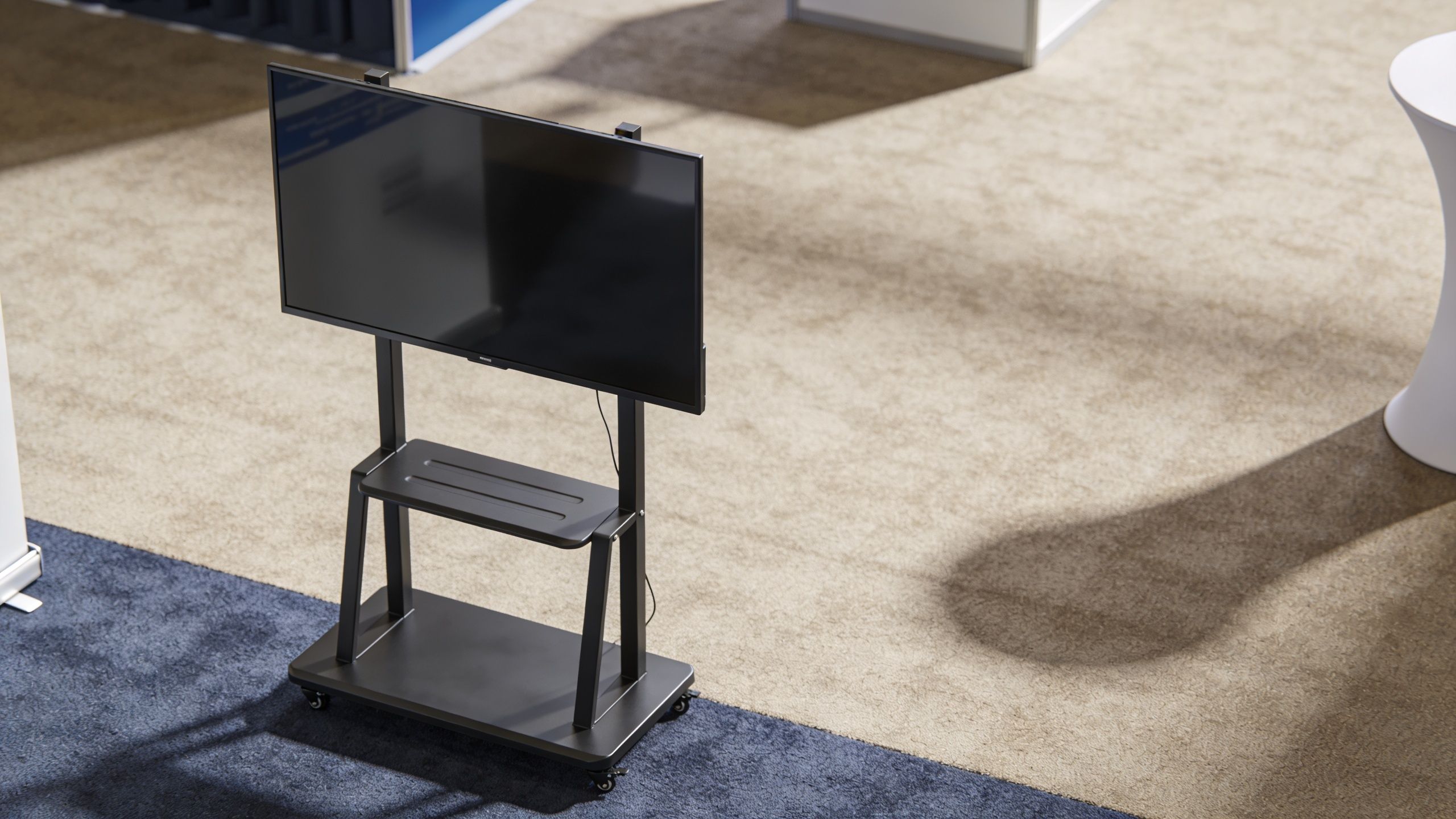
Most traditional tradeshow tv stand options fall into a few categories.
Freestanding portable stands are the common choice for simple booth demos. They usually use aluminum or steel, support a single monitor, and offer adjustable height. Some include casters. Some break down into compact cases for easier transport.
Heavy-duty monitor stands are built for larger screens or touch interaction. These tend to be sturdier, bulkier, and less forgiving to ship. They’re often the safer pick when the TV is large and attendees may interact with the screen directly.
Graphic-integrated monitor stands combine a TV mount with tension fabric or printed backdrops. These try to soften the look of a bare stand by adding branding around the screen. They’re a step up visually, but the monitor is still a separate object mounted in front of or inside a frame.
What matters when you spec a tradeshow tv stand
A good stand isn’t just about screen size. We look at a few practical details first.
- VESA compatibility: If the mount pattern doesn’t match the monitor, setup stops fast.
- Base stability: Trade show floors get bumped, and people lean where they shouldn’t.
- Adjustable height: Sightlines matter more than often anticipated.
- Case design: The stand may fit the booth, but the case still has to get there.
- Cable routing: If power and HDMI hang loose, the booth instantly looks unfinished.
A strong stand is a logistics tool first, then a display tool.
Where traditional stands still make sense
There are situations where a standard tradeshow tv stand is the right answer.
A single product demo in a compact booth can work well. A staff-led presentation station can work well too. If the screen’s job is functional, not architectural, a stand is often enough.
What it doesn’t do well is disappear. Even the better models still read as hardware. That’s the core limitation.
The Hidden Headaches of a Separate TV Stand
The biggest problem with a tradeshow tv stand isn’t the sticker price. It’s everything wrapped around it after the purchase order.
Shipping looks simple until show services get involved
Portable stands with integrated fabric graphics that weigh under 25 lbs can cut labor by 60%, according to Anything Display’s modular monitor stand details. That’s the best-case version.
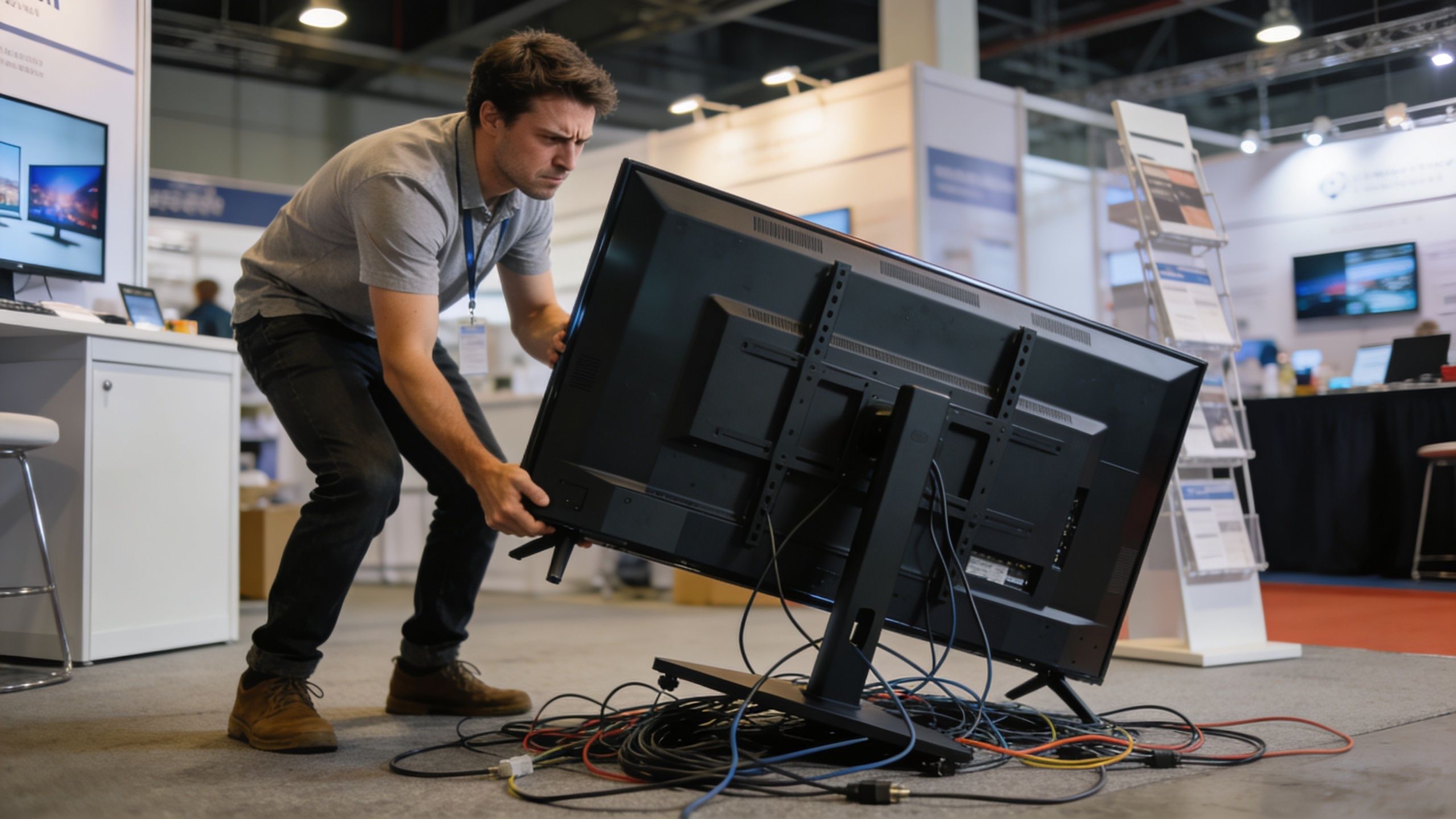
The trouble starts when exhibitors move up to heavier steel stands for larger screens. In major convention hubs, those can trigger drayage fees of $150 to $300 per event, and that’s before you count the monitor, case count, repacking time, and labor coordination from the dock to the booth.
For teams planning repeated events, it helps to understand the packing risk too. This practical guide on avoiding TV damage during moves is worth a read because a damaged screen can wipe out any savings you thought you gained by shipping your own setup.
If you’ve dealt with advance warehouses, forced freight deadlines, and floor paperwork, you already know the issue. A “simple stand” rarely travels alone. It travels with a monitor, cables, adapters, pads, cases, labels, and a growing set of small failure points. That’s why many exhibitors spend time planning trade show shipping and material handling long before they think about what content is going on the screen.
Setup gets messy fast
A separate stand adds one more build sequence to booth install. It has to be assembled, leveled, mounted, powered, tested, and then disguised as much as possible.
That sounds manageable until the floor opens in a few hours and someone realizes:
- The HDMI run is visible: It cuts right across the cleanest side of the booth.
- The power drop landed awkwardly: The stand wasn’t designed around the booth layout.
- The screen height is wrong: Too low and people miss it. Too high and it feels detached.
- The base plate is in the way: Staff keep stepping around it, and attendees notice.
Separate screens create separate problems. Every extra component adds another handoff, another cable, and another place for the booth to look unfinished.
The visual compromise is hard to hide
This is the part many buying guides don’t discuss clearly enough. Traditional TV stands often fight the booth design.
A luxury product brand doesn’t want a black rolling stand visible under a polished presentation. A software company launching a new platform doesn’t want two or three TVs lined up with thick bezels breaking the motion across each screen. Even when the content is good, the hardware announces itself.
The result is a booth that feels assembled instead of designed. Attendees may not say that out loud, but they feel it.
The Superior Alternative a Seamless LED Video Wall
The better move is to stop buying a screen and stand as separate parts of the booth. Treat the display as part of the booth architecture from the start, and the economics change.
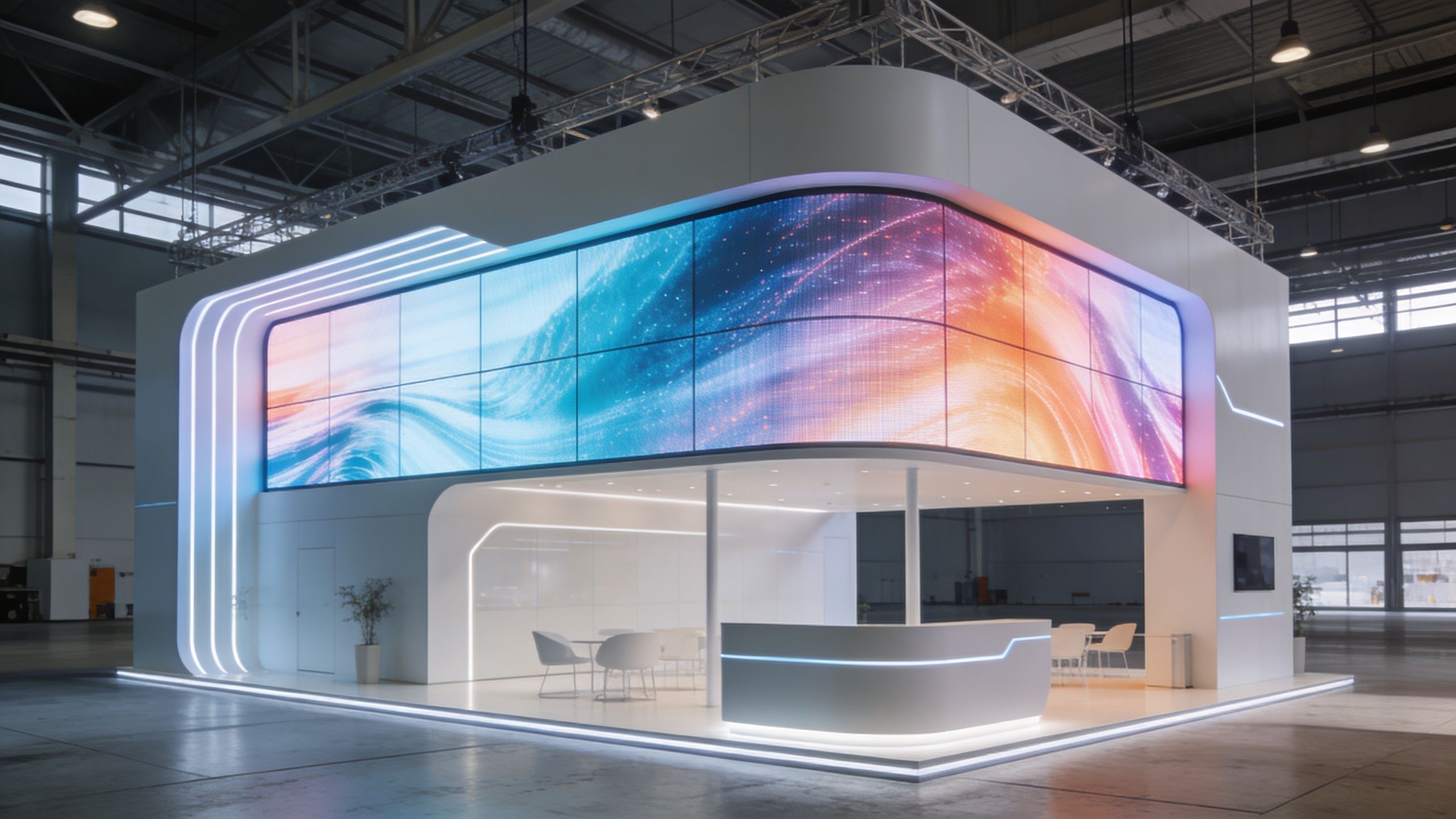
An integrated LED video wall changes the job completely. The wall, corner, arch, or counter becomes the display surface, so the visual system and the booth are working together. That gives exhibitors an image without bezel breaks and removes the floor-space penalty that comes with a separate stand base.
Why this format works better on the floor
An integrated LED wall draws people into the booth instead of asking them to look at a device parked in front of it.
That difference matters on a busy aisle. Content can wrap a corner, carry across a full backdrop, or support a product launch with motion that matches the booth shape. The result feels designed, not assembled in pieces after the fact.
For brands comparing display formats, video display wall options for trade show booths make more sense when the goal is stronger booth performance, not just basic playback.
Resolution and viewing distance matter
Not all LED walls are equal. Pixel pitch affects how sharp the display looks at the distances where attendees stand.
Many competitors use 2.5 pitch. Our preferred spec is 1.9 pitch, which delivers a cleaner image at closer viewing distances. That shows up fast in text, product renders, and motion graphics. If a booth sits on a crowded aisle, those details affect whether the display looks premium or rough.
Higher resolution changes the real attendee experience. A wall that looks crisp up close supports the brand. A wall that looks coarse undercuts it.
The cost picture is better than it first appears
A TV on a stand usually wins the sticker-price comparison. It often loses the total-cost comparison.
With an integrated LED booth, exhibitors are paying for a display system that also does design work. It can replace printed backdrops, reduce the need for extra monitor placements, and cut down the number of disconnected components that need to be shipped, assembled, dressed, and managed on site. That is where ROI improves. The spend is higher up front, but the booth often works harder and looks stronger at the same time.
The service model matters too. We structure projects so pricing covers the booth and display package, excluding only show-billed charges such as electricity and material handling. That gives teams a clearer number before the event instead of a low entry price followed by added AV labor, mounting, cabling, and troubleshooting.
White-glove support also changes the operating reality on site. An audiovisual technician is available during show hours, so your team is not burning selling time trying to fix a screen issue.
Here’s a quick look at how the display behaves in the field:
What exhibitors gain by replacing the tradeshow tv stand
A continuous LED wall improves more than appearance.
- Stronger branding: The display supports the booth design instead of interrupting it.
- More content flexibility: Graphics can span walls, curves, counters, and other built elements.
- Cleaner presentation: The image holds together without bezel lines cutting through motion.
- Better use of space: Staff and visitors move naturally because there is no separate stand footprint to work around.
- Higher return from one display system: The video surface carries messaging, atmosphere, and visual impact at the same time.
Traditional tradeshow TV stands solve for screen placement. Integrated LED walls solve for booth performance.
How to Choose Your On-Booth Video Display
A tradeshow tv stand isn’t automatically wrong. It’s just often judged on the wrong criteria. Buyers compare purchase price and ignore ownership friction.
The better comparison is total event performance. That includes setup effort, freight reality, visual quality, and how well the display supports the rest of the booth.
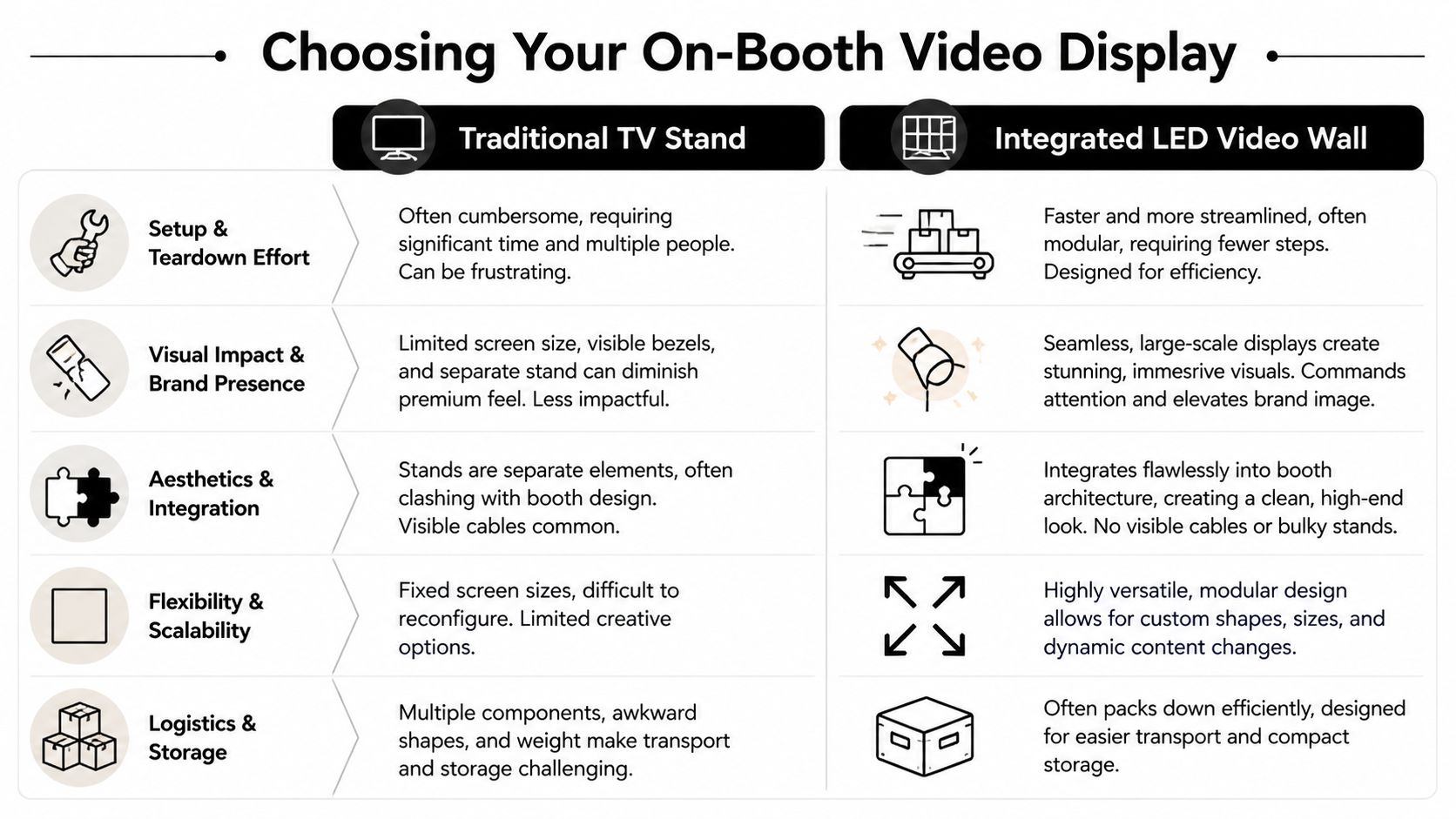
Tradeshow TV Stand vs. LED Video Wall Comparison
| Factor | Traditional TV Stand | Integrated LED Video Wall |
|---|---|---|
| Visual impact | Single screen or separated screens with visible hardware | Seamless architectural display integrated into the booth |
| Budget view | Lower apparent entry cost, but extra logistics can build quickly | Higher headline investment, often stronger value when judged on total booth effect |
| Setup and teardown | More component-by-component assembly and cable management | Streamlined modular install with the display built into the structure |
| Shipping and drayage | Cases, monitors, stands, and accessories add handling complexity | Fewer visible components on site and a more consolidated presentation system |
| Content flexibility | Limited to screen dimensions and orientation | Scales across walls, curves, counters, and larger creative layouts |
Questions that usually decide it
Some teams need a quick answer. These questions usually sort the decision fast.
Is the screen just for demos?
If yes, a stand may be enough. If the display is there to create atmosphere, shape traffic, or define the brand presence, an integrated wall is stronger.
Does the booth need to look premium?
Luxury, enterprise, and launch-focused brands rarely benefit from visible support hardware.
Will the team reuse this across multiple show formats?
If your program changes booth sizes, content goals, or traffic patterns from event to event, a modular system gives you more room to adapt. That’s one reason many exhibitors look at LED video wall rental options instead of forcing the same monitor-and-stand package into every footprint.
The budget trap to avoid
The cheapest display line item can produce the more expensive event.
A tradeshow tv stand often looks economical because the stand itself is not expensive compared with larger digital systems. But exhibitors don’t attend line items. They attend shows. Once shipping, handling, labor coordination, stand placement, and aesthetic compromise are all part of the equation, the low-cost option may not be the low-cost outcome.
Buy based on total cost of ownership, not the cheapest object in the booth.
That’s the comparison that usually changes the decision.
Tips for Maximum Video Engagement at Your Booth
Good hardware won’t save weak content. A beautiful display showing a slow corporate reel still underperforms.
Design also matters more than many teams admit. 76% of attendees are drawn to a booth based on its design, interactive elements can boost engagement by 50%, and proper lighting can enhance visibility by 60%, according to Cvent’s trade show statistics overview. Video works best when it supports those fundamentals instead of trying to replace them.
Build for a no-audio environment
Trade show aisles are noisy, and many attendees won’t hear your soundtrack.
Use bold headlines, short phrases, and motion that reads from a distance. If the message only works with voiceover, it’s not ready for the floor.
Keep loops short and visual
Long brand films rarely perform well in a booth. Attendees join mid-stream and leave fast.
Use compact loops with one clear goal:
- Stop traffic: Lead with motion and contrast.
- Explain fast: Show the product or outcome immediately.
- Support staff conversations: Give reps visuals they can point to while talking.
Let the content fit the structure
Integrated displays distinguish themselves from a tradeshow tv stand. A TV gives you a rectangle. A continuous wall lets the content interact with the booth.
Use corners, vertical formats, counters, and full-width scenic motion when the display allows it. Teams that need help creating those assets usually benefit from specialized video wall content production for trade shows, because booth content has different requirements than a website video or paid ad edit.
Make motion work from the aisle
The first job of booth video is attraction, not explanation.
Use clean movement, strong contrast, readable typography, and product visuals that make sense in a glance. Once people stop, your staff can do the deeper work.
If someone can’t understand the subject of your screen in a few seconds, the content is too complicated for the aisle.
Strong booth video does three things. It pulls attention, supports live conversation, and reinforces memory after the attendee walks away. The more unobtrusively the display is built into the environment, the easier it is to do all three well.
If you’re weighing a tradeshow tv stand against a more integrated video solution, LED Exhibit Booths can help you compare the practical trade-offs. We build cohesive video wall trade show displays with white-glove, turnkey service, clear project scope, and on-site AV support so your team can stay focused on customers instead of screen logistics.