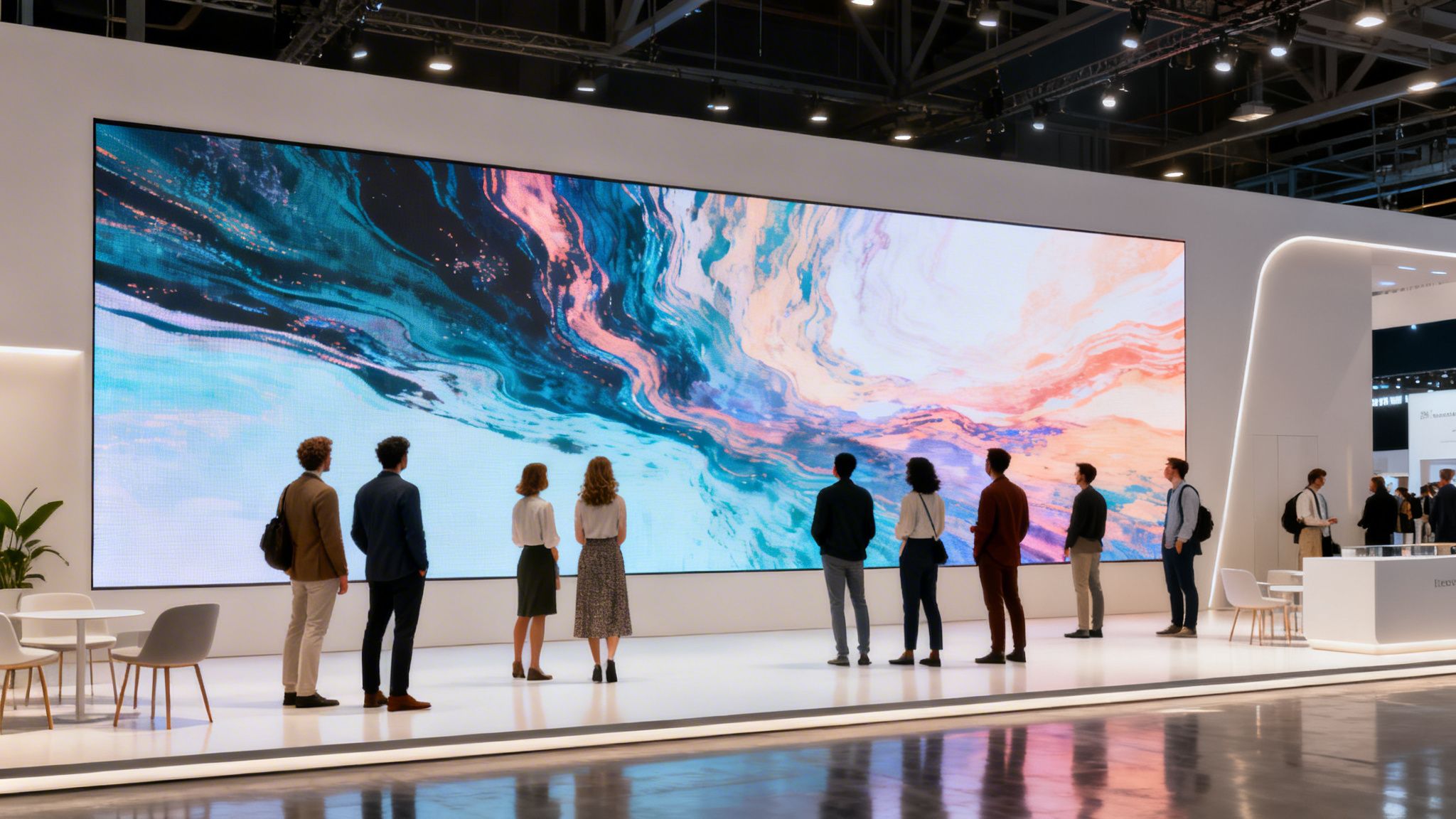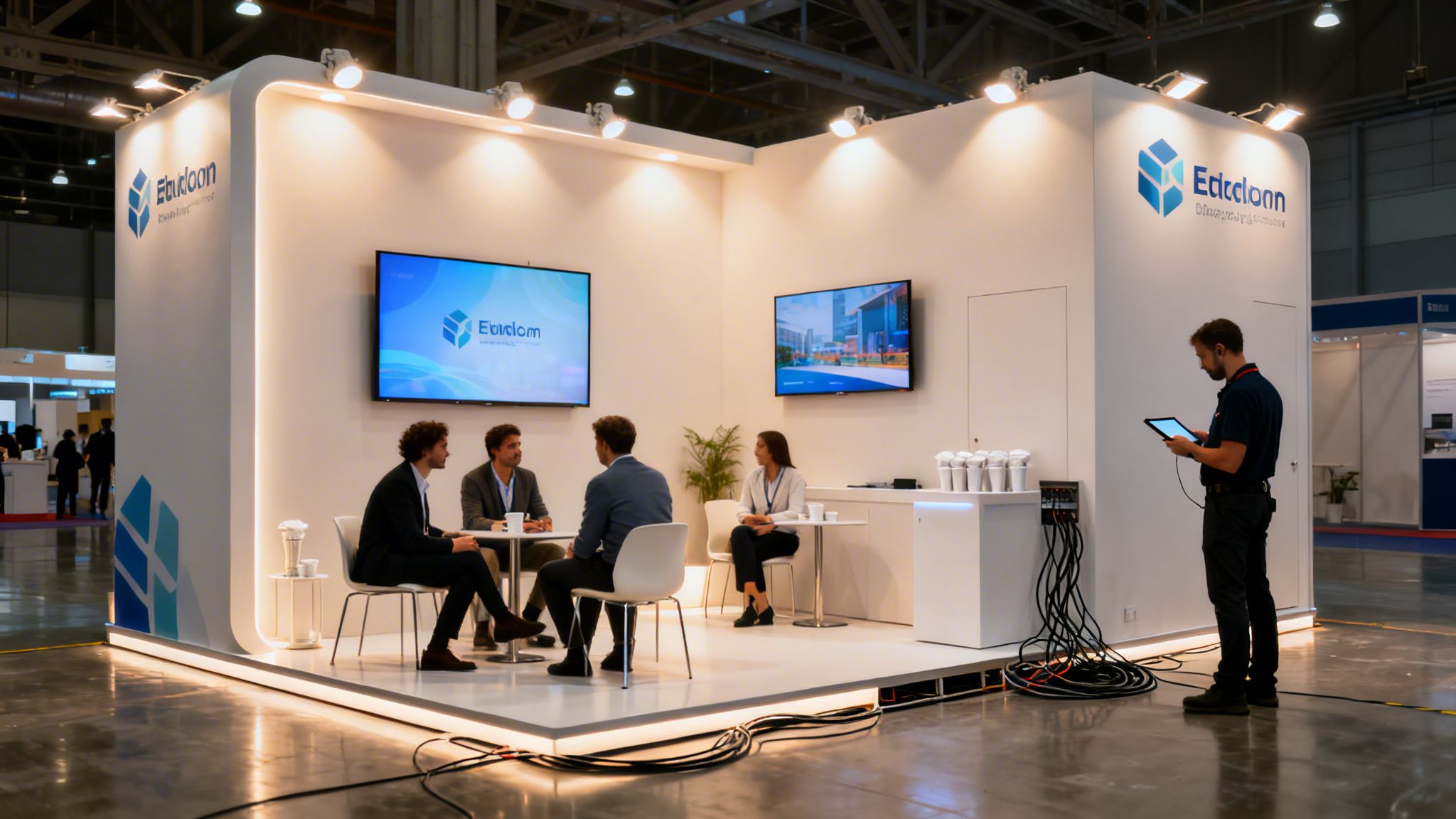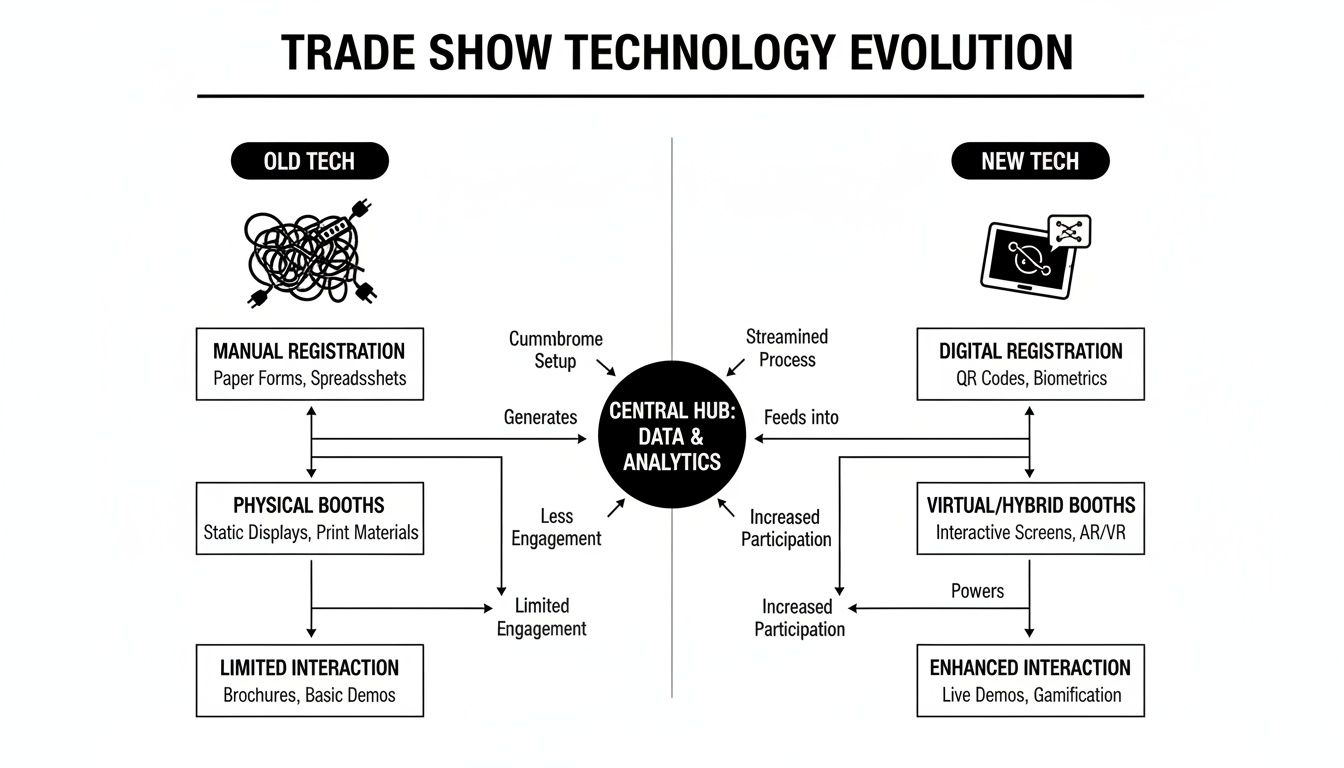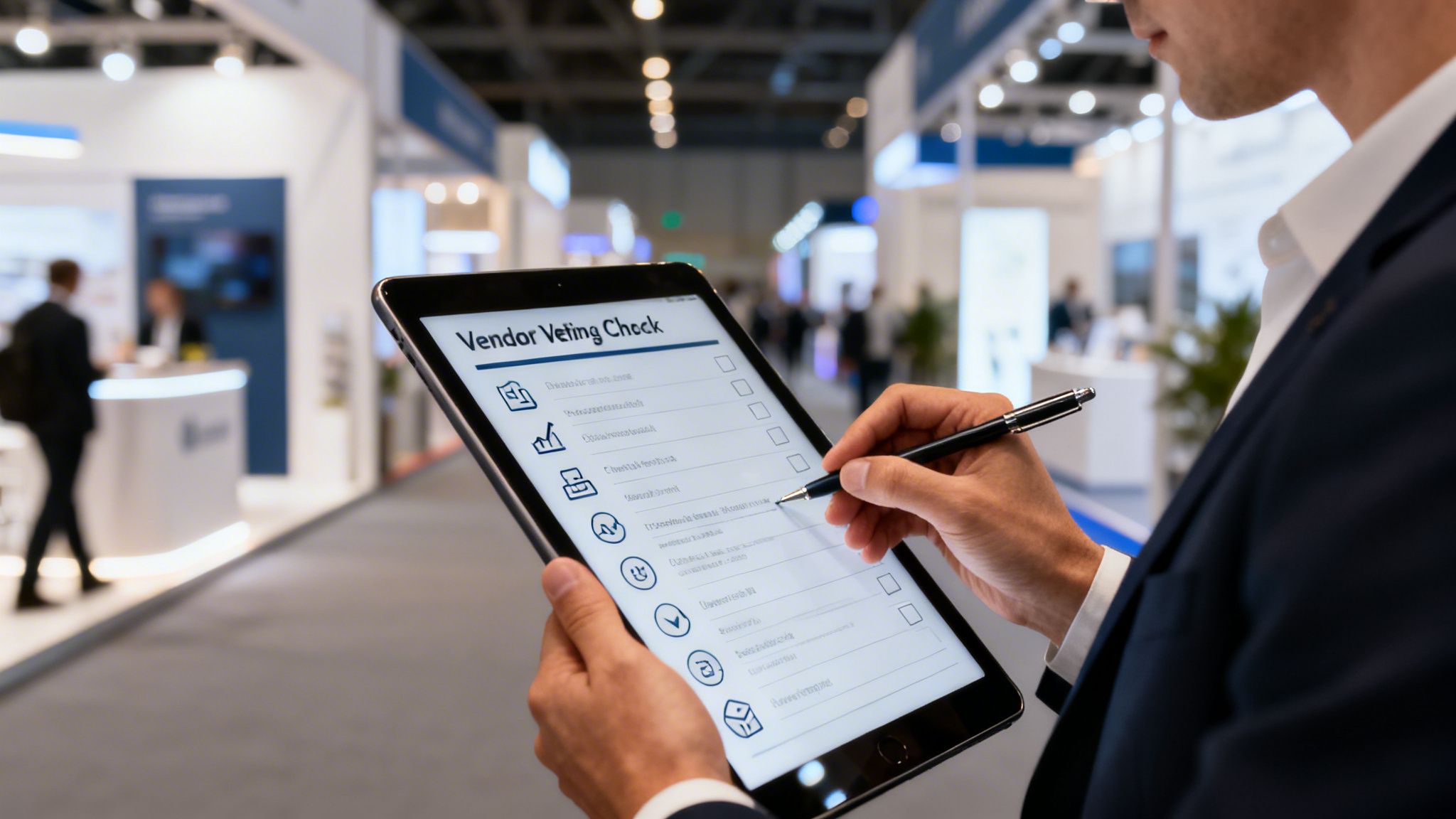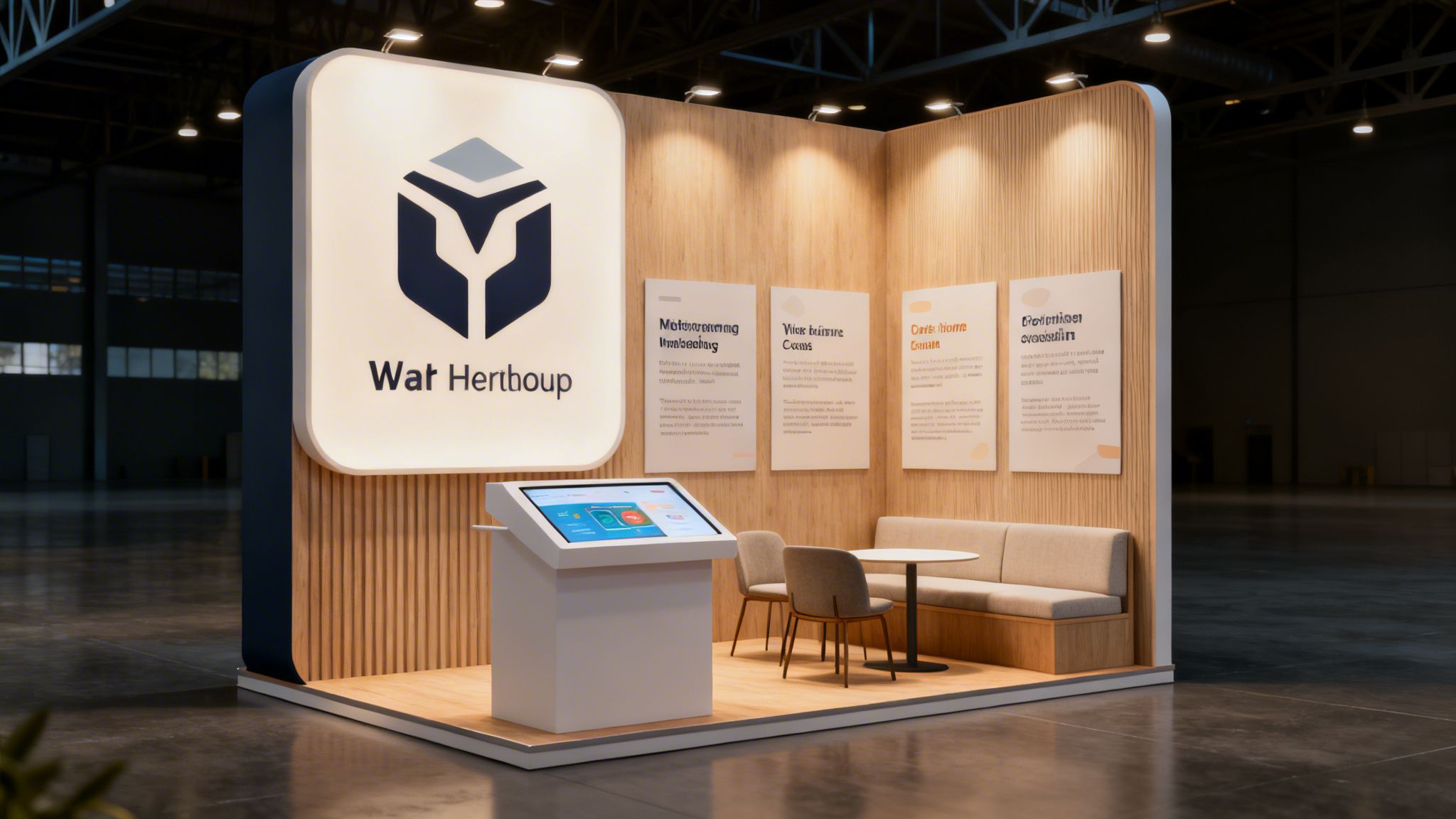
Illuminate Your Booth: Backlit Trade Show Displays

You have a show coming up. The booth is booked. The freight forms are in motion. Someone on the team says the old pop-up still works, so maybe you can save money and reuse it one more time. However, backlit trade show displays help you to stand out from the crowd.

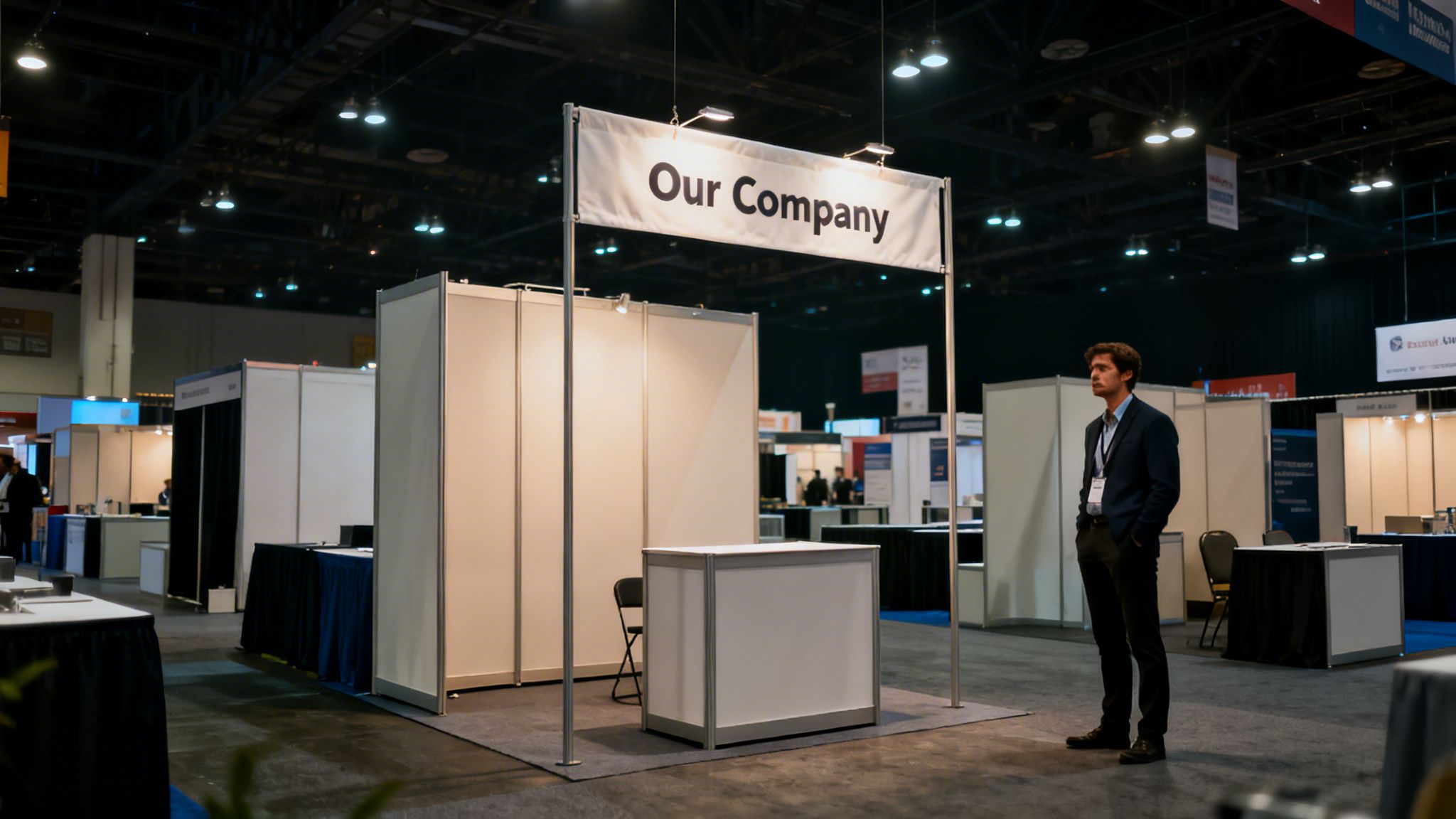
Then you get to the convention hall and see the problem.

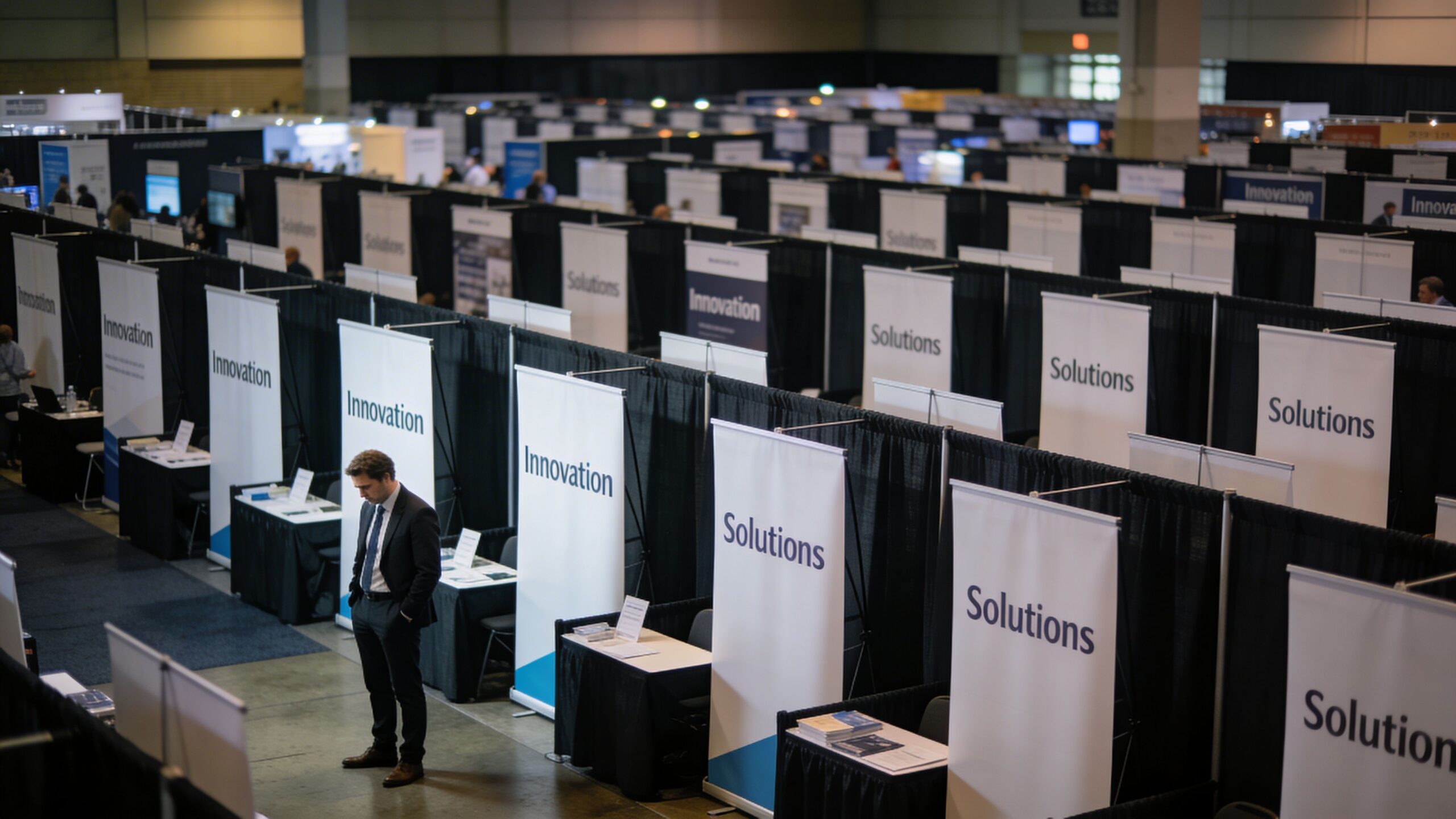
Rows of booths blend together. Printed walls fade into the background under venue lighting. Attendees walk the aisle scanning for something that feels current, active, and worth stopping for. If your booth looks static, people assume the experience will be static too.

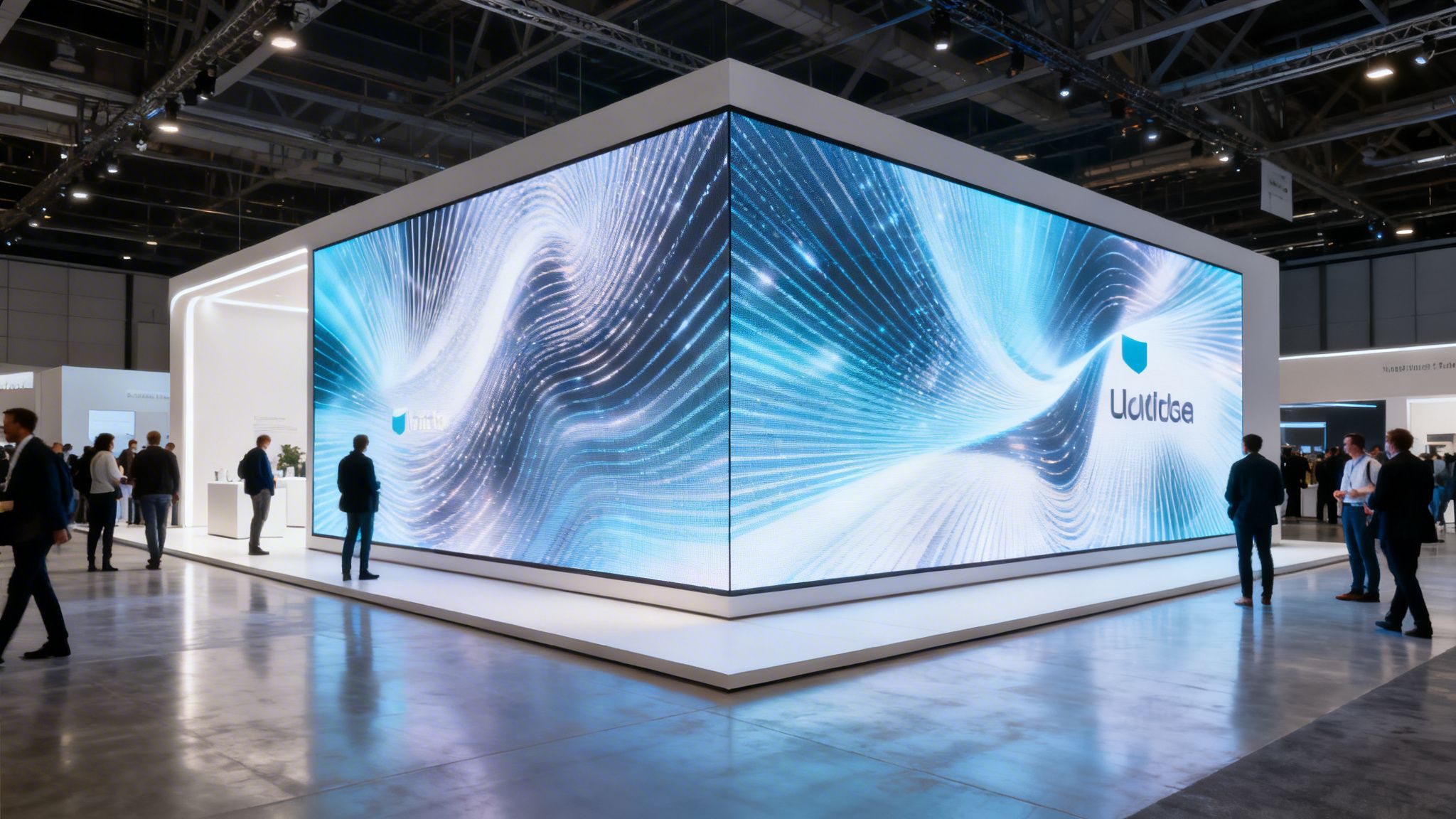
That is why backlit trade show displays have moved from nice upgrade to practical necessity for many exhibitors. And for brands that want the strongest visual impact, seamless LED video walls have become the standard worth comparing everything else against.

Beyond the Pop-Up Banner Why Your Booth Needs an Upgrade

A lot of exhibitors know this feeling. You spend real money on floor space, travel, labor, shipping, and lead capture, only to realize your booth disappears the moment the hall opens.
backlit trade show displays

The old pop-up banner was built for a different trade show era. It did one job well enough. It held a logo, a tagline, and maybe a product shot. But on a modern show floor, that is like bringing a flashlight to compete with storefront signage.

Static booths get ignored fast but not backlit trade show displays

Attendees make snap decisions. They are not reading every panel from left to right. They are moving, scanning, filtering.

A printed backdrop can still look clean. It can still be professional. But it rarely creates a reason to stop unless the design is exceptional and the aisle traffic is slow enough for people to notice details.

If you are looking for fresh creative directions before you commit to a booth redesign, these inspiring trade show display ideas offer useful examples of what catches attention without relying on clutter.

The market is moving toward illuminated systems

This is not a niche trend. The global backlit displays market was valued at USD 7.5 billion in 2024 and is projected to reach USD 15.2 billion by 2034, growing at a CAGR of 8.30%. The trade show display segment dominated in 2023, driven by companies trying to stand out with more attractive booth spaces and leave a stronger impression on visitors, according to Polaris Market Research.

That growth makes sense if you spend time on show floors. Brands are not just buying a backdrop anymore. They are buying visibility.

Some exhibitors start that shift with a simple pop-up display for trade show setup, then realize quickly that lighting changes how people read the booth from across the aisle.

A booth does not need to be the biggest on the floor. It needs to be the easiest to notice and the easiest to understand.

What the upgrade really changes with backlit trade show displays

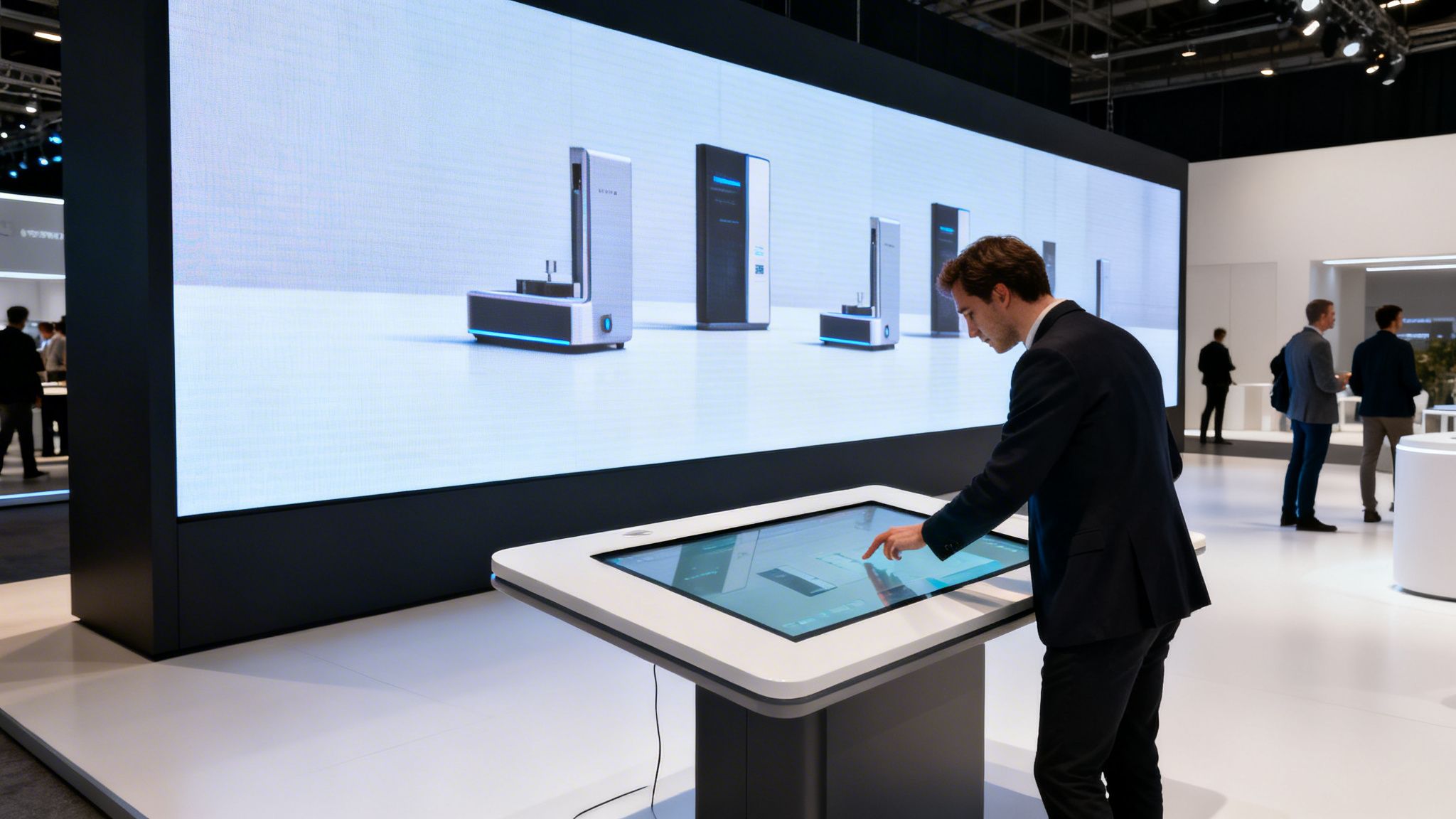
Backlit trade show displays solve the first problem, visibility. LED video walls solve the second one too. They let the booth communicate motion, depth, and relevance.

That matters because trade show success usually starts before a conversation. It starts with a glance. If the booth wins that moment, your team gets more chances to do the part that closes business.

Understanding Backlit Displays vs LED Video Walls

People often use these terms interchangeably. That creates confusion during planning, budgeting, and vendor comparison.

Both options light up your booth. They are not the same product.
backlit trade show displays

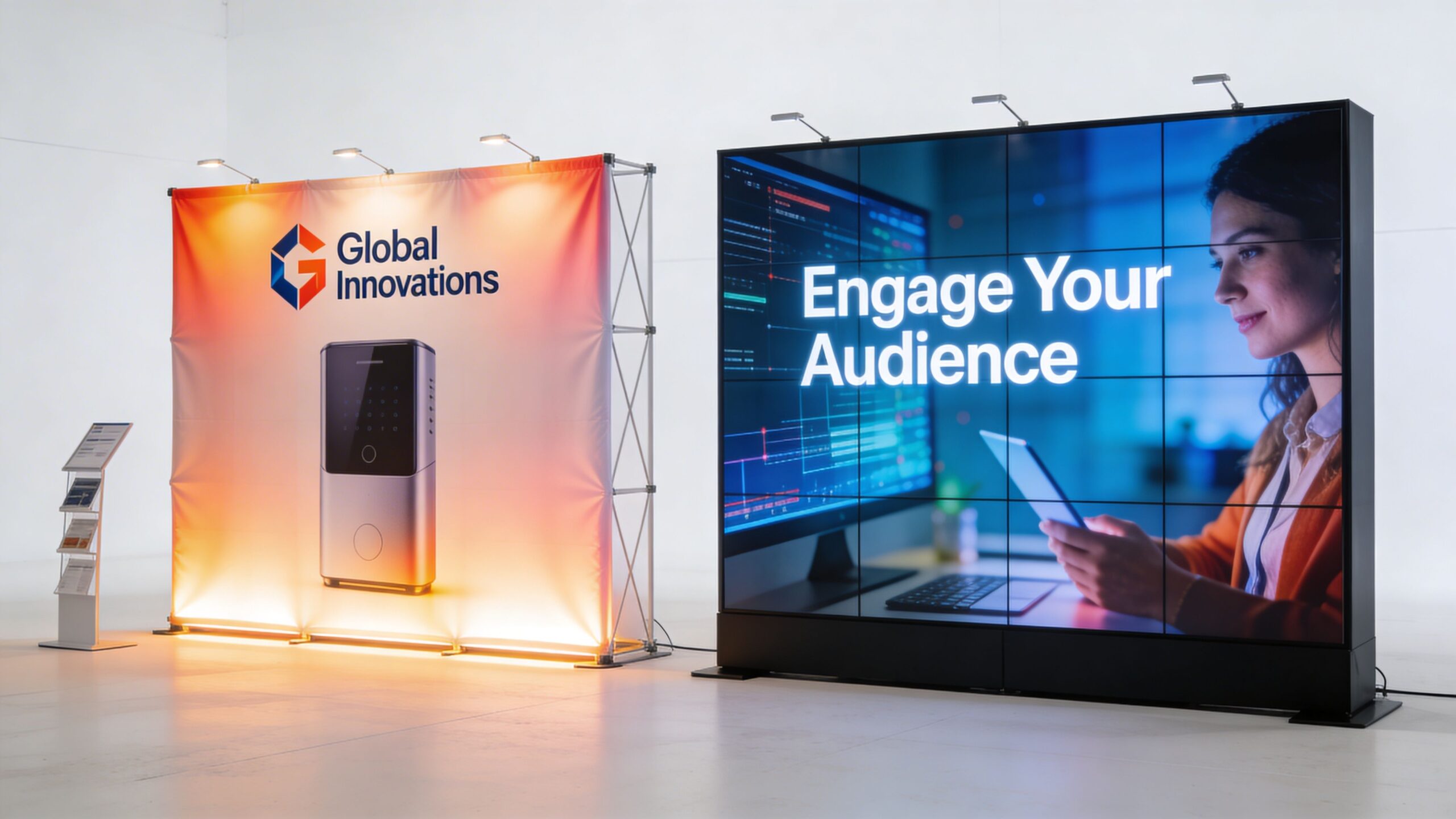
What a fabric backlit display is

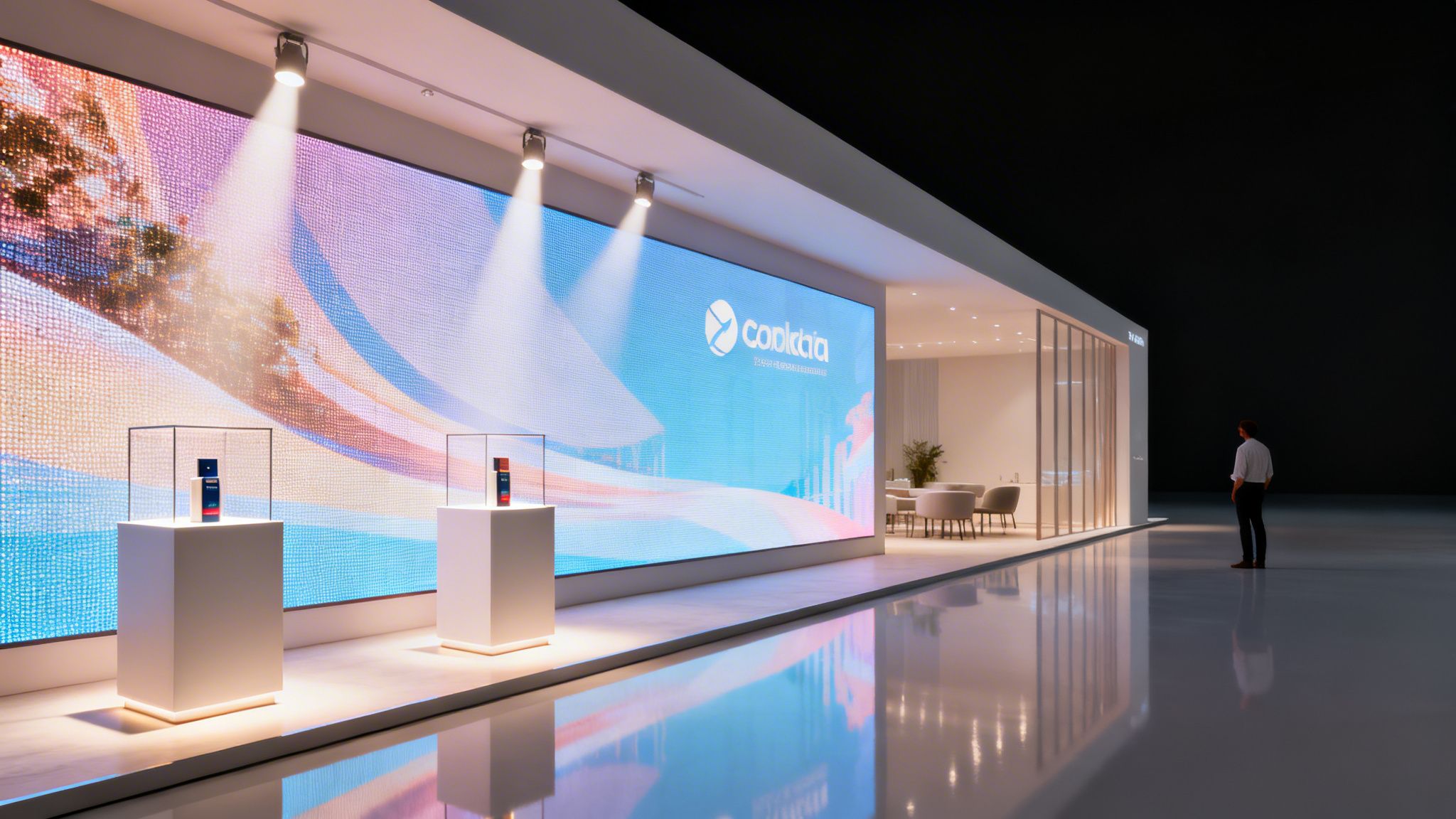
A traditional fabric backlit display is basically a lightbox. You have a frame, internal LED lighting, and a printed fabric graphic stretched across the face.

It looks polished. It is much more eye-catching than a standard printed panel. For logos, lifestyle imagery, product photos, and simple branded environments, it works well.

Its strengths are clear:

  • Clean presentation: The glow gives printed graphics more depth and contrast.
  • Straightforward messaging: One hero image or a clear product visual can read well from a distance.
  • Reusable structure: You can update the fabric print while keeping the frame.

Its limits are just as important:

  • The message is fixed: If your campaign changes, the display does not.
  • No motion: A static graphic cannot show a demo, rotate headlines, or react to crowd flow.
  • Less immersive: It improves your booth backdrop, but it does not turn the booth itself into media.

What an LED video wall is

An LED video wall is not one giant screen shipped in one piece. Consider it a wall built from digital tiles. Each tile is a small section of display, and the sections connect to form one continuous surface.

A good way to picture it is Lego bricks made of light. Individually, each tile is just one piece. Together, they create a single canvas.

That is what makes a video display wall different from a row of monitors mounted side by side. Monitors bring bezels, gaps, visible framing, and a temporary feel. LED tiles are built to disappear into the final image.

Why the structural difference matters

With a lightbox, the structure supports a graphic.

With a video wall, the structure is the graphic.

That opens up design options that older display types cannot match. A wall can loop product animation. A column can carry brand motion. A counter can display supporting visuals. An arch can become part of the story instead of a frame around it.

Here is the practical difference in booth behavior:

Display type Best use Main limitation
Fabric backlit display Strong static branding and photo-based messaging Content cannot change during the show
LED video wall Dynamic storytelling, demos, changing campaigns Requires stronger planning, content, and technical support

Which one fits your event goal backlit trade show displays or video wall booths

If you need a polished visual backdrop and your message is simple, a fabric backlit system can be enough.

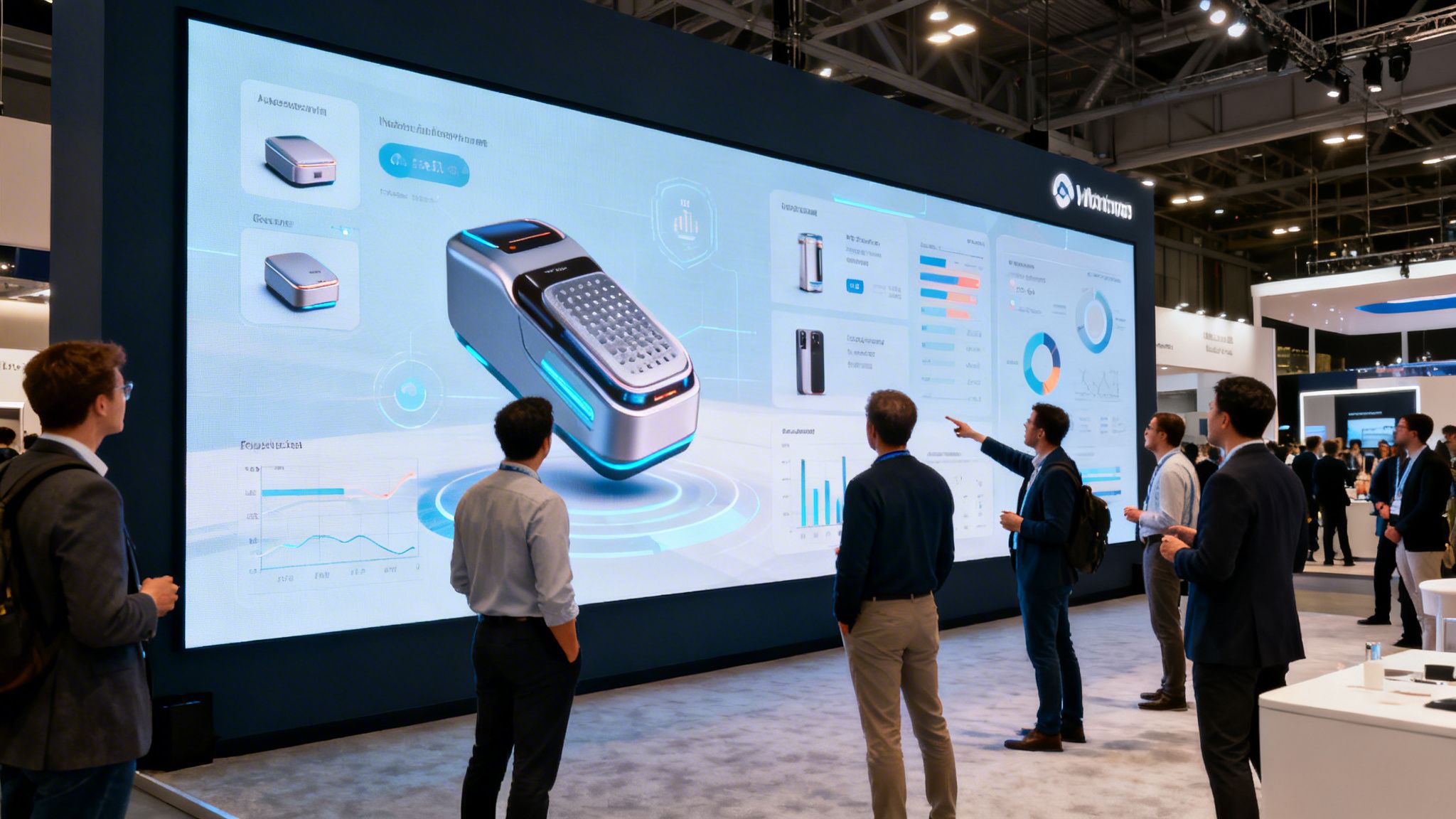
If you are launching a product, showing software, explaining a process, rotating audience-specific messaging, or trying to create a premium booth experience, the LED wall usually earns its place quickly.

A backlit lightbox says, “Here we are.” An LED wall says, “Come see what we do.”

That distinction is why experienced exhibitors look past the word backlit and ask a better question. Do they need illumination, or do they need communication?

The Unmissable Benefits of Going With Backlit Trade Show Displays

The first benefit is obvious. People can see your booth sooner.

The better benefits show up after that first glance. Good backlit trade show displays do not just brighten a space. They make your booth easier to understand, easier to move through, and easier to remember.

Visibility that works from aisle distance

Most show floors are visually noisy. Hanging signs, overhead lights, glossy flooring, neighboring demos, and competing color palettes all fight for attention.

Backlighting helps your brand cut through that clutter because illuminated graphics hold contrast better than flat prints under uneven venue lighting. A lit visual looks intentional. It reads as active, not parked.

That matters most when attendees are still several steps away. If they can identify your brand promise before they reach the booth, your staff starts the conversation with less friction.

Better storytelling without adding physical clutter

Older booths often try to say too much with too many panels. One wall explains the company. Another lists features. A third shows use cases. The result is usually a booth people skim but do not absorb.

Backlit systems simplify that problem.

A lightbox can anchor the brand with one clean image. A video wall can do more. It can rotate through product views, highlight customer use cases, show interface screens, and support live presentations without covering the booth in separate signs.

That reduces visual noise while increasing the amount of information you can communicate.

Lower operating strain than many people expect

A lot of exhibitors assume illuminated displays must be expensive to power and complicated to run. Modern LED systems changed that calculation.

Modern LED technology used in backlit trade show displays can result in up to 75% less power consumption compared to traditional lighting, which can reduce electrical costs at venues. That efficiency is one reason fixed installation segments, common in booth structures, were projected to hold 68% market share in the U.S. in 2026, according to Cardinal Expo.

That point gets overlooked. Convention center power is never an afterthought. Efficient display technology can help keep operating costs from climbing faster than the booth budget.

Practical benefits of backlit trade show displaysteams notice on show day

The operational upside is often what wins over event managers after the first event. Strong systems are designed to reduce common booth headaches.

  • Fewer moving parts on site: Modular systems reduce the pile of mismatched hardware and last-minute improvisation.
  • Cleaner presentation: You avoid the cobbled-together look that happens when separate screens, mounts, and printed signs compete inside one footprint.
  • Faster content control: Teams can update visuals before the show or between audience segments without replacing hardware.
  • Better booth flow: One integrated visual surface often works better than several disconnected displays.

The business outcome is usually simple

People stop more often at booths that look active and current. Staff waste less time trying to pull attention in from the aisle. Product marketers can tell one consistent story instead of asking attendees to assemble it from separate signs.

Backlit trade show displays support all of that. LED walls extend it further by turning the booth itself into a communication tool.

The gain is not brightness alone. It is clarity, presence, and a booth that does more work before your reps say hello.

Key Technical Specifications That Matter With Backlit Trade Show Displays

A lot of display proposals hide behind jargon. Buyers get a list of specs, a rendering, and a price. Then they are expected to know whether they are comparing premium hardware or a compromise that only looks good from far away. Plus, they are very affordable lightweight trade show booths.

The spec sheet gets easier once you translate it into show-floor consequences.
backlit trade show displays

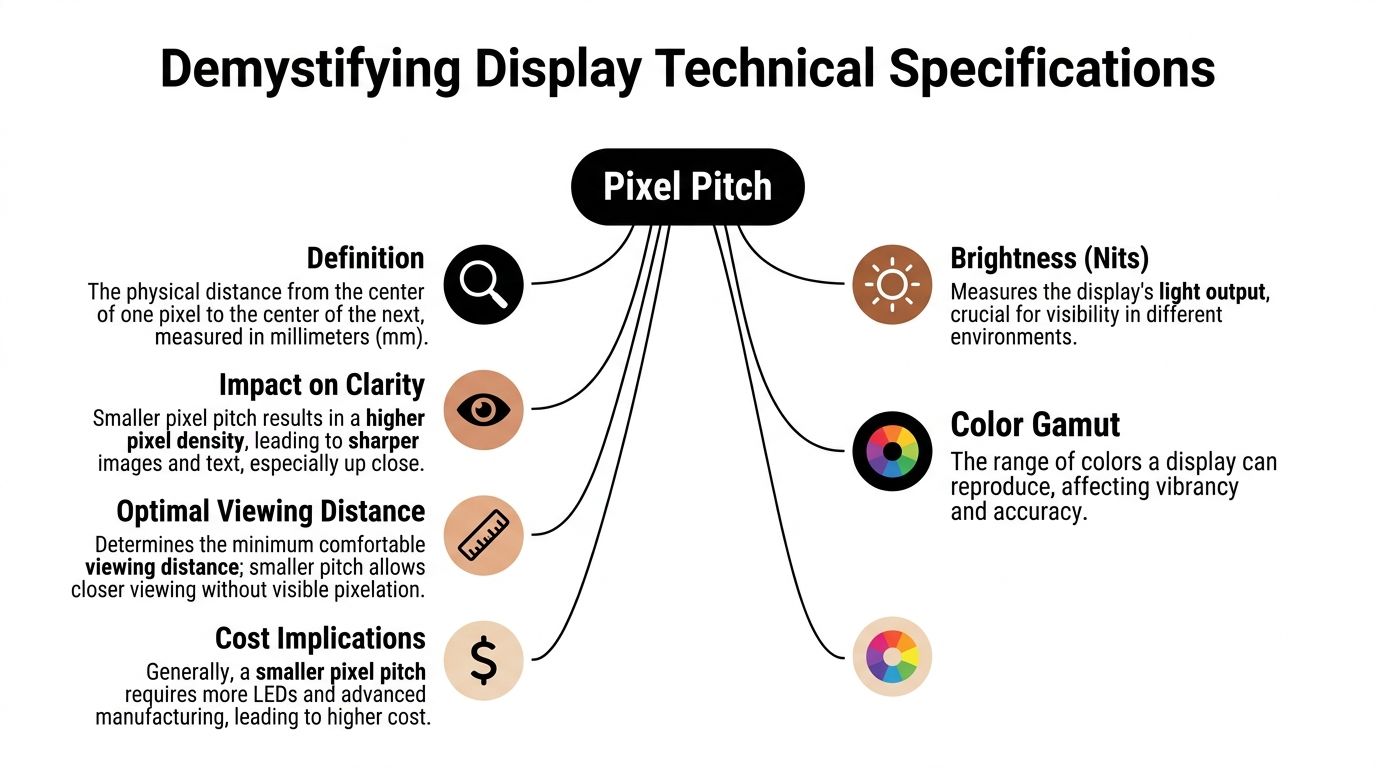
Pixel pitch is the first spec to check

If you only learn one term, learn pixel pitch.

Pixel pitch is the distance between pixels, measured in millimeters. Smaller number, tighter pixels. Tighter pixels, sharper image at close range.

That is why 1.9 matters. Many competitors work with 2.5 pitch. A 1.9 pitch video wall has higher resolution and finer detail, which becomes obvious when attendees stand near the booth.

Compare it to print quality. A brochure can look fine from across a room, but if the image breaks apart in your hand, the quality was never really there. Pixel pitch works the same way.

A product close-up, crisp text, or software interface shown on a 1.9 wall holds together better than it does on a 2.5 wall when viewed up close.

You can review the hardware side of this more closely through an LED panel for video breakdown, but the practical takeaway is simple. If your booth invites people to stand near the display, lower pixel pitch is worth serious attention.

Brightness matters, but context matters more

Brightness is usually measured in nits. Buyers often fixate on that number because it sounds important, and it is. But brightness by itself does not guarantee a better booth.

In a trade show environment, the goal is not to create a blinding wall. The goal is to keep content visible under venue lighting without washing out colors or fatiguing the viewer.

A good system balances brightness with content quality and hall conditions. Too little brightness and the wall looks dull. Too much and skin tones, product images, and text can look harsh.

Seam quality separates a video wall from a monitor wall

Many exhibitors say they want a video wall when what they are being quoted is a monitor array. That difference shows up immediately in the seams.

Monitors have bezels. Even slim bezels interrupt content. If you are showing a product hero shot and a bezel cuts through the middle of it, the illusion breaks.

LED tiles are meant to create one uninterrupted image. That seamless effect is a major reason premium booths look premium. The technology disappears and the content takes over.

Weight and modularity affect your budget more than you think

This part is less exciting than resolution, but it matters just as much. Booth hardware that is lighter and more modular is easier to ship, easier to stage, and easier to install cleanly.

That affects real-world costs and risk:

  • Shipping: Lighter components are easier to move and manage.
  • Material handling: Simpler packaging and modular builds reduce the chance of show-floor chaos.
  • Labor: Toolless or simplified assembly gives installers fewer ways to make mistakes.
  • Adaptability: Modular inventory can fit different booth footprints without forcing a total redesign.

What to ask when comparing proposals with backlit trade show displays

Do not just ask for a quote. Ask what the hardware means for your specific booth.

Use questions like these:

  1. How close will attendees stand to the screen? If the answer is very close, pixel pitch matters more.
  2. Will the content include small text or software UI? If yes, lower pitch becomes more valuable.
  3. Is the quoted display seamless, or is it a monitor wall? That should be answered plainly.
  4. How is the system assembled on site? This affects labor time and execution risk.
  5. Who supports it once the hall opens? This question is as important as any spec on the sheet.

Cheaper hardware often looks affordable only until the booth opens and the compromises become visible.

The best spec is not the one with the fanciest label. It is the one that protects image quality, operational simplicity, and attendee experience in the environment where the booth has to perform.

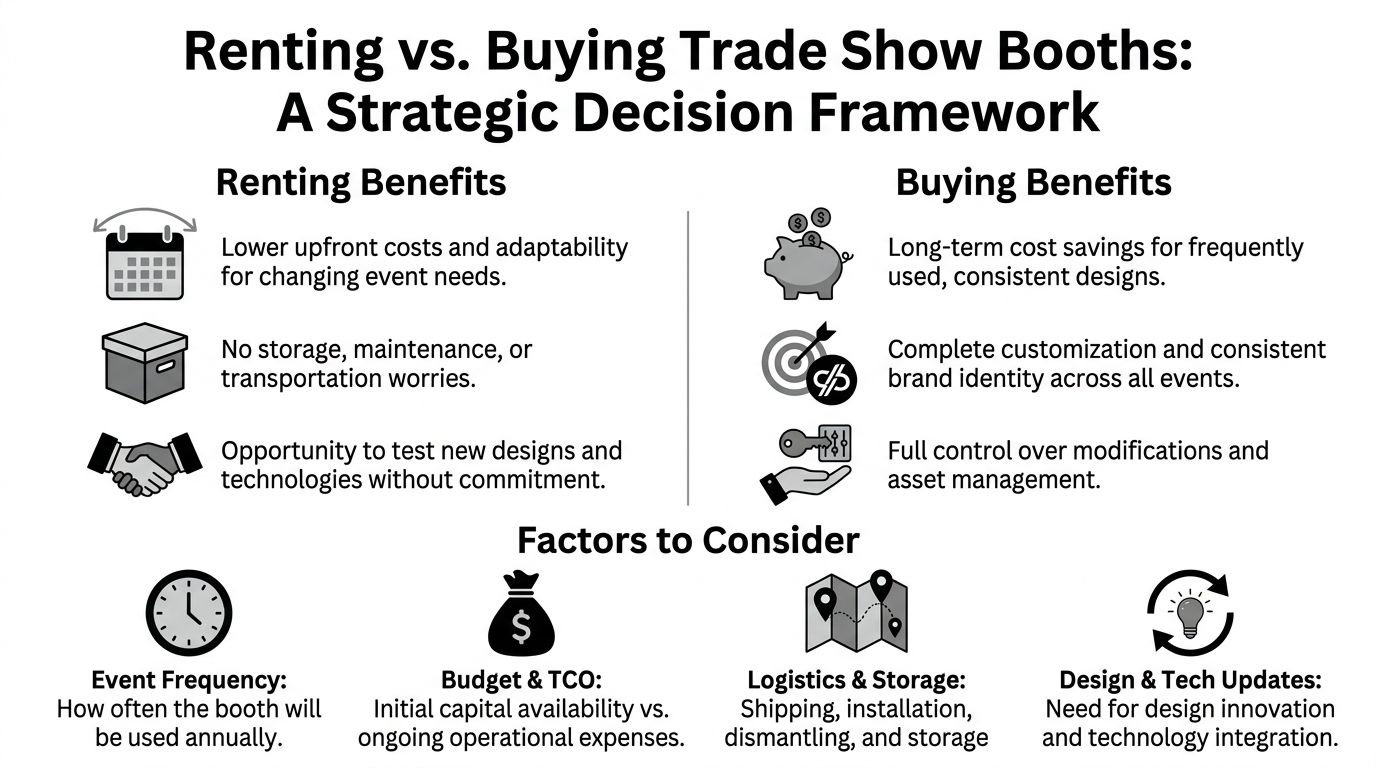
Renting vs Buying Your Video Wall Booth

Most exhibitors ask the wrong first question. They ask, “What does it cost to buy?”

The better question is, “How often will we use it, and who is going to manage it?”

For many brands, the smartest choice is not ownership. It is access to the right system, in the right configuration, with the right support.

The core decision is operational, not just financial

Buying can make sense for companies with a busy event calendar, internal exhibit operations, storage capacity, and people who know how to manage hardware between shows.

Renting makes more sense when the team wants flexibility, wants to avoid maintenance responsibility, or does not want capital tied up in equipment that sits between events.

That is why a lot of event teams start with a is it better to buy or rent an LED video wall evaluation instead of jumping straight to purchase quotes.

Rent vs Buy Decision Framework

Consideration Best for Renting Best for Buying
Show frequency A limited number of events or changing booth schedules Frequent exhibiting with predictable use
Content and booth changes Brands that want different configurations by event Teams with a stable booth format
Internal staff capacity Companies that do not want to manage storage, maintenance, and tech coordination Companies with dedicated exhibit operations
Risk tolerance Teams that want support built into execution Teams comfortable owning service and repair responsibility
Cash flow preference Businesses that prefer project-based spend Businesses prepared for upfront investment

Why turnkey service changes the math

Initial price is only one part of the cost. Trade shows create hidden labor, logistics, and stress costs that never show up in a simple hardware comparison.

A strong rental partner can remove much of that burden.

The best turnkey model includes everything in the rental price except the charges the show bills directly to you. In practice, that usually means the event bills you for things like electricity and material handling, while the display partner handles the rest of the booth-side execution.

That difference matters because it creates budgeting clarity. You are not trying to guess which line items will appear later as “extras.”

White glove support is not a luxury

It is easy to underestimate how much can go wrong during an event. Content does not load correctly. A connection needs attention. A panel needs adjustment. Staff on site are busy with prospects, not troubleshooting display systems.

That is where white glove, turnkey service earns its value.

With a full-service setup, the partner handles the details so your team can focus on meetings and demos. The strongest version of that model leaves an audiovisual technician onsite for the entire time the show is open. If something goes wrong, your team can text or call and get help at the booth within minutes.

That is a very different experience from getting handed equipment and a support number.

What usually works best

For most exhibitors, renting is the safer first move because it limits risk and includes expertise they do not have in-house.

Buying becomes more attractive when a company already knows the exact booth format it wants, exhibits often, and has the internal discipline to support the asset properly.

In other words, the right choice is not about pride of ownership. It is about whether your team wants to operate display technology or use display technology to win business.

A Practical Checklist for Your Next Exhibit

A video wall booth performs best when the planning is disciplined. Most show-floor problems do not start in the hall. They start weeks earlier with vague assumptions, incomplete forms, or content that was approved too late.

Use this checklist before your next event.
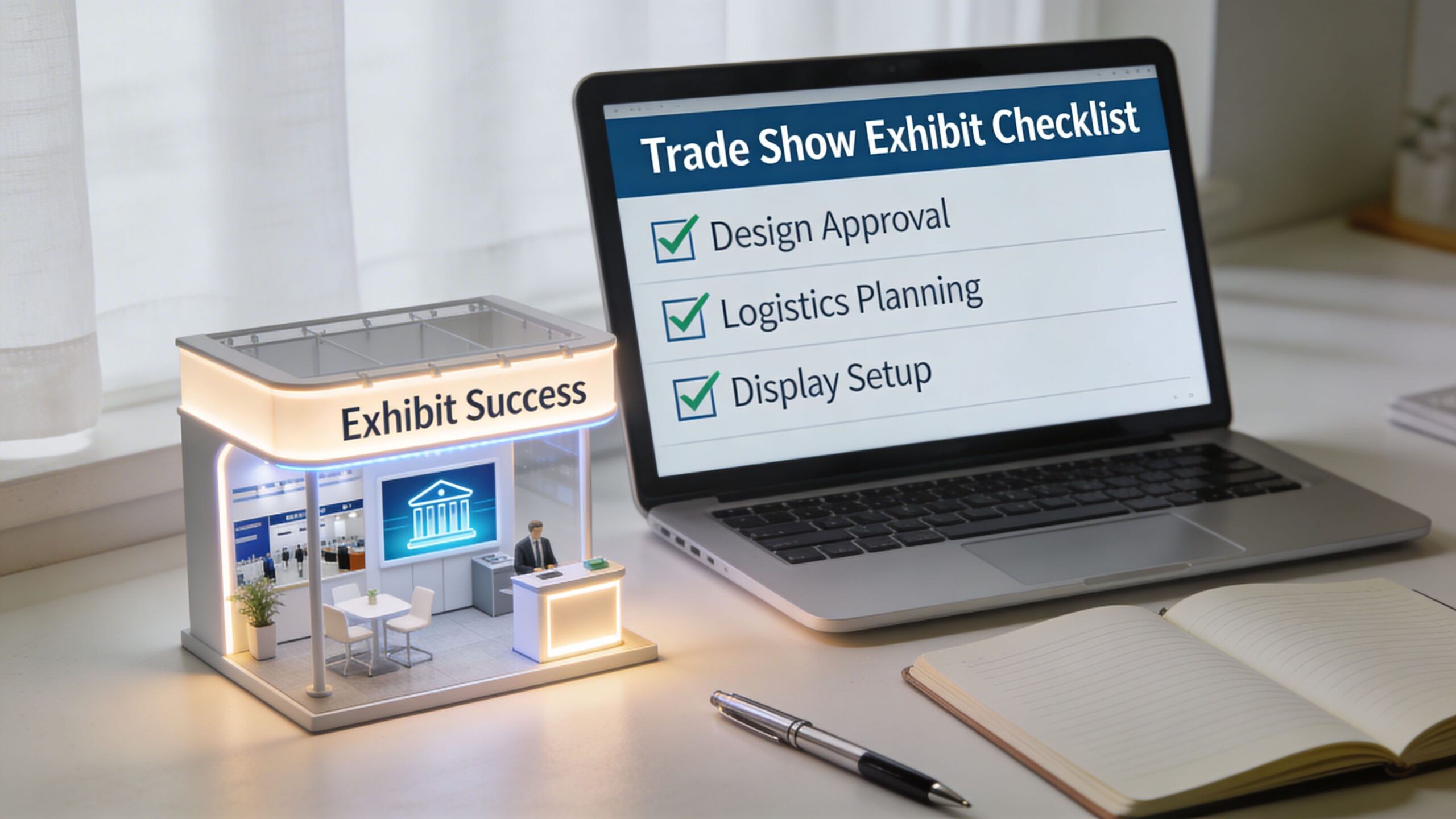
A miniature trade show display booth model sits next to a laptop displaying a project success checklist.

Lock the budget before creative starts

Do not budget only for the booth footprint and display hardware. Build a full event budget that includes content production, show-ordered services, and any requirements the venue bills directly.

A practical budgeting conversation should separate three buckets:

  • Partner-managed costs: Design support, equipment, transport coordination, setup, dismantle, and onsite tech support if included.
  • Show-billed costs: Items such as power and material handling.
  • Marketing costs: Motion graphics, edited loops, demo videos, and lead capture tools.

That discipline prevents a common mistake. Teams approve a booth concept, then discover the actual event spend is larger because no one accounted for operating requirements.

Design content for movement, not for a brochure

A video wall is not a PDF viewer. Content should be easy to understand in passing and strong enough to reward a second look.

Good show content usually has these traits:

  1. Short loops: Keep messages concise and repeatable.
  2. Large focal points: Product visuals, headlines, and motion cues should read from distance.
  3. Simple calls to action: Tell people what to do next, whether that is watch a demo, ask a question, or book a meeting.
  4. Controlled pacing: Fast edits can look chaotic on the floor.
  5. Silent-first design: Assume many viewers will see it before they hear anything.

If a stranger cannot understand the main point of your screen within a few seconds, the content is doing too much.

Confirm logistics early

Turnkey support saves time here, but the exhibitor still needs visibility into the plan.

Review the basics early:

  • Power order: Confirm what the booth needs and when the order is due.
  • Internet needs: Live demos, lead retrieval systems, and streamed content may require more than standard venue access.
  • Load-in schedule: Know your install window and any restrictions.
  • Content handoff dates: Late content causes rushed testing.
  • Onsite escalation: Everyone should know who to contact if anything needs attention.

For teams handling setup coordination internally, this trade show set up guide helps frame the operational side before show week arrives.

Measure the outcome after the booth comes down

The easiest way to misjudge a booth investment is to evaluate it only by gut feeling. Busy booths can still produce weak leads. Quiet-looking booths can still create strong meetings.

Track the results with a simple post-show review:

What to review Why it matters
Lead quality Tells you whether the booth attracted the right audience
Staff feedback Reveals where traffic flow or content created friction
Content performance Shows which visuals sparked conversations
Booth operations Identifies setup or support issues to fix next time

A good partner handles many of the moving parts. A good exhibitor still reviews the outcome with discipline. That combination is what turns one successful event into a repeatable exhibiting system.

Make Your Next Show Your Best Show

Trade shows are expensive places to be invisible.

That is the simplest reason backlit trade show displays keep gaining ground. They help brands get seen. And when the goal is more than visibility, when the booth needs to demonstrate, persuade, and hold attention, seamless LED video walls offer advantages older display formats cannot match.

The details matter. Resolution matters. A 1.9 pixel pitch gives you sharper imagery up close than the 2.5 pitch many exhibitors still get quoted. Seamless construction matters because it keeps the audience focused on the content instead of the hardware. And support matters because even great equipment can fail to deliver if no one owns the execution once the doors open.

The bigger lesson is about total cost of ownership. The cheapest-looking quote is often not the lowest-cost exhibit experience. Not if it leaves your team managing setup problems, support gaps, vague scope, or onsite technical issues while prospects are standing in the booth.

A full-service partner changes that equation. When the pricing includes the major execution pieces and the only separate charges are the ones billed directly by the show, budgeting gets easier. When white glove service covers planning, install, dismantle, and active support, your internal team gets to stay focused on customers. When an audiovisual technician remains onsite during show hours, small issues stay small.

That is what modern exhibiting should feel like. The technology should help your staff sell, not give them one more thing to babysit.

If your current booth still relies on static graphics and hope, this is the right time to evaluate an upgrade. Strong backlit systems pull attention. High-resolution LED walls hold it. The right service model protects the investment from the first planning call to the final teardown.


LED Exhibit Booths helps exhibitors build high-impact trade show environments with seamless LED video wall booths, turnkey logistics, and white glove support. If you want a higher-resolution booth solution with planning, setup, dismantle, and onsite AV help handled for you, talk with LED Exhibit Booths about the right rental or purchase option for your event calendar.
LED Video Wall Price: Your Guide to True Trade Show Costs

You are looking at two wildly different quotes right now for an LED video wall price.

One vendor gave you a low panel price that looks manageable. Another gave you a much higher number and said it is “turnkey.” Then your exhibit house mentioned labor. Your show manual mentioned electrical. Your operations team brought up shipping. The led video wall price is no longer one number. It is a stack of costs, responsibilities, and risk.

That confusion is normal in trade shows. Online price guides usually talk about hardware. Exhibitors pay for outcomes on a show floor.

Why Is Calculating LED Video Wall Price So Hard

A marketing manager usually starts with a simple budgeting question. “What does a video wall cost for our booth?” The answer should be straightforward. It rarely is.

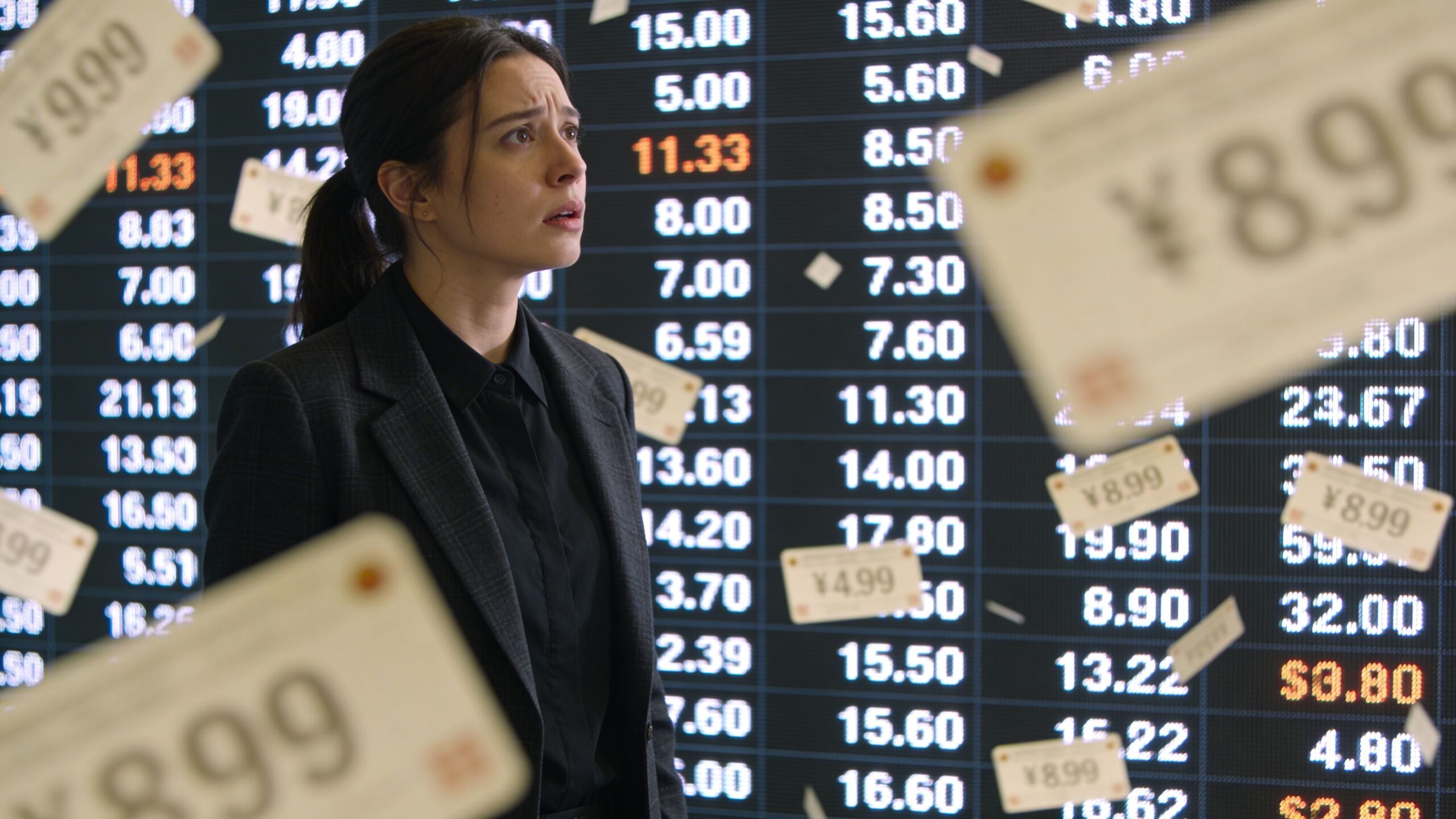
A concerned professional woman standing in front of a digital LED video wall displaying fluctuating market prices.

The first quote might only cover panels. The second might include processing, setup, teardown, and support. A third might sound cheap until you realize it assumes your team will coordinate freight, labor, and troubleshooting. On paper, all three are “video wall” quotes. In practice, they are completely different products.

Trade show buyers run into this constantly. They see a beautiful wall online, ask for pricing, and get a number that does not explain what happens between the warehouse and the show floor. That gap is where budgets get blown.

If you are pricing a booth display, you need to separate hardware cost from event cost. Those are not the same thing. A panel price tells you what the screen costs. It does not tell you what it takes to get that screen into your booth, make it look right, keep it running, and solve problems when the hall opens.

A useful starting point is understanding the difference between raw panel specs and a show-ready system such as an LED panel for video applications. Buyers who skip that distinction usually compare quotes that should never be compared side by side.

The hard part is not finding a number. The hard part is finding the number that reflects what you will spend to exhibit successfully.

What Determines the LED Video Wall Price

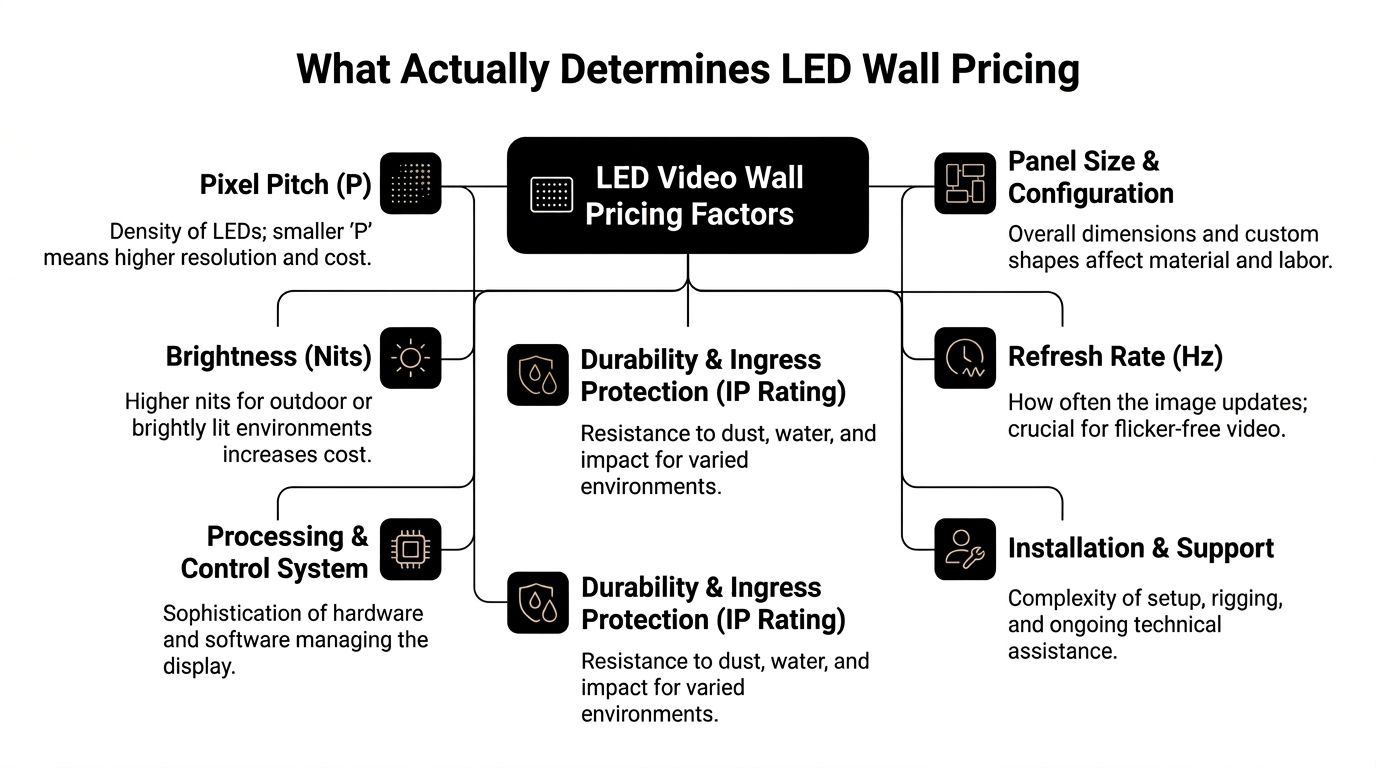
The led video wall price starts with the screen, but the screen is only one layer. Several technical choices shape the final number, and each one affects image quality in a visible way.

Infographic

Pixel pitch changes what people see

Pixel pitch is the distance between LED clusters. Smaller pitch means tighter pixel spacing. Tighter spacing means a sharper image at closer viewing distances.

That matters at trade shows because attendees do not stand fifty feet away. They walk right up to the booth. They take photos. They watch demos from a few feet away. A wall with 1.9 pitch looks noticeably cleaner in that environment than the 2.5 pitch walls many competitors use.

This is similar to comparing two TVs of the same size with different resolution. From across the room, both may seem acceptable. Up close, one looks crisp and premium. The other starts to show its structure.

Size and shape affect more than material cost in the video wall price

A bigger wall costs more, but size alone does not tell the whole story. Configuration matters.

A simple flat back wall is easier to price and deploy than a structure with returns, corners, columns, arches, or suspended sections. Custom geometry affects how many tiles are needed, how they are framed, how content is mapped, and how much labor the setup requires.

If you are still deciding layout, reviewing common video wall sizes helps narrow the discussion before you start collecting quotes.

Indoor quality lives in a different price band

For 2025, the average cost of LED video walls ranges from $800 to $2,500 per square meter, with fine-pitch indoor displays at $2,000 to $2,500 per square meter and large-pitch outdoor displays at $800 to $1,200 per square meter, according to this 2025 LED video wall cost guide.

That range explains why broad online searches can be misleading. A low outdoor billboard number does not tell you much about the cost of a fine-pitch indoor wall for a convention center booth.

Brightness and environment matter and change the video wall price

Trade show halls are tricky lighting environments. Some booths sit under harsh overhead fixtures. Others face open entrances, windows, or bright neighboring displays.

You need enough brightness to hold contrast without washing out content. But brightness is not a spec to chase blindly. Paying for outdoor-level intensity in an indoor booth can be unnecessary if the environment does not require it.

A good quote should account for where the wall will be used, not just list a generic brightness figure and move on.

Processing is the part many buyers miss

Panels display the image. Processing and control systems make the wall behave like one seamless screen.

That means scaling, synchronization, color uniformity, refresh behavior, source switching, and signal stability. If this side of the system is weak, the wall may still power on, but it will not perform cleanly during live demos, camera moments, or fast-moving content.

A smart buyer asks questions about the video wall price like:

  • What processor is included
  • How is content scaled to the wall resolution
  • Will the wall handle live video cleanly
  • Who manages calibration and signal testing on site

Cheap visual hardware paired with weak processing is one of the fastest ways to make an expensive booth look amateur.

Should You Rent or Buy Your Trade Show Video Wall

This decision is less about technology and more about operating model.

Some exhibitors should buy. Most should rent. The right choice depends on show frequency, internal staff capacity, storage tolerance, and how much risk your team is willing to manage.

When buying makes sense

Buying can work if your company exhibits often, uses a consistent booth footprint, and has people who can manage logistics. Ownership gives you control over the asset and lets you standardize a repeatable look.

It also creates obligations. Someone must store the wall, maintain it, track damage, arrange freight, coordinate labor, confirm compatibility, and handle repairs. If your event team is already stretched, ownership often shifts work onto people who were never hired to be AV managers.

There is also the technology question. The global LED video wall display market is projected to grow from US$6.85 billion in 2025 to US$15 billion by 2032, and some panel costs have dropped by nearly 50% in the last four years, which is one reason many exhibitors prefer renting instead of tying capital to hardware that may age quickly, as noted by LEDinside’s market outlook.

If your finance team is weighing ownership structure, this practical guide to equipment financing versus leasing is a useful read before you commit.

Why renting fits trade shows better

Rental aligns with how trade show programs operate. Booth sizes change. Creative changes. Cities change. Labor rules change. Your display strategy may need to adapt from one event to the next.

With a rental, you are not stuck defending an older asset just because you own it. You choose the system that fits the event. You avoid storage headaches. You avoid maintenance planning. You avoid being the person who discovers a damaged tile the morning before install.

Rental also simplifies internal budgeting. Marketing teams usually care about one clean event number. They do not want to split costs across capital equipment, warehouse handling, service contracts, and repair contingencies.

A practical decision filter

Use this framework:

Situation Rent Buy
Booth sizes vary by event Best fit Harder to standardize
Internal AV support is limited Best fit Risky
You want current display quality Best fit Obsolescence risk
You exhibit with the same format repeatedly Possible Can make sense
You want no storage burden Best fit Not ideal

A side-by-side breakdown of whether it is better to buy or rent an LED video wall can help if your team is still split.

Ownership works best when your company wants to run a display program. Rental works best when your company wants to run trade shows.

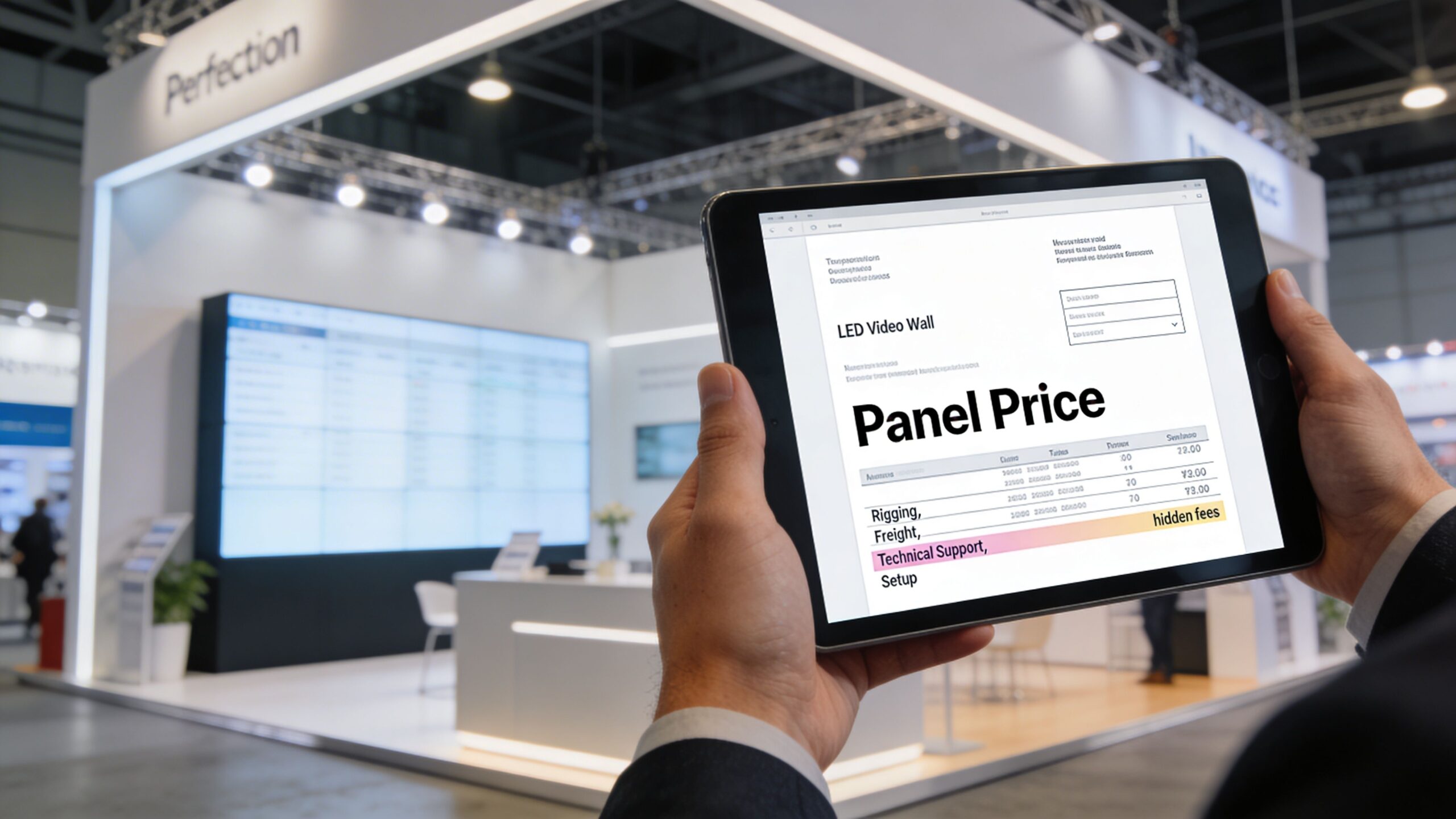
Beyond the Panel Price Hidden Trade Show Fees Add to the LED Video Wall Price

The panel quote is where many exhibitors get trapped.

A purchased wall may look cost-effective until the event-specific charges start landing. Those charges are not side notes. They are often the difference between a manageable program and a painful surprise.

video wall price

Drayage and labor are not optional details

For trade show exhibitors, total cost of ownership often includes overlooked costs like drayage at $50 to $100 per hundredweight and union labor at $75 to $150 per hour per technician, which can add $3,500 to $8,000 per event to a purchased wall. The same source notes that modular, toolless systems can cut those labor costs by 50 to 70 percent, according to this review of trade show LED wall ownership costs.

If you have not dealt with drayage before, it is the venue’s material handling charge. Your crate arrives. The venue or general contractor moves it from receiving to your booth and back out again. You pay for that movement whether the product inside is cheap or premium.

Union labor is similar. In many cities, your own staff cannot build everything themselves. Certified labor crews may be required for setup and dismantle. The more complicated the system, the more hours you buy.

Other costs that hit later add to the total LED video wall price

These line items often appear after buyers think they are done budgeting:

  • Shipping and freight: Especially painful when timing is tight or the system needs special handling.
  • On-site coordination: Someone must receive, inspect, and manage the equipment.
  • Electrical service: Ordered through the show, not the vendor.
  • Troubleshooting coverage: If no one stays with the wall, your team becomes first response.
  • Damage exposure: Purchased inventory can create repair or replacement costs after the event.

A lot of exhibitors miss these items during early planning. This guide on budgeting for your trade show is worth sharing with anyone on your team who touches operations, procurement, or event finance.

Why the cheapest quote often stops being a cheap LED video wall price

A low upfront number usually means one of two things. Either the quote excludes major services, or the system requires more support than the buyer expects.

That is why logistics planning matters as much as panel selection. If your team is moving displays across events, understanding the practicalities of shipping trade show materials is part of pricing the wall.

A panel-only quote is not a trade show budget. It is one line in a trade show budget.

The All-Inclusive Advantage of a Turnkey Rental

The strongest rental model removes work, not just cost.

That matters because show teams do not need one more vendor to coordinate. They need one accountable partner who handles the display from pre-show planning through move-out.

video wall price

What turnkey should mean in real life

A true turnkey rental includes everything needed to get the wall designed, delivered, installed, operated, and removed, except the charges the show bills you directly. In practice, that usually means the show bills for electricity and material handling. The display partner should be covering the rest.

That all-inclusive structure is valuable because it eliminates gray areas. You are not wondering who owns calibration. You are not guessing whether labor is included. You are not finding out on install day that signal distribution was “outside scope.”

White glove service is part of that. Not a marketing phrase. Execution.

Resolution matters on a crowded floor

For trade shows, 1.9 pitch is a meaningful quality threshold. It gives exhibitors a sharper, more refined image at typical booth viewing distances than the 2.5 pitch systems that are still common in the market.

That difference shows up in text, product renders, motion graphics, and close-up conversations. It also affects how premium your booth feels from the aisle. Buyers may not know the term pixel pitch, but they absolutely notice image quality.

The processor matters as much as the panel and influences the LED video wall price

Video processing and control systems can represent 20 to 40 percent of an LED wall’s total cost, and using high-end processors with refresh rates of 3840Hz+ is critical for preventing flicker and moiré on camera during live demos, according to Neoti’s breakdown of LED video wall cost and processing requirements.

This is one of the biggest gaps between professional rentals and bargain packages. Cheap packages often focus attention on the wall surface while downgrading the processor behind it. That is a mistake if your booth includes presentations, product demos, filming, interviews, or any content people will view up close.

On-site support changes the risk profile but doesn’t add to the LED video wall price

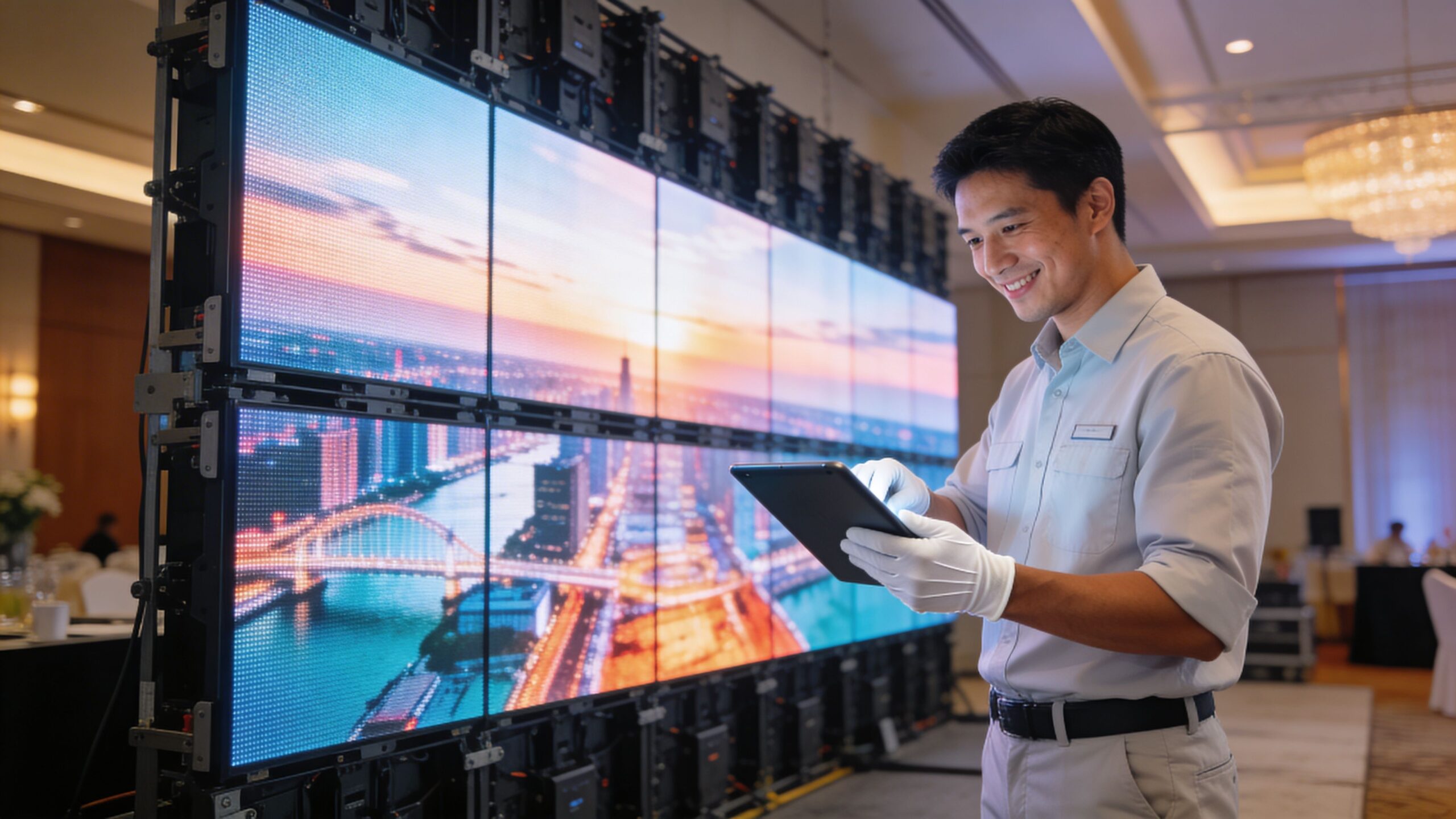
One of the most underrated parts of a good rental is having an audiovisual technician on site for the full time the show is open. Naturally, many vendors charge extra if you want an AV Technician on call. However, we include that peace of mind in the price. Obviously, it costs money to fly the audiovisual technician back home after setup and costs money to fly the technician back to dismantle the booth at the end of the show. For that reason, we prefer to simply leave our AV Technician at the show the entire time the show is open. Consequently, you get peace of mind knowing someone is just a phone call away. At the same time, we aren’t flying people back and forth. 

That changes everything. If content fails, if a source drops, if settings need adjustment, your booth staff does not stop selling to troubleshoot a display. They text or call, and someone resolves it quickly.

A proper LED video wall rental should not end at installation. Trade shows are live environments. Support during show hours is part of the product.

The best rental quote is not the one with the lowest starting number. It is the one that leaves your team free to meet customers while the display runs without drama.

Real-World LED Video Wall Price Examples

Most buyers do not think in cost per square meter. They think in booth formats. That is the practical way to budget.

The examples below are not panel-only numbers. They are typical turnkey rental ranges for common trade show scenarios. Final pricing depends on show city, booth design, content complexity, duration, rigging needs, and support scope.

Sample turnkey rental ranges

Booth Size Common Configuration Typical Turnkey Rental Range
10×10 inline Single LED back wall Custom quote based on show, but maybe $20,000 – $25,000
10×20 inline Full back wall with integrated demo area Custom quote based on show, but maybe $30,000 – $40,000
20×20 island Multi-sided LED structure, columns, or archway Custom quote based on show, but maybe $40,000 – $60,000
Small product launch space LED feature wall plus branded counter Custom quote based on show, but maybe $20,000 – $25,000

Why examples stay custom

Two booths with the same footprint can price very differently.

One may use a simple rectangular wall and looped brand content. Another may need custom framing, live presentations, source switching, embedded product messaging, and full-time technical oversight. Same size. Very different led video wall price. Plus, the number of days the show is open matters. Of course, labor costs are higher in a union city compared with a non-union city. Additionally, if the setup or dismantle is on a weekend or holiday then labor cost are higher.

This is also why experienced vendors ask better questions at the start:

  • What city is the show in
  • How many open days
  • Is the wall camera-facing
  • Will you run live demos or only playback
  • Do you need the structure to do more than act as a backdrop

A better way to use sample numbers

Use examples to set expectations, not to lock a budget prematurely.

If you need a rough planning number, ask for a turnkey estimate tied to your booth size, your city, and whether support stays onsite during show hours. That will get you much closer to reality than shopping by panel dimension alone.

One practical note from the field: a smaller wall with excellent content and clean support usually performs better than a larger wall that your team cannot manage confidently. On crowded floors, reliability and polish beat raw size.

Smart Ways to Reduce Your Video Wall Price Budget

Reducing cost does not mean chasing the cheapest wall. It means cutting waste while protecting the parts attendees notice.

Book early and lock the right scope

Last-minute design changes create expensive problems. So does waiting too long to reserve inventory, labor, and freight windows.

Early planning gives you better control over screen size, content formatting, and booth integration. It also gives your vendor time to recommend a simpler structure if one will accomplish the same visual goal.

Reuse content intelligently

Trade show content gets expensive when every show starts from zero.

Build motion graphics, product loops, and branded background elements that can be adapted across events. Then create only the event-specific pieces fresh. That approach keeps the wall dynamic without forcing a full content rebuild every time.

Design for modularity

A modular tile system gives you options. The same general package can often be reconfigured for different footprints or creative concepts.

That is much better than specifying a one-off structure that only fits one booth layout. Buyers save money when they plan a display system that can evolve with the event calendar.
  • Trim complexity first: Simplify shapes before cutting image quality.
  • Protect resolution: Fine pitch is usually worth preserving in close-viewing booths.
  • Ask about included support: Cheap packages become expensive when small issues require emergency fixes.

If you must choose, reduce size before you reduce reliability.

Your Video Wall Rental Questions Answered

How far in advance should I book

Earlier is better, especially for major shows. Good inventory, experienced labor windows, and thoughtful content prep all get tighter as the event approaches.

Is a 1.9 pitch wall really better than 2.5

Yes, for typical indoor trade show viewing distances it is visibly sharper. Text reads cleaner, motion looks more refined, and close-up conversations happen in front of a more premium image.

What should be included in a turnkey quote

Everything needed to deliver, install, operate, and remove the wall should be clearly included, except the charges the show bills directly, such as electricity and material handling.

Do I need an on-site technician

For a serious trade show program, it is a strong advantage. If anything changes or fails during show hours, your booth team should stay focused on attendees, not screens.

Should I buy if I exhibit often

Maybe, but only if your organization can manage storage, freight, setup coordination, maintenance, and repair responsibility without straining the event team.

What is the biggest mistake buyers make

They compare a panel quote with a turnkey quote as if both represent the same thing. They do not. One prices equipment. The other prices execution.


If you want a clear, all-in quote instead of another vague hardware number, talk to LED Exhibit Booths. Our turnkey rental model includes everything except the charges the show bills you directly, such as electricity and material handling. As a result, you get higher-resolution 1.9 pitch video walls, white glove service, and an on-site AV technician throughout show hours so your team can focus on customers, not troubleshooting.

Video Wall Pricing: Your 2026 Trade Show Budget Guide

Let’s make sense of video wall pricing. For instance, you open three quotes for what looks like the same trade show video wall and the spread is huge. One looks suspiciously low. One feels high. One is full of line items you do not recognize, and none of them make it easy to answer the only question that matters.

What will this cost me by the time the show opens?

That confusion is normal. Video wall pricing is rarely just the cost of screens. It is a mix of display technology, pixel pitch, processing, logistics, labor, show services, and support. The problem is not that pricing varies. The problem is that many quotes hide where and why it varies.

On a trade show floor, that matters more than most buyers realize. A wall that looks fine on paper can look soft up close. A “cheap” quote can become expensive once processors, setup, dismantle, freight, and troubleshooting are added back in. And if something fails during show hours, the savings disappear fast.

Why Is Video Wall Pricing So Complicated

The trade show buyer sees the same pattern. Two vendors promise an LED wall. Both show attractive renderings. Both claim a turnkey experience. Then the quotes arrive and the numbers are nowhere near each other.

That gap happens because the product is not just the wall. It is the wall, the control system, the mounting method, the content requirements, the crew, the shipping plan, and the level of support standing behind it. If even one of those is treated differently, the quote changes.

The category itself is expanding quickly. The global video wall market was valued at USD 10.23 billion in 2024 and is projected to grow at a CAGR of 11.7% to reach USD 20.37 billion by 2030, with North America accounting for over 35% of global revenue, according to Grand View Research’s video wall market report. Growth creates more options. More options create more pricing variation.

What buyers think they are comparing in video wall pricing

Most exhibitors think they are comparing screen size.

They are not. They are comparing different image resolutions, different panel quality levels, different processors, different rigging assumptions, different service models, and very different ideas of what “included” means.

A low quote often leaves out expensive pieces until later. A high quote sometimes includes those pieces from the start. Without reading scope carefully, the cheaper number can look better even when it carries more risk.

Why trade shows make pricing harder

Trade shows add pressure that permanent installs do not have.

You have fixed move-in windows, venue rules, power deadlines, freight handling, and no tolerance for downtime. If a boardroom display goes dark, people reschedule a meeting. If a trade show wall goes dark, it happens in front of prospects, partners, and your own team.

Practical takeaway: The right way to compare video wall pricing is not panel against panel. Compare full event delivery against full event delivery.

That means asking a harder question than “How much is the wall?” Ask, “What does it cost to have this wall working properly, on time, for the full run of the show?”

The Core Technology Drivers of Video Wall Cost

The single biggest driver in video wall pricing is pixel pitch. If you understand that, most of the quote starts to make sense.

Pixel pitch is the distance between LED pixels, measured in millimeters. Smaller pitch means tighter pixel spacing. Tighter spacing means a sharper image at close range. It also means higher cost because the display packs in more LEDs and requires more precise manufacturing.

Why pixel pitch changes the number in video wall pricing so much

Fine-pitch indoor displays in the P0.6 to P2.5 range can cost $2,000 to $2,500 per square meter, and halving the pixel pitch can double the cost because it requires far more LEDs per square meter, as explained in this LED video wall cost guide from Reiss Optoelectronics.

That is why a premium P1.9 wall and a more common P2.5 wall do not price the same, even if the footprint is similar.

For trade shows, that difference matters because most attendees stand close to the booth. They are not viewing from the back of an arena. They are often just a few feet away, reading text, watching product animation, or looking at a presenter standing in front of the screen.

Our standard pitch is 1.9, while many competitors quote 2.5. That means our walls deliver higher resolution for close viewing. On a crowded floor, that shows up in three places:

  • Text clarity: Smaller pitch keeps headlines, UI elements, and product labels cleaner at short distance.
  • Image smoothness: Gradients and fine edges look more refined instead of slightly blocky.
  • Camera friendliness: Booth photography and recorded walkthroughs tend to look more polished.

For buyers comparing options, this page on LED panels for video walls is a useful reference point for how modular booth-integrated LED systems are built.

This video can help you decide if you should buy or rent a video wall for trade shows.

The hardware choices that also move cost of video wall pricing

Pixel pitch is the headline item, but not the only one.

Size and shape

A simple flat wall is easier to quote and deploy than a booth with columns, corners, arches, or wraparound surfaces. More structure means more engineering, more panels, and more coordination.

Panel quality

Not all panels perform the same under trade show conditions. Alignment, color consistency, and serviceability matter. A wall that is easy to assemble and fine-tune saves headaches during installation and reduces visible seams.

Processing

A wall is only as good as the system driving it. If content has to switch sources, scale cleanly, or look good on camera, processing quality matters. Cheap hardware can make an expensive wall look average.

Buyer tip: If your booth relies on close-range viewing, product demos, or live camera capture, do not let a vendor swap in a larger pixel pitch just to lower the quote.

What does not work well is buying the lowest pitch you can find without considering support, or buying the cheapest wall possible and hoping content will make up for weak resolution. It does not.

Renting vs Purchasing Your Video Wall A Financial Breakdown

The rent-versus-buy decision is less about ideology and more about show frequency, internal capability, and appetite for ownership headaches.

Some exhibitors should buy. Many should not.

Where renting makes more sense

If you exhibit occasionally, rent. If your booth sizes change from show to show, rent. If your team does not want to manage storage, maintenance, repairs, and logistics, rent.

As of 2026, hybrid rental models are becoming more common. For close-viewing booths, a P1.9 to P2.5 wall can be rented for $1,000 to $5,000 per day, and that pricing now includes processors and mounts, according to this 2026 video discussion on LED wall rental pricing.

That matters for small and mid-sized exhibitors because it makes good LED more accessible without forcing a capital purchase.

If you are evaluating short-term event use, LED video wall rental options are worth reviewing before you commit to ownership.

Where purchasing makes more sense

Buying starts to make sense when a company exhibits frequently, uses a fairly consistent footprint, and has the internal systems to manage the asset well.

Ownership can work for brands that:

  • maintain a year-round events calendar
  • reuse the same content formats
  • have storage and freight processes already in place
  • can support maintenance planning

What trips buyers up is that ownership is not just a hardware purchase. It becomes an operations project.

Video Wall Rental vs. Purchase Comparison

Consideration Renting Purchasing
Upfront spend Lower initial commitment Higher initial capital outlay
Technology refresh Easier to access newer display options You own what you bought until you upgrade
Booth flexibility Easier to scale for different events Best when booth dimensions stay consistent
Storage and maintenance Usually handled by provider Your team handles storage, upkeep, and repairs
Logistics burden Lower if the provider offers turnkey service Higher, especially across multiple venues
Risk of obsolescence Lower Higher
Best fit Occasional exhibitors, changing footprints, lean event teams Frequent exhibitors with repeatable booth programs

The Trade-Off in Video Wall Pricing

Renting is better for preserving flexibility and avoiding hidden ownership work.

Purchasing can lower long-term event costs for the right exhibitor, but only when the company is disciplined enough to manage the asset properly. A lot of buyers focus on “cost per show” and ignore everything that happens between shows. Storage, refurbishment, shipping coordination, and spare parts can turn an attractive ownership model into a burden.

What does not work is buying because it feels financially responsible, then discovering your team does not want to become a display logistics department.

Decoding the Quote The Power of Turnkey Service

Many buyers get misled here. They compare a turnkey quote against an a la carte quote as if both numbers represent the same thing.

They do not.

A panel-only or lightly bundled quote can look cheaper because it leaves out the expensive, annoying, failure-prone parts of the job. Those parts still exist. They just show up later.

What hides inside the lower quote in video wall pricing

Beyond the panels, video processing and system integration can account for 15 to 25% of total costs, and a processor capable of flicker-free broadcast can add $5,000 to $15,000 to a setup, according to Smart LED’s video wall pricing breakdown.

That is one of the most common quote traps.

A buyer sees a strong panel price and assumes the hard part is covered. Then the full scope emerges:

  • processor
  • sending equipment
  • mounting hardware
  • cable management
  • setup crew
  • dismantle crew
  • on-site troubleshooting
  • freight coordination
  • testing and calibration

If those are not clearly included, they are risks.

What we include and what the show bills directly

Our pricing model is simple. Our price includes everything except the bills the show sends you directly.

That means we include the event-side delivery work needed to get the wall to your booth and operating properly. The show’s direct charges are separate. The clearest examples are electricity and material handling.

We also provide white glove, turnkey service. We handle the details so your team can focus on attendees, meetings, demos, and lead capture instead of trying to manage AV issues from the aisle.

For exhibitors comparing full-service partners, this trade show display company page shows the type of integrated booth delivery model that fits this approach.

Why on-site support matters more than people think

A quote is not only about equipment. It is also about response time when something goes wrong.

We leave an audiovisual technician onsite the entire time the trade show is open. If there is an issue, you call or text and an AV technician comes to the booth within minutes to resolve it. Naturally, it’s the same AV technician we use for conference audiovisual setups.

That is a different service model from a provider who installs the wall, leaves the hall, and hopes nothing fails.

Key question to ask every vendor: “Who is physically responsible for fixing the wall during show hours, and where will that person be when the floor is open?”

What works is predictable scope. What does not work is discovering, two days before move-in, that “turnkey” meant panels on pallets plus a few assumptions.

Navigating Hidden Show Floor Fees Drayage Electricity and Labor

Some costs are not controlled by your video wall vendor. They come from the show, the venue, or the general contractor. Buyers need to separate these from the display quote or they will budget incorrectly.

Frustration often starts here. A client thinks the vendor added surprise costs. In reality, the venue did.

Drayage is not shipping

The most misunderstood fee on a trade show floor is drayage, also called material handling.

Shipping gets your crates to the venue. Drayage is what the show contractor charges to receive those materials, move them to your booth, store empties, and return them after the show. It is a separate charge, and it can be painful if you did not plan for it.

Complete LED systems can range from $2,500 for small setups to over $100,000, but that often excludes mandatory show services. Installation can add $500 to $3,000, and shipping plus material handling can add 15 to 30% to total event expenditure if not budgeted properly, according to Vibo LED’s cost guide.

Electricity is a show order, not a vendor markup – It’s not included in our video wall pricing

LED walls need power, and the venue bills for it. That charge comes from the show service provider, not from the display company.

Order it early. Late orders often create avoidable stress, and under-ordering power can cause operational problems once the wall is installed and content starts running.

If your team needs a primer on freight planning around these event charges, this guide to shipping trade show materials is a practical place to start.

Labor rules can change what is possible

Venue and union rules affect who can move equipment, who can install it, and how long setup takes.

That does not mean every show becomes difficult. It means the provider needs to know the rules before move-in, not after. A good event plan accounts for them in advance.

Here is the cleanest way to think about show-floor fees:

  • Vendor-managed scope: Equipment, prep, integration, booth-side AV execution, and support.
  • Show-billed scope: Electricity, material handling, internet, and venue-mandated labor rules.
  • Shared planning area: Scheduling, paperwork, delivery timing, and booth readiness.

Budgeting habit that saves pain: Build two columns in your event budget. One for vendor costs. One for show-billed costs. Do not mix them.

What does not work is blaming the wrong line item. When buyers separate vendor scope from show scope, video wall pricing becomes much easier to evaluate.

Smart Strategies to Maximize Your Video Wall Pricing Budget

A smart buyer does not chase the lowest quote. A smart buyer matches the wall to the job.

That starts with asking what the wall needs to do. Brand presence? Product storytelling? Live demos? A backdrop for presentations? Once that is clear, budget decisions get cleaner.

Match pitch to actual viewing distance

For close-viewing booths, a P1.9 to P2.5 rental can be the right fit, and the current rental market for those walls often falls in the $1,000 to $5,000 per day range with processors and mounts included, based on the 2026 rental trend discussion here.

That does not mean every booth needs the finest pitch available. It means you should choose the pitch that suits how attendees will view the content.

If your audience will stand close, cheaper larger-pitch walls often look worse than expected. If your audience views from farther away, you may not need to pay for extremely fine pitch.

Design the wall around the booth, not the other way around

Modular LED is most cost-effective when you use only as much display as the experience requires.

A few practical examples:

  • A smaller inline booth may benefit more from one strong seamless canvas than from trying to wrap every surface in screen.
  • An island exhibit may justify multiple faces or architectural shapes if they support traffic flow and storytelling.
  • A product launch may need a wall optimized for motion graphics and timed demos, not a broadcast-grade configuration built for camera work.

For teams thinking about budget and booth performance together, this article on how LED exhibit booths can increase ROI at trade shows adds useful context.

Spend where attendees will notice

There are smart corners to cut and uninformed corners to cut in video wall pricing.

Smart:

  • simplify content layouts
  • use the right wall size for the space
  • rent when your show calendar changes often

Uninformed:

  • downgrade pitch too far for close viewing
  • choose a wall without dependable support
  • accept vague scope language in the quote

Keep the content realistic

A great LED wall cannot rescue weak content.

If the message is cluttered, the wall will display clutter beautifully. If the content is made for a different screen shape and stretched at the last minute, the booth will look improvised no matter how good the hardware is.

The best budgets put enough money into the screen, enough thought into the content, and enough discipline into the execution.

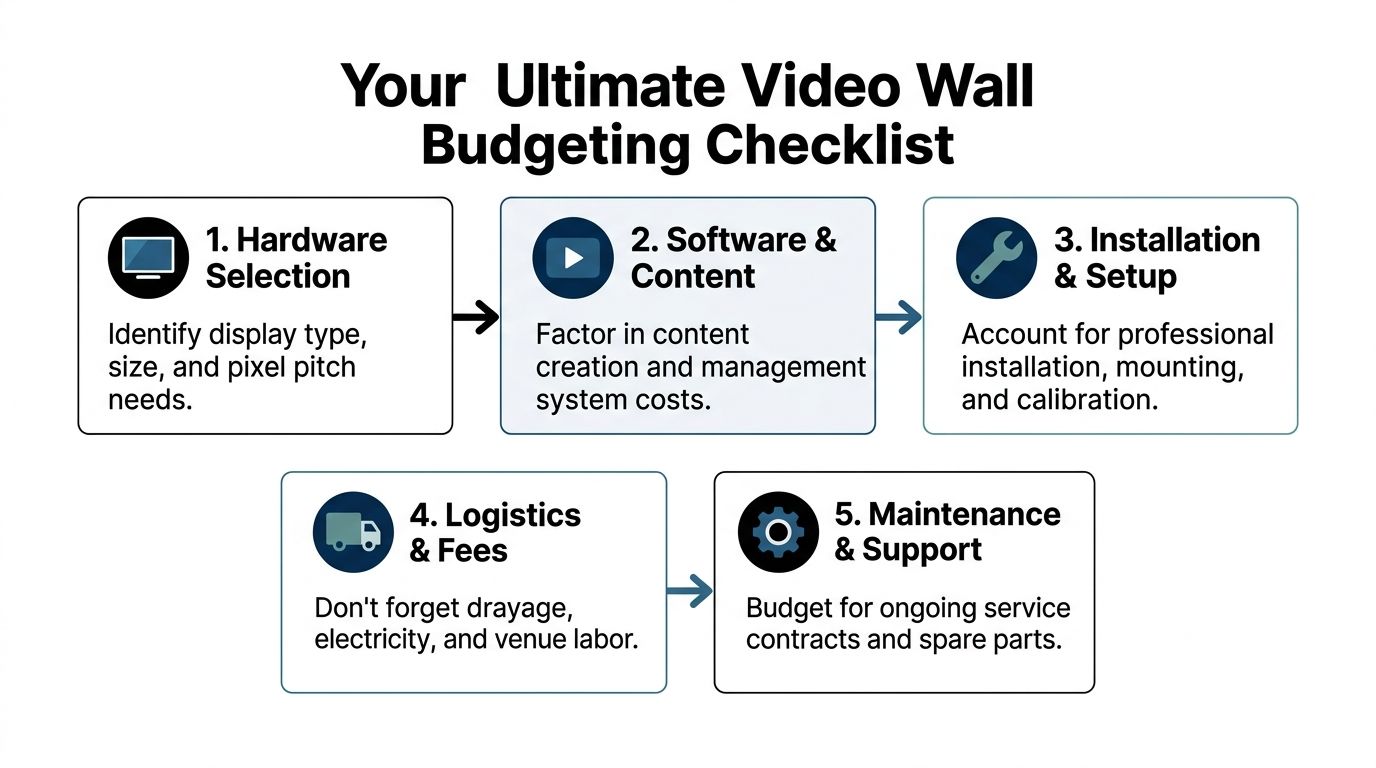
Your Ultimate Video Wall Pricing Budgeting Checklist

Most budgeting mistakes happen before the first quote arrives. The team has not defined priorities, has not separated vendor scope from show scope, and has not decided what the wall needs to accomplish.

Use this checklist before you approve a display concept or compare prices.

video wall pricing

Start with the booth objective

If the wall is meant to stop traffic, the design approach will differ from a wall meant to support demos or presentations.

Ask:

  1. Is the goal brand impact, lead generation, product education, or all three?
  2. Will attendees view the wall from close range, aisle distance, or both?
  3. Does the wall need to support live presentations, multiple sources, or simple playback?

Define the technical requirements early

Do not request pricing without basic requirements.

Include:

  • Booth size: Inline, peninsula, or island changes everything.
  • Wall role: Hero backdrop, architectural element, demo canvas, or integrated booth structure.
  • Viewing distance: This drives pitch selection.
  • Content format: Static loops, motion graphics, live video, or presentations.

Ask for quote clarity in writing

Disciplined buyers protect themselves here.

Confirm these items:

  • Hardware scope: Panels, processing, mounts, and all required accessories.
  • Service scope: Delivery, setup, dismantle, testing, and show-hour support.
  • Exclusions: Ask the vendor to state plainly what is not included.
  • Failure response: Who fixes issues during live show hours?

Checklist rule: If a quote says “turnkey,” ask the vendor to define turnkey line by line.

Build a separate show-services budget

Do not assume your vendor controls venue billing.

Create a separate line for:

  • Electricity
  • Material handling
  • Internet if needed
  • Any show-specific labor or venue requirements

Review the final plan like an operator

Before sign-off, make sure someone on your team can answer these practical questions:

  • Who is shipping what, and when?
  • Who is the day-of-show contact?
  • What content files are due, and by what date?
  • What happens if a panel, processor, or source fails mid-show?

That final review catches the issues that become expensive.

Frequently Asked Questions About Video Wall Pricing

How much does a trade show video wall usually cost

There is no single honest answer without scope. Pricing depends on pitch, size, shape, processing, support model, and whether you are renting or buying.

At the broad market level, complete LED systems can range from small basic setups to very large high-resolution builds, but trade show buyers should be far more interested in what the quote includes than in any abstract starting number.

Why is one quote so much cheaper than another

Usually because the scopes are different.

The cheaper quote may use a larger pixel pitch, weaker processing, fewer included services, or limited support. It may also exclude items that are essential but easy to leave off the first version of a proposal.

Compare the full deliverable, not the headline number.

Is P1.9 really worth it over P2.5

For many trade show applications, yes.

If attendees will stand close to the wall, read text, watch product visuals, or take photos and video near the booth, the higher resolution of 1.9 pitch is noticeable. If the wall is viewed from farther away, the case becomes more situational.

Is content creation included in the price

Not automatically.

Vendors vary. Some provide guidance on formatting and playback requirements. Custom content creation is often a separate service unless the quote specifically includes it. Buyers should ask this early, because content decisions affect screen performance more than many people expect.

What happens if a panel or component fails during the show

This is one of the most important questions to ask.

Our model includes an AV technician onsite for the entire time the trade show is open. Naturally, we bring spare parts to every trade show. If something goes wrong, you call or text and the technician comes to the booth to resolve it. That is the difference between active show support and passive equipment rental.

Are electricity and drayage included in the video wall price

No, not if the show bills you directly.

Those are venue or show-contractor charges. A trustworthy vendor should tell you that clearly instead of burying the distinction.

How far in advance should I book a video wall

Earlier is better, especially for major shows and custom booth concepts. Of course, for a stress free show, we recommend booking us at least 3 months in advance.

Booking early gives your team more room for design coordination, content prep, logistics planning, and show paperwork. Last-minute bookings reduce options and increase pressure and stress. For instance, with early booking you’ll have plenty of time to design the graphics and video. Conversely, with last minute booking your designer is under pressure to design graphics fast.

Should I rent or purchase

Rent if you want flexibility, lower commitment, and fewer operational headaches.

Purchase if you exhibit frequently, have a stable booth program, and can support storage, maintenance, and logistics. The right answer depends less on preference and more on how disciplined your event operation is. Of course, we suggest that if you do 1-2 shows per year, rental is the way to go. However, when you do 4-6 shows per year you should consider buying. Naturally, when you are doing 6-10 shows per year, buying your own LED video wall booth is the way to go.

What is the biggest mistake buyers make with video wall pricing

Treating the display like a commodity.

A trade show video wall is not just a screen size and a price. It is a live event system with real operational consequences. Buyers who focus only on the cheapest number often end up paying for omissions, delays, stress, or weak on-floor performance.


If you want a quote that reflects the full event cost, not just a tempting partial number, talk with LED Exhibit Booths. We provide trade show video wall displays with an all-inclusive, white glove service model, including everything except the show bills you directly for, such as electricity and material handling.

Boost Impact: Top Rentals for Trade Shows

Rentals for trade shows help you have a new look at every show while keeping your costs down. You have a show date on the calendar, the space is reserved, the team has talking points, and the budget has already been defended internally. Then a significant concern shows up. Your booth still has to earn attention in a hall full of companies that also paid to be there.

That is why rentals for trade shows deserve a more strategic look than they usually get. A rental is not just a backup plan for companies that do not want to buy. It can be the smarter way to put better technology, better support, and less operational risk on the floor.

The shift is obvious in the market. Companies report an average ROI of $20.98 for every $1 spent on trade shows, and nearly 40% of businesses plan to increase their trade show budget in 2026 according to these trade show statistics. When the upside is that strong, the cost of blending in gets harder to justify.

Why Your Rentals for Trade Shows Disappear on a Crowded Show Floor

The problem usually is not effort. It is sameness.

A team spends months planning a launch, approves graphics, ships samples, books travel, and arrives at the venue expecting momentum. Then the floor opens. Across the aisle, another booth has a fabric backwall. Two booths down, a competitor is running a looping product reel on a pair of monitors. Ten more exhibitors are using the same visual language. Everything starts to flatten.

rentals for trade shows

Static rentals for trade shows lose the first battle

Attendees make fast decisions. They scan shape, motion, brightness, and visual clarity before they read a headline or ask a question.

If your exhibit relies on printed panels and a few disconnected screens, you are asking people to work too hard to understand what you do. Most will not. They keep walking until something feels more current, more active, or easier to process from a distance.

That is where many old-school rentals for trade shows fall short. They solve for footprint and basic presence. They do not solve for visibility.

Attention is part of the ROI equation

Trade shows can produce strong returns, but only if your booth creates enough stopping power to start conversations. The financial case for exhibiting is real. The tactical challenge is converting floor traffic into qualified engagement.

Practical takeaway: If your booth does not stand out in the first few seconds, your team ends up working harder to compensate for a weak environment.

The issue is not only aesthetics. It affects everything downstream.

  • Fewer stops: Your staff spends more time prospecting outward instead of welcoming people in.
  • Weaker demos: Product stories feel fragmented when content is split across separate screens and printed messaging.
  • Lower recall: Attendees may remember the category, but not your brand.

The booth rentals for trade shows have to act like media

On a packed show floor, your structure is not just architecture. It is your broadcast surface.

That means the rental decision should be treated like a media decision. What are people going to see from the aisle? What feels premium up close? What supports movement, storytelling, and brand clarity without adding complexity for your team?

The answer is rarely a taller banner or one more monitor. It is usually a better display system.

The Modern Rentals for Trade Shows Seamless LED Video Wall Booths

A modern LED rental booth works less like a traditional exhibit and more like a flexible digital building system. The easiest way to think about it is this. The booth is no longer a frame that holds a screen. The booth itself becomes the screen.

rentals for trade shows

How modular LED walls work

Modular LED systems use lightweight tiles that connect with magnets and toolless locks. That matters because it changes both the look and the labor profile of the booth.

Instead of stacking flat panels with bezels, gaps, mounts, and cable clutter, the tiles snap together into one continuous visual surface. Walls, corners, columns, arches, and islands can all carry content without the visual breaks that make traditional monitor arrays look patched together.

Modern modular LED systems use high-powered magnets and toolless locks, reducing setup time by up to 70% compared to legacy truss systems. This magnetic alignment ensures sub-millimeter pixel registration, which is essential for achieving a seamless look with fine-pitch tiles (1.9mm-2.5mm) and has been shown to boost viewer engagement by 40% in eye-tracking studies, as described in this overview of trade show display rentals.

That technical point has a visible consequence. The content feels unified. Motion graphics move cleanly around corners. Product visuals do not break at the edges of separate monitors. The booth reads as one designed experience.

Why 1.9 pitch matters up close in rentals for trade shows

Pixel pitch is the distance between LED pixels. Smaller pitch means higher resolution at closer viewing distances.

Our standard pitch is 1.9, while many competing rentals sit at 2.5. The practical difference is simple. Your visuals look sharper when someone stands near the wall. Text holds together better. Fine details in product renders stay cleaner. Brand videos look more polished instead of slightly coarse.

For trade shows, that matters because attendees do not only view your booth from across the aisle. They step right up to it. They stand a few feet away during demos. They take photos. They look at technical diagrams, UI screens, packaging details, and motion assets from close range.

A wall that looks good at distance but soft up close undercuts the premium impression you are trying to create.

Tip: If your content includes product UI, small typography, or detailed animation, ask to see it on the actual pitch you will rent, not just a generic mockup.

The structure becomes part of the story

A seamless LED booth gives you more than a large display. It changes how you use the space.

You can turn a corner into a continuous brand narrative. You can wrap a column with motion graphics. You can build a backwall that shifts from atmosphere to product demo to lead capture prompt over the course of the day. For companies evaluating LED video wall rental options, that flexibility is often the key advantage, not just the visual impact. Plus, the same video wall technology can be used for conference audiovisual

What works and what does not in rentals for trade shows

What works is using the wall as one coordinated canvas. One message at a time. Strong motion. Clear transitions. Readable calls to action.

What does not work is treating a high-end wall like a giant slideshow. If the booth has advanced display hardware but the content is static, cluttered, or overloaded with tiny text, the system is underused.

The display should simplify your story, not add another layer of noise.

Renting vs Buying A Strategic Decision Framework

For most exhibitors, the rent-versus-buy question is not about preference. It is about usage pattern, internal process, and tolerance for operational overhead.

If you exhibit constantly, use the same footprint, and want long-term control of a stable booth system, ownership can make sense. If your schedule changes, your booth sizes shift, your campaigns evolve, or you want current display tech without carrying the burden of ownership, renting is usually the cleaner decision.

rentals for trade shows

The comparison that matters

A lot of teams compare only the initial invoice. That is too narrow.

A thorough comparison includes storage, maintenance, repairs, logistics, refurbishment, and whether your owned booth still reflects the brand six or twelve months from now. It also includes internal friction. A rented system can be aligned to the event. An owned system often pushes the event to fit the asset.

Here is a practical side-by-side view.

Factor Renting Buying
Upfront commitment Lower initial commitment and easier to approve for a specific event Higher initial capital commitment
Design flexibility Easier to adapt booth size, shape, and messaging by show Better if your program needs the same configuration repeatedly
Technology freshness Access to current display formats without owning aging hardware You manage obsolescence and upgrade timing
Storage No long-term storage burden for your team You need a storage plan
Maintenance Provider handles service, prep, and replacement planning Your team or vendor must maintain the asset
Shipping strategy Built around the specific event and booth design You ship the same owned assets repeatedly
Brand consistency Strong when managed well, with room to tailor by audience Useful when consistency across shows is the top priority
Risk if plans change Lower, because the program can be adjusted show by show Higher, especially if your footprint or campaign changes
Internal operations Simpler for lean teams Better for teams with established exhibit operations
Best fit Brands that want flexibility, support, and current tech Brands with frequent use and stable requirements

When rentals for trade shows usually wins

Renting is usually the better strategic move when your team wants agility.

That includes situations like these:

  • Changing show sizes: You may need a compact inline booth at one event and a larger island at another.
  • Different messages by market: Product launches, regional priorities, and campaign themes change faster than owned structures do.
  • Lean internal teams: If nobody wants to manage warehousing, repairs, and shipping coordination, renting removes that load.
  • Technology-sensitive presentation: LED formats evolve. Renting helps you avoid being locked into older hardware.

A lot of companies also underestimate how often their exhibit needs revision. Messaging changes. Product lines expand. Brand standards get updated. What felt like a good owned solution can start looking dated long before accounting says it should.

When buying may still be right

Buying can be the right move if your exhibit program is highly repeatable and operationally mature.

That usually means:

  • Your team exhibits often in similar footprints.
  • The brand presentation stays consistent across events.
  • You have a process for storage, maintenance, and logistics.
  • You want direct control over owned assets.

Decision rule: If your event calendar and booth requirements stay stable, buying deserves consideration. If they move around, renting protects flexibility.

For a more focused look at the trade-offs, this guide on whether it is better to buy or rent an LED video wall is a useful planning reference.

A hybrid approach can also work

Some exhibitors split the difference. They keep a few branded assets they want to reuse, then rent the LED structure, support components, or event-specific elements around them.

That model works well when you want continuity without forcing every show into one fixed physical design. It also gives agencies and in-house marketers more room to refresh the experience without starting from zero each time.

Budgeting and Logistics for Your Rentals for Trade Shows

Once you decide to rent, the next question is usually less about design and more about certainty. What exactly is included, what will the show bill separately, and when do all the moving parts need to be locked?

That is where many exhibit projects get muddy. Pricing looks comparable until one quote leaves out installation, another excludes shipping, and a third says support is available but not present onsite.

What should be included in your rental price

A clean rental proposal should cover the parts your exhibit partner controls.

That normally includes the LED hardware, structural components, packing, transportation planning, installation, dismantle, and show-site coordination. In our model, everything is included except the charges the show itself bills directly to the exhibitor.

Those direct show charges typically include electricity and material handling. Those are venue and contractor costs, so no booth provider can credibly bundle them as fixed costs for every event.

This distinction matters because it lets you budget with fewer surprises.

  • Included by your rental partner: Booth hardware, LED walls, setup, teardown, and managed execution.
  • Billed by the show: Venue power, drayage, and any show-order services tied directly to the facility.
  • Worth confirming early: Internet, rigging rules if applicable, and any venue-specific service forms.

If you are comparing proposals, use the same checklist against every vendor. A lower number is not a better number if half the scope is still sitting off-page.

For line-item guidance, this overview of video wall booth rental costs can help frame the conversation before you request a quote.

A workable planning timeline

The smoothest rentals for trade shows are usually the ones that get simple decisions made early. You do not need to finalize every animation months in advance, but you do need the booth concept, footprint, and support plan settled soon enough for production and logistics to stay calm.

A reverse timeline keeps the project practical.

Before the show opens

  • Final pre-show checks happen on site.
  • The booth is installed, tested, and content is verified on the wall.
  • Show services like power and material handling should already be ordered.

About a month out

  • Final content should be delivered in approved formats.
  • Staff should know the flow of demos, lead capture, and escalation contacts.
  • Any last booth adjustments need to be minor, not structural.

A few months out

  • Lock the booth size, configuration, and major creative direction.
  • Confirm venue rules and show forms.
  • Approve the rental scope, so logistics and content production can move.

What creates avoidable problems

Most show-floor issues start earlier than people think.

Late content causes rushed testing. Unclear booth goals lead to generic visuals. Missing show forms create expensive scramble fees. And if nobody defines who owns approvals, small questions sit too long and become large delays.

Practical rule: Treat the venue as a separate billing entity and your exhibit partner as the execution entity. Budget for both from day one.

The simpler your scope and approval chain, the easier the install.

Designing High-Impact Content for Your Video Wall

A strong LED booth can attract attention on its own. To hold that attention, the content has to do a job.

Most exhibitors waste the wall by running a generic brand loop that could have lived on any lobby screen. It looks polished for a few minutes, but it does not guide the attendee toward a conversation, a demo, or a lead capture action.

Build content around booth behavior

Attendees do not all arrive in the same state of attention. Some are walking past fast. Some are scanning from the aisle. Others are already in the booth and waiting for a rep.

Your content should serve those moments differently.

A group of professionals in a modern trade show booth viewing a large digital data visualization display.

A practical content stack often looks like this:

  • Aisle content: Large-format motion, short headlines, bold product visuals.
  • Engagement content: Clear explanation of what you solve and for whom.
  • Demo content: Product workflows, use cases, feature comparisons, or technical proof points.
  • Conversion content: Prompt for a scan, signup, meeting, or live interaction.

When teams think like producers instead of designers, the booth gets stronger. The wall is not one asset. It is a schedule of assets that support the day.

Interactivity changes the value of the booth

The strongest rental booths often combine the main video wall with interactive touchpoints. That is where the display stops being just a visual attractor and starts functioning as a lead-generation system.

Integrating rental touchscreen kiosks and digital signage can deliver lead capture rates 3-5 times higher than static graphics. Interactive content like AR overlays can increase attendee dwell time by 150%, turning passive viewers into active participants, according to this article on smart trade show rental solutions.

That does not mean every booth needs a flashy gimmick. It means the content should invite action.

Some formats consistently work better than others:

  • Product configurators: Useful when buyers need to compare options quickly.
  • Interactive demos: Helpful for software, controls, equipment interfaces, or layered product stories.
  • Live data or social feeds: Effective when they support credibility, not when they act as filler.
  • Guided touchscreen journeys: Good for collecting intent before a rep steps in.

If you need support developing those assets, video wall video production for trade show content is usually a separate workstream worth planning early rather than treating as a last-minute add-on.

What content fails on LED walls

Tiny paragraphs fail. Overly corporate stock footage fails. Long explainer videos with no silent-mode clarity fail.

So do layouts designed for laptops or websites. A trade show wall needs visual hierarchy that reads instantly.

Content rule: If someone cannot understand the point in a glance from the aisle, simplify the message before you animate it.

The best booth content is clear before it is clever. Once the message lands, the motion and interactivity do the rest.

The White-Glove Service Difference Onsite and Stress-Free

A rental booth can look excellent in a rendering and still create a miserable show experience if support falls apart onsite.

This is the part many buyers underestimate. Hardware matters. Service determines whether the event feels controlled or chaotic.

Turnkey means your team is not managing the rentals for trade shows booth build

White-glove, turnkey service should mean one thing above all. Your team is not chasing labor, troubleshooting signal issues, or trying to decode a venue form while attendees walk by.

The booth partner handles planning, coordination, install, testing, dismantle, and show-site execution. Your staff can focus on the reason they came. Meeting prospects, running demos, and moving conversations forward.

That distinction becomes critical when something small goes wrong. A cable issue. A playback problem. A content trigger that does not behave the way it did in pre-show review. Those are manageable problems for the right technician and expensive distractions for your sales team.

Onsite technical support changes the risk profile

One of the most valuable service decisions is keeping an audiovisual technician onsite while the show is open.

That support model is simple. If something needs attention, you text or call. An AV technician comes to the booth and handles it. Your team does not leave the conversation they are in to become an emergency production crew.

That changes the emotional texture of the whole event. Demos feel safer to run. Staff can lean into the experience instead of worrying about what happens if the wall glitches at the worst possible moment.

A rental program should not ask your team to absorb technical risk just because the booth uses advanced display hardware.

Sustainability is now part of the service conversation

Support also includes helping modern brands make choices they can defend internally.

With 41% of B2B firms focusing on low-carbon rentals, modular LED systems offer a significant advantage. Built with 95% recyclable aluminum frames and shipped in reusable flat-packs, they can slash a booth’s carbon footprint by 45% over its lifecycle compared to traditional single-use exhibit materials, according to this rentals-focused sustainability discussion.

That matters if procurement, brand, or leadership is asking harder questions about materials and waste. It also matters if you exhibit often and want a solution that feels current on both performance and responsibility.

For companies looking at providers that handle both execution and support, this trade show display company page shows the type of turnkey service model worth asking about. LED Exhibit Booths is one example of a vendor that provides LED video wall trade show displays along with concepting, logistics, and onsite assistance.

What to ask before signing: Who is onsite during show hours, who handles failures, and how fast can they act without pulling your staff into the problem?

If the answer is vague, the support plan is weak.

FAQ and Pre-Show Rentals for Trade Shows Checklist

A rental project gets easier when the final questions are answered before they turn into show-week stress.

Pre-show checklist

Use this as a working list before you approve any booth.

  • Confirm the booth objective: Product launch, lead generation, demos, meetings, or brand awareness.
  • Lock the footprint early: Inline, peninsula, island, or a custom shape that fits the event.
  • Review what is included: Hardware, install, dismantle, and onsite support should be clearly stated.
  • Identify show-billed items: Electricity and material handling need to be budgeted separately.
  • Finalize content ownership: Decide who creates motion graphics, revisions, and final playback files.
  • Submit venue forms on time: Do not let power, internet, or labor paperwork drift.
  • Assign one internal approver: Fast approvals prevent rushed production at the end.
  • Share onsite contacts: Sales lead, marketing lead, and technical contact should all have the support number.

FAQ

What happens if a single LED tile fails

A well-supported rental program plans for service and replacement. The practical question is not whether hardware can ever have an issue. It is whether the support model can resolve it quickly without disrupting your team.

How much power should I order from the show

Ask your exhibit partner for the power requirements for your exact booth configuration. Do not guess, and do not use a prior show’s order as a template if the design changed.

What is the latest I can book a rental

Earlier is always safer because design, logistics, and content all benefit from lead time. Last-minute bookings are sometimes possible, but your options narrow and your team loses room for thoughtful planning.

Can I rent if my booth size changes from show to show

Yes. That is one of the main reasons renting works well. A modular system can be adapted more easily than an owned booth built around one fixed footprint.

Do I need custom content to justify an LED wall

Yes, at least to some degree. You do not need a cinematic campaign, but you do need content designed for the format. The wall should support your message, not just display an enlarged version of existing graphics.

Is turnkey support worth it

If your sales team is expensive, your event matters, and your display is central to the experience, then yes. It protects staff time and reduces show-floor risk.


If you are evaluating rentals for trade shows and want a booth that combines seamless LED visuals, transparent scope, and full onsite support, talk with LED Exhibit Booths. The right rental should do more than look impressive. It should make the show easier to run and easier to justify.

Your 2026 Las Vegas Trade Shows Calendar: 7 Resources

Las Vegas stands as the global epicenter for trade shows, drawing millions of professionals to hundreds of major events annually. For exhibitors aiming to make a significant impact, success is built on a foundation of precise, long-range planning. This all starts with a reliable and comprehensive Las Vegas trade shows calendar. Knowing the exact dates, venues, and expected attendance for key events is the first step in booking premium booth space, managing complex logistics, and maximizing your return on investment. As you begin to plan the logistics for your 2026 exhibit, don’t overlook strategies for cost-effective transportation; consider exploring efficient shipping options like intermodal freight.
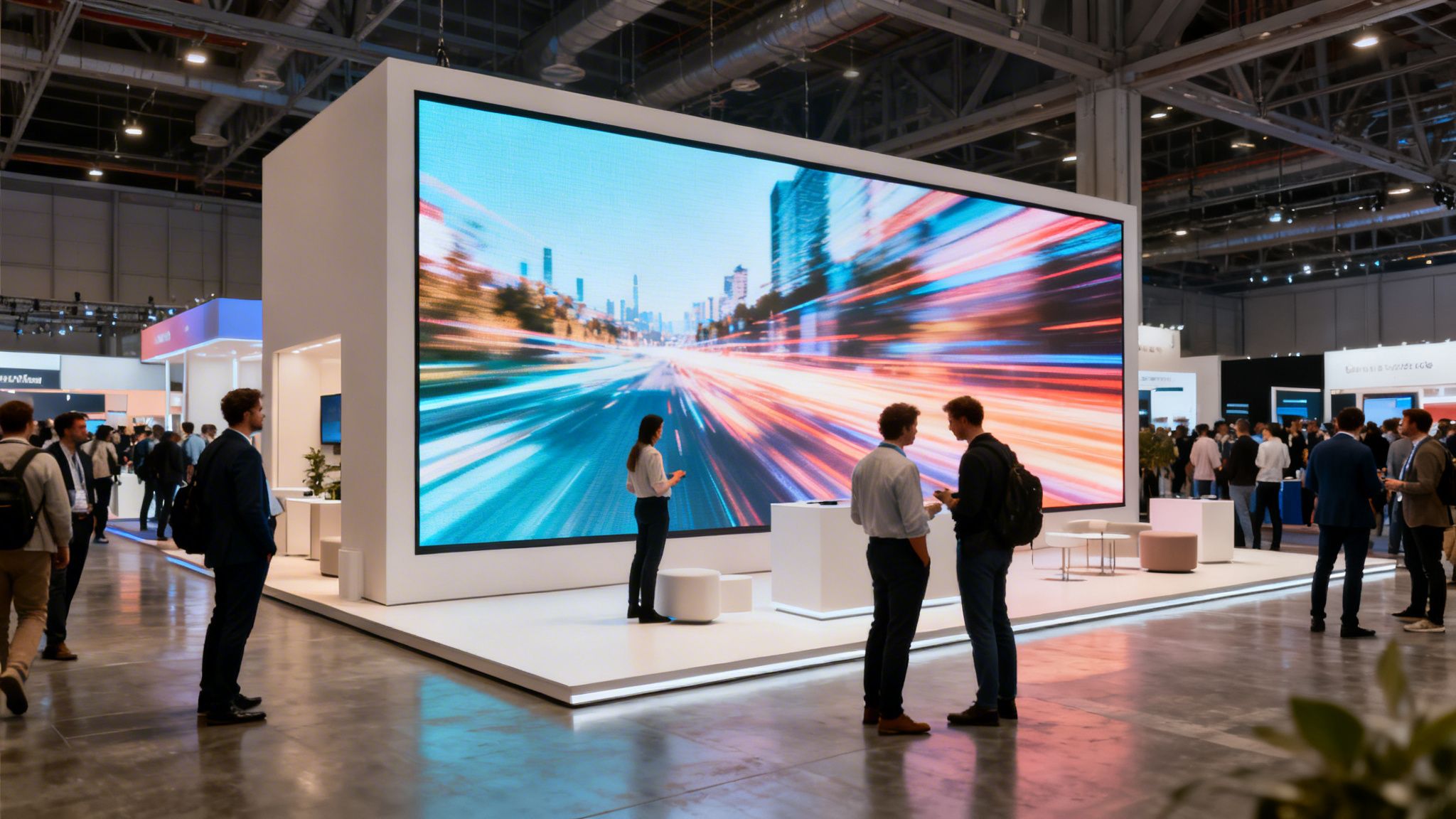
This guide moves beyond a simple list of dates. We are providing a strategic overview of the top 7 resources you need to build your 2026 event schedule, complete with screenshots and direct links. We will cover everything from official city-wide calendars managed by the LVCVA to specialized industry directories, giving you the tools to find the perfect events for your brand.

Most importantly, we connect this planning to what truly matters on the show floor: capturing attention and driving engagement. A dynamic LED video wall can transform your booth from a static display into an immersive brand destination. Our white-glove, turnkey service takes care of everything so you can just greet customers. We provide high-resolution video walls with a 1.9mm pixel pitch, delivering a much sharper image than the 2.5mm pitch used by most competitors. Our price includes everything except the bills you get directly from the show, like electricity and material handling. Plus, we leave an audiovisual technician onsite the entire time the show is open. If anything goes wrong, you can text or call, and an AV technician will be at your booth within minutes to resolve the problem.

1. LVCVA Convention Calendar (Vegas Means Business)

Your first stop for building a Las Vegas trade shows calendar should be the official source: the Las Vegas Convention and Visitors Authority (LVCVA) destination calendar, also known as Vegas Means Business. This platform serves as the city’s official aggregator, pulling together a high-level view of major conventions, trade shows, and corporate events across all primary venues, including the Las Vegas Convention Center (LVCC), Venetian Expo, Mandalay Bay, and Caesars Forum. It’s an indispensable tool for initial planning and strategic date selection.

LVCVA Convention Calendar (Vegas Means Business)

The primary strength of the LVCVA calendar is its authority and breadth. It provides a citywide snapshot, allowing your team to quickly identify key event dates, see projected attendance numbers, and find direct links to official show organizer websites. This is critical for both participating in a show and for strategically avoiding the logistical crunch of mega-events like CES or SEMA if they aren’t on your schedule.

How to Use It Effectively

The user interface is straightforward, offering simple filters for date ranges and event types. For exhibitors, the most effective approach is to use this calendar to create a foundational timeline.

  1. Identify Your Target Quarter: Start by filtering for the months or quarter you plan to exhibit.
  2. Scan for Tentpole Events: Note the major shows in your industry and their official dates and venues.
  3. Check for Conflicts: Use the attendance data to understand when the city will be at its busiest. This insight helps you anticipate higher costs for travel, accommodations, and even labor.
  4. Drill Down: Once you find a potential event, use the provided link to go directly to the organizer’s site for detailed exhibitor prospectuses, floor plans, and booking deadlines.

Key Insight: The LVCVA calendar is best for high-level, long-range planning. While it lists major events, it’s not 100% exhaustive and sometimes includes public or entertainment events. Always cross-reference with industry-specific sources before finalizing your budget or booth design.

Platform Breakdown

Feature Details
Coverage Citywide; includes all major convention centers and many resort properties.
Access Free and open to the public. No account is required.
Data Points Event name, dates, venue, projected attendance, link to the organizer’s site.
Updates Frequently updated by the LVCVA, making it a reliable source for date changes.

While this calendar is perfect for “what and when,” the next step is planning the “how.” Once you’ve selected your event, securing high-impact trade show booth rentals in Las Vegas becomes the priority. A well-executed booth can make all the difference in a crowded expo hall.

Website: LVCVA Destination Calendar

2. LVCVA 90-Day Event Calendar (Signature Events at LVCC)

For near-term operational planning, another official LVCVA resource provides a more focused view: the 90-Day Event Calendar. Unlike the broader destination calendar, this tool zeroes in on signature citywide events scheduled within the next three months. It highlights major conventions, sporting events, and festivals that are large enough (typically 3,000+ attendees) to significantly impact city logistics, from hotel rates to labor availability.

LVCVA 90‑Day Event Calendar (Signature Events at LVCC)

The primary strength of this calendar is its immediacy and focus on logistical impact. It’s the perfect tool for an exhibitor who has already booked a show and now needs to manage the final details. By seeing what other large-scale events are happening around your show dates, you can anticipate bottlenecks for freight, predict surges in ride-share pricing, and make informed decisions about booking travel for your team.

How to Use It Effectively

The interface is a simple, rolling list that gives you a quick snapshot of what’s on the horizon. For operations and logistics managers, this is a critical resource for fine-tuning your execution plan.

  1. Check Your Show Window: Before booking flights and accommodations, consult this calendar for the weeks surrounding your install, show, and dismantle dates.
  2. Identify Logistical Pressures: Note any overlapping stadium concerts, major fights, or citywide festivals. These events compete for the same pool of labor and transportation resources.
  3. Adjust Your Timelines: If your move-in coincides with another mega-event, consider adding buffer time to your freight and labor schedules to account for potential delays.
  4. Connect for Local Intel: The calendar provides direct LVCVA contact details, giving you a line to local experts who can offer insights on specific logistical challenges.

Key Insight: Use the 90-Day Calendar for tactical, short-range planning. Its purpose is not show discovery but operational awareness. It helps you answer the question, “What external factors will affect my exhibit’s setup and teardown in the next 90 days?”

Platform Breakdown

Feature Details
Coverage Curated list of large (3,000+ capacity) events citywide with major logistical impact.
Access Free and public. No registration is needed.
Data Points Event name, dates, venue, and links for more information. Includes sports and entertainment.
Updates Maintained by the LVCVA as a rolling 90-day forecast.

Once your logistical timeline is set, the focus shifts to maximizing your impact on the show floor. A well-considered approach to your trade show booth design is essential for capturing attention in a competitive environment. With a solid plan, you can ensure your booth is a destination, not just another stop.

Website: LVCVA Signature Events

3. TSNN Trade Show Calendar (filter to Las Vegas)

For exhibitors looking to dig deeper than just the mega-events, the Trade Show News Network (TSNN) calendar is an essential resource. As a leading B2B exhibition directory maintained by a respected trade show news organization, TSNN offers a more granular view of the event landscape. It’s particularly useful for building a comprehensive Las Vegas trade shows calendar that includes mid-size and niche vertical-specific events that might not get top billing on venue-only sites.

TSNN Trade Show Calendar (filter to Las Vegas)

The real value of TSNN lies in its powerful filtering capabilities and broad coverage. While city-wide calendars are great for a high-level overview, TSNN allows you to zero in on specific industry sectors within Las Vegas. This helps you uncover valuable, highly targeted shows where your brand can stand out without competing against the noise of a 100,000-person convention.

How to Use It Effectively

TSNN’s interface is designed for detailed searches, making it a great tool for strategic roadmap planning beyond the current quarter.

  1. Filter by Location and Industry: Start by setting the location filter to “Las Vegas, NV” and then select your specific industry sector from the dropdown menu. This immediately narrows the results to relevant opportunities.
  2. Explore Mid-Tier Events: Pay close attention to the shows listed with smaller but still significant attendance figures. These events often provide a higher ROI due to a more focused audience and less exhibitor saturation.
  3. Cross-Reference for Details: Like any aggregator, TSNN is a starting point. Use the direct links to the official show websites to confirm dates, download exhibitor kits, and verify all critical details before making any commitments.
  4. Build a Multi-Year Calendar: Its extensive database is perfect for long-range planning, helping you identify annual events and map out a potential exhibiting schedule for the next 18-24 months.

Key Insight: Use TSNN to discover “shoulder season” shows or niche events that align perfectly with your target buyer persona. Attending these can be a cost-effective way to generate high-quality leads when your larger competitors are focused elsewhere.

Platform Breakdown

Feature Details
Coverage National B2B directory with strong Las Vegas filtering. Good for mid-tier and vertical-specific shows.
Access Free and open to the public. No account needed for basic searches.
Data Points Event name, dates, venue, industry, link to organizer’s site. Some listings include size metrics.
Updates Maintained by a trade show news organization, but always verify details on the official event site as there can be lags.

Once you’ve identified a promising show on TSNN, the next step is planning your exhibit. A detailed understanding of your trade show booth cost is critical for budgeting. Opting for a turnkey service that includes a high-resolution 1.9mm pixel pitch video wall can make your booth a beacon, drawing attendees in with crystal-clear visuals that outshine competitors’ standard 2.5mm displays.

Website: TSNN Trade Show Calendar

4. Events In America (Las Vegas listings)

For exhibitors looking to dig deeper than just the mega-events, Events In America provides a robust, U.S.-focused directory that’s excellent for building a more nuanced Las Vegas trade shows calendar. While it covers major conventions, its real value lies in uncovering mid-tier and niche industry shows that might not appear on high-level citywide calendars. The platform aggregates events with helpful filters for location, industry, and dates, making it a powerful research tool.
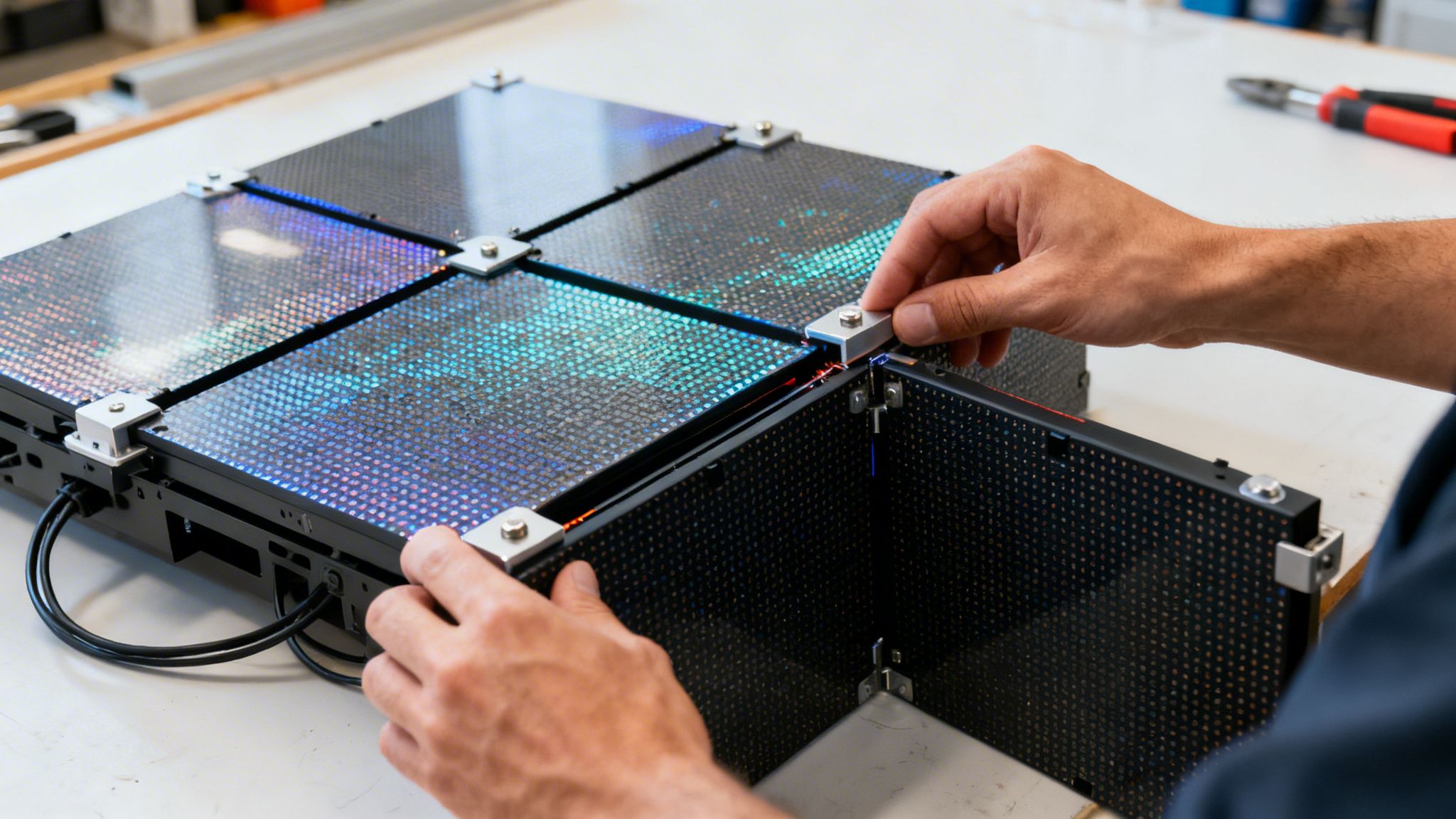
The primary advantage of Events In America is the additional context it often provides. Many listings include details on expected audience profiles, historical attendance data, and links to suppliers, which are invaluable for preliminary budgeting. You can gauge the potential scale of a show and start thinking about staffing needs and what kind of booth presence is appropriate long before you even see a floor plan.

How to Use It Effectively

The platform’s strength is in its filtering and discovery capabilities. It allows you to search beyond the obvious and identify opportunities that align perfectly with your target demographic.

  1. Filter for Las Vegas: Start by narrowing the entire U.S. directory to Las Vegas, Nevada.
  2. Apply Industry Filters: Add your specific industry or vertical to see a curated list of relevant events, from large to small.
  3. Analyze Historical Data: For recurring events, look at past listings to understand growth trends and audience consistency. This helps you infer the show’s value and stability.
  4. Cross-Reference and Verify: Once you identify a promising event, always use the organizer link to visit the official show website. Data on third-party directories can sometimes lag, so confirming dates, deadlines, and exhibitor details is a crucial final step.

Key Insight: Use Events In America to build your “long list” of potential shows. It’s especially useful for finding smaller, targeted events that offer a higher ROI by connecting you with a very specific audience, reducing the noise common at larger expos.

Platform Breakdown

Feature Details
Coverage U.S.-wide, with strong filtering for Las Vegas and specific venues like the LVCC.
Access Free for basic searches. Some deeper data or promotional tools may be gated.
Data Points Event name, dates, venue, industry, audience profile, organizer links, past data.
Updates Varies by listing; reliant on submissions and internal curation.

After identifying the right niche show, the next step is planning your execution. The logistics of getting everything to the convention center can be complex, and understanding the process for shipping and material handling for a trade show is fundamental to staying on budget and on schedule.

Website: Events In America – Las Vegas Shows

5. 10Times (Las Vegas Trade Shows)

If the LVCVA calendar provides the official citywide overview, 10Times offers a sprawling global directory with a powerful local lens. This platform is a must-use for any exhibitor building a Las Vegas trade shows calendar because it casts a wider net, capturing not just the mega-shows but also a significant number of niche, specialized, and consumer-facing events that might otherwise be missed. Its robust filtering capabilities make it a fantastic tool for discovery and logistical planning.

The main advantage of 10Times is its granularity. While official sources focus on major conventions, 10Times allows you to sift through events by dozens of industry categories, from “Apparel & Clothing” and “Medical & Pharma” to “IT & Technology.” This helps you uncover adjacent or overlapping shows that could present new marketing opportunities or logistical challenges.

How to Use It Effectively

The platform’s strength lies in its filters and calendar integration features. For exhibitors looking to maximize their time in Las Vegas, it’s a strategic goldmine.

  1. Filter by Industry & Month: Select your core industry and target months to generate a list of relevant shows. Then, remove the filter to see all other events happening during that time.
  2. Identify Logistical Synergies: Spotting a smaller, relevant show immediately before or after your primary event could allow you to extend your stay and exhibit at both, potentially reducing shipping and drayage costs by consolidating freight.
  3. Set Alerts: Use the “Add to Calendar” and reminder functions for shows you are tracking. This helps you monitor key dates without having to manually check multiple sites.
  4. Cross-Verify Information: Because 10Times aggregates data from many sources, some listings can become outdated. Always click through to the official organizer’s website to confirm dates, venues, and deadlines before making any financial commitments.

Key Insight: Use 10Times for discovering opportunities and planning logistics around your main event. Its broad coverage is excellent for identifying smaller shows that might be a perfect fit for a targeted marketing effort or for avoiding scheduling conflicts at your chosen venue.

Platform Breakdown

Feature Details
Coverage Global; extensive Las Vegas listings across all venues, including hotels and resorts.
Access Free to browse. Account needed for alerts and other features.
Data Points Event name, dates, venue, industry tags, organizer info, “attendee interest” signals.
Updates Varies by listing; some are updated frequently, others may lag. Verification is key.

Once you’ve used a tool like 10Times to finalize your event schedule, the focus shifts to creating an unforgettable presence. A high-resolution LED video wall is a powerful way to stand out. An effective LED video wall rental should offer a turnkey solution, where a dedicated team handles everything from setup to on-site support, allowing your team to focus solely on engaging with attendees.

Website: 10Times Las Vegas Trade Shows

6. Network in Vegas – Conventions & Trade Shows Calendar

Beyond the official convention center schedules, a truly effective Las Vegas trade shows calendar must account for the ecosystem of events happening around the main show. This is where Network in Vegas shines. This locally-run platform provides a valuable ground-level view, listing not only major trade shows but also the crucial after-hours networking events, industry parties, and ancillary gatherings that define the complete Las Vegas event experience.

Network in Vegas – Conventions & Trade Shows Calendar

The primary advantage of this calendar is its focus on the “what else” of a trade show week. For exhibitors, this information is gold. It helps you understand where your target audience will be after show hours, offering opportunities for sponsored brand activations, targeted invites to private dinners, or simply knowing the city’s pulse. It transforms your planning from being booth-centric to being experience-centric, aligning your presence with the wider citywide buzz.

How to Use It Effectively

The simple, month-view calendar format makes it easy to spot clusters of activity. For marketing managers, this tool is ideal for tactical planning once the main show is booked.

  1. Find Your Show Week: Navigate to the month of your event to see what else is officially and unofficially scheduled.
  2. Identify Ancillary Opportunities: Look for listings of mixers, happy hours, and sponsored parties. These are prime spots for continued networking or guerrilla marketing.
  3. Gauge Attendee Flow: The density of events gives you a signal for expected attendee engagement and when people will be most active outside the convention hall.
  4. Time Your Brand Activations: Use this insight to schedule your own private events or brand activations during windows with high potential attendance and low direct competition.

Key Insight: Treat Network in Vegas as your tactical intelligence source. While you must always confirm primary show dates with official organizer sites, use this calendar to plan your team’s on-the-ground activities and maximize your brand’s visibility beyond the expo floor.

Platform Breakdown

Feature Details
Coverage Las Vegas focused; mixes major trade shows with ancillary networking events and parties.
Access Free and open to the public with no account required.
Data Points Event name, dates, venue, times, and often links to registration or more info.
Updates Frequently updated with a local perspective, often catching smaller events missed by larger directories.

Once you’ve mapped out both the main show and the surrounding events, the focus shifts to creating a can’t-miss presence. This is where a high-resolution LED video wall rental can make a huge impact, drawing attendees in a sea of standard booths. Our turnkey service provides a brilliant 1.9mm pixel pitch for sharper visuals, an onsite AV technician for the entire show, and all-inclusive pricing that covers everything except direct show bills like electricity and material handling. You just focus on greeting customers; we handle the rest.

Website: Network in Vegas Calendar

7. VegasLocal.com – Las Vegas Convention Calendar

For exhibitors who want a streamlined, convention-focused view without the noise of citywide public events, VegasLocal.com offers a purpose-built Las Vegas trade shows calendar. This platform aggregates B2B events across both Strip and off-Strip properties, presenting them in a clean, chronological list. Its primary value is logistical clarity, as it clearly lists venue addresses and multi-day spans for each show.
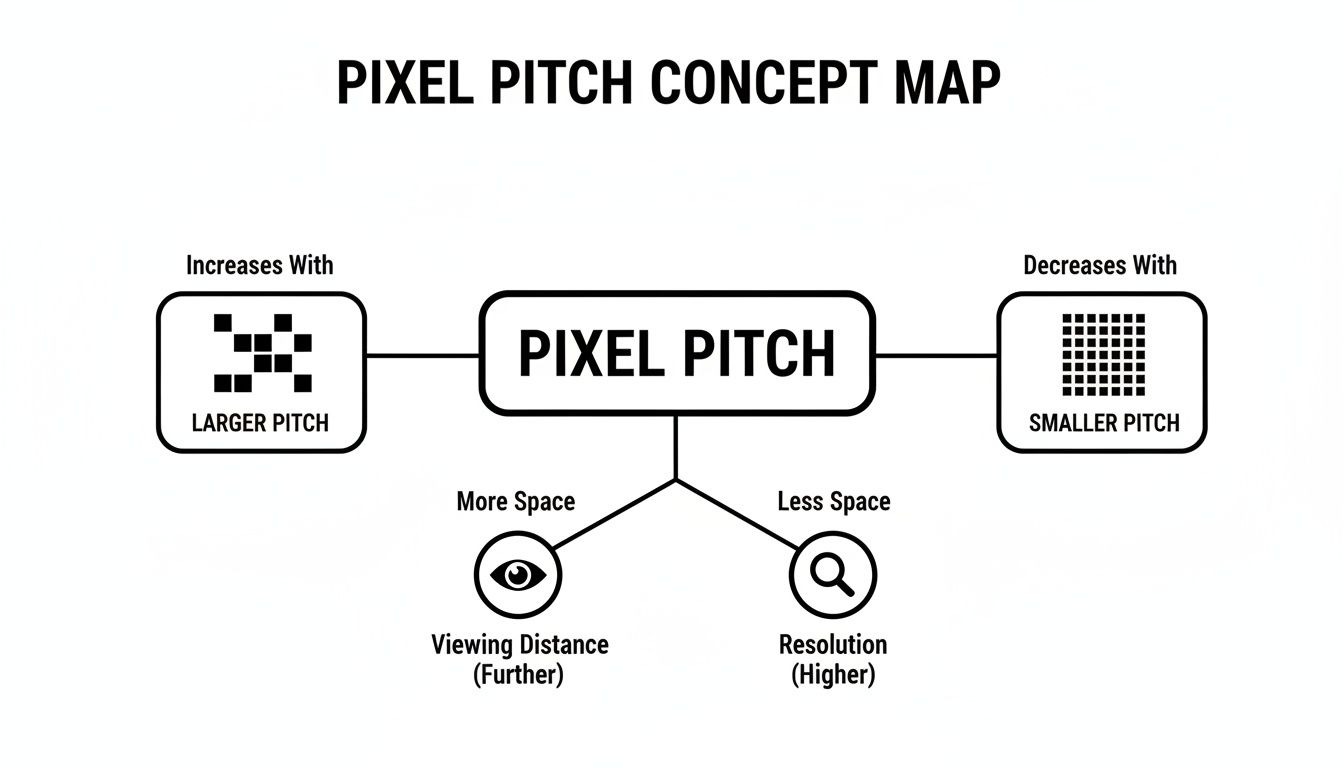
VegasLocal.com – Las Vegas Convention Calendar

This specific focus makes VegasLocal.com a practical tool for mapping out the physical aspects of exhibiting. You can quickly see which shows are happening concurrently or back-to-back at the same or nearby venues. This insight is gold for scheduling booth installations, planning drayage, and staging deliveries of sensitive equipment like high-resolution LED tiles. It helps identify opportunities for venue clustering and potential multi-show efficiencies.

How to Use It Effectively

The site’s no-frills interface gets straight to the point. It is best used as a secondary resource for logistical cross-referencing and identifying mid-market or niche events that might be missed on larger, city-wide portals.

  1. Filter by Month: Begin by selecting your target month to see a focused list of conventions.
  2. Map Your Logistics: Pay attention to the venue addresses. If you are considering multiple shows, use this data to plan efficient travel paths for your team and freight.
  3. Identify Install/Dismantle Windows: The clear multi-day blocks for each event provide a good initial estimate for your move-in and move-out schedule.
  4. Confirm Details: Since it is not an official source, always click through to the event organizer’s website to confirm dates, times, and exhibitor details before making any commitments.

Key Insight: Use VegasLocal.com to find logistical synergies. Seeing two of your target shows at the same venue in consecutive weeks could open up possibilities for reduced shipping costs or extended booth rental agreements, maximizing your marketing budget.

Platform Breakdown

Feature Details
Coverage Convention-only focus; includes a mix of marquee and mid-market B2B events on and off the Strip.
Access Free and open to the public. No registration is needed.
Data Points Event name, date span, venue, venue address, and direct link to the organizer’s site when available.
Updates Updated periodically; details should always be cross-checked with the official event or venue source.

After identifying your show and mapping its logistics, the next step is making an impact. Opting for a turnkey LED video wall rental means your message is seen in stunning high resolution (1.9mm pitch vs. the common 2.5mm pitch). Our white-glove service includes an on-site technician for the duration of the show, ensuring any issue is fixed in minutes so you can focus on your customers.

Website: VegasLocal.com Convention Calendar

Top 7 Las Vegas Trade Show Calendars — Quick Comparison

Source 🔄 Implementation complexity ⚡ Resource requirements 📊 Expected outcomes 💡 Ideal use cases ⭐ Key advantages
LVCVA Convention Calendar (Vegas Means Business) Low — simple citywide calendar & filters Low — minimal time to scan; web access Broad city snapshot for date scanning and synchronization High‑level planning; avoid or align with peak weeks Official source; aggregates major venues; frequent updates
LVCVA 90‑Day Event Calendar (Signature Events at LVCC) Low — rolling 90‑day list Low — focused near‑term monitoring Accurate short‑term capacity/operational signals Near‑term resourcing, freight and labor planning Curated for high‑impact events; includes LVCVA contacts
TSNN Trade Show Calendar (filter to Las Vegas) Moderate — requires filtering and verification Moderate — some vetting of listings Comprehensive B2B coverage including mid‑tier vertical shows Year‑round exhibiting roadmap; discover niche/mid‑size events Broad industry filters; recognized trade‑show directory
Events In America (Las Vegas listings) Moderate — search and interpret listing details Moderate — may need to access gated info Useful for estimating scale, audience profile and budgets Preliminary budgeting; staffing and LED content planning U.S. depth and historical context per event/venue
10Times (Las Vegas Trade Shows) Moderate — uses filters, alerts and reminders Moderate — use calendar/alert features to track events Strong for spotting adjacent shows and scheduling conflicts Logistics planning; reduce shipping/drayage costs; reminders Very broad coverage; powerful filters and reminder tools
Network in Vegas – Conventions & Trade Shows Calendar Low — local month‑view calendar Low — quick local updates Practical on‑the‑ground intel and ancillary event cues Local activations, networking, after‑hours planning Local perspective; surfaces networking/ancillary events
VegasLocal.com – Las Vegas Convention Calendar Low — convention‑focused listing Low — quick reference for multi‑day spans Clear venue/date blocks useful for staging and deliveries Mapping install/dismantle windows; venue clustering Convention‑only focus for straightforward reference

Turn Your Calendar into a Competitive Advantage

You’ve explored the most effective tools for building your master Las Vegas trade shows calendar. This detailed schedule is your roadmap, outlining every major opportunity to connect with your target audience on the convention floor. But a map is only useful if you know how to navigate the terrain. Moving from a list of dates to a series of successful exhibitions requires a strategic shift in focus from planning to execution, specifically concerning your booth presence.

The true value of your calendar emerges when you pair it with a booth strategy designed for maximum impact. A generic display will get lost in the visual noise of a packed expo hall. To stand out at events like CES, NAB, or SEMA, you need a presence that stops attendees in their tracks and draws them in. This is where your choice of an exhibit partner becomes a critical decision.

From Dates to Dominance: Your Exhibit Strategy

An effective exhibit strategy goes beyond simply showing up. It involves creating an immersive brand experience that captivates and converts. Think of your booth not as a physical space, but as a dynamic storytelling platform.

  • Visual Fidelity is Key: Your brand’s message, product demos, and visual identity must be presented with absolute clarity. A fuzzy or pixelated display undermines your credibility. This is why we exclusively use 1.9mm pixel pitch LED tiles. Compared to the industry standard of 2.5mm, our screens deliver a significantly higher resolution, ensuring your content is crisp, vibrant, and professional, even from just a few feet away.

  • Simplicity in Execution: Managing a trade show presence involves countless moving parts. Your exhibit partner should simplify this process, not complicate it. We offer a true white-glove, turnkey service. Our all-inclusive pricing model covers everything except for direct show services like electricity and material handling (drayage). You receive one clear, predictable price for labor, shipping, setup, and technology, eliminating the risk of surprise fees.

Key Insight: A transparent, all-in-one pricing structure allows your marketing team to budget accurately and focus resources on what matters most: engaging with prospects and customers on the show floor.

The Onsite Support Guarantee

Even with the best technology and planning, unforeseen issues can arise. A blank screen or a software glitch during peak show hours can be disastrous. This is where our commitment to your success truly sets us apart.

We provide an expert audiovisual technician onsite for the entire duration of the show. This isn’t a shared resource covering the whole event; this technician is dedicated to ensuring your booth runs perfectly. If you encounter any technical problem, a quick text or call brings our expert to your booth within minutes to resolve it. This is your safety net, your on-demand support system, and your guarantee of a stress-free, high-performance exhibition.

As you populate your Las Vegas trade shows calendar for the upcoming year, think beyond the dates and venues. Consider how you will transform each event into a powerful competitive advantage. Aligning your schedule with a strong content plan is also essential for pre-show promotion and post-show follow-up. To truly leverage your event schedule, explore strategies like how to create a content calendar that works to maintain focus and consistency.

Your trade show calendar is the blueprint for your brand’s biggest moments. Don’t leave their success to chance. Choose a partner who provides superior technology, transparent service, and unwavering support. Let’s turn your schedule into a series of unforgettable victories.


Ready to transform your spot on the Las Vegas trade shows calendar into a show-stopping exhibit? The team at LED Exhibit Booths provides turnkey, high-resolution video wall solutions with dedicated onsite support to ensure you stand out. Visit our website to see how we make exhibiting easier and more impactful.

Master Your Shipping Trade Show Logistics

When you think about shipping trade show materials, you probably picture a mountain of paperwork, endless phone calls with freight carriers, and that constant knot in your stomach worrying about something going wrong.

But what if you could just… not do any of that? A true turnkey, white-glove service model shifts that entire logistical headache from your team to a dedicated partner. It lets you focus on what you’re actually there to do: greet customers and build relationships.

The Superior Alternative to Traditional Shipping Trade Show Booths

This modern approach isn’t just about making your life easier; it’s about giving you a better exhibiting experience, period. For instance, the video walls we build use a 1.9 pixel pitch. This might sound technical, but the industry standard is a much lower-resolution 2.5 pitch.

What does that mean for you? A much sharper, higher-definition display that makes your content pop and grabs attention from clear across the hall. It’s the difference between watching a video in standard definition versus brilliant HD.

All-Inclusive Pricing and On-Site Support

One of the biggest headaches in trade show budgeting is the flood of unexpected bills that show up after the event is over. With a full-service rental, your pricing is simple and clear from day one.

Our model is designed for clarity and peace of mind. We include everything in our price except for the services the show bills you for directly, such as electricity and material handling. Everything else—from the technology to the on-site support—is covered.

This gives you one transparent price without having to guess about hidden fees for labor, setup, or technical help. It turns your budget from a crapshoot into a predictable investment. But our commitment doesn’t stop once the booth is built.

We know that even the most reliable tech can have a hiccup. That’s why we leave an expert audiovisual technician on-site for the entire time the trade show is open. If you notice a glitch or just have a question, you don’t have to panic or track someone down.

You just send a text or make a quick call, and our AV tech is at your booth in minutes to fix the problem. This on-demand support guarantees you have zero downtime, ensuring your brand is always presented perfectly. For a deeper dive on how this works in practice, check out our trade show shipping case study.

International Shipping Trade Show Booth Considerations

For exhibitors crossing borders, the logistical challenges get even more complicated. If you’re planning a temporary import to Canada, for example, you need to be familiar with things like carnets and duty exemptions.

One mistake in the paperwork can get your entire shipment stuck at the border, putting your whole event at risk. A logistics partner who knows the ins and outs of international shipping can guide you through these rules and make sure everything arrives on time.

This chart shows the basic steps of quoting, booking, and shipping your trade show materials.

shipping trade show

As you can see, a turnkey service handles all these steps for you. This allows you to focus on your exhibiting goals instead of getting bogged down in the details. When you choose a partner who manages these critical functions, you’re not just renting a booth; you’re securing a seamless, stress-free path to a successful trade show.

Packing and Crating Your Booth the Right Way

shipping trade show

The success of your trade show often comes down to what you do long before you ever set foot on the show floor. How you pack and crate your booth has a huge impact on whether it arrives in one piece, how quickly you can set it up, and—most importantly—your final bill.

I’ve seen it a hundred times: a poorly packed crate shows up cracked open, with damaged graphics and broken electronics inside. That’s a recipe for costly delays and a whole lot of stress. Seasoned exhibitors know that custom-built, durable crates aren’t a luxury; they’re essential for protecting your investment.

But the real secret to smart shipping isn’t just the crate—it’s the booth itself. A smart choice in your exhibit system can literally save you thousands of dollars.

Rethinking Booth Design for Smarter Shipping Trade Show Booths

Let’s talk about traditional booths. They’re often built with heavy trusses, separate big-screen monitors, and all sorts of bulky structural parts. All that stuff requires massive, heavy crates to ship.

That bulk and weight directly translate into higher costs for everything, especially drayage, which the show charges you based on weight. Shipping trade show booths is much more economical with lightweight trade show booths.

This is exactly why our modular LED panels were designed to be different. The video wall is the structure, which means you can get rid of all those heavy, separate supports. It’s a completely different approach that dramatically cuts down your crate size and weight. Naturally, this leads to big savings on both shipping and those painful material handling fees.

When you look at the big picture of global trade, this efficiency makes a lot of sense. Seaborne trade volume tripled from 4 billion tons in 1990 to nearly 13 billion tons by 2026, now accounting for over 80% of all goods moved worldwide. For an exhibitor, that means every square inch and every pound counts. Just by using lighter, modular components that pack flat, you can cut drayage costs by up to 40%. You can dig into more shipping data on Statista.com.

Traditional Booth vs Modular LED Booth Packing Comparison

Thinking about how your booth packs up before you buy or rent can save you a fortune. Here’s a quick comparison of what you’re dealing with when it comes to old-school booths versus a modern LED exhibit.

Factor Traditional Booth (Truss, Monitors, Graphics) LED Exhibit Booths (Modular LED Panels)
Components Separate heavy truss, multiple large monitors, bulky graphic panels, lighting rigs. Integrated, lightweight LED panels that form the structure. No separate truss needed.
Crate Size Requires multiple large, heavy, often oddly-shaped crates to fit all the pieces. A few streamlined, rectangular crates. Panels stack flat and efficiently.
Total Weight Extremely heavy. It’s not uncommon for a 20×20 booth to weigh several thousand pounds. Significantly lighter. A comparable LED booth can be 50-60% lighter.
Drayage Cost Very high. Billed by CWT (cost per 100 lbs), so every pound adds to the bill. Much lower. The dramatic weight reduction directly cuts your material handling fees.
Setup Complexity Complex and time-consuming. Requires rigging and assembling many different parts. Simple and fast. Panels connect easily, significantly reducing labor time and cost.

As you can see, the difference is huge. The old way means you’re essentially paying to ship air and a lot of dead weight. The modular approach is just plain smarter and more cost-effective from the ground up.

Our Turnkey Service Simplifies Everything Including Shipping Trade Show Booths

Beyond just giving you lighter hardware, a real partner should make the entire process easy. That’s why we offer a white glove, turnkey service. We handle all the logistics so you can walk onto the show floor and focus on what you’re there to do: meet customers and close deals.

Our all-inclusive approach gives you a single, clear price right up front. It covers everything from shipping and transport to the full installation and dismantle. The only other bills you’ll have are for things the show charges every exhibitor directly, like electricity and material handling. Everything else is in our price.

This quality-first mindset extends to our tech, too. Our video walls feature a 1.9 pixel pitch, which is a major step up from the 2.5 pitch you’ll see from many competitors. A lower number means the pixels are closer together, giving you a much higher-resolution, sharper image that makes your videos and graphics look incredible.

The ultimate peace of mind comes from knowing you have an expert on standby. We leave a dedicated audiovisual technician on-site for the entire time the show is open. If anything goes wrong, you just text or call, and an AV tech will be at your booth in minutes to fix it.

This on-demand support guarantees your display runs perfectly, so you don’t have to worry about embarrassing downtime when you’re trying to make a great impression. When you combine smarter packing with a full-service partner, you don’t just save money—you get your time and sanity back. You can learn more about how this works by checking out our guide on trade show set up.

Navigating Freight, Drayage, and Hidden Fees

shipping trade show

Let’s talk about the one area where even the most carefully planned trade show budgets completely fall apart: the complicated world of shipping trade show freight and, more importantly, drayage. You can have every other cost nailed down, but surprise fees at this stage can be a nightmare for your bottom line.

Most new exhibitors get a handle on the freight bill – that’s just the cost to ship your crates from Point A to the convention city. The real budget killer, though, is drayage. This is also called material handling, and it’s the non-negotiable fee the show’s official contractor charges you to move your stuff from the loading dock to your booth space. And then back again when it’s all over.

Here’s the catch: drayage is almost always billed by CWT, which means “cost per 100 pounds.” Every single pound adds up, and it’s not unusual for drayage fees to be more expensive than the cross-country freight bill itself. This is the surprise that catches so many exhibitors off guard.

Finding and Understanding Drayage Rates

So, where do you find these critical rates? It’s all buried in your exhibitor kit. Somewhere in that mountain of paperwork are the official drayage costs, deadlines for shipping to the advance warehouse, and the much higher rates you’ll pay for shipping directly to the show site. Ignoring these documents is a guaranteed way to get a shocking invoice after the show.

It’s a modern-day logistics puzzle. In fact, you can look back at the history of American maritime trade and see how transportation costs have always shaped commerce. When that industry faltered, it revealed just how much an economy relies on efficient transport. Today, with drayage easily eating up 15-25% of an entire booth budget, it’s clear that reducing shipping weight isn’t just a small saving—it’s a massive strategic advantage.

How a Lighter Booth Slashes Your Drayage Bill

The absolute best way to control these costs is to ship less weight. It’s that simple. And this is where your booth design becomes your most powerful tool for saving money.

Traditional booths are drayage nightmares. They’re built with heavy truss systems, solid wood or metal walls, and separate, bulky crates for monitors. In contrast, our modern booth systems, built with lightweight, modular LED panels, are engineered specifically to be lighter and more compact. That translates directly into a much, much smaller drayage bill. Imagine saving thousands of dollars before you even set foot on the show floor.

The Power of a Turnkey, White-Glove Service

Of course, you could try to manage all these moving parts yourself, but it’s a huge headache. The alternative is to work with a partner who offers a white glove, turnkey service. This approach rolls everything into one clear, upfront price, simplifying the entire process.

We take care of everything so you can just greet customers. Our all-inclusive pricing model is designed for total transparency. The only costs not included are the ones the show bills you for directly, like electricity and material handling. Everything else is covered.

This means you won’t see surprise invoices for labor, setup, or technical support. You get one number you can count on, making your budget predictable and stress-free. For a deeper look at what goes into an exhibit budget, check out our guide on trade show booth cost.

Our commitment to a better experience goes right down to the technology. We provide video walls with a 1.9 pixel pitch, which is a significant upgrade from competitors who often use a 2.5 pitch. That lower number means the pixels are closer together, giving you a much sharper, higher-resolution image that makes your video content look absolutely incredible.

Even better, we always keep an audiovisual technician on-site for the entire show. If a technical issue ever pops up, you just text or call, and our expert is at your booth in minutes to fix it. This guarantees zero downtime for your display, ensuring your brand always looks its best.

Mastering Your Shipping Paperwork and Insurance

A shipping document with 'drayage' highlighted under a magnifying glass, next to a toy truck, calculator, and scale.

When it comes to shipping trade show materials, your paperwork isn’t just a formality—it’s everything. One little mistake can lead to some seriously expensive delays or even lost freight. Getting your documents and insurance sorted out is a critical part of making sure your event goes off without a hitch.

The most important piece of paper you’ll handle is the Bill of Lading, or BOL. Think of it as the legal contract between you and the freight carrier. It spells out exactly what you’re shipping, where it’s headed, and its weight. You absolutely cannot afford to have inaccuracies here.

Just as vital are your shipping labels. Every single crate and case has to have a clear, simple label. This isn’t the time to get creative with design; it’s about pure, functional information.

Your Essential Labeling Checklist

To keep your shipment from getting swallowed up in the chaos of the loading dock, make sure every label has these details:

  • Show Name: The official name of the event.
  • Exhibiting Company Name: Your company’s name, big and clear.
  • Booth Number: This is crucial for getting your items to the right spot.
  • Piece Count: Use a format like “Crate 1 of 4,” “Crate 2 of 4,” and so on. This tells the crew exactly when your full shipment has made it.

If you’re shipping internationally, the paperwork gets even more intense. A simple error on a customs form can leave your entire booth stranded at the border. Of course, this means having all your commercial invoices, and any required carnet documents, in perfect order. It’s a good idea to familiarize yourself with every document, including things like the consignment note.
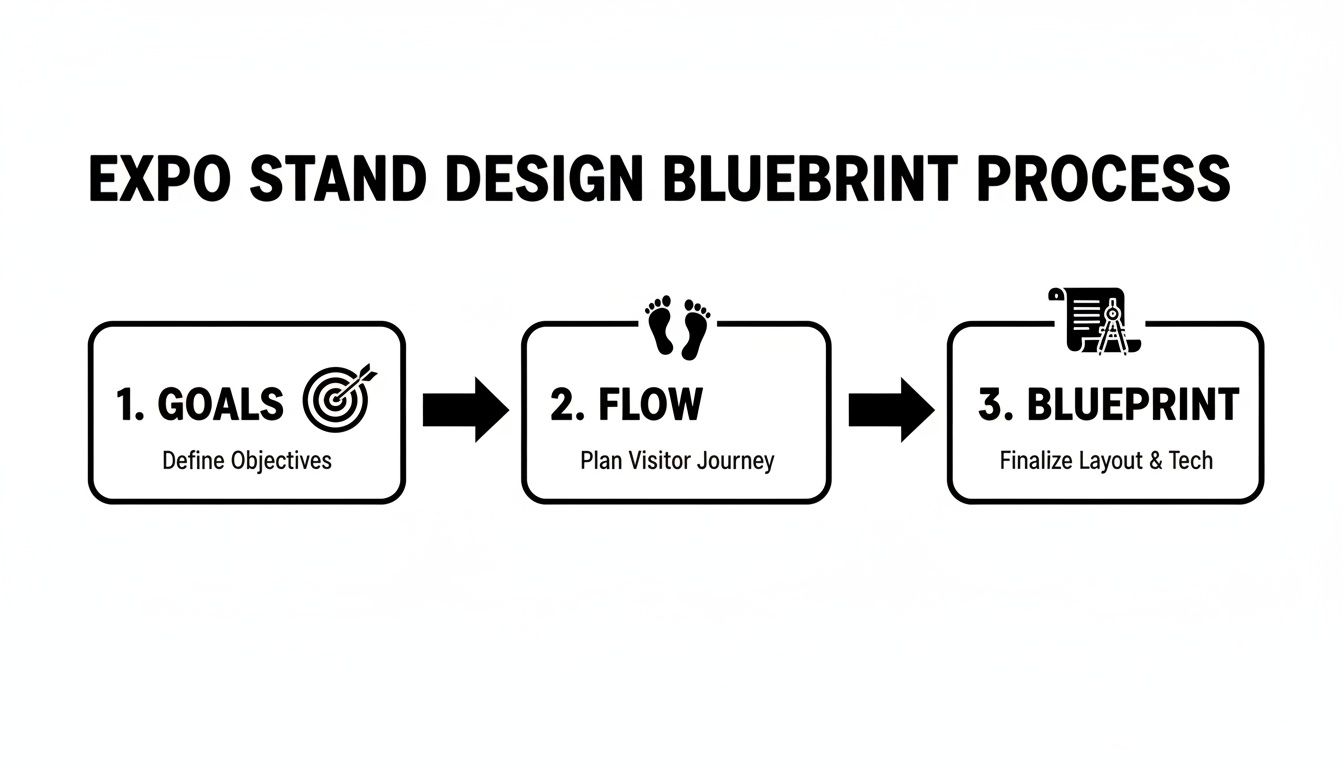
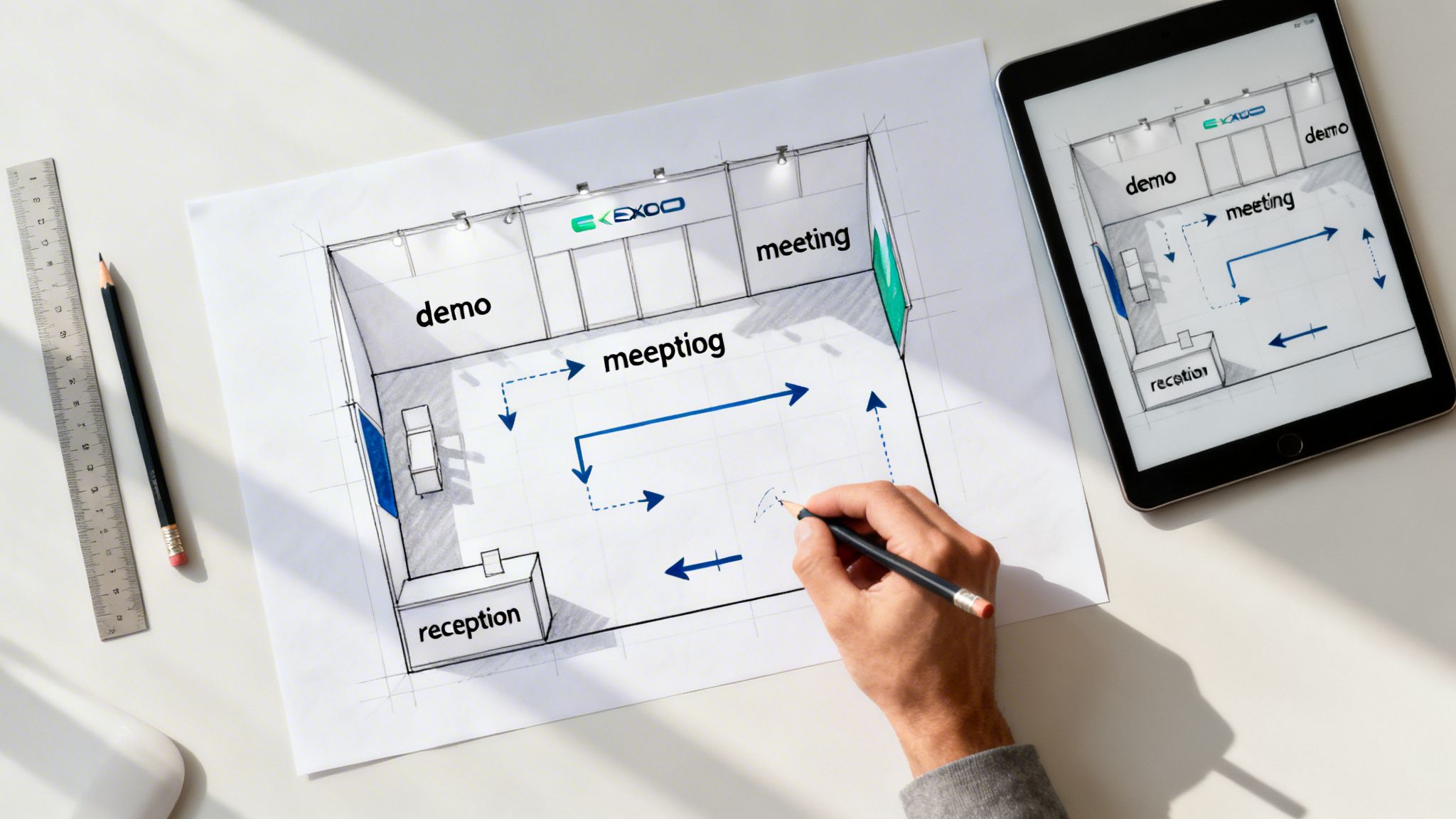
Protecting Your Investment With The Right Insurance

Let’s be very clear about something: the “insurance” your freight carrier offers isn’t really insurance at all. It’s called carrier liability, and the coverage is laughably minimal. Often, it’s based on weight—sometimes as low as $0.50 per pound. If your expensive, lightweight LED panels get damaged, that payout won’t even cover the cost of a replacement cable.

To actually protect your booth, you need a separate exhibitor insurance policy. This will cover the full replacement value of your booth, graphics, and tech if they get damaged, lost, or stolen. Trust me, the peace of mind is worth every penny.

The most stressful parts of any trade show are the logistical hurdles you have to jump through just to get set up. That’s why a true white-glove, turnkey service is so valuable. It eliminates the paperwork and coordination headaches.

With a full-service partner, you get one transparent price that covers everything except the direct show bills like electricity and material handling. There are no surprise invoices for labor, setup, or support.

This approach even simplifies on-site support. We always keep a dedicated audiovisual technician on-site for the entire show. If you have any kind of issue, a quick text or call brings an expert right to your booth to solve it in minutes, ensuring zero downtime. This lets you focus on what you’re there to do: connect with customers and grow your business. If you are looking for a reliable partner for your next event, learn more about what a top-tier trade show display company can do for you.

The Turnkey Solution: A Smarter Way to Exhibit

Imagine your next trade show without the logistical nightmare. No more chasing down freight carriers, trying to make sense of drayage rules, or getting lost in a mountain of paperwork. Instead, you and your team just show up. Your booth is already built, it looks incredible, and all you have to do is focus on talking to customers and closing deals.

That’s the reality of a true turnkey, white-glove service. It’s a smarter way to exhibit because it takes the entire logistical headache off your plate and puts it onto a dedicated partner. It saves a ton of time and, frankly, delivers a much better result on the show floor.

Superior Visuals That Command Attention

In a packed exhibit hall, you have to grab attention from across the aisle. A grainy, pixelated display makes your brand look outdated. But a razor-sharp, vibrant video wall pulls people in. This is where the technical specs really make a difference.

A lot of providers are still using video walls with a 2.5mm pixel pitch, which has become the common, average standard. We only provide a 1.9mm pixel pitch on our video display walls. That smaller number means the pixels are packed much closer together, giving you a massive jump in resolution. It’s the difference between watching standard-def and stunning HD—your graphics are crisper, your videos look real, and your message lands with serious impact.

The whole point of a turnkey service is to get rid of complexity and nasty surprises. Our all-inclusive pricing is built around that idea. We include everything in our fee, except for the services the show bills you for directly, like electricity and material handling.

This means you get one, clear price for the booth, the tech, the labor, and all the support. You won’t have to worry about a stack of unexpected invoices showing up after the event for things like setup or a technician’s time. It makes your budget predictable and your life a lot less stressful.

On-Site Support That Guarantees Zero Downtime

What’s your plan if your tech goes down in the middle of the show? For most exhibitors, it’s a full-blown panic. You’re scrambling to find someone, anyone, to help while your expensive booth sits dark. It’s embarrassing and costs you opportunities.

A real white-glove service plans for this. We leave an expert audiovisual technician on-site for the entire duration of the trade show. If anything goes wrong with your display, you don’t file a support ticket and hope for the best. You just text or call our guy who is right there at the convention center.

Within minutes, an expert is at your booth, fixing the problem. This on-demand support guarantees your exhibit runs perfectly from the minute the doors open to the moment they close. Your brand is always presented exactly how you intended.

This model is all about efficiency. Think about how standardized shipping containers revolutionized global trade back in the day. Our approach does the same for exhibiting. Our magnetic, tool-less video tiles weigh 60-70% less than old-school monitors and trusses, and they pack neatly into standard cases. This alone slashes your shipping and drayage costs by 25-35% compared to a bulky, traditional setup. It’s a page from the history of maritime trade and its impact on transportation—a smarter, more efficient system.

When you choose a turnkey solution, you’re not just renting a booth. You’re buying peace of mind and a far more effective way to do trade shows.

Your Top Shipping Trade Show Questions Answered

Fun Fact: We use the same LED Video Wall technology for conference audiovisual as shown in the video above. Even with the best plan, trade show shipping can throw some serious curveballs. The logistics have a lot of moving parts, and believe me, even the most seasoned exhibitors run into trouble. We’ve seen it all.

Let’s walk through some of the most common questions we get. Getting these sorted out ahead of time will save you from massive headaches on the show floor. After all, you’re there to close deals, not put out logistical fires.

What Is The Biggest Mistake Exhibitors Make With Shipping?

The single biggest—and most expensive—mistake we see is underestimating drayage costs and blowing past the shipping deadlines. It’s a classic rookie error.

Exhibitors get a quote for freight to get their booth to the event city and think they’re all set. Then they get absolutely blindsided by the material handling fees from the show’s official contractor. These fees are based on weight and can easily cost more than the initial shipping itself.

To make matters worse, missing the deadline for the advance warehouse means you’re shipping directly to the show floor. This triggers even higher “special handling” drayage rates. It also lands you at the back of a very long line in the marshalling yard, leading to stressful waits and potential overtime labor charges just to get your booth set up.

The fix is simple, but you have to do it:

  • Read your exhibitor kit. No, really, read it. Pay close attention to the drayage rate sheets and every single shipping deadline.
  • Ship to the advance warehouse. We’ll get into this more next, but it’s almost always the smarter, cheaper choice.
  • Design for weight. This is the secret weapon. A lightweight, modular booth design, like the ones we build with our LED panels, is the most effective way to slash these variable costs right from the start.

Should I Ship To The Advance Warehouse Or Directly To The Show?

For nearly every exhibitor, shipping to the advance warehouse is the better option. I can’t stress this enough.

It might feel like an unnecessary step, but it gives you a huge strategic advantage. When your freight arrives at the advance warehouse, it’s checked in, stored, and guaranteed to be sitting in your booth space before your team even shows up for setup.

This simple move lets you bypass the notorious chaos and long delays at the loading dock. Your team can arrive, find your crates, and get straight to work, avoiding expensive overtime labor.

Shipping directly to the show is a gamble. You’re completely at the mercy of your carrier hitting a tiny delivery window. A little traffic can mean your truck waits for hours in the marshalling yard, throwing your entire setup schedule into chaos. The only time direct shipping might make sense is if you have a tiny, hand-carried display or you’re a local exhibitor who can personally drive everything to the dock with perfect timing.

How Does A Turnkey Rental Simplify Shipping And Logistics?

A turnkey rental service, like the one we offer, is specifically designed to make all these logistical nightmares disappear.

Instead of you trying to juggle freight carriers, crating, confusing drayage forms, and labor unions, a full-service partner handles everything. We manage the transport, the complete setup, and the final dismantle of your booth.

Our white glove, turnkey service is designed for ultimate simplicity. We take care of everything so you can just greet customers. This means your team can fly in, focus on building relationships, and fly out, without ever touching a crate or filling out a shipping form.

Honestly, it transforms your entire exhibiting experience. Your team’s time is your most valuable asset, and it should be spent talking to prospects, not stressing over logistics.

What’s The Best Way To Handle Return Shipping?

You can’t just pack up and leave when the show ends. Planning your return shipment is just as critical as planning your arrival.

Before the show even closes, you have to fill out the Material Handling Agreement (MHA), which you’ll find in your exhibitor kit. Think of this as your instruction sheet for the general contractor, telling them exactly where to send your freight.

Have your return shipping labels printed and ready to go before you even leave for the show. As you pack up, slap them on every crate. You must schedule the pickup with your chosen freight carrier in advance and give them a copy of your completed MHA.

Of course, if you’re using a full-service partner like LED Exhibit Booths, you don’t have to worry about any of this. We handle the MHA, the labeling, and all the coordination with carriers. Your team can head straight to the airport after the show closes, while we manage the entire teardown and shipping process for you.


At LED Exhibit Booths, we believe exhibiting should be about making an impact and building connections, not wrestling with logistics. Our turnkey rental solutions are built to give you a stunning, high-resolution display with zero hassle. We handle the complex shipping and setup, and we even provide an on-site technician to ensure you have zero downtime. Ready to experience a smarter way to exhibit? Explore our video wall booth options today.

Choosing a Trade Show Display Company for Max Impact

So, what exactly does a trade show display company do? At its core, they help you design, build, and manage your booth for events. But the best partners are so much more than just hardware suppliers. They’re a strategic part of your team, handling everything from the initial idea and design to logistics, on-site support, and teardown. They make sure your brand shows up and makes a real impact.

Why Your Display Partner Matters in 2026

trade show display company

Let’s be honest. The trade show floor in 2026 is a war for eyeballs. Simply showing up with a couple of pop-up banners is a guaranteed way to get lost in the crowd. If you want to pull attendees away from your competitors and into your booth, you have to create an experience. This turns your choice of a display company from a simple purchase into a critical decision for your event’s success.

The numbers don’t lie. The US B2B trade show market shot up to $15.8 billion in 2024, blowing past pre-pandemic numbers, and it’s expected to climb to $17.3 billion by 2028. With 48% of exhibitors saying an eye-catching display is their number one way to draw a crowd, the visual power of your booth is directly tied to your ROI. You can see more on spending and attendance trends in the full Bear Analytics report.

Beyond the Booth: Finding a True Trade Show Display Company Partner

A top-tier partner isn’t just selling you a booth; they’re delivering a result. This means a complete, white-glove service where they manage every single detail. You shouldn’t have to stress about shipping logistics, setup headaches, or technical meltdowns. Your team’s only job should be to greet customers and close deals. For many, integrating strong Trade Show Advertising Support is a key part of this winning formula.

The right partner provides peace of mind as a service. Imagine knowing that an audiovisual technician is on-site for the entire duration of the show. If anything goes wrong, a simple text or call brings an expert to your booth within minutes to resolve the problem.

This level of support is what separates a stressful event from a wildly successful one. Your partner’s abilities directly reflect on your brand’s image on the show floor. Finding a company that delivers on its promises can turn your booth from a simple space into a magnet for foot traffic. Of course, getting the initial plan right is crucial, and you can learn more by exploring our guide on effective trade show booth design.

Choosing the right company is one of the most important decisions you’ll make for your event. Here’s a quick look at what really defines an elite partner in today’s market.

Key Traits of an Elite Trade Show Partner

Feature What It Means For You Impact on Your Event
Superior Technology They offer high-resolution video walls, like a 1.9 pixel pitch while competitors mostly have 2.5, ensuring your content looks sharp. Your brand looks modern and high-quality, capturing attention from across the hall with crisp, clear visuals.
Transparent Pricing The price includes everything—shipping, labor, and support. The only other bills are for services like power from the show itself. You get a predictable budget with no surprise fees for labor or other hidden costs, preventing budget overruns.
Dedicated On-Site AV An audio-visual technician is on-site for the entire show, ready to handle any issue instantly via a simple text or call. You get instant support for any technical glitches, ensuring zero downtime and a smooth, professional presentation.

Ultimately, a great partner makes your job easier and your brand look better. When you vet potential companies, make sure they check all these boxes to protect your investment and guarantee a successful show.

What a True Turnkey Service Looks Like

trade show display company

You’ve probably heard the phrase “turnkey service” thrown around. But what does it actually mean for your trade show experience? A true white glove, turnkey service is all about giving you back the one thing you can’t buy at an event: time. We take care of everything so you can just greet customers.

It’s the difference between showing up to chaos—boxes everywhere, confused labor, technical glitches—and walking into your booth completely built, lit up, and ready to go. This level of service turns your event from a logistical nightmare into a strategic opportunity, freeing up your team to focus on what they do best: talking to customers.

What All-Inclusive Pricing Really Means With a Trade Show Display Company

A real turnkey partnership is built on all-inclusive pricing. This isn’t just a buzzword; it’s a promise of budget transparency. When you get a quote, it should cover every single piece of the puzzle from our warehouse to the show floor and back.

A single, upfront price should include:

  • Hardware and Equipment: The booth structure, LED video walls, and everything needed to make it run.
  • Logistics Management: All shipping to and from the event, including drayage fees.
  • Professional Labor: The full installation and dismantle (I&D) of your entire display by our crew.
  • On-Site Support: A dedicated AV technician for the entire duration of the show.

With this model, the only extra costs are the things you have to order directly from the show itself, like electricity and internet. We include everything in our price except the bills the show sends you for directly. This protects your budget from the nasty surprise fees that are notorious for derailing event ROI.

Your On-Site Insurance Policy: A Dedicated Technician

Maybe the most important part of a premier service is the on-site support. What happens if a screen flickers or your content freezes right as the doors open? With a regular vendor, you’re stuck flagging down the general show IT guy, who’s already overwhelmed.

A truly committed trade show display company doesn’t just drop off equipment; they provide an insurance policy for your success. We leave an audiovisual technician onsite the entire time the trade show is open. If anything goes wrong, you simply text or call, and within minutes, an AV technician is at your booth to resolve the problem.

This dedicated support means you get maximum uptime and avoid the embarrassment of a dead screen. It’s the ultimate peace of mind, especially when you’re relying on powerful tech. You can learn more about how this applies to our professional LED video wall rental service.

Why Higher Resolution Makes a Huge Difference

Finally, a top partner invests in technology that makes you look good. Many providers are still using older video walls with a 2.5 pixel pitch. Up close, these can look blurry or pixelated, which isn’t the impression you want to make.

We use video walls with a 1.9 pixel pitch. This simply means the individual pixels are packed much closer together, meaning our video walls have higher resolution than competitors who mostly have pitch 2.5. The result is a dramatically sharper image that looks flawless, even when attendees are standing right in your booth.

It’s like upgrading from standard-def to 4K TV—the difference is obvious and immediately communicates your brand’s commitment to quality.

The Technology That Makes You Unforgettable

In a sea of pop-up banners and tired-looking fabric walls, your trade show booth has to be the one that stops people cold. The difference between blending in and being the main attraction often boils down to your tech. Choosing a display company that invests in better technology means you’re making a statement before you even say hello.

The jump from old, clunky displays to modern, seamless LED video walls is a game-changer for event marketers. This isn’t just about having a screen; it’s about creating a perfect digital backdrop that makes your brand look sharp, professional, and current. This tech gets rid of the ugly lines, messy cables, and bulky frames that plagued older video wall systems.

The Critical Detail of Pixel Pitch

To really get what makes a great video wall, you need to understand pixel pitch. Think of it like the resolution on your TV. Pixel pitch is just the distance, in millimeters, from the center of one tiny light (pixel) to the center of the next. Naturally, picking the right trade show display company can make all the difference in the world.

A smaller number means the pixels are packed in tighter, giving you a higher resolution and a much sharper, clearer picture. A bigger number means the pixels are spread out, which can make the image look blocky or fuzzy, especially when people are standing right in your booth. This one technical detail makes a huge difference in how attendees see your brand.

Plenty of our competitors still use video walls with a 2.5mm pixel pitch. They work fine from a distance, but as people get closer, the image starts to break down and look pixelated. It’s like watching an old standard-def video on a huge screen—you can see all the imperfections.

We only use a top-of-the-line 1.9mm pixel pitch for our video walls. That means our video walls have higher resolution. Your content—whether it’s a product demo, a brand story, or just stunning graphics—stays crystal clear and vibrant, even for someone standing just a few feet away. It’s the difference between making a decent impression and one they won’t forget.

Beyond a Better Picture to a Better Service

Cutting-edge technology is only half the battle. The best displays are backed by an equally impressive service. A truly professional trade show display company makes sure your experience is as seamless as the video wall itself. This is where our white glove, turnkey service really shines.

This approach means we handle literally everything. We don’t just drop off the hardware. We manage the entire process so your team can walk into the show and start talking to customers right away. This includes all the logistics, the complete setup, and the teardown after the show.

All-Inclusive Pricing and On-Site Support With our Trade Show Display Company

One of the biggest headaches with trade show budgeting is getting hit with surprise fees. Our pricing is designed to be completely transparent. When we give you a quote, it includes everything you need to get your booth up and running.

Here’s what our all-inclusive pricing covers:

  • The high-resolution 1.9mm pixel pitch video wall booth.
  • All shipping, transportation, and drayage fees.
  • Full professional installation and dismantle (I&D) labor.
  • A dedicated on-site audiovisual technician.

The only costs not included are the direct show services you pay for yourself, like electricity or internet access. We include everything in our price except the show bills you for directly. This simple approach protects your budget from nasty surprises and eliminates a ton of stress.

Plus, that on-site technician is your ultimate safety net. We leave an AV expert at the venue for the entire duration of the show. If a screen flickers or you need help switching your content, you just text or call them. They’ll be at your booth in minutes to fix the problem, ensuring you have zero downtime. This level of support is what a real partnership is about, letting you get the most out of our amazing interactive trade show displays and engage your audience without a single hiccup. This combination of superior technology and dedicated service is what makes your booth—and your brand—truly unforgettable.

Understanding the Real Cost and ROI of Your Booth

If you’ve ever planned a trade show booth, you know how quickly a ‘great deal’ can spiral into a budget nightmare. The initial quote often feels like a guessing game, and the final bill is full of surprises. To figure out if your event was worth it, you first have to nail down the real cost of your exhibit.

The way different trade show display companies price their services is all over the map. Many will give you a price for the display hardware, and that’s it. Before you know it, you’re slammed with separate, costly invoices for shipping, union labor, drayage, and on-site support you thought were already covered.

Championing All-Inclusive, Transparent Pricing

The only way to protect your budget is to work with a trade show display company that offers truly all-inclusive pricing. This isn’t just for convenience; it’s about knowing your exact cost from day one. A transparent, upfront quote should cover every single thing needed to get your booth from our warehouse to the show floor and back.

With an all-inclusive model, there are no last-minute financial shocks. Your single price includes:

  • The high-resolution 1.9mm pixel pitch video wall display.
  • All transportation and logistics, even those notoriously expensive drayage fees.
  • Professional installation and teardown labor (I&D).
  • A dedicated audiovisual technician on-site for the entire event.

This approach makes budgeting simple. The only other costs you’ll see are the ones the show itself bills you for directly, like electricity or internet. This is the foundation of a partnership you can actually rely on.

When your vendor absorbs all the logistical costs into one fee, you get budgetary peace of mind. We take care of everything so you can focus on what you’re there to do: greet customers and build relationships.

This white glove, turnkey service completely changes your on-site experience. Instead of chasing down lost freight or fighting with your budget spreadsheet, your team can walk into a finished, working booth and focus 100% of their energy on attendees.

The On-Site Support That Guarantees Uptime

Beyond a clear price, real value comes from knowing your booth will actually work. What’s your plan if the video wall glitches or your content won’t play minutes before the doors open? With most companies, you’re left on your own, trying to flag down a busy venue technician who has 100 other booths to worry about.

That’s why our service includes a dedicated audiovisual technician onsite the entire time the trade show is open. Think of this as your personal insurance policy against tech failures. If anything goes wrong, you just call or text your dedicated tech. They’ll be at your booth in minutes to fix the issue, ensuring your display runs perfectly and your brand looks professional.

trade show display company

As you can see, the game has changed. We’ve moved past the chaos of old-school setups to clean, reliable systems that are fully supported from start to finish.

Calculating Your True Return on Investment

Once you have a fixed, predictable cost, calculating your ROI becomes much easier. But a successful show isn’t just about the number of badges you scan. It’s about the quality of the conversations that a high-impact booth can generate.

We use a superior 1.9mm pixel pitch for our video walls, which offers much higher resolution than the 2.5mm pitch technology many competitors still use. This creates a sharper, more vibrant image that makes your content—and your brand—look incredible. That visual pop is what stops people in the aisle and pulls them into your booth for a real conversation.

The true ROI of your booth shows up in a few key areas:

  • Increased Brand Recall: An unforgettable display makes your brand stick with attendees long after they’ve gone home.
  • Higher Quality Conversations: A dynamic, professional environment attracts serious buyers, not just tire-kickers, leading to more productive talks.
  • A Stronger Sales Pipeline: The leads you generate are more engaged from the start, making them easier for your sales team to convert.

Ultimately, choosing a partner with transparent pricing, dedicated support, and better technology isn’t just about renting a booth. It’s a strategic investment in a powerful lead-generation machine that delivers results you can actually measure.

Your Vendor Vetting Checklist

Man in suit vetting vendors on a tablet at a professional trade show event.

Picking the right partner is, without a doubt, the most important decision you’ll make for your show’s success. A great trade show display company isn’t just dropping off hardware; they’re delivering an entire experience so you can actually focus on your customers. To find that partner, you’ve got to dig deeper than the sales pitch and start asking the tough questions.

I’ve put together this checklist to help you confidently size up potential vendors. Think of it as your guide to spotting a true partner who stands by their word and avoiding the ones who will surprise you with headaches and hidden fees.

Before diving into calls, it’s helpful to have a structured way to compare your options. This table outlines the key questions you should be asking every potential partner.

Vendor Comparison Checklist

Question to Ask Ideal Answer (What You Want to Hear) Why It Matters
What is the pixel pitch of your LED panels? “We use 1.9mm pixel pitch, while most competitors use 2.5mm.” A lower number means higher resolution. Anything over 2.5mm will look blurry up close, which is exactly where your booth visitors will be.
Is a dedicated technician on-site for the entire show? “Yes, an A/V technician is on-site from open to close, every day.” This is your insurance policy. If a screen glitches, you need immediate help, not a support number that goes to a call center.
Is your quote all-inclusive? What’s not included? “Our price includes everything except what the show bills you directly for.” Hidden fees for labor, drayage, and shipping are common. A transparent, all-in price prevents budget-busting surprises after the show.
Do you handle all the shipping and logistics? “Yes, we coordinate all freight and logistics to and from the venue.” You have enough to worry about. A true turnkey partner manages the complexities of shipping, which often requires choosing a reliable freight forwarder company.

Using this checklist will give you a clear, side-by-side comparison, making your decision much easier and protecting you from common industry pitfalls.

Evaluating Technology And Visual Quality of a Trade Show Display Company

First things first, you need to look at the quality of their gear. The visual impact of your booth is a direct reflection of your brand, so don’t let a vendor make you look dated with subpar equipment.

The most telling question is, “What is the pixel pitch of your video walls?” This spec tells you how sharp the image will be. For instance, we use a superior 1.9mm pixel pitch, but many competitors are still renting out blurrier 2.5mm panels. Our walls deliver a much crisper, higher-resolution picture that looks fantastic, even when people are standing right in your booth.

If you get a vague answer or they quote a pitch higher than 2.0mm, that’s a big red flag. A company that’s proud of its technology will be upfront about the quality. This choice is just as critical as deciding whether it is better to buy or rent an LED video wall.

Understanding The Service Guarantee

Next up is support. An incredible display is completely worthless if it starts glitching mid-show and you have no one to turn to for help.

This is where the idea of white glove, turnkey service really matters. Does their job end once the gear is delivered, or are they with you for the whole event? A top-tier partner is basically an insurance policy against tech failures.

The most important service question to ask is: “Is a dedicated audiovisual technician onsite for the entire show?” Our commitment is simple: we leave an audiovisual technician onsite the entire time the trade show is open. If something goes wrong, you just text or call, and our tech is at your booth in minutes to fix it.

This level of instant, dedicated support is rare, and honestly, it’s invaluable. It guarantees your display is always running and gives you total peace of mind. You can greet customers without that nagging fear of a technical disaster.

Clarifying Pricing And Inclusions

Finally, you need absolute clarity on pricing. The trade show world is infamous for hidden fees that can completely blow up a marketing budget. Don’t fall for a low initial quote.

You must ask, “Is your pricing truly all-inclusive?” A trustworthy partner will give you a single, straightforward price that covers everything. Our price includes the display hardware, all shipping and logistics, professional installation and dismantle (I&D), and that dedicated on-site technician.

The only costs not included are the bills the show sends you directly, like for electricity or internet. We include everything in our price except the show bills you for directly. This model means no surprise invoices for labor or drayage show up after the event. A partner who handles all the logistics, including the complexities of choosing a reliable freight forwarder company, provides tremendous value by taking that off your plate.

If a vendor’s pricing is complicated or they won’t give you a firm, all-in number, take it as a serious warning. A truly professional trade show display company makes budgeting simple and predictable.

Here are the answers to the most common questions we get from exhibitors. When you’re putting a lot of money into a high-impact booth, you deserve to feel completely confident in your partner.

What Is a Turnkey Trade Show Booth Service?

A turnkey service, which some people call a “white glove” service, is where your display partner handles every last detail of your booth. It’s a completely hands-off experience for your team, getting rid of all the stress and logistical headaches. We take care of everything so you just greet customers.

This all-in-one approach covers:

  • Initial Design: We’ll work with you to map out the perfect booth layout and visual strategy.
  • Hardware and Logistics: We provide all the gear and take care of the shipping and drayage.
  • Professional Setup and Teardown: Our crew builds your booth before you even get there and takes it down when the show’s over.
  • On-Site Support: You get a dedicated technician at your booth for the whole event.

The bottom line is, a turnkey service means your team can show up, find your booth built and ready for action, and put 100% of their focus on talking to customers. You manage the relationships; we’ll manage everything else.

Why Is On-Site AV Support So Important?

Think of an on-site audiovisual technician as your best insurance policy. Tech can be unpredictable, and even a tiny glitch when the show floor is open can kill your presentations, make your brand look bad, and cost you good leads.

Without your own support, you’re stuck trying to flag down the general show technician. Of course, that person is usually responsible for hundreds of other exhibitors. You could be waiting a long, long time while your expensive display just sits there, dark. That’s a risk you really can’t afford.

We fix this problem by leaving an audiovisual technician onsite the entire time the trade show is open. This expert is dedicated only to our clients. If you have any issue at all—a flickering screen, a problem with your content—you have a direct line to them.

A quick text or call, and they’ll be at your booth in minutes to get it sorted out. This guarantees your display is always running and gives you incredible peace of mind. Naturally, this lets you focus on your prospects without worrying about technical meltdowns.

What Is the Real Difference Between 1.9mm and 2.5mm Pixel Pitch?

Pixel pitch is a huge deal for an LED video wall, and it has a direct impact on how professional your brand looks. It’s simply the distance between the center of each tiny pixel on the screen. A smaller number means the pixels are packed tighter, which creates a much sharper, higher-resolution image.

It’s like the difference between an old standard-definition TV and a new 4K Ultra HD one. From way across the room, both might seem fine. But when you walk up close, the lower-resolution screen gets all fuzzy and “blocky,” while the 4K screen stays perfectly crisp.

A lot of our competitors are still using older video walls with a 2.5mm pixel pitch. For anyone standing near your booth, the image can look pixelated, and that really takes away from your message. Our video walls use a much higher-resolution 1.9mm pixel pitch. This means our video walls have higher resolution and give you a smooth, flawless image that looks amazing even from just a few feet away. That superior clarity sends a strong signal about your company’s commitment to quality.

How Does an LED Booth Compare to Traditional Displays in Cost?

The initial rental price for a full LED video wall booth might look higher than a simple fabric banner display, but when you look at the total cost, it’s often very competitive. Sometimes, it’s even cheaper. That’s because modern LED displays help you sidestep some of the biggest hidden costs of any trade show.

Traditional custom-built booths are usually incredibly heavy and bulky. This leads to huge bills for:

  • Shipping: Moving heavy crates across the country costs a fortune.
  • Drayage: This is what the venue charges to move your stuff from the loading dock to your booth space, and it’s all based on weight.
  • Labor: Heavy, complex structures take more union labor hours to set up and tear down, and that can run you hundreds of dollars an hour.

Our advanced LED panels, on the other hand, are lightweight and lock together without any tools. This design slashes all three of those hidden costs. For more information, check out these frequently asked questions about all things LED video walls. Plus, our all-inclusive pricing bundles everything into one clear quote. You won’t get hit with a surprise bill for labor or logistics later, which makes your total investment much more predictable and keeps your event budget safe.


Ready to stand out with a display that stops traffic and a service that eliminates stress? At LED Exhibit Booths, we deliver high-resolution video wall booths with a white-glove, turnkey service that lets you focus on what matters most—your customers. Learn more and get a quote for your next show.

LED Screen Rental for Unforgettable Events

A good led screen rental is probably the single most powerful tool you have to stop people dead in their tracks on a crowded show floor. It turns your booth from a static display into a living, breathing canvas for your story. It’s a world away from those clunky, outdated monitor stacks with their ugly black lines.

Why a Smarter LED Screen Rental Matters

led screen rental

Picture a packed trade show hall. It’s loud, it’s chaotic, and everyone is fighting for the same eyeballs. Your one job is to grab that attention and pull people into your space. Any digital display is an upgrade from a printed banner, but let’s be honest—not all LED screen rentals are the same. The details in the tech and the service can be the difference between a show-stopping success and a stressful, glitch-filled nightmare.

When we talk about a “smarter” rental, we’re really focused on three things: how good it looks, how simple the process is for you, and whether someone has your back if things go wrong.

Superior Resolution for a Premium Look in Your LED Screen Rental

The sharpness of your video wall is everything, especially when attendees are standing right in your booth. This all comes down to pixel pitch—basically, the distance between each tiny LED light. The smaller the gap, the more pixels you have, and the crisper your image looks.

A lot of companies will offer you a standard 2.5mm pitch. We don’t. Our video walls feature a much tighter 1.9mm pixel pitch. In plain English, that means our video walls have a higher resolution, so your text will be razor-sharp, your product shots will pop with detail, and the whole thing will look incredibly professional, even when someone is standing two feet away.

Turnkey Service and Transparent Pricing

A trade show is your time to focus on greeting customers, not to play tech coordinator or chase down shipments. That’s why we only do a true white-glove, turnkey service. We take care of everything: the design, the shipping, the setup, and the teardown when it’s all over.

Our all-inclusive pricing model gives you one, single price for the entire package. We include everything in our price except for the services the show bills you for directly, like electricity. This way, you have total certainty about your budget with zero hidden fees.

Unbeatable Peace of Mind with On-Site Support for Your LED Screen Rental

What happens if a screen flickers or your video feed cuts out mid-show? With us, you have an audiovisual technician on-site for the entire time the trade show is open. You’re not calling a help line and waiting for someone to show up tomorrow.

This on-site presence means you get immediate help:

  • Instant Troubleshooting: If anything goes wrong, you just text or call.
  • Rapid Resolution: Within minutes, an AV Technician is at your booth to resolve the problem.
  • Zero Distractions: Your team can stay 100% focused on talking to customers and making sales.

That level of dedicated support is the best insurance policy for a perfect event. You can see how these crucial pieces fit into a larger strategy by checking out our guide to booth design ideas.

Understanding Modern LED Video Wall Technology

led screen rental

First, let’s get one thing straight. A modern trade show video wall is not just a bunch of TVs stacked together. Those old setups always had thick frames (bezels) that sliced your beautiful content into a grid of distracting squares. A true, seamless LED video wall is something else entirely.

Think of it like a single, giant picture with no frame. It’s a completely uninterrupted digital canvas. We build it using individual LED panels that are engineered to snap together magnetically. The result is a perfectly flush surface with no gaps, no messy cables in sight, and no need for big, clunky support trusses.

This is why the event industry is all in on LED rentals. The global market was already around USD 5.5 billion back in 2020 and it’s been growing fast ever since. The numbers don’t lie: immersive LED walls can boost attendee engagement by 40% and pull 25% more foot traffic into your booth.

More Than an LED Screen Rental, It Is Your Booth

Here’s the real game-changer: these LED panels become the structure of your exhibit. You’re not just hanging a screen on a booth wall. The screen is the booth. This opens up incredible possibilities for stand-out designs.

We can build almost anything you can imagine:

  • Massive back walls that blast your brand message across the show floor.
  • Architectural columns wrapped in eye-catching, moving video.
  • Sleek reception counters that greet visitors with a dynamic logo.

This isn’t just a display; it’s a dynamic architectural experience. It gives you a clean, professional look that tells everyone walking by that your company is a serious, innovative player.

The Turnkey LED Screen Rental Service Difference

A great led screen rental is about more than just the hardware. It’s about the service that makes sure everything goes off without a hitch. This is where a true white-glove, turnkey service makes all the difference. It means we handle every single detail so your team can focus on what they do best: talking to customers and closing deals.

We take care of everything so you can greet customers. Our all-inclusive price covers the entire package, except for services the trade show bills you for directly, like electricity. This transparency gives you complete budget certainty.

We also make sure your message is crystal clear by using a higher-resolution 1.9mm pixel pitch for our video walls. Many competitors use a standard 2.5mm pitch, which can look fuzzy or pixelated up close. Our finer pitch means your content stays sharp and professional, even when an attendee is standing right next to the screen. You can learn more about how these components come together in our guide to video display walls.

And if a technical glitch ever does happen? Just send a quick text or make a call. We leave an audiovisual technician onsite the entire time the trade show is open. Within minutes, that technician will be at your booth to fix the problem, ensuring your display looks perfect for the entire show. That on-site support is the ultimate peace of mind.

Why Pixel Pitch Is Your Most Important Decision

When you’re planning a video wall rental, it’s easy to get sidetracked by the size, shape, and cost of the display. But there’s one technical detail that stands above everything else when it comes to the quality and impact of your booth: pixel pitch. Getting this one thing right is the key to making your brand look sharp, professional, and ready to do business.

Think of pixel pitch like the resolution on your phone or TV. It’s simply the distance, measured in millimeters, from the center of one LED bulb to the center of the one next to it. A smaller number means the LEDs are packed tighter, creating a denser, crisper, and more brilliant image.

This is especially critical on a busy trade show floor, where people will see your content from all sorts of distances. A potential client might spot your display from across the aisle, but the real test is when they step inside your booth and are just a few feet away.

The Critical Difference Between 1.9mm and 2.5mm

A lot of led screen rental companies offer a standard pixel pitch of 2.5mm. From a distance, this can look perfectly fine. The problem is, as attendees get closer, the image can start to look grainy or “pixelated,” meaning they can actually see the individual dots of light. This instantly cheapens the look of your entire exhibit and makes detailed product photos or crisp text appear blurry and unprofessional.

This is exactly why we made the decision to standardize our entire rental inventory to a 1.9mm pixel pitch. It’s a huge upgrade in resolution that makes all the difference up close. With our screens, your content stays flawless and sharp, even when a customer is standing inches away looking at your product demo.

This higher resolution means every single part of your content—from the fine print and detailed logos to high-definition video—is shown with incredible clarity. It sends a message of premium quality that reflects directly on your brand.

All-Inclusive Service That Makes a Difference in LED Screen Rental

Of course, getting a high-resolution screen is only half the job. A successful trade show hinges on transparent pricing and support you can count on. Our whole approach to led screen rental is built on a white-glove, turnkey service model that’s designed to get rid of stress and surprise costs. We bundle everything into one straightforward price, covering everything except for services you pay for directly to the show, like electricity.

This all-in-one package includes:

  • High-resolution 1.9mm pixel pitch video walls.
  • All logistics, including shipping and material handling (drayage).
  • Complete professional setup and teardown labor.

This simple approach gives you total certainty over your budget. Better yet, we don’t just set up the wall and disappear. We leave an audiovisual technician onsite the entire time the trade show is open. If you have any issue at all, you just text or call, and an AV Technician is at your booth in minutes to resolve the problem. You can learn more about how our top-tier hardware and service combine to create the ultimate led video wall rental experience.

For exhibitors, this kind of quality and support turns a booth into a powerful storytelling tool. Research shows that high-quality digital displays can increase attendee dwell time by 35% and boost lead generation by 28%. In major event markets like North America, which holds 35% of the global share, the demand for UHD screens is growing by over 25% annually, making them essential for product launches where every detail counts. You can find out more about the growing rental market by exploring the latest research on LED screen rental trends.

Choosing the Right LED Screen Size and Layout

Okay, so you’ve got a handle on pixel pitch. Now comes the fun part: figuring out the right size and layout for your booth. This is more than just trying to fill up empty space. It’s about being deliberate with your design to grab people’s attention, tell a compelling story, and guide them right into your exhibit. Your video wall’s size and shape should be a perfect match for your booth’s footprint to really make a splash.

The possibilities are pretty much endless, but let’s walk through some common trade show booth sizes to give you a good idea of what’s possible.

Creative Layouts for Common Booth Sizes

For a standard 10×10 booth, turning the entire back wall into an LED screen creates a massive impact that you just can’t miss. This approach makes your whole space a dynamic canvas for your brand message or product demos. It makes a small booth feel a whole lot bigger and more immersive.

When you have a larger 10×20 inline booth, you’ve got more room to get creative. You could build an L-shaped corner display that pulls in traffic from two directions. Or, you could use part of the back wall for your main video and add smaller, interactive screens for more personal, one-on-one conversations.

In a 20×20 island booth, you can really go all out and get architectural. Think about a central tower wrapped in LED screens, a huge hanging display, or even an archway made entirely of video panels. These kinds of setups create an amazing centerpiece that draws people in from every corner of the trade show floor.

The image below shows how pixel pitch, which we just talked about, plays a huge role in how clear your image looks.

led screen rental

As you can see, a smaller pixel pitch means the LEDs are packed together more densely. This gives you a sharper, higher-resolution picture that looks perfect even when people are standing right up close in your booth.

The All-Inclusive Service That Makes It All Happen

Dreaming up these incredible designs is one thing, but actually making them happen without a ton of stress is something else entirely. This is where a true white-glove, turnkey service makes all the difference. We believe your job is to greet customers and close deals, not to chase down logistics or troubleshoot tech problems.

Our all-inclusive pricing means you get one, single price for the whole package. It covers everything from the high-resolution 1.9mm pixel pitch screens to shipping and labor. We include everything in our price except the show bills you for directly, like electricity.

This approach gives you total certainty over your budget. Leading manufacturers are making amazing progress with lightweight, curved screens that are perfect for these kinds of dynamic booths. For experiential marketers, this means you can rent flexible video walls that can be shaped into columns or counters, showing seamless 4K content that really boosts engagement. In fact, studies show they drive 45% more interactions than old-school static graphics. You can learn more about the global rental market’s innovations to see how far the technology has come.

Most importantly, our service always includes an audiovisual technician onsite the entire time the trade show is open. If you ever have an issue, a quick text or call brings an expert right to your booth in minutes to fix it. This ensures your display stays perfect, so your team can stay focused on what they do best: generating leads and making connections.

How to Budget for Your LED Screen Rental

Let’s pull back the curtain on what a trade show LED screen rental really costs. A lot of exhibitors get burned by a low initial quote, only to watch it get inflated with sneaky fees for shipping, labor, and other so-called “extras.” This piecemeal, à la carte pricing from most vendors can turn your budget into a guessing game, causing stress right when you need it least.

Understanding what goes into the total cost is the first step to avoiding those nasty surprises. A standard quote often lists the hardware separately from the services, leaving you to piece together a dozen line items. This doesn’t just make budgeting a headache; it hides the true investment until the final, often shocking, invoice lands on your desk.

Exposing the Hidden Costs of a Standard Rental

With a typical rental company, the price you see upfront might only cover the LED panels themselves. From there, the charges start piling up, and it’s on you to keep track of everything.

Common hidden or separate charges often include:

  • Shipping & Freight: The cost to get the display from their warehouse to the event city.
  • Drayage (Material Handling): The fee the show’s general contractor charges to move your crates from the loading dock to your booth space.
  • Installation & Dismantle Labor (I&D): The specialized union labor required to build and take down the video wall.
  • On-Site Support: If you want a technician to stick around in case something goes wrong, it’s usually an expensive add-on, billed by the hour or day.

This model puts all the pressure squarely on you. Suddenly, you’re a project manager, trying to coordinate different vendors and praying the labor you booked actually shows up on time. It’s a recipe for budget overruns and a massive headache.

Our Transparent, All-Inclusive Pricing

We do things differently. We believe a successful LED screen rental experience has to start with total clarity and a budget you can count on. That’s why we built our business around a white-glove, turnkey service with one simple, all-inclusive price.

Your quote from us is the final price. It includes everything from the high-resolution 1.9mm pixel pitch video wall to shipping, drayage, and professional labor. The only other bills you’ll see are the ones the show sends you directly for things like electricity. We include everything except what the show bills you for.

This transparent approach means no financial surprises. You know the full cost right from the start. Your team can then focus on getting ready for a great show, not trying to figure out a complicated invoice. For a deeper look at the numbers, you can explore our detailed breakdown of video wall booth rental costs.

More Than Just a Price—It’s Peace of Mind

Our commitment to a stress-free show goes beyond just the price. While many competitors offer a standard 2.5mm pixel pitch screen that can look fuzzy up close, our entire rental inventory is a superior 1.9mm pitch. This ensures your content looks sharp and professional, reinforcing your brand’s quality from any distance.

But the real secret to a flawless event is the support system. We don’t just set up your screen and walk away. We provide a dedicated audiovisual technician who stays on-site for the entire trade show.

If any issue comes up—a flicker, a bad connection, anything at all—you don’t have to call a help desk. You simply text or call your dedicated technician, and they’ll be at your booth in minutes to fix the problem on the spot. This level of on-demand support is included in your price. It gives your team the freedom to do what they do best: talk to customers and grow your business.

When you’re investing in a high-impact LED screen rental for a trade show, the screen itself is only half the story. The other half—and arguably the more important part—is the service that comes with it. This is where “white-glove, turnkey service” stops being a buzzword and becomes a real promise for a stress-free event.

Picture this: your booth is buzzing, the trade show is in full swing, and your team is right in the middle of a fantastic product demo. All of a sudden, the video wall starts to flicker. Instant panic. If you went with a standard rental, you’d be desperately calling a helpline, just hoping someone might show up the next day. A true turnkey service is designed to make sure that nightmare scenario never happens.

Our entire approach is built on providing proactive support and taking total ownership. We don’t just ship you a crate of LED panels with a phone number attached. We handle every single detail from start to finish. This frees up your team to do what they came to do: connect with attendees and close deals.

The Turnkey Service Promise in Action

True turnkey service means we do the heavy lifting for you, both literally and figuratively. You get one straightforward price that covers everything, except for the services the show bills you for directly, like your electricity hookup. This all-inclusive package is about more than just transparent pricing; it’s about delivering a complete, worry-free solution.

Here’s what our turnkey promise actually includes:

  • Superior Hardware: We provide high-resolution video walls with a 1.9mm pixel pitch. Many competitors still offer a standard 2.5mm pitch, but our screens deliver a much sharper and more detailed image. It looks perfect even when people are standing just a few inches away.
  • Comprehensive Logistics: We take care of all the shipping, handling, and drayage. You’ll never have to waste time coordinating with freight companies or the show’s general contractor.
  • Expert Setup and Teardown: Our professional labor team handles the complete installation and dismantles. They make sure your booth is built flawlessly and taken down efficiently as soon as the show ends.

This approach gets rid of the hidden fees and logistical headaches that so often ambush exhibitors. You get total certainty for your budget and a single point of contact for the whole process.

The Ultimate Insurance Policy: An On-Site Technician

Now, here’s the secret ingredient for absolute peace of mind. We don’t just set up your LED screen rental and then disappear. We provide a dedicated audiovisual technician who stays on-site for the entire duration of your trade show. They aren’t just a phone call away or sitting in a van down the street; they are right there on the show floor with you.

This on-site presence is your ultimate safety net. If anything goes wrong—a slight flicker, a connection problem, or a content glitch—you just text or call your dedicated technician. Within minutes, an AV expert is physically standing in your booth, fixing the issue.

That level of immediate support is a total game-changer. It turns a potential crisis into a minor blip that attendees probably won’t even notice. Your team stays calm and confident, completely focused on engaging with customers, knowing that expert help is just a text message away.

You can learn more about finding the right partner by exploring our guide on choosing a video wall rental company. This is what turns a good rental experience into a great, stress-free one.

LED Screen Rental FAQ

Renting an LED screen for your trade show booth can feel like a big undertaking. You’ve probably got a lot of questions. We’ve put together answers to the most common ones we hear from exhibitors to help you get your plans sorted out with confidence.

What Makes Your Video Walls Better?

It all comes down to the picture quality. We use a 1.9mm pixel pitch for our entire rental inventory, which provides a higher resolution than our competitors. A lot of our competitors are still using a standard 2.5mm pitch, which can look fuzzy or pixelated, especially when people are standing right in your booth.

Our finer pitch packs the LEDs much closer together. The result is a much higher-resolution display that keeps your videos and graphics looking crisp and professional, even if an attendee is standing just a few feet away.

Of course, a great screen is only half the battle. You also need service you can count on.

We offer a true white-glove, turnkey service. Our all-inclusive price covers everything from shipping to setup and teardown labor. We include everything except the services the show bills you for directly, like electricity.

What Happens if There Is a Technical Problem?

This is where you’ll really see the difference in our service. We don’t just set up the screen and wish you luck. We leave an audiovisual technician onsite the entire time the trade show is open. Think of it as your personal safety net.

If a glitch happens, you don’t have to call a 1-800 number and wait for someone to get back to you. You just text or call your on-site tech. Within minutes, an AV Technician will be at your booth to resolve the problem. This ensures your display is always running perfectly so your team can focus on what they’re there to do—talk to customers.

What Kind of Support Can I Expect?

When we say white-glove, turnkey service, we mean it. We take care of everything so you can just greet customers. Our goal is for you to be able to walk into your booth and focus on your customers, knowing all the technical stuff is completely taken care of.

Here’s what our comprehensive support includes:

  • Design Consultation: We’ll work with you to figure out the perfect screen size and layout for your booth space.
  • Logistics Management: Forget about coordinating shipping, freight, and drayage. We handle all of it.
  • Professional Labor: Our experienced crew manages the complete setup and dismantle of the video wall.
  • On-Site Technician: You get an expert on standby for the entire show, ready to solve any issue immediately.

This all-in-one support system is designed to give you total peace of mind. It makes the entire LED screen rental process smooth and stress-free, so you can greet your customers with confidence.


At LED Exhibit Booths, we deliver flawless video wall experiences so you can focus on what matters most. Learn more about our turnkey rental solutions.

A Guide to Interactive Touch Screen Tables for Trade Shows in 2026

Imagine turning your trade show booth from a static, one-way presentation into a hands-on conversation starter. That’s exactly what touch screen tables do. They have the power to turn people just walking by into genuinely interested participants, which does wonders for engagement and the quality of your leads.

Why Touch Screen Tables Are a Game Changer for Exhibitors

In the controlled chaos of a trade show floor, just getting an attendee’s attention—and keeping it—is half the battle. Your old-school paper brochures and videos looping on a monitor just get lost in the noise. This is where a touch screen table completely changes the game. It’s not just another gadget; it’s a strategic tool.

Think of it like this: you’re switching from a megaphone blasting a single message to having multiple, engaging conversations at once. A touch screen table acts like a collaborative digital workbench. Several attendees can huddle around it at the same time, swiping through your company’s story, spinning 3D models of your products, or even configuring services themselves. This lets visitors discover what interests them on their own terms, freeing up your booth staff to have more meaningful, in-depth talks with prospects who are already warmed up.

Turning Passive Viewers into Active Participants

The real magic is in the shift from passive viewing to active participation. Instead of being talked at, attendees are invited to touch, explore, and learn for themselves. This hands-on approach builds a much stronger and more memorable connection to your brand.

  • Increased Dwell Time: It’s only natural. When people can interact with your content, they stick around longer. The more time someone spends at your booth, the more likely they are to remember you and turn into a solid lead.
  • Collaborative Experience: A table is a social object. Unlike a tablet or a single-person kiosk, it encourages groups to gather. Colleagues can discuss features right there, and your team can walk several people through a demo at once. Your booth becomes a hub.
  • Enhanced Lead Qualification: By seeing what content attendees are drawn to, you get a sneak peek into their specific interests before your salesperson even says “hello.” This makes for a much more targeted and productive conversation.

Adopting this technology isn’t just a fleeting trend; it’s a major shift in the market. The global interactive touch table market was valued at around USD 1,314.5 million in 2025. It’s projected to more than double to USD 2,341.2 million by 2030. That kind of rapid growth shows you just how critical these immersive experiences are becoming for trade shows. You can read the full research about this market expansion to understand the trajectory.

A quick look at the benefits makes it pretty clear why interactive tables are taking over.

Touch Screen Tables vs Traditional Display at a Glance

This table breaks down the core advantages of using an interactive table versus sticking with static monitors or print materials.

Feature Touch Screen Tables Traditional Display (Static Monitor/Print)
Engagement Active, hands-on participation Passive viewing
Dwell Time Significantly longer Very short, often just a glance
Experience Collaborative, social, and multi-user Individual and isolated
Lead Intel Gathers data on user interests Provides no data
Content Dynamic, self-guided, customizable Static, one-way, fixed message
Memorability High, creates a lasting impression Low, easily forgotten

As you can see, it’s not really a fair fight. One is a conversation, and the other is a monologue.

Beyond the Table: A Full-Service Approach

Of course, just having a great touch screen table is only one piece of the puzzle. Real success on the show floor comes from flawless, worry-free execution. That’s why we believe a white-glove, turnkey service is absolutely essential. Our approach means you can focus on what you’re there to do: greet customers and build relationships. We take care of everything.

Our all-inclusive pricing means there are no hidden fees or surprises. We include everything in our price except for the utility bills the show organizer bills you for directly.

This commitment goes for our technology and support, too. When you pair our touch tables with a video wall, you get a noticeably better picture. While competitors mostly have a 2.5mm pixel pitch, our video walls feature a 1.9mm pitch, meaning they have a much higher resolution so your graphics look significantly sharper and more brilliant.

Plus, we provide a level of support that you just won’t find anywhere else. We leave an audiovisual technician onsite the entire time the trade show is open. If anything goes wrong, you just text or call, and within minutes an AV Technician is at your booth to resolve the problem. To learn more about creating compelling digital environments, check out our guide on interactive trade show displays.

Decoding the Tech of Touch Screen Tables and Choosing the Right Features

Before you jump into renting or buying any touch screen tables, it’s important to understand the tech that makes it tick. Not all interactive displays are the same, and knowing a few key details will help you pick the right features for a smooth, engaging experience for your visitors.

The magic behind a modern touch screen table is its touch technology. Most quality tables you’ll find today use what’s called Projected Capacitive (PCAP) Touch. This is the exact same super-responsive system you have in your smartphone. It lets people pinch-to-zoom and supports multiple users at once, which is perfect for a busy trade show floor where you want groups to collaborate.

Essential Technical Specifications to Consider

When you start looking at options, you’ll see a list of technical specs. You don’t need to be an engineer, but focusing on a few key metrics will make sure the table looks great in a bright expo hall and really makes your content pop.

  • Resolution (Full HD vs. 4K): This is all about image clarity. Full HD (1920×1080 pixels) is the standard, but a 4K Ultra HD (3840×2160 pixels) display has four times the pixels. If you’re showing off detailed product models, complex plans, or slick videos, 4K is the way to go for a truly premium look.
  • Brightness (Nits): Trade show halls are notoriously bright. A screen’s brightness is measured in “nits,” and a higher number means it will be more visible. A dim screen just looks washed out and won’t pull anyone in.
  • Durability: An expo floor is a high-traffic zone. You’ll want a table with commercial-grade, tempered glass that can handle scratches, bumps, and the occasional spilled coffee.

This chart shows where a touch table fits in the hierarchy of exhibitor tools. As you can see, it sits right at the top, far above old-school static displays and brochures.

touch screen tables

The touch table is the primary interactive tool, while passive things like brochures and static signs play a secondary, less engaging role.

Keeping Your Touch Screen Tables Clean and Professional

When you’re choosing features, don’t forget about maintenance. A high-tech display covered in fingerprints just looks sloppy. To make sure your screens stay pristine and inviting for every single attendee, it’s a good idea to keep a high-quality, specialized Touchscreen Mist Cleaner on hand for quick wipe-downs.

A Complete White Glove Service Goes Beyond the Table

Choosing the right tech is about more than just the table itself. To create a truly immersive booth, you’ll probably want to pair your touch tables with a massive LED video wall. The quality of this setup is just as important as the individual pieces.

Our all-inclusive pricing means you get a complete turnkey service. The price we quote you covers everything—delivery, setup, and teardown. We include everything in our price except the show bills you for directly.

We take a lot of pride in our equipment. Many competitors use video walls with a 2.5mm pixel pitch, but our video walls have a much finer 1.9mm pitch, meaning our video walls have higher resolution. That smaller gap between pixels gives you a much sharper image, so your videos and graphics look incredibly crisp. You’ll really notice the difference up close, and it provides a premium experience that perfectly matches the 4K quality of our touch tables.

This commitment to quality is part of our white glove, turnkey service. We take care of everything so you just greet customers. We handle all the logistics and tech headaches so you can show up and focus on what you do best: talking to customers. For a deeper dive into our large-format display options, you might want to read our guide on LED trade show displays.

Plus, our service promise includes unrivaled support. We don’t just drop off the gear and leave. In fact, we leave an audiovisual technician onsite the entire time the trade show is open. If anything goes wrong, you text or call and within minutes an AV Technician is at your booth to resolve the problem. This ensures your investment is always up and running.

Creating an Unforgettable Immersive Booth Experience

A high-tech touch screen table is impressive by itself, but the real magic happens when you sync it up with a big-screen LED video wall. This combination turns your booth from a simple display into a full-blown immersive environment that stops people in their tracks. It’s the best way to tell a complete brand story that actually holds an audience’s attention.

Imagine someone is at the touch table, exploring your product. They tap a feature on the screen, and instantly, a huge, eye-catching animation plays on the massive video wall behind them. This connects the small detail right at their fingertips to the big picture, drawing a crowd and making sure your message sticks.

touch screen tables

Why Higher Resolution for Touch Screen Tables Is a Non-Negotiable

For this to work, the visuals have to be perfect. The content on that giant video wall needs to look just as sharp as it does on the 4K table screen. This is where a technical detail called pixel pitch becomes critical. Pixel pitch is just the distance between the individual LED lights on a video wall, measured in millimeters.

A smaller pixel pitch number means the LEDs are packed tighter together. This creates a much higher-resolution image that looks smooth and sharp, not blocky. It’s the difference between an old standard-def TV and a brand new 4K screen.

A lot of rental companies in the trade show world will give you video walls with a 2.5mm pixel pitch. From up close, where your booth visitors will be standing, this can look grainy and pixelated. We think that ruins the premium experience you’re trying to create. That’s why we only use video walls with a 1.9mm pitch. It’s a significant difference that results in a much clearer, more professional look that reflects the quality of your brand.

A True Turnkey Solution for Flawless Execution

Pulling off a big tech experience like this shouldn’t add to your stress. The last thing you need is to juggle different vendors, try to make sense of confusing invoices, or troubleshoot tech problems when the show floor is packed. A true white glove, turnkey service is your best bet for success.

Our whole approach is to take the logistics completely off your plate. We take care of everything so you just greet customers.

  • Comprehensive Logistics: We handle everything. That includes delivery, professional setup, getting all the tech to work together, and the complete teardown and removal after the show.
  • No Technical Headaches: You don’t have to be an AV expert. We make sure the touch tables, video walls, and all the software are working perfectly from the second the show opens.
  • Your Focus Stays on Customers: Since we manage the entire technical side, your team is free to engage with attendees, generate leads, and get the most out of your investment.

Transparent Pricing and Unmatched On-Site Support

Budgeting for a trade show can be a nightmare of unexpected costs. We get rid of that problem with simple, clear pricing. We include everything in our price except for the utility bills the show organizer bills you for directly. This means no surprise fees for labor, shipping, or drayage. The price we quote is the price you pay.

But our job isn’t over once the booth is set up. We provide a safety net that other companies don’t. While others are just a phone call away if something goes wrong, we leave an audiovisual technician onsite the entire time the trade show is open.

If there’s any issue with your touch screen tables or video wall, you just text or call and within minutes an AV Technician is at your booth to resolve the problem. This on-the-ground support gives you peace of mind and guarantees your tech performs flawlessly, keeping your booth the center of attention. For more ideas on boosting your booth’s impact, check out our guide on effective trade show booth design.

Content and Interaction Ideas That Drive Engagement

A high-performance touch screen table is a fantastic tool, but let’s be honest, its real power comes from the content you load onto it. To really grab people’s attention and see a return on your investment, you need to go way beyond a simple slideshow. You need to create an experience. This is your playbook for turning that table into the most popular spot in your booth.

Imagine a prospect walking up and being able to spin, zoom, and explore a perfect 3D model of your product with their own hands. This isn’t just about showing them a picture; it’s about letting them get a feel for it and discover the features on their own terms. Your goal is to turn them from a passive bystander into an active participant. That’s what creates a memorable impression and genuine interest.

Educate and Inform with Interactive Content on Touch Screen Tables

Your touch screen table can easily become the learning hub for your entire exhibit. Forget handing out stacks of brochures that usually end up in the trash can. Instead, you can offer rich, interactive content that lets prospects learn what they want, when they want.

  • Interactive Product Catalogs: Let attendees browse your full product line, filter by their specific needs, and pull up detailed specs, videos, or case studies for anything that catches their eye. It’s a self-guided journey where they essentially pre-qualify themselves.
  • Company Timelines and Storytelling: You can lay out your company’s history, big wins, and key milestones in a slick, scrollable format. This builds a connection and a sense of credibility that a static sign just can’t match.
  • Architectural or Solution Walkthroughs: If you sell something complex, let users navigate it virtually. A construction firm could let a potential client explore a 3D model of a new building, or a software company could let them walk through a typical user workflow.

This kind of hands-on interaction is a huge deal in the events industry right now. In fact, the market for these tables is expected to jump from USD 1,314.5 million in 2025 to USD 2,390.7 million by 2032, which is an 8.7% compound annual growth rate. That boom is happening for one simple reason: these devices are incredible at engaging people with gesture controls and multimedia.

Gamify the Experience to Capture Leads

Let’s face it, nobody enjoys filling out a boring lead form on a clipboard. But what if you could make it fun? Gamification turns that chore into something people actually want to do, which means you get more—and better—leads.

Two men in business attire interact with a touch screen table featuring a camera device at a technology exhibition.

By making data collection enjoyable, you create a positive first impression. Attendees are more willing to share information when they are actively engaged and entertained.

Think about running a short, fun quiz related to your industry. At the end, attendees can pop in their contact info to see their score and get entered into a prize drawing. It’s a super low-pressure way to gather solid lead data while giving them a reason to remember you.

Enable Self-Service and Configuration

Empower your prospects by putting the tools right in their hands. A “build-your-own” configurator is one of the single most powerful things you can put on a touch screen table. It lets a potential customer pick and choose features, select options, and see a custom solution with a price quote in real-time.

This is a massive value-add for the attendee, but it’s also a goldmine for your sales team. When a prospect has already built their perfect package, your team can skip all the basic discovery questions. They can jump straight into a high-level conversation about that person’s specific needs. For more great ways to make your exhibit the main attraction, check out our article on interactive booth ideas.

The common thread here is simple: you’re putting the user in the driver’s seat. Whether they’re exploring a 3D model, taking a quick quiz, or building their own product, they are actively talking with your brand, not just being talked at. This level of engagement is what turns a casual booth visit into a real business opportunity. It’s the key to making your touch screen tables the most talked-about feature of your exhibit.

Why a Turnkey Service Is Your Secret Weapon for Success

Exhibiting at a trade show is a massive undertaking. Your team is already juggling travel, sales presentations, and lead-gen goals. The last thing you need is to become an audiovisual expert overnight. This is exactly why choosing the right rental partner for your touch screen tables is a strategic move, not just a logistical one.

The difference between a simple equipment drop-off and a true turnkey service can make or break your entire event.

Imagine this: one company drops a crate with your interactive table at your booth and just leaves. Now it’s on you. You have to unbox it, figure out the connections, troubleshoot the software, and pray nothing goes wrong. Contrast that with a white glove, turnkey service where a professional team manages every single technical detail from start to finish. This is the model we use because it lets your team do what they do best: talk to customers and close deals.

We handle it all—from delivery and professional setup to tech integration and post-show teardown.

All-Inclusive Pricing and Superior Technology in our Touch Screen Tables

One of the biggest headaches for exhibitors is the surprise invoice that shows up after the show. Hidden fees for labor, shipping, and setup can completely wreck a carefully planned budget. We get rid of that anxiety with our transparent, all-inclusive pricing.

Our quoted price covers the complete service. We include everything in our price except the show bills you for directly, such as electricity. This clarity protects your budget and ensures there are no financial surprises.

This commitment to quality carries over to our equipment. When you pair your touch screen table with a video wall, visual consistency is critical. Many competitors use video walls with a 2.5mm pixel pitch, which can look grainy and fuzzy up close. Frankly, your brand deserves better.

That’s why our video walls feature a finer 1.9mm pitch. This simply means the tiny LED lights are packed much tighter together, giving you a significantly higher resolution. Your graphics and videos will look sharper, crisper, and more brilliant—a seamless, premium experience that perfectly matches the 4K display on your touch screen tables.

The Power of On-Site Support

Even with the best technology in the world, things can happen. A software glitch, a loose connection, or someone accidentally unplugging a cable can bring your interactive experience to a screeching halt right in the middle of peak show hours. In those moments, a 1-800 number for remote support just isn’t going to cut it.

This is where our service model really proves its worth. We don’t just promise support; we deliver it, in person.

  • Dedicated On-Site Technician: We leave an audiovisual technician onsite the entire time the trade show is open. They aren’t sitting in a van or back at a hotel; they are on the floor, ready to help.
  • Instant Response Time: If you run into any issue, no matter how small, you just text or call our technician directly.
  • Minutes to Resolution: Within minutes, that technician will be physically standing in your booth, actively fixing the problem to get your tech back online.

This level of dedicated, on-site support is your ultimate peace of mind. It’s an insurance policy for your trade show investment. You can exhibit with confidence, knowing your tech will perform flawlessly from the moment the doors open until the last attendee leaves. You focus on your customers; we’ll take care of the rest.

On-Site Technical Support Is Your Peace of Mind

What’s the one thing that keeps every exhibitor with a high-tech booth up at night? It’s that horrible moment when your main interactive display—the star of your show—goes black right in the middle of peak traffic. This is where you find out the real difference between an average vendor and a true partner.

A lot of providers will just give you a support number to call. This leaves you trying to troubleshoot over the phone while a river of potential clients flows right past your booth. Frankly, we think that’s a terrible way to do business. A premium service needs premium support, and that means having someone on the ground, ready to help immediately.

The Critical Difference of An On-Site Presence

Let’s imagine a different story. A cable gets kicked loose, or someone accidentally changes a software setting, and your touch screen tables freeze up. Instead of scrambling for a phone number and waiting on hold, your staff just sends a quick text.

Within minutes, an AV Technician is at your booth to resolve the problem. This isn’t some remote help desk. It’s an expert, right there beside you, focused on getting your tech back online.

We station an experienced audiovisual technician on-site for the entire time the trade show is open. Think of it as an insurance policy for your trade show investment, guaranteeing uptime and protecting your brand’s image.

This kind of instant response is a non-negotiable part of our service. For real peace of mind, you need solid on-site technical support. Some companies even offer specialized support packages, like an On Sitego Livesupport Service, to make sure events run smoothly. This commitment means your technology works like it’s supposed to, letting you exhibit without the stress.

A Turnkey Service That Includes Unmatched Support

Our job is to do more than just drop off impressive hardware. Our white glove, turnkey service is built to handle every single technical detail of your exhibit. That way, your team can put 100% of their energy into talking with customers. This all-in-one approach has a few key parts that create a totally stress-free show.

  • Transparent, All-Inclusive Pricing: We believe in straightforward pricing. Our quote includes everything—delivery, setup, teardown, and that crucial on-site support. The only extra costs you’ll see are the direct utility bills from the show organizer, so there are never any surprises.
  • Superior Technology: We match our high-resolution touch screen tables with video walls that are just as impressive. While many competitors are still using 2.5mm pixel pitch walls, our video walls feature a finer 1.9mm pitch, meaning our video walls have higher resolution. This delivers a much sharper, more brilliant picture that makes your brand look its best.

When you go with a full-service solution, you’re not just renting gear. You’re getting a dedicated partner obsessed with flawless execution. Our goal is to manage all the tech so well that you forget it’s even there. If you want to see how we handle all the little details, you can learn more about our process for trade show set-up.

At the end of the day, the peace of mind you get from having an expert on-site is invaluable. It turns a stressful logistics puzzle into a focused, productive opportunity. You can greet your customers with total confidence, knowing that no matter what happens, a technician is just minutes away.

Thinking about using interactive tech in your trade show booth? You’re bound to have some questions. Here are some straight answers to help you figure out what you need for your next show.

What’s the Big Deal with a Turnkey Service?

Let’s be honest, exhibiting is a headache. The last thing you and your team should be worried about is whether the tech is going to work. Your job is to talk to customers and close deals.

That’s where a white glove, turnkey service comes in. It just means you don’t have to lift a finger. A professional crew handles everything from delivery and setup to making sure it all works and tearing it down. This lets you focus on what really matters: generating leads.

How Does Your Pricing Work?

We believe in being upfront about costs. In the trade show world, it’s far too easy to get hit with surprise fees you never saw coming. Our goal is to get rid of that budget anxiety.

We include everything in our price except for what the show bills you for directly, like electricity. This all-inclusive approach means no hidden fees for labor, shipping, or setup. You’ll know the full cost from the start, giving you complete confidence in your budget.

Why Should I Care About Video Wall Resolution?

If you’re pairing a touch table with a big video wall, the picture quality needs to be top-notch across the board. If it isn’t, the whole setup can look cheap. The key thing to look at here is pixel pitch—that’s just the distance between each little LED light. A smaller number means a sharper, clearer picture.

Many of our competitors are still using a 2.5mm pixel pitch. Up close, where your booth visitors will be, that can look fuzzy and pixelated. Our video walls all use a superior 1.9mm pitch. It might not sound like a big difference, but it’s night and day. It ensures your videos and graphics look absolutely brilliant, which reflects the quality of your brand.

What If Something Breaks During the Show?

This is a huge question, and it’s where you can really tell the difference between providers. Having a tech support number to call is useless when you have a line of prospects waiting at your booth. You need someone there, right now.

We think of it as an insurance policy on your investment. That’s why we leave an audiovisual technician onsite for the entire time the trade show is open. If you have any problem at all, you just text or call our guy. He’ll be at your booth in minutes to fix it, making sure your tech works perfectly and giving you total peace of mind.


Ready to put together an exhibit that people will remember, without all the stress? LED Exhibit Booths delivers turnkey video wall and interactive solutions with honest pricing and on-site support that nobody else offers. Find out how we can make your next trade show a massive success at https://ledexhibitbooths.com.

Winning Expo Stands Design: Your Guide to Trade Show Success

A great expo stand does more than just look pretty—it transforms an empty patch of convention center floor into a lead-generating powerhouse. Expo stands design is not about just picking out cool furniture and a flashy sign. It’s a strategic plan to maximize every dollar you spend by figuring out your goals, understanding how attendees walk the floor, and creating a layout that pulls them right in.

This way, your booth becomes a destination, not just another box people walk past.

Your Blueprint for an Unforgettable Expo Stands Design

Looking at a blank floor plan can be intimidating. Where do you even start? The most successful exhibitors know that a powerful stand design begins long before you choose a single color swatch or material. It starts with a solid blueprint focused on real, measurable results.

Think of it like building a house. You wouldn’t just start ordering lumber and windows without a detailed architectural plan, right? Your booth is no different.

Every single design choice should be a direct answer to a specific goal you have. Are you trying to get 500 qualified leads? Launch a new product and get press coverage? Or just build stronger relationships with your current customers? Your main goal will shape every decision you make, from the booth layout and lighting all the way to the content you put on your screens.

Define Your Goals and KPIs First

Before you can design an “effective” space, you have to decide what “effective” actually means for your business. This means setting specific, measurable Key Performance Indicators (KPIs). Vague goals like “increase brand awareness” are useless because you can’t measure them. You have to get specific.

Good, solid goals sound more like this:

  • Generate 300 badge scans from people who fit our ideal customer profile.
  • Conduct 50 live product demos for qualified prospects during the show.
  • Lock in 20 scheduled follow-up meetings with key decision-makers.

These concrete numbers give you a framework for your expo stands design. If demos are your priority, you’ll need a dedicated space that’s set up for them. If lead capture is the main goal, your layout needs to make it easy for people to get to your scanning stations without creating a bottleneck.

The Foundation of Great Expo Stands Design

This first phase—setting goals, getting inside the head of an attendee, and drafting a strategic blueprint—is the foundation for the entire project. This simple diagram shows how you move from your initial goals to the final plan.

expo stands design

As you can see, each step builds on the one before it. This ensures your final blueprint isn’t just a pretty picture but a direct reflection of your business goals, designed for how real people actually move through a crowded expo hall.

By mapping out this blueprint first, you turn your booth from a passive display into an active machine built for success. You’re not just putting up some walls; you’re engineering an environment to get a real return on your investment.

A great trade show booth isn’t just seen—it’s experienced. The design’s primary job is to turn passive walkers into active participants by creating an environment that is both intriguing and intuitive.

Ultimately, you want a space that pulls people in from the aisle. By thinking about how attendees naturally behave—how they scan the hall, where their eyes go first, and what makes them stop in their tracks—you can create a layout that feels open and is easy to navigate. This is a critical part of modern expo stands design. This groundwork is what turns foot traffic into actual business conversations.

Designing For Engagement And Attendee Flow

expo stands design

A great expo stands design is more than just a box with your logo on it. It’s a space designed to pull people in and guide them through an experience. The layout is all about managing the flow of traffic in a way that feels natural and makes people want to stick around.

You want to turn your patch of the show floor into a destination, not just a sales pitch. A smart layout can double or triple the time attendees spend with your brand. That means more opportunities for real conversations that turn into real business. It all starts by creating a booth that’s open and inviting.

Creating An Open And Welcoming Facade

Your booth’s entrance is everything. If it looks closed off or intimidating with high walls and a tiny entry, people will walk right on by. You need an open, airy design that practically pulls attendees in from the aisle.

Here are a few ways to do it:

  • Corner Booths: Got a corner spot? Keep that corner wide open. Putting a big wall or counter right on the corner is a rookie mistake that blocks your view and cuts off traffic from a whole aisle.
  • Minimal Barriers: Use low counters or small reception pods at the front. A giant desk acts like a fortress wall, scaring off anyone who’s just casually browsing.
  • Clear Sightlines: Let people see the good stuff from the aisle. If you have a killer video wall or a cool product demo, make sure it’s visible. This sparks curiosity and gives them a reason to step inside.

An open design tells everyone you’re confident, accessible, and ready to talk. That alone makes them far more likely to enter your space.

Zoning Your Booth For Maximum Impact

Once they’re in, you need to guide them. A chaotic, one-size-fits-all layout just confuses and overwhelms people. The pro move is to create different “zones,” each with its own job. This keeps traffic moving and gives visitors a clear path.

Think of it like a well-designed retail store. There are areas for browsing, areas for trying things on, and areas for checking out. Your booth should work the same way to make the customer’s journey smooth.

For example, you can have an “Attraction Zone” right at the front with a massive, bright video wall to grab attention. Our video walls use a 1.9 pixel pitch, which offers much higher resolution than the 2.5 pitch many competitors use. This means your videos look incredible even up close, making it the perfect hook.

Deeper inside the booth, you can set up:

  • Engagement Zones: For hands-on product demos or interactive screens.
  • Conversation Zones: Comfy, semi-private seating areas for serious talks with qualified leads.
  • Hospitality Zones: A simple coffee or water station to encourage people to stay a little longer.

Zoning prevents traffic jams and makes sure every square foot of your booth is working for you. You can see more examples in our guide to designing better trade show booth layouts.

The All-Inclusive Expo Stands Design Advantage For Flawless Execution

A great layout on paper is one thing, but making it happen flawlessly on the show floor is what really counts. We make it simple with our white glove, turnkey service. Our pricing is all-inclusive and totally transparent—it covers everything in our price except what the show bills you for directly, like electricity and rigging. We take care of everything so you can just greet customers.

This means you’re not juggling a dozen different vendors or getting hit with surprise fees. Better yet, we leave an audiovisual technician onsite the entire time the trade show is open. If anything goes wrong, you just text or call. Within minutes, an AV Technician is at your booth to resolve the problem, guaranteeing zero downtime.

With our team handling all the logistics, you can focus on what you’re there to do: talk to customers and grow your business.

The Power of Light and Pixels in Your Design

Step into any trade show, and you’re hit with a wall of visual noise. It’s a chaotic, overwhelming space where everyone is fighting for a sliver of attention. In this environment, the last thing you want is a booth that just sits there. Your best bet for cutting through the chaos isn’t a pile of brochures—it’s light and motion.

Strategic lighting and a killer audiovisual (AV) setup can transform your booth from a simple backdrop into the main event. Lighting does way more than just keep the shadows away. It guides the eye, creates a mood, and turns your brand into a beacon that attendees can spot from across the hall. But while good spotlights are helpful, the real game-changer is a seamless LED video wall. We’re not talking about a few TVs pushed together; these are stunning, bezel-free canvases that bring your brand to life.

Beyond Basic Screens: The Impact of Pixel Pitch

When it comes to video walls, you really do get what you pay for, and the single biggest factor in quality is pixel pitch. Simply put, this is the distance in millimeters between the center of one pixel and the center of the next. The smaller the number, the closer the pixels are, and the sharper your image will be.

Many vendors will offer you a video wall with a 2.5mm pixel pitch. From far away, it might look okay. But up close, where your potential customers are, the image can start to look grainy and pixelated. That’s a bad look.

Our video walls, on the other hand, feature a 1.9mm pixel pitch. This might not sound like a huge difference, but the higher resolution results in a massive visual impact.

With a 1.9mm pitch, your videos and graphics stay crisp and flawless, even when someone is standing right in front of the screen. This means your high-res product shots and brand messaging look professional and impressive, not cheap and blocky.

Understanding how pixel pitch affects your display’s clarity is critical. Here’s a quick comparison to show you exactly what that difference means for your booth experience.

Pixel Pitch Comparison for Video Wall Clarity

Feature Our 1.9mm Pitch LED Walls Competitor 2.5mm Pitch LED Walls
Pixel Density Higher. More pixels per square foot. Lower. Fewer pixels per square foot.
Image Quality Excellent. Sharp, smooth, and clear. Good. Can look “blocky” or pixelated.
Optimal Viewing As close as 6 feet. Perfect for interaction. Best from 8 feet or more. Not ideal for close engagement.
Impression Looks premium, professional, and high-tech. Can appear dated or low-budget up close.

This higher resolution means you can confidently design an experience where attendees get right up close to your displays, making them perfect for interactive content or showing off fine product details. You can explore more on how a superior video wall display can completely change your expo presence.

A Turnkey Service for Zero Technical Headaches

A stunning video wall is worthless if it’s not working. The trade show floor is the last place you want to be dealing with technical glitches, but they happen. This is where having a true partner—not just a hardware rental company—makes all the difference.

We provide a white glove, turnkey service designed to take all that stress off your plate. Our pricing is straightforward and includes everything except the services you are billed for directly by show management. We take care of everything so you can focus on greeting customers.

This approach means you can stop worrying about logistics and start focusing on what you’re there to do: talk to customers. But we don’t stop there.

On-Site Support That Guarantees Uptime

Picture this: the show floor is packed, you’re talking to a huge prospect, and your main video wall suddenly goes black. It’s a nightmare scenario. With most vendors, you’d be stuck frantically calling a support line, waiting on hold, and praying someone shows up before the show ends.

We’ve made sure that never happens.

We leave a dedicated audiovisual technician on-site for the entire duration of the trade show. If anything goes wrong—a loose cable, a software glitch, anything at all—you just text or call them. Within minutes, that technician is standing in your booth, fixing the problem.

This on-demand support means you never lose your momentum. You can greet every visitor with total confidence, knowing a tech expert is always on standby to keep your booth running perfectly. When paired with a professional LED lighting installation, you have a reliable, high-impact setup. Our job is to make sure the technology empowers your team, so you can just focus on building relationships.

Bringing Your Brand Story to Life

expo stands design

A great expo stand is much more than just a temporary structure. It’s the moment your brand steps out from behind the screen and into the real world. This is where your colors, logos, and the whole feel of your company become a three-dimensional experience for potential customers.

Your real goal is to tell a story that grabs people walking by and pulls them in, turning them from random attendees into genuinely interested leads.

This means every single element—the graphics, the words on the screen, the videos—has to work together. It’s where your expo stands design meets your marketing plan head-on to create an experience that actually drives business.

Crafting Content for the Show Floor

What works on your website or social media will not work on the show floor. You have just a few seconds to catch someone’s eye as they navigate a crowded, noisy aisle.

Your content needs to be big, bold, and instantly understandable. Forget about long paragraphs or complicated charts. Think in terms of powerful, silent video loops on your video walls and headlines so clear they can be read from 20 feet away. Good content warms up your visitors before your staff even has a chance to say hello.

The Turnkey Advantage for a Perfect Presentation

Of course, the most amazing content strategy is useless if the execution is a mess. That’s why a white glove, turnkey service is a game-changer. It means your brand looks exactly how you planned, without the usual logistical nightmares that give exhibitors headaches.

We provide a simple, all-inclusive price that covers everything: design, hardware, shipping, and all the labor. The only bills you’ll see are the ones that come directly from the show organizer, like your electricity hookup. We take care of everything.

We handle every single detail of the setup and teardown. This frees up your team to do what they’re there for: talking to customers and closing deals. You just show up and greet customers, and your booth is built, clean, and ready to go.

When you aren’t chasing down lost freight or fighting with union stewards, you can actually focus on your marketing plan and have a successful show. For more ideas on this, check out our guide on designing interactive trade show displays.

Unmatched Visual Quality for Your Content

Let’s be honest: the quality of your screens reflects on the quality of your brand. If your video looks grainy or pixelated, you look amateur. This is a critical part of your expo stands design that many people overlook.

A lot of our competitors use video walls with a 2.5 pixel pitch. From a distance, they look okay, but up close, attendees can see the blocky pixels. It’s not a great look.

We use a much higher-resolution 1.9 pitch for our video walls. The pixels are packed together much more tightly, creating an image that’s incredibly sharp, smooth, and vibrant. This higher resolution looks perfect, even when someone is standing a foot away. This ensures your content—and your brand—is always seen in its best light.

On-Site Support Guarantees Zero Downtime

Even with the best gear, things happen at a trade show. A cable gets kicked loose during cleaning, or a software setting acts up. Every minute your screens are dark is a minute you’re losing opportunities.

We make sure that never happens.

We have a dedicated audiovisual technician on-site for the entire time the trade show is open. If you have any issue at all, just send a text. Our tech will be at your booth in minutes to fix it. This is our promise: your brand’s story will be told without interruption, from the moment the show opens until it closes.

Navigating Budgets and White-Glove Logistics for Expo Stands Design

A modern expo stand with a logo, interactive screen, seating area, and informational posters.

An amazing expo stand design is one thing; getting it built and running on a chaotic trade show floor is a whole different beast. The road from a great idea to a booth that actually generates leads is full of logistical hurdles, surprise costs, and last-minute fires to put out. Honestly, for most exhibitors, this is the most stressful part of the whole process.

This is exactly where having the right partner makes all the difference. Instead of trying to wrangle separate vendors for design, hardware, shipping, and labor, a single, unified approach just makes everything easier. It turns your budget from a wild guess into a predictable number and lets your team walk onto the show floor ready to go.

Demystifying The Real Costs of Expo Stands Design

When you’re budgeting for a trade show, the price of the booth structure itself is just the tip of the iceberg. There’s a long list of other expenses that pop up and can give you some serious sticker shock if you’re not prepared.

These are the “hidden” costs you need to watch out for:

  • Drayage: This is the fee the show charges just to move your crates from the loading dock to your booth space.
  • Labor: The non-negotiable costs for union workers to install and dismantle your booth.
  • Electrical: The price to get power to your stand, which can vary wildly from show to show.
  • Rigging: The cost to hang anything from the ceiling, like signs or lighting trusses.
  • Shipping: Getting your booth and materials to the convention center and back again.

Typically, the show organizer manages and bills you for these services separately, which makes it almost impossible to get a clear picture of your total spend upfront. This is why having a transparent, all-in price is so important. For a deeper dive into all the potential expenses, you can check out our detailed guide on trade show booth costs.

The Power of a True White-Glove Turnkey Service

Now, imagine a world where you don’t have to worry about any of that. That’s what a real white-glove, turnkey service is all about. The term “turnkey” literally means you just “turn the key” and your booth is 100% ready.

Our entire approach is built around this idea. We give you one clear, all-inclusive price that covers the complete design, all the hardware, graphics, shipping, installation, and dismantle. We handle every single thing related to the physical booth.

This means the only bills you’ll pay outside of our invoice are the ones the show sends you directly for things like electricity or Wi-Fi. No surprise fees, no hidden labor charges, no last-minute panic. Your team can just show up and start talking to customers.

This streamlined process frees up your team to focus on what they do best: engaging with attendees and closing deals. You do the selling; we’ll handle the rest.

Comparing Turnkey Service vs Standard Rental in Expo Stands Design

To really see the value, it helps to put the options side-by-side. A standard rental might look cheaper at first glance, but it often leaves you managing a dozen different vendors and a mountain of paperwork.

Turnkey Service vs Standard Rental Breakdown

Here’s a look at what’s included in a ‘white glove’ turnkey service versus a typical a la carte rental package.

Service/Item Turnkey All-Inclusive Service Standard A La Carte Rental
Design & Concept Included. Collaborative design process. Usually a separate fee.
Hardware Rental Included. All walls, counters, etc. Billed per item.
Graphics Production Included. High-quality printing. Billed separately.
Project Management Included. We coordinate all logistics. Your responsibility to manage.
Shipping & Drayage Included. We handle all freight. Your responsibility to arrange and pay.
Installation & Dismantle Included. Our expert team handles it. You hire and manage show labor.
On-Site Support Included. Dedicated AV tech on-site. Typically a phone support line.

This table makes it pretty clear how a turnkey solution delivers peace of mind and predictable costs, which are crucial for effective expo stands design and a successful show.

Flawless Visuals and Unmatched On-Site Support

A huge part of our white-glove service is making sure your technology works perfectly, every single time. Our video walls use a 1.9mm pixel pitch, which gives you a much higher resolution than the 2.5mm or 2.8mm pitch you’ll see from many competitors. This guarantees your content looks incredibly sharp and professional, even when attendees are standing right up close.

But the best tech in the world is useless if it’s not working. That’s why we go a step further than anyone else in the industry.

We station an audiovisual technician on-site for the entire time the trade show is open. This isn’t some shared resource for the whole show; this person works exclusively for our clients. If you have any issue at all—a cable gets unplugged, a video isn’t looping—you just text or call. Within minutes, an expert will be at your booth fixing the problem. This commitment means you get zero downtime and can focus on your customers, not on troubleshooting your tech.

The global exhibition stand market is projected to grow from USD 10.28 billion in 2025 to USD 17.67 billion by 2034, and a lot of that growth is driven by advanced digital tech like seamless video walls. As you can read in the full research about these market trends, exhibitors who use advanced designs with full-service support see a much greater return. They create immersive experiences that pull in attendees, all without the logistical headaches.

Here are some of the questions we get asked all the time about designing a trade show booth. Getting a handle on timelines, budgets, and what kind of service you need is the first step to a successful show. Let’s get you some straightforward answers so you can plan with confidence and sidestep the usual rookie mistakes.

How Far in Advance Should I Plan My Expo Stand Design?

Ideally, you want to start the design process 6 to 9 months before the show. I know, that sounds like a long time. But trust me, it allows for a thoughtful, unhurried approach that pays off in the end.

This gives you plenty of breathing room for all the important steps. You’ll need time for concept development, a few rounds of revisions, fabricating materials, and nailing down all the show logistics. Starting early means you avoid those heart-stopping rush fees. More importantly, it gives your team the freedom to get creative, lock in the best tech, and make sure every little detail lines up with your marketing goals. It’s the best way to reduce stress and prevent expensive, last-minute changes.

What Is the Biggest Mistake to Avoid in Booth Design?

The single biggest mistake we see is a cluttered, unfocused booth. It’s a classic trap. Exhibitors get excited and try to cram every single product and every company message into one small space. This almost always backfires.

Think about it from an attendee’s perspective. A booth that’s exploding with too much information, too many products, or clashing visuals just creates sensory overload. Instead of pulling people in, that kind of chaos makes them want to walk right on by.

A truly great design is all about clarity and focus. It zeroes in on one or two main goals and uses plenty of open space, a clear primary message, and an inviting layout to pull visitors toward the most important parts of your exhibit.

Should I Choose a Turnkey Rental or Purchase a Booth?

This is a big one, and the right answer really depends on how often you exhibit and what your goals are. A turnkey rental is an all-in-one package that bundles the design, hardware, graphics, shipping, installation, and support. It’s a fantastic choice if you’re testing a new design, only do a couple of shows a year, or just want to avoid the logistical nightmare.

On the other hand, purchasing a booth means you own the whole structure. This can be cheaper in the long run if you plan on attending a lot of shows with the exact same setup. However, ownership comes with its own set of headaches, like paying for storage, maintenance, and managing all the logistics yourself.

Our white glove, turnkey service really offers the best of both worlds. We give you a complete, stress-free rental experience where we handle every single detail. Your team’s only job is to show up and sell, without a single worry about the booth itself.

This service includes everything in one transparent price. The only other bills you’ll see are the ones that come directly from the show organizer. We even have an on-site AV technician at the show for the entire run. If you have a problem, you just text or call, and an expert is at your booth in minutes to fix it. It means you can greet customers with total confidence, knowing everything will work perfectly.

How Do I Measure the ROI of My Expo Stand Design?

Measuring the return on your investment (ROI) doesn’t start after the show; it starts long before you even set foot on the show floor. It all begins with setting clear, measurable goals.

A few key metrics you should absolutely be tracking include:

  • The number of qualified leads you get from badge scans.
  • The total number of product demos you run.
  • How many post-show meetings you book with key prospects right there at the booth.

A well-designed expo stand has a direct impact on these numbers. It drives more foot traffic, keeps visitors in your booth longer, and improves the quality of the conversations you have. Our video walls, for instance, use a 1.9 pitch, which is a much higher resolution than the 2.5 pitch most of our competitors use. That means your content looks sharper and more professional, even up close, which does wonders for holding an attendee’s attention.

To figure out your final ROI, just compare the total cost of the exhibit (your design, rental space, staff, travel) against the value of the business you generated from the leads you collected.


Ready to create an immersive brand experience without any of the logistical headaches? LED Exhibit Booths provides turnkey video wall displays that turn your space into a destination people won’t forget.

Discover how our all-inclusive service and on-site support can make your next trade show your most successful one yet.