
You are looking at two wildly different quotes right now for an LED video wall price.
One vendor gave you a low panel price that looks manageable. Another gave you a much higher number and said it is “turnkey.” Then your exhibit house mentioned labor. Your show manual mentioned electrical. Your operations team brought up shipping. The led video wall price is no longer one number. It is a stack of costs, responsibilities, and risk.
That confusion is normal in trade shows. Online price guides usually talk about hardware. Exhibitors pay for outcomes on a show floor.
Why Is Calculating LED Video Wall Price So Hard
A marketing manager usually starts with a simple budgeting question. “What does a video wall cost for our booth?” The answer should be straightforward. It rarely is.
The first quote might only cover panels. The second might include processing, setup, teardown, and support. A third might sound cheap until you realize it assumes your team will coordinate freight, labor, and troubleshooting. On paper, all three are “video wall” quotes. In practice, they are completely different products.
Trade show buyers run into this constantly. They see a beautiful wall online, ask for pricing, and get a number that does not explain what happens between the warehouse and the show floor. That gap is where budgets get blown.
If you are pricing a booth display, you need to separate hardware cost from event cost. Those are not the same thing. A panel price tells you what the screen costs. It does not tell you what it takes to get that screen into your booth, make it look right, keep it running, and solve problems when the hall opens.
A useful starting point is understanding the difference between raw panel specs and a show-ready system such as an LED panel for video applications. Buyers who skip that distinction usually compare quotes that should never be compared side by side.
The hard part is not finding a number. The hard part is finding the number that reflects what you will spend to exhibit successfully.
What Determines the LED Video Wall Price
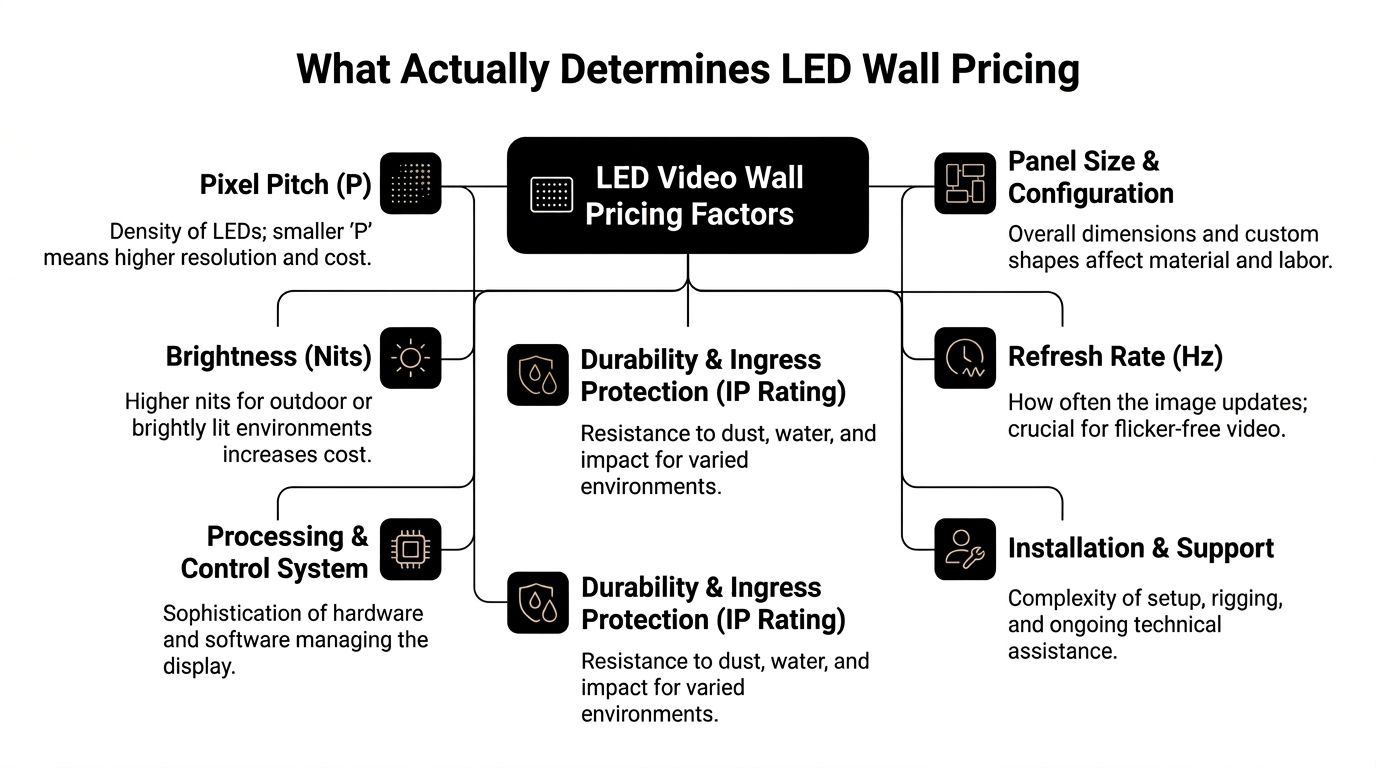
The led video wall price starts with the screen, but the screen is only one layer. Several technical choices shape the final number, and each one affects image quality in a visible way.
Pixel pitch changes what people see
Pixel pitch is the distance between LED clusters. Smaller pitch means tighter pixel spacing. Tighter spacing means a sharper image at closer viewing distances.
That matters at trade shows because attendees do not stand fifty feet away. They walk right up to the booth. They take photos. They watch demos from a few feet away. A wall with 1.9 pitch looks noticeably cleaner in that environment than the 2.5 pitch walls many competitors use.
This is similar to comparing two TVs of the same size with different resolution. From across the room, both may seem acceptable. Up close, one looks crisp and premium. The other starts to show its structure.
Size and shape affect more than material cost in the video wall price
A bigger wall costs more, but size alone does not tell the whole story. Configuration matters.
A simple flat back wall is easier to price and deploy than a structure with returns, corners, columns, arches, or suspended sections. Custom geometry affects how many tiles are needed, how they are framed, how content is mapped, and how much labor the setup requires.
If you are still deciding layout, reviewing common video wall sizes helps narrow the discussion before you start collecting quotes.
Indoor quality lives in a different price band
For 2025, the average cost of LED video walls ranges from $800 to $2,500 per square meter, with fine-pitch indoor displays at $2,000 to $2,500 per square meter and large-pitch outdoor displays at $800 to $1,200 per square meter, according to this 2025 LED video wall cost guide.
That range explains why broad online searches can be misleading. A low outdoor billboard number does not tell you much about the cost of a fine-pitch indoor wall for a convention center booth.
Brightness and environment matter and change the video wall price
Trade show halls are tricky lighting environments. Some booths sit under harsh overhead fixtures. Others face open entrances, windows, or bright neighboring displays.
You need enough brightness to hold contrast without washing out content. But brightness is not a spec to chase blindly. Paying for outdoor-level intensity in an indoor booth can be unnecessary if the environment does not require it.
A good quote should account for where the wall will be used, not just list a generic brightness figure and move on.
Processing is the part many buyers miss
Panels display the image. Processing and control systems make the wall behave like one seamless screen.
That means scaling, synchronization, color uniformity, refresh behavior, source switching, and signal stability. If this side of the system is weak, the wall may still power on, but it will not perform cleanly during live demos, camera moments, or fast-moving content.
A smart buyer asks questions about the video wall price like:
- What processor is included
- How is content scaled to the wall resolution
- Will the wall handle live video cleanly
- Who manages calibration and signal testing on site
Cheap visual hardware paired with weak processing is one of the fastest ways to make an expensive booth look amateur.
Should You Rent or Buy Your Trade Show Video Wall
This decision is less about technology and more about operating model.
Some exhibitors should buy. Most should rent. The right choice depends on show frequency, internal staff capacity, storage tolerance, and how much risk your team is willing to manage.
When buying makes sense
Buying can work if your company exhibits often, uses a consistent booth footprint, and has people who can manage logistics. Ownership gives you control over the asset and lets you standardize a repeatable look.
It also creates obligations. Someone must store the wall, maintain it, track damage, arrange freight, coordinate labor, confirm compatibility, and handle repairs. If your event team is already stretched, ownership often shifts work onto people who were never hired to be AV managers.
There is also the technology question. The global LED video wall display market is projected to grow from US$6.85 billion in 2025 to US$15 billion by 2032, and some panel costs have dropped by nearly 50% in the last four years, which is one reason many exhibitors prefer renting instead of tying capital to hardware that may age quickly, as noted by LEDinside’s market outlook.
If your finance team is weighing ownership structure, this practical guide to equipment financing versus leasing is a useful read before you commit.
Why renting fits trade shows better
Rental aligns with how trade show programs operate. Booth sizes change. Creative changes. Cities change. Labor rules change. Your display strategy may need to adapt from one event to the next.
With a rental, you are not stuck defending an older asset just because you own it. You choose the system that fits the event. You avoid storage headaches. You avoid maintenance planning. You avoid being the person who discovers a damaged tile the morning before install.
Rental also simplifies internal budgeting. Marketing teams usually care about one clean event number. They do not want to split costs across capital equipment, warehouse handling, service contracts, and repair contingencies.
A practical decision filter
Use this framework:
| Situation | Rent | Buy |
|---|---|---|
| Booth sizes vary by event | Best fit | Harder to standardize |
| Internal AV support is limited | Best fit | Risky |
| You want current display quality | Best fit | Obsolescence risk |
| You exhibit with the same format repeatedly | Possible | Can make sense |
| You want no storage burden | Best fit | Not ideal |
A side-by-side breakdown of whether it is better to buy or rent an LED video wall can help if your team is still split.
Ownership works best when your company wants to run a display program. Rental works best when your company wants to run trade shows.
Beyond the Panel Price Hidden Trade Show Fees Add to the LED Video Wall Price
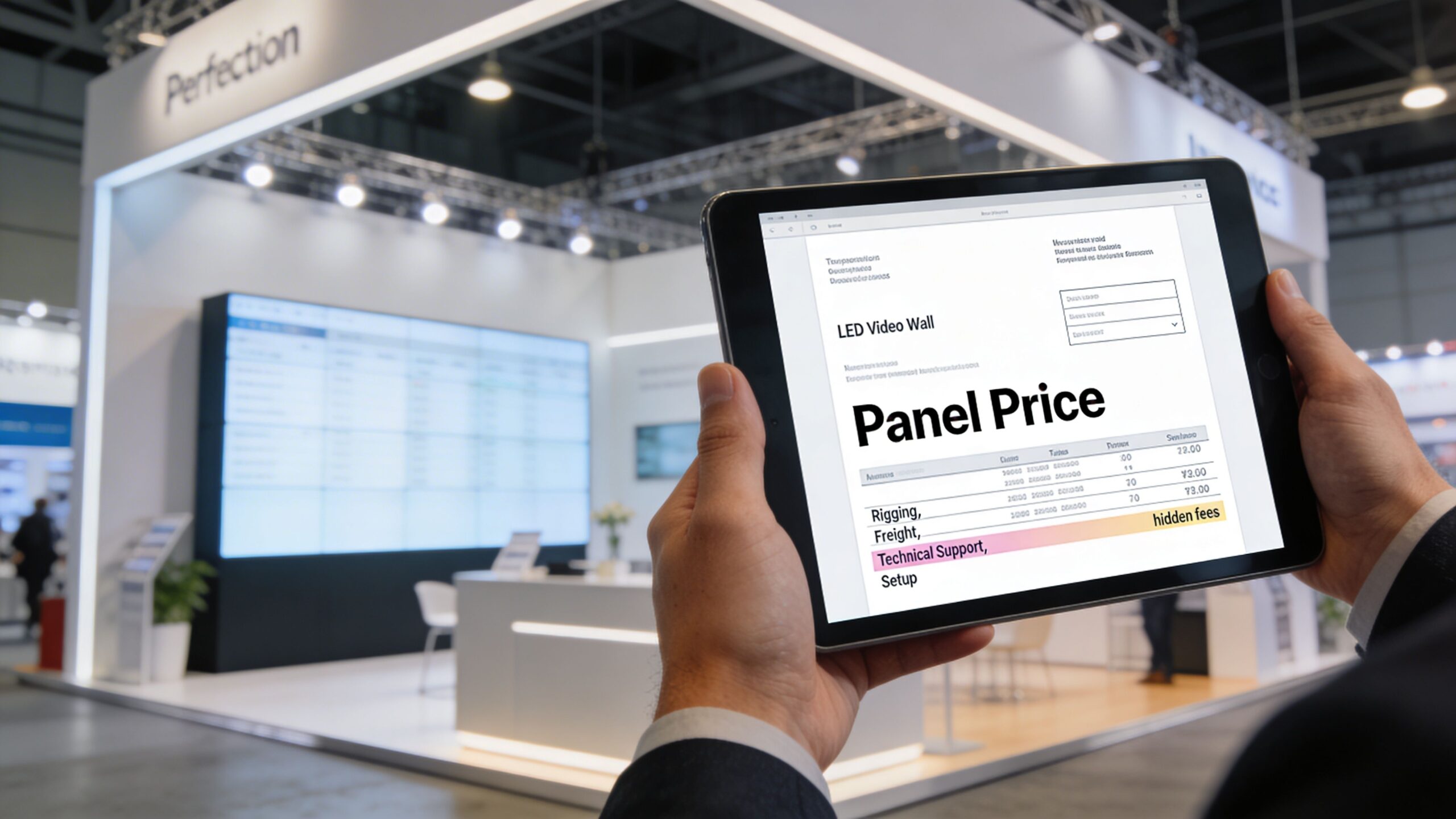
The panel quote is where many exhibitors get trapped.
A purchased wall may look cost-effective until the event-specific charges start landing. Those charges are not side notes. They are often the difference between a manageable program and a painful surprise.
Drayage and labor are not optional details
For trade show exhibitors, total cost of ownership often includes overlooked costs like drayage at $50 to $100 per hundredweight and union labor at $75 to $150 per hour per technician, which can add $3,500 to $8,000 per event to a purchased wall. The same source notes that modular, toolless systems can cut those labor costs by 50 to 70 percent, according to this review of trade show LED wall ownership costs.
If you have not dealt with drayage before, it is the venue’s material handling charge. Your crate arrives. The venue or general contractor moves it from receiving to your booth and back out again. You pay for that movement whether the product inside is cheap or premium.
Union labor is similar. In many cities, your own staff cannot build everything themselves. Certified labor crews may be required for setup and dismantle. The more complicated the system, the more hours you buy.
Other costs that hit later add to the total LED video wall price
These line items often appear after buyers think they are done budgeting:
- Shipping and freight: Especially painful when timing is tight or the system needs special handling.
- On-site coordination: Someone must receive, inspect, and manage the equipment.
- Electrical service: Ordered through the show, not the vendor.
- Troubleshooting coverage: If no one stays with the wall, your team becomes first response.
- Damage exposure: Purchased inventory can create repair or replacement costs after the event.
A lot of exhibitors miss these items during early planning. This guide on budgeting for your trade show is worth sharing with anyone on your team who touches operations, procurement, or event finance.
Why the cheapest quote often stops being a cheap LED video wall price
A low upfront number usually means one of two things. Either the quote excludes major services, or the system requires more support than the buyer expects.
That is why logistics planning matters as much as panel selection. If your team is moving displays across events, understanding the practicalities of shipping trade show materials is part of pricing the wall.
A panel-only quote is not a trade show budget. It is one line in a trade show budget.
The All-Inclusive Advantage of a Turnkey Rental
The strongest rental model removes work, not just cost.
That matters because show teams do not need one more vendor to coordinate. They need one accountable partner who handles the display from pre-show planning through move-out.
What turnkey should mean in real life
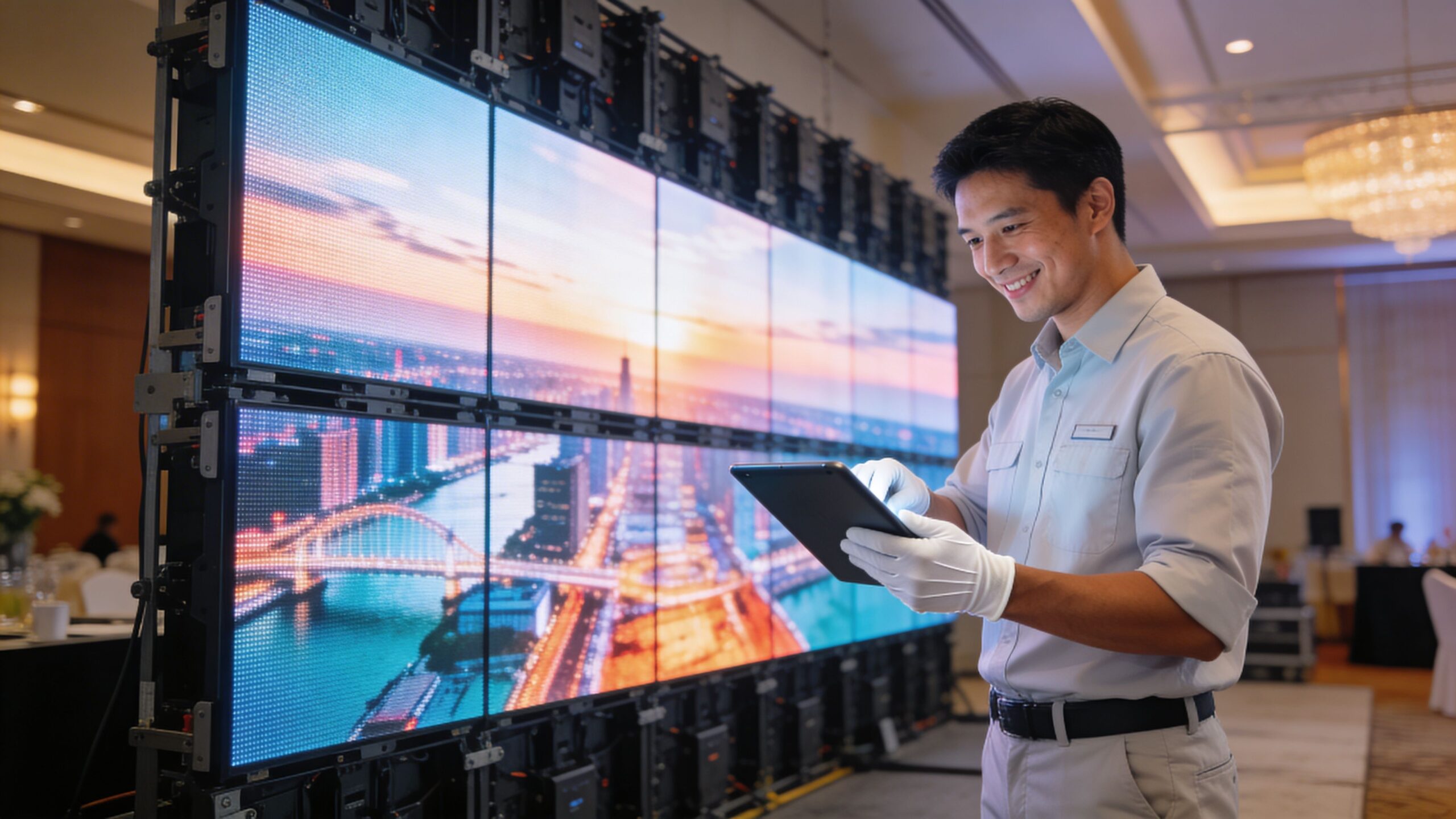
A true turnkey rental includes everything needed to get the wall designed, delivered, installed, operated, and removed, except the charges the show bills you directly. In practice, that usually means the show bills for electricity and material handling. The display partner should be covering the rest.
That all-inclusive structure is valuable because it eliminates gray areas. You are not wondering who owns calibration. You are not guessing whether labor is included. You are not finding out on install day that signal distribution was “outside scope.”
White glove service is part of that. Not a marketing phrase. Execution.
Resolution matters on a crowded floor
For trade shows, 1.9 pitch is a meaningful quality threshold. It gives exhibitors a sharper, more refined image at typical booth viewing distances than the 2.5 pitch systems that are still common in the market.
That difference shows up in text, product renders, motion graphics, and close-up conversations. It also affects how premium your booth feels from the aisle. Buyers may not know the term pixel pitch, but they absolutely notice image quality.
The processor matters as much as the panel and influences the LED video wall price
Video processing and control systems can represent 20 to 40 percent of an LED wall’s total cost, and using high-end processors with refresh rates of 3840Hz+ is critical for preventing flicker and moiré on camera during live demos, according to Neoti’s breakdown of LED video wall cost and processing requirements.
This is one of the biggest gaps between professional rentals and bargain packages. Cheap packages often focus attention on the wall surface while downgrading the processor behind it. That is a mistake if your booth includes presentations, product demos, filming, interviews, or any content people will view up close.
On-site support changes the risk profile but doesn’t add to the LED video wall price
One of the most underrated parts of a good rental is having an audiovisual technician on site for the full time the show is open. Naturally, many vendors charge extra if you want an AV Technician on call. However, we include that peace of mind in the price. Obviously, it costs money to fly the audiovisual technician back home after setup and costs money to fly the technician back to dismantle the booth at the end of the show. For that reason, we prefer to simply leave our AV Technician at the show the entire time the show is open. Consequently, you get peace of mind knowing someone is just a phone call away. At the same time, we aren’t flying people back and forth.
That changes everything. If content fails, if a source drops, if settings need adjustment, your booth staff does not stop selling to troubleshoot a display. They text or call, and someone resolves it quickly.
A proper LED video wall rental should not end at installation. Trade shows are live environments. Support during show hours is part of the product.
The best rental quote is not the one with the lowest starting number. It is the one that leaves your team free to meet customers while the display runs without drama.
Real-World LED Video Wall Price Examples
Most buyers do not think in cost per square meter. They think in booth formats. That is the practical way to budget.
The examples below are not panel-only numbers. They are typical turnkey rental ranges for common trade show scenarios. Final pricing depends on show city, booth design, content complexity, duration, rigging needs, and support scope.
Sample turnkey rental ranges
| Booth Size | Common Configuration | Typical Turnkey Rental Range |
|---|---|---|
| 10×10 inline | Single LED back wall | Custom quote based on show, but maybe $20,000 – $25,000 |
| 10×20 inline | Full back wall with integrated demo area | Custom quote based on show, but maybe $30,000 – $40,000 |
| 20×20 island | Multi-sided LED structure, columns, or archway | Custom quote based on show, but maybe $40,000 – $60,000 |
| Small product launch space | LED feature wall plus branded counter | Custom quote based on show, but maybe $20,000 – $25,000 |
Why examples stay custom
Two booths with the same footprint can price very differently.
One may use a simple rectangular wall and looped brand content. Another may need custom framing, live presentations, source switching, embedded product messaging, and full-time technical oversight. Same size. Very different led video wall price. Plus, the number of days the show is open matters. Of course, labor costs are higher in a union city compared with a non-union city. Additionally, if the setup or dismantle is on a weekend or holiday then labor cost are higher.
This is also why experienced vendors ask better questions at the start:
- What city is the show in
- How many open days
- Is the wall camera-facing
- Will you run live demos or only playback
- Do you need the structure to do more than act as a backdrop
A better way to use sample numbers
Use examples to set expectations, not to lock a budget prematurely.
If you need a rough planning number, ask for a turnkey estimate tied to your booth size, your city, and whether support stays onsite during show hours. That will get you much closer to reality than shopping by panel dimension alone.
One practical note from the field: a smaller wall with excellent content and clean support usually performs better than a larger wall that your team cannot manage confidently. On crowded floors, reliability and polish beat raw size.
Smart Ways to Reduce Your Video Wall Price Budget
Reducing cost does not mean chasing the cheapest wall. It means cutting waste while protecting the parts attendees notice.
Book early and lock the right scope
Last-minute design changes create expensive problems. So does waiting too long to reserve inventory, labor, and freight windows.
Early planning gives you better control over screen size, content formatting, and booth integration. It also gives your vendor time to recommend a simpler structure if one will accomplish the same visual goal.
Reuse content intelligently
Trade show content gets expensive when every show starts from zero.
Build motion graphics, product loops, and branded background elements that can be adapted across events. Then create only the event-specific pieces fresh. That approach keeps the wall dynamic without forcing a full content rebuild every time.
Design for modularity
A modular tile system gives you options. The same general package can often be reconfigured for different footprints or creative concepts.
That is much better than specifying a one-off structure that only fits one booth layout. Buyers save money when they plan a display system that can evolve with the event calendar.
- Trim complexity first: Simplify shapes before cutting image quality.
- Protect resolution: Fine pitch is usually worth preserving in close-viewing booths.
- Ask about included support: Cheap packages become expensive when small issues require emergency fixes.
If you must choose, reduce size before you reduce reliability.
Your Video Wall Rental Questions Answered
How far in advance should I book
Earlier is better, especially for major shows. Good inventory, experienced labor windows, and thoughtful content prep all get tighter as the event approaches.
Is a 1.9 pitch wall really better than 2.5
Yes, for typical indoor trade show viewing distances it is visibly sharper. Text reads cleaner, motion looks more refined, and close-up conversations happen in front of a more premium image.
What should be included in a turnkey quote
Everything needed to deliver, install, operate, and remove the wall should be clearly included, except the charges the show bills directly, such as electricity and material handling.
Do I need an on-site technician
For a serious trade show program, it is a strong advantage. If anything changes or fails during show hours, your booth team should stay focused on attendees, not screens.
Should I buy if I exhibit often
Maybe, but only if your organization can manage storage, freight, setup coordination, maintenance, and repair responsibility without straining the event team.
What is the biggest mistake buyers make
They compare a panel quote with a turnkey quote as if both represent the same thing. They do not. One prices equipment. The other prices execution.
If you want a clear, all-in quote instead of another vague hardware number, talk to LED Exhibit Booths. Our turnkey rental model includes everything except the charges the show bills you directly, such as electricity and material handling. As a result, you get higher-resolution 1.9 pitch video walls, white glove service, and an on-site AV technician throughout show hours so your team can focus on customers, not troubleshooting.