
You have a show coming up. The booth is booked. The freight forms are in motion. Someone on the team says the old pop-up still works, so maybe you can save money and reuse it one more time. However, backlit trade show displays help you to stand out from the crowd.
Then you get to the convention hall and see the problem.
Rows of booths blend together. Printed walls fade into the background under venue lighting. Attendees walk the aisle scanning for something that feels current, active, and worth stopping for. If your booth looks static, people assume the experience will be static too.
That is why backlit trade show displays have moved from nice upgrade to practical necessity for many exhibitors. And for brands that want the strongest visual impact, seamless LED video walls have become the standard worth comparing everything else against.
Beyond the Pop-Up Banner Why Your Booth Needs an Upgrade
A lot of exhibitors know this feeling. You spend real money on floor space, travel, labor, shipping, and lead capture, only to realize your booth disappears the moment the hall opens.
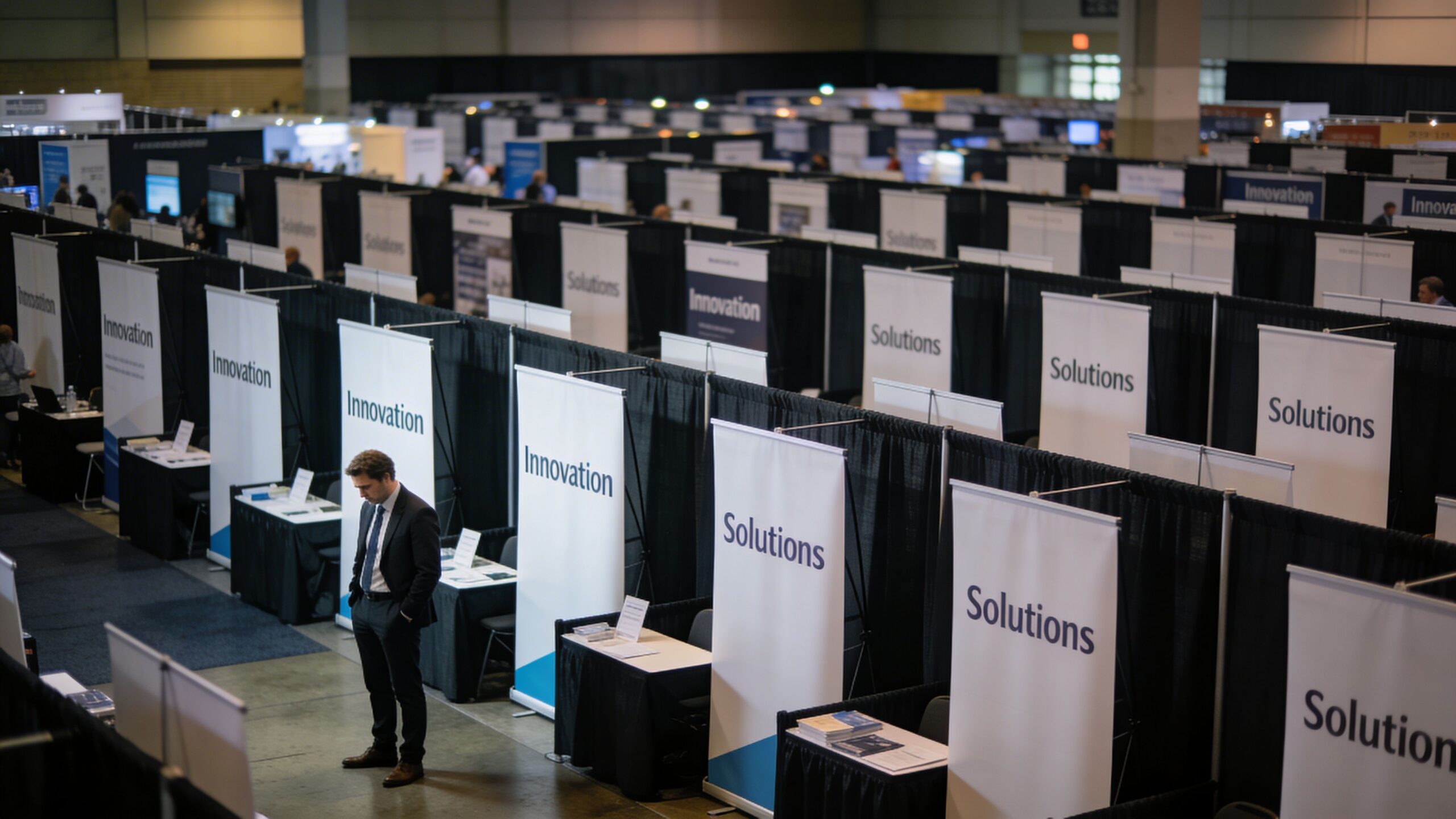
The old pop-up banner was built for a different trade show era. It did one job well enough. It held a logo, a tagline, and maybe a product shot. But on a modern show floor, that is like bringing a flashlight to compete with storefront signage.
Static booths get ignored fast but not backlit trade show displays
Attendees make snap decisions. They are not reading every panel from left to right. They are moving, scanning, filtering.
A printed backdrop can still look clean. It can still be professional. But it rarely creates a reason to stop unless the design is exceptional and the aisle traffic is slow enough for people to notice details.
If you are looking for fresh creative directions before you commit to a booth redesign, these inspiring trade show display ideas offer useful examples of what catches attention without relying on clutter.
The market is moving toward illuminated systems
This is not a niche trend. The global backlit displays market was valued at USD 7.5 billion in 2024 and is projected to reach USD 15.2 billion by 2034, growing at a CAGR of 8.30%. The trade show display segment dominated in 2023, driven by companies trying to stand out with more attractive booth spaces and leave a stronger impression on visitors, according to Polaris Market Research.
That growth makes sense if you spend time on show floors. Brands are not just buying a backdrop anymore. They are buying visibility.
Some exhibitors start that shift with a simple pop-up display for trade show setup, then realize quickly that lighting changes how people read the booth from across the aisle.
A booth does not need to be the biggest on the floor. It needs to be the easiest to notice and the easiest to understand.
What the upgrade really changes with backlit trade show displays
Backlit trade show displays solve the first problem, visibility. LED video walls solve the second one too. They let the booth communicate motion, depth, and relevance.
That matters because trade show success usually starts before a conversation. It starts with a glance. If the booth wins that moment, your team gets more chances to do the part that closes business.
Understanding Backlit Displays vs LED Video Walls
People often use these terms interchangeably. That creates confusion during planning, budgeting, and vendor comparison.
Both options light up your booth. They are not the same product.
What a fabric backlit display is
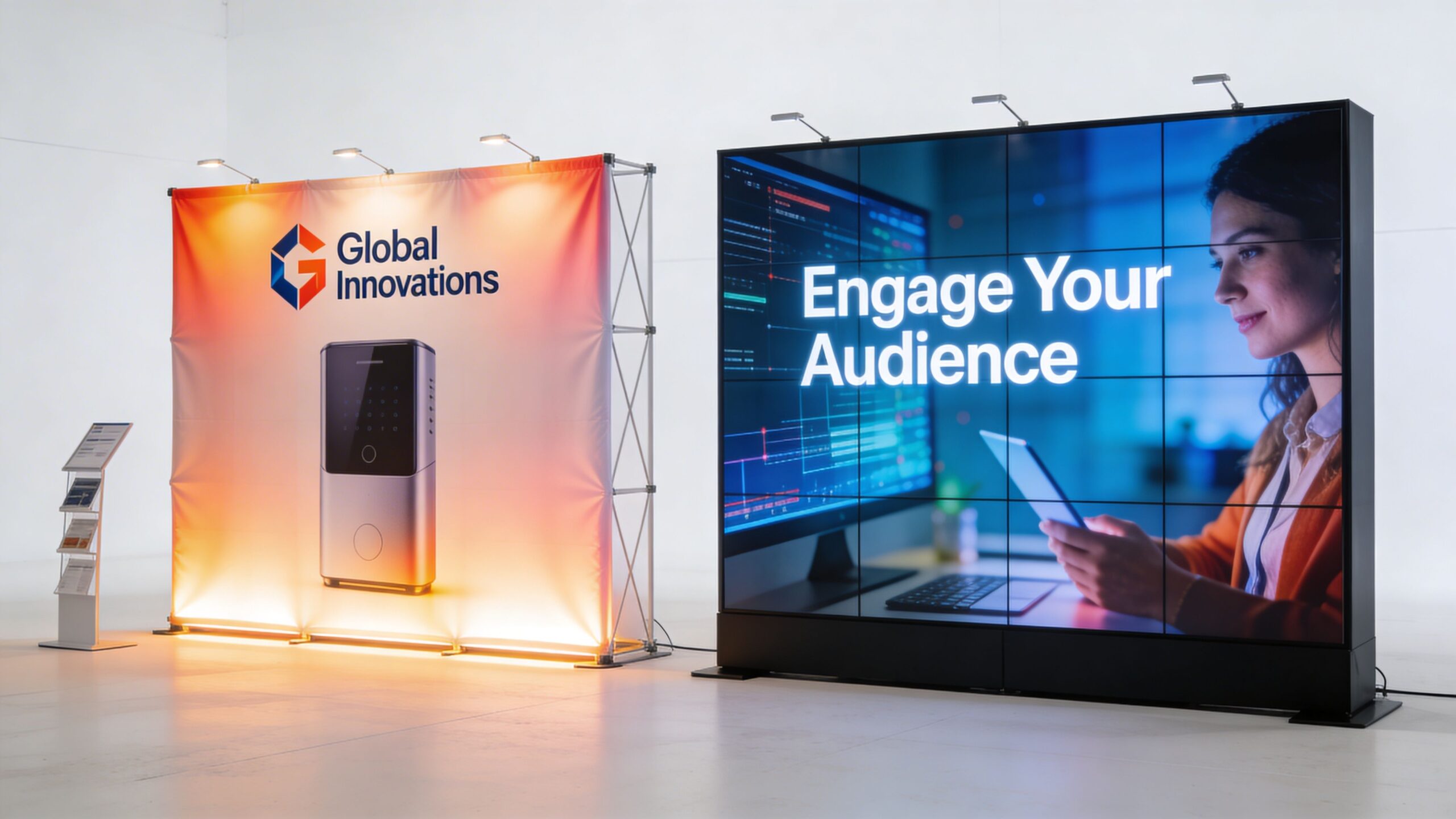
A traditional fabric backlit display is basically a lightbox. You have a frame, internal LED lighting, and a printed fabric graphic stretched across the face.
It looks polished. It is much more eye-catching than a standard printed panel. For logos, lifestyle imagery, product photos, and simple branded environments, it works well.
Its strengths are clear:
- Clean presentation: The glow gives printed graphics more depth and contrast.
- Straightforward messaging: One hero image or a clear product visual can read well from a distance.
- Reusable structure: You can update the fabric print while keeping the frame.
Its limits are just as important:
- The message is fixed: If your campaign changes, the display does not.
- No motion: A static graphic cannot show a demo, rotate headlines, or react to crowd flow.
- Less immersive: It improves your booth backdrop, but it does not turn the booth itself into media.
What an LED video wall is
An LED video wall is not one giant screen shipped in one piece. Consider it a wall built from digital tiles. Each tile is a small section of display, and the sections connect to form one continuous surface.
A good way to picture it is Lego bricks made of light. Individually, each tile is just one piece. Together, they create a single canvas.
That is what makes a video display wall different from a row of monitors mounted side by side. Monitors bring bezels, gaps, visible framing, and a temporary feel. LED tiles are built to disappear into the final image.
Why the structural difference matters
With a lightbox, the structure supports a graphic.
With a video wall, the structure is the graphic.
That opens up design options that older display types cannot match. A wall can loop product animation. A column can carry brand motion. A counter can display supporting visuals. An arch can become part of the story instead of a frame around it.
Here is the practical difference in booth behavior:
| Display type | Best use | Main limitation |
|---|---|---|
| Fabric backlit display | Strong static branding and photo-based messaging | Content cannot change during the show |
| LED video wall | Dynamic storytelling, demos, changing campaigns | Requires stronger planning, content, and technical support |
Which one fits your event goal backlit trade show displays or video wall booths
If you need a polished visual backdrop and your message is simple, a fabric backlit system can be enough.
If you are launching a product, showing software, explaining a process, rotating audience-specific messaging, or trying to create a premium booth experience, the LED wall usually earns its place quickly.
A backlit lightbox says, “Here we are.” An LED wall says, “Come see what we do.”
That distinction is why experienced exhibitors look past the word backlit and ask a better question. Do they need illumination, or do they need communication?
The Unmissable Benefits of Going With Backlit Trade Show Displays
The first benefit is obvious. People can see your booth sooner.
The better benefits show up after that first glance. Good backlit trade show displays do not just brighten a space. They make your booth easier to understand, easier to move through, and easier to remember.
Visibility that works from aisle distance
Most show floors are visually noisy. Hanging signs, overhead lights, glossy flooring, neighboring demos, and competing color palettes all fight for attention.
Backlighting helps your brand cut through that clutter because illuminated graphics hold contrast better than flat prints under uneven venue lighting. A lit visual looks intentional. It reads as active, not parked.
That matters most when attendees are still several steps away. If they can identify your brand promise before they reach the booth, your staff starts the conversation with less friction.
Better storytelling without adding physical clutter
Older booths often try to say too much with too many panels. One wall explains the company. Another lists features. A third shows use cases. The result is usually a booth people skim but do not absorb.
Backlit systems simplify that problem.
A lightbox can anchor the brand with one clean image. A video wall can do more. It can rotate through product views, highlight customer use cases, show interface screens, and support live presentations without covering the booth in separate signs.
That reduces visual noise while increasing the amount of information you can communicate.
Lower operating strain than many people expect
A lot of exhibitors assume illuminated displays must be expensive to power and complicated to run. Modern LED systems changed that calculation.
Modern LED technology used in backlit trade show displays can result in up to 75% less power consumption compared to traditional lighting, which can reduce electrical costs at venues. That efficiency is one reason fixed installation segments, common in booth structures, were projected to hold 68% market share in the U.S. in 2026, according to Cardinal Expo.
That point gets overlooked. Convention center power is never an afterthought. Efficient display technology can help keep operating costs from climbing faster than the booth budget.
Practical benefits of backlit trade show displaysteams notice on show day
The operational upside is often what wins over event managers after the first event. Strong systems are designed to reduce common booth headaches.
- Fewer moving parts on site: Modular systems reduce the pile of mismatched hardware and last-minute improvisation.
- Cleaner presentation: You avoid the cobbled-together look that happens when separate screens, mounts, and printed signs compete inside one footprint.
- Faster content control: Teams can update visuals before the show or between audience segments without replacing hardware.
- Better booth flow: One integrated visual surface often works better than several disconnected displays.
The business outcome is usually simple
People stop more often at booths that look active and current. Staff waste less time trying to pull attention in from the aisle. Product marketers can tell one consistent story instead of asking attendees to assemble it from separate signs.
Backlit trade show displays support all of that. LED walls extend it further by turning the booth itself into a communication tool.
The gain is not brightness alone. It is clarity, presence, and a booth that does more work before your reps say hello.
Key Technical Specifications That Matter With Backlit Trade Show Displays
A lot of display proposals hide behind jargon. Buyers get a list of specs, a rendering, and a price. Then they are expected to know whether they are comparing premium hardware or a compromise that only looks good from far away. Plus, they are very affordable lightweight trade show booths.
The spec sheet gets easier once you translate it into show-floor consequences.
Pixel pitch is the first spec to check
If you only learn one term, learn pixel pitch.
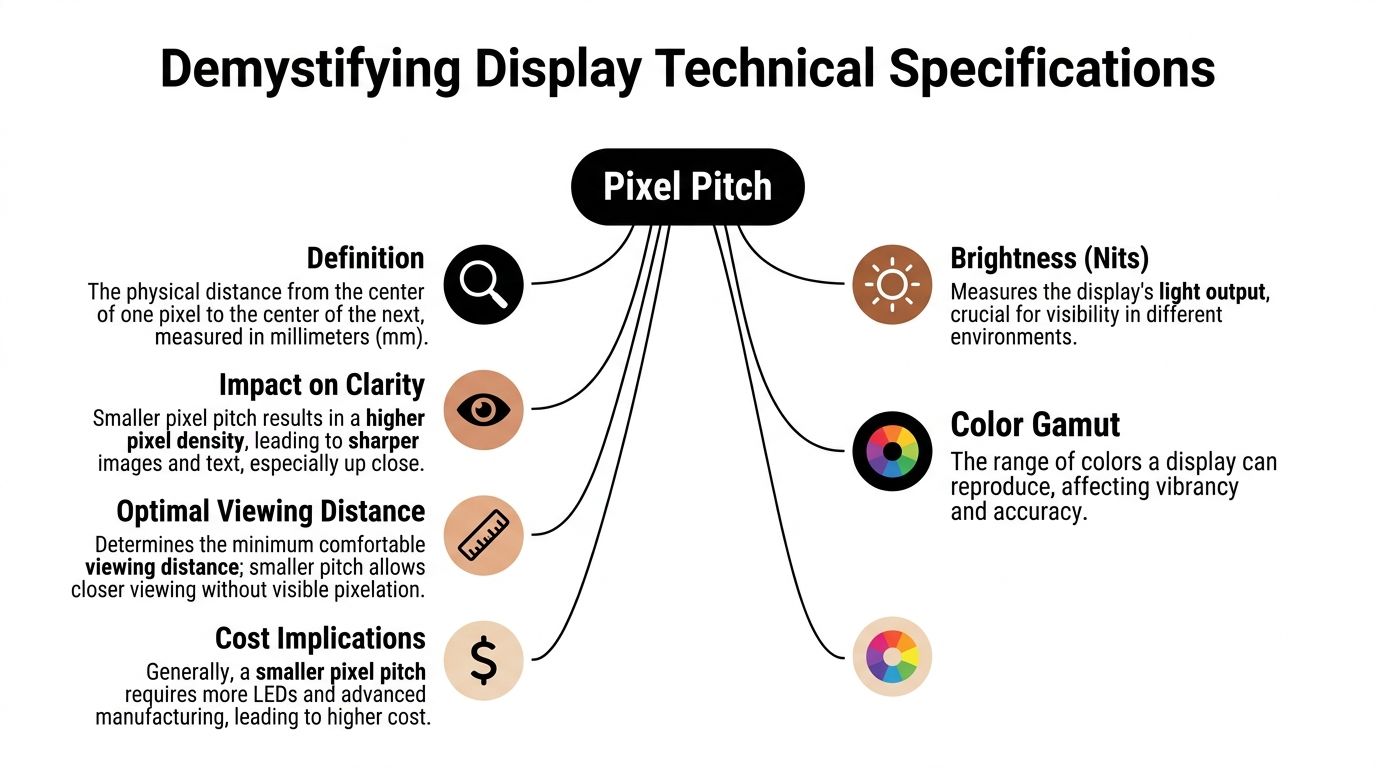
Pixel pitch is the distance between pixels, measured in millimeters. Smaller number, tighter pixels. Tighter pixels, sharper image at close range.
That is why 1.9 matters. Many competitors work with 2.5 pitch. A 1.9 pitch video wall has higher resolution and finer detail, which becomes obvious when attendees stand near the booth.
Compare it to print quality. A brochure can look fine from across a room, but if the image breaks apart in your hand, the quality was never really there. Pixel pitch works the same way.
A product close-up, crisp text, or software interface shown on a 1.9 wall holds together better than it does on a 2.5 wall when viewed up close.
You can review the hardware side of this more closely through an LED panel for video breakdown, but the practical takeaway is simple. If your booth invites people to stand near the display, lower pixel pitch is worth serious attention.
Brightness matters, but context matters more
Brightness is usually measured in nits. Buyers often fixate on that number because it sounds important, and it is. But brightness by itself does not guarantee a better booth.
In a trade show environment, the goal is not to create a blinding wall. The goal is to keep content visible under venue lighting without washing out colors or fatiguing the viewer.
A good system balances brightness with content quality and hall conditions. Too little brightness and the wall looks dull. Too much and skin tones, product images, and text can look harsh.
Seam quality separates a video wall from a monitor wall
Many exhibitors say they want a video wall when what they are being quoted is a monitor array. That difference shows up immediately in the seams.
Monitors have bezels. Even slim bezels interrupt content. If you are showing a product hero shot and a bezel cuts through the middle of it, the illusion breaks.
LED tiles are meant to create one uninterrupted image. That seamless effect is a major reason premium booths look premium. The technology disappears and the content takes over.
Weight and modularity affect your budget more than you think
This part is less exciting than resolution, but it matters just as much. Booth hardware that is lighter and more modular is easier to ship, easier to stage, and easier to install cleanly.
That affects real-world costs and risk:
- Shipping: Lighter components are easier to move and manage.
- Material handling: Simpler packaging and modular builds reduce the chance of show-floor chaos.
- Labor: Toolless or simplified assembly gives installers fewer ways to make mistakes.
- Adaptability: Modular inventory can fit different booth footprints without forcing a total redesign.
What to ask when comparing proposals with backlit trade show displays
Do not just ask for a quote. Ask what the hardware means for your specific booth.
Use questions like these:
- How close will attendees stand to the screen? If the answer is very close, pixel pitch matters more.
- Will the content include small text or software UI? If yes, lower pitch becomes more valuable.
- Is the quoted display seamless, or is it a monitor wall? That should be answered plainly.
- How is the system assembled on site? This affects labor time and execution risk.
- Who supports it once the hall opens? This question is as important as any spec on the sheet.
Cheaper hardware often looks affordable only until the booth opens and the compromises become visible.
The best spec is not the one with the fanciest label. It is the one that protects image quality, operational simplicity, and attendee experience in the environment where the booth has to perform.
Renting vs Buying Your Video Wall Booth
Most exhibitors ask the wrong first question. They ask, “What does it cost to buy?”
The better question is, “How often will we use it, and who is going to manage it?”
For many brands, the smartest choice is not ownership. It is access to the right system, in the right configuration, with the right support.
The core decision is operational, not just financial
Buying can make sense for companies with a busy event calendar, internal exhibit operations, storage capacity, and people who know how to manage hardware between shows.
Renting makes more sense when the team wants flexibility, wants to avoid maintenance responsibility, or does not want capital tied up in equipment that sits between events.
That is why a lot of event teams start with a is it better to buy or rent an LED video wall evaluation instead of jumping straight to purchase quotes.
Rent vs Buy Decision Framework
| Consideration | Best for Renting | Best for Buying |
|---|---|---|
| Show frequency | A limited number of events or changing booth schedules | Frequent exhibiting with predictable use |
| Content and booth changes | Brands that want different configurations by event | Teams with a stable booth format |
| Internal staff capacity | Companies that do not want to manage storage, maintenance, and tech coordination | Companies with dedicated exhibit operations |
| Risk tolerance | Teams that want support built into execution | Teams comfortable owning service and repair responsibility |
| Cash flow preference | Businesses that prefer project-based spend | Businesses prepared for upfront investment |
Why turnkey service changes the math
Initial price is only one part of the cost. Trade shows create hidden labor, logistics, and stress costs that never show up in a simple hardware comparison.
A strong rental partner can remove much of that burden.
The best turnkey model includes everything in the rental price except the charges the show bills directly to you. In practice, that usually means the event bills you for things like electricity and material handling, while the display partner handles the rest of the booth-side execution.
That difference matters because it creates budgeting clarity. You are not trying to guess which line items will appear later as “extras.”
White glove support is not a luxury
It is easy to underestimate how much can go wrong during an event. Content does not load correctly. A connection needs attention. A panel needs adjustment. Staff on site are busy with prospects, not troubleshooting display systems.
That is where white glove, turnkey service earns its value.
With a full-service setup, the partner handles the details so your team can focus on meetings and demos. The strongest version of that model leaves an audiovisual technician onsite for the entire time the show is open. If something goes wrong, your team can text or call and get help at the booth within minutes.
That is a very different experience from getting handed equipment and a support number.
What usually works best
For most exhibitors, renting is the safer first move because it limits risk and includes expertise they do not have in-house.
Buying becomes more attractive when a company already knows the exact booth format it wants, exhibits often, and has the internal discipline to support the asset properly.
In other words, the right choice is not about pride of ownership. It is about whether your team wants to operate display technology or use display technology to win business.
A Practical Checklist for Your Next Exhibit
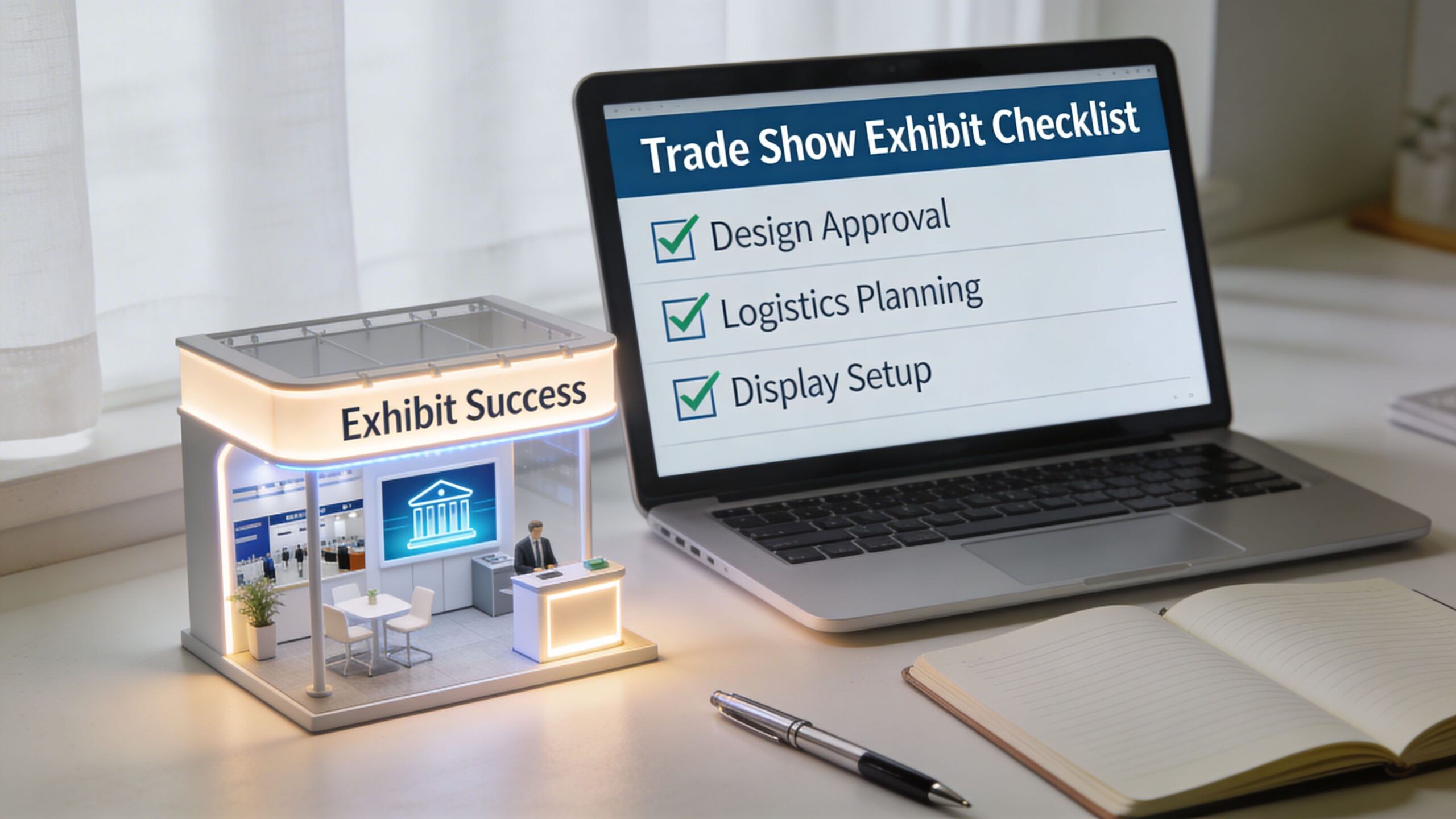
A video wall booth performs best when the planning is disciplined. Most show-floor problems do not start in the hall. They start weeks earlier with vague assumptions, incomplete forms, or content that was approved too late.
Use this checklist before your next event.
Lock the budget before creative starts
Do not budget only for the booth footprint and display hardware. Build a full event budget that includes content production, show-ordered services, and any requirements the venue bills directly.
A practical budgeting conversation should separate three buckets:
- Partner-managed costs: Design support, equipment, transport coordination, setup, dismantle, and onsite tech support if included.
- Show-billed costs: Items such as power and material handling.
- Marketing costs: Motion graphics, edited loops, demo videos, and lead capture tools.
That discipline prevents a common mistake. Teams approve a booth concept, then discover the actual event spend is larger because no one accounted for operating requirements.
Design content for movement, not for a brochure
A video wall is not a PDF viewer. Content should be easy to understand in passing and strong enough to reward a second look.
Good show content usually has these traits:
- Short loops: Keep messages concise and repeatable.
- Large focal points: Product visuals, headlines, and motion cues should read from distance.
- Simple calls to action: Tell people what to do next, whether that is watch a demo, ask a question, or book a meeting.
- Controlled pacing: Fast edits can look chaotic on the floor.
- Silent-first design: Assume many viewers will see it before they hear anything.
If a stranger cannot understand the main point of your screen within a few seconds, the content is doing too much.
Confirm logistics early
Turnkey support saves time here, but the exhibitor still needs visibility into the plan.
Review the basics early:
- Power order: Confirm what the booth needs and when the order is due.
- Internet needs: Live demos, lead retrieval systems, and streamed content may require more than standard venue access.
- Load-in schedule: Know your install window and any restrictions.
- Content handoff dates: Late content causes rushed testing.
- Onsite escalation: Everyone should know who to contact if anything needs attention.
For teams handling setup coordination internally, this trade show set up guide helps frame the operational side before show week arrives.
Measure the outcome after the booth comes down
The easiest way to misjudge a booth investment is to evaluate it only by gut feeling. Busy booths can still produce weak leads. Quiet-looking booths can still create strong meetings.
Track the results with a simple post-show review:
| What to review | Why it matters |
|---|---|
| Lead quality | Tells you whether the booth attracted the right audience |
| Staff feedback | Reveals where traffic flow or content created friction |
| Content performance | Shows which visuals sparked conversations |
| Booth operations | Identifies setup or support issues to fix next time |
A good partner handles many of the moving parts. A good exhibitor still reviews the outcome with discipline. That combination is what turns one successful event into a repeatable exhibiting system.
Make Your Next Show Your Best Show
Trade shows are expensive places to be invisible.
That is the simplest reason backlit trade show displays keep gaining ground. They help brands get seen. And when the goal is more than visibility, when the booth needs to demonstrate, persuade, and hold attention, seamless LED video walls offer advantages older display formats cannot match.
The details matter. Resolution matters. A 1.9 pixel pitch gives you sharper imagery up close than the 2.5 pitch many exhibitors still get quoted. Seamless construction matters because it keeps the audience focused on the content instead of the hardware. And support matters because even great equipment can fail to deliver if no one owns the execution once the doors open.
The bigger lesson is about total cost of ownership. The cheapest-looking quote is often not the lowest-cost exhibit experience. Not if it leaves your team managing setup problems, support gaps, vague scope, or onsite technical issues while prospects are standing in the booth.
A full-service partner changes that equation. When the pricing includes the major execution pieces and the only separate charges are the ones billed directly by the show, budgeting gets easier. When white glove service covers planning, install, dismantle, and active support, your internal team gets to stay focused on customers. When an audiovisual technician remains onsite during show hours, small issues stay small.
That is what modern exhibiting should feel like. The technology should help your staff sell, not give them one more thing to babysit.
If your current booth still relies on static graphics and hope, this is the right time to evaluate an upgrade. Strong backlit systems pull attention. High-resolution LED walls hold it. The right service model protects the investment from the first planning call to the final teardown.
LED Exhibit Booths helps exhibitors build high-impact trade show environments with seamless LED video wall booths, turnkey logistics, and white glove support. If you want a higher-resolution booth solution with planning, setup, dismantle, and onsite AV help handled for you, talk with LED Exhibit Booths about the right rental or purchase option for your event calendar.