Expert Guide to LED Screen for Stage

Trade show floors are crowded with safe choices. Printed backwalls. A looping monitor on a stand. Maybe a lightbox if the team pushed the budget. Most of those booths disappear the moment attendees walk past them. Naturally, an led screen for stage can make all the difference.

led screen for stage setups solve that problem when they’re planned correctly. They don’t just show content. They turn your booth into the content. That’s the difference between being seen and being remembered.

We’ve watched exhibitors make the same mistake over and over. They focus on the hardware first, then get surprised by setup complexity, hidden venue charges, weak content, or a screen that looked fine in a sales deck and underwhelming on the show floor. The smarter move is to treat the screen, the structure, the logistics, and the support model as one decision.

A strong LED wall can stop traffic, frame product launches, support demos, and clean up the whole look of your exhibit. A poorly planned one becomes an expensive troubleshooting project. That’s why the question isn’t just whether you should use LED. It’s how to do it without wasting money or creating more operational risk for your team.

Transform Your Booth with an LED Screen for Stage

Most booths ask for attention. A good LED booth holds it.

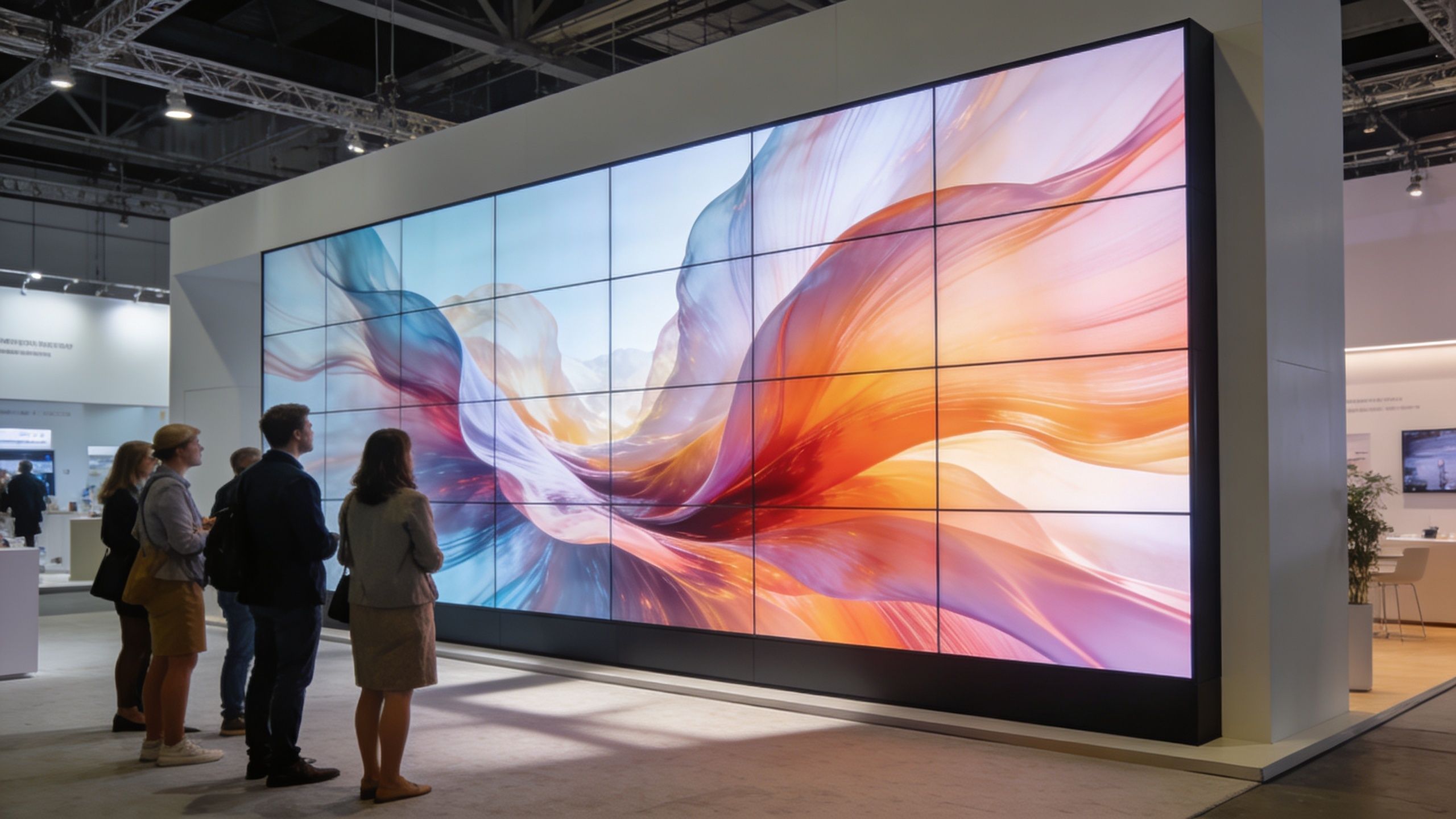
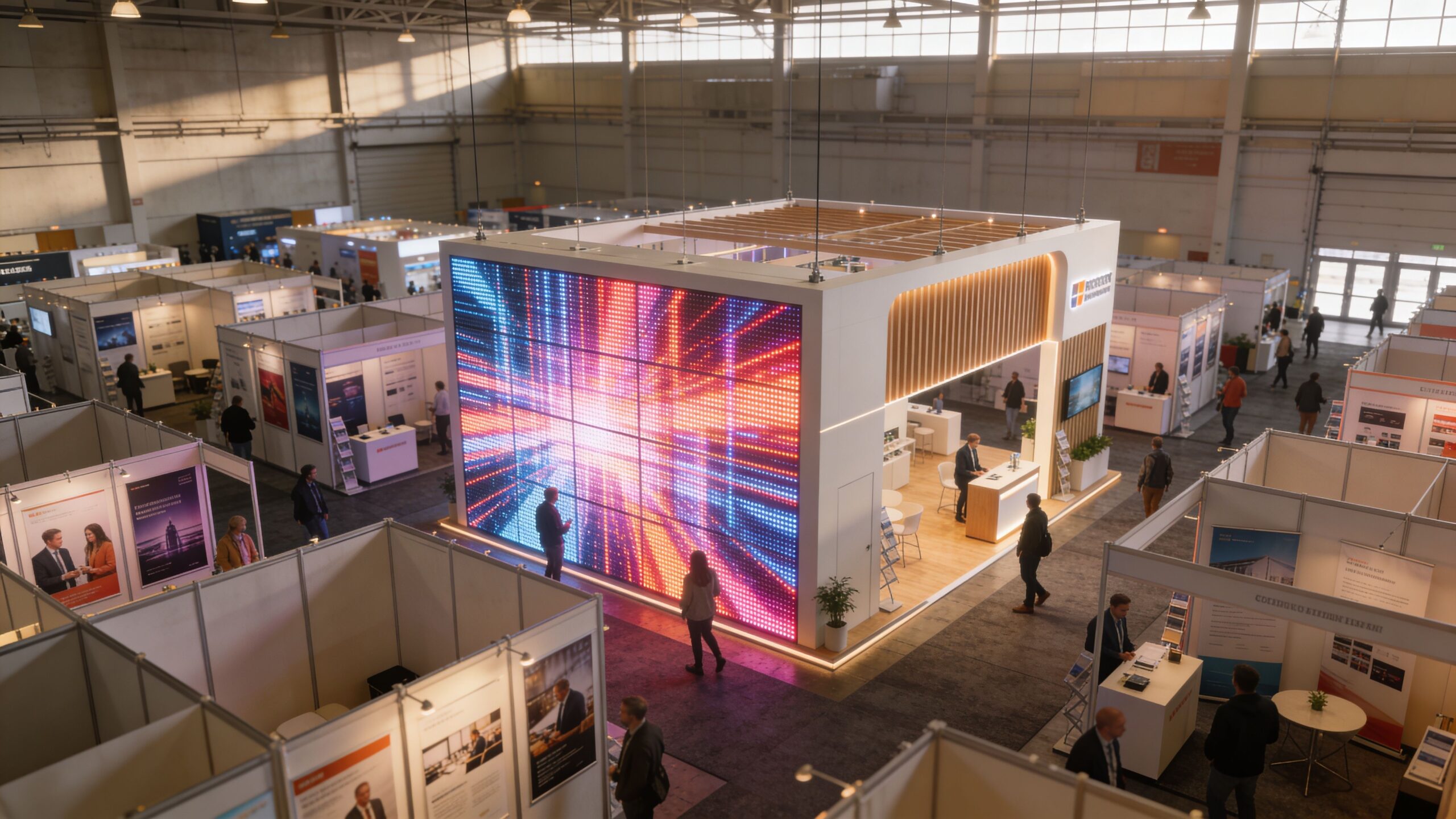
Walk a typical expo hall and you’ll see the same visual pattern repeating. Static graphics. Small monitors with bezels. Booth staff trying to create energy that the environment doesn’t support. Then you hit one exhibit where the entire structure moves with clean video, brand color, product visuals, and motion that pulls people in from the aisle. That booth changes the pace of foot traffic around it.

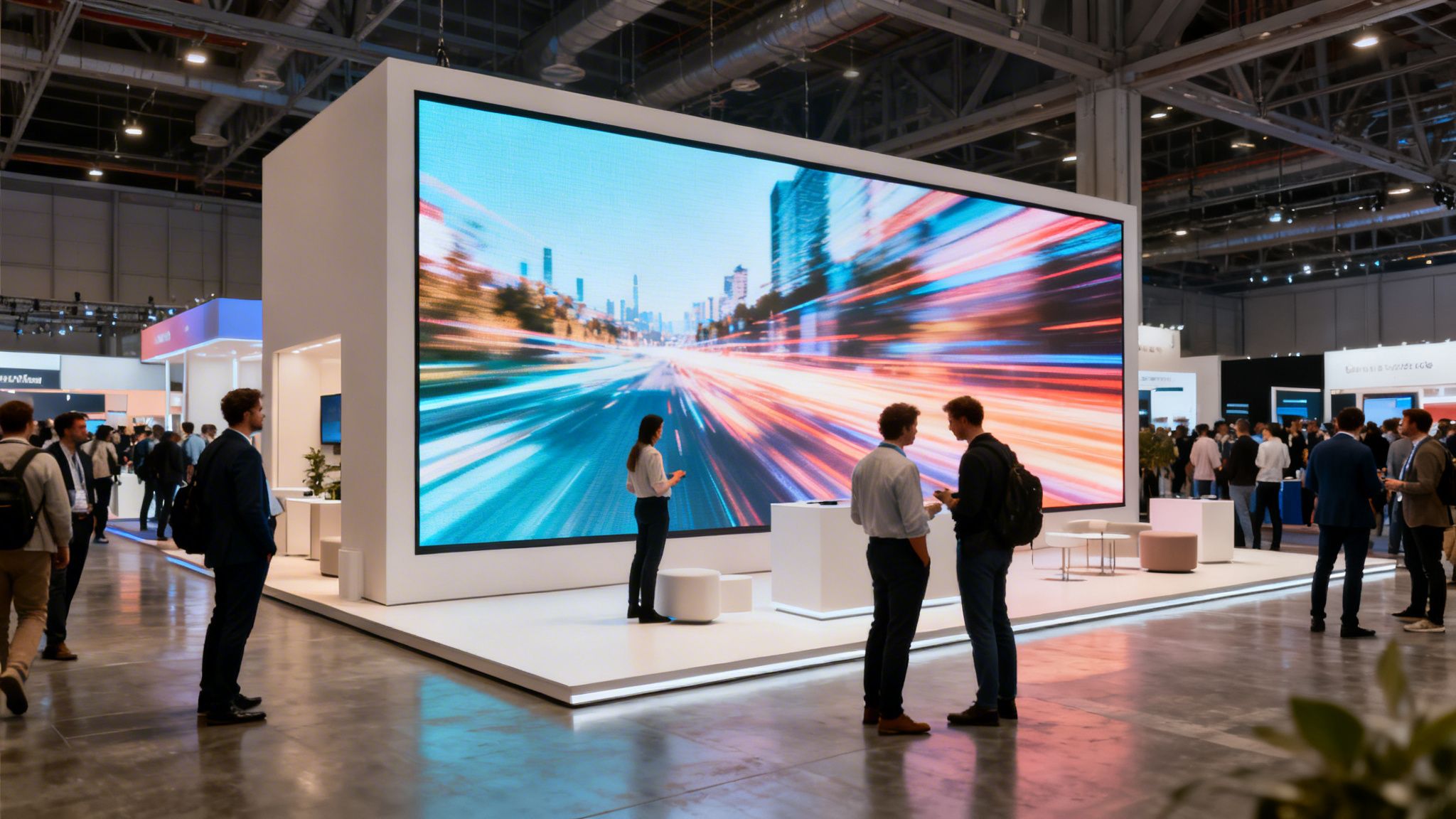
led screen for stage

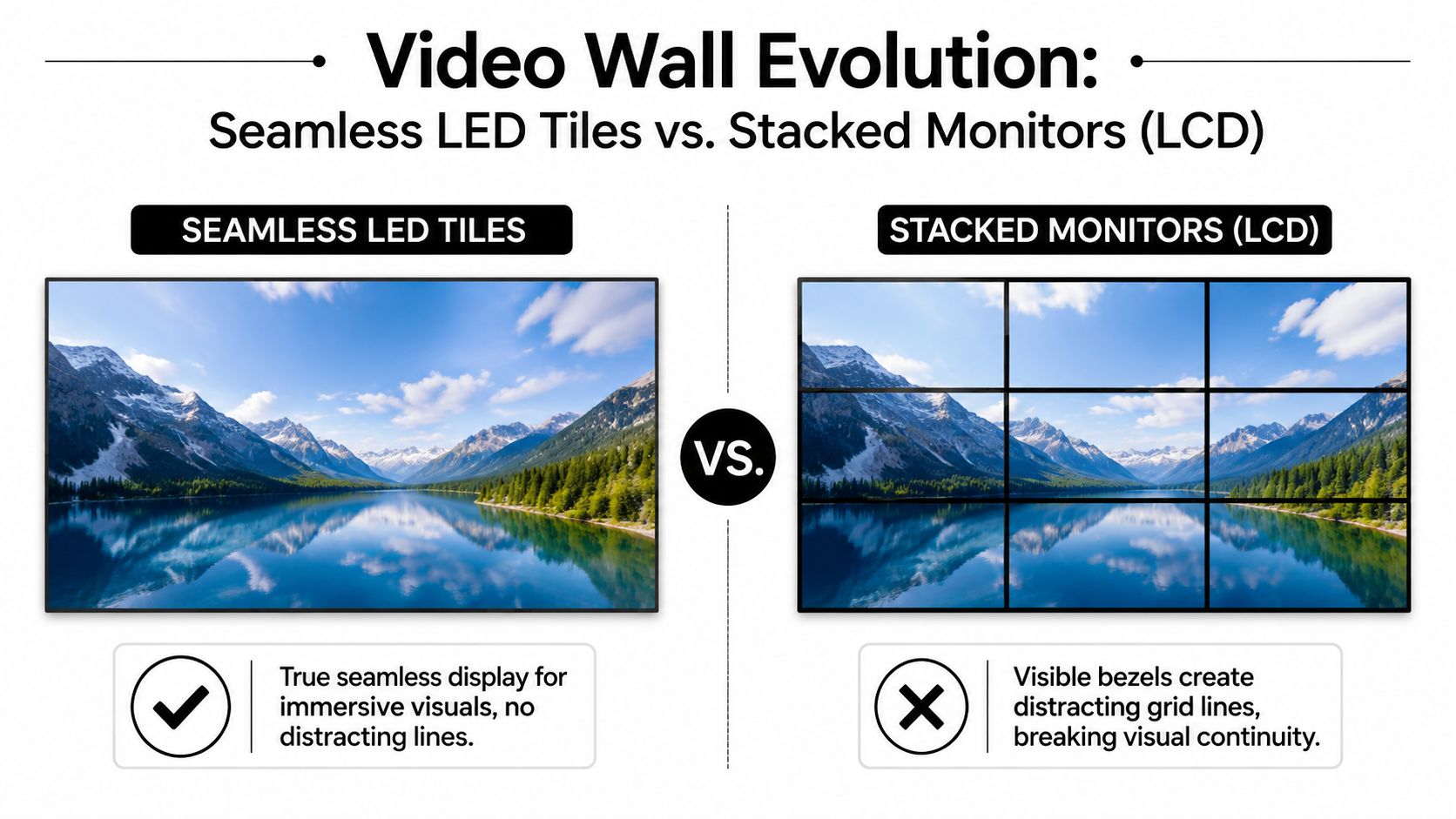
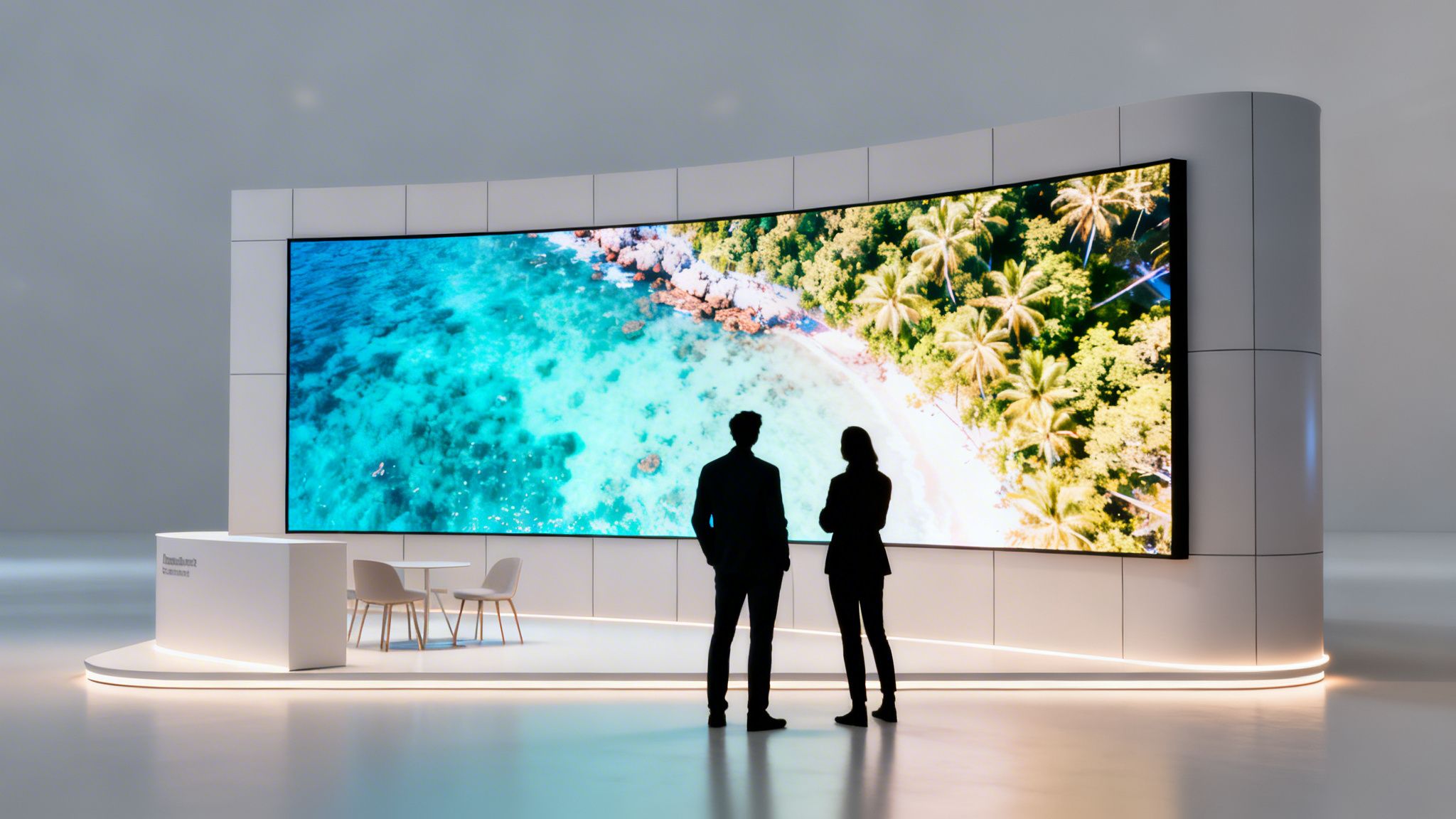
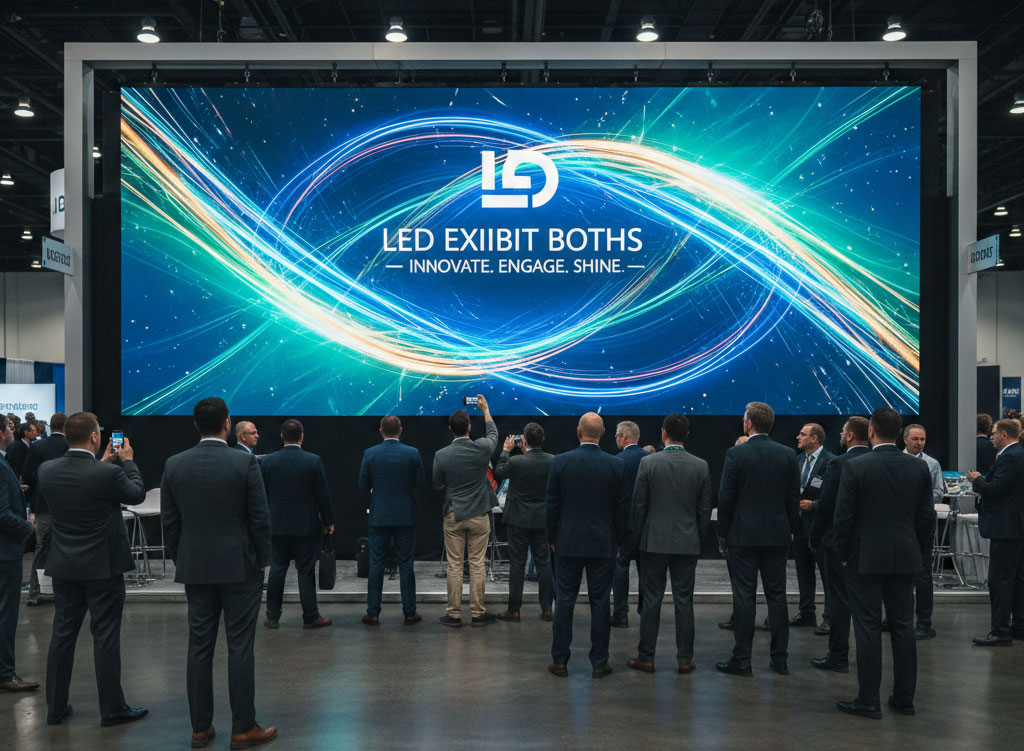
That’s the practical value of an LED screen for stage use in trade shows. It gives you one uniform visual surface instead of a patchwork of screens, cables, and support hardware. If you want to see how that looks in practice, study these video wall booth examples. The pattern is obvious. The booths that feel modern don’t rely on more parts. They rely on fewer distractions.

What attendees notice first

Attendees don’t walk up thinking about pixel pitch, refresh rate, or panel design. They react to three things:

  • Motion: Content that moves cleanly catches the eye faster than static graphics.
  • Scale: A large visual field changes how people read your brand from the aisle.
  • Finish: Continuous surfaces look premium. Gaps, stands, and exposed hardware don’t.

A trade show booth has a few seconds to make its case. LED gives you a much stronger first impression than printed graphics alone.

The important part is execution. LED can make a small booth look bigger, a standard booth look custom, and a product launch feel like an event. But it only works when the specs fit the environment and the service model removes friction instead of adding it.

What Makes a High-Impact LED Screen for Stage

The biggest mistake buyers make is assuming all LED walls look roughly the same. They don’t. A high-impact wall comes down to the right pixel pitch, enough brightness, and a panel system that looks clean at trade show viewing distances.

led screen for stage

Pixel pitch decides whether your wall looks premium

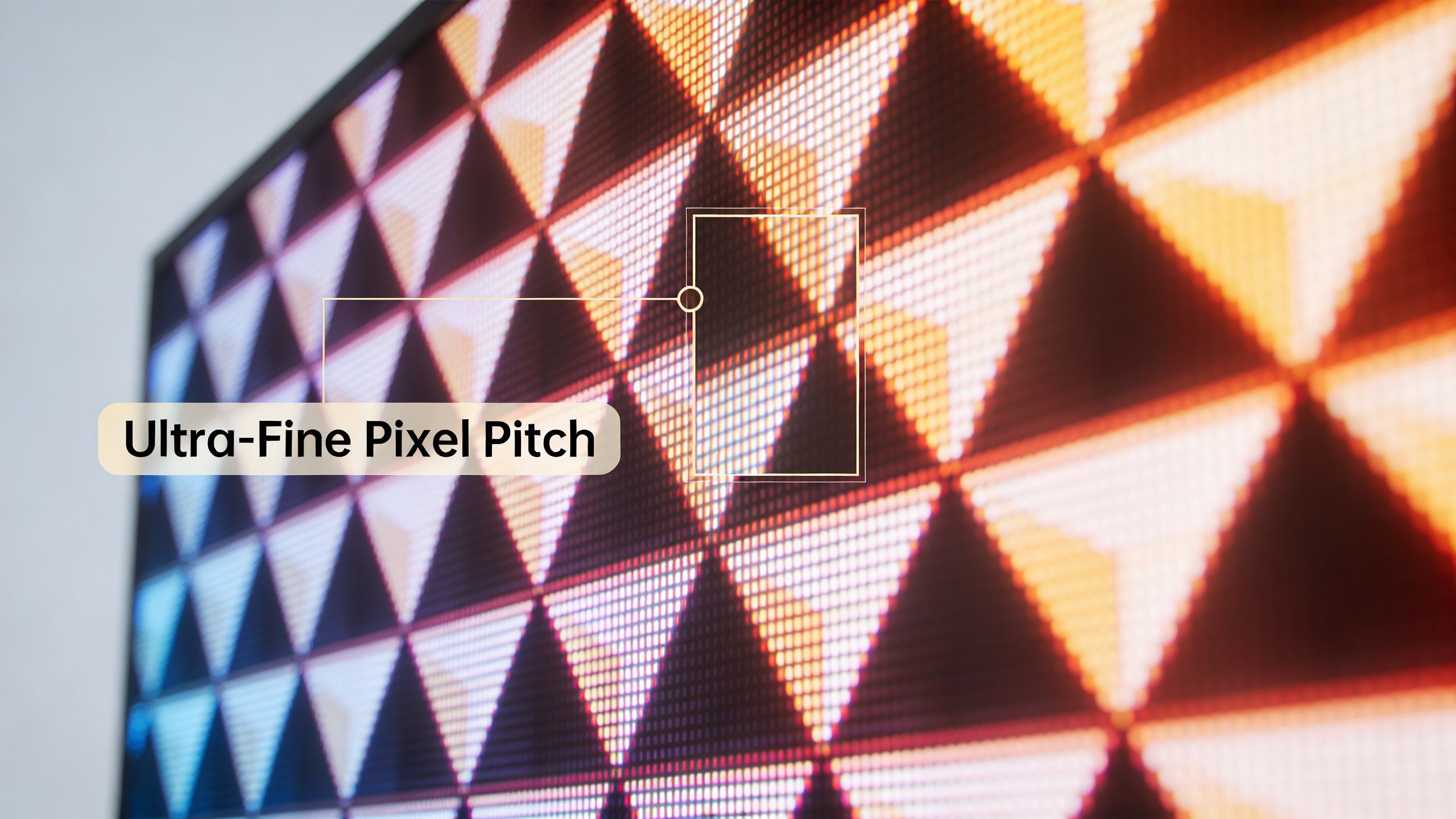
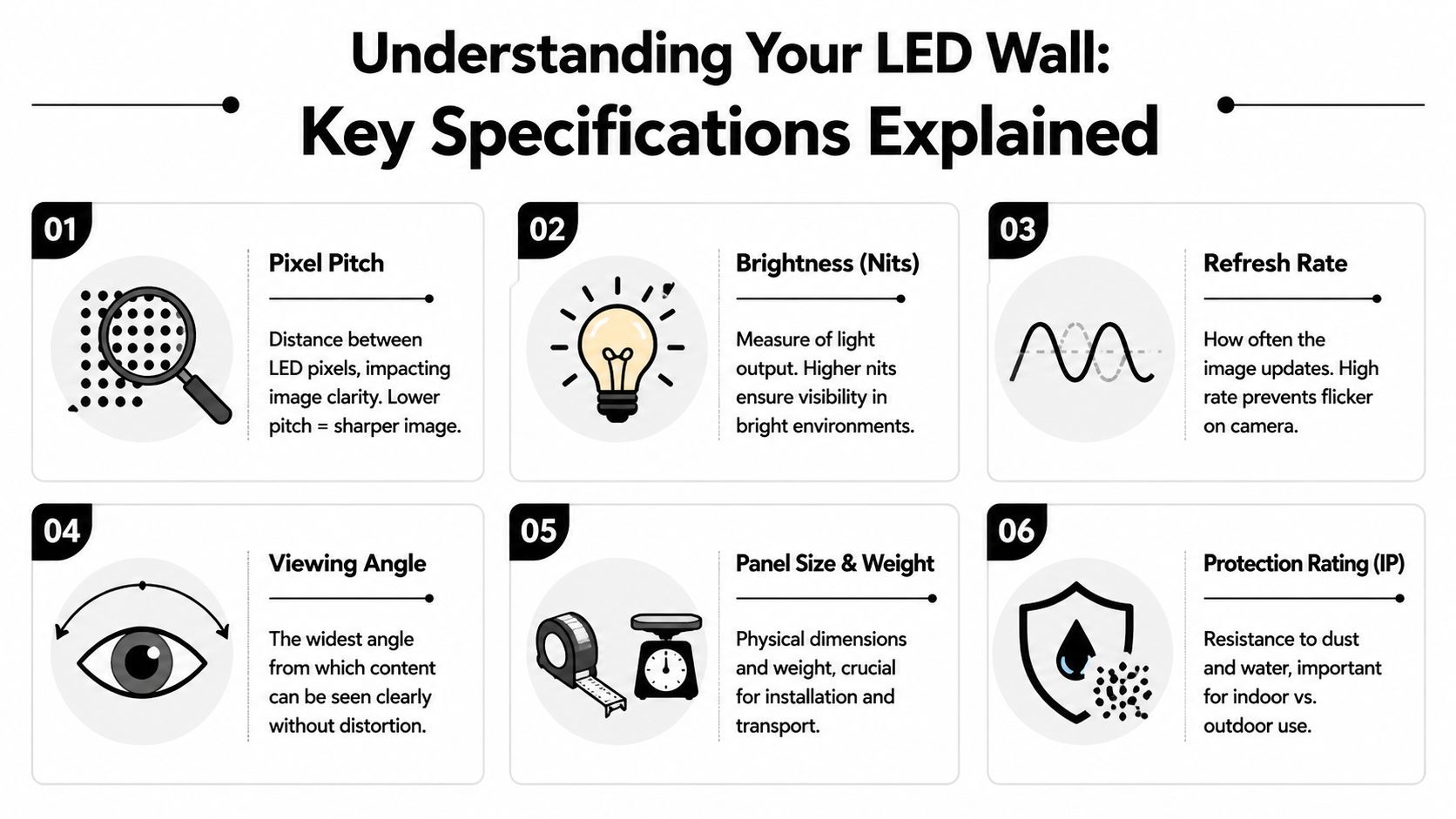
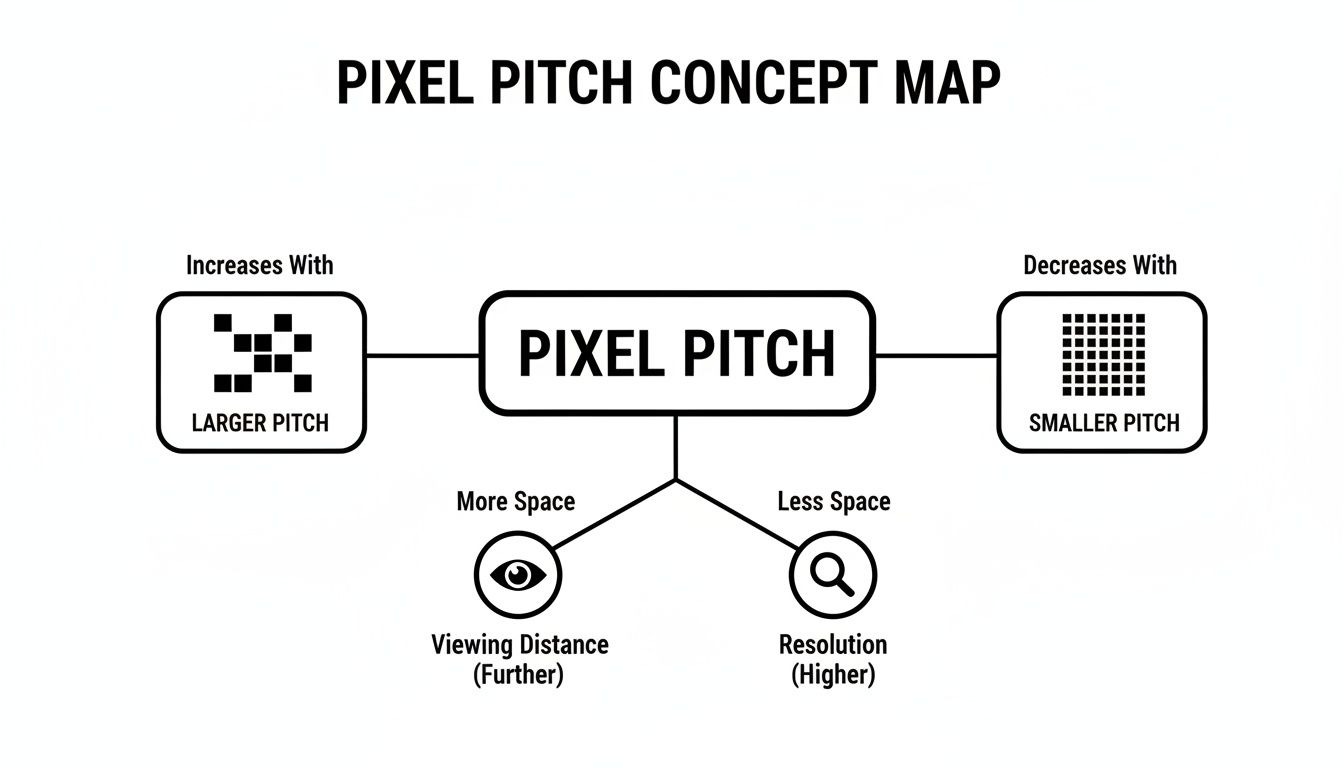
Pixel pitch is the spacing between the LEDs. Smaller pitch means tighter spacing and a sharper image at close range. That matters on a trade show floor because people don’t stand far away. They walk right up to your booth.

For indoor LED screen for stage applications, a finer pitch like P1.9 to P3.9 keeps visuals sharp for attendees viewing from 2 to 5 meters, supports 140° viewing angles, and helps eliminate Moiré in photos, according to this LED stage screen guide from RTLED Solution.

Our view is simple. P1.9 is the better choice. Many competitors use P2.5, and that’s where you start seeing the difference between “good enough” and “crisp.” In a booth environment, that finer pitch gives you higher apparent resolution and a cleaner image when attendees are close, taking photos, or watching product demos.

The situation resembles the difference between an older TV and a sharper modern display. Both show the message. Only one looks expensive.

Brightness matters more than spec sheets suggest

A booth doesn’t exist in a controlled theater. It sits under venue lighting, aisle glare, overhead signs, and whatever lighting neighboring exhibitors brought with them.

Indoor screens generally need enough output to stay vivid under show lighting. The same RTLED source notes 1,200 nits as a practical indoor brightness level for stage use, while outdoor variants can reach much higher brightness for sunlight conditions. That’s why you shouldn’t buy on price alone. If the wall can’t hold color and contrast in the venue, the content falls flat.

Here’s a quick comparison buyers should keep in mind:

Spec Better choice for trade shows Why it matters
Pixel pitch P1.9 over P2.5 Sharper visuals at close viewing distances
Indoor brightness Properly matched for venue conditions Prevents washed-out content
Viewing performance Wide angle panels Keeps visuals clean from side traffic
Photo friendliness Panels that reduce Moiré Helps your booth look better on camera

A short demo makes these differences easier to spot:

The screen has to work as part of the booth

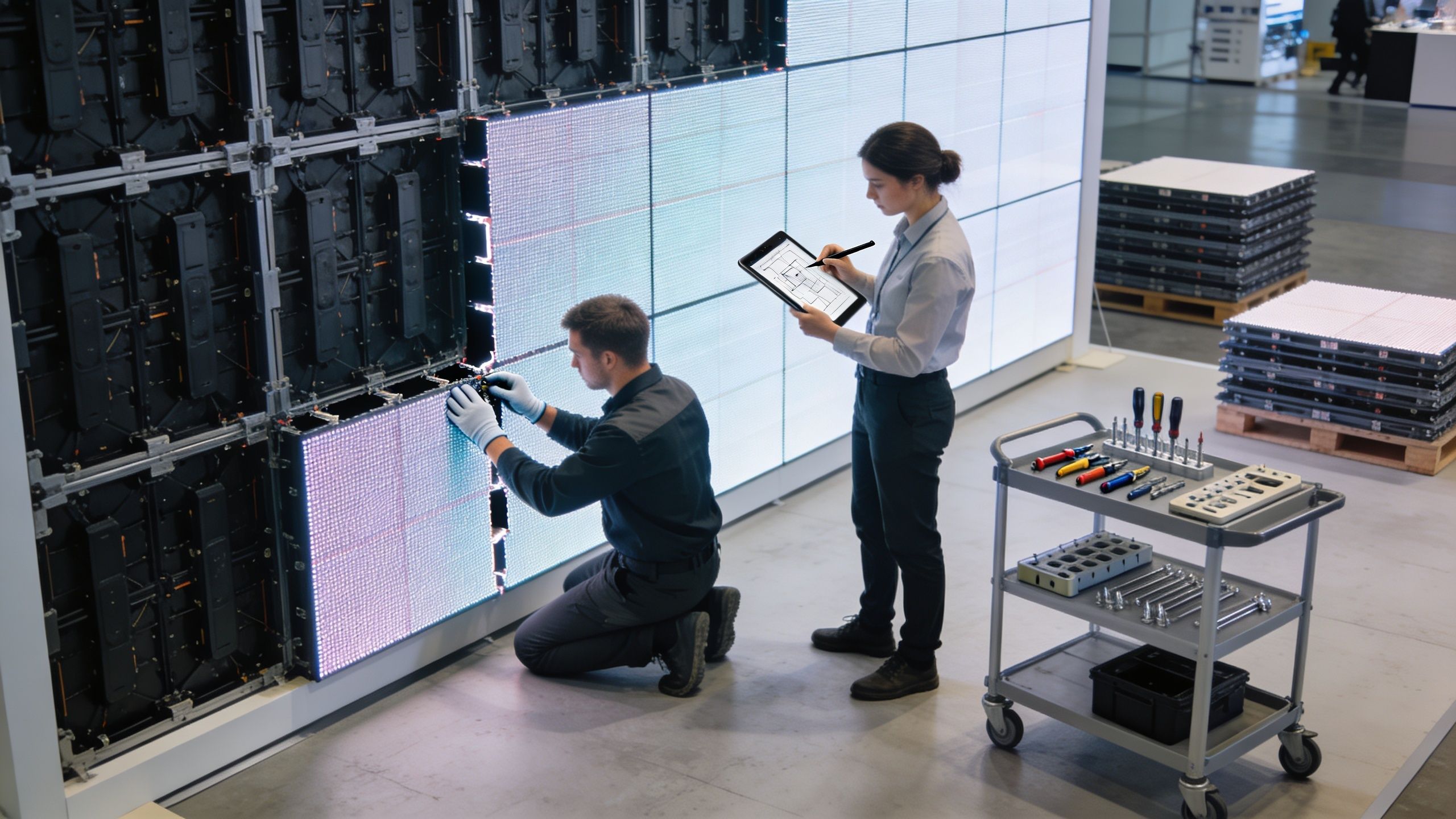
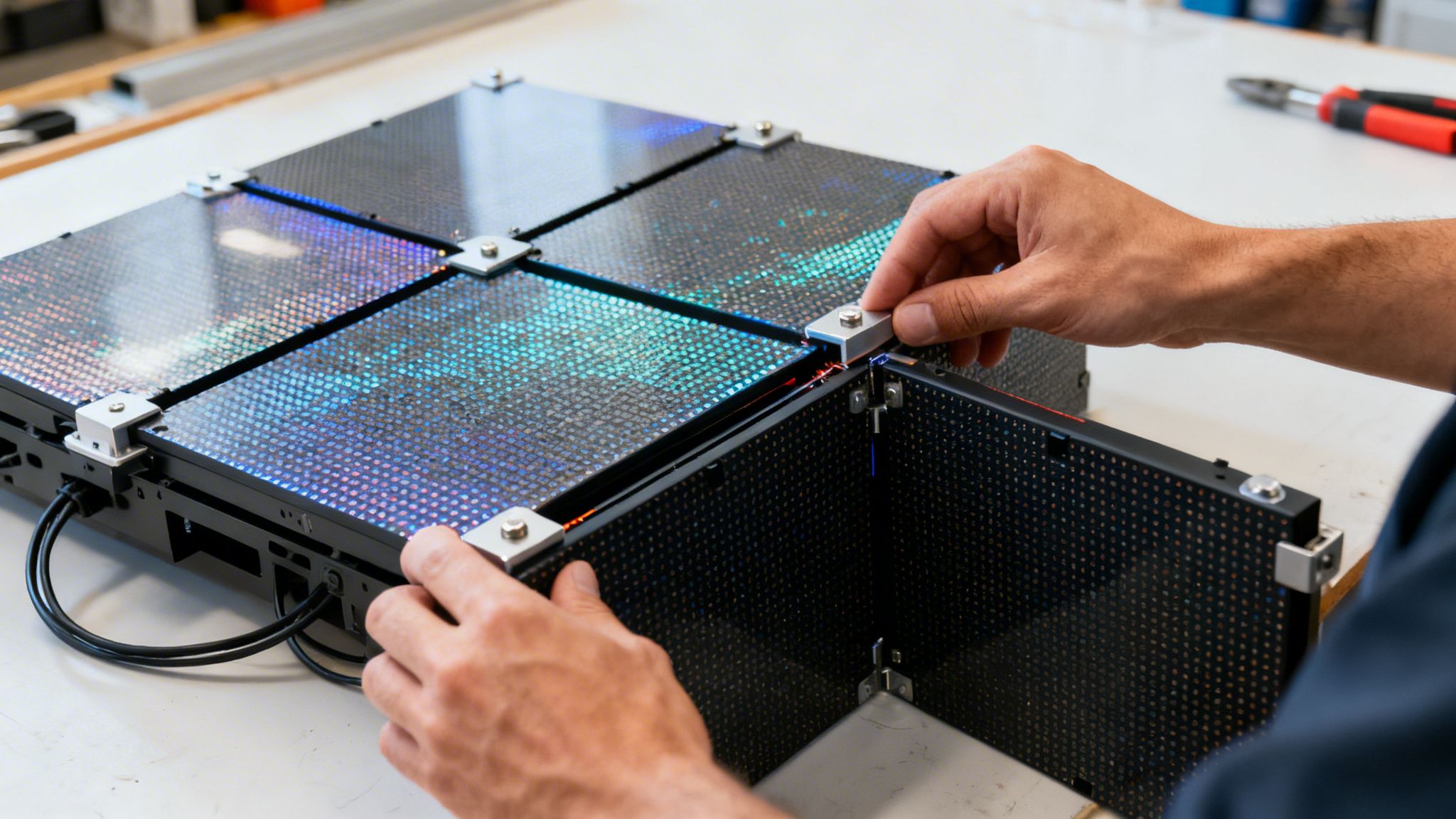
The wall itself isn’t the whole system. Mounting, alignment, content playback, and integration into the booth matter just as much. If you’re comparing panel systems, review real LED wall panel options for exhibit builds and ask how they behave in a finished booth, not just in a warehouse.

If you’re also evaluating venue infrastructure and efficiency, this overview of LED lighting advantages for your property is useful context. It’s not trade-show-specific, but it helps explain why LED technology keeps replacing older display and lighting approaches.

Practical rule: If attendees will stand close, photograph the booth, or watch detailed product visuals, don’t settle for coarse pitch just to shave the quote.

Choosing the Right Size and Shape for Your LED Screen

Most buyers ask for the biggest wall they can fit. That’s not the right question. The right question is what size and shape helps people see, understand, and remember your message from the way they move through the booth.

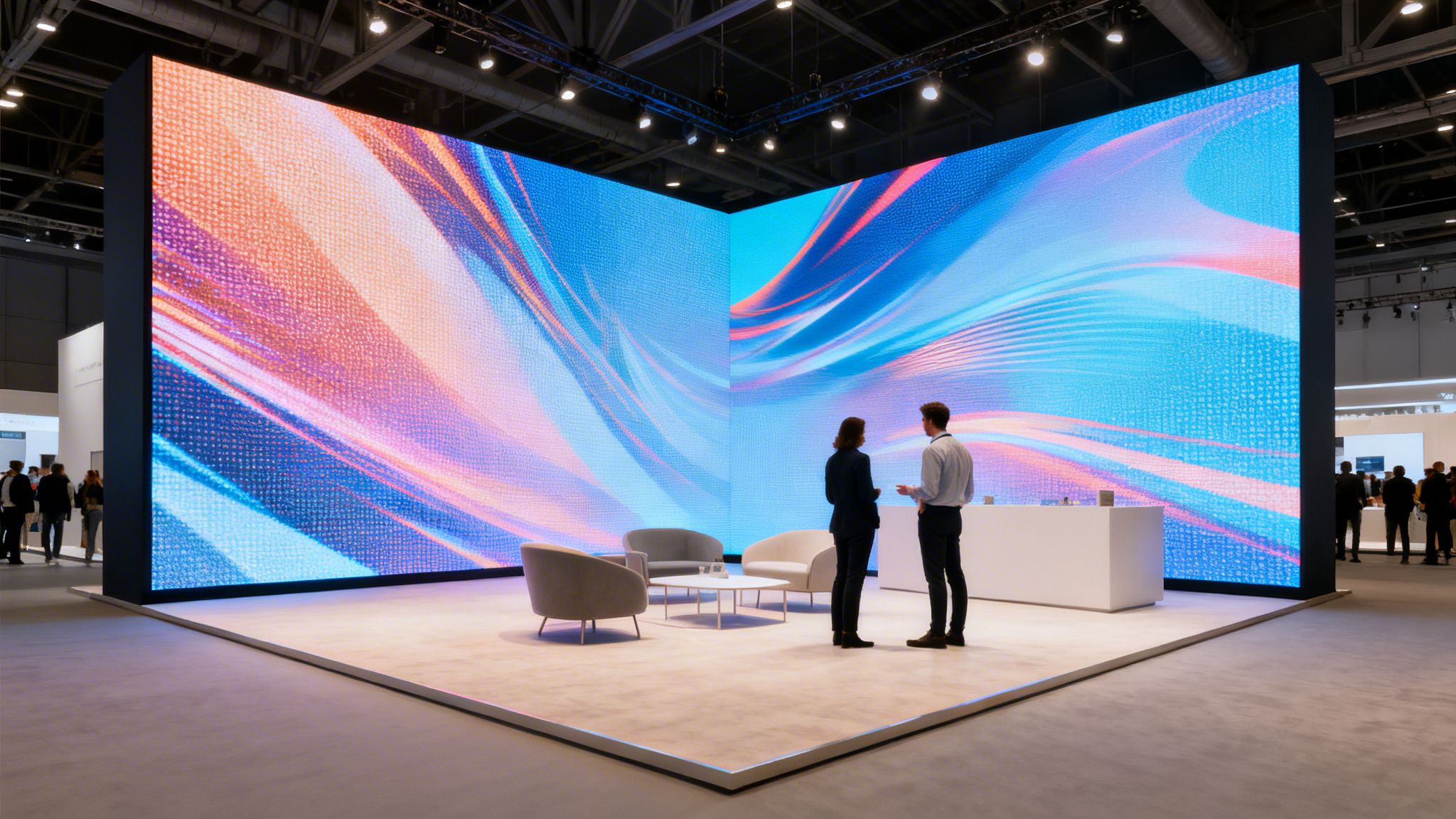
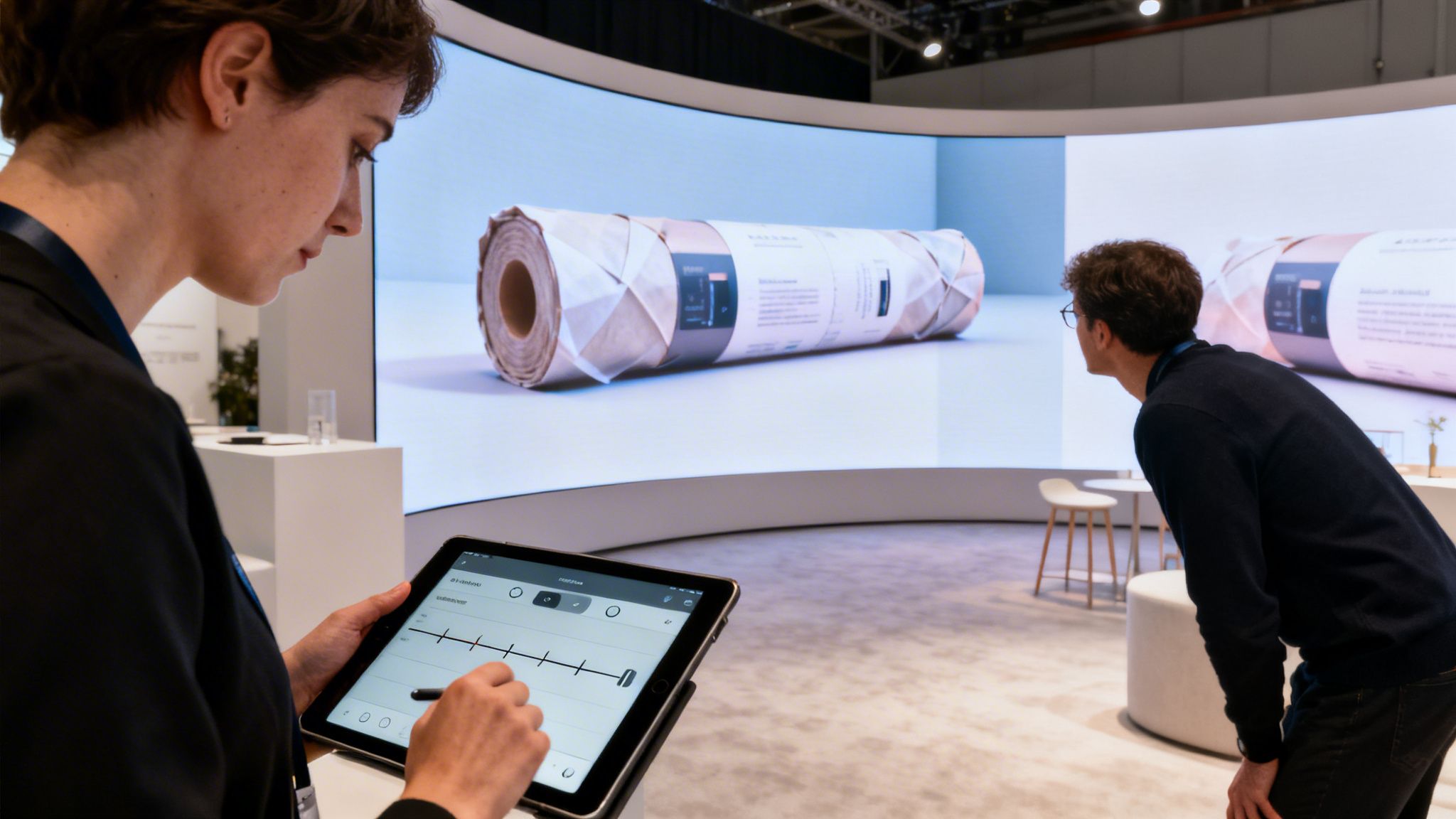
A professional trade show exhibition booth featuring large LED screens, curved digital displays, and a reception desk.

A useful rule from this stage LED screen size calculator is that screen height often follows a 1/6th rule, where the height is one-sixth of the distance to the furthest viewer. That’s a practical starting point because it ties the screen to sightlines, not guesswork.

The same source notes that a standard 7.32m x 2.74m screen can be built from 96 individual tiles and weigh 576kg without heavy steel frames, which matters for shipping and drayage planning.

Start with the viewing pattern

Before choosing dimensions, answer these questions:

  • Aisle visibility: Are you trying to pull attention from across a main aisle, or support conversations inside the booth?
  • Booth depth: A shallow booth usually benefits from a strong backdrop. A deeper footprint may support a wider or wrapped display.
  • Content type: Product reels, live demos, speaker support, and ambient motion all favor different aspect ratios.
  • Traffic direction: Island booths and corner booths often need different visual strategies.

If you’re comparing options, these video wall size examples make it easier to see what fits different footprints.

Flat isn’t your only option

Modular LED becomes much more interesting than a standard “screen rental.” You’re not limited to a rectangle on a truss.

A well-planned LED screen for stage can become:

  • A continuous backdrop behind presenters or product showcases
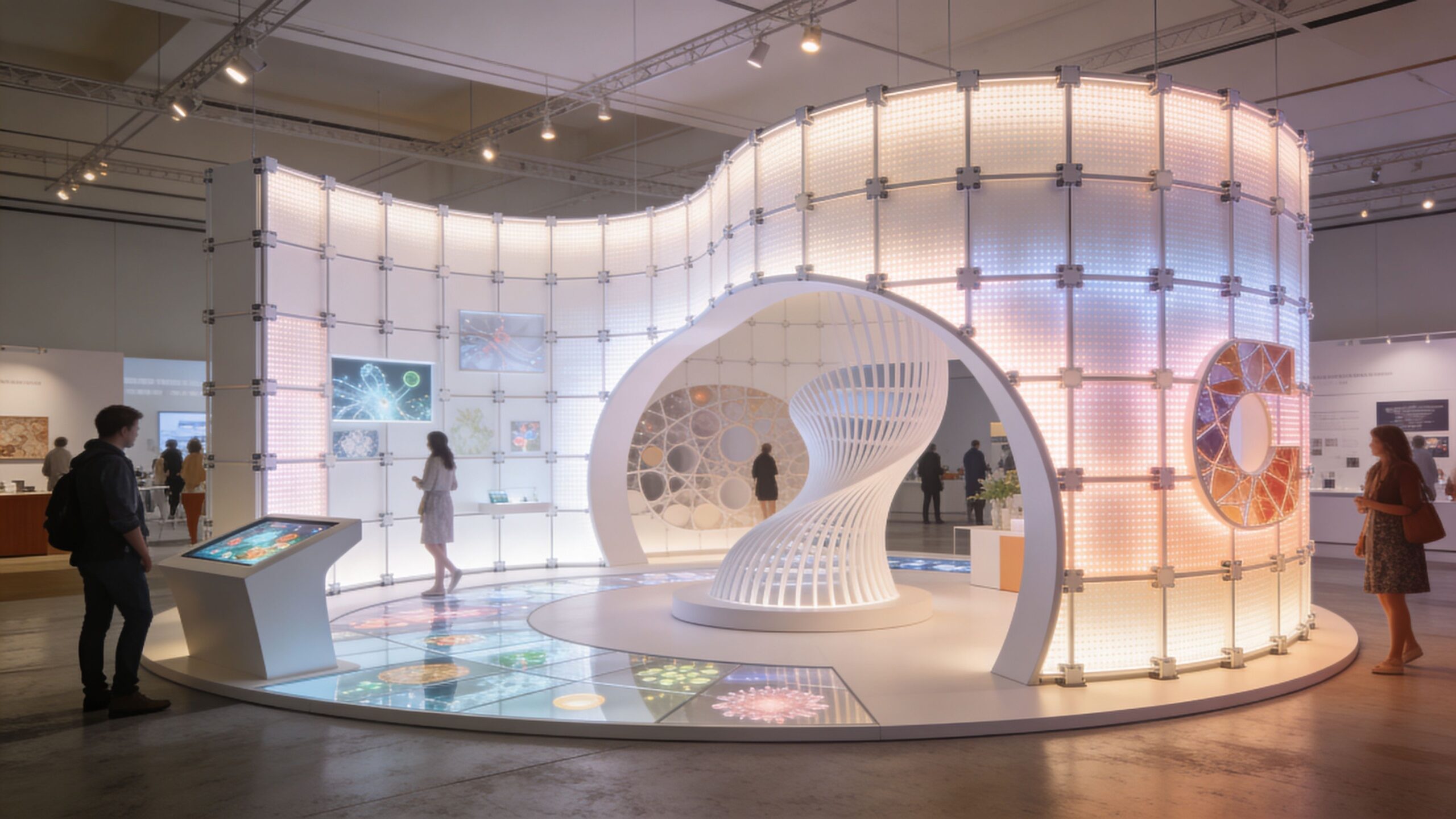
  • A curved feature wall that softens the booth and improves sightlines
  • A wrapped column that turns dead structural space into media
  • An arch or portal that pulls people into the exhibit
  • An island element visible from multiple approaches

Curved configurations deserve more attention than they usually get. They can create a stronger sense of immersion and help a booth feel custom instead of rented.

If your booth shape is unusual, that’s not a constraint. It’s often the best reason to use modular LED in the first place.

A simple decision checklist

Use this when narrowing the shape:

  1. Need brand visibility from distance? Prioritize height and bold content.
  2. Need product education at close range? Prioritize finer pitch and clean frontal viewing.
  3. Need to stand apart from neighboring booths? Consider curved or wrapped elements.
  4. Need easier logistics? Ask how the panel system affects freight, drayage, and install time.
  5. Need one screen to do several jobs? Design content zones instead of oversizing the wall.

Bigger helps only when the wall is matched to your layout. The best LED installations feel intentional, not oversized.

Renting vs Buying Your Trade Show LED Screen

For most exhibitors, renting is the smarter decision. Buying only makes sense when your team uses the system often enough, stores it properly, maintains it well, and has people who can manage deployment without drama.

A comparison chart outlining the pros and cons of renting versus buying an LED screen for trade shows.

High-quality LED panels can last 100,000 hours of operation, which translates to over 10 years of reliable performance with proper maintenance, and many systems see continuous use for 6 to 8 years before replacement, according to this overview of stage LED screen durability. So yes, ownership can pay off for frequent exhibitors.

But longevity alone doesn’t make buying the right move.

When buying makes sense

Buying is worth considering if you:

  • Exhibit constantly: You use the system across many events every year.
  • Have internal operational support: Someone owns storage, maintenance, testing, and logistics.
  • Need fixed brand control: The same system appears repeatedly in the same format.
  • Can handle technical risk: If a panel issue shows up before a show, your team has a recovery plan.

Ownership gives you asset control. It also gives you responsibility for every detail people forget to budget time for.

Why renting usually wins

Renting suits how most marketing teams work. Campaigns change. Booth sizes change. Event goals change. Technology changes too.

Here’s the clean comparison:

Option Strongest advantage Main tradeoff
Renting Flexibility and lower upfront commitment You don’t own the asset
Buying Long-term control and repeat use value You own maintenance, storage, and refresh risk

If you’re weighing the two, this breakdown of owning vs renting an LED video wall is a useful reference.

Renting lets marketing teams stay focused on outcomes. Buying turns them into equipment managers unless the company has a strong support structure.

The other reason I lean toward renting for trade shows is simple. Most exhibitors want a result, not a warehouse problem. They want the wall to show up, look sharp, work all day, and disappear after the event without creating another internal process.

Why Our White-Glove Service Makes Your LED Screen Shine

This is the part most LED vendors underplay. The screen is only half the job. The other half is everything that can go wrong between the quote and the moment your booth opens.

Trade show LED projects get messy fast when multiple vendors touch different parts of the build. One group handles the structure. Another handles playback. Another handles install. Someone else is responsible for content formatting. Then the venue adds its own rules, labor windows, power requirements, and material handling process. If nobody owns the whole chain, your team ends up owning the stress.

We don’t think that model works.

What turnkey should actually mean

A proper white-glove, turnkey model should include everything needed to get the LED wall delivered, installed, operated, and removed cleanly. Our position is straightforward. If the show doesn’t bill you directly, it should already be in the price.

That means our pricing includes the moving parts buyers usually get surprised by later. Design coordination, equipment, setup, dismantle, and show support are covered. The exceptions are the charges the show itself bills directly, such as electricity and material handling.

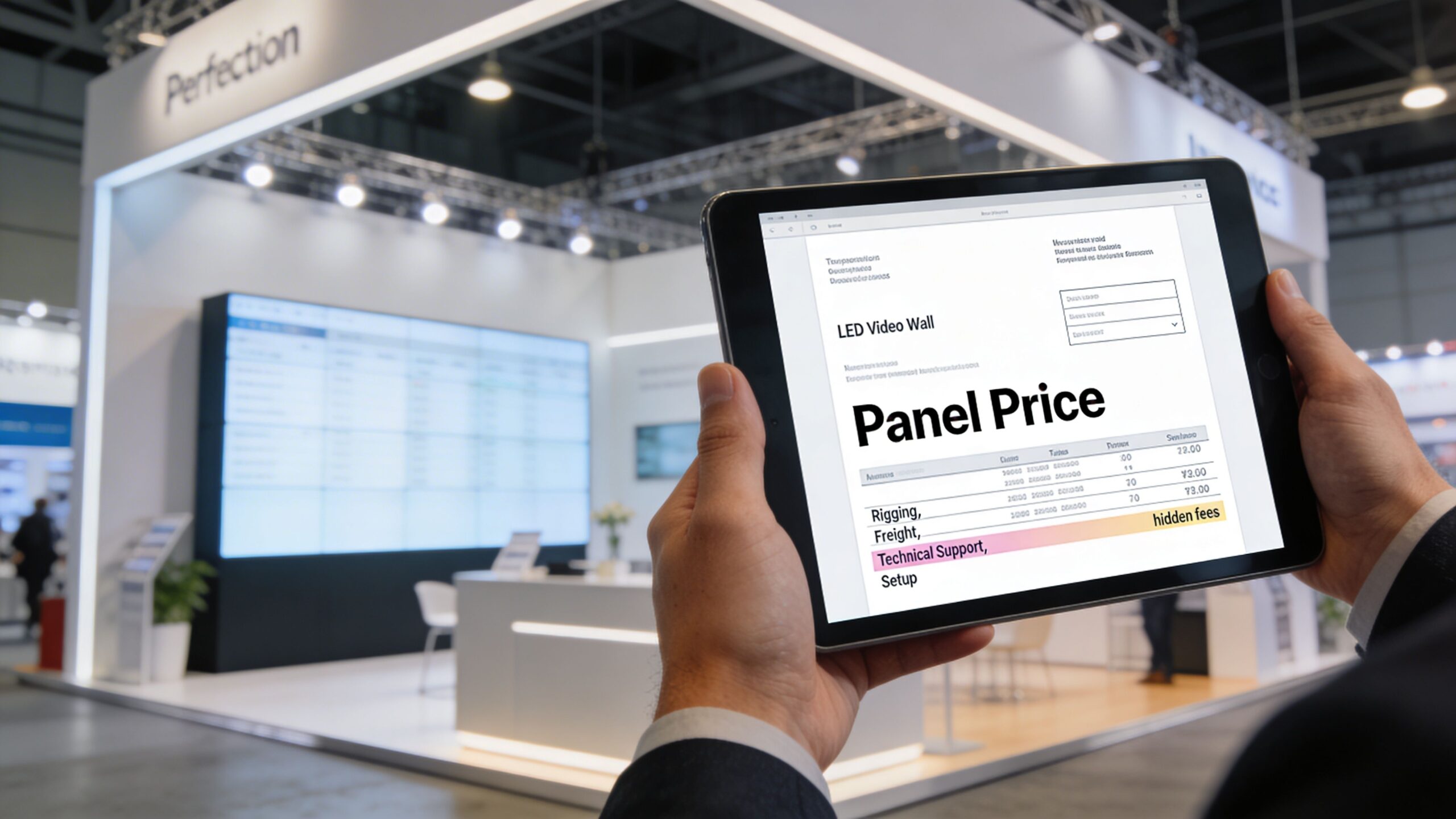
That pricing structure matters because LED quotes can look artificially low when key services are excluded. A cheap number upfront often turns into a more expensive project once labor, support, and logistics are added back in.

The onsite technician is not optional

An LED wall at a trade show isn’t a “set it and forget it” item. Content needs to run properly. Playback systems need to stay stable. If something changes on site, somebody qualified needs to fix it quickly.

That’s why we leave an audiovisual technician onsite the entire time the trade show is open. If anything goes wrong, you text or call, and an AV technician is at the booth within minutes to solve the problem.

That’s not a luxury add-on. It’s the difference between a minor issue and a public failure.

The real value of LED support isn’t visible when everything works. It shows up the moment something doesn’t.

Better hardware still needs better execution

We also use P1.9 pitch as our standard, while many competitors still quote P2.5. That means the wall starts with a sharper image at the close viewing distances common on a convention floor. But superior panels only matter when the system around them is handled correctly.

That includes:

  • Pre-show planning: Matching wall size, shape, and playback needs to the booth
  • Installation discipline: Clean alignment, proper cabling, and polished finish
  • Operational support: Fast adjustments during show hours
  • Post-show teardown: Efficient dismantle without leaving your team exposed

Curved builds are a good example. According to this stage LED screen resource focused on curved configurations, integrated curved setups can outperform flat screens by 35% in viewer dwell time, and modern magnetic locking systems can assemble a 20m² curved wall in under an hour. That’s exactly why execution matters. The format is powerful, but only when the crew knows how to deploy it cleanly.

What this means for your team

Most exhibitors don’t want to manage AV. They want to meet customers, run demos, support sales, and protect the brand. That’s the right priority.

Here’s what a white-glove model changes in practice:

  • Fewer vendors to coordinate: One partner handles the moving parts.
  • Cleaner budgeting: Fewer surprise add-ons hiding outside the initial quote.
  • Less show-floor risk: Problems get solved immediately by a qualified technician.
  • Less internal distraction: Your team stays focused on attendees instead of troubleshooting.

The LED wall should be the easiest part of your event once the show opens. If your provider can’t make that true, keep shopping.

Creating Content That Captivates and Converts

A sharp wall with weak content is still a weak booth. The screen gets attention. The content decides whether people stop, understand what you do, and move into a real conversation.

The first rule is ruthless simplicity. Trade show attendees don’t stand still and read paragraphs. They glance, scan, and keep moving unless something earns another few seconds.

Build content for motion, not for a brochure

The best booth content usually does three jobs at once. It attracts from distance, explains quickly up close, and supports your staff while they talk to visitors.

Use this structure:

  • Ambient layer: Movement, brand color, and visual energy that catches attention from the aisle
  • Message layer: Short statements that explain the offer fast
  • Proof layer: Product visuals, interface footage, use cases, or demo support

If you need help generating short-form visual concepts quickly, tools like ShortGenius AI video ad maker can help marketing teams produce motion assets faster. You still need human judgment, but speed matters when event deadlines are tight.

For teams planning custom content, this guide to video wall video production for trade shows is a solid starting point.

Don’t treat the wall like a giant PowerPoint slide. Treat it like a moving storefront.

Keep text minimal and hierarchy obvious

Common booth content mistakes are predictable. Too much copy. Small text. Overstuffed layouts. Videos designed for desktop screens instead of large-format playback.

A better approach:

  1. Lead with one clear idea at a time. Don’t stack five messages on one loop.
  2. Use bold typography sparingly. People should understand the headline from the aisle.
  3. Show the product early. Don’t make viewers wait through a long animated intro.
  4. Design loops to operate without sound. Audio often isn’t practical on a busy floor.
  5. Plan for repetition. Attendees join the loop at random points.

Make sustainability and power part of the decision

LED content strategy also benefits from the technology’s efficiency. LED screens consume substantially less power than projectors and produce less heat, and high-end models can reach 5,000 to 10,000 nits of brightness, according to this analysis of LED stage screens and video walls. That same source notes this efficiency can reduce a booth’s overall electricity expenses by 15-20% or more.

That matters for two reasons. First, lower power demand can support tighter event budgets. Second, many brands now care how exhibit choices align with sustainability goals. LED helps on both fronts.

A practical content checklist

Before final export, check for these issues:

  • Resolution fit: Match files to the wall layout so playback stays clean
  • Readable pacing: Give headlines enough screen time to be understood while walking
  • Brand consistency: Keep colors, fonts, and transitions aligned with the campaign
  • Demo support: Include visuals that help staff explain the offer live
  • Photo value: Make sure the booth looks good in attendee and press photos

Content doesn’t need to be complicated. It needs to be intentional, fast to understand, and designed for the way people behave on a show floor.

Your Partner for an Unforgettable Event Presence

A strong LED exhibit comes down to three decisions. Choose the right specs. Choose the right size and shape. Choose a partner that removes complexity instead of adding it.

That’s why we push hard on details that many buyers overlook. P1.9 pitch matters because close-range booth viewing exposes weak resolution fast. Turnkey pricing matters because hidden exclusions distort the actual cost. Onsite technician support matters because trade shows don’t give you time to troubleshoot in public.

An LED screen for stage use should make your brand look sharper, your booth feel more modern, and your team’s job easier. If it creates stress, the service model is broken.

We believe the best trade show technology is the kind your attendees notice and your internal team barely has to think about. Clean visuals. Smart design. Fast support. No surprises beyond the direct show charges you already know the venue controls.

Choose the provider that gives you the finished result, not just the hardware list.


If you want a booth that looks sharper, runs smoother, and comes with true turnkey support, talk to LED Exhibit Booths. We provide P1.9 video wall booths, all-inclusive pricing except direct show charges like electricity and material handling, and white-glove service with an onsite AV technician throughout show hours so your team can focus on customers, not screens.

Your Guide to PPAI Trade Shows in 2026

If you’re in the promotional products business, you already know PPAI trade shows are the main event. These aren’t just conferences; they’re the central hub where the entire branded merchandise industry comes together to connect, discover, and make deals happen.

Why PPAI Trade Shows Are a Must-Attend Event

Showing up to a PPAI event is about so much more than just having a booth. It’s about strategically placing your brand at the heart of the action and setting the stage for a successful year. This is where relationships are built, new products get their big break, and major deals are signed. You simply won’t find this concentration of qualified buyers and key decision-makers anywhere else.

Think about it. You get a direct line to thousands of potential clients who are actively looking for new products and partners. PPAI events create that exact environment. It’s your best chance to get instant feedback on your offerings, see where the industry is headed, and get a good look at what your competitors are bringing to the table.

ppai trade shows

The Scale of Opportunity in PPAI Trade Shows

The numbers speak for themselves. The attendance figures and economic impact show just how vital this marketplace is. If you’re not there, you’re missing out.

For example, a recent PPAI Expo was the largest in a decade, bringing in 12,400 distributor attendees from 4,550 companies. With 1,222 exhibiting companies and over 20,000 participants in total, the event generated an estimated $40 million in economic impact from visitor spending alone. You can dig into more details on the PPAI Expo’s impressive attendance growth.

This isn’t just another trade show. It’s the industry’s annual family reunion, business hub, and innovation showcase all rolled into one. Your most important customers, prospects, and partners are all there.

More Than Just a Booth

Exhibiting at PPAI is an investment that pays off in many ways beyond just scanning badges. The real value is much broader.

  • Brand Visibility: Being here cements your company’s status as a serious player in the promotional products market. It shows you’re committed.
  • Networking: This is where you connect with peers, form strategic partnerships, and build relationships that will benefit you for years to come.
  • Market Intelligence: You’ll get invaluable insights into new trends, technologies like AI-driven sourcing, and the shifts in what customers want.
  • Product Launches: There’s no better place to unveil your new products. You have a built-in, captivated audience that’s there specifically to find the next big thing.

Ultimately, having a strong presence at PPAI sends a clear message. It tells the industry your business is thriving, innovative, and ready to compete.

Designing a Booth That Stops Traffic

At a show as packed as a PPAI event, your booth has to do more than just show up. It needs to stop people dead in their tracks. The secret to pulling attendees out of the aisles and into your space is all about the visual experience you create.

That’s why the technology you choose is so critical. A major factor is the clarity of your digital screens. We build our video walls with a 1.9mm pixel pitch. This just means the individual pixels are incredibly close together, creating a super sharp, high-resolution image that makes your brand look premium. Many competitors use a 2.5mm pitch, which simply can’t compete up close and can make visuals look blurry or cheap.

Our Transparent, All-Inclusive Approach

We know trade show logistics are a headache. That’s why we make it simple with our white glove, turnkey service. Our pricing is completely transparent.

When we give you a price, that’s the price. It covers everything we provide. The only other costs you’ll see are the ones billed directly by the show itself, like electricity and material handling (drayage). We take care of the rest.

This straightforward approach means you can actually budget without worrying about surprise fees popping up later. You can get more insights on this in our complete guide to trade show booth design. We handle the complicated stuff so you can focus on your customers.

On-Site Support for Total Peace of Mind

What if a screen glitches in the middle of the show? With us, you don’t have to worry about it. We have an audiovisual technician on-site for the entire time the show floor is open.

If any issue comes up, you have their direct number. A quick text or call, and they’ll be at your booth in minutes to get it fixed. This on-the-spot support guarantees your booth runs without a hitch, so you never miss a chance to connect with a potential client. Your job is to impress your visitors; our job is to make sure nothing gets in your way.

Decoding Your Booth Budget and Logistics


Let’s talk about the two things every exhibitor worries about: the budget and the logistics. Sorting out the costs for PPAI trade shows can feel like you’re trying to hit a moving target, but it doesn’t have to be that way. We’ve built our entire business around making this simple.

When we give you a price, that’s the price you pay for our services. No hidden fees, no last-minute surprises. That’s our white glove, turnkey service promise.

That single quote covers everything we provide: the complete LED wall system, its support structure, all the freight to get it to the venue, and the professional union labor for a perfect setup and a swift teardown. We handle the headaches so you can just show up and sell.

Understanding the Full Cost at PPAI Trade Shows

So, what’s not in our quote? The only other costs you’ll see are the ones billed directly by the show itself. These are mandatory charges you’d have to pay no matter what kind of booth you have.

  • Electricity: Powering up your brilliant LED display and any other electronics in your booth.
  • Material Handling (Drayage): The fee the venue charges to move your materials from the loading dock to your booth space and back out again.

Everything else is bundled into our straightforward, all-inclusive price. This kind of clarity is what lets you budget with confidence. If you’re still weighing different options, our guide on trade show booth cost dives even deeper into the numbers.

Our whole mission is to get the logistics out of your way. We want you to walk onto the show floor at the Mandalay Bay Convention Center, see your booth ready to go, and immediately start greeting customers.

And when you do, the quality of your display will speak for itself. It’s a technical detail, but it makes a huge difference on the floor.

ppai trade shows

This graphic says it all. Our standard 1.9mm pixel pitch screens deliver a much sharper, clearer, and more professional image than the 2.5mm screens many others use. It ensures your brand and products look absolutely pristine.

On-Site Support That Delivers Peace of Mind

Our service doesn’t stop once the booth is built. We station an expert audiovisual technician on-site for the entire duration of the show.

If any issue pops up—a small content glitch or a bigger technical problem—you just text or call. Within minutes, our tech is at your booth, fixing the problem. This guarantees you have zero downtime and can keep your focus where it belongs: on your customers.

Why On-Site Support Is a Must During the Show

When you’re at a packed event like a PPAI trade show, the last thing you can afford is a technical glitch. The floor is swarming with prospects, and a blank screen is more than just an inconvenience—it’s a disaster that can cost you thousands in lost opportunities. What’s your backup plan when the tech fails? Waiting around for a show-appointed technician is simply not an option.

This is where our full-service approach really makes a difference. Our white glove, turnkey service isn’t just about setting up your booth; it’s about giving you complete peace of mind. We take care of everything so you can just greet customers. That’s why we leave an audiovisual technician on-site the entire time the trade show is open.

ppai trade shows

Immediate Fixes for Zero Downtime

Imagine your worst-case scenario: a key piece of content isn’t playing right, or worse, a part of your video wall goes dark. Most people would panic. With our on-site support, the solution is immediate.

If anything goes wrong, you text or call and within minutes an AV Technician is at your booth to resolve the problem. This isn’t just a nice-to-have feature; it’s an insurance policy for your entire trade show investment.

Our all-inclusive price means we handle all logistics except for what the show bills you for directly, like electricity and material handling. But our true value is having an expert on standby, ensuring your booth runs flawlessly from start to finish.

This is a world away from the standard experience of submitting a help ticket and just hoping someone shows up eventually. Our team stays on-site specifically to guarantee you have zero downtime, so you never miss a chance to connect with a potential client. This is a key benefit when you look into our complete rentals for trade shows.

Of course, our superior technology—like the crisp 1.9mm pixel pitch on our video walls that makes competitors’ 2.5mm screens look dated—is a huge part of the equation. But backing that tech with a real, live expert is what delivers true value and lets you focus on what you do best: making connections and growing your business.

Turning Booth Buzz Into Measurable ROI

A show-stopping booth at a PPAI trade show is great for creating buzz, but let’s be honest—the real win is turning that attention into actual business. Blending in is simply not an option. The promotional products industry is booming, with sales hitting $26.78 billion in 2024. Your booth isn’t just an expense; it’s how you grab your piece of that pie.

Making an impact starts with your presentation. Our video walls use a stunningly crisp 1.9mm pixel pitch, which delivers a premium look that screens with a 2.5mm pitch just can’t compete with. That visual pop gets people to stop and talk, but you need a solid plan to turn those conversations into customers.

A professional business meeting where a man reviews lead and conversion statistics on a digital tablet.

From Conversation to Conversion

Every person you talk to on the show floor is a potential lead. The days of just scanning a badge and hoping for the best are over. Modern B2B lead generation software is essential for capturing and qualifying leads right there in your booth. For a deeper dive, check out these Formzz insights on lead capture to see how the right tech can completely streamline your follow-up.

Our white glove, turnkey service means everything is handled for you except for direct show bills like electricity and material handling. This frees you up to greet customers while an AV technician remains on-site, ready to resolve any issue within minutes.

After the show, it’s all about the follow-up. A quick, personal touch is what separates a closed deal from a missed opportunity. Your system for nurturing these new contacts is just as critical as the first impression you made. With the right strategy, you can draw a straight line from your booth’s traffic to your bottom line. We get into the specifics in our article about how LED exhibit booths can increase ROI at trade shows.

Frequently Asked Questions About Exhibiting in PPAI Trade Shows

Planning for a major event like a PPAI trade show brings up a lot of questions, especially when you’re looking to integrate a high-impact video wall. We get it. Here are the answers to some of the most common things people ask us, so you know exactly what to expect.

What Makes Your Video Wall Resolution Better?

It all comes down to the pixel pitch. Our LED video walls use a tight 1.9mm pixel pitch. Many competitors are still using a larger 2.5mm pitch, and while that doesn’t sound like a big difference, the visual result is night and day.

A smaller pitch means the individual pixels are packed much closer together. The result? A far higher-resolution image that’s sharp, vibrant, and looks absolutely flawless—even for attendees standing right at your booth’s edge. At a top-tier show like PPAI, you want your brand to look modern and professional, not pixelated.

What Does Your Turnkey Price Really Include?

Our white glove, turnkey service means the price we quote is the price you pay for everything we provide. It’s that simple. We’ve designed our service to eliminate the usual headaches and surprise fees.

Our pricing includes:

  • The complete LED video wall and its support structure
  • All the hardware and tech needed to run it
  • Transportation to and from the convention center
  • All professional labor for both setup and teardown

The only things you’ll pay for separately are the direct show services, like your electricity hookup and material handling (drayage). We handle the rest. You just show up to a stunning, fully operational booth, ready to greet customers.

Our all-inclusive price gives you total budget clarity. We manage the complex logistics so you can arrive stress-free to a booth that’s ready to make sales.

What Happens if There Is a Technical Problem at PPAI Trade Shows

?

We’ve built a safety net right into our service. A dedicated audiovisual technician stays on-site for the entire duration of the trade show, from the minute it opens until the doors close.

If you run into any issue at all, you just text or call your dedicated technician. They’ll be at your booth within minutes to get things sorted. This immediate, expert support means you never have to worry about downtime. You can stay focused on your visitors, confident that a pro has your back.

For more details on our tech, you can always check out our other common LED video wall FAQs.


Ready to make a real impact at your next PPAI trade show? At LED Exhibit Booths, we deliver stunning, high-resolution video walls with transparent pricing and unbeatable on-site support. Visit us at https://ledexhibitbooths.com to see how we can help you stop traffic and drive results.

Tradeshow TV Stand: The Complete 2026 Exhibitor’s Guide

Tradeshow tv stand buyers usually start with the wrong question. They ask which stand to buy, rent, or ship. The better question is what kind of on-booth video system will give the cleanest look, the least hassle, and the strongest return once the show is over.

A tradeshow tv stand can absolutely work. We’ve used them, seen them used well, and know where they fit. But the popular advice around them is too narrow. Most content stops at wheels, VESA patterns, and height adjustment. It skips the expensive part: what happens when you try to make that separate screen feel like part of a premium booth.

That gap matters because trade show presentation is visual first. Buyers notice design before they notice your pitch. If your screen looks bolted on, your booth feels bolted on.

Rethinking the Standard Tradeshow TV Stand

Most exhibitors searching for a tradeshow tv stand want one thing. They want motion in the booth. That’s a smart instinct. Static graphics alone often can’t carry a launch, demo, or product story on a crowded floor.

The problem is that a standard stand solves only the mounting problem. It doesn’t solve the presentation problem.

Industry content still leans heavily toward standalone display stands, yet it often misses the bigger challenge of integrating screens into booth walls, counters, and architecture without distracting gaps, cables, or truss clutter. That blind spot leaves many exhibitors unaware of newer options such as modular LED walls, which can cut total exhibiting costs by up to 40% and draw 3x more foot traffic, according to American Image on trade show TV stands and digital displays.

What exhibitors think they’re buying with a tradeshow tv stand

On paper, a stand looks simple:

  • A screen holder: Put a TV at eye level.
  • A portable asset: Pack it, ship it, reuse it.
  • A low-cost visual upgrade: Add motion without redesigning the entire booth.

That logic makes sense, especially for smaller footprints or teams using pop-up display walls. But in practice, the stand itself becomes another object to hide, wire, stabilize, and design around.

Practical rule: If your video display looks like equipment instead of architecture, attendees will read it as equipment.

Why the old advice falls short

A separate monitor can show content. It usually can’t create an environment. That distinction matters more now because exhibitors are putting better content on screen. Teams using tools and AI workflows for video advertising can create polished loops, product animations, and promo edits faster than before. But polished content loses force when it’s framed by bezels, exposed cabling, and a black metal stand parked next to a branded wall.

That’s why the key decision isn’t “Which tradeshow tv stand is best?” It’s “Should the screen be a device in the booth, or should the booth itself become the screen?”

Understanding the Traditional Tradeshow TV Stand

The TV stand market is large and still growing. The broader market, which includes tradeshow tv stand solutions, was valued at $14.8 billion in 2025 and is projected to reach $24.6 billion by 2034, based on Dataintelo’s TV stand market report. That growth reflects strong demand for digital displays in busy environments, including exhibitions.

tradeshow tv stand

The main stand types exhibitors use

Most traditional tradeshow tv stand options fall into a few categories.

Freestanding portable stands are the common choice for simple booth demos. They usually use aluminum or steel, support a single monitor, and offer adjustable height. Some include casters. Some break down into compact cases for easier transport.

Heavy-duty monitor stands are built for larger screens or touch interaction. These tend to be sturdier, bulkier, and less forgiving to ship. They’re often the safer pick when the TV is large and attendees may interact with the screen directly.

Graphic-integrated monitor stands combine a TV mount with tension fabric or printed backdrops. These try to soften the look of a bare stand by adding branding around the screen. They’re a step up visually, but the monitor is still a separate object mounted in front of or inside a frame.

What matters when you spec a tradeshow tv stand

A good stand isn’t just about screen size. We look at a few practical details first.

  • VESA compatibility: If the mount pattern doesn’t match the monitor, setup stops fast.
  • Base stability: Trade show floors get bumped, and people lean where they shouldn’t.
  • Adjustable height: Sightlines matter more than often anticipated.
  • Case design: The stand may fit the booth, but the case still has to get there.
  • Cable routing: If power and HDMI hang loose, the booth instantly looks unfinished.

A strong stand is a logistics tool first, then a display tool.

Where traditional stands still make sense

There are situations where a standard tradeshow tv stand is the right answer.

A single product demo in a compact booth can work well. A staff-led presentation station can work well too. If the screen’s job is functional, not architectural, a stand is often enough.

What it doesn’t do well is disappear. Even the better models still read as hardware. That’s the core limitation.

The Hidden Headaches of a Separate TV Stand

The biggest problem with a tradeshow tv stand isn’t the sticker price. It’s everything wrapped around it after the purchase order.

tradeshow tv stand

Shipping looks simple until show services get involved

Portable stands with integrated fabric graphics that weigh under 25 lbs can cut labor by 60%, according to Anything Display’s modular monitor stand details. That’s the best-case version.

The trouble starts when exhibitors move up to heavier steel stands for larger screens. In major convention hubs, those can trigger drayage fees of $150 to $300 per event, and that’s before you count the monitor, case count, repacking time, and labor coordination from the dock to the booth.

For teams planning repeated events, it helps to understand the packing risk too. This practical guide on avoiding TV damage during moves is worth a read because a damaged screen can wipe out any savings you thought you gained by shipping your own setup.

If you’ve dealt with advance warehouses, forced freight deadlines, and floor paperwork, you already know the issue. A “simple stand” rarely travels alone. It travels with a monitor, cables, adapters, pads, cases, labels, and a growing set of small failure points. That’s why many exhibitors spend time planning trade show shipping and material handling long before they think about what content is going on the screen.

Setup gets messy fast

A separate stand adds one more build sequence to booth install. It has to be assembled, leveled, mounted, powered, tested, and then disguised as much as possible.

That sounds manageable until the floor opens in a few hours and someone realizes:

  • The HDMI run is visible: It cuts right across the cleanest side of the booth.
  • The power drop landed awkwardly: The stand wasn’t designed around the booth layout.
  • The screen height is wrong: Too low and people miss it. Too high and it feels detached.
  • The base plate is in the way: Staff keep stepping around it, and attendees notice.

Separate screens create separate problems. Every extra component adds another handoff, another cable, and another place for the booth to look unfinished.

The visual compromise is hard to hide

This is the part many buying guides don’t discuss clearly enough. Traditional TV stands often fight the booth design.

A luxury product brand doesn’t want a black rolling stand visible under a polished presentation. A software company launching a new platform doesn’t want two or three TVs lined up with thick bezels breaking the motion across each screen. Even when the content is good, the hardware announces itself.

The result is a booth that feels assembled instead of designed. Attendees may not say that out loud, but they feel it.

The Superior Alternative a Seamless LED Video Wall

The better move is to stop buying a screen and stand as separate parts of the booth. Treat the display as part of the booth architecture from the start, and the economics change.

tradeshow tv stand

An integrated LED video wall changes the job completely. The wall, corner, arch, or counter becomes the display surface, so the visual system and the booth are working together. That gives exhibitors an image without bezel breaks and removes the floor-space penalty that comes with a separate stand base.

Why this format works better on the floor

An integrated LED wall draws people into the booth instead of asking them to look at a device parked in front of it.

That difference matters on a busy aisle. Content can wrap a corner, carry across a full backdrop, or support a product launch with motion that matches the booth shape. The result feels designed, not assembled in pieces after the fact.

For brands comparing display formats, video display wall options for trade show booths make more sense when the goal is stronger booth performance, not just basic playback.

Resolution and viewing distance matter

Not all LED walls are equal. Pixel pitch affects how sharp the display looks at the distances where attendees stand.

Many competitors use 2.5 pitch. Our preferred spec is 1.9 pitch, which delivers a cleaner image at closer viewing distances. That shows up fast in text, product renders, and motion graphics. If a booth sits on a crowded aisle, those details affect whether the display looks premium or rough.

Higher resolution changes the real attendee experience. A wall that looks crisp up close supports the brand. A wall that looks coarse undercuts it.

The cost picture is better than it first appears

A TV on a stand usually wins the sticker-price comparison. It often loses the total-cost comparison.

With an integrated LED booth, exhibitors are paying for a display system that also does design work. It can replace printed backdrops, reduce the need for extra monitor placements, and cut down the number of disconnected components that need to be shipped, assembled, dressed, and managed on site. That is where ROI improves. The spend is higher up front, but the booth often works harder and looks stronger at the same time.

The service model matters too. We structure projects so pricing covers the booth and display package, excluding only show-billed charges such as electricity and material handling. That gives teams a clearer number before the event instead of a low entry price followed by added AV labor, mounting, cabling, and troubleshooting.

White-glove support also changes the operating reality on site. An audiovisual technician is available during show hours, so your team is not burning selling time trying to fix a screen issue.

Here’s a quick look at how the display behaves in the field:

What exhibitors gain by replacing the tradeshow tv stand

A continuous LED wall improves more than appearance.

  • Stronger branding: The display supports the booth design instead of interrupting it.
  • More content flexibility: Graphics can span walls, curves, counters, and other built elements.
  • Cleaner presentation: The image holds together without bezel lines cutting through motion.
  • Better use of space: Staff and visitors move naturally because there is no separate stand footprint to work around.
  • Higher return from one display system: The video surface carries messaging, atmosphere, and visual impact at the same time.

Traditional tradeshow TV stands solve for screen placement. Integrated LED walls solve for booth performance.

How to Choose Your On-Booth Video Display

A tradeshow tv stand isn’t automatically wrong. It’s just often judged on the wrong criteria. Buyers compare purchase price and ignore ownership friction.

The better comparison is total event performance. That includes setup effort, freight reality, visual quality, and how well the display supports the rest of the booth.

A comparison chart highlighting the benefits of integrated LED video walls over traditional trade show TV stands.

Tradeshow TV Stand vs. LED Video Wall Comparison

Factor Traditional TV Stand Integrated LED Video Wall
Visual impact Single screen or separated screens with visible hardware Seamless architectural display integrated into the booth
Budget view Lower apparent entry cost, but extra logistics can build quickly Higher headline investment, often stronger value when judged on total booth effect
Setup and teardown More component-by-component assembly and cable management Streamlined modular install with the display built into the structure
Shipping and drayage Cases, monitors, stands, and accessories add handling complexity Fewer visible components on site and a more consolidated presentation system
Content flexibility Limited to screen dimensions and orientation Scales across walls, curves, counters, and larger creative layouts

Questions that usually decide it

Some teams need a quick answer. These questions usually sort the decision fast.

Is the screen just for demos?
If yes, a stand may be enough. If the display is there to create atmosphere, shape traffic, or define the brand presence, an integrated wall is stronger.
Does the booth need to look premium?
Luxury, enterprise, and launch-focused brands rarely benefit from visible support hardware.

Will the team reuse this across multiple show formats?
If your program changes booth sizes, content goals, or traffic patterns from event to event, a modular system gives you more room to adapt. That’s one reason many exhibitors look at LED video wall rental options instead of forcing the same monitor-and-stand package into every footprint.

The budget trap to avoid

The cheapest display line item can produce the more expensive event.

A tradeshow tv stand often looks economical because the stand itself is not expensive compared with larger digital systems. But exhibitors don’t attend line items. They attend shows. Once shipping, handling, labor coordination, stand placement, and aesthetic compromise are all part of the equation, the low-cost option may not be the low-cost outcome.

Buy based on total cost of ownership, not the cheapest object in the booth.

That’s the comparison that usually changes the decision.

Tips for Maximum Video Engagement at Your Booth

Good hardware won’t save weak content. A beautiful display showing a slow corporate reel still underperforms.

Design also matters more than many teams admit. 76% of attendees are drawn to a booth based on its design, interactive elements can boost engagement by 50%, and proper lighting can enhance visibility by 60%, according to Cvent’s trade show statistics overview. Video works best when it supports those fundamentals instead of trying to replace them.

Build for a no-audio environment

Trade show aisles are noisy, and many attendees won’t hear your soundtrack.

Use bold headlines, short phrases, and motion that reads from a distance. If the message only works with voiceover, it’s not ready for the floor.

Keep loops short and visual

Long brand films rarely perform well in a booth. Attendees join mid-stream and leave fast.

Use compact loops with one clear goal:

  • Stop traffic: Lead with motion and contrast.
  • Explain fast: Show the product or outcome immediately.
  • Support staff conversations: Give reps visuals they can point to while talking.

Let the content fit the structure

Integrated displays distinguish themselves from a tradeshow tv stand. A TV gives you a rectangle. A continuous wall lets the content interact with the booth.

Use corners, vertical formats, counters, and full-width scenic motion when the display allows it. Teams that need help creating those assets usually benefit from specialized video wall content production for trade shows, because booth content has different requirements than a website video or paid ad edit.

Make motion work from the aisle

The first job of booth video is attraction, not explanation.

Use clean movement, strong contrast, readable typography, and product visuals that make sense in a glance. Once people stop, your staff can do the deeper work.

If someone can’t understand the subject of your screen in a few seconds, the content is too complicated for the aisle.

Strong booth video does three things. It pulls attention, supports live conversation, and reinforces memory after the attendee walks away. The more unobtrusively the display is built into the environment, the easier it is to do all three well.


If you’re weighing a tradeshow tv stand against a more integrated video solution, LED Exhibit Booths can help you compare the practical trade-offs. We build cohesive video wall trade show displays with white-glove, turnkey service, clear project scope, and on-site AV support so your team can stay focused on customers instead of screen logistics.

Projection Video Wall vs LED: The 2026 Exhibitor’s Guide

Projection video wall decisions usually happen when the pressure is already on. Your booth space is booked. The show date is close. Sales wants a crowd. Marketing wants a clean brand presentation. Operations wants no surprises. You’re stuck deciding whether to go with projection or move to direct-view LED.

We’ve seen this decision play out on crowded expo floors, and the wrong choice usually fails in the same places. It doesn’t fail in the brochure. It fails during setup, under show lighting, and when your team is trying to talk to prospects instead of babysitting AV gear.

A projection video wall helped define large-format event visuals. It got the industry here. But for most trade show exhibitors in 2026, it’s the wrong centerpiece.

Choosing Your Booth’s Centerpiece

You’re probably looking at a floor plan right now, trying to answer one practical question. What’s going to stop people in the aisle and make your booth look like it belongs at a major show instead of getting lost in the visual clutter?

That’s where a projection video wall still enters the conversation. It has history, and that history matters. Projection video wall technology first emerged in the early 1980s, and around 1989 Pioneer’s videowall cube put a CRT projector inside an enclosure with a 41-inch diagonal rear projection screen, becoming a familiar sight at trade shows and corporate events for years, as documented in Electrosonic’s history of videowalls.

A businessman in a suit stands in an exhibition booth, thoughtfully looking at a large blank video wall.

The old answer versus the current reality

Projection solved a real problem when display options were limited. Early systems let exhibitors scale visuals beyond what single monitors and projectors could do. That mattered then. It doesn’t settle the question now.

Today, the booth display isn’t just a screen. It’s the visual anchor of the whole exhibit. It has to handle motion graphics, product demos, brand video, live messaging, and the conditions of bright convention halls. It also has to fit your booth without turning installation into a geometry exercise.

Here’s the blunt advice. If you want the display to be the centerpiece, not a technical compromise, judge it by show-floor performance, not nostalgia.

Factor Projection video wall Direct-view LED wall
Image in bright halls Vulnerable to ambient light washout Strong visibility in typical expo lighting
Booth integration Needs screen planning and projection geometry Can become part of walls, columns, or arches
Setup stress Alignment and placement are sensitive Modular systems are easier to deploy
Support risk More points of failure during operation Better suited to fast serviceability
Best fit Controlled environments with room to engineer around it Trade shows where speed, impact, and reliability matter

Projection belongs in environments you can fully control. Trade shows aren’t one of them.

If your team needs a display that looks sharp, goes in fast, and doesn’t create new problems on show day, LED is the smarter call.

Comparing Projection Video Wall Technology and Image Quality

A projection video wall throws light onto a surface. An LED wall creates the image at the pixel level. That difference sounds technical, but the practical result is simple. One fights the room. The other overpowers it.

Trade shows are not kind to projected images. Overhead hall lighting, reflective flooring, neighboring exhibits, and open aisles all work against projection. You can manage some of that in a ballroom. You usually can’t manage it on an expo floor.

What the numbers actually tell you

According to AVIXA’s video wall overview, LED video walls can achieve pixel pitches as fine as 0.6–1.5mm and deliver contrast ratios of 1,000,000:1, while projection systems are around 8,000:1. That gap is why LED holds up far better in high-brightness trade show conditions.

That same difference shows up in close viewing. Booth visitors don’t stand at the back of a theater. They walk by at short distance, glance sideways, stop briefly, and decide in seconds whether your content is worth their time.

Why pixel pitch matters more than most exhibitors realize

Pixel pitch determines how tight and sharp the image looks up close. Smaller pitch means higher resolution at practical trade show viewing distances.

Our practical view: if your wall will be seen from a few feet away, finer pitch wins. Our standard 1.9mm pitch gives a sharper result than the 2.5mm pitch many competitors rely on.

That difference matters for product renders, UI demos, text overlays, and any brand content with detail. If you’re showing a software platform, medical device animation, engineering schematic, or packaging close-up, mushy visuals weaken the presentation immediately.

For exhibitors comparing panel options, review the actual LED wall panel configurations and ask one direct question: how close will attendees be when they first see the content?

Seams, blending, and why projection still looks fragile

Multi-projector systems can work, but they demand careful blending and calibration. If alignment drifts or the surface isn’t ideal, the image looks compromised. You’ll notice it in edge transitions, brightness inconsistencies, or geometry that feels slightly off.

LED doesn’t fight those same battles in the same way. A well-built modular wall gives you a cleaner canvas for motion content and typography. That’s what exhibitors need. Not a heroic setup effort. Just a wall that looks right from the moment the hall opens.

Performance in Real-World Trade Show Conditions

The show floor is where projection video wall plans usually get humbled. Specs look fine in isolation. Then the hall lights come up, the neighboring booth runs bright content, the aisle fills, and your image starts losing the fight for attention.

People looking at a large digital projection wall displaying advertisements for cylindrical electronic devices at a trade show.

Bright halls punish a projection video wall

Projection depends on reflected light. That’s the problem. Convention centers are full of uncontrolled light sources, and they flatten projected content fast. Blacks lift. Contrast drops. Colors lose punch. The wall that looked dramatic in a dark demo becomes forgettable in a live hall.

LED handles this environment far better because the image is emissive. It stays bold enough to cut through the background noise, which is exactly what you need when attendees are scanning dozens of booths in a single aisle.

Low ceilings and awkward booth geometry

A lot of generic projection advice ignores trade show architecture. That’s a mistake. In major markets like CES or InfoComm, low ceilings under 10ft force compromises, and Elite Screens notes that vertical projection angles above 8.5 degrees cause keystoning that digital correction worsens, dropping image quality by up to 20% per pixel shift.

That matters if your booth footprint is tight or your hanging options are limited. Many exhibitors don’t have the luxury of perfect throw distance, perfect projector placement, or ideal ceiling height. They have a standard inline, a peninsula with constraints, or an island that needs sightlines from multiple aisles.

For teams planning around those constraints, it helps to look at how professional LED video wall installation is handled in actual exhibit builds rather than in home theater examples.

Here’s a quick visual on show-floor realities:

Viewing angles decide whether people stop

Attendees rarely approach your booth head-on. They catch your display from the side while moving. If the image falls apart off-axis, you lose the moment before your staff even gets a chance to start a conversation.

Projection is less forgiving in this situation, especially when the screen placement and angles aren’t ideal. LED is better suited to broad, aisle-facing visibility. In trade shows, that’s not a minor advantage. It’s the whole game.

Setup, Shipping, and Booth Integration

A projection video wall can look affordable until install day starts. Then the practical work begins. Projector placement, screen tension, throw calculations, rear clearance, cable management, rigging coordination, and alignment all start competing with your schedule.

That complexity is why exhibitors should stop judging display systems by the rendered booth image alone. Judge them by what your team and labor crews have to do in the hall.

A detailed comparison chart outlining the logistics of setting up and installing projection video walls.

Projection takes more room than most floor plans can spare

Rear projection needs depth. Front projection needs clean sightlines and careful placement. Both demand you think about obstruction, shadows, access, and ventilation. That’s before you account for neighboring booths, utility placement, and the realities of move-in.

As Screen Works explains in its projection versus LED comparison, projection offers theoretical scalability, but its practical use is limited by infrastructure needs like rear projection depth and ambient light control. For trade shows, that limitation is a big deal.

LED works like exhibit architecture, not just display hardware

Modular LED offers a distinct advantage. It doesn’t have to sit awkwardly inside the booth plan. It can become the booth plan.

You can build uninterrupted visual surfaces into structures that projection can’t handle cleanly:

  • Full-height branded walls that double as the visual backdrop and the main traffic stopper.
  • Columns and curves that carry motion content without relying on separate screens.
  • Arches, counters, and islands that turn dead structure into active messaging.

That changes the design conversation. Instead of asking, “Where can we fit a screen?” you ask, “What part of the booth should communicate?”

Shipping and labor matter more than exhibitors want to admit

Shipping isn’t just about getting pieces from one city to another. It’s about road cases, handling, timing, and what happens once freight hits the dock.

If you’re evaluating logistics, look closely at how trade show shipping is managed and whether the display system reduces labor instead of adding to it. Modular magnetic LED systems are easier to stage, easier to assemble, and easier to integrate into exhibit structures without turning install into a fragile sequence of calibrations.

Good booth design reduces dependencies. If your display system demands ideal conditions, it’s not helping your exhibit team.

Comparing Cost Models and Total Investment With a Projection Video Wall

A projection video wall often gets approved because the first number looks manageable. That’s how exhibitors end up comparing the wrong thing.

The smarter comparison isn’t rental quote versus rental quote. It’s total investment, including setup labor, risk exposure, refresh cycles, service calls, and the cost of downtime when the wall doesn’t perform the way the rendering promised.

Cheap upfront can get expensive fast

For frequent exhibitors, lamp life and reliability aren’t background details. They hit the budget directly. According to Rent For Event’s event display guidance, projection bulb life is 2000-5000 hours versus LED’s 100,000+ hours, and projection failure rates spike 25% in humid expo halls.

That matters even if you’re renting. Rental buyers still pay for support, troubleshooting, replacement logistics, delays, and the indirect cost of a booth feature that underperforms during show hours.

Predictable pricing beats “surprise later” pricing

At this point, exhibitors need to ask tougher questions before signing anything:

  • What exactly is included in the quoted number?
  • Who handles setup and dismantle?
  • Is on-site support included, or billed separately?
  • What costs are still coming from the show?
  • Who owns the problem if the display fails during open hours?

We prefer all-in pricing because budgeting for a trade show is hard enough already. The only charges that should sit outside the display provider’s price are the ones the show bills directly, such as electricity and material handling.

If you’re comparing options, review a clear video wall pricing breakdown and push vendors to define every included service in writing.

The right budget question

Don’t ask which option is cheapest. Ask which option gives you a predictable number, cleaner execution, and fewer ways to lose money once the booth is on site.

That’s the core comparison.

Reliability, Maintenance, and On-Site Support for a Projection Video Wall

Most exhibitors don’t worry about support until something breaks during show hours. Then support becomes the only thing that matters.

Projection video wall systems have more ways to create stress in a live event setting. Alignment can drift. A component can fail. A screen can get compromised. A projector issue can affect the image in a way that’s obvious to everyone walking past your booth.

A male technician adjusts the lens on a projector integrated into a large video wall display system.

Trade show reliability is different from permanent install reliability

A permanent installation gets consistency. Trade show gear gets freight movement, dock handling, compressed install windows, crowded floors, and constant operation. That environment punishes delicate systems.

LED is better suited to this reality because modular panels are serviceable in a practical way. If a tile needs attention, the problem is more contained than a projection setup that depends on alignment, optics, and screen conditions all working together.

The support model matters as much as the hardware

A lot of vendors say they offer support. That can mean a phone number. It can mean someone “available if needed.” That isn’t enough during a live show.

What you want is turnkey execution and a person on site who owns the outcome. If you’re exploring trade show rental support options, ask whether the vendor leaves an audiovisual technician on site while the show is open or disappears after setup.

Support standard: white-glove, turnkey service is the only model that makes sense for exhibitors who need to focus on customers. We believe the AV team should handle the wall, the content playback, and any issue resolution while your staff handles meetings and leads.

If something goes wrong, you shouldn’t open a help ticket. You should text or call, and an AV technician should be at the booth within minutes.

Peace of mind is not a luxury line item

It’s operational protection. Your sales team is too expensive to turn into a troubleshooting crew. Your marketing team shouldn’t spend show hours hunting down an installer. If the video wall is central to the booth, support has to be immediate and visible.

That’s why reliability is never just about hardware specs. It’s about whether the system and service model let your team stay focused on the reason they came to the show.

Your Trade Show Projection Video Wall Decision Checklist

If you’re still debating projection video wall versus LED, use this checklist and answer.

Ask yourself these questions

  • Will your booth sit in bright, uncontrolled lighting? If yes, projection starts with a disadvantage.
  • Will attendees see the wall from close range? If yes, image sharpness and pixel pitch matter immediately.
  • Do you have low ceilings, a tight footprint, or an awkward layout? If yes, projection geometry can become a headache fast.
  • Do you want the display integrated into the booth structure itself? If yes, modular LED is the stronger fit.
  • Can your team tolerate technical downtime during show hours? If no, choose the system with the cleaner support path.
  • Do you want a price that’s easier to forecast? If yes, insist on a package that includes everything except what the show bills directly.
  • Do you need your staff selling, not troubleshooting? If yes, on-site technician coverage isn’t optional.

The practical recommendation

Projection video wall technology still has niche uses. If you control the room, can manage light, and have the space to engineer around throw distance and placement, it can work.

Most exhibitors don’t have that environment.

They have a live convention hall, a fixed move-in window, neighboring booths throwing light everywhere, and a sales team that needs the booth to work the minute doors open. In that setting, LED is the better decision because it solves the actual trade show problems, not just the display problem.

Buy for the hall you’re exhibiting in, not the demo room you were sold in.

If your display has to be bright, sharp, structurally flexible, logistically sane, and backed by real support, the answer is straightforward. Choose LED.


If you want a booth that looks sharp, installs cleanly, and comes with true turnkey support, talk to LED Exhibit Booths. We build high-resolution 1.9mm LED video wall booths, while many competitors still use 2.5mm pitch. Our pricing includes everything except the charges the show bills you directly, such as electricity and material handling. We also provide white-glove service with an AV technician on site the entire time the trade show is open, so your team can focus on customers instead of chasing technical fixes.

Trade Show Display Near Me: Your Guide to Top Vendors

If you’re searching trade show display near me, you’re probably already in the messy part of the process. The show date is fixed. Sales wants a booth that pulls people in. Procurement wants a quote that doesn’t explode after union labor, drayage, and last-minute fixes show up. Then Google gives you a page full of banner stands, table throws, and local print shops.

That’s the trap.

Most exhibitors don’t need another backdrop vendor. They need a partner who can handle show-floor logistics, build a booth that stops traffic, and keep the tech running while the event is open. If you’re considering LED video walls, the difference between a printer and a true display partner isn’t small. It’s the difference between a smooth show and a booth-side fire drill.

Why Searching for a ‘Trade Show Display Near Me’ Is Deceptive

Type the phrase into Google and you’ll see what everyone sees. A flood of local companies offering pop-ups, retractables, printed graphics, and modular banner systems. Those products have their place, but they are not the same thing as a high-impact exhibit environment.

trade show display near me

The problem is simple. Search results often reward whoever has a local page and a decent Google profile, not whoever can engineer an LED booth, manage install and dismantle, and support content playback under show conditions. That’s why trade show display near me searches overwhelmingly yield static, modular banner stands and printed graphics providers, while guidance on dynamic LED video walls is hard to find, as noted by Colorado Live Events’ trade show display page.

A printer isn’t a production partner

A local graphics house can print beautiful fabric. That doesn’t mean they can handle:

  • LED wall integration that turns the booth structure itself into display surface
  • Venue coordination with show rules, labor windows, and access times
  • Onsite troubleshooting when content, power, or panel issues appear mid-show
  • Booth flow planning so the screen faces real traffic, not empty aisle space

This distinction matters more than people think. An LED wall booth isn’t just “a screen in a booth.” It’s a system. Hardware, content, rigging logic, cable routing, brightness, service access, and setup speed all affect whether it works.

Why local can still matter

Local support is useful, but only if the vendor is local to the type of work, not just local to your ZIP code. If your shortlist includes companies that mostly sell printed displays, you’re comparing the wrong category.

Practical rule: Ask what they install most often. If the answer is retractable banners and SEG backwalls, they may be solid at graphics and weak at live exhibit technology.

If you want a better starting point, look for partners that specialize in rentals, logistics, and active show support, not just production. A good example of the type of provider to compare against is a company focused on Las Vegas trade show booth rentals, where venue rules, labor, and show-floor speed aren’t optional details.

The search term sounds straightforward. It isn’t. The question isn’t who’s nearby. It’s who can deliver a booth that works under pressure.

Smart Search Tactics to Find a True Trade Show Display Partner Near You

A better search starts when you stop relying on the search bar alone. Good exhibitors don’t just look for vendors. They look for proof that a vendor can survive the realities of the show floor.

trade show display near me

Start with the venue, not the vendor

Pull the exhibitor kit from the event you’re attending. Check the forms, contractor rules, target dates, and any guidance around material handling, labor, electrical ordering, and move-in windows. You don’t need a vendor who merely says “we ship nationwide.” You need one who understands how your specific event works.

Regional conditions aren’t consistent. Trade show attendance recovery has varied sharply by state, with Nebraska at +61% while Nevada declined 48% from pre-pandemic levels, according to 2025 trade show statistics compiled by Giant Printing. That kind of variation affects booth strategy, staffing expectations, and how aggressive you should be with visibility.

Search the people who already know

Google is broad. Industry relationships are narrow, and that’s good. Use LinkedIn to find:

  1. Event marketers at companies that exhibited last year
    Ask who handled their booth and whether that vendor stayed responsive after install.

  2. Freelance exhibit designers and experiential producers
    They usually know which firms are dependable and which ones oversell.

  3. General service contractors and venue contacts
    They won’t always give a formal endorsement, but their reaction tells you a lot.

If you work internationally or across event formats, it’s worth seeing how event suppliers frame service in different markets. A practical example is this guide to event decor in Cape Town, which shows how local sourcing becomes more useful when it includes setup knowledge and event execution, not just inventory.

Use better search phrases

Generic searches produce generic results. Tighten your query. Search for the service you actually need.

Try phrases like:

  • LED video wall booth rental near me
  • trade show video wall rental
  • onsite AV support for trade show booth
  • modular LED booth display rental
  • trade show booth install dismantle with LED wall

You can also search by city plus venue. A vendor that knows your convention center, marshalling yard process, and labor rhythm is more useful than one that merely ships a crate and hopes for the best.

Look for evidence of operational depth

A real partner should be able to discuss more than design. They should be able to explain logistics, risk, and service. That’s why I like reviewing pages that focus on trade show rental programs, because rentals usually expose whether a company has actual processes for transport, setup, support, and reuse.

The best vendor conversations sound operational, not decorative. They talk about timing, labor, access, content testing, and who fixes what when something fails.

Red flags that save you time

Use this quick filter before you request a quote:

Signal What it usually means
Website only shows banner stands and pop-ups Likely a print-first vendor
No mention of install or dismantle You’re probably managing more than you think
No examples of live screens or content integration Tech execution may be outsourced
Vague wording around support Trouble later becomes your problem

A local name on a map listing doesn’t mean local execution strength. Search for a vendor the way a show manager would, not the way a casual buyer would.

Key Questions to Vet Your Next Trade Show Display Provider

Once you have a shortlist, stop asking soft questions. “Can you help us with a booth?” gets you polished sales language and vague quotes. Ask questions that force specifics.

If a vendor can’t answer directly, move on.

Ask about screen resolution first

Start with pixel pitch. That’s the quickest way to separate someone who knows LED from someone reselling it.

Ask: What is the pixel pitch of your LED panels?

Our view is simple. P1.9 beats the more common P2.5 for close-range trade show viewing because the image looks sharper at attendee distance. In a booth, people don’t stand across a parking lot. They stand a few feet away. That’s where finer pitch matters.

If a vendor dodges the question or changes the subject to “high definition” or “great quality,” that’s a warning sign. LED quality isn’t a vibe. It’s a spec.

Ask what’s included, line by line

Here, bad quotes often hide. A lot of vendors quote the wall and leave the painful parts for later.

Ask them to spell out:

  • Design and rendering. Included or extra?
  • Shipping. Included or estimated?
  • Install and dismantle labor. Included, supervised, or passed through?
  • Content formatting. Included or your problem?
  • Onsite support. Remote only, on-call, or physically present?
  • Storage between shows. Available or not?

Here’s the standard I recommend you demand. Everything should be included except the charges the show bills you directly, such as electricity and material handling. If a vendor can’t make that boundary clear, your final invoice won’t be clean.

Ask who is onsite when the doors open

Lots of companies say they offer turnkey service. Ask what that means in real life.

Good follow-up questions:

  • Who is my point of contact on show days?
  • Is an AV technician onsite the entire time the exhibit hall is open?
  • If playback fails, who fixes it and how fast?
  • Do I call a hotline, a project manager, or someone physically in the building?

Setup mistakes aren’t rare. Cable management errors delay 20% of setups, and cluttered displays can lose 80% of passersby, according to Event Marketer’s trade show organizer guidance. A provider with integrated tech and real content guidance reduces both risks.

If support disappears after setup, you didn’t buy turnkey service. You bought delivery.

Ask how the system goes together

You want to know whether the display is built for speed or built for labor invoices.

Ask these questions in one shot:

  • Is the wall modular?
  • Is assembly toolless or tool-heavy?
  • How are power and data handled?
  • What happens if one panel needs service?

This is where magnetic, modular systems stand out. Toolless assembly and cleaner cable routing reduce setup friction. They also reduce the chances of a rushed crew creating problems you inherit on opening morning.

Ask for content rules, not just content upload

A vendor who knows exhibits should have strong opinions about what belongs on screen. If they say, “Send anything you want,” that’s not service.

Ask what they recommend for:

  • message hierarchy
  • type size
  • motion use
  • dwell-time content versus walk-by content
  • how many claims should appear at once

A sharp provider should tell you to simplify. They should help you avoid overcrowding. They should know what a passerby can absorb in a few seconds.

If you want a benchmark for the level of detail your vendor should be able to discuss, compare them against a specialist in trade show display services.

Ask the one question most buyers skip

Ask: What usually goes wrong, and how do you prevent it?

Then stay quiet.

The best vendors answer with specifics. They mention setup access, cable routing, content mismatch, panel swaps, labor timing, and show forms. Weak vendors answer with “nothing usually goes wrong.”

That’s not confidence. That’s inexperience.

The Complete Checklist for Evaluating Your Trade Show Display Options

Most booth decisions go sideways because buyers compare concepts, not operating realities. They choose a pretty rendering, then get surprised by labor, freight, service gaps, or weak screen quality. Use a checklist that forces apples-to-apples comparison.

trade show display near me

Decide whether renting fits your schedule

For most exhibitors, renting is the smarter move. 70% of exhibitors choose rentals to reduce costs and improve flexibility, and 75% face pressure to reduce exhibit costs, while 48% say eye-catching displays are the most effective way to attract attendees, according to Exhibit Experience’s booth rental analysis.

That combination tells you a lot. Teams want impact, but they don’t want ownership headaches. Rental gives you flexibility on footprint, show schedule, and refresh cycles without locking money into a single structure.

A rental is especially attractive if you:

  • Attend different booth sizes from one show to the next
  • Need visual impact fast without a custom fabrication timeline
  • Don’t want storage and maintenance between events
  • Need to test messaging before committing to ownership

Evaluate the booth as a system

A booth isn’t one product. It’s a chain of dependencies. If one weak link breaks, the whole experience suffers.

Use this checklist when reviewing options:

  • Booth footprint fit
    Can the concept work cleanly in your exact space, not just in a generic rendering?

  • Viewing distance
    If attendees will stand close, screen resolution matters more. That’s why pitch should be part of your comparison, not an afterthought.

  • Brightness for the hall
    A booth has to compete with overhead lighting and neighboring exhibits.

  • Sightlines and traffic approach
    Can attendees understand your offer at a glance from the aisle?

  • Serviceability
    If a component fails, can it be swapped or fixed without tearing apart the booth?

Field note: The smartest buyers review the booth from the attendee’s path, not from the designer’s favorite angle.

Compare the hidden costs, not just the front-end quote

A cheap display can become an expensive show. Many teams often get burned as a result.

Look beyond the headline number and compare:

Cost area What to verify
Freight Is transport included or estimated separately?
Drayage Is the structure lightweight, or are you paying to move heavy gear?
Labor Does the setup method reduce crew time, or require more hands?
Support Is tech support onsite or remote?
Show services Which charges come from the venue, and which come from the vendor?

If you’re budgeting the full program, it helps to review a breakdown of trade show booth cost factors so you can separate vendor pricing from direct show charges.

Review the content plan before you approve the hardware

A high-resolution wall with weak content is still a weak booth. Before you commit, ask to see content guidance or templates. You don’t need a vendor that only plays files. You need one that helps shape what belongs on screen.

If your team is still building the pre-show asset package, this resource on how to prepare for trade shows with marketing is useful because it covers the support materials that should reinforce what your booth is saying.

Use this practical evaluation list

Print this and score each option.

  1. Can the display scale to our booth sizes?
    One footprint isn’t enough if your event calendar changes.

  2. Is the screen quality appropriate for close viewing?
    If your audience stands near the wall, finer pitch wins.

  3. Does the quote clearly separate included services from direct show bills?
    Confusion here always costs money later.

  4. Who handles install, dismantle, and onsite troubleshooting?
    Don’t assume. Ask for names and responsibilities.

  5. Is the booth visually simple enough to read fast?
    The aisle is not a conference room.

  6. Can the structure reduce shipping and handling burden?
    Lightweight modular systems have an advantage.

  7. Will the vendor help shape the content?
    Hardware without messaging support is incomplete.

  8. Do we trust them under pressure?
    This isn’t abstract. It’s the whole game.

The right display isn’t just attractive. It’s the one that gets installed cleanly, reads clearly, and doesn’t create a pile of small disasters during the event.

Our Turnkey Process for a Stress-Free Trade Show Display Experience

The smoothest trade show experiences all look the same from the exhibitor side. The booth is ready. The content works. The team shows up and starts talking to prospects instead of chasing cables, labor, or missing gear.

That’s what a real turnkey process should feel like.

A person holding a tablet displaying a diagram of a turnkey trade show display design process.

It starts before the freight leaves

A capable team doesn’t wait until move-in to solve booth problems. The work starts with pre-show analysis. Floor plan review. Traffic direction. Screen orientation. Message hierarchy. What should appear high, what should face the aisle, and what should stay off the wall entirely.

That planning matters because setup speed and labor efficiency don’t come from hustle. They come from system design. A documented process that includes pre-show analysis and toolless magnetic assembly can get a 10×10 booth set up in under 2 hours by a 2-person crew, while cutting labor costs 40-60% versus traditional setups, according to this expert booth methodology summary. The same source notes that reusing modular systems across five shows can improve ROI by 70%.

The booth should assemble cleanly

Modular LED offers significant advantages. Lightweight panels that lock together without a tool-heavy build reduce setup friction. Cleaner assembly usually means fewer mistakes, less crew time, and less drama during move-in.

Just as important, the vendor should manage the movement of the system itself. If you’re evaluating how the display will get to and from the venue, look at whether they have a clear process for shipping trade show exhibits, not just a vague promise that “logistics are covered.”

Good trade show support is quiet. You barely notice it because problems get handled before they reach your team.

The last mile is where vendors prove themselves

Setup isn’t the finish line. Open hours are.

A proper turnkey partner calibrates the wall, checks content playback, verifies brightness in hall lighting, and keeps support available while the event is live. That’s the part many exhibitors underestimate. A booth can look perfect at handoff and still fail when the show opens if no one owns playback, panel health, or live troubleshooting.

Here’s a quick look at the kind of process buyers should expect:

Stage What a strong partner handles
Pre-show planning Floor plan review, content guidance, traffic orientation
Logistics Scheduling, transport coordination, move-in timing
Install Assembly, calibration, testing
Live show support Monitoring, troubleshooting, rapid response
Breakdown Dismantle, pack-out, post-show handling

This short walkthrough shows the kind of execution standard exhibitors should expect from a true turnkey setup:

What matters most is simple. Your team should spend show hours meeting buyers, not babysitting technology.

Your Vendor Outreach Toolkit Contact Templates and Checklists

Most vendor outreach is too vague. Buyers ask for “pricing for a trade show booth,” and vendors respond with polished but incomplete answers. If you want useful proposals, your first message has to force clarity.

Use the checklist below to compare vendors side by side. Then use the email template to get direct answers on resolution, service, logistics, and pricing scope.

Sample Vendor Comparison Checklist

Feature/Service Vendor A Vendor B Our Standard (LED Exhibit Booths)
LED pixel pitch     P1.9 available
Booth sizes supported     Compact to larger modular formats
Quote clarity     Everything included except direct show charges like electricity and material handling
Design and renderings     Included in turnkey planning
Shipping coordination     Included
Install and dismantle support     Included
Assembly method     Toolless magnetic LED tile system
Content guidance     Included
Onsite AV technician during show hours     Included
Troubleshooting response path     Text or call for immediate booth-side support
White glove service     Standard
High-resolution screen focus     Yes

Email template to send vendors

Subject: Trade show display near me inquiry for upcoming event

Hi [Vendor Name],

We’re evaluating partners for an upcoming trade show and need a booth solution that goes beyond printed graphics. We’re specifically interested in an LED video wall exhibit or similar high-impact display.

Please reply with the following:

  • What LED pixel pitch do you offer for trade show booths?
  • What booth sizes and configurations can you support?
  • What is included in your quoted price?
  • What direct show charges are not included?
  • Do you provide shipping, install, dismantle, and content setup?
  • Is an AV technician onsite while the show is open?
  • How do you handle live troubleshooting during the event?
  • What is your assembly method, and how complex is setup?
  • Can you share examples of booths designed for close-range attendee viewing?
  • What do you recommend for content layout and message hierarchy?

Event details:

  • Show name:
  • Venue:
  • Booth size:
  • Show dates:
  • Primary goal:
  • Products or services featured:

We want a turnkey solution with clear pricing and reliable onsite support. Please send your recommended approach, lead time, and next steps.

Thanks,
[Your Name]
[Company]
[Phone]

A quick outreach checklist before you hit send

  • Include the venue name so the vendor can speak to logistics, not guess.
  • State your booth size because screen recommendations depend on footprint.
  • Ask for pixel pitch in writing so no one hides behind generic quality claims.
  • Demand pricing boundaries so you know what’s vendor-included and what’s billed by the show.
  • Require onsite support details because “support available” often means little.

The vendors worth talking to answer specific questions with specific answers. The rest save you time by being vague early.

If you’re narrowing your options and want a partner that handles the booth as a full operating system, not just a box of parts, LED Exhibit Booths is built for that job. We provide high-resolution LED video wall exhibits with P1.9 pitch, white glove turnkey service, and pricing that includes everything except the direct charges the show bills you for, such as electricity and material handling. We also keep an AV technician onsite while the show is open, so if something needs attention, help is minutes away and your team can stay focused on customers.

Large Touchscreen Display: A Trade Show Exhibitor’s Guide

Large touchscreen display choices can make or break your booth when the hall opens and every aisle is crowded with motion, noise, and brands fighting for the same few seconds of attention. We’ve seen the pattern over and over. A company invests in graphics, ships product, trains staff, and still ends up with a booth that looks static next to brighter, smarter, more interactive exhibits.

The problem usually isn’t effort. It’s the display decision.

A booth display isn’t just AV gear. It’s your storefront, your demo station, your brand signal, and in many cases your first salesperson. If it looks dated, has visible seams, washes out under show lighting, or fails when people start touching it, attendees move on fast. If it pulls them in, gives them something to do, and supports your team instead of distracting them, you win more conversations.

Why Your Booth Needs More Than Just a Sign

A printed backdrop still has a role. It gives your booth structure and branding. It does not stop traffic on its own.

At a busy show, attendees scan fast. They look for movement, clarity, and a reason to step in. A static message gets absorbed in a second. A large touchscreen display or dynamic visual surface gives people a reason to pause, explore, and interact.

large touchscreen display

What attendees actually respond to

Most exhibitors don’t lose attention because their product is weak. They lose it because their booth doesn’t communicate fast enough. A moving product loop, an interactive configurator, or a touch-driven demo tells your story without waiting for a rep to start the conversation.

That’s why interactive exhibit strategy matters. If you want ideas beyond hardware, PSW Events’ interactive solutions is a useful reference for how brands turn passive spaces into active experiences.

A display also changes how your team works. Instead of repeating the same top-level explanation all day, your booth can show it. Your staff then spends more time qualifying buyers and less time reciting an elevator pitch.

Practical rule: If your booth display can’t explain your value from the aisle, your staff is doing too much lifting.

Signage informs. Interactive displays engage. Large Touchscreen Displays Keep Them Involved

There’s a big difference between being visible and being memorable. A sign helps people identify you. A large-format digital surface helps them experience you.

That’s why many exhibitors move beyond traditional graphics and start comparing digital formats. If you’re evaluating display-driven booth design, digital signage for trade shows is the right starting point.

The exhibitors who stand out usually make one smart shift. They stop treating the booth wall as decoration and start treating it as media.

The Big Screen Showdown Large Touchscreen Display vs Seamless LED Wall

You are on day one of the show. Freight is late, install hours are tight, and the booth has to pull people in before your team says a word. That is why the critical decision is not screen size. It is choosing a display format that fits trade show logistics, booth design, and live audience behavior.

A traditional large touchscreen display and a continuous LED wall serve different jobs on the floor. A touchscreen gives you a defined interaction point. A unified LED wall turns more of the booth into active media and gives you far more flexibility during design, setup, and on-site changes.

large touchscreen display

Where traditional large touchscreen displays works well

Choose a standard large touchscreen display when you need close-range interaction and a clear user path.

It works well for product selectors, guided demos, lead forms, and one-on-one selling conversations. People understand it fast because the format is familiar. Your team can place it in a kiosk, a meeting area, or a demo counter without redesigning the whole booth around it.

It also keeps execution simple. If your plan calls for one screen, one message path, and one staff-led interaction zone, a touchscreen is often the right tool.

Where it starts to fall short

Trade shows expose the limits of fixed hardware quickly. A large touchscreen has a set size, a visible frame, and a physical footprint that can be hard to hide in a tighter booth.

The problem gets bigger when exhibitors try to create a large visual statement by grouping multiple flat panels. Bezels break up the image. Content loses impact. The booth starts to feel pieced together, which is the opposite of what you want at a premium event.

Setup is another difference buyers miss. Standard touchscreens are easy to understand, but they do not give you much design freedom once the booth layout changes. If aisle traffic favors one side, if a product pedestal moves, or if the structure needs to do more visual work from a distance, the screen stays exactly what it is.

If people notice the hardware before the message, the display choice is costing you attention.

Why continuous LED walls win in exhibit environments

A continuous LED wall gives you more control where trade shows are least forgiving. You can build it into back walls, curves, towers, counters, and custom structures without forcing the booth to conform to a single framed screen.

That matters during planning, install, and show hours. We can design the display into the exhibit from the start, reduce the visual clutter of separate devices, and create a cleaner result from every aisle angle. If your team needs booth-scale media that feels integrated instead of added on later, review our video display wall solutions.

It also solves a practical booth problem. One larger visual surface carries branding, motion, and product storytelling across the structure, so the booth works harder even when staff are tied up with other visitors. That is a better fit for busy show floors where you have only a few seconds to get noticed.

Large Touchscreen Displays vs. Continuous LED Video Wall for Trade Shows

Feature Traditional Large Touchscreen Continuous LED Video Wall (Our Solution)
Interaction style Direct touch on a single panel Can support booth-scale interactive experiences
Visual continuity Framed screen with edges Unified visual canvas
Booth fit Fixed rectangular format Custom shapes and integrated structures
Viewing strength Best for close-up engagement Strong for both close and farther viewing
Expansion Limited by panel size Modular and scalable
Overall impression Functional demo station Immersive branded environment

My recommendation

Use a traditional large touchscreen when you need a focused demo station and direct user input at arm’s length.

Choose a continuous LED wall when the booth itself needs to attract, explain, and sell. For most exhibitors, that is the stronger move. You get more design freedom, stronger aisle presence, and a display system that fits the realities of trade shows instead of fighting them.

Decoding the Tech Specs for Your Large Touchscreen Display

You are on day one of the show. The booth is built, the lights are brutal, and your display has two jobs. It needs to pull people in from the aisle, then hold up when they step in close. That is why spec sheets matter. The wrong specs create expensive disappointment on a trade show floor.

For a large touchscreen display, we tell clients to judge four things first. Resolution, brightness, touch performance, and viewing distance. If you are also comparing that screen to an LED wall, pixel pitch belongs on the list too, because it changes how polished the image looks at booth range.

Resolution, brightness, and pitch

A standard large touchscreen usually gets sold on 4K, and that is a sensible starting point. ViewSonic’s commercial display guide explains why brightness and environment matter just as much as panel resolution in public-facing spaces. On a trade show floor, overhead hall lighting can wash out weak screens fast.

For LED systems, pitch deserves equal attention. Pixel pitch is the distance between LEDs. Smaller pitch produces a tighter image at close range, which matters in booths where visitors often stand only a few feet away. That is one reason our walls use finer pitch options than the larger formats many exhibitors get quoted first. If your booth depends on product detail, text, or premium brand visuals, that difference shows up immediately.

If you are comparing modular systems, review the build quality and image options in these LED wall panels for trade show exhibits. It is the fastest way to compare what looks good on paper versus what will hold up under real booth conditions.

What matters on the show floor

Specs only matter if they improve the attendee experience.

Here is what we push clients to verify before they commit:

  • Close-view sharpness: Booth visitors do not watch from the back of a conference room. They walk up close. Fine detail needs to stay clean at short distance.
  • Brightness under venue lighting: Convention centers are full of spill light, truss lighting, and glare. A display that looked acceptable in an office can look flat at the event.
  • Touch response with real traffic: A laggy interactive screen kills demos. Fast response keeps the experience feeling deliberate and professional.
  • Playback quality: Motion graphics and product loops should run smoothly, especially if your booth relies on animation to stop traffic.
  • Physical format: A large touchscreen gives you a fixed rectangle. An LED wall can match the booth footprint far more closely, which often solves layout problems before they become setup problems.

The spec sheet does not tell you how the display will behave after shipping, install, and eight hours of constant attendee use. We do.

Why IR touch works well in exhibits

For trade shows, we prefer infrared touch because it is practical in public-use environments. It does not depend on the same kind of direct surface contact some other touch systems require, and that makes it a strong fit for repeated demos, shared interaction, and fast booth turnover. Elo’s explanation of infrared touch technology gives a useful overview of how the sensor grid detects input across the display surface.

That matters on a busy floor. People tap quickly, they come in at odd angles, and they do not treat your screen gently. You need touch hardware that responds cleanly and keeps working through the show.

If you need to build motion content for that interactive experience without dragging your internal team into a long production cycle, the Direct AI platform for AI video can speed up screen content creation.

Questions to ask before you sign

Do not stop at size and price. Ask the vendor these questions and push for clear answers:

  1. How will this look from the aisle and from two to three feet away?
  2. What brightness level is recommended for a convention hall, not an office lobby?
  3. What is the actual pixel pitch on the LED option being quoted?
  4. What touch technology is included, and how does it perform during repeated public use?
  5. How long does setup take on site, and who handles problems if something fails during the show?

That last question gets ignored too often. It should not. A standard touchscreen can be simpler to deploy, but it also limits your booth design and audience reach. An integrated LED wall takes more planning, yet it gives you stronger visual coverage and a better fit for custom exhibits. We help clients choose based on the full trade show reality, not just the monitor spec sheet.

Creating Content That Engages and Converts

A great screen with weak content is just expensive wallpaper.

Most exhibit content fails because it’s designed like a website or a sales deck. Trade show content has a different job. It has to stop people, orient them fast, and move them toward a next step without requiring patience.

Build for two modes of attention

Your booth content should work in passive mode and active mode.

Passive mode is what people see from the aisle. This includes motion graphics, product hero visuals, short value statements, and ambient loops that make the booth feel alive. It should be readable quickly and from a distance.

Active mode begins once someone steps in. That’s where touch demos, product selectors, interactive explainers, and lead capture tools take over. The screen stops broadcasting and starts guiding.

Design for use, not for approval meetings

A lot of internal teams overpack booth content because every stakeholder wants something included. That creates clutter. Attendees won’t stand there and decode six product categories, a feature grid, and a corporate timeline.

Use a simple structure instead:

  • Top-level attraction: one clear visual idea
  • Immediate choice: a small set of touch targets
  • Focused path: one task per screen
  • Clear handoff: talk to staff, scan a badge, request follow-up

If you’re producing motion content quickly, Direct AI platform for AI video can help teams explore faster video workflows before final polishing.

Treat the large touchscreen display like a staff member

The most effective booth screens do one of three jobs well. They qualify visitors, explain complex products, or create a reason to start a conversation.

A booth display shouldn’t try to replace your team. It should free your team to have better conversations.

That means the interface has to be obvious. Buttons should look touchable. Menus should be limited. Text should be short. If several people may gather around the screen, the layout needs to stay understandable without one person “driving” the experience for everyone else.

For brands building custom media for booth-scale displays, video wall video production is a useful benchmark because it forces content decisions around scale, distance, and motion.

The content mistakes I’d cut immediately

  • Long paragraphs: nobody reads them on a show floor.
  • Tiny product labels: they disappear at distance.
  • Overcomplicated navigation: people leave before they learn anything.
  • Generic stock footage: it fills space but doesn’t sell your offer.

Good booth content isn’t about showing everything. It’s about making the right next interaction easy.

Turnkey Installation for a Flawless Show

You arrive at the hall for move-in and the booth footprint is taped out, crates are still in transit, labor has a tight window, and your screen vendor is nowhere to be found. That is how expensive display choices fail. On a trade show floor, the key test is not how the screen looked in a product photo. It is how fast it gets installed, how cleanly it fits the booth, and who fixes it when something breaks at 9:12 a.m. on show day.

Shipping, drayage, labor scheduling, cable routing, content checks, and day-of support decide whether your booth feels polished or patched together. Standard large touchscreen displays can work well, but they often bring more pieces, more visible framing, and more setup constraints. An integrated LED wall usually gives us more control over footprint, sightlines, and install speed, which matters when union labor is billing by the hour.

large touchscreen display

Setup speed affects labor cost

Every extra install step adds labor time and creates another chance for alignment problems, missing hardware, or last-minute changes. That is why we prefer display systems built for events, not repurposed office or retail hardware.

Toolless LED cabinet systems and pre-engineered booth integrations cut down on small failures that waste hours. Fewer brackets. Fewer loose parts. Less time spent shimming mounts or hiding support structures. If your priority is a large interactive surface, a standard touchscreen may still be the right call. If your priority is high visual impact across a wider wall with cleaner integration into the booth build, LED usually wins on event practicality.

What turnkey should actually include

A real turnkey partner handles the work exhibitors should never be stuck managing from the aisle.

  • Pre-show coordination: booth layout, power planning, content specs, freight timing, and labor scheduling
  • Install and dismantle: handled by crews who know the exact system going in
  • On-site supervision: one accountable team owns performance during show hours
  • Immediate support: fast troubleshooting for playback, processor, signal, or panel issues

This is also where renting often beats ownership for exhibitors who want fewer operational headaches. Our guide to owning versus renting an LED video wall for trade shows breaks down the support and logistics differences clearly.

We take this further than basic delivery. We handle the install, stay accountable during the event, and keep an audiovisual technician on site while the trade show is open. If something goes wrong, you text or call. An AV technician comes to the booth and fixes it.

Avoid the multi-vendor trap

A surprising number of exhibitors still piece together a booth from separate monitor vendors, mount providers, content teams, and show labor. That approach looks cheaper on a spreadsheet. On the floor, it creates confusion about who owns the problem.

If a touchscreen mount arrives late, the screen vendor blames freight. If content scales wrong, the content team blames the hardware. If an LED processor loses signal, nobody wants the call. We do. One team, one plan, one point of accountability.

Here’s a closer look at how a professional build comes together in the field.

White-glove support for large touchscreen displays protects show performance

White-glove service is not a fancy add-on. It is risk control.

Your staff should spend show hours meeting buyers, running demos, and booking follow-ups. They should not be under a counter tracing a bad cable, rebooting a media player, or searching the hall for emergency AV help. For trade shows, the best display partner is the one that stays responsible after the screen turns on.

Calculating the Value Renting Versus Buying

Most exhibitors don’t need to buy first. They need the right decision for how often they exhibit, how much flexibility they need, and how much operational burden they want to carry.

A large touchscreen display or LED system can make sense as either a rental or a purchase. The smart choice depends on use frequency and internal capacity, not pride of ownership.

A split path illustration in an empty room, choosing between renting and buying a property.

When renting is the better move

Renting is usually the right call when you exhibit occasionally, want to test a format before committing, or need different booth footprints across shows. It keeps you flexible. It also removes the long list of ownership issues that buyers underestimate, including storage, maintenance, transport, refurbishment, and tech updates.

Renting makes even more sense if your internal team isn’t built to manage AV logistics. In that case, ownership can create work instead of value.

When buying starts to make sense

Buying works better for frequent exhibitors, brands that want a consistent system across multiple events, or organizations that also plan to use the display outside trade shows. If the system will live in a showroom, briefing center, or headquarters between events, the investment may be easier to justify.

But even then, don’t buy just because the hardware can be owned. Buy if your team can support the lifecycle.

Price transparency matters more than the base number

Exhibitors often find themselves in a bind. A low initial quote often excludes the work that makes the exhibit function.

Our pricing approach is simple. We include everything in our price except the bills the show sends you directly. For example, the show will bill you for electricity and material handling. Everything else is included in our price. That means you’re not piecing together separate charges for core execution after the fact.

If you’re comparing models in detail, owning vs renting an LED video wall is a practical resource because it forces the conversation past sticker price.

How I’d think about return on value

I wouldn’t reduce the decision to a spreadsheet alone. Booth displays influence more than direct lead count.

Look at the value across several categories:

Consideration Renting Buying
Flexibility High Lower
Upfront commitment Lower Higher
Operational burden Lighter Heavier
Format experimentation Easier Harder
Long-term asset use Limited Stronger if used often

Then ask the harder questions. Did the display make the booth easier to find? Did it improve first impressions? Did it help your team start better conversations? Did it make your launch or demo feel more established?

Buy when repetition justifies ownership. Rent when agility matters more than possession.

That’s the cleaner way to make the call.

Your Next Steps to a Standout Booth Experience

If you’re deciding on a large touchscreen display for an upcoming show, don’t start with the biggest screen size or the flashiest render. Start with how your booth needs to perform.

A good decision comes down to a few practical filters.

Use this short decision checklist

Ask these questions before you approve anything:

  1. Do we need one-to-one interaction or booth-wide visual impact?
    If the answer is both, you may need a broader display strategy than a single panel.

  2. Will attendees view the content from a few feet away, across the aisle, or both?
    That determines how much image precision and scale matter.

  3. Is our content built for trade shows or recycled from other channels?
    Most repurposed content looks busy and weak on the floor.

  4. Who is responsible if something fails during show hours?
    If the answer is “our team,” rethink the plan.

Pick the large touchscreen display solution that matches the environment

Trade shows are temporary, crowded, bright, and unforgiving. That’s why a display that works in a lobby or conference room may disappoint in an exhibit hall.

If your goal is a contained demo station, a traditional touchscreen can work. If your goal is to create presence, continuity, and a booth that reads as modern from every angle, a unified integrated display format is usually the better move.

Don’t separate the hardware from the experience

The strongest booths connect three things well:

  • Display format
  • Content strategy
  • Execution support

Miss one of those, and the whole experience softens. Nail all three, and your booth stops looking like rented equipment and starts feeling like a branded environment.

If you’re planning now, the next step is simple. Build your shortlist around vendors who can answer technical questions clearly, support content decisions, and stay accountable when the hall opens. That’s the standard worth holding.

Frequently Asked Questions About Large Display Technology

The final questions are usually the ones that matter most on a trade show floor. Exhibitors stop asking what looks impressive in a showroom and start asking what will hold up during install, perform under hall lighting, and stay reliable once the doors open.

FAQ

Question Answer
Will a large touchscreen display work under bright expo lighting? Yes, if you choose the right panel. Bright halls expose weak screens fast. Glare, poor off-angle visibility, and washed-out color make touch content harder to use, which is why viewing performance and surface treatment matter as much as resolution. This viewing-angle display analysis explains why wide-view technology helps maintain image consistency across the booth.
Is an integrated LED wall too much for a smaller booth? No. In a small footprint, a single integrated display surface often looks cleaner than stacking separate screens, mounts, and cables into a tight space. It also simplifies the visual story. One strong canvas usually beats several disconnected screens.
Should we choose touch for every booth display? No. Use touch where people need to explore products, compare options, or trigger a guided demo. Use non-touch screens where the job is visibility, motion, and brand impact from a distance.
What matters more, brightness or resolution? Brightness wins first. If attendees cannot see the screen clearly from the aisle, resolution does not save it. Once visibility is handled, image detail matters most for close-up interaction and product content.
How many people should be able to use an interactive display at once? Match the display to the booth workflow. A one-on-one sales demo needs speed and simplicity. A busy booth with shared exploration needs a layout, software, and screen size that prevent people from crowding each other out.
What gets overlooked when comparing a touchscreen to an LED wall? Setup time, cable management, transport risk, and who fixes problems on site. General tech guides skip that part. At trade shows, those details shape the outcome as much as the hardware does.

A few blunt answers exhibitors need for large touchscreen displays

A screen that looks strong in a conference room can fail fast in an exhibit hall.

We tell clients to judge display options by three things. How hard they are to ship. How clean they look once installed. How much support they need during show hours. That is where the key trade-off sits between a standard large touchscreen display and an integrated LED wall.

Touchscreens are a smart fit for focused demos. Integrated LED walls are the stronger choice when the booth needs scale, cleaner sightlines, and fewer visible hardware distractions.

The right display choice reduces booth friction for your team and makes the brand easier for attendees to notice, understand, and remember.

If you want help choosing the right format for your next exhibit, talk with LED Exhibit Booths. We’ll compare a large touchscreen display against an integrated LED booth solution, explain the trade-offs clearly, and build a turnkey plan that fits your space, content, and budget.

Light Box Displays: A Complete Exhibitor’s Guide

Light box displays are usually on your shortlist when you’re planning a booth and realize your space has to do three jobs at once. It has to stop traffic, explain your offer fast, and make your brand look established. That’s when the options start piling up. Backlit fabric walls. SEG frames. Monitor stacks. Rental counters. Video walls. Every vendor says theirs is the smart choice.

We see the same decision point again and again. A team wants something brighter than a printed pop-up, cleaner than a banner stand, and more polished than a patchwork of screens. That makes light box displays a logical place to start. They look sharp, they’re proven, and they solve a real visibility problem on crowded show floors.

But stopping at “lighted graphic = good” is where many exhibitors make an expensive mistake. The right question isn’t whether light box displays work. They do. The real question is whether a static illuminated display is enough for your message, your booth size, and your event strategy.

Choosing Your Booth’s Visual Centerpiece with Light Box Displays

Most exhibitors don’t struggle with whether they need a focal point. They struggle with picking the right one.

A marketing manager might start with a clean idea: one illuminated back wall, one counter, one product demo station. Then reality kicks in. The booth sits between bigger brands. The aisle is noisy. Competitors are running motion content. Suddenly a static display feels safe, but maybe too safe.

That tension is why light box displays remain popular. They have history on their side. Light box displays originated in the mid-20th century, and Testrite began producing them for the photographic industry in 1952, a manufacturing milestone that helped define the format. Those early units used heavy metal frames and fluorescent bulbs, and shipping and installation costs could exceed 30% of total exhibit budgets, according to Testrite’s history of light box manufacturing.

That background matters because it explains both the appeal and the limitation. Light box displays became a staple because they grabbed attention with simple, bold illumination. They also carried baggage. Weight, logistics, and static messaging were always part of the trade-off.

What most exhibitors are really deciding regarding light box displays

You’re usually choosing between three paths:

  • A static illuminated message: Best when your brand story is simple and your offer is easy to understand at a glance.
  • A modular backlit booth system: Better when you want flexibility and cleaner presentation across multiple events.
  • A dynamic digital surface: Best when your content needs motion, sequencing, demos, or frequent updates.

If you’re still evaluating classic backlit options, it helps to review examples of backlit trade show displays and compare them against what your booth needs to do.

Practical rule: If your main message fits in one hero image and one headline, a light box can work well. If your booth needs to tell a story, motion usually wins.

The centerpiece of your booth shouldn’t just look premium. It should match how people buy from you.

Understanding Light Box Displays

A light box display is basically a high-end illuminated frame built for branded graphics. In trade shows, the modern version usually combines an aluminum frame, a printed fabric graphic, and an internal LED lighting system. When it’s done right, the result looks clean, bright, and far more polished than a standard printed wall.

The easiest way to think about it is this: a light box is a static message with internal illumination. It isn’t a digital screen. It doesn’t play video. It makes one printed visual look better.

light box displays

The three parts that matter

The frame is the structure. Most modern systems use modular aluminum extrusions because they’re lighter and easier to handle than older welded sign bodies. The graphic is usually a fabric print, often finished with a silicone edge bead so it tucks into the frame tightly. The lighting sits behind or along the edge of the graphic.

That fabric system matters more than many exhibitors realize. The silicone edge approach creates a taut, edge-to-edge look without the wrinkles and visible hardware that make cheaper displays look temporary. If you’re comparing products, that’s one of the first details to inspect.

Edge-lit vs backlit

This is the decision that affects visual quality the most.

Backlit systems place LEDs behind the graphic. According to LED lightbox technical specifications, backlit configurations use 30-60 LEDs per square meter with optic lenses and can achieve brightness up to 1360 cd/m². That layout is designed for more even illumination across the graphic surface.

Edge-lit systems place LEDs along the perimeter and push light inward through diffusion material. They give you a slimmer profile, but they can struggle with consistency in larger formats. That’s why some displays look great in a showroom sample and less convincing on a full event wall.

Backlit is the safer choice when visual consistency matters more than the thinnest possible frame.

Here’s the practical breakdown:

Display type Best use Main advantage Main drawback
Edge-lit Smaller formats, tighter footprints Slimmer profile Can lose brightness toward the center
Backlit Larger branded walls, premium booth visuals More uniform illumination Slightly deeper construction

If you’re reviewing illuminated formats that add more visual interest than a basic static wall, animation light boxes are worth looking at because they sit between traditional static displays and fully dynamic digital surfaces.

Why exhibitors like SEG systems for light box displays

Modern light box displays are built for repeat use. A new campaign doesn’t require a new frame. You swap the fabric. That’s one of the strongest reasons these systems remain viable for trade shows.

Use them when you need:

  • Fast graphic changes: Seasonal promotion, new product image, updated messaging.
  • A polished finish: No obvious clamps, exposed hardware, or cheap-looking seams.
  • Reasonable portability: Easier handling than legacy illuminated sign structures.

Use caution when you need motion, layered storytelling, live demos, or multiple messages in the same visual footprint. That’s where the category starts to run out of room.

Comparing Light Box Displays and LED Video Walls

Here, exhibitors need to stop thinking in product categories and start thinking in outcomes.

A light box display gives you one illuminated printed message. An LED video wall gives you a digital canvas. Those are not small differences. They’re different communication tools.

light box displays

Static impact vs dynamic impact

A strong light box can absolutely anchor a booth. For logo visibility, brand color, and a clean hero image, it does the job. If your company sells one product with one clear promise, a static illuminated wall can be enough.

But “enough” isn’t the same as “best.”

Video walls let you rotate messages, run product footage, show animations, sequence benefits, display testimonials, and adapt content throughout the day. That matters when attendees don’t all care about the same thing. One prospect wants a technical view. Another wants proof of use. Another only notices movement and walks over because the booth feels active.

Resolution matters more than most vendors admit

Not all video walls look the same up close. That’s one of the biggest traps in the category.

Many providers use a 2.5mm pitch. Our view is simple: that’s not where you want to stop if attendees will stand close to the wall. A 1.9mm pitch gives a sharper, higher-resolution image. If your booth relies on detailed visuals, premium branding, product renders, or text that people may read from short distance, finer pitch matters.

This is the same basic logic buyers use when they compare large-format viewing technologies at home. If someone is weighing screen sharpness, immersion, and room conditions, resources on best home cinema display options help illustrate why image quality specs shouldn’t be treated as afterthoughts.

Scalability changes the decision

A lot of exhibitors assume they can just scale a light box up. That’s not always true.

According to DSA Signage’s discussion of edge-lit versus backlit light boxes, edge-lit displays can grow dimmer in the center on displays over 10 feet wide. That’s a real issue on trade show floors because the larger the wall, the more obvious uneven illumination becomes.

If you’re trying to create an immersive branded environment, that limitation matters. Large trade show visuals don’t just need to be big. They need to stay visually consistent.

When a booth wall gets large enough to become architecture instead of signage, uneven illumination stops being a minor flaw and starts hurting the whole presentation.

Side-by-side decision criteria

Here’s the blunt comparison most exhibitors need:

  • Choose light box displays if your message is stable, your content is primarily graphic, and you want a premium static look.
  • Choose a video wall if your message changes, your booth needs motion, or you want the structure itself to become the attraction.
  • Avoid cheap digital alternatives if they rely on stacked monitors, visible bezels, cable clutter, or awkward support structures.

The seamless factor with light box displays

This part gets overlooked until show day.

A lot of “digital booth” solutions are really screens bolted into a booth design. You end up with gaps, framing lines, extra hardware, and content chopped across panels. That undercuts the experience.

An integrated LED wall behaves differently. It turns walls, towers, arches, and counters into one connected visual surface. That changes how a booth feels. It looks intentional, not assembled from separate pieces.

If you want to see how that format works in exhibit design, a trade show display wall built as a continuous digital surface is the right reference point.

Our recommendation

If your brand only needs a polished backdrop, use light box displays and keep the design disciplined.

If your booth has to educate, persuade, demo, and hold attention, skip the static compromise. Go digital, and go with the finest pitch you can justify. A video wall isn’t just a prettier screen. It’s a better storytelling tool.

Trade Show Setup and Logistics

Most booth decisions look smart in a rendering and painful in a convention hall.

Shipping cases arrive late. Labor windows shrink. Material handling fees pile up. Someone realizes the booth needs tools nobody brought. Then the team that wanted to spend setup day rehearsing demos is stuck managing parts and paperwork.

That is why logistics should drive your display decision almost as much as visual impact.

light box displays

Why modular systems changed the game

Older illuminated structures were heavy, awkward, and expensive to move. Modern systems improved the situation by using aluminum extrusion frames and SEG graphics. According to this overview of display light box selection factors, modular aluminum frames and tool-free SEG assembly are designed to reduce shipping weight and cut installation time from hours to minutes.

That matters because show-floor costs punish complexity. The longer a setup takes and the more physical bulk it involves, the more likely you are to feel it in drayage and labor.

The real cost centers exhibitors forget with light box displays

Booth budgets usually focus on the display itself. The smarter approach is to break the event into operational categories:

  • Material handling: The show moves freight from the dock to your booth and back. Heavy systems can make this line item painful.
  • Install and dismantle labor: If the build requires tools, extra hands, or longer labor windows, the cost goes up fast.
  • Shipping and packing: Bulky hardware creates recurring friction, especially across multiple events.
  • Failure risk: More parts and more complexity mean more chances something goes wrong on setup day.

If you want a simpler mindset for small-format event planning, even non-trade-show resources like 10 craft fair booth setup ideas are useful because they reinforce the same practical truth: the easier your booth is to transport, assemble, and present clearly, the better your event experience tends to be.

What fast setup actually looks like

The best systems remove avoidable decisions from the floor. Frames align predictably. Graphics install cleanly. Panels lock in without specialized tools. Power and connections are integrated instead of improvised.

That approach doesn’t just save labor. It reduces mistakes.

Field advice: If a display requires a long setup explanation, it will eventually fail under show pressure.

A modern setup partner should be able to tell you exactly who handles freight coordination, who supervises install, who manages dismantle, and what support exists if something misfires during live hours. If those answers are vague, the proposal is incomplete.

For exhibitors evaluating service-heavy options, it helps to compare what a true trade show set up partner handles versus what still lands on your team.

Why lightweight digital systems deserve a hard look

There’s still a misconception that digital booths automatically mean difficult setup. That used to be true when screens were treated like equipment racks and truss projects. It doesn’t have to be true now.

Lightweight LED tiles with magnetic and tool less locking systems change the equation. They can reduce physical burden, simplify assembly, and make large digital surfaces more practical than many exhibitors expect. That becomes especially important when your booth design includes walls, columns, or counters that need to look integrated rather than pieced together.

This walkthrough gives a useful visual sense of how modern modular displays come together in real life:

Our blunt recommendation on logistics

If your team is small, your event calendar is busy, or your tolerance for show-floor chaos is low, don’t choose a display system based only on the purchase or rental number. Choose the system that lowers handling, setup friction, and failure points.

A booth that looks dramatic but creates operational headaches is not a premium solution. It’s a stress generator.

Evaluating Cost ROI and Service Models

The cheapest booth proposal is often the most expensive booth decision.

Exhibitors get trapped when they compare line-item prices without comparing what the price covers. One vendor quotes the structure. Another quotes the graphics. Another adds install later. Then support becomes a separate conversation. By the time the event happens, the “lower price” wasn’t lower at all.

This is why we push people to evaluate total cost of ownership, not just purchase price.

A modern illuminated light box display showcasing a business ROI calculation presentation in a professional office boardroom.

What to include in a real ROI review

According to Displays2go’s discussion of LED light box considerations, a 3-5 year review should include purchase price, energy consumption, replacement parts, and maintenance labor. That’s the right framework because booth decisions rarely live for one event.

If you exhibit repeatedly, ask these questions:

  • How often will we refresh content? Static graphics may be easy to replace, but frequent campaign changes still add cost and coordination.
  • What maintenance does the system require? Older technologies create more upkeep. LED-based systems make a stronger case because of longevity and low maintenance.
  • What labor does this format create every show cycle? A complicated install creates recurring cost, not a one-time inconvenience.
  • What happens when something fails during show hours? When faced with this question, many proposals go silent.

Upfront price vs complete price with light box displays and LED video wall booths

Our advice is simple. Treat incomplete pricing as a warning sign.

A serious event display quote should make clear what the show bills directly and what your display partner includes. In our model, the show bills direct venue items such as electricity and material handling. Everything else is included in our price. That means the planning, the display, shipping, setup, dismantle, and support aren’t left dangling as surprise add-ons.

That pricing structure is worth more than it first appears. It lets your team budget accurately, and it removes the awkward handoff where everyone assumes someone else is handling a critical piece.

Renting vs owning

There isn’t one right answer. There is a right answer for your event cadence.

Scenario Better fit
You attend occasional shows and want flexibility Renting
You exhibit frequently with a repeatable footprint Owning
Your content changes often and booth sizes vary Renting
You need consistency across many events Owning

If you’re weighing those paths, compare your use pattern before you compare monthly or event-specific pricing. A useful starting point is this guide on owning vs renting an LED video wall.

Service model matters more than most buyers think

Premium providers separate themselves from box shippers.

White-glove, turnkey service means your team isn’t coordinating freight, chasing labor, troubleshooting screens, or patching together missing responsibilities on show day. It means one group owns execution. That’s the only model we trust for high-stakes events.

The strongest version of that model includes on-site technical support throughout open show hours. We leave an audiovisual technician onsite the entire time the trade show is open. If anything goes wrong, your team texts or calls, and an AV technician is at the booth within minutes to resolve the problem.

A display isn’t fully supported because it arrived assembled. It’s fully supported when someone owns performance after the doors open.

Our recommendation on value

If you’re comparing a bargain display against a fully managed one, don’t ask which is cheaper. Ask which one leaves your staff free to greet customers, run demos, and close meetings.

That’s the true return. Peace of mind isn’t fluff at a trade show. It’s an operational advantage.

Tips for High-Impact Display Content

A great display with weak content is just expensive furniture.

We’ve seen booths with premium hardware fail because the message was cluttered, the imagery was generic, or the video tried to do too much. We’ve also seen simple displays perform well because the content was disciplined and built for the environment.

What works on light box displays

A static illuminated surface has one job. Deliver one message quickly.

Use a short headline, a single visual focal point, and typography people can read while walking. Don’t cram a brochure onto the wall. Light helps, but it doesn’t rescue crowded design.

A strong light box graphic usually includes:

  • One hero image: Product, outcome, or brand scene. Not a collage.
  • One headline: Short enough to understand in seconds.
  • Minimal supporting text: A subhead if needed, but no dense copy blocks.
  • High contrast: The illumination should support readability, not wash it out.

What works on video walls

Video walls give you more freedom, but they also punish bad editing.

The best content loops are built for trade show behavior. People join mid-sequence. They glance first, then stop if something is relevant. Your content has to communicate even if nobody watches from the beginning.

Use motion with purpose:

  1. Start with a visual hook. Product motion, transformation, or a bold opening frame.
  2. Follow with one idea at a time. Don’t stack every benefit at once.
  3. Build silent-first content. Assume many viewers won’t hear audio.
  4. End in a way that loops cleanly, without awkward resets.

Creative note: If a passerby only gives you five seconds, your content still has to make sense.

Match content to booth goals

Different goals need different formats.

If you’re launching a product, run short product animations and close-up detail shots. If you’re selling a complex service, use sequenced messaging that simplifies the process. If credibility is the challenge, show short testimonial clips, client logos, or proof-driven visuals.

A useful planning exercise is to assign each part of the wall a role:

  • Top of wall: Brand recognition and distance visibility
  • Center zone: Product or service explanation
  • Near eye level: CTA, demo cue, or meeting prompt

Common mistakes we tell clients to avoid

Some problems repeat across almost every event season.

  • Overloading a static wall: Too many logos, too much copy, no focal point.
  • Using video that depends on sound: Trade shows are noisy and inconsistent for audio.
  • Creating long-form content for short attention spans: Keep loops tight and scannable.
  • Forgetting brand consistency: Booth content should match your sales deck, landing pages, and follow-up emails.

The strongest booth content doesn’t try to say everything. It starts the conversation your team can finish in person.

Your Exhibitor’s Decision Checklist

By this point, the decision usually gets clearer. You’re not choosing between “good” and “bad.” You’re choosing between a static illuminated graphic and a dynamic visual system, then deciding how much service and support you need wrapped around it.

Use this checklist the same way we do when advising exhibitors.

Ask what your message needs

If your core message can live in one image and one headline, light box displays may be enough. If your offer needs demonstration, sequencing, or multiple audience-specific messages, a video wall is the stronger fit.

Write your booth message in one sentence. Then ask whether a static visual can carry it without explanation.

Check booth scale and viewing distance

Large walls magnify weaknesses. If you’re designing a broad visual surface, pay attention to how the display technology scales and how it looks from both aisle distance and close range.

For digital, resolution matters. That is where finer pitch earns its keep. For static illuminated systems, uniformity matters just as much.

Audit the hidden cost questions

Before signing anything, ask for a plain-English list of what’s included and what isn’t.

Use this shortlist:

  • Direct venue charges: What will the show bill you for directly?
  • Freight and handling: Who manages it?
  • Install and dismantle: Included or extra?
  • On-site support: Available during live show hours or not?
  • Content help: Included guidance or DIY only?

Stress-test your content plan

Your booth hardware can’t save weak content. Make sure your visuals are built for how attendees behave.

If you need stronger product imagery before committing to final graphics or motion assets, resources on how to boost conversions with AI photos can help your team think through faster creative production and cleaner visual presentation.

Decide how much operational burden you want

This is the question buyers often avoid because it sounds subjective. It isn’t.

If you want your internal team managing setup details, support calls, and technical issues, choose accordingly. If you want your staff focused on meetings and customer conversations, pay for the service model that protects that outcome.

The best booth decision is the one that still feels smart at 7 a.m. during install, not just the one that looked good in the mockup.

Our final checklist

Before you choose, make sure you can answer yes to these:

  • Do we know whether our message is static or dynamic
  • What do we know how close attendees will stand to the display
  • Are we sure we understand the actual setup and handling burden
  • Do we know what support exists during show hours
  • Have we decided whether renting or owning fits our event schedule
  • We have content designed for the actual medium

If you can’t answer those confidently, don’t buy yet. Get clearer first. The wrong display doesn’t just waste money. It weakens your booth performance and creates avoidable stress for your team.


If you want a booth partner that handles the details and leaves your team free to greet customers, talk with LED Exhibit Booths. We provide turnkey LED video wall trade show displays with higher-resolution 1.9 pitch tiles, while many competitors use 2.5 pitch. Our pricing includes everything except what the show bills you directly, such as electricity and material handling. We also provide white-glove service and keep an AV technician onsite for the full time the show is open, so if something needs attention, help is only a text or call away.

LED Wall Panels: The Exhibitor’s Complete 2026 Guide

led wall panels solve a problem most exhibitors know too well. You pay for the space, ship the booth, brief the team, and still end up looking flat next to brands that move, glow, and pull people in from the aisle.

Marketing managers don’t need another gadget. You need a booth that gets noticed, supports your story, and doesn’t create technical chaos during show hours. That’s why we recommend led wall panels when the goal is stronger presence and less stress. Done right, they turn your structure itself into the message instead of treating the screen like an accessory.

Why Your Booth Needs More Than a Banner to Stand Out

Most booths fail before anyone reads the headline. Attendees scan fast. If your space looks static, they keep walking. A printed backdrop can still support a booth, but it won’t compete with motion, scale, and light on a crowded floor.

Modern led wall panels changed that. The key turning point came in 1992, when the invention of true blue LEDs enabled full-color RGB displays, a breakthrough later tied to the 2014 Nobel Prize in Physics. That innovation is what transformed LED displays from single-color indicators into the large visual canvases now used across trade shows and events, as noted in this history of direct-view LED video walls.

led wall panels

Static graphics don’t stop traffic like LED wall panels

A banner tells. A video wall demonstrates. That difference matters when you’re launching a product, showing software, running a brand film, or trying to make a small footprint feel bigger.

We see the same pattern at shows. Brands that rely only on print often struggle to create depth. Brands that use motion graphics, product visuals, and timed messaging across led wall panels create a booth people notice before the sales team says a word.

If you’re still weighing whether the upgrade is worth it, look at the difference between a standard backdrop and a pop-up wall display approach that creates a focal point.

A trade show booth has one job first. Earn the next three seconds of attention.

Attention is only half the value

The primary benefit isn’t just visual impact. It’s control. You can change messaging by daypart, audience, or meeting schedule. You can run a teaser before a demo, product visuals during traffic peaks, and cleaner brand content during networking hours.

That’s why we push clients to think beyond “screen size.” The right led wall panels give you a live communication surface that works as hard as your team does.

Decoding the Specs of High-Impact LED Wall Panels

Most spec sheets are written for engineers. Marketing managers need a simpler filter. When we evaluate led wall panels for a trade show booth, we care about one question first. Will this look sharp from the actual distance your audience sees it?

That’s where pixel pitch matters most. Pixel pitch is the distance between LED pixel centers. For trade shows, it’s the main driver of both cost and visual quality, and a finer pitch like P1.9 gives higher pixel density for close-up viewing than the coarser P2.5 or P3.0 options commonly offered elsewhere, as discussed in Samsung’s overview of digital signage and video wall innovations.

led wall panels

Pixel pitch decides whether your booth looks premium

Think of pixel pitch like the difference between a crisp laptop display and an old scoreboard. The smaller the spacing, the smoother the image looks up close. That matters in trade shows because people don’t always stand far away. They stop at the aisle, step into the booth, and often view the wall from only a short distance.

Our standard recommendation is P1.9 for brands that care about a polished presentation. Many competitors lean on P2.5 because it’s cheaper. That’s the tradeoff. Lower upfront equipment cost, lower resolution. If you’re showing product detail, software interfaces, lifestyle footage, or brand video with text overlays, P1.9 is the better call.

The core specs that actually matter with LED wall panels

Below is the practical version of the spec sheet.

Specification What It Means Our Advantage (LED Exhibit Booths) Competitor Standard
Pixel Pitch Distance between LED pixels and the main factor behind clarity P1.9 for sharper close-up viewing Often P2.5
Brightness Light output needed for venue conditions Spec matched to booth environment One-size-fits-all recommendations
Refresh Rate How smoothly video displays, especially on camera Chosen for live event content and filming needs Often treated as an afterthought
Viewing Angle How well content holds up from the side Better planning around aisle traffic and booth geometry Flat-wall assumptions
Panel Construction How panels connect and assemble Built for fast exhibit deployment More cumbersome setups
Service Model What happens if something fails during show hours On-site support model Remote help or limited floor support

If you’re comparing products, don’t get distracted by a long list of secondary features before you confirm the pitch and viewing distance match.

For a closer look at display options built for exhibit environments, review this page on LED panels for video walls.

Brightness has to fit the hall

Brightness is not a vanity metric. It’s about whether your content stays visible in the actual booth location. A dim panel can look fine in a dark showroom and washed out on a bright convention floor.

We also care about how the wall performs when the content is filmed. Brands doing interviews, demos, or social capture at the booth need panels configured to avoid visual issues on camera. That doesn’t mean chasing specs for the sake of it. It means choosing the right system for the content plan.

Practical rule: Start with viewing distance, then pick pixel pitch. Start with venue lighting, then pick brightness. Don’t do it in reverse.

Lightweight modular design affects real cost

Marketing teams often focus on the display and forget the labor. That’s a mistake. Panel construction changes setup time, install complexity, and the chances of something going wrong under deadline.

We prefer modular systems that go up cleanly and predictably. Better panel design means fewer install headaches, cleaner seams, and less booth-side improvisation. That has direct ROI because your team spends less time troubleshooting and more time meeting prospects.

Cheaper options usually hide the pain in deployment. The wall may technically work, but the finish looks rough, the process drags, and every adjustment becomes a production.

Creative Designs Using Modular LED Wall Panels

A flat rectangle is the most conservative use of led wall panels. It works, but it leaves a lot on the table. The modular format is what makes LED interesting for trade shows. You’re not limited to a screen on a stand. You can build the booth itself around the display surface.

led wall panels

We’ve used modular walls to create branded backdrops that wrap into side returns, reception counters that animate with product visuals, and booth entrances that feel more like stage sets than standard exhibits. That matters because the physical form and the content work together. If the wall shape guides traffic, the message lands before the rep starts the conversation.

Shapes change how people experience the booth

Curved layouts deserve more attention than they get. In real trade show traffic, people rarely face the booth straight on. Many approach from the side, glance while walking, or stand at odd angles in crowded aisles. Standard viewing angle claims don’t tell the whole story.

A useful reference on placement notes that curved led wall panels can boost effective viewing by 25% in trade show layouts where people see content from sharp angles, according to this guide on LED video wall viewing angles. We agree with the practical takeaway. Curves are not decorative fluff. They help more people see the content as intended.

If you’re planning a custom environment rather than a basic inline booth, modular structures like those used in a modular trade show booth give you more design freedom.

Three configurations we recommend often with LED wall panels

  • Immersive back wall: Best for product launches, software demos, and brand storytelling. Keep the main narrative on the center field and use side zones for motion texture or supporting visuals.
  • LED columns and portals: Strong for island spaces where attendees approach from multiple directions. These forms create visibility from farther down the aisle.
  • Reception counters with integrated motion: Useful when you want the first touchpoint to feel active instead of static. It can carry logo animation, product loops, or directional messaging.

Here is a visual example of how dynamic booth video can shape the whole environment:

Curved and sculptural LED works best when the content is designed for the form, not stretched from a flat template.

The common pitfall is buying the hardware idea before solving the storytelling problem. A dramatic structure with lazy content still underperforms. We push clients to match the shape to the audience flow and the content rhythm, not just the booth rendering.

Our White-Glove Turnkey Service for LED Wall Panels

Most LED projects go wrong. Not on the screen itself. In the handoffs.

One vendor handles the booth. Another handles the video wall. Someone else ships the pieces. A freelancer exports the content. Then show day arrives and your marketing team becomes the project manager for a technical installation they didn’t sign up to run.

We don’t think that’s acceptable. If you hire led wall panels for a trade show, you should not spend the event chasing cables, installer updates, or software issues.

What turnkey should actually include

A real white-glove process means one coordinated path from concept to teardown. We handle planning, booth integration, logistics, install, operation, and dismantle so your team can stay focused on customers.

Our pricing is also simple. We include everything except the charges the show bills you directly, such as electricity and material handling. Those venue bills come from the show. The rest is covered in our price.

That matters because a lot of cheaper proposals look fine until the add-ons start stacking up. Labor. Setup support. show-site fixes. content handling. On-site oversight. The invoice grows, and your team still carries the risk.

The on-site support difference

We leave an audiovisual technician onsite the entire time the trade show is open. If anything goes wrong, you text or call and within minutes an AV Technician is at your booth to resolve the problem.

That changes the experience completely. Your staff doesn’t need to troubleshoot playback. They don’t need to explain a signal issue to venue labor. They don’t need to stand in the aisle wondering whether the wall will come back online before the next demo.

Most exhibit problems are manageable. The real damage happens when no one owns the fix in the moment.

Why cheaper options often cost more

The low-price version of an LED wall usually cuts support first. You may get the hardware, basic setup, and a phone number. What you don’t get is accountability at the booth during live show hours.

That’s a bad trade. A trade show isn’t a warehouse install. It is a live sales environment with fixed deadlines and no tolerance for downtime during traffic peaks.

White-glove service protects you from:

  • Last-minute install surprises: Booth plans and display plans need to align before freight arrives.
  • Content mismatches: Screen dimensions, resolution mapping, and playback formatting have to be checked early.
  • Live-show failures: If an issue appears during booth traffic, somebody needs to own the repair immediately.
  • Team distraction: Your marketers should greet buyers, not coordinate technicians.

We’d rather be judged on a complete operating model than a bare hardware quote. That’s the right way to buy LED for events.

Rental vs Purchase Calculating the True Cost and ROI with LED Wall Panels

Most exhibitors should rent first. That’s our blunt advice.

If you exhibit occasionally, change booth sizes, or want flexibility across different shows, renting led wall panels is usually the smarter decision. You avoid storage, maintenance, refresh-cycle headaches, and internal technical ownership. You also keep the option to change configuration based on each event.

Buying makes sense when you exhibit frequently, use similar booth formats repeatedly, and have a clear plan for storage, transport, content management, and support. If you don’t have those pieces locked down, ownership can become a burden instead of an asset.

Two professionals analyze data on LED wall panels and a tablet in a modern office environment.

Rent when flexibility matters

Rental works well for launch campaigns, annual conferences, regional test programs, and brands that need different booth footprints over the year. It also fits teams that want a managed solution rather than becoming display operators.

The big advantage is operational simplicity. You get the visual impact without taking on long-term technical responsibility.

If you’re comparing options, use a transparent quote format and check what’s included. A useful starting point is to review video wall pricing for trade shows and compare that structure against competing proposals line by line.

Buy when repetition is predictable

Purchase is more defensible if your event calendar is stable and your booth architecture stays close to the same from show to show. In that case, the system can become part of your standard exhibit toolkit.

But don’t evaluate purchase on hardware alone. Include internal labor, logistics oversight, replacement planning, storage, and who supports the wall when something goes wrong at the venue. Many teams underestimate the management load.

ROI comes from outcomes, not just equipment cost

We look at ROI in three buckets.

First, brand perception. A sharper wall with P1.9 pitch presents content more cleanly than the common P2.5 competitor option mentioned earlier. That improves how polished your booth feels in close-range interactions.

Second, team productivity. If the booth runs smoothly and support is handled, your staff can focus on meetings, demos, and lead conversations.

Third, content visibility. Brightness has to match the hall. Indoor booths typically need 800 to 1,500 nits, while booths near windows or in brightly lit halls need 5,000+ nits to remain visible, and panels with adaptive brightness help maintain impact while avoiding sustained full-load operation, according to this overview of LED wall panel brightness and environmental use.

Don’t compare a managed rental to a bare panel quote. Compare complete outcomes against complete outcomes.

What to ask before approving either option

Use these questions in procurement conversations:

  • What’s included in the quoted price? If labor, integration, on-site support, or content handling sit outside the quote, your actual cost is higher than it appears.
  • Who owns show-site problem resolution? If that answer is vague, the risk falls on your team.
  • Is the pitch right for our audience distance? Cheap resolution compromises are easy to miss until the wall is already on the floor.
  • Does the system fit our booth environments? A panel that struggles in bright conditions undermines the whole investment.

The wrong LED wall isn’t just a visual downgrade. It’s a management problem waiting to happen.

Logistics and Content Tips for a Flawless Show

A strong LED booth is built long before install day. Most problems come from missed details in logistics or lazy content preparation, not from the display itself.

We handle the coordination work because it’s the part most exhibitors underestimate. Power requirements, load-in windows, rigging limitations, venue rules, freight timing, and floor conditions all affect how led wall panels get deployed. If nobody owns those details early, the booth becomes expensive improvisation.

Logistics details that matter

Before the show, we lock down the practical issues that can derail setup:

  • Power planning: The venue has to know what the system needs, and your order has to match the actual booth design.
  • Material handling expectations: Show-site handling affects timing and budget, so it needs to be accounted for early.
  • Install sequencing: The LED structure, graphics, lighting, and any product demo stations have to be installed in the right order.
  • Freight protection: Proper packing matters. If your team wants a useful outside perspective on transport protection, this guide to crating for shipping is worth reviewing.

Content that works on LED Wall Panels

Too many brands take desktop presentation content and push it onto a massive wall. That usually looks weak. LED content should be built for motion, distance, and fast comprehension.

Use these rules:

  1. Lead with motion, not paragraphs. Attendees should understand the category or message at a glance.
  2. Keep text minimal. Sales reps can explain. The wall should attract and reinforce.
  3. Use high-contrast visuals. Booth environments are busy, and subtle design often disappears.
  4. Build short loops. Repetition is fine if the sequence is clean and easy to enter at any point.
  5. Design for the structure. A curved wall, counter, or column needs custom framing and motion logic.

Good booth content doesn’t try to say everything. It gives your reps a stronger opening.

We also push teams to review content in the actual mapped canvas size before the event. A file that looks balanced on a laptop can feel cramped or empty on a large-format LED surface. That final pre-show review saves a lot of regret.

Exhibitor Questions About LED Wall Panels Answered

What if the wall fails during show hours

That depends on the service model you bought. This is exactly why we insist on on-site technical coverage for live events. If support lives somewhere off-site, your staff becomes the middle layer between the booth and the fix. That’s slow and avoidable.

Do we need special content for led wall panels

Usually, yes. You can repurpose existing assets, but they often need to be reformatted for the wall shape, viewing distance, and motion pacing. A good starting resource if you’re comparing approaches in a major event market is this Trade Show Booth LED Technology Las Vegas Guide, which helps frame the practical differences between booth LED applications.

Are LED wall panels only for large island booths

No. They work in smaller spaces too. The mistake is assuming LED only makes sense at massive scale. A compact booth can benefit a lot from one sharp visual surface if the content and structure are designed with discipline.

How much control do we have over messaging

A lot. That’s one of the biggest advantages. You can rotate loops, update product visuals, change messaging by audience, and tailor the content to the event goal. If you want a deeper look at common setup and planning concerns, review these LED video wall FAQs.

What’s the biggest buying mistake exhibitors make

They buy on panel price instead of show performance. The cheaper quote often excludes support, compromises resolution, or ignores the booth’s real lighting and traffic conditions. That’s how a “deal” turns into a distraction for your team.


If you’re planning a booth and want led wall panels that are handled end to end, talk with LED Exhibit Booths. We can help you evaluate the right pitch, configuration, service model, and show strategy so your booth works on the floor, not just in the rendering.

High-Impact Ideas for Booths That Stop Traffic

Ideas for booths usually start the same way. You book the space, look at the floor plan, and realize your brand is about to sit in a row of booths that all blend together. The result isn’t just disappointing. It costs conversations you should have had. Naturally, we have plenty of trade show booth examples.

The strongest ideas for booths don’t start with a table, a backdrop, and a logo placement exercise. They start with a question: what should someone feel, understand, and do in the first few seconds they see your space? Once you think that way, the booth stops being a container and becomes a working brand experience.

Your Guide to Unforgettable Trade Show Booth Ideas

Most exhibitors know the pain point. You spend on the show, ship materials, brief staff, and show up to a hall full of visual noise. Then attendees walk past because your booth looks like a dozen others nearby.

That reaction is predictable. 76% of trade show attendees say booth design influences their decision to visit a booth. Design isn’t decoration. It’s the first filter attendees use to decide where their time goes.

The practical implication is simple. If your concept can only live on printed panels, you’re limiting what the booth can do before the show even opens. The better approach is to treat the structure itself as media. A continuous LED wall can become the background, the product stage, the brand signal, and the directional system all at once.

What ideas for booths actually makes an exhibit memorable

A memorable booth does three jobs at the same time:

  • Stops traffic: It creates enough visual contrast to break the attendee’s autopilot.
  • Explains quickly: It communicates what you do without forcing people to read a wall of copy.
  • Supports sales conversations: It gives your team a setting that helps demos, qualification, and follow-up.

That matters even more when you’re planning a larger footprint. Booths sized 20×20 and above attract 2x more visitors than smaller ones in the same source above, which makes the quality of the experience inside that space even more important.

Practical rule: If a booth idea only looks good in a render and doesn’t help a real visitor understand your offer faster, it isn’t a strong idea.

The exhibitors who get the best results usually make one shift early. They don’t ask, “What graphics should go on the wall?” They ask, “What should the wall do?” That change leads to better concepts, clearer layouts, and stronger content.

The best LED-driven ideas for booths are built from the start around motion, scale, and flexibility. Curves, corners, counters, columns, and full-height surfaces can all become part of one visual system. That opens the door to booth ideas that static builds can’t execute cleanly.

Fresh Ideas for Booths Begin with the Right Canvas

A good booth concept doesn’t come from collecting random features. It comes from choosing the right canvas first. If the structure can only support flat printed graphics, your thinking gets boxed in. If the structure itself can display motion, depth, texture, and responsive content, your concept options expand immediately.

ideas for booths

The most useful way to generate ideas for booths is to work from concept models, not decorations. That keeps the idea tied to visitor behavior instead of surface-level styling.

The immersive environment

This model turns the booth into a place, not just a display. A cybersecurity company can surround visitors with animated threat maps and system visuals. A manufacturing brand can simulate a factory line or place attendees inside the product workflow. A wellness company can create a calm, low-noise atmosphere that feels different from the aisle outside.

This works because the LED wall isn’t acting like a television bolted onto a booth. It becomes architecture. Curved walls, entry portals, and digital backdrops all support the same story.

For teams refining the look and feel, it helps to review core visual branding principles before content production begins. Strong visual systems matter more on a large LED surface because inconsistency becomes obvious fast.

The interactive digital playground

Some brands need attendees to do something, not just watch. That’s where an interactive concept works well. Visitors can trigger product reveals, explore use cases, scan QR codes tied to zones, or activate on-screen comparisons through touchpoints or guided demos.

The mistake here is making interactivity feel like a gimmick. If the interaction doesn’t reinforce the product story, it creates crowd noise without sales value. The best version is simple. One action, one payoff, one clear reason to engage.

A lightweight modular wall helps because you can build the interaction into the shape of the space. A counter can become a demo station. A column can become a product selector. A side wall can become a live comparison surface.

The dynamic storytelling stage

Some products need a narrative arc. A startup launching a new platform may need to explain the problem, show the workflow, then prove the result. That sequence is hard to communicate with static signage alone.

A storytelling stage lets the booth run in chapters:

  1. Problem frame: show the friction your buyer already recognizes.
  2. Product in action: move into feature demonstration and use-case visuals.
  3. Proof and next step: give staff a natural point to start the conversation.

This concept works especially well when the booth has one dominant visual anchor and a clean entry path. Teams that want a compact option can look at modular pop up walls for trade shows as a starting point for scaling this idea into smaller footprints.

A booth concept gets stronger when the structure, content, and staffing plan all support the same behavior.

Design a Visitor Journey Not Just Random Ideas for Booths

Many booth ideas fail for a simple reason. They look exciting in elevation, but they don’t work at floor level. Attendees don’t experience your booth as a rendering. They experience it while walking fast, scanning side to side, and deciding in seconds whether to step in or keep moving.

The fix is to design a journey, not just a footprint.

ideas for booths

Research on trade show ROI points to a recurring gap: exhibitors often struggle to connect booth aesthetics to measurable outcomes. At the same time, friction-free layouts can boost qualified interactions by up to 40% when the space guides visitors through a planned journey instead of leaving them to wander.

Attraction zone

The outer edge of the booth has one job. It has to signal relevance from the aisle. LED surfaces are invaluable for this purpose. Motion, contrast, and scale help people understand what your company is about before they commit to entering.

Keep this zone open. Don’t choke the front line with furniture, storage, or staff huddles. The perimeter should invite movement inward.

A useful planning discipline comes from retail and interior design thinking. If you want a strong framework for circulation and functional zoning, mastering interior space planning with AI offers a helpful way to think about movement through a space.

Engagement zone

Once someone stops, the booth has to reward that pause. This is the area for product demos, touchpoints, featured content loops, and short interactions. It should feel obvious where to stand and what to look at.

The common mistake is overcrowding this area with too many messages. A tighter plan works better:

  • One focal demo: Give visitors a clear center of gravity.
  • One secondary support element: Add detail without stealing attention.
  • One easy next step: Scan, watch, touch, or talk.

If you’re mapping options for different footprints, these trade show booth layout examples are useful for thinking through inline spaces, corners, and larger islands.

Conversation zone

Not every prospect should be handled in the aisle. Once interest is established, people need a place where the conversation can deepen without blocking traffic. This can be a side counter, a partially enclosed nook, or a quieter edge of the booth.

Keep your highest-value conversations one step away from the aisle, not buried at the back.

That placement matters. Too exposed, and serious prospects won’t linger. Too hidden, and staff won’t transition people there naturally. The best conversation zones feel like a continuation of the experience, not an afterthought added with a café table.

Create Unforgettable Content for Seamless LED Walls

A premium LED booth can still underperform if the content is weak. Hardware gets attention. Content earns the conversation. If the wall shows generic stock video, overloaded slides, or low-resolution graphics, the booth loses credibility fast.

Resolution matters here. Our pitch is 1.9, while many competitors sit at 2.5, which means the wall presents a sharper image at closer viewing distances. In practice, that means clearer text, cleaner product renders, and a more polished look for motion graphics on the show floor.

ideas for booths

Use three content layers

The strongest ideas for booths separate content by job, not by department. That prevents the wall from turning into a dumping ground for every brand asset.

Here are the three layers that work best:

  • Ambient content: This sets the visual mood. It can be subtle motion, environmental visuals, branded textures, or slow product atmosphere.
  • Attraction loops: These are short sequences designed to catch the eye and explain the offer quickly.
  • Interactive or staff-led content: This supports real conversations, demos, and specific walkthroughs.

The attraction loop is where many brands either win or lose. It needs to communicate one message fast. If someone has to watch too long to understand what’s happening, the content is too slow or too abstract.

Design for the distance people actually stand

Trade show content has to work at multiple distances. Someone across the aisle sees shape, color, and motion first. Someone near the wall sees typography, detail, and product proof. Your creative has to hold up at both ranges.

That is one reason digital execution keeps replacing static materials. 36% of exhibitors are ditching printed materials for digital, and the same source notes that consistent branding boosts recall by 80%. Uniform surfaces support that consistency far better than a patchwork of standees, monitors, and printed panels.

If your team needs a basic refresher on display quality, this guide on how to optimize your video resolution is worth reviewing before final export decisions.

What works and what doesn’t in ideas for booths

Take a look at what works:

  • Bold hierarchy: One main message visible from a distance.
  • Motion with restraint: Enough movement to attract attention, not so much that the booth feels chaotic.
  • Readable typography: Short lines, strong contrast, generous sizing.
  • Content built for the structure: Curved walls, counters, and tall surfaces each need different creative treatment.

Now let’s see what doesn’t work:

  • Presentation decks on loop: Slides made for conference rooms rarely work on an expo floor.
  • Tiny product labels: If people need to stand still and squint, the design failed.
  • Unrelated videos: Visual noise may attract a glance, but it won’t support the sales team.
  • Last-minute exports: LED content needs testing, scaling, and calibration.

A large-format video display wall for trade shows works best when the creative team designs with the physical structure in mind from day one.

Good booth content doesn’t just look impressive. It tells your staff exactly where to start the conversation.

Understand the True Cost and ROI of Ideas for Booths

A lot of exhibitors compare booth options the wrong way. They line up rental prices, circle the lowest number, and assume they’re making a disciplined decision. Then the hidden costs show up. Labor changes. Drayage grows. Setup gets more complicated. Vendors start pointing at one another when something breaks.

That’s why a booth should be evaluated as an operating system, not a line item.

A conceptual trade show booth display featuring charts and graphs detailing cost and ROI projections.

There is a real gap in the market here. Budget-to-impact ratios are rarely explained clearly, and exhibitors often don’t get a full picture of trade-offs before they commit. One useful framing is this: a well-integrated LED system with magnetic assembly can reduce hidden costs like drayage and labor hours, which is why a transparent cost-benefit view matters when comparing it with traditional modular systems, as discussed in this analysis of trade show booth cost trade-offs.

Compare total burden, not quoted price

When evaluating booth ideas, ask better questions:

  • What is included: Shipping, install, dismantle, content support, show services coordination, and on-site help all matter.
  • What is billed separately by the show: Electricity and material handling are common direct show charges.
  • What risk sits on your team: If something goes wrong during show hours, who fixes it and how fast?

Here, white-glove service changes the math. A turnkey model removes operational drag from your marketing team. Instead of coordinating fabricators, labor, AV, and last-minute troubleshooting across multiple vendors, one team handles the build, logistics, setup, and support.

The hidden cost of stress

Exhibitors often underestimate the cost of uncertainty. If your screen glitches, a connector fails, or content doesn’t display correctly, your team shouldn’t be hunting down a technician while qualified prospects are standing in front of the booth.

A better setup leaves an audiovisual technician onsite for the full time the show is open. If anything needs attention, your team texts or calls and an AV technician is at the booth quickly to resolve it. That isn’t a luxury feature. It’s operational insurance.

The cheapest quote can become the most expensive booth once labor, delays, and downtime enter the picture.

The other practical advantage is pricing clarity. A strong turnkey quote includes everything except the bills the show charges directly, such as electricity and material handling. That makes budgeting more honest because your team isn’t trying to decode a low initial price wrapped around a pile of later add-ons.

For a more realistic planning view, these trade show booth cost considerations are a good reference when you’re comparing concepts, footprints, and service models.

Proven Ideas Booth Ideas for Every Space from 10×10 to Islands

The best booth concepts scale. A startup in a small inline space still needs presence. A mid-size exhibitor needs a stronger story. An enterprise island needs multiple engagement modes without turning into chaos.

Below is a practical set of starting templates that show how ideas for booths can work across common footprints.

Three examples that translate to real shows

A startup in a 10×10 usually needs focus more than variety. One clean LED backdrop, one key message, one short demo loop, and one staff-led interaction can outperform a cluttered setup. In a small space, discipline is the differentiator.

A mid-size brand in a 10×20 has room to sequence the experience. One side can handle attention-grabbing motion content while the other supports guided demos or scans. That extra depth gives the team a chance to qualify visitors without stalling the front aisle.

An enterprise exhibitor in a 20×20 island can treat the booth like a full environment. That’s where curved counters, multiple sightlines, and zoned storytelling become powerful. In one example, a client’s interactive LED wall in a 20×20 island booth achieved 50% higher visitor engagement than its previous static display, and heatmaps showed that a central curved video counter increased product demo requests by 35%, as shared in this review of trade show booth engagement design.

LED Video Wall Booth Idea Templates

Booth Size Concept Idea Primary Goal Sample Layout & Content
10×10 The Product Portal Lead capture with fast qualification Full back wall LED canvas, short attraction loop, narrow front counter, one staff demo point, QR follow-up
10×20 The Brand Journey Balanced awareness and conversations LED hero wall at rear, side engagement station, open center path, rotating chapter-based content, semi-private discussion edge
20×20 island The Interactive Stage Deep demos and multi-person engagement Central curved video counter, perimeter attraction content, multiple entry points, zoned staff positions, story-driven content by side

For smaller exhibitors exploring compact concepts, these 10 x 10 booth layout ideas are a useful benchmark for building presence without overcrowding the space.

The point isn’t to copy a template exactly. It’s to start with a concept that fits your footprint, your sales motion, and the way attendees move through the hall.


If you want booth ideas that are built around continuous LED walls from the start, LED Exhibit Booths can help you move from concept to execution without the usual trade show chaos. We handle the booth as a true turnkey system, including design guidance, logistics, setup, dismantle, and white-glove support, with only direct show bills like electricity and material handling left outside the price. We also keep an AV technician onsite while the show is open, so your team can focus on customers instead of troubleshooting.

Furniture for Trade Shows: Expert Booth Design

Furniture for trade shows usually become urgent the week before a show, when someone realizes the rental stools don’t match the brand, the reception counter has nowhere to hide chargers, and the product pedestal blocks the screen everyone paid to showcase. That’s when furniture stops being a line item and starts affecting traffic, conversations, and credibility.

We see the same pattern across exhibit programs. Teams spend months on graphics, demos, and sales prep, then treat the booth’s physical environment like a checklist. The result is a booth that functions against them. Visitors hesitate at the edge, staff have no clean place to meet, and cables, bags, and literature end up visible from the aisle.

Good furniture for trade shows fixes that. It gives visitors a reason to step in, supports the kind of conversation you want to have, and makes your space feel intentional instead of improvised. That matters in a category where visual sameness is common and buyers move fast.

Beyond Chairs and Tables Why Your Furniture for Trade Shows Strategy Matters

A familiar scene plays out on setup day. The booth looks strong on the rendering, but the actual furniture arrives as a pile of compromises. A heavy laminate counter eats up the front corner. Two lounge chairs sit too deep in the footprint and create a dead zone. The storage cabinet lands where a product demo should happen. By opening morning, the team has a booth, but not a working environment.

That’s the mistake. Furniture for trade shows isn’t only about giving people a place to sit. It shapes movement, frames conversations, holds product, hides clutter, and signals what kind of company you are before anyone says a word.

The broader market tells the same story. The global furniture market reached USD 786.13 billion in 2025 and is expected to grow to USD 1,334.08 billion by 2033, according to VIFA ASEAN’s overview of major furniture fairs. At the event level, that pressure to stand out gets even sharper. The same source notes that High Point Market draws over 75,000 visitors, which means exhibitors compete in an environment where small design decisions have outsized consequences.

What furniture actually does on the show floor

The right furniture changes booth behavior in practical ways:

  • Guides entry: Low-profile front pieces invite people in. Bulky front pieces stop them at the aisle.
  • Supports selling: A standing-height counter works for quick qualification. Lounge seating supports longer discussions.
  • Improves product focus: Pedestals, shelves, and demo surfaces tell attendees where to look first.
  • Protects brand perception: Worn rentals, mismatched finishes, and exposed clutter make a premium brand look unprepared.

Furniture should solve a booth problem. If a piece doesn’t improve flow, comfort, storage, or storytelling, it’s decoration.

That’s why we recommend planning furniture at the same time as graphics, demos, and staffing. If you’re already reviewing general trade show trends for 2026, add furniture strategy to that same planning conversation rather than leaving it to an event decorator at the end.

Why furniture and displays have to work together

One of the fastest ways to weaken a booth is to separate furniture planning from product presentation. Teams choose a beautiful table set, then realize it blocks the hero message or competes with the main display. That’s especially common when the booth includes product showcases or freestanding display elements.

If your booth needs to merchandise physical samples, prototypes, or packaged goods, the furniture should support that objective, not compete with it. A smart starting point is to map furniture around the display system itself, especially if you’re using display stands for products as a core part of the visitor journey.

Choosing the Right Types of Furniture for Trade Shows

Not all furniture for trade shows plays the same role. The mistake isn’t choosing the wrong style first. It’s choosing pieces before deciding how the booth needs to function. Start with the job each area must do, then select the furniture category that supports it.

Seating that sets the tone

Seating changes the pace of interaction more than most exhibitors expect.

Lounge chairs tell visitors it’s acceptable to stay. They work well for consultative selling, partnership conversations, and booths where the goal is depth over volume. The downside is footprint. Oversized lounge seating can consume valuable square footage and make a compact booth feel full before anyone walks in.

Bar stools create a more active posture. They’re useful when you want short, efficient conversations and a clean visual line across the booth. They also pair well with charging counters or standing demo stations.

Task seating belongs behind workstations, kiosks, and consult desks. It’s practical, but it rarely adds much to the brand unless the workstation itself is central to the experience.

A simple rule helps here:

  • Use lounge seating when privacy and longer dwell matter
  • Use stools when throughput matters
  • Use task chairs only where a specific function requires them

Counters and reception points

The reception counter is often the most overloaded furniture choice in the booth. Teams expect it to greet visitors, hide personal items, hold giveaways, support lead capture, and sometimes serve as a demo point too. That can work, but only if it’s sized and positioned correctly.

A strong counter should do three things well:

  1. Face the aisle clearly
  2. Provide concealed storage
  3. Leave room for staff to engage without creating a wall

Counters fail when they become barriers. If visitors have to lean over a large block to talk to your team, the booth starts to feel transactional. If your team needs tablets or interactive content at the front of the booth, integrated surfaces like touch screen tables can handle that role more effectively than a standard podium.

Demo stations and product surfaces

Demo surfaces need stability, visibility, and wiring logic. That sounds basic, but it’s where many booths break down. A beautiful table without cable planning becomes a visible tangle. A small pedestal may look elegant, but it can fail if staff need room for samples, literature, or a monitor.

Use different surface types based on the interaction:

Booth need Best furniture type Common mistake
Quick product handling Standing demo counter Making it too deep
Detailed consultation Seated meeting table Using a low coffee table for paperwork
Premium sample display Clean pedestal or shelf Mixing too many heights
Self-guided exploration Interactive station No nearby storage for resets

Storage that protects the front-of-house experience

Storage is usually the least glamorous decision and one of the most important. If there’s no lockable place for bags, literature overstock, chargers, cleaning kits, and staff water bottles, those items drift into sight by mid-morning.

Practical rule: If you can see staff supplies from the aisle, you don’t have enough storage.

For small footprints, hidden storage inside counters often works best. Larger spaces can justify a back-wall closet or enclosed cabinet zone. What matters is keeping operational materials out of the selling area.

Materials and finishes

Material choice communicates more than exhibitors think. Matte laminates tend to feel cleaner than shiny budget finishes under show lighting. Upholstery can soften a tech-heavy booth, but only if the color palette is disciplined. Wood looks warm, but lower-grade woodgrain prints can make the booth feel temporary.

Use finishes to support your brand, not to chase trends. If your message is precision, choose sharp lines and restrained palettes. If your category is hospitality or residential design, softer textures may make sense. Either way, consistency matters more than novelty.

How to Integrate Furniture for Trade Shows with High-Impact LED Booths

Most furniture for trade shows is still planned as if the booth graphics and the booth structure are separate things. That old model creates friction. The screen becomes one element, the counter becomes another, and the visitor experiences them as disconnected parts. The booth may contain technology, but it doesn’t feel integrated.

That gap shows up in practical ways. Furniture interrupts sightlines. Counters block content. Cables distract from the visual story. The result is a booth that asks visitors to process too many unrelated signals at once.

furniture for trade shows

Why static furniture often weakens a digital booth

According to Novo Studio Events’ discussion of trade show furniture trends, most guidance around furniture for trade shows overlooks integration with immersive LED video walls. That same source notes a major gap in how furniture should be positioned to enhance video flow, and it reports that dynamic furniture-embedded LED counters boosted visitor dwell time by 35% based on client analytics from Q1 through Q4 of 2025.

That finding aligns with what we see in real booth planning. A booth performs better when the furniture is part of the visual system rather than sitting in front of it as an obstacle.

What integrated furniture looks like in practice

Integrated design usually works best in a few common forms:

  • Reception counters beneath active LED surfaces: The counter handles check-in or lead capture while the wall above carries motion content, messaging, or product visuals.
  • Low-profile demo counters under LED arches: This keeps the visual field open and lets the digital content frame the conversation.
  • Embedded charging or interaction points: Visitors engage with the furniture while the surrounding content reinforces the message.

A strong example is using a video display wall as the architectural backdrop, then selecting furniture heights and placements that preserve continuous visual flow instead of slicing it into disconnected layers.

Resolution matters when the booth itself becomes the screen

If your booth uses LED as structure, pixel pitch matters because visitors stand close. Our standard pitch is 1.9, while many competitors offer 2.5. That means our video walls deliver higher resolution and a cleaner image at close viewing distances, which matters for product visuals, typography, motion graphics, and branded environments where people are only a few steps away.

That isn’t just a spec-sheet point. It affects whether text looks crisp, whether gradients look smooth, and whether your booth reads as premium or improvised.

The closer attendees get to your booth, the less forgiving low-resolution LED becomes.

Integration also changes the operational side

This approach isn’t only about aesthetics. It solves practical booth problems. When furniture and LED are planned together, cable pathways are cleaner, the layout is easier to stage, and setup tends to be more controlled because each piece has a defined role inside the system.

We also build around a white-glove, turnkey model. Our pricing includes everything except the charges the show bills exhibitors directly, such as electricity and material handling. That clarity matters because exhibitors often compare booth quotes without realizing how many services are excluded elsewhere. We also keep an audiovisual technician onsite the entire time the show is open, so if a content or hardware issue appears, help is immediately available.

Strategic Layouts in Furniture for Trade Shows and Compliance Rules

The layout usually breaks before the furniture does. A booth can be furnished well and still underperform if people hesitate at the edge, staff block the entry, or a tall piece violates show rules and has to be moved on site.

furniture for trade shows

In LED booths, layout discipline matters even more. The screen draws attention fast, but furniture determines whether that attention turns into a conversation, a demo, or a bottleneck. I recommend planning the path first, then assigning furniture to support that path. Lounge seating, counters, charging tables, and storage should reinforce the visitor journey, not compete with the video wall for space or sightlines.

Start with traffic flow, then place furniture

Visitors should understand the booth in seconds. Where do they step in? Where do they pause? Where does a short conversation happen without blocking the aisle?

Those answers shape the furniture plan.

A practical layout usually follows a few rules:

  • Keep the front edge open: Low-profile pieces at the aisle invite entry and let staff greet visitors without talking over furniture.
  • Establish one main interaction zone: Put the primary demo, reception point, or product conversation area where attendees can see it immediately.
  • Push support functions out of the way: Storage, literature backups, charging accessories, and staff bags belong behind the active zone, not beside the entry.
  • Protect LED sightlines: Don’t place tall stools, shelving, or high-back seating where they cut into the screen’s visibility from the aisle.

That last point gets missed in traditional furniture guides. In a modern booth, the LED wall often carries your motion graphics, product visuals, and brand message. Furniture has to frame that content, not interrupt it.

Show rules shape furniture for trade shows layout more than exhibitors expect

Every venue and organizer publishes an exhibitor manual, and the details matter. Linear booths often have strict height limits and line-of-sight restrictions so neighboring exhibitors keep visibility into the aisle. Instructables’ guide to booth furniture compliance summarizes a common standard: rear height in a linear booth is typically limited to 8 feet, with lower height restrictions closer to the aisle.

That affects more than walls and signs. Tall shelving, decorative towers, oversized reception counters, and stacked product displays can all create compliance problems if they sit in the wrong zone. I have also seen exhibitors create a furniture issue accidentally by adding a branded backdrop behind a counter without checking how that element fits the footprint rules.

Review the official show manual before approving any piece that adds height, depth, or concealed storage. It is also smart to confirm freight timing and floor handling early, especially for heavier lounge pieces or integrated counters. This guide to trade show shipping and material handling planning helps teams avoid layout decisions that look fine in a render but create problems at move-in.

Accessibility has to survive the real booth, not just the rendering

Accessibility issues often show up after the final styling pass. A layout can appear open in a design file, then tighten up once sample cases, literature holders, bar stools, and attendee traffic enter the picture.

The ADA Standards for Accessible Design from the U.S. Department of Justice are the right reference point for clearance and accessible route requirements. For trade show furniture planning, the practical takeaway is straightforward. Maintain a clear route through the booth, leave enough turning and passing space near seating and counters, and avoid creating narrow pinch points at corners or entry points.

Use this check before signoff:

Layout question What to confirm
Seating area Guests can enter, sit, and exit without moving chairs into the main path
Demo zone Viewers can gather without blocking the accessible route
Counter placement Staff interaction stays inside the booth footprint
Product displays Corners and side walls do not create tight turns or dead ends

Common mistakes that hurt performance

The mistakes are rarely dramatic. They are small planning decisions that add friction all day.

  1. Furniture loads the front of the booth: Attendees read the space as occupied before they enter.
  2. Meeting seating sits too far back: Staff miss early engagement opportunities and qualified visitors drift away.
  3. The booth has no working space: Samples, personal items, and literature end up visible because there is nowhere to reset.
  4. Furniture ignores the LED program: A chair cluster or counter blocks the screen, weakens content visibility, and shrinks the visual impact you paid for.

Good layout work is operational as much as visual. It improves traffic flow, keeps the booth compliant, and protects the investment in both furniture and LED structure. That is also part of the total cost of ownership. A cheaper furniture plan that causes rework, on-site changes, or poor traffic conversion usually costs more by the end of the show.

Renting vs Purchasing A Financial and Logistical Breakdown

The rent-versus-buy decision usually gets framed as budget only. That’s too narrow. The better question is how often you exhibit, how consistent your booth program is, and how much control you need over the final environment.

furniture for trade shows

According to Interactive Party’s summary of ExhibitorLIVE trade show trends, 10’x10’ and 10’x20’ booths each account for 28.3% of setups, which is one reason many exhibitors choose rental flexibility. That same source notes that 46% of companies manage 21 or more shows yearly, and for those exhibitors, purchasing can make more long-term financial sense.

When renting furniture for trade shows makes more sense

Renting is usually the better fit when your program changes often. That includes companies testing new markets, rotating booth sizes, or attending a small number of shows where storage and maintenance would add unnecessary complexity.

Renting also works when:

  • You need flexibility: Different venues require different footprints.
  • Your brand is evolving: You don’t want hard assets locking you into last year’s look.
  • Your team is lean: You’d rather outsource warehousing, refurbishment, and replacement.

The tradeoff is limited control. Rental catalogs can solve a need, but they don’t always create a distinctive environment. Availability can also become an issue close to major shows.

When purchasing earns its place

Purchasing becomes more attractive when the same core footprint appears across many events and the brand benefits from repeatable execution. You control the finishes, the fit, and how the furniture works with the rest of the exhibit system.

This matters even more for integrated environments. If your booth relies on repeated demo choreography, branded interaction points, or a consistent LED-driven presentation, ownership can make operations smoother from show to show. A useful comparison point is this guide on owning vs renting an LED video wall, which mirrors the same logic exhibitors should apply to furniture and structural components.

Side-by-side decision criteria

Factor Renting Purchasing
Upfront cost Lower Higher
Flexibility Strong Moderate
Brand consistency Variable Strong
Storage needs Minimal Ongoing
Long-term control Limited High
Best fit Occasional or changing programs Frequent, repeatable programs

A short visual can help teams align on that decision before they commit to a program-wide model.

The practical middle ground

Many exhibitors do best with a hybrid approach. They purchase the pieces that define the brand and rent the items that depend on venue size, campaign changes, or local show requirements. That’s often the smartest path for firms that want consistency without carrying unnecessary assets.

Buy what repeats. Rent what changes.

That approach keeps the booth disciplined while preserving room to adapt.

Budgeting for the Hidden Costs of Trade Show Furniture

At budget review, the furniture line often looks straightforward. Then the actual numbers surface. Freight is higher than expected, union labor takes longer than planned, the lounge chairs block a cable path to the LED wall, and a last-minute floor adjustment turns a low-cost order into an expensive one.

That gap between quote and actual spend is why experienced exhibitors budget furniture by total cost of ownership, not purchase price alone. A lower-priced piece can cost more over the life of the program if it ships poorly, needs extra setup time, creates access problems, or does not integrate cleanly with the booth structure and media system.

The hidden costs usually show up in four places.

Material handling increases with weight, bulk, and inefficient packing. Furniture that looks compact in a catalog can still take up expensive floor-to-freight volume once it is padded, crated, and routed through the venue.

Installation and dismantle labor rises when pieces need tools, field assembly, alignment with counters or shelving, or careful placement around LED walls and powered demo stations. In a modern booth, furniture is rarely standalone. It has to work around screens, sightlines, power drops, and presenter movement.

Onsite corrections are expensive because they happen under time pressure. If a bench blocks a storage door, a table sits too close to an LED corner, or seating interrupts a traffic lane, the fix happens on show-floor labor rates.

Downtime risk is easy to miss on a spreadsheet. In LED-driven exhibits, the furniture plan can either support the content experience or interfere with it. A badly placed seating group can weaken viewing angles. The wrong table height can expose cables, force awkward demo posture, or create glare and reflections that make the media wall work harder than it should.

What an honest budget should include

A realistic furniture budget covers more than the order itself. It should answer questions like these:

  • How many labor hours will setup and teardown take
  • How the furniture packs, ships, and protects finished surfaces
  • Whether power access, cable routing, or AV integration affects placement
  • What storage, drape, or back-of-house functions the furniture replaces or creates
  • What contingency cost applies if a piece arrives damaged or does not fit the final floor plan

Shipping decisions belong in that conversation early. Teams that want a clearer picture of freight, timing, and show-site handling should review this guide on shipping trade show materials before approving final furniture counts.

Where turnkey service changes the math

Proposals often look comparable until the show invoice arrives. One vendor includes delivery but not setup. Another includes furniture but not the labor to integrate it with the exhibit. A third quotes the booth without accounting for the AV support needed when furniture and LED presentation zones share the same footprint.

We price projects differently. We include everything in our quote except venue-billed items such as electricity and material handling. That gives clients a cleaner budget and fewer late additions.

It also matters during the show. Our team handles the booth as one system, not as separate furniture, structure, and screen packages managed by different parties. That reduces coordination errors and protects the exhibit experience your visitors see.

We also provide white-glove, turnkey service. Your team can stay focused on meetings, demos, and lead capture while we handle setup issues. During show hours, an audiovisual technician remains onsite the entire time. If something goes wrong, you call or text, and an AV technician is at the booth within minutes to fix it.

A Procurement Checklist for Flawless Execution

Furniture for trade shows goes wrong when decisions are made in isolation. Marketing chooses the look. Operations worries about shipping later. Sales asks for more meeting space after the layout is approved. The cleanest exhibits come from a procurement process that forces those decisions into one shared plan.

A tablet displaying a trade show furniture procurement checklist next to fabric samples, a pen, and furniture miniatures.

Pre-approval checks

Before ordering anything, confirm the following:

  • Booth objective: Decide whether the priority is lead capture, demos, meetings, product display, or a mix.
  • Interaction style: Match furniture to the type of conversation you want staff to have.
  • Brand fit: Review finish samples under show-style lighting, not just office lighting.
  • Layout fit: Confirm every piece on the scaled floor plan, not a mood board.

Compliance and logistics checks

These checks save the most pain later:

  1. Confirm ADA clearance on the final layout
  2. Review height restrictions for the exact booth type
  3. Get material handling implications before signoff
  4. Verify concealed storage for staff and operational items
  5. Map power and cable paths before selecting demo furniture

If your team is evaluating assembly complexity, it can help to understand the role of movers in disassembling and reassembling furniture. The same operational logic applies on the trade show floor. Every extra assembly step introduces time, cost, and failure points.

Final show-readiness checklist

Use this as the last review before freight leaves:

  • Sales-team test: Have staff walk the layout and simulate greeting, demoing, sitting, and resetting.
  • Storage test: Place actual giveaway volume, chargers, literature, and cleaning supplies into the storage plan.
  • Content sync: If furniture integrates with digital surfaces, schedule final content review before move-in.
  • Damage plan: Identify who handles repair, replacement, or technical support during show hours.
  • Post-show decision: Decide in advance what gets stored, refurbished, rented again, or replaced.

A booth feels effortless to visitors only when the planning was disciplined behind the scenes.

The strongest furniture choices don’t call attention to themselves. They make the booth work better, the staff more effective, and the brand easier to trust.


If you want a booth where furniture, structure, and content work as one system, LED Exhibit Booths can help. We build turnkey LED trade show environments with higher-resolution 1.9 pitch video walls, integrated counters and display elements, white-glove support, transparent pricing that includes everything except show-billed services like electricity and material handling, and an onsite AV technician available throughout show hours so your team can stay focused on customers.