A Guide to 10′ x 20′ Trade Show Booths That Stand Out

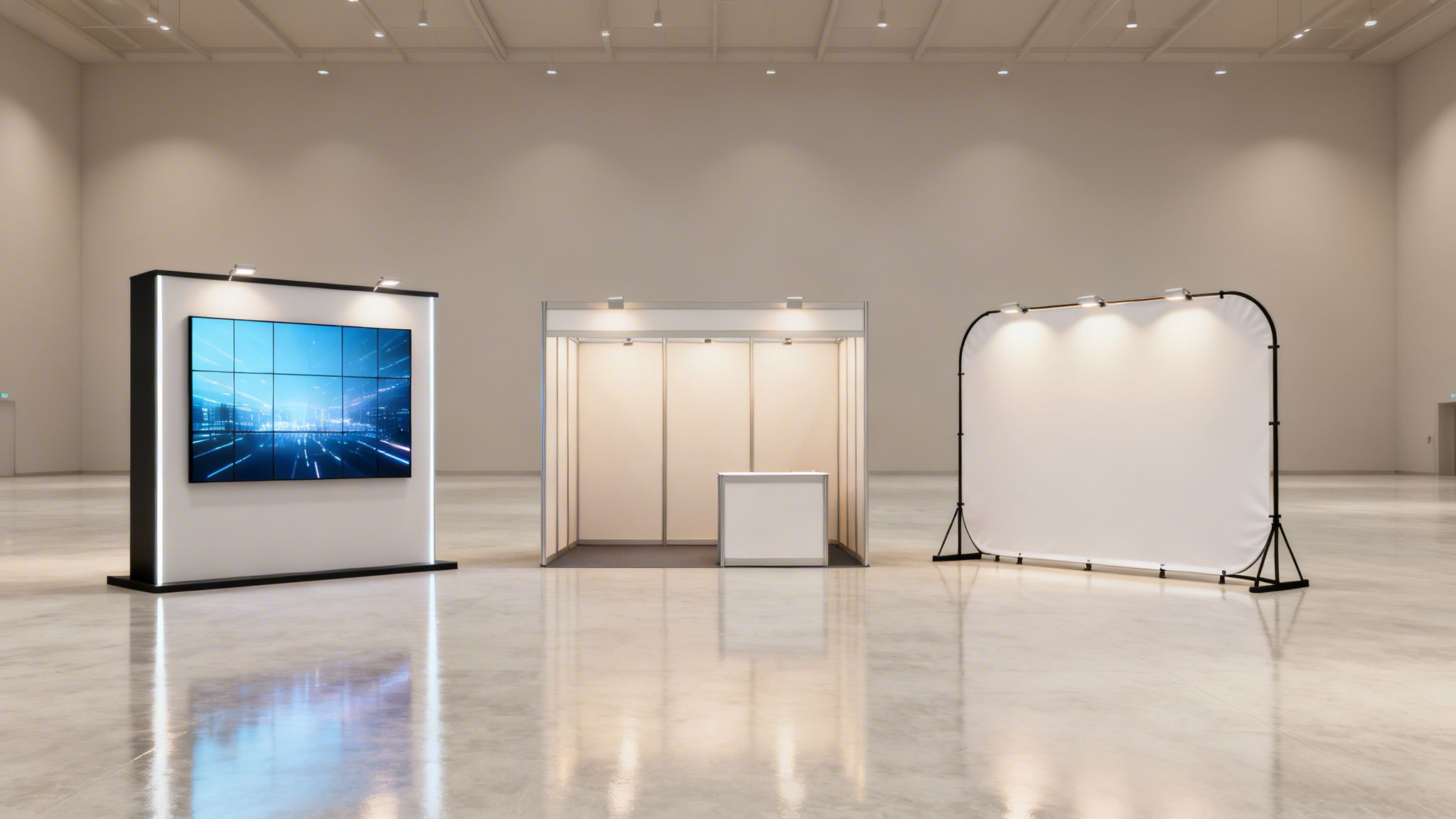
For seasoned exhibitors, the 10′ x 20′ trade show booth is the real sweet spot. It gives you double the space of a cramped 10′ x 10′ without the monster budget required for a huge island exhibit. This 200-square-foot space is the perfect canvas to make a real impact, run immersive product demos, and actually have meaningful conversations with attendees. Plus, we have much more affordable trade show booths that don’t include a video wall. 

Why a 10′ x 20′ Booth Is Your Strategic Advantage

Moving up from a 10′ x 10′ isn’t just about getting a little more elbow room. It’s about unlocking a whole new level of strategic possibilities on the show floor. This is where your brand stops just being there and starts commanding some serious attention.

Think of it like the difference between a small pop-up kiosk and a real boutique shop. That extra 10 feet of width turns a basic backdrop into a wide, cinematic canvas. Suddenly, you have the room to tell a much bigger story, guide people through your space, and create separate zones for different activities.

Doubling Down on Impact and Engagement

With 200 square feet, you finally have the freedom to design an environment, not just a display. This lets you create more dynamic layouts that can seriously boost the number of people who stop and how long they stick around.

  • Create Dedicated Zones: You can set up a comfy lounge area for deep-dive conversations on one end and an interactive demo station on the other, all without everything feeling jammed together.

  • Improve Traffic Flow: You can actually guide visitors on a path through your booth. This prevents the awkward bottlenecks you see in smaller spaces and encourages people to explore instead of just glancing and walking away.

  • Amplify Visual Presence: That 20-foot-wide backwall is a powerful billboard. It makes your brand impossible to miss from across the aisle, pulling attendees in from a distance.

The Power of Smart Design and Technology

The real magic happens when you pair this ideal footprint with smart design and the right technology. The data doesn’t lie: booth size has a huge influence on success. In fact, 76% of visitors say the booth’s design is the main reason they decide to stop. Making a 10′ x 20′ look amazing isn’t just a nice-to-have; it’s critical. You can see more about how top exhibitors are using these trends in 2025.

The right technology turns a well-sized booth into an unforgettable experience. Our approach focuses on seamless integration where the booth structure is the display. We offer transparent, all-inclusive pricing that covers everything except what the show bills you for directly, so you can budget with confidence.

With our advanced video walls, your message isn’t just bigger; it’s sharper. We provide a 1.9mm pixel pitch, a detail that delivers a noticeably higher-resolution image than the common 2.5mm pitch many competitors use. What that means for you is your videos and graphics look incredibly crisp and professional, even for people standing right up close.

Designing a Layout That Guides and Engages

A great 10′ x 20′ trade show booth is more than just a box on a show floor; it’s a carefully planned experience for every person who walks by. Think of it like a well-run retail store. The layout naturally pulls you in, guides you past the key products, and makes you want to explore. Your 200 square feet needs to do the same job.

Without a smart layout, your booth becomes just another cluttered space that attendees glance at and walk past. The whole point is to make your space feel open, inviting, and easy to navigate, using every square foot to hit your event goals.

Popular Layouts for a 10′ x 20′ Booth

The long, rectangular shape of a 10′ x 20′ booth is perfect for a few proven layouts. The best one for you really depends on what you’re trying to accomplish. Are you trying to book a bunch of one-on-one meetings? Or do you need to show off a complicated product to small groups?

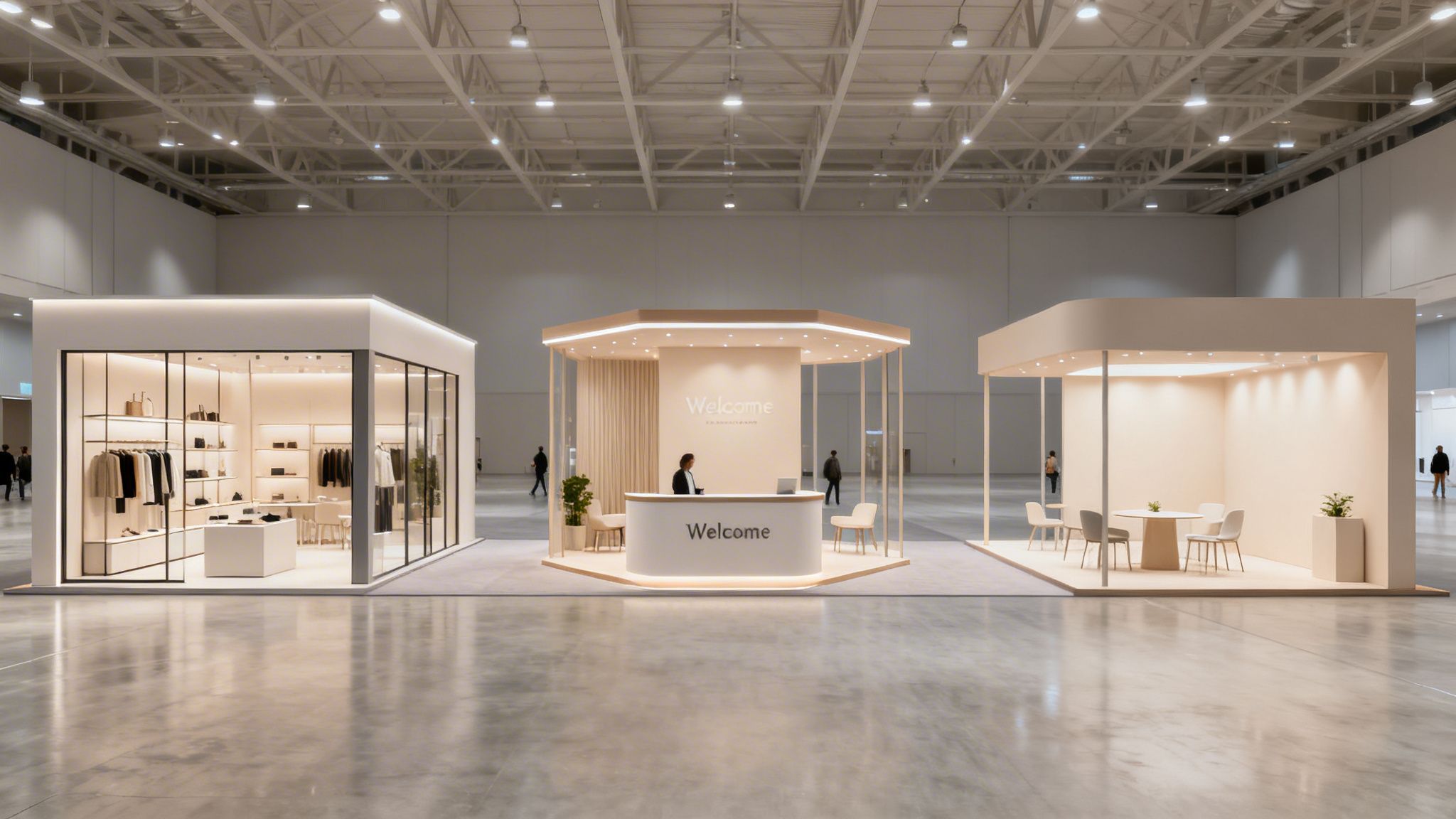
Three popular styles are a great place to start:

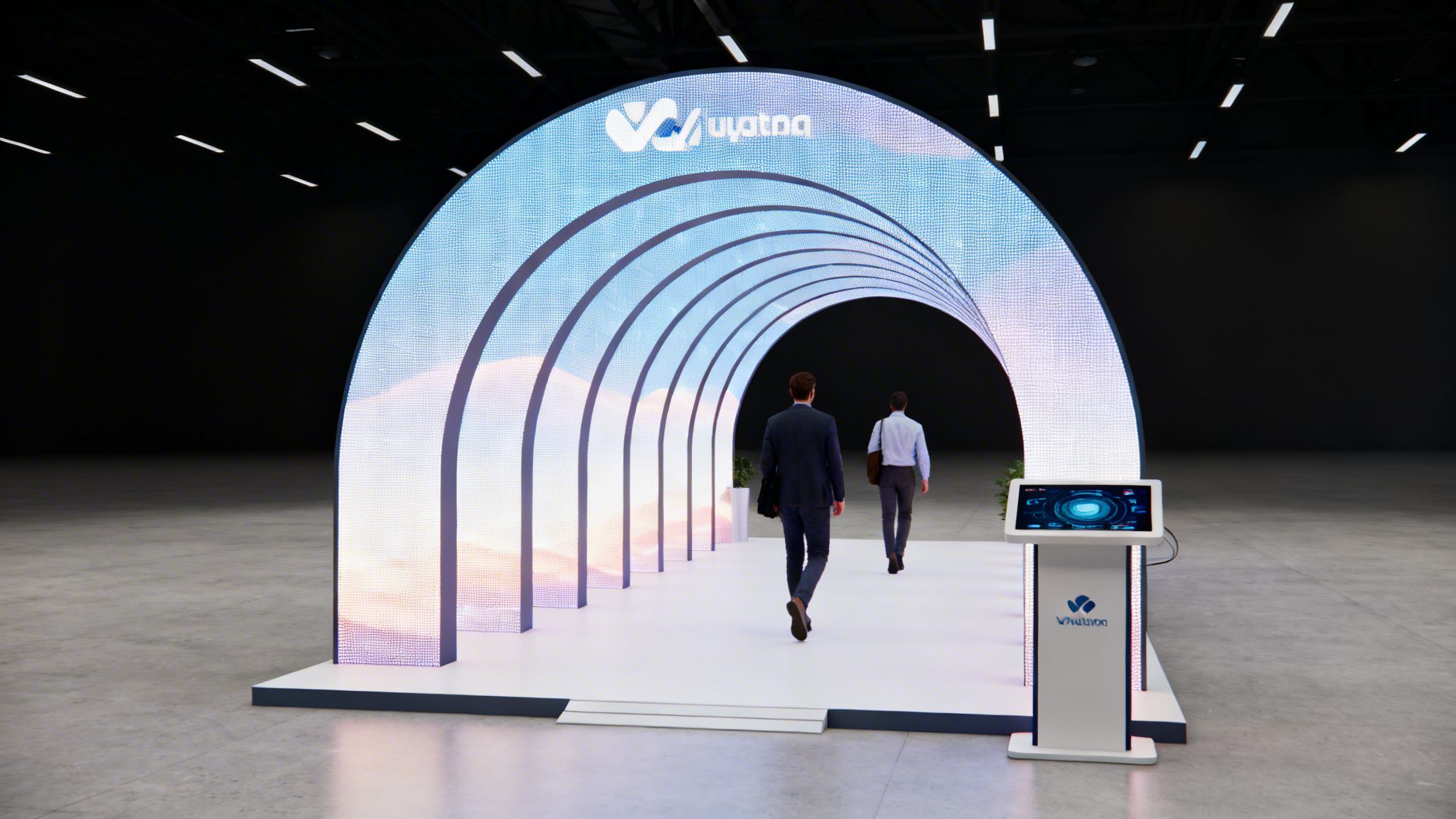
  • The Tunnel Layout: This design puts your displays and counters along the two short 10-foot walls. This creates a clear path down the middle, making it easy to draw people all the way through your space and show them multiple things along the way.

  • The Reception Layout: With this setup, you have a big welcome counter right at the front. The space behind it is open for demos or conversations. It’s a fantastic choice for grabbing leads because your staff can greet and qualify visitors the second they step in.

  • The Lounge Layout: By placing comfy chairs and tables deeper inside the booth, you create a semi-private spot to get away from the noisy show floor. This style is perfect for building relationships and having real, in-depth talks with your most important prospects.

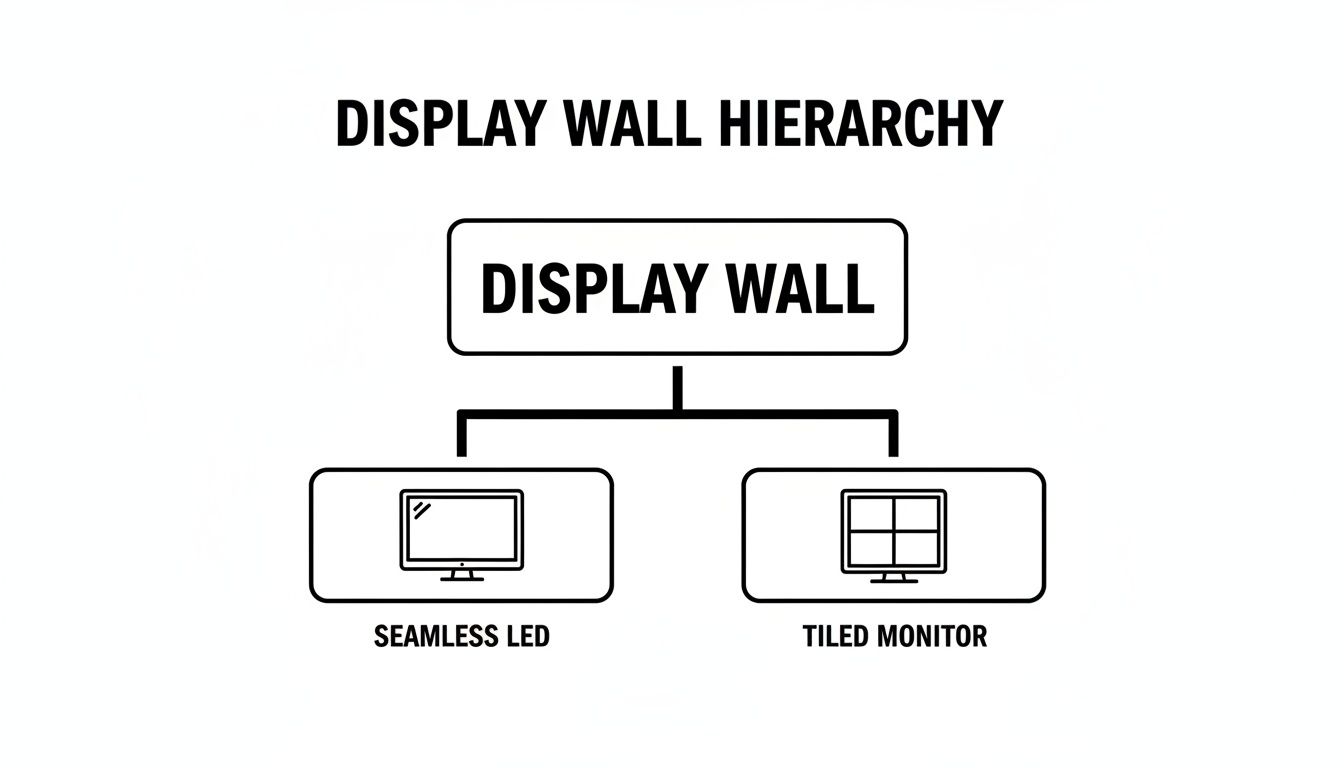
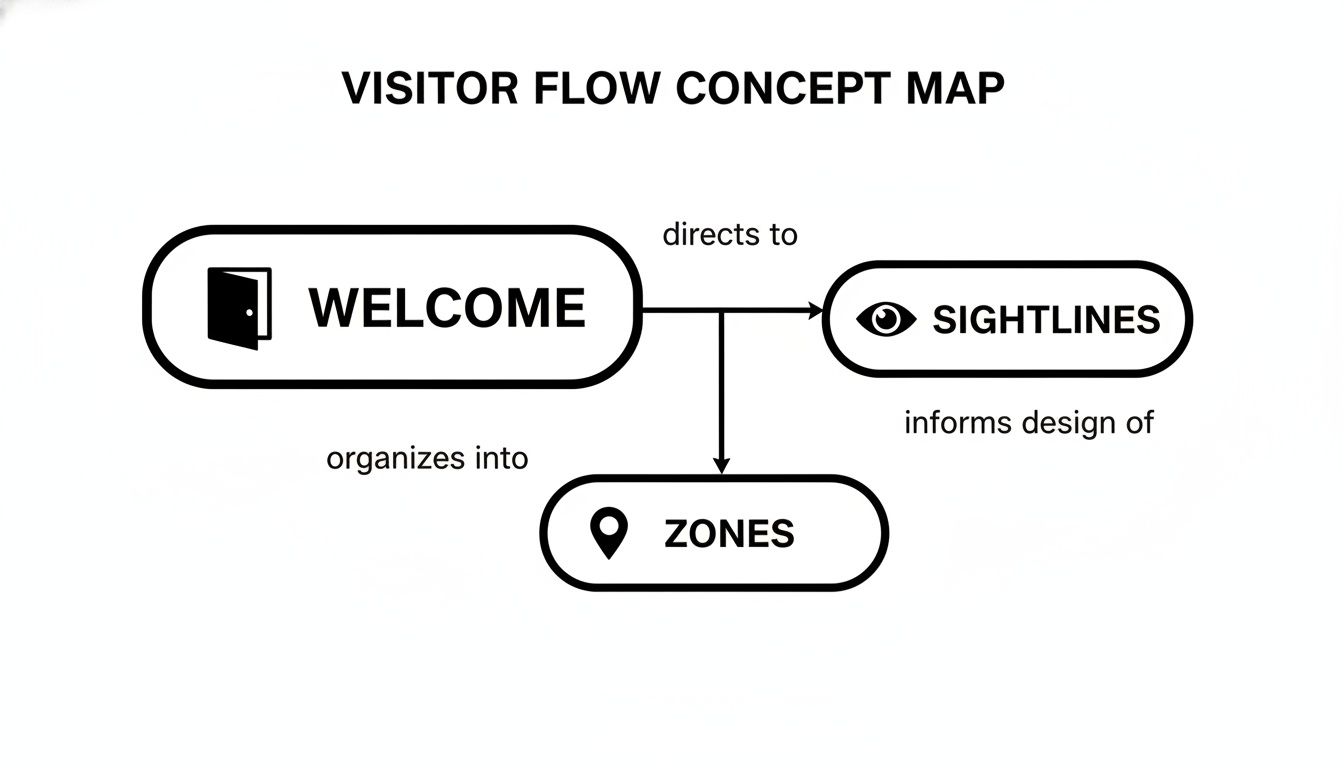
This concept map breaks down the key parts of a successful booth strategy, starting with visibility and flowing through to function and budget.

A concept map illustrating how Booth Advantage improves visibility, enhances function, and optimizes budget.

As the map shows, you have to get these three things right—visibility, function, and budget—to get the most out of your 10′ x 20′ booth.

Managing Traffic Flow and Creating Zones

One of the big advantages of the 10′ x 20′ size is that you can create different zones for different activities without making the booth feel cramped. But to pull this off, you have to manage how people move through the space. The last thing you want is a traffic jam right at the entrance that makes people turn away.

The best booths just feel intuitive. A visitor should never have to stop and think, “Where do I go now?” Your layout should answer that question for them before they even have to ask.

Think about creating one clear entry point, usually on one side of the 20-foot opening, to get a natural flow going. You can use different flooring, special lighting, or furniture to guide people toward your main attraction, whether that’s a product demo, an interactive screen, or a meeting area. For more great ideas, you can learn more about trade show booth design strategies in our detailed article.

Using Vertical Space and Smart Lighting

When you don’t have a lot of floor space, you have to think up. Use tall backwalls, hanging signs (if the show allows them), and stacked displays to draw people’s eyes upward. This trick not only makes your booth easier to spot from across the aisle but also gives the impression of a bigger, more impressive space.

Good lighting is another game-changer. Use spotlights to make your key products or messages on the backwall pop. You can also use backlit counters and subtle LED strip lighting to give your booth a professional, modern vibe that stands out from all the boring, flatly lit exhibits around you. When you combine these design tricks, your 10′ x 20′ trade show booth will feel both grand and welcoming.

Using LED Video Walls to Capture Attention

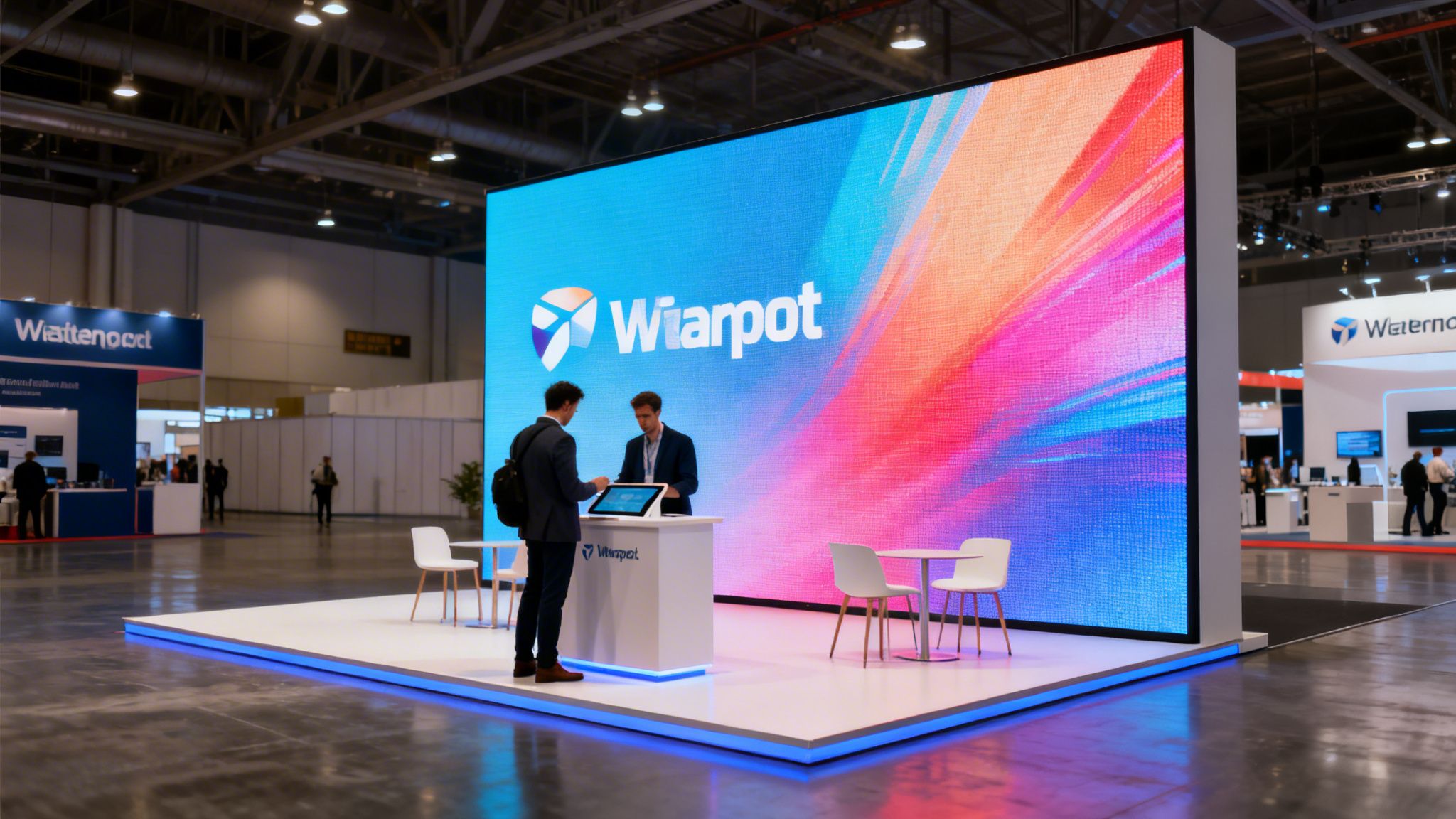
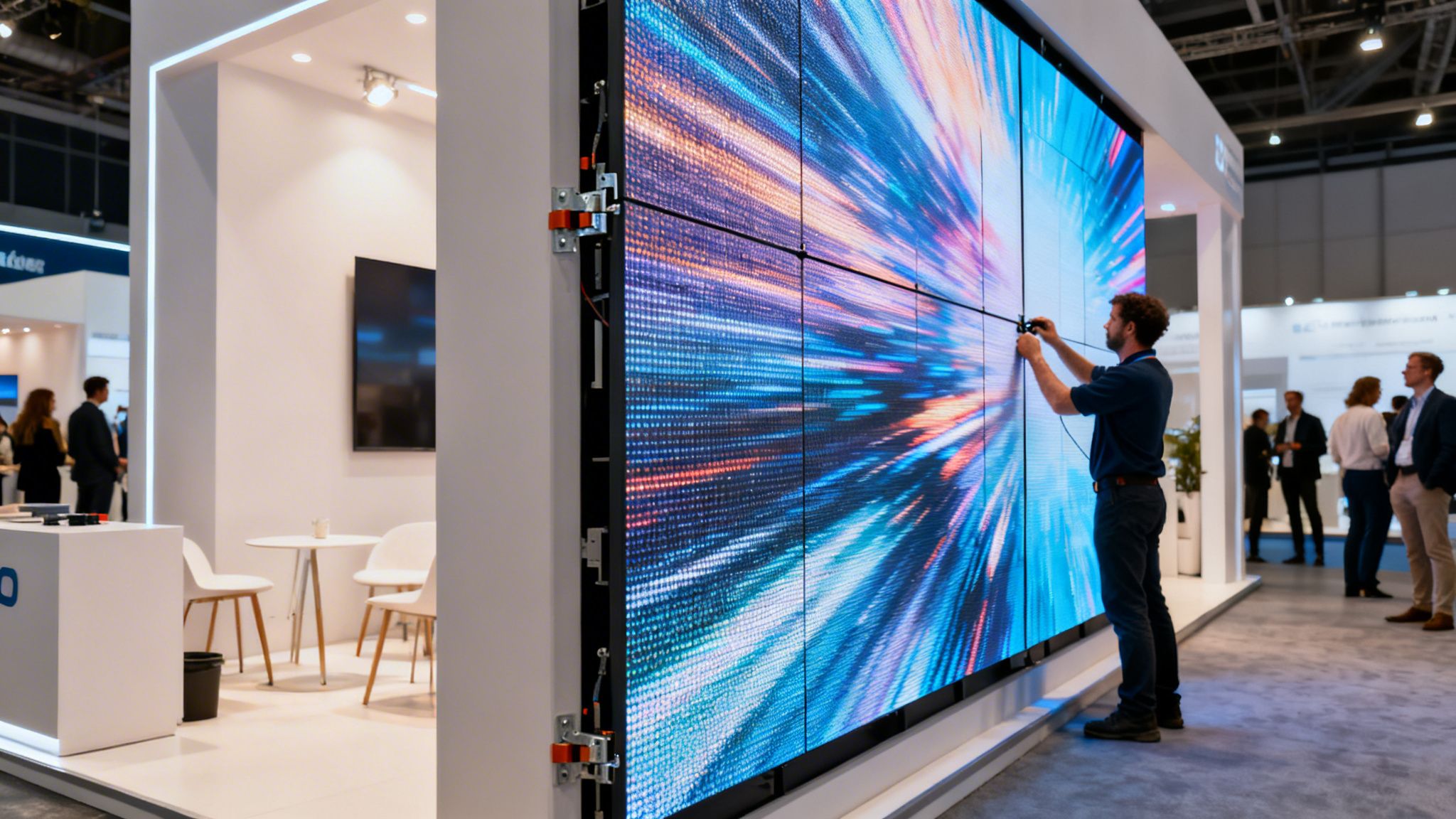
Let’s be honest: static graphics and clunky, stacked monitors just don’t cut it anymore. They’re quickly becoming relics of the past. For a 10′ x 20′ trade show booth, the real game-changer is a seamless LED video wall. It turns your entire 20-foot backwall into a stunning, dynamic digital canvas that literally stops attendees in their tracks.

Unlike old-school setups with distracting screen borders (bezels), messy cables, and heavy truss systems, modern LED panels create a completely clean and uninterrupted visual. This isn’t just about putting up a screen; it’s about building your booth out of the screen. Your static backdrop transforms into a powerful storytelling tool.

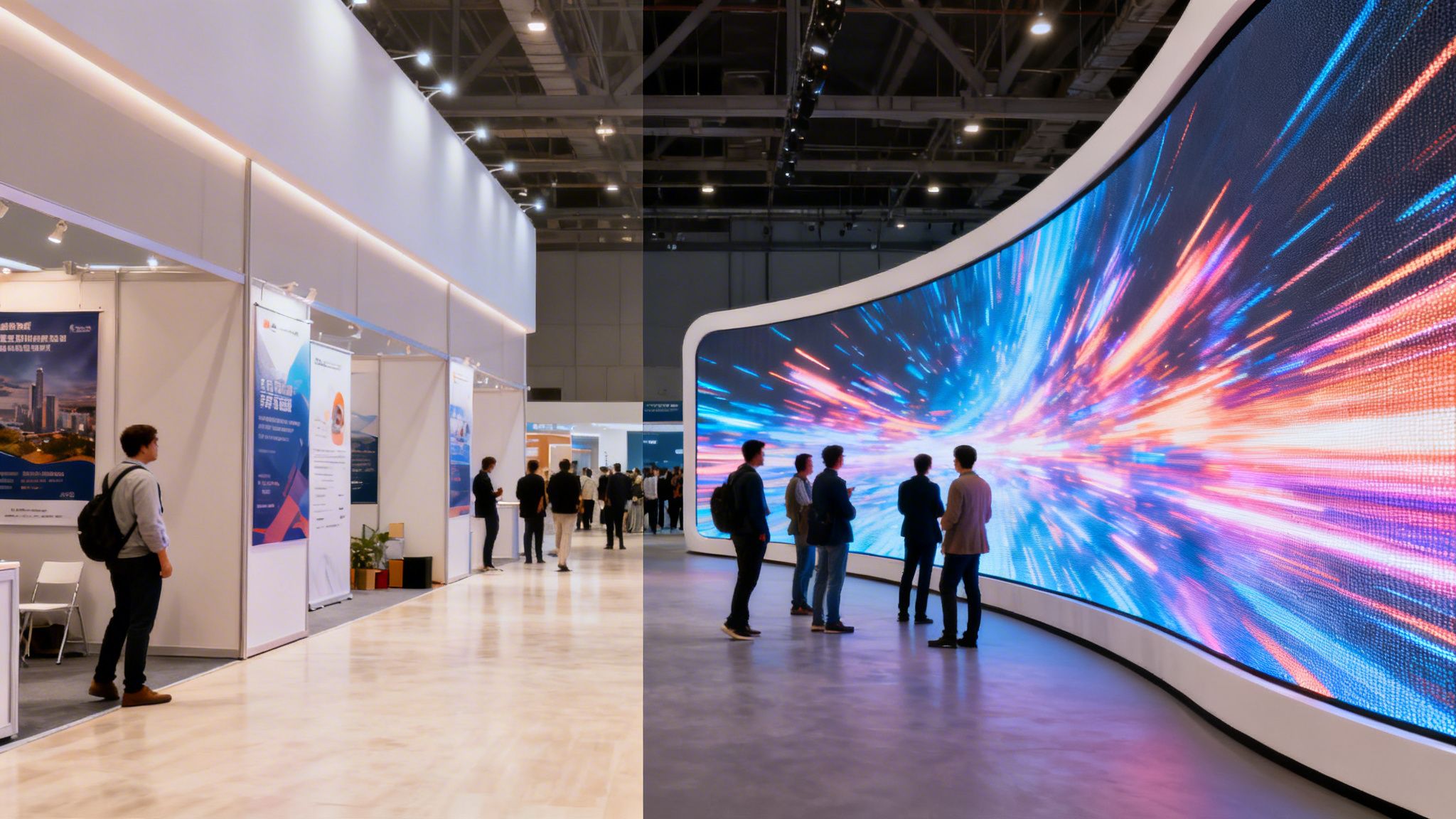
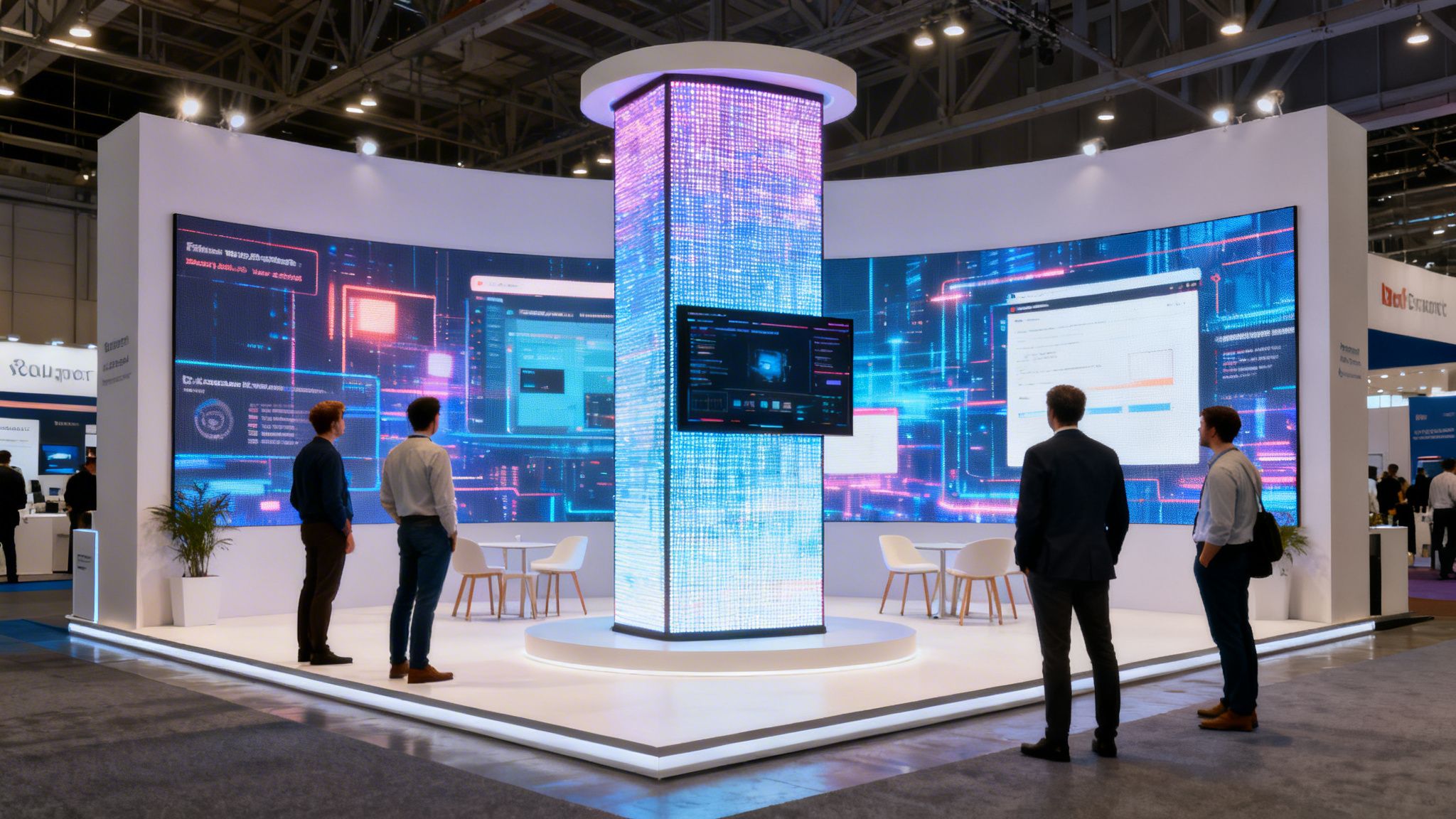
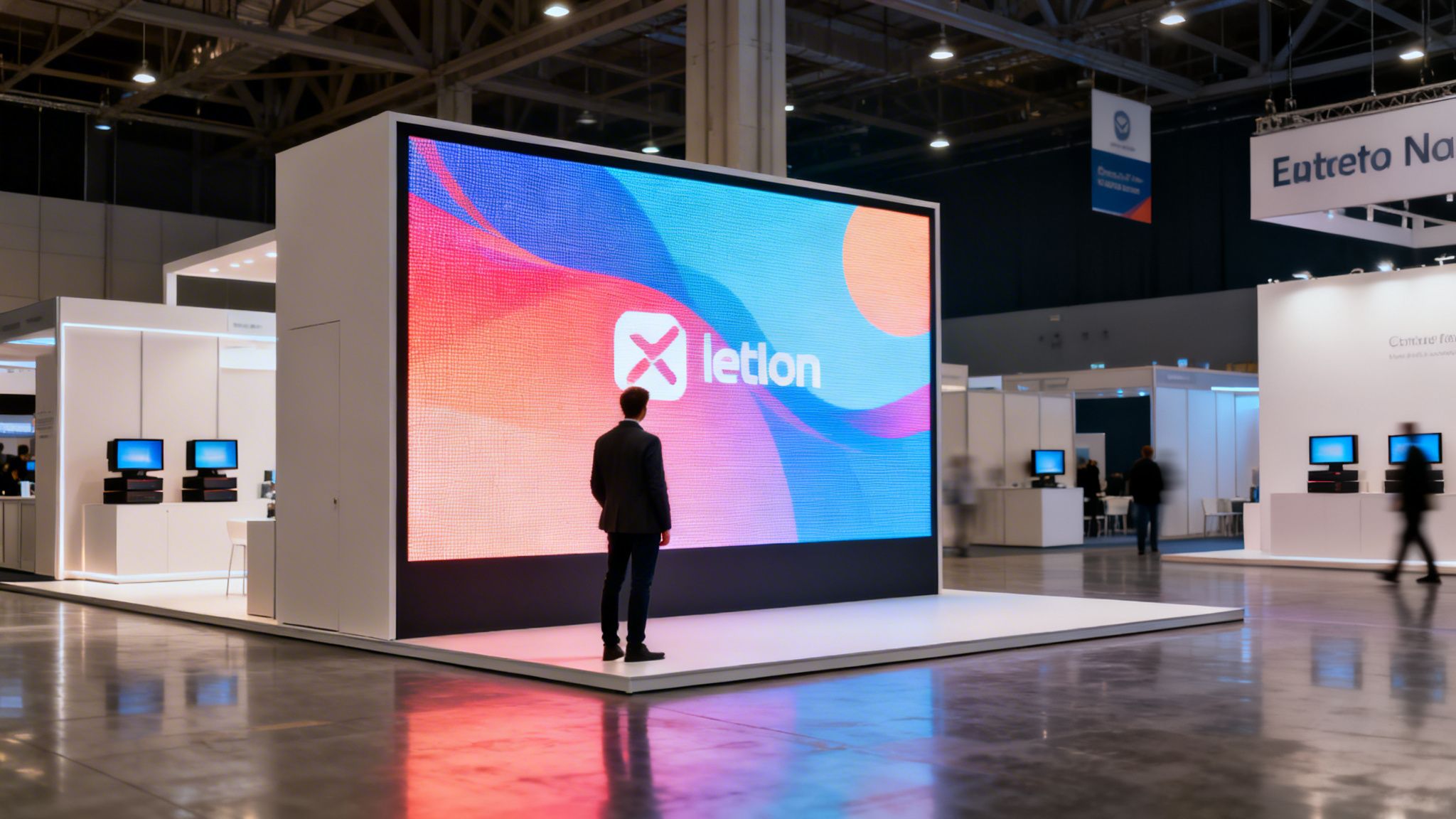
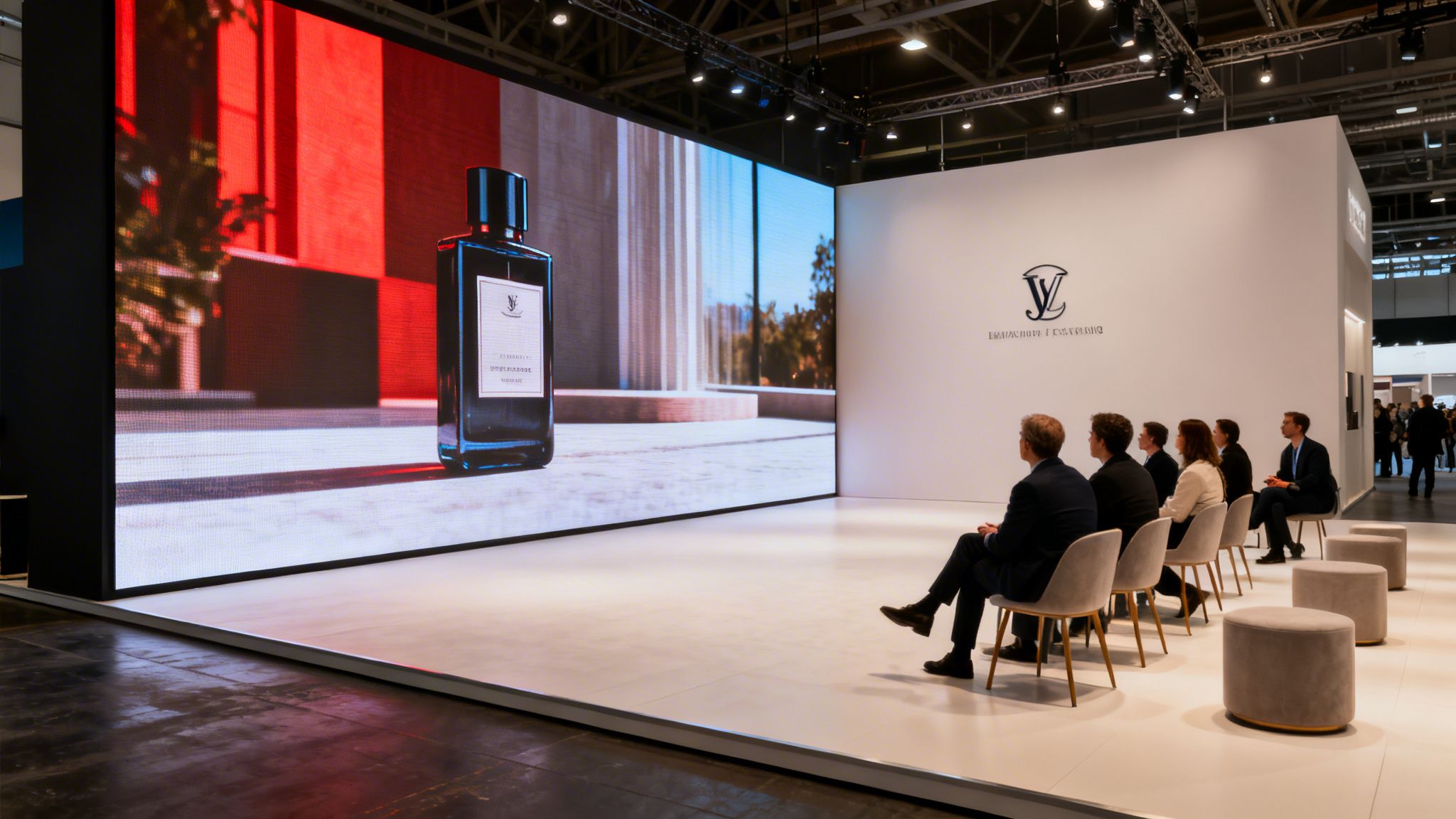
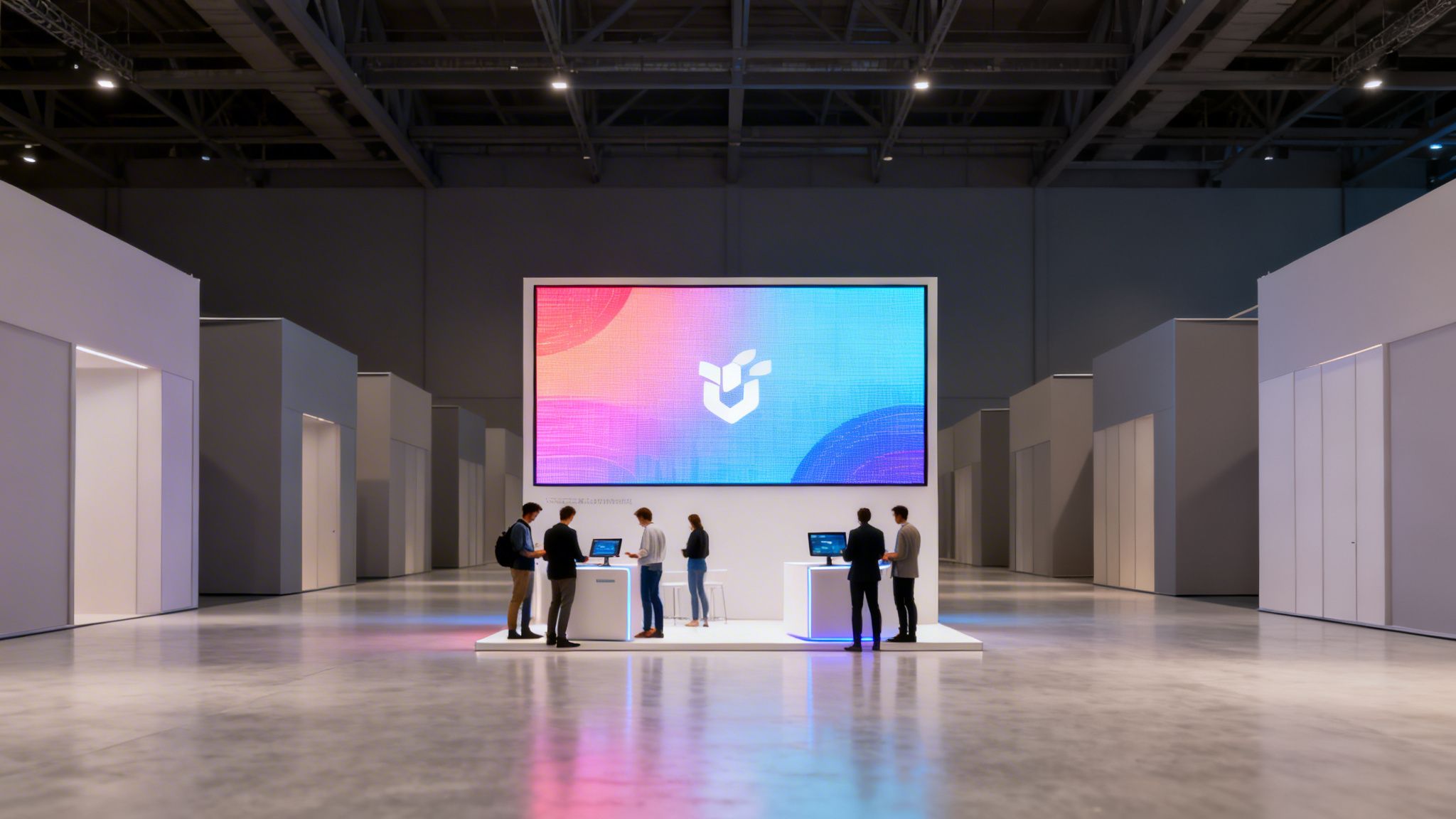
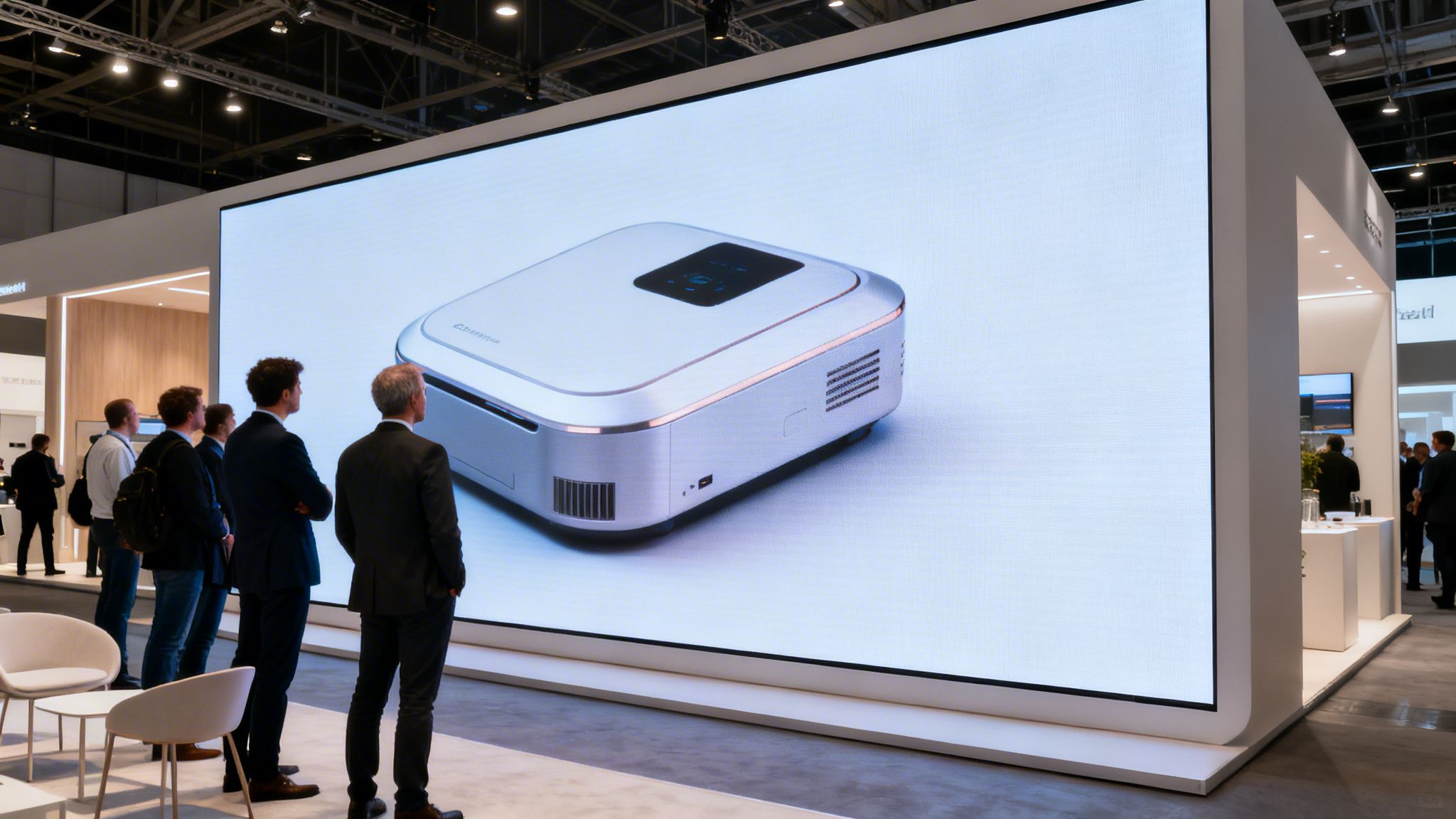
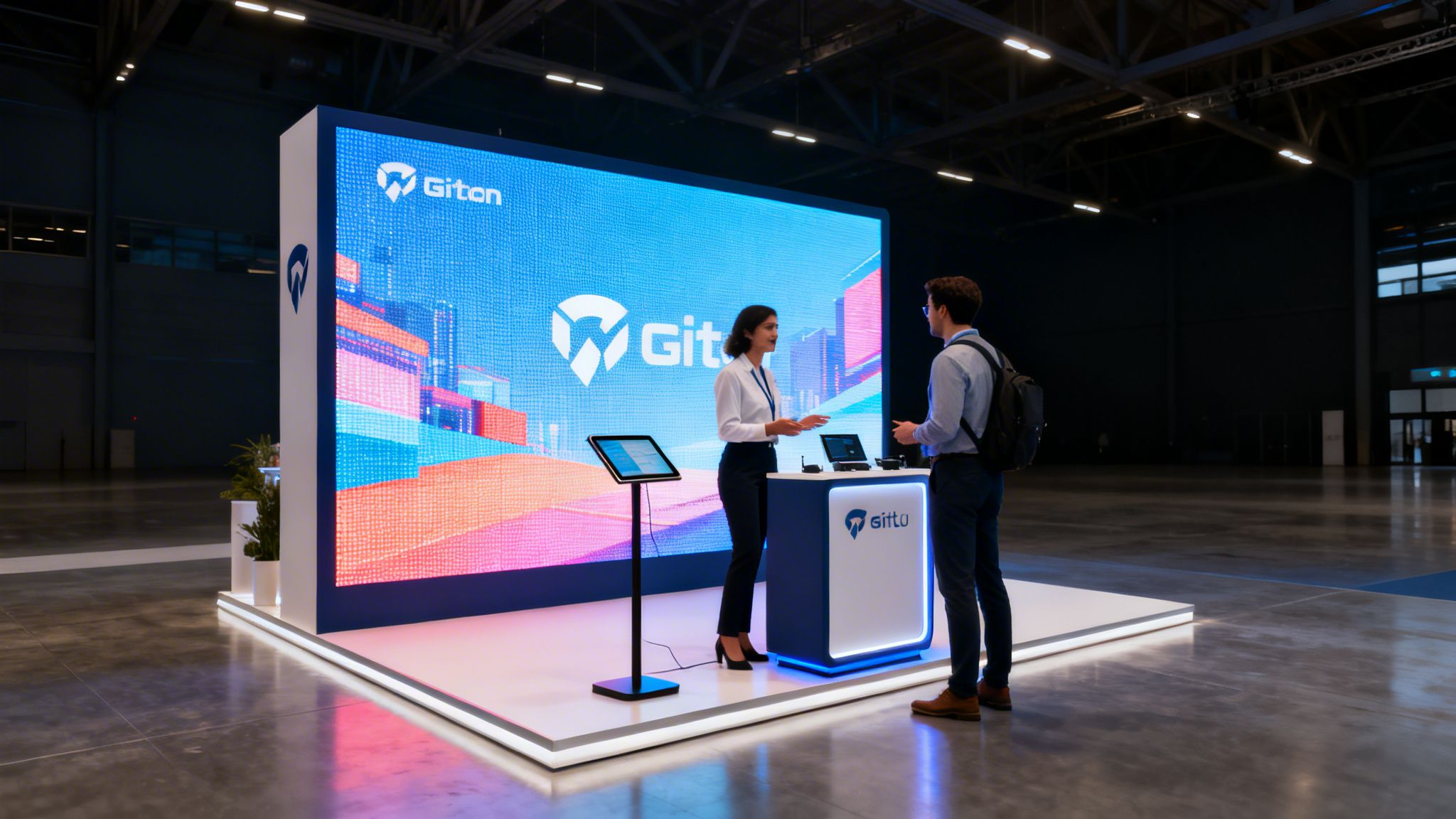
People viewing a vibrant 10' x 20' video wall display at a modern trade show booth.

10′ x 20′ trade show booths

Why Pixel Pitch Is a Game Changer

Not all LED video walls are created equal. The single most important detail determining your display’s quality is pixel pitch—the distance in millimeters from the center of one pixel to the center of the next. A smaller number means the pixels are packed closer together, creating a much sharper, higher-resolution image.

Many competitors still use panels with a 2.5mm pixel pitch. Up close, this can look grainy or “pixelated.” Our video walls, on the other hand, feature a 1.9mm pixel pitch. That tiny difference has a massive impact on how good your content looks.

Think of it like the difference between standard definition and 4K Ultra HD. With a 1.9mm pitch, your content looks incredibly sharp and vibrant, even when attendees are standing just a few feet away. It’s all about making sure your brand and products are always presented with the highest possible clarity.

This is a critical detail. This superior resolution means you can show off detailed product images, crisp text, and complex animations without worrying about them looking blurry or unprofessional. For a 10′ x 20′ trade show booth, where people are right up close to your display, that sharp visual quality is what makes a premium impression.

Choosing the right pixel pitch is crucial for a professional look. The table below breaks down why our finer 1.9mm pitch stands out against the more common 2.5mm standard you’ll often see from other providers.

Pixel Pitch Comparison: What It Means for Your Booth

Feature Our LED Walls (1.9mm Pitch) Competitor Standard (2.5mm Pitch)
Image Quality Ultra-sharp, crisp “4K-like” visuals Visibly lower resolution, can look grainy
Close Viewing Looks great even from a few feet away Can appear pixelated up close
Professionalism High-end, premium brand impression Can look dated or “budget”
Content Display Ideal for detailed text and product shots Best for simple graphics or distant viewing

As you can see, the closer pixel spacing of our panels ensures your message is delivered with maximum impact, no matter where an attendee is standing in your booth.

The Financial Advantage of Modern LED Panels

Beyond the incredible visuals, the way modern LED video walls are built offers some serious cost-saving benefits, especially when it comes to show logistics. Traditional video wall setups required heavy, clunky equipment and specialized labor, which drove up costs for shipping, drayage (material handling), and installation.

Our lightweight, toolless panels completely change that equation. Here’s how:

  • Reduced Drayage Costs: Drayage is charged by weight. Because our LED panels are so much lighter than older systems, you pay far less to get them from the loading dock to your booth space.

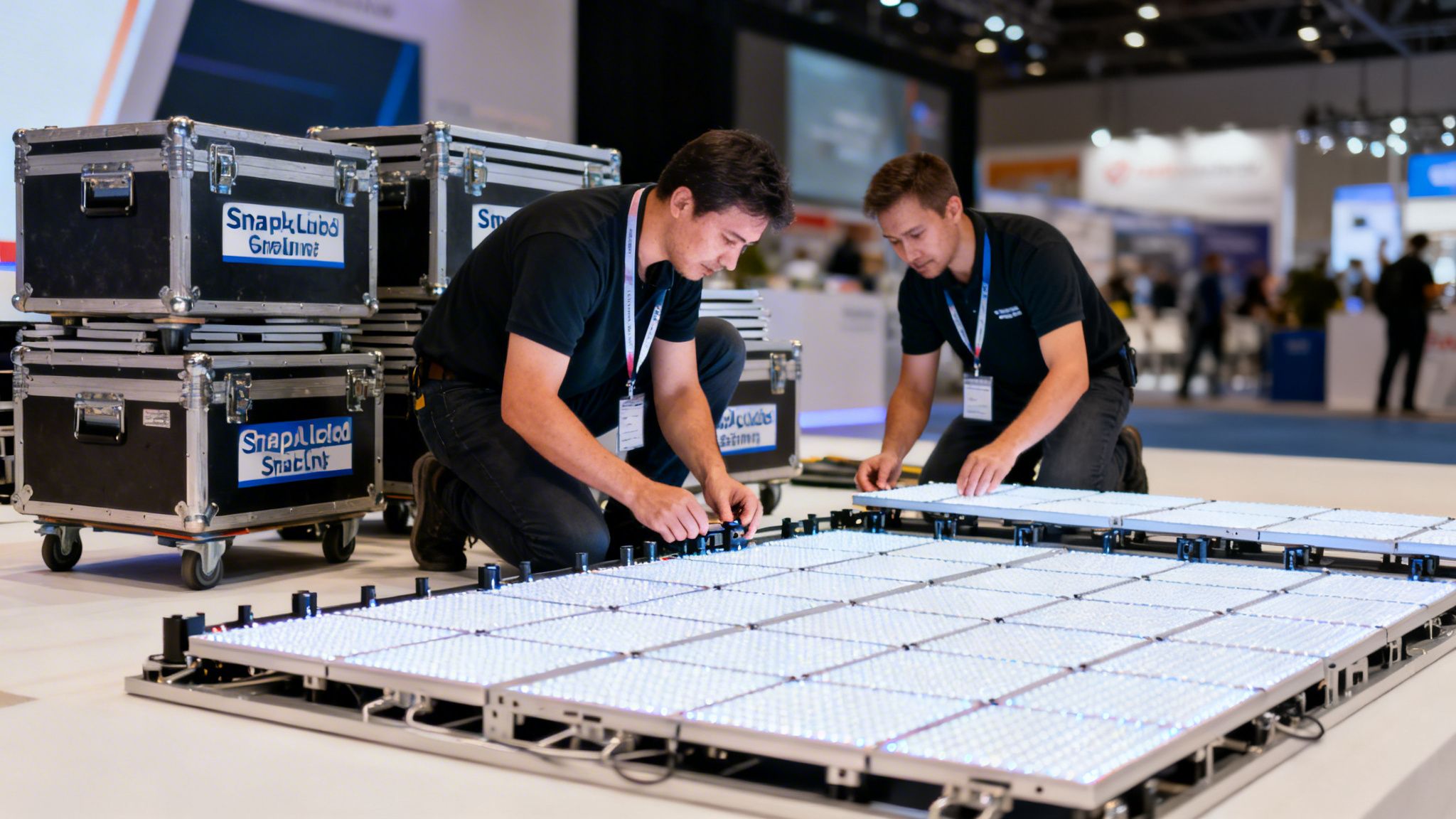
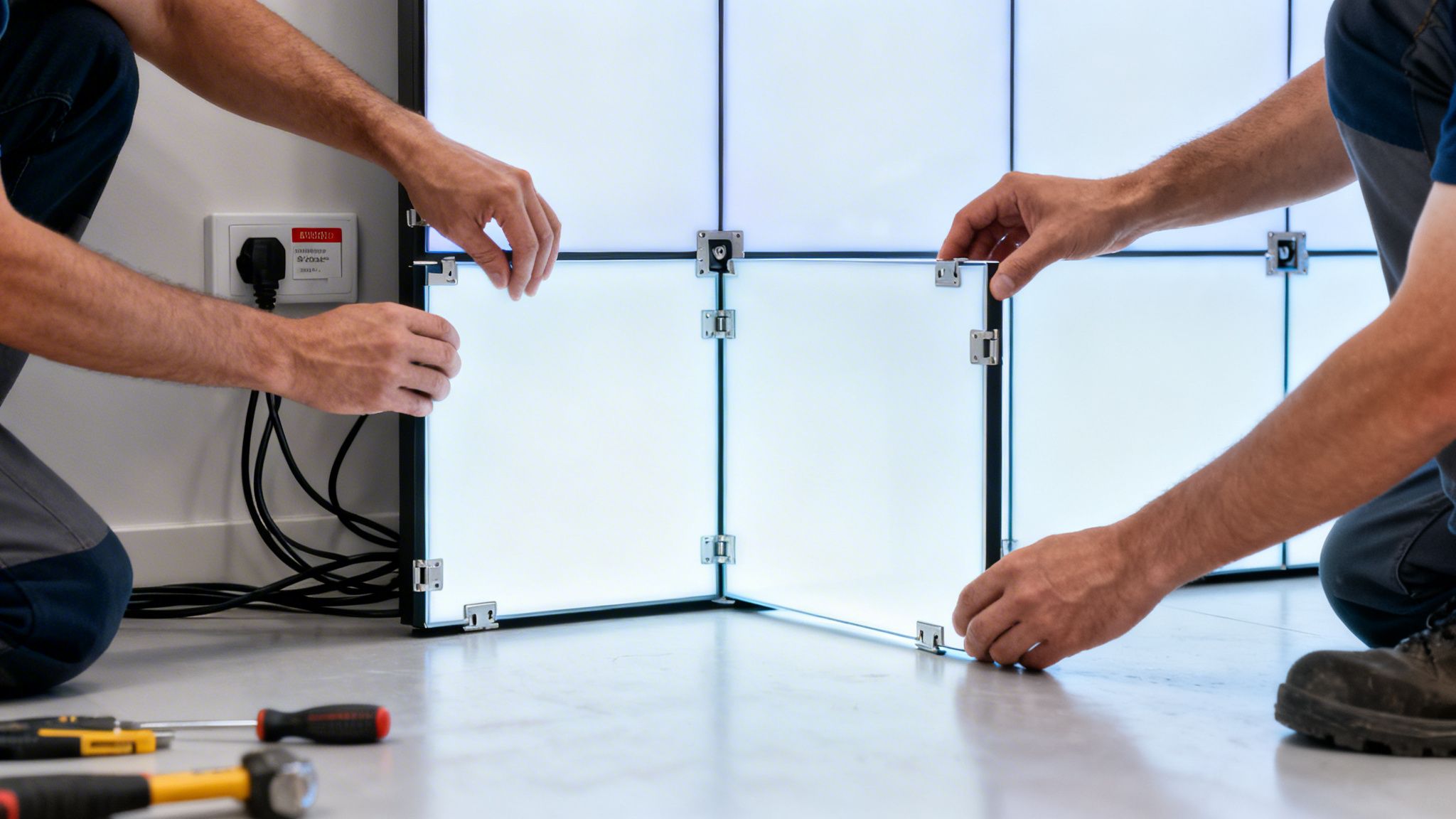
  • Lower Labor Bills: The panels are designed to snap together quickly with magnets and toolless locks. This fast assembly means fewer hours of union labor for setup and teardown, which directly saves you money.

  • Simplified Shipping: The compact, lightweight design also cuts down on freight costs. The panels simply take up less space and weight on a truck.

This efficiency gives you a much more predictable and manageable budget. If you want to get into the nuts and bolts, you can learn more about our LED video wall rental options and see how they can fit into your event strategy.

All-Inclusive Pricing for Peace of Mind

Budgeting for a trade show can be a nightmare. Hidden fees and surprise charges seem to pop up at every turn. We get it. That’s why we simplify the whole process with a clear, all-inclusive pricing model for our booth structures and technology.

When you work with us, our price covers everything needed for the booth itself—the LED panels, the structure, and all the hardware. The only extra costs are the direct bills you’ll get from the show organizer, such as:

  • Electrical service to your booth

  • Internet connectivity

  • Material handling (drayage)

This transparency takes the guesswork out of budgeting and lets you plan with confidence. You won’t get hit with unexpected rental fees for cables, mounts, or other little components that other suppliers love to add on later. Our goal is to provide a powerful, high-impact solution for your 10′ x 20′ trade show booth without the financial surprises, so you can focus on what really matters: connecting with attendees.

Understanding the True Cost of Your Booth

Budgeting for a 10′ x 20′ trade show booth can feel like trying to hit a moving target. The number you see on a quote for the booth structure? That’s just the tip of the iceberg. The real challenge—and where budgets get blown—is the long list of extra charges from show organizers and other vendors that can pile up fast.

To plan effectively, you have to look beyond the booth itself and get a realistic picture of every potential expense. It’s not just about renting the hardware; it’s about what it costs to get that hardware set up, powered on, and running on the show floor. These are the “surprise” costs that catch even seasoned marketers off guard.

What Really Goes into a Trade Show Budget

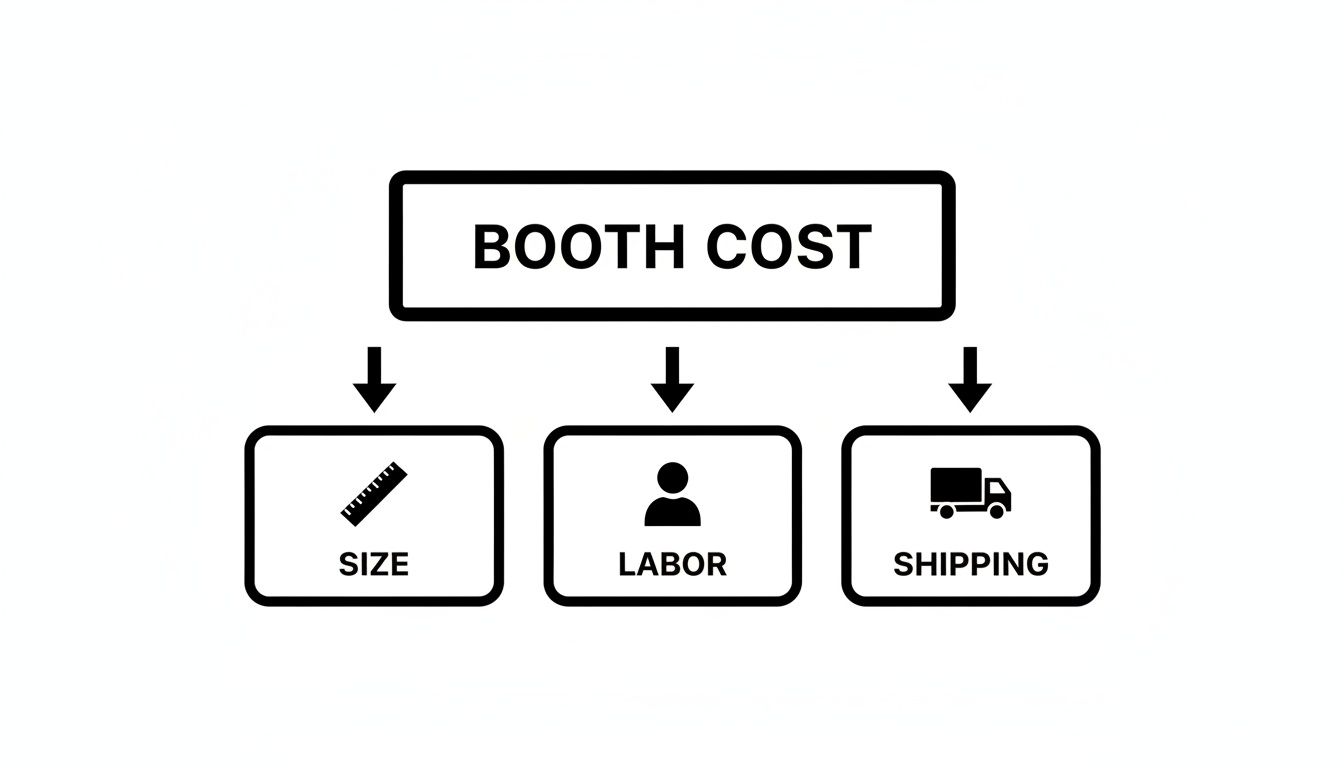
Beyond the physical booth, your budget has to cover several critical services, often called “show services.” These aren’t optional—they’re required to exhibit, and their costs can swing wildly from one city and venue to the next.

Here are the key expenses you need to plan for:

  • Drayage (Material Handling): This is the fee the show charges just to move your freight from the loading dock to your booth space and back again. It’s usually billed by weight, so heavy, clunky booths will cost you a fortune before the show even opens.

  • Electrical Service: Power isn’t free on the show floor. You’ll have to order electrical drops to run your lights, charge laptops, and especially to power a high-impact LED video wall.

  • Internet and Connectivity: If you need a stable internet connection for software demos or lead capture, you’ll have to pay for it. Relying on the free venue Wi-Fi is usually a recipe for disaster.

  • Labor for Installation & Dismantle (I&D): In many major convention centers, you’re required to use union labor to set up and take down your booth. Those hourly rates add up very, very quickly.

These four items are notorious for causing budget overruns. A simple miscalculation on drayage or underestimating your labor needs can wreck your event ROI before a single attendee walks by. However, with our company the Installation & Dismantle is always included in our price quote.

Why Location Heavily Influences Your Costs

Where you exhibit plays a huge role in your final bill. Labor rates, drayage fees, and service charges aren’t the same everywhere. Cities with high costs of living and strong union rules will always hit your budget harder.

For example, a complete turnkey 10′ x 20′ trade show booth rental—with graphics, flooring, furniture, and labor—might run between $30,000 to $40,000 in a city like Las Vegas. That same exact booth could easily jump to $35,000-$45,000 in Chicago and skyrocket to $40,000-$50,000 in pricey locations like New York or Philadelphia. This is important context, especially when you realize the U.S. B2B trade show market hit $15.78 billion in 2024—a figure driven by these exact expenses. Making smart technology choices, like using compact, magnetic LED panels for video walls, can slash drayage and labor costs by up to 50%, delivering massive savings.

A predictable budget is a powerful advantage. Our straightforward pricing model is designed to give you exactly that. We provide one clear, all-inclusive price for the booth structure and technology.

This approach takes the guesswork out of the equation and protects you from surprise fees on the core components of your booth.

Our All-Inclusive Pricing: A Clear and Simple Approach

We don’t think budgeting for a high-impact 10′ x 20′ trade show booth should be a source of stress. That’s why we’ve made the process simple. Our rental price includes everything you need for the physical booth structure and its integrated technology.

What’s included in our price: The entire booth structure, the seamless LED video wall panels, and all the hardware and components needed to make it work. Our price includes everything for the booth itself; you’re only responsible for what the show bills you for directly.

What’s not included: The services you have to order directly from the show organizer. These are the bills you’d get no matter who you rent your booth from. This includes:

  • Drayage

  • Electrical

  • Internet

By being upfront about what’s covered, we make sure there are no hidden fees or last-minute charges from our end. Unlike other companies that might nickel-and-dime you for cables, mounts, or other “add-ons,” our price is comprehensive. This makes our solution a predictable, high-value investment you can count on. For a more detailed look at the numbers, check out our guide on understanding video wall booth rental costs.

Creating Visual Content That Converts

A flashy LED video wall is just an expensive light fixture if you don’t have good content to put on it. For your 10′ x 20′ trade show booth, what you show on that screen is just as critical as the technology itself. You can’t just throw a corporate video on a loop and call it a day; you need a real strategy to grab attention and drive results on a packed show floor.

A man interacts with a tablet at a modern trade show booth featuring illuminated product displays and a silhouette figure.

The best way to think about your content is in layers, kind of like a pyramid. Each layer has a specific job, designed to pull an attendee from the aisle into a real conversation with your team. This simple approach makes sure you’re showing the right message to the right person at the right time.

The Content Pyramid Framework

This strategy breaks your visual content into three stages. Each one targets attendees at different distances and with different levels of interest.

  1. Attract (The Base): This is for people just walking by. Your content needs to be big, bold, and interesting enough to make them stop. Think eye-catching motion graphics, beautiful brand imagery, or even abstract visuals that match your company’s vibe. The goal isn’t to explain anything yet—it’s just to get them to pause and look your way.

  2. Engage (The Middle): Okay, you’ve got their attention. Now you need to give them a reason to come closer. This content layer should be more informative. Show off key product features, quick customer benefits, or short, punchy testimonials. Keep it simple and easy to read from a few feet back.

  3. Convert (The Peak): This is for the people who have actually stepped into your booth. This content is all about getting them to take the next step. It might be a clear call-to-action for a product demo, a QR code for a show-only discount, or a screen showing your meeting schedule. This is where you turn a passive looker into an active lead.

We make sure your content looks its absolute best. Our video walls feature a 1.9mm pixel pitch, which delivers a significantly higher resolution than the 2.5mm pitch often used by competitors. This means every detail of your content—from fine text to intricate product shots—remains perfectly crisp and professional, even up close.

Technical Tips for Your Content

Getting your content right for a trade show isn’t just about good design; you have to think about the technical side, too. The show floor has its own set of rules, and a few key pointers will make sure your visuals look perfect.

First, always design as if there’s no audio. Trade shows are incredibly loud, and any sound you play will just get lost. Your visuals have to do all the storytelling. Use clear text overlays and powerful images to get your message across. Subtitles aren’t just an option; they’re essential.

Next, pay attention to the resolution. For a standard 10′ x 20′ trade show booth backwall, you’re working with a very wide canvas. You have to get the exact pixel dimensions of the LED wall from your provider and design your files to match. This prevents any ugly stretching or pixelation and keeps everything looking sharp.

Finally, remember our straightforward pricing helps you budget for killer content. Our all-in price covers the booth and the tech. The only extra costs are what the show bills you for directly, like power and drayage. Knowing your costs upfront frees up money you can put toward creating high-quality visuals that actually work.

Your On-Site Success Checklist

Even the most impressive 10′ x 20′ trade show booth can fall flat without solid on-the-ground execution. A smooth show really comes down to sweating the small stuff and planning for every detail on-site. This checklist is your game plan for managing a tech-heavy booth, making sure everything from the power drop to your staff schedule is handled.

The global exhibition market was valued at $39.4 billion in 2023 and is expected to hit a massive $88.76 billion by 2029. With events pulling in thousands of attendees—and 78% of them traveling over 400 miles for that face-to-face connection—your on-site game has to be flawless.

Being prepared is everything. Especially when you consider that good design is what makes 76% of visitors stop in the first place, and adding interactivity can boost their engagement by 50%. You can dig into more trade show insights to see why a perfect execution is so critical.

Pre-Show Logistics and Final Checks

Before you even pack your bags, a few key confirmations can save you from huge headaches later. This is all about verifying the details that make for a smooth setup.

  • Confirm Your Power Drop Location: An LED video wall is power-hungry. Look at your floor plan again and make sure the electrical outlet is exactly where you need it. The last thing you want is to run ugly, hazardous extension cords across your booth floor.

  • Finalize and Test All Content: Run through every single video loop and graphic one last time. Are the files in the right format? Is the resolution perfect for that crisp 1.9mm pixel pitch wall? A quick check now prevents a blurry, unprofessional look later.

  • Share Tracking Information: Make sure your on-site supervisor and the booth setup crew have all the freight tracking numbers. Knowing precisely when your crates will land on the show floor is absolutely critical for lining up your labor.

Setup Day Supervision and Testing

Setup day is where the plan becomes reality. Your role is to oversee the installation and test every single component to guarantee you’re ready for showtime. A hands-on approach here will stop problems before they start.

Your presence during setup isn’t just about watching people work; it’s about quality control. It’s far better to catch a misaligned panel or a bad cable before the show opens than to scramble for a fix while attendees are walking the aisles.

  • Supervise Installation: Be there in person to oversee the I&D (Installation & Dismantle) team. You’ll be able to answer questions on the spot, confirm the layout, and make sure the booth is built exactly to spec.

  • Run a Full Tech Rehearsal: The moment the LED wall is powered on, test everything. Run all your content loops, check for glitches, confirm the playback order, and make sure any interactive elements are working perfectly.

  • Stock and Organize the Booth: Get your literature, giveaways, and lead capture devices (like tablets or scanners) set up in their proper places. Double-check that everything is fully charged and ready to go.

Show Days Execution and Management

Once the show opens, your focus pivots to engaging with visitors and managing your booth staff.

  • Review the Staff Schedule: Start each day with a quick huddle. Go over the schedule, assign specific roles (who’s running demos, who’s qualifying leads), and set some clear goals for the day.

  • Monitor the Lead Capture Process: Pop in with your team throughout the day to make sure they’re consistently scanning badges or entering contact info. A leaky lead process makes it impossible to calculate your event ROI.

  • Keep It Clean: A messy booth screams unprofessional. Assign someone the job of doing quick clean-ups throughout the day—wiping down counters, tidying up brochures, and keeping the space looking sharp.

Frequently Asked Questions

Working through the details of a 10′ x 20′ trade show booth, especially one with a big video wall, always brings up some good questions. Here are some clear, straight-to-the-point answers to the most common ones we hear.

What Makes Your Video Walls Better Than Others?

It really all comes down to the picture quality, and that’s determined by a little detail called pixel pitch. We exclusively use video wall panels with a 1.9mm pixel pitch. Many other companies still use a 2.5mm pitch, and that might not sound like a big difference, but it’s huge because it means our walls have a much higher resolution.

Think about the jump from an old standard-def TV to a new 4K screen. That’s the kind of difference we’re talking about. A smaller 1.9mm pitch means the pixels are packed incredibly close together. The result is a much sharper, cleaner, and more professional-looking image that holds up even when people are standing just a few feet away.

What Is Included in Your Booth Rental Price?

We like to keep things simple and upfront. Our rental price covers everything you need for the booth structure itself. That means the entire physical framework, all the seamless LED video wall panels, and every piece of hardware needed to make it all work together. Our price includes everything for the booth itself.

The only things not baked into our price are the services you have to order directly from the show itself. These are mandatory costs you’d have no matter who you rented from.

  • Drayage (the show’s fee for moving your materials from the dock to your spot)

  • Electrical service for power

  • Internet hookup

This way, you don’t get hit with surprise fees from our end. You get a clear, predictable budget for the most important part of your exhibit: the high-impact 10′ x 20′ trade show booth.

Is a 10′ x 20′ Booth Big Enough for a Video Wall?

Absolutely. In fact, a 10′ x 20′ booth is the perfect canvas for a full backwall video display. That 20-foot width gives you a massive digital backdrop that creates a serious “wow” factor, pulling people in from way down the aisle.

And because today’s LED panels are so lightweight and built right into the booth structure, they don’t eat up your precious floor space. You’re left with the full 200 square feet to use for product demos, meetings, and actually talking to prospects.

Can We Provide Our Own Content for the LED Wall?

Yes, and you absolutely should! The booths that get the best results are always the ones running custom content that’s designed with specific event goals in mind.

We’ll give your creative team the exact tech specs—resolution, file types, the whole nine yards—so they can create visuals that look perfect on the screen. Our team is also here to share what we’ve learned about content strategy for the show floor. It’s a loud, fast-paced environment, and we can help make sure your message cuts through the noise and tells your brand’s story just right.


Ready to make your exhibit the one everyone remembers? LED Exhibit Booths delivers turnkey video wall solutions that turn your brand into the main event. Check out our high-impact booth rentals today and see what a difference it can make.

Your Guide to a High-Impact Trade Show Video Display Wall

Think of a video display wall as a massive, single digital canvas. It's built by seamlessly connecting many smaller display panels, all working together to show one huge, crisp image. These aren't just screens; they're tools for turning an ordinary space into something dynamic and unforgettable, perfect for grabbing attention at a busy trade show.

Why a Video Display Wall Is Your Secret Weapon

Silhouettes of people in front of a large, curved video display wall with the Hatche logo.

Picture your booth not just as a spot on the floor, but as a destination. While your competitors are still using static banners and posters—the trade show equivalent of silent movies—a video display wall turns your booth into a blockbuster experience. It’s what pulls people out of the crowded aisles and into your world.

The old-school approach was to line up a few TVs. The problem? You end up with a clunky grid of black plastic borders, called bezels, breaking up your content. It looks cheap, distracts from your message, and instantly signals "amateur hour" to anyone walking by.

Shifting from Monitors to Immersive Structures

Today's most successful exhibitors have moved way beyond those bezel-filled TV setups. They're taking a completely different approach where the booth structure is the display. This is done by constructing the entire exhibit—walls and all—from advanced, snap-together LED panels.

Instead of just hanging a screen on a wall, the wall itself becomes the screen. The result is a perfectly seamless, stunning canvas for your brand's story. It's the difference between looking through a window with multiple panes and standing before a floor-to-ceiling glass wall with a completely uninterrupted view.

Our transparent pricing simplifies your budget. When you get a quote from us, it includes everything needed to make your booth function perfectly. The only extra costs are the direct show services you’re billed for anyway, like electricity.

The Advantage of Superior Technology

Here's a key detail: not all video walls are created equal. The quality of the image all comes down to its pixel pitch—the tiny distance between the center of each LED light. The smaller the pitch, the closer the lights, and the sharper and more detailed your image will be.

Many of our competitors are still using a standard 2.5mm pitch. Our video walls, however, feature a superior 1.9mm pitch. This might not sound like a huge difference, but on the show floor, the impact is massive. It means you get a much higher resolution.

Here’s what that actually means for your booth:

  • Crisper Text: Your taglines and messaging are perfectly sharp and easy to read, whether someone is across the aisle or up close.
  • Detailed Imagery: Product photos and videos look stunningly clear and lifelike. Attendees can see every little detail you want to show off.
  • Premium Appearance: That flawless image quality sends a powerful message. It says you're a high-end, professional brand that invests in quality.

This level of clarity ensures your brand looks its absolute best, no matter where an attendee is standing.

This shift to integrated LED structures is about more than just better tech; it's about creating a true environment. When your walls, arches, and even reception desks can all display coordinated, flowing content, you build a cohesive and magnetic experience that static displays just can't compete with. This is the real secret weapon that turns passive walkers into truly engaged prospects.

Understanding The Technology Behind A Great Display

Close-up of a digital display with a thin black bezel, showing '1.9mm' on its bright, patterned surface.

Walking onto a trade show floor can feel like sensory overload. Countless booths are all screaming for attention. While a big video display wall is a fantastic way to stand out, it's the technology behind the screen that really separates a forgettable display from a premium one. Getting these details right is how you make sure your investment truly reflects the quality of your brand.

At the heart of every LED display is a spec called pixel pitch. The easiest way to think about it is like the dots per inch (DPI) on a glossy, high-end magazine page. Pixel pitch is simply the distance, in millimeters, from the center of one tiny LED light to the center of the next.

The rule here is simple: a smaller number means the pixels are packed closer together. This creates a much denser, higher-resolution image that looks incredibly sharp and clear, even when people are standing just a few feet away from your booth. This single detail can make or break the visual impact you're trying to create.

Our Advantage A 1.9mm Pixel Pitch

Many providers in the exhibit world use panels with a 2.5mm pixel pitch. For a long time, this was the industry standard. It works okay from a distance, but the wider spacing can make images and text look fuzzy or "pixelated" up close—which is exactly where your most interested prospects are going to be standing.

We do things differently. All our video wall booths are built with a superior 1.9mm pixel pitch. That seemingly tiny difference of just 0.6mm creates a massive leap in visual quality, giving you a higher resolution display.

A finer pixel pitch is your competitive edge on the show floor. It communicates precision, quality, and attention to detail—the same attributes you want associated with your brand and products.

Pixel Pitch Comparison Your Visual Advantage

You might be wondering just how much of a difference that 0.6mm makes in a real-world booth environment. The table below breaks it down, showing why a smaller number leads to a much better experience for your visitors.

Feature Our Advanced Booths (1.9mm Pitch) Typical Competitor Booths (2.5mm Pitch)
Pixel Density Higher (More pixels per square foot) Lower (Fewer pixels per square foot)
Optimal Viewing As close as 6 feet away Best from 8 feet or more away
Image Quality Sharp & Crisp for text, logos, video Softer, potentially pixelated up close
Impression Premium, high-tech, precise Standard, functional, less refined

As you can see, our 1.9mm displays ensure your content remains flawless, whether an attendee is looking from across the aisle or standing right at your reception counter. It's an investment in clarity and professionalism. You can see more on how this elevates your exhibit by checking out our LED video wall rental solutions and their specs.

Seamless Design For An Unbroken Canvas

Beyond how close the pixels are, the physical build of the wall itself is critical. Old-school setups that just stacked a bunch of TVs together were a mess. They had thick plastic borders (bezels) that chopped the image into a distracting grid, which looks unprofessional and pulls focus from your message.

A modern video display wall, on the other hand, is engineered to be totally seamless. Our panels lock together perfectly, creating one single, uninterrupted digital canvas. This lets your content flow smoothly across the entire surface, creating an immersive effect that really pulls visitors in.

The Importance Of All-Inclusive Pricing

Finally, knowing the tech is only half the battle; you also have to understand the money side. Hidden fees for things like essential hardware, specialized labor, and shipping can blow up your budget fast. That's why we keep it simple with transparent, all-inclusive pricing.

Our quotes cover everything you need. We handle the display hardware, the processing equipment, and all the support. The only costs not included are the services the show bills you for directly, like electricity and internet. This straightforward approach gets rid of budget surprises and lets you focus on what really matters—connecting with your audience. That clarity, combined with superior technology, is what defines a truly great display experience.

Designing Your Booth to Maximize Visitor Engagement

A sleek, modern exhibition booth with ambient lighting and two men at a reception desk.

Having incredible technology is only the first part of the equation. The real art is in how you weave that tech into a smart, thoughtful booth design. An expertly placed video display wall does more than just show content; it actually shapes the entire visitor experience, turning your booth into a destination people can't resist.

Your main goal is to grab attention from the moment an attendee steps into a busy aisle. This means you have to think strategically about sightlines. What will people see from 50 feet away? How about 20 feet, or 10? Your video wall needs to act like a powerful beacon, pulling them in with motion and visuals that are impossible to miss.

This is where the flexibility of today's LED systems really shines. Forget about those clunky, fixed-size setups of the past that needed heavy trusses and separate monitors. Our booths are built from lightweight, modular panels that just snap together, giving you total creative freedom.

Creative Configurations for Any Booth Size

With a toolless, magnetic panel system, your design possibilities open up in a big way. You're no longer stuck with a simple flat screen on a back wall. Instead, you can build a whole magnetic environment that feels completely custom to your brand.

Here are a few configurations that are simply impossible with old-fashioned setups:

  • Sweeping Curved Walls: Create a gentle arc that wraps around visitors, making the experience feel more immersive and personal.
  • Integrated LED Counters: Turn your reception desk into part of the show, displaying logos, welcome messages, or subtle animations.
  • Dramatic Arches and Overhangs: Build architectural elements that display content overhead, grabbing attention from far away and making your booth feel bigger.
  • Full Island Wraps: Construct a 360-degree digital experience that makes sure your booth has no "bad side," engaging people from every single angle.

The move to modular systems is a huge reason digital signage has taken off in North America, which now accounts for over 35% of the global market. In the U.S. especially, LED technology is king, grabbing more than 59% of the revenue because it's brighter and more energy-efficient—perfect for exhibit booths where every inch and watt is precious.

Matching Wall Design to Marketing Goals

The shape and size of your video wall should directly support what you're trying to achieve at the show. A great booth doesn't just look good; it's a strategic tool. Your design has to line up with your main goal, whether that's getting leads, launching a new product, or just building brand awareness.

The beauty of a modular video display wall is its adaptability. You can craft a small, punchy display for a 10×10 booth or a massive, architectural masterpiece for a 50×50 island, all using the same core technology.

For example, if you're launching a new physical product, an integrated LED counter can showcase it with supporting graphics displayed right on the surface underneath it. For an interactive software demo, a large, high-resolution back wall lets groups watch comfortably. And for brand storytelling, a sweeping curved wall creates a cinematic feel that pulls people right into your narrative. To learn more about tailoring your space to your goals, check out our complete guide to trade show booth design.

Ultimately, designing for engagement means thinking beyond just the screen. It's about creating a unified environment where the technology, the layout, and your marketing message all work together in perfect harmony.

Creating Content That Captivates and Converts

A brilliant video display wall is an incredible tool, but it's ultimately just a blank canvas. The real magic happens when you fill that canvas with content that stops people in their tracks and tells your story. Your visuals are what turn a technically impressive screen into a real business driver.

To stand out on a crowded show floor, your content strategy needs to be smart and layered. It isn't about running a single video on a loop all day. Instead, you need a mix of content designed for different stages of an attendee's journey—from catching their eye in the aisle to sparking a real conversation inside your booth.

This means you need a plan that balances different visual goals throughout the event. You need content that attracts, content that informs, and content that simply sets the right mood.

The Three Pillars of Video Wall Content

A solid content plan for your video wall should be built around three core types of media, each with its own job to do. By cycling through these formats, you create a dynamic experience that keeps your booth feeling fresh and engaging for hours.

  1. The Attract Loop: Think of this as your digital handshake. It’s a short, high-energy, visually bold video designed to do one thing: grab attention from a distance. Use large text, powerful brand imagery, and dynamic motion graphics with minimal detail.
  2. The Demo or Info Loop: Once you’ve drawn someone in, this content takes over. It’s more detailed, showing off product demonstrations, customer testimonials, or key features and benefits. The visuals are still engaging, but the focus shifts from pure attraction to providing valuable information.
  3. Ambient Content: This is the visual glue that holds everything together. It consists of subtle, branded animations or abstract graphics that keep the screen alive without being distracting. Ambient content is perfect for maintaining a sophisticated vibe during one-on-one conversations.

Research shows that dynamic displays can increase brand awareness by nearly 48%. A well-planned content cycle makes sure your video wall is always working to keep your brand top of mind, even when your team is busy with other visitors.

Optimizing Your Message for a Massive Screen

Making content for a huge video wall is a totally different ballgame than making a video for a website or social media. The sheer scale and resolution of the screen change all the rules. You have to think big, both literally and figuratively.

The key is clarity and impact. Text has to be large enough to be read from across the aisle. Your color palette should be bold and on-brand to cut through the visual noise of neighboring booths. Most importantly, you need to account for the incredible detail a high-resolution screen can show.

This is where our superior 1.9mm pixel pitch becomes a critical advantage for your content. While competitors often use a 2.5mm pitch that can make fine details look blurry, our higher-resolution screens ensure your product shots are crisp, your logos are sharp, and your videos look absolutely flawless, even up close. This allows you to create more sophisticated and detailed content, confident that it will be displayed perfectly. For a deeper dive into content creation, explore our guide on producing video for video walls.

Full-Service Support for Flawless Execution

Developing a content strategy and producing high-quality visuals can feel like a huge project, but you don’t have to go it alone. We offer comprehensive support to ensure your message is not only visually stunning but also strategically sound.

Our team provides expert guidance on everything from initial concepts and storyboarding to final animation and production. We'll help you balance text and imagery, choose the right pacing, and craft a content plan that hits all your trade show goals. We make sure your visuals are optimized for our high-resolution displays, helping you drive more leads and create a brand experience that people won't forget.

Calculating the True Cost and ROI of Your Display

Let's talk numbers. When you're planning for a major trade show, you need to know the full investment for your booth. A video display wall is a powerful tool, but its real cost goes way beyond the rental or purchase price you see on a quote. To get an honest look at your return on investment (ROI), you have to factor in everything—especially the often-overlooked expenses like shipping, drayage, and labor.

The good news? Modern, integrated LED booth systems are specifically designed to slash these "hidden" costs. Unlike old-school setups that need heavy trusses, separate monitors, and a ton of complex rigging, our lightweight, toolless panels completely change the financial equation. This smarter approach is the key to unlocking a much higher ROI.

Demystifying Your Total Investment

One of the biggest frustrations for exhibitors is getting hit with a surprise bill after the show. Drayage fees, which are calculated by weight, and hourly labor costs for a complicated assembly can spiral out of control fast. This is where the actual design of your video display wall becomes a huge financial factor.

For a B2B product launch, an integrated video display wall can turn your booth into a magnet for attendees. For example, a seamless 20×10-foot screen playing 4K demos can easily pull in 2x the foot traffic compared to just using static graphics.

Our snap-together panels give trade show pros a massive advantage by cutting shipping weights by up to 40%. This directly lowers drayage fees and shrinks setup time from days down to a few hours—no cranes or complicated trusses required. You can check out more insights on how the global video wall market is impacting trade shows.

Our pricing is built for clarity. We include everything you need for a fully functional booth in our quotes. The only costs not covered are the direct show services you’d be paying for anyway, like electricity and internet.

This simple, all-in approach takes the guesswork out of budgeting. You know your costs upfront, so you can focus on what matters: connecting with attendees, not trying to figure out a complicated invoice after the fact.

The infographic below shows the three main types of content to use on your display. Each one plays a part in your overall ROI strategy.

Bar chart illustrating video wall content strategies with Attract (20%), Demo (30%), and Ambient (20%) screen time.

This visual breaks down how to split your screen time between attracting visitors, demonstrating your products, and creating ambient branding to keep your booth looking sharp.

Cost Analysis Traditional Display vs Integrated LED Wall

To really see the difference, it helps to compare the numbers side-by-side. The sticker price for a traditional setup with monitors and truss might look lower at first, but the "hidden" costs of drayage and labor add up quickly. Our integrated solution is designed to minimize these exact expenses.

Cost Factor Traditional Monitors and Truss Integrated LED Video Wall Booth
Material Handling (Drayage) $3,500 – $6,000 (Heavy, bulky) $1,500 – $2,500 (Lightweight, compact)
I&D Labor $4,000 – $8,000 (Complex, long) $2,000 – $3,500 (Toolless, fast)
Rigging (if required) $2,000 – $5,000 $0 (No rigging needed)
Rental Equipment $12,000 – $18,000 $15,000 – $22,000
Total Estimated Project Cost $21,500 – $37,000 $18,500 – $28,000

As you can see, once you factor in the logistical savings, the total cost for a sleeker, more advanced integrated wall is often less than the old-fashioned alternative. You get a better-looking booth for a lower total price.

Measuring Your Return on Investment

Calculating the ROI of a video display wall means connecting your investment to real business results. The "wow" factor is great, but the real value is in measurable gains that directly help your bottom line.

A high-impact display drives results in a few key areas:

  • Increased Foot Traffic: Dynamic visuals pull more people into your booth, giving your sales team more chances to talk to them.
  • Higher Quality Leads: A professional presentation on a high-res screen attracts more serious and informed prospects who are genuinely interested in what you offer.
  • Enhanced Brand Perception: A seamless, sophisticated display shows that your brand is modern, innovative, and a leader in your industry.

Ultimately, your video display wall isn't just an expense; it's a machine for generating revenue. By cutting down on hidden logistical costs and making your marketing message impossible to ignore, it delivers a powerful return that makes your trade show presence more profitable and memorable. It’s a strategic investment that makes sure you stand out for all the right reasons.

Thinking about a video display wall for your trade show booth brings up a lot of questions. It's a big step up for your exhibiting game, so you want to be sure you understand the practical side of things before you dive in. We get it.

Our goal here is to give you clear, straight answers to the questions we hear most often from exhibitors. We'll skip the tech jargon and focus on what really matters for making a splash on the show floor.

How Difficult Is It to Set Up an LED Video Wall Booth?

This is the number one question we get, and the answer always comes as a pleasant surprise: it's incredibly simple. Our video wall booths are designed to be tool-free, with lightweight panels that just snap together using strong magnets and locking clips.

This means you can forget about the heavy, clunky trusses and specialized rigging crews that older displays required. A small team can put together a standard 10×20 foot booth in a matter of hours, not days. This seriously cuts down on your I&D (Install & Dismantle) labor bill and takes a lot of the usual setup stress off your plate.

Forget the nightmare of tangled cables and complex mounting hardware you see with a wall of TVs. Our integrated system is built for speed and a perfect, clean look every time.

Plus, our service always includes on-site technicians who handle the whole process. This hands-on support guarantees a flawless setup, so your team can focus on getting ready for the show instead of fighting with the hardware.

What Is the Advantage of a 1.9mm Pixel Pitch?

Pixel pitch sounds technical, but it's really simple. It’s just the distance between each tiny LED light on the screen. The smaller the number, the closer the lights are packed together, which gives you a much higher resolution and a sharper picture.

A lot of companies still use panels with a 2.5mm pixel pitch. From a distance, they look okay. But up close—right where your best prospects are standing in your booth—that wider spacing can make your text and images look fuzzy or "blocky."

Our video walls are all built with a superior 1.9mm pixel pitch. This gives you a much higher-resolution canvas.

  • Flawless Clarity: Your product videos, branding, and messages look stunningly crisp and professional, even to someone standing just a few feet from the screen.
  • Premium Look: The incredible image quality sends a strong message about your company's high standards and reinforces your brand's quality.

Basically, this finer pitch ensures your video display wall delivers a top-tier visual that matches the quality of what you're selling.

Can I Rent a Video Display Wall for a Single Show?

Absolutely. Renting is a very popular and smart way for exhibitors to make a huge impact for a key event without the major expense of buying.

Our turnkey rental program is designed to be completely hassle-free. It includes everything you need:

  • The LED panels to build out your booth structure.
  • Content management systems to play your videos.
  • Full logistics coordination, including all the shipping and drayage.
  • On-site technicians for a perfect setup and on-call support.

We can create anything from a small but powerful 10-foot wall to a massive, immersive island exhibit. This flexibility means you can get the perfect setup for your budget and goals for any given show.

What About All the Extra Costs?

We know trade show budgets are a minefield of hidden fees. It's one of the biggest headaches for exhibitors. That’s why our business is built on transparent, all-in pricing.

When we give you a quote, it includes everything needed to get your video display wall booth up and running. That means the display hardware, the processing gear, and all the support you need.

The only costs not included in our price are the direct show services you're billed for by the show organizer anyway, like electricity, internet, or booth cleaning.

This approach gets rid of budget surprises and makes your planning so much easier. You know exactly what you're spending upfront, so you can plan with confidence and avoid those frustrating post-show invoices. It's just simple, clear, and honest.


Ready to stop blending in and start standing out? At LED Exhibit Booths, we make it easy to create an immersive, high-impact experience that grabs attention and gets you results.

Explore our video wall booth solutions and get a quote for your next show.

LED Display Boards,Your Guide to Winning Trade Shows

Let’s be honest, your trade show booth is either a magnet or it’s invisible. For too long, exhibitors have been stuck with the same old printed banners and clunky TV monitors—tools that just don’t cut it on a packed show floor anymore. This is where modern LED display boards come in, and they’re a complete game-changer.

Think of it this way: a traditional pop-up banner is like a photograph. It might be nice, but it’s static. A vibrant LED video wall, on the other hand, is like a Hollywood blockbuster. It’s dynamic, impossible to ignore, and pulls people in with stunning visuals and motion that makes your brand the star of the show.

Why LED Display Boards Are Your New Secret Weapon

The real magic of LED display boards is that they’re modular. Instead of being stuck with a standard TV size or dealing with those ugly black lines (bezels) between multiple screens, these systems are built from individual LED panels. These panels are surprisingly lightweight and click together like Legos, creating one massive, seamless digital canvas in any size or shape you can imagine.

This modular design opens up a world of possibilities:

  • Build Something Unforgettable: Don’t just settle for a flat wall. You can build incredible arches, towering video columns, or even wrap your content around the reception desk. Your entire booth structure can become part of the display.
  • Make Logistics a Breeze: Modern LED panels are light and often snap together without any tools. This seriously cuts down on setup time, labor, and those painful shipping and drayage fees you get with heavy, awkward equipment.
  • Tell a Better Story: You’re no longer limited to one static image. You can schedule your content to change throughout the day—run product demos in the morning, switch to customer testimonials in the afternoon, and show off your live social media feed during peak hours.

This isn’t just a fleeting trend; it’s a strategic shift happening across the industry. The global market for LED signage is predicted to hit an incredible USD 41.36 billion by 2032. For exhibitors, this means the tech is more affordable and reliable than ever. We’re seeing small and mid-sized companies slash their setup times by up to 50% compared to old-school monitor walls, which translates to real budget savings. You can dig into the numbers yourself and see how this technology drives traffic by checking out the full market forecast.

Before we move on, let’s quickly stack up the old way against the new way.

Traditional Displays vs Modern LED Display Boards

Feature Traditional Displays (Banners, Monitors) Modern LED Display Boards
Visual Impact Static, easily overlooked, limited brightness. Dynamic, high-brightness, impossible to ignore.
Flexibility Fixed sizes, ugly bezels on multi-monitor setups. Completely modular for any size, shape, or curve. Seamless picture.
Content Single, static message. Costly to reprint. Unlimited video, animations, and real-time content. Instantly updatable.
Setup & Logistics Bulky, heavy, and often requires specialized mounting. Lightweight panels, toolless setup, reduced shipping costs.
Brand Perception Dated, passive, and conventional. Modern, innovative, and high-tech.

The table makes it pretty clear. One approach keeps you in the past, while the other positions you as a forward-thinking leader.

Gaining a Competitive Edge with Superior Technology

Now, not all LED video walls are created equal. The most critical factor for a trade show is image quality, because attendees will be looking at your booth from all different distances—both far away and right up close. This is where pixel pitch becomes extremely important.

Pixel pitch is simply the distance between the center of one LED and the center of the next one, measured in millimeters. A smaller number means the LEDs are packed tighter together, which gives you a higher resolution and a much sharper, clearer picture—just like the difference between an old standard-def TV and a new 4K screen.

Many rental companies still offer a 2.5mm pixel pitch as their standard. From a distance, it might look okay, but when an attendee walks up to your booth, the image can look grainy and pixelated. It’s not a great look.

That’s why we only provide a 1.9mm fine-pitch display. This higher resolution guarantees your videos and graphics look sharp, smooth, and professional, even when someone is standing just a few feet away. It makes a massive difference in how your brand is perceived. Plus, our pricing is all-inclusive and straightforward. Our price includes everything except for what the show bills you for directly, so you can budget accurately without worrying about surprise charges.

Decoding the Tech Specs That Drive Results

Stepping into the world of LED display boards can feel like learning a new language. You’ll hear a lot of technical terms, but you only need to get a handle on a few key specs to know what really works on a busy trade show floor. Getting these right is the difference between a display that just blends in and one that stops people in their tracks.

The most important thing for a trade show is image clarity, especially since attendees will be looking at your booth from all over the place. This is where pixel pitch becomes your most critical number.

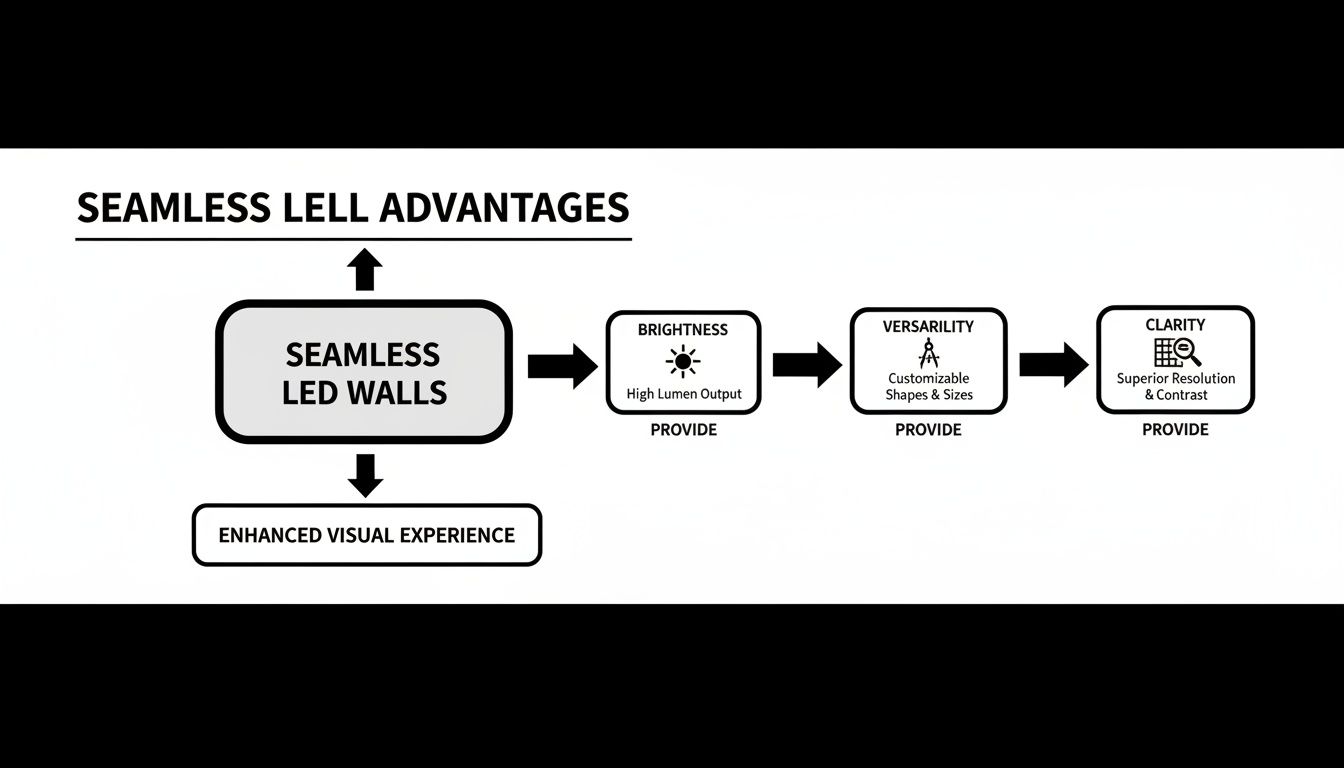
A concept map showing how LED displays drive engagement, offer modularity, and create impact for trade shows.

This graphic breaks down the benefits of modern LED displays, showing how the tech directly creates more engagement and impact through its modular design. The real takeaway here is that every technical part of an LED display is built to solve a specific problem for exhibitors, from grabbing attention to making setup easier.

Why Pixel Pitch Is the Key to a Flawless Image

Think of pixel pitch as the resolution of your video wall. It’s simply the distance, in millimeters, from the center of one tiny LED light to the center of the next. A smaller pixel pitch number means the LEDs are packed more densely together.

Why this matters: Tightly packed LEDs create a higher-resolution image. The result is a picture that’s incredibly sharp, smooth, and clear—even when people walk right up to it. This is absolutely essential for making a professional impression.

A lot of rental providers offer a 2.5mm pixel pitch as their standard. While this might look okay from across the aisle, it can start to look grainy or pixelated as potential customers get closer to your booth. That’s not the high-end experience you want to give them.

This is exactly why we’ve made a much higher-quality 1.9mm pixel pitch our standard. Our video walls have a higher resolution, delivering a visibly sharper, more detailed picture that holds up under close inspection, ensuring your brand and content always look their absolute best.

Brightness That Overcomes Any Lighting Condition

Trade show halls are known for their blindingly bright lighting, with thousands of lights all competing for attention. A regular TV or a cheap LED screen will look washed out and dull, making your expensive content practically invisible. This is why you need to pay close attention to brightness, which is measured in nits.

  • What are nits? A nit is just a unit of measurement for how bright a screen is. A higher nit value means a brighter display.
  • Why it’s crucial: For a trade show, you need a display that can hit at least 1,000 to 1,500 nits to cut through all the ambient glare and make your colors pop. This ensures your display stays vibrant and eye-catching from every angle.

A bright, powerful display acts like a beacon, pulling people toward your booth while your competitors with dimmer screens just fade into the background.

Keeping Your Content Camera-Ready with Refresh Rate

In today’s social media world, your booth isn’t just for the people there in person; it’s also for the thousands who will see it online. When someone pulls out their phone to take a picture or video of your amazing display, the last thing you want are ugly black lines or flickering that ruin the shot.

This is where refresh rate, measured in Hertz (Hz), comes in. It’s how many times per second the screen redraws the image. A low refresh rate is invisible to the naked eye but is easily picked up by a camera lens.

A high refresh rate (usually 3840Hz or higher) makes sure your display looks perfectly smooth and flicker-free on camera. This encourages attendees to capture and share content from your booth, which multiplies your reach far beyond the trade show floor. If you’re wondering how these specs affect different screen dimensions, you can learn more about how to choose from various video wall sizes.

Finally, figuring out the costs shouldn’t be a headache. Our all-inclusive pricing is designed to be completely transparent. We bundle everything into one clear price; the only things not included are the bills the show sends you directly, like for electricity. This means no surprise fees for shipping, setup, or support, so you can budget with total confidence.

Connecting Your Booth to Business Benefits

A modern LED display booth at an exhibition, with three men observing the screens and branding.

While all the technical specs for LED display boards are good to know, what really matters is how they help your business. A slick-looking display is nice, but it’s really a tool for grabbing attention, getting your message across, and making your life a whole lot easier on the show floor. When you add it all up, it directly impacts your bottom line.

These benefits all work together. They can turn your booth from just another stop on the aisle into a space that actively pulls people in and starts conversations. Let’s look at how the technology drives real ROI.

Command Attendee Attention and Drive Foot Traffic

Think about a typical B2B exhibitor trying to launch a new software product. Their old booth probably had a few static banners loaded with text. To understand anything, an attendee would have to stop and read, which almost never happens. Most people just walk right by, lost in the noise of the show.

Now, imagine that same booth with a massive, seamless LED video wall. It’s cycling through a high-energy product demo, quick cuts of customer testimonials, and maybe even an interactive poll people can join from the aisle. The motion and brightness act like a beacon, pulling people in from across the hall. This is the biggest benefit of a great display—it earns you the first five seconds of someone’s attention. That’s often all you need to get a real conversation started.

Achieve Unmatched Content and Creative Flexibility

Traditional banners and printed signs lock you into one message for the entire show. With modular LED panels, you’re free from all that. You can change your content on a whim, and you can build your booth in shapes that just weren’t possible before.

This creative freedom lets you do some amazing things:

  • Tell a Dynamic Story: Instead of one static graphic, you can run a whole playlist. Show off product features in the morning, switch to case studies in the afternoon, and then run an ad for your happy hour event later in the day.
  • Build Architectural Statements: Since the LED panels are the structure, you can create displays that become part of the booth itself. Think about flowing arches, towering video columns, or even wrapping your reception desk in video. Now that’s memorable.

This level of flexibility turns your booth from a simple backdrop into a storytelling platform. It empowers you to tailor your messaging on the fly and create a physical presence that is as unique as your brand.

Gain Significant Logistical and Budgetary Efficiencies

Here’s the benefit most people overlook: the huge logistical advantage. Old-school displays are often heavy, a pain to ship, and require a ton of labor and specialized tools to set up. That leads to sky-high costs for shipping, drayage (the fee for moving your stuff around the venue), and installation.

Modern LED systems are designed to fix this. Our systems use lightweight panels that just snap together with a tool less locking system. This design cuts setup time, reduces the chance of things going wrong, and slashes your labor needs. The market for these efficient solutions is exploding, hitting USD 8.96 billion in 2023. Modular LED booths are a big reason why—they can reduce drayage costs by 30-40%. That frees up a lot of money you can use for other parts of your marketing. To get a better sense of this trend, you can explore detailed LED market research reports.

Making the Right Choice Between Renting and Buying

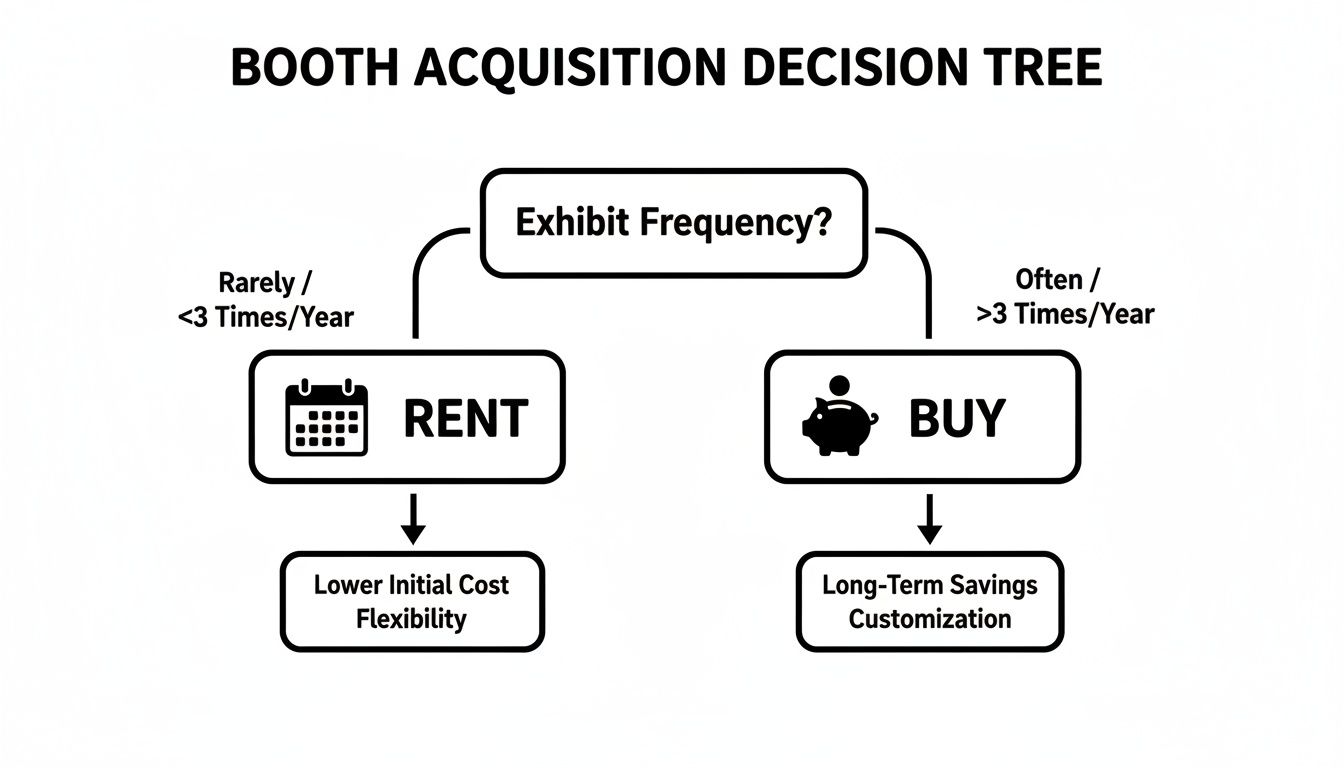
Deciding whether to rent or purchase your LED display board is a major strategic call for your trade show program. This isn’t just about the budget; it’s a decision that ripples through your logistics, brand image, and long-term return on investment. To make the right choice, you need a simple framework that lines up with your company’s actual exhibiting goals.

The good news is, it doesn’t have to be a complicated decision. By asking a few direct questions, you can figure out which path makes the most sense. It really boils down to how often you exhibit, what resources you have, and your bigger event marketing picture.

The Smart Case for Renting an LED Display Board

For a lot of exhibitors, renting is the perfect way to get into the game. It lets you test the waters with a high-impact digital display, make a huge splash at a key event, and see how the tech affects your lead gen—all without a huge capital investment upfront.

Renting is probably your best bet if you find yourself nodding along to these points:

  • Do you exhibit at just one or two major shows a year? If your trade show calendar is light, renting gives you all the “wow” factor without the hassle of owning and storing the equipment year-round.
  • Are you trying to make a massive impression for a specific product launch or must-win event? A rental lets you go all-out for that one show that truly matters.
  • Do you lack the in-house team to store, ship, and manage the display? Ownership comes with real logistical work. Renting hands all of that off to your vendor partner.

Our turnkey rental options are built to make this powerful tech accessible for everyone, even if you’re working with a smaller booth. We have complete solutions for compact 10-foot spaces, proving you don’t need a massive footprint to create a knockout experience. You can see how flexible these options are by checking out our guide on LED video wall rental solutions.

When Purchasing Becomes a Strategic Investment

Once your trade show schedule starts getting busy, the financial and strategic upside of owning your own LED display board system becomes crystal clear. Buying turns the display from a show-by-show expense into a valuable company asset that pays for itself over time.

Buying is the smarter long-term play if your team agrees with the following:

  • Do you attend three or more shows every year? At this frequency, the total cost of renting can quickly add up and even surpass the purchase price, often within just a few events.
  • Is brand consistency across all events a huge priority? Owning your display ensures your booth looks and feels the exact same at every show, hammering home your brand identity.
  • Do you have the resources to handle storage and logistics? If you have a team or a partner who can manage the gear between shows, ownership becomes a smooth, cost-effective operation.

The breakeven point is often the key. A simple calculation can show you exactly how many shows it takes for purchasing to become cheaper than renting. That number makes a powerful argument for the long-term ROI.

To help you visualize this choice, here’s a straightforward comparison:

Renting vs Buying Your LED Display Board System

Consideration Best for Renting Best for Purchasing
Exhibiting Frequency Fewer than 3 shows per year 3 or more shows per year
Upfront Cost Low, treated as an operational expense High, a one-time capital investment
Long-Term ROI Lower, you’re paying for convenience Higher, asset pays for itself over time
Brand Consistency Varies by vendor and availability Guaranteed, you own the exact same setup
Logistics & Storage Handled entirely by the rental vendor Your responsibility (or a partner’s)
Customization Limited to vendor’s inventory Total freedom to build a unique system
Technology Upgrades Access to the latest tech each time Requires a new purchase to upgrade

This table should make it pretty clear which path aligns with your company’s current situation and future ambitions.

Our Commitment to Quality and Transparency

Whether you rent or buy, the quality of the technology and the clarity of the pricing are everything. Plenty of vendors out there will offer you displays with a standard 2.5mm pixel pitch. This might look okay from a distance, but up close, it can look grainy and cheap—undermining the professional image you’re trying to project.

Frankly, your brand deserves better. That’s why we only provide a 1.9mm pixel pitch for our video walls. This higher resolution delivers an image that is noticeably sharper and crisper, looking absolutely flawless even when attendees are standing just a few feet away.

On top of that, we’ve built our business on transparent, all-in pricing. Our quotes include everything you need for a successful show. The only costs not included are the direct show service bills for things like electricity and drayage. You won’t get hit with surprise fees for shipping, setup, or on-site support. This lets you budget with 100% confidence and avoid the hidden costs that trip up so many exhibitors.

Designing Content That Captures and Converts

A modern exhibition booth with a large LED display showcasing a black tech product and staff members.

A brilliant LED display board is really just an empty canvas. It’s the content you put on it that does all the heavy lifting. On a chaotic trade show floor, your visuals have just seconds to stop people in their tracks. Good content design isn’t about being the loudest; it’s about being the clearest and most interesting.

You have to live by the “five-second rule.” That’s about how long you have to get your main point across to someone walking by. If your message is buried in a wall of text or a confusing graphic, they’re already gone. Your content has to make a powerful first impression from clear across the aisle.

Master the Five-Second Rule

To grab that instant attention, your content needs to be crystal clear and pack a visual punch. The whole point is to make your main message understandable in a single glance.

Here’s how you pull it off:

  • High-Contrast Visuals: Stick with bold color palettes and make sure there’s strong contrast between your background and what’s in front. This keeps your content readable and eye-catching, even under the weird, bright lights of a convention hall.
  • Minimal Text: Keep the words on screen to a bare minimum. Focus on a single, powerful headline or a few benefit-focused bullet points. Full sentences are the enemy of engagement here.
  • Dynamic Motion: Use smooth, professional motion graphics to draw the eye. Subtle animations and slick transitions bring a sense of life that a static image just can’t compete with.

Your LED display board should be a powerful magnet for foot traffic. This starts with creating content that is visually striking and instantly digestible, turning passive glances into active interest.

Design for the Loop

A trade show display isn’t a movie that plays once; it’s a continuous loop that tells your story over and over. “Designing for the loop” means creating a seamless cycle of content that can catch someone’s eye whether they see it for five seconds or two minutes.

Your content should rotate through a few different types of visuals to keep things fresh and achieve different goals. A solid loop strategy includes:

  1. Ambient Branding: This is your visually rich, low-information content, like an animated logo or abstract brand graphics. It sets the mood and makes sure the screen never feels dead.
  2. Product Spotlights: These are short, high-impact clips showing your product in action. Think dynamic product demos, 3D renderings, or quick-cut highlights of key features.
  3. Clear Calls to Action (CTAs): This is the final piece of the puzzle. These screens need to tell attendees exactly what you want them to do next—”Ask for a Live Demo,” “Scan to Win,” or “Talk to an Expert.”

When you integrate the LED wall into your booth’s overall design, it becomes a natural part of the experience. It shouldn’t feel like a TV tacked onto a wall; it should feel like the vibrant, beating heart of your entire exhibit.

This approach is a huge reason the LED modular display market is exploding. It was valued at USD 7.08 billion in 2023 and is projected to hit USD 24.88 billion by 2033. This growth is all about exhibitors creating immersive spaces that pull in way more visitors and build real brand connections. You can dig into the specifics in the latest market analysis on LED modular displays.

Calculating the True Cost and ROI of Your Display

Let’s talk numbers. When you’re investing in a high-impact trade show booth, you need to know the full cost and, more importantly, how you’re going to measure your return. The price tag on LED display boards can seem complicated, but a good partner will make it totally straightforward and predictable. That’s how you build a solid business case for the investment.

The first step is cutting through the confusing pricing structures. You’ve probably seen it before: a vendor gives you a low initial quote, only to pile on extra fees for shipping, installation labor, tech support, and content management later on. These surprises can blow up your budget and cause a lot of last-minute stress.

Our Transparent LED Display Boards All-Inclusive Pricing

We do things differently with a radically simple and transparent pricing model. Our quotes are all-inclusive, bundling every single critical component into one clear number. This covers the display hardware, shipping, all the setup and teardown labor, and even dedicated on-site support for the entire show.

Our price includes everything except for the show bills you for directly. This approach means no hidden fees and no surprises, so you can budget with complete confidence.

This is a world away from competitors who love to nickel-and-dime their clients with unexpected add-ons. We also make sure you get superior technology for your money. While others might supply a standard 2.5 pitch display, which can look blurry and pixelated up close, we provide a much higher-resolution 1.9 pitch video wall. Our video walls have a higher resolution, meaning your content simply looks sharper and more professional, reflecting the quality of your brand from any distance.

Calculating Your Return on Investment

Getting your leadership team to sign off on the expense requires more than just a cool-looking display; it requires data. Calculating the ROI of your LED display board is all about tracking the right things to prove it was worth it.

A basic ROI formula is a good place to start:
(Gain from Investment - Cost of Investment) / Cost of Investment

To figure out the “Gain from Investment,” you need to track key performance indicators (KPIs) that connect the display to real business results. Focus on things you can actually count, such as:

  • Increased Booth Traffic: Use badge scanners or simple people counters to measure how many more visitors you got compared to previous shows without the video wall.
  • Lead Quality and Quantity: Don’t just count the leads; look at their quality. Did the dynamic display attract more of the right kind of prospects?
  • Social Media Mentions: Keep an eye on your brand’s hashtags and mentions. How many attendees are snapping photos and videos of your booth and sharing them online?
  • Post-Show Brand Recall: Send out follow-up surveys asking prospects what they remember most about your booth. A memorable display directly boosts how well they remember you.

By tracking these metrics, you can confidently show how a dynamic display turns into real business growth. If you want to dig deeper into this, you can learn more about how LED exhibit booths can increase ROI at trade shows.

Common Questions About Our LED Video Walls

When you start digging into video walls for your next trade show, a few questions always pop up. Let’s get right to them so you know exactly what you’re getting into.

What Makes Your Video Walls Higher Resolution?

The sharpness of a video wall all comes down to its pixel pitch—that’s simply the distance between each tiny LED light. A lot of our competitors use a standard 2.5mm pixel pitch, which is fine from a distance, but can look a little blocky or pixelated when people get close to your booth.

We only use a much tighter 1.9mm pixel pitch. This means the LEDs are packed together more densely. The result? Our video walls have a higher resolution, creating a super sharp image that looks crisp and flawless, even when an attendee is standing just a few feet away. It’s the difference between a “good enough” display and one that truly makes your brand look top-tier.

What’s Included in the Price?

Getting a quote for a trade show booth can be a real headache. So many companies hit you with surprise fees for shipping, setup, or technical help later on. We don’t play that game. Our pricing is straightforward and all-inclusive because we believe in total transparency.

Our price includes everything except the show bills you for directly. This covers the high-resolution LED panels, all the shipping costs, the complete setup and dismantle labor, and an on-site technician.

This way, you can actually budget with confidence. No nasty surprises, guaranteed.

How Difficult Is Setup and Teardown?

You’d be surprised how simple it’s become. Our modular LED panels are designed to go up fast, without any special tools. They literally snap together with high-powered magnets and secure locks. This cuts down on labor time and costs significantly. A small crew can have a full booth built in just a couple of hours.

What Support Is Included?

A good vendor is a partner, not just some company that drops off equipment. We provide full-service support, just like an agency would. We can help with everything from brainstorming the initial concept and content strategy all the way through handling logistics and being on-site to fix any issues. Our whole goal is to manage the technical stuff so you can focus on what you’re there to do: talk to your customers.


Ready to make a real impact at your next trade show with a stunning, high-resolution video wall? The team at LED Exhibit Booths is here to make it happen with clear pricing and expert support.

Explore our turnkey rental and purchase solutions today.