
Interactive trade show displays do one thing really well: it turns someone just walking by into someone who stops and plays. Instead of a passive sign, these booths use tech like LED video walls, touchscreens, or even motion sensors to create a hands-on experience. The goal is to be memorable, get people engaged, and ultimately, capture better leads.
Why Static Booths Get Lost in the Crowd
Think about any trade show floor you’ve walked. It’s a loud, overwhelming blur of lights and sound, with dozens of companies all fighting for a few seconds of your time. Most of them use the same old playbook: a printed backdrop, a few banners, and maybe a bowl of candy. Of course, some will use a custom trade show booth. While that’s the standard approach, it’s like showing up with a flip phone at a smartphone convention—it just doesn’t make an impact.
In a sea of look-alike booths, these static displays just become background noise. Attendees stroll past, their eyes glazing over, and nothing really sticks. The whole experience is forgettable and does little to spark a real conversation.
This is exactly where an interactive trade show display completely changes the game. You’re not just telling people what you do; you’re inviting them to experience it firsthand.
From Passive Viewer to Active Participant With Interactive Trade Show Displays
Interactivity gives attendees a reason to stop, touch, and spend their time with you. It’s the difference between looking at a car in a brochure and actually getting to sit in the driver’s seat. An interactive element could be a game, a product configurator that lets them build their own version, or an immersive video that reacts as they move.
This kind of hands-on engagement gives you a few major wins:
- Increased Dwell Time: When people are busy doing something, they stick around longer. That gives your sales team a bigger window to start a good conversation.
- Better Brand Recall: We all remember what we do far better than what we just see. A fun, memorable interaction makes sure your brand is the one they’re talking about after the show.
- Deeper Product Understanding: Letting people explore your products or services on their own terms helps them see the value for themselves, making for a much more powerful connection.
The numbers don’t lie. The trade show industry is massive, expected to reach $171.6 billion by 2032, so standing out is non-negotiable. Here in the US, booths with interactive elements pull in 52% more visitors than static ones. Plus, that engagement leads to a 35% increase in dwell time and a huge lift in qualified leads. You can dig into more numbers in this report on trade show statistics.
Making High-Impact Interactive Trade Show Displays Accessible
It used to be that creating a truly immersive booth required a ton of complicated, heavy, and seriously expensive gear. Today, that’s all changed. Modern LED technology makes building incredible interactive trade show displays easier and more affordable than ever. With our unique system, your entire booth structure actually becomes the digital canvas.
We use video walls with a 1.9mm pixel pitch, which gives you a much higher resolution and a sharper picture than the 2.5mm pitch our competitors often use. What that means for you is your content looks incredibly crisp and professional, even when attendees are standing right up close. Best of all, our pricing is all-inclusive. The price we quote is the price you pay, covering everything except for what the show bills you for directly.
Exploring Interactive Trade Show Display Technologies
Picking the right technology for your interactive trade show displays is a bit like choosing the right tool for a job. A hammer isn’t great for a screw, and a simple tablet won’t create the same jaw-dropping effect as a massive video wall. Understanding your options is the first step to building a booth that works as hard as you do.
The most common interactive tools are standalone devices. Think tablets for one-on-one demos, large touchscreens where people can browse your product line, or self-service kiosks for lead capture. These are fantastic for focused, individual interactions, letting attendees explore at their own speed.
Then you have things like gamification. Turning your demo into a game with a live leaderboard is a surefire way to pull a crowd from the aisles and spark some friendly competition. Augmented Reality (AR) and Virtual Reality (VR) take things even further, creating immersive experiences that let people see your product in their world or step inside a virtual one.
Finding The Right Fit For Your Booth
Every technology has its place, and the best one for you boils down to what you’re trying to achieve.
- Touchscreens and Tablets: Perfect for letting attendees dig into detailed product catalogs, build custom configurations, or sign up for a newsletter. They’re direct, intuitive, and people already know how to use them.
- Gamified Demos: Use these to create a buzz. A simple, fun game that connects to your brand can do wonders for brand recall and get people excited about what you do.
- Augmented and Virtual Reality: AR and VR are your go-to for showing off products that are too big, too complex, or just too conceptual to haul onto the show floor. They create those powerful “wow” moments people remember.
This shift from a passive, static booth to a dynamic, interactive one is a huge leap in effectiveness. Plus, you can have a lightweight trade show booth with a TV monitor to keep costs down.
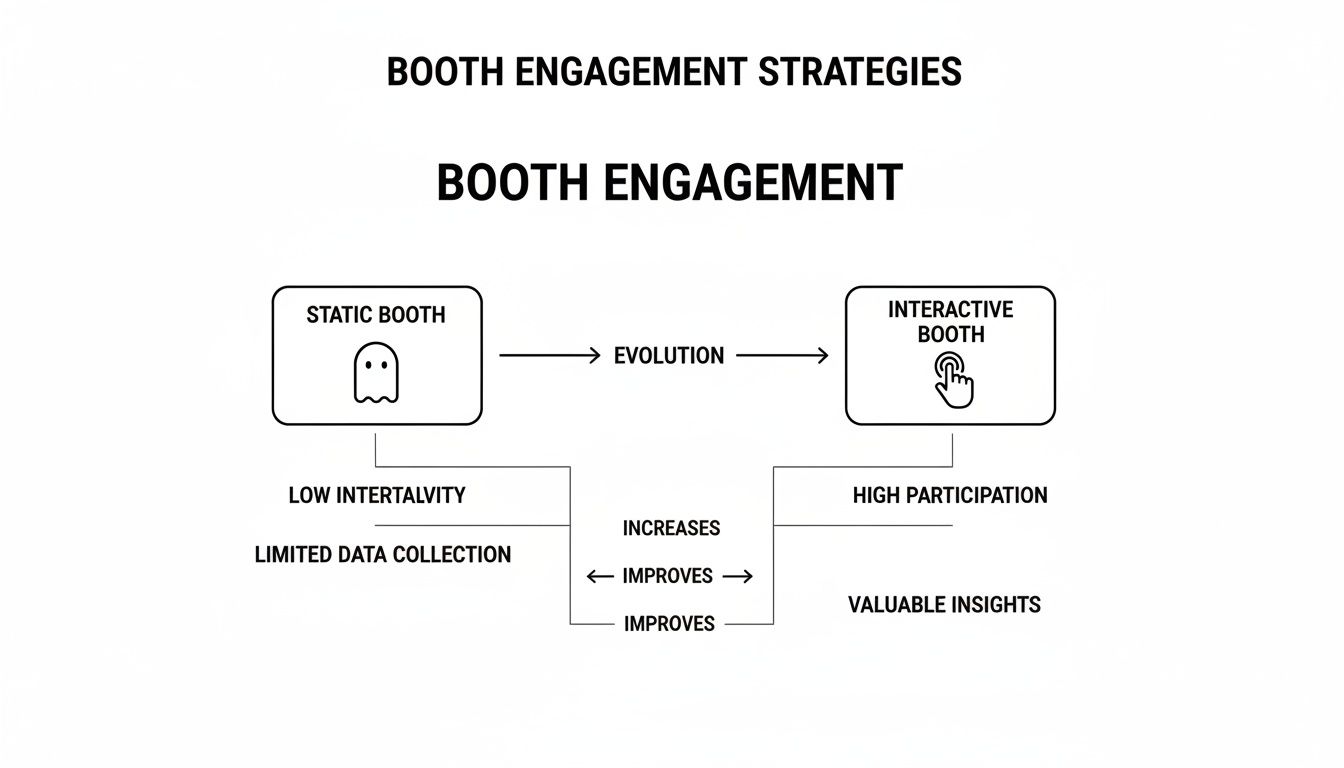
It’s about turning people who are just walking by into active participants. You’re not just showing them something; you’re giving them something to do.
Choosing the right technology can be tricky. Each has its strengths, weaknesses, and ideal applications. This table breaks down the most common options to help you decide.
Comparing Interactive Trade Show Displays Technologies
| Technology | Pros | Cons | Best For |
|---|---|---|---|
| Touchscreens & Tablets | Intuitive, great for detailed content, easy for data capture. | Limited to one-on-one or small group use, smaller visual impact. | Self-guided product catalogs, lead capture forms, personalized demos. |
| LED Video Walls | Massive visual impact, highly versatile, can unify all other tech. | Higher cost, requires more power and structural support. | Creating a high-impact, immersive booth environment that attracts from afar. |
| Augmented Reality (AR) | Memorable “wow” factor, great for product visualization, no headset required. | Requires attendees to use their own phones, app can be a barrier. | Demonstrating large or complex products in the attendee’s physical space. |
| Live Demos & Presenters | Human connection, can answer questions in real time, highly engaging. | Dependent on presenter skill, can only engage a limited number at a time. | In-depth product explanations, building rapport, and handling complex Q&A. |
While each of these has its place, the goal is often to create a single, seamless experience rather than a collection of separate activities.
The LED Video Wall: Your Interactive Hub
While all these technologies are effective, they often feel like separate islands in your booth. The ultimate solution brings them all together into one cohesive experience: an integrated LED video wall.
Imagine your entire booth structure isn’t just a static backdrop but a dynamic, digital canvas. That’s the power of a fully integrated video wall. It becomes the centerpiece, the main event, capable of hosting every other interaction you have planned. It’s not just a screen; it’s the entire environment.
With a video wall, you can guide attendees on a journey. First, a bold, motion-graphic animation grabs their attention from across the hall. As they get closer, the wall can prompt them to scan a QR code, launching an AR experience on their phone. Then, it can switch to a live presenter-led demo or display an interactive game for the crowd.
This approach creates a powerful, unified narrative. The video wall is the thread that ties everything together, guiding visitors through different levels of engagement within one stunning space.
Of course, the quality of that visual is everything. Many providers use a 2.5mm pixel pitch for their walls, but our interactive trade show displays are built with a 1.9mm pixel pitch. That smaller distance between pixels gives you a much higher resolution. Your videos and images will look sharper, clearer, and more professional—even when people are standing right up close. That premium look makes sure your brand message lands with maximum impact.
On top of that, our transparent, all-inclusive pricing means the quote you see is the quote you pay. We bundle all the hardware, logistics, and on-site support into one clear price. The only extra costs are what you pay the show directly for, like electricity and internet. This gets rid of surprise fees and makes budgeting a whole lot simpler. You can focus on creating an amazing experience, not worrying about hidden costs.
The Unmatched Advantage of Seamless LED Video Walls
When you decide to build your booth around an LED video wall, you’re doing more than just picking a display—you’re crafting an entire digital environment. This is where your brand’s story comes to life on a huge, dynamic canvas. But not all video walls are created equal. In fact, the tiny technical details can make a world of difference in how attendees see your brand.
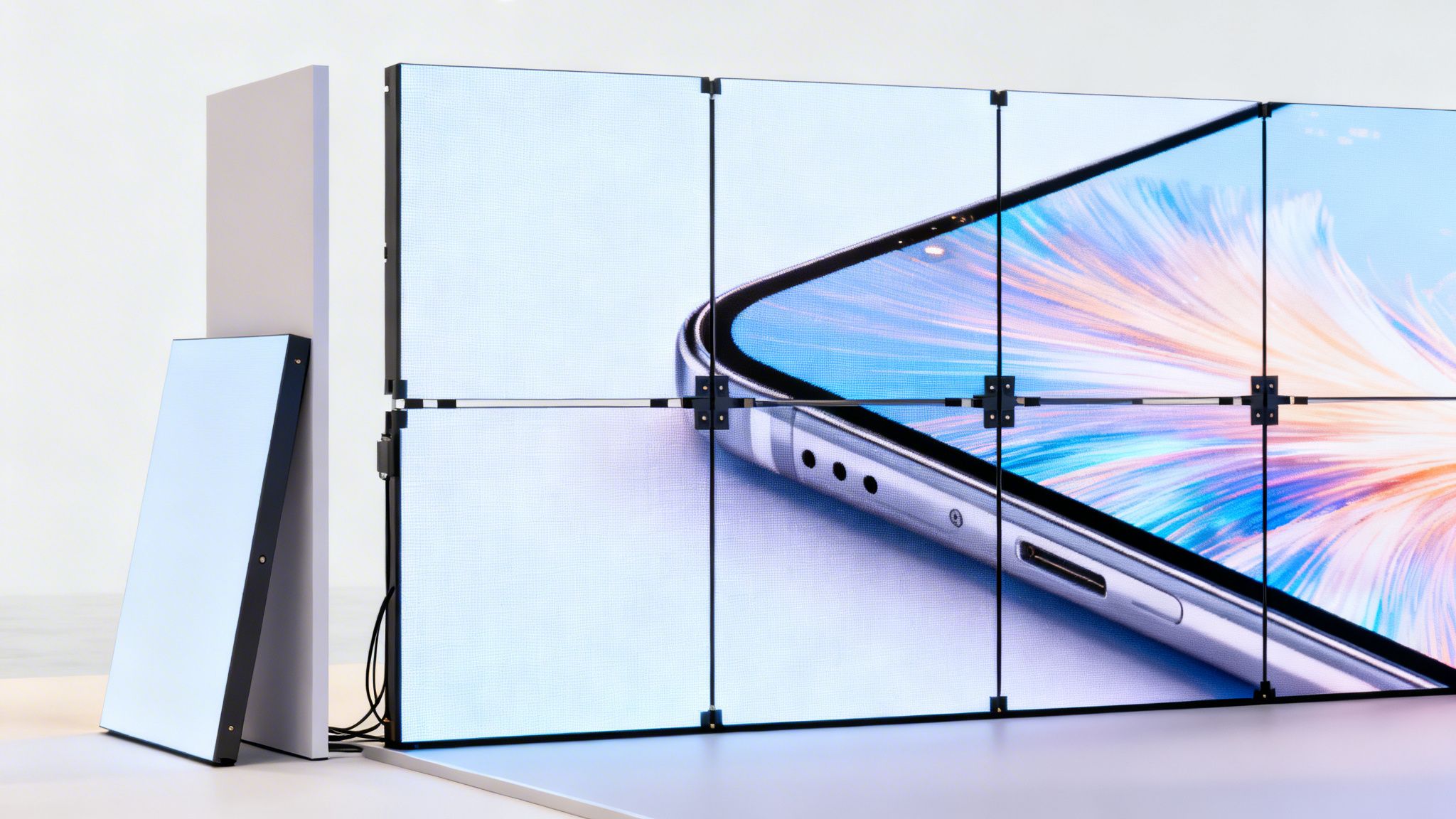
The heart of any great LED display is its visual clarity. The single most important factor here is pixel pitch—the distance between each individual LED on the screen. A smaller pixel pitch means the LEDs are packed tighter, creating a denser, more detailed picture. It’s like the thread count in high-end sheets; more threads per inch gives you a smoother, more luxurious feel.
Why a 1.9mm Pixel Pitch Is a Game Changer
Many providers use a standard 2.5mm pixel pitch. From a distance, it works. But for attendees standing right in your booth, it can look pixelated or grainy. Our interactive trade show displays are built with a 1.9mm pixel pitch, giving you a serious visual upgrade.
This means your videos and product shots will look dramatically sharper and more vibrant. For people who are right in your space, the image stays crystal clear. This communicates a sense of quality that reflects directly on your brand. It’s a premium detail that makes sure your message lands with maximum impact, no matter where someone is standing.
A Smarter Structure Built for the Real World
Beyond the screen quality, the physical construction of the booth itself is a critical advantage. Traditional video wall setups are often a logistical nightmare. They involve heavy trusses, complicated rigging, and a spiderweb of cables that need more time, more labor, and more money.
Our approach is different. The booth is the video wall. We use lightweight LED panels that serve as the actual building blocks of your exhibit. These panels snap together effortlessly with high-powered magnets and a toolless locking system.
This integrated design completely gets rid of the ugly bezels, messy wiring, and bulky support structures that ruin the visual experience. The result is a truly seamless digital canvas that wraps attendees in your content.
This smart construction isn’t just about looks; it helps your bottom line. Lightweight panels mean lower shipping and drayage fees, which are often a huge hidden cost. The toolless setup also slashes assembly time, so you’re not spending as much on expensive show floor labor. Plus, we can help with any type of Interactive Trade Show Displays.
Transparency in Pricing and Logistics
Speaking of costs, navigating trade show expenses can be a real headache. We believe in making the process as straightforward as possible. That’s why we include everything in our price except the bills you get directly from the show organizer.
This all-inclusive approach covers:
- The LED video wall hardware itself.
Programming of interactive trade show displays. - All necessary logistics, including shipping and handling.
- On-site technical support to make sure everything runs smoothly.
The only things not included are services like electricity and internet, which exhibitors have to order and pay for directly with the show. This transparency takes the guesswork and surprise fees out of your budget, letting you focus on what really matters—connecting with customers. Check out our guide to learn more about the specifics of our video display wall solutions.
Ultimately, a superior video wall isn’t just for showing content; it’s about providing a smarter, more efficient, and visually stunning foundation for your entire trade show strategy. These immersive canvases can increase engagement by 45%, while magnetic locking panel systems can slash shipping costs by 25% and dramatically reduce setup errors. It’s no wonder the market for interactive trade show displays is projected to grow from $52.27 billion in 2025 to $105.53 billion by 2035.
Designing Content That Captures and Converts

You can have the most stunning LED wall on the show floor, but if what’s on screen doesn’t connect, you’ve just got a very expensive, very bright paperweight. The secret is to stop thinking about your content as just a video on a loop. Instead, see it as a complete system designed to pull an attendee out of the aisle and turn them into a qualified lead.
A really effective way to do this is with the ‘Attract, Engage, Inform’ model. It’s a simple framework that breaks your content down into three jobs. This method is all about turning passive walkers into people who genuinely want to talk to you.
The Attract Stage: Your Visual Handshake
First things first, your interactive trade show display has to stop traffic. Cold. At this stage, your content is a visual magnet, pulling people in from the sea of competing booths. You need to be big, bold, and impossible to ignore.
This is your ‘Attract’ content. Its only job is to get eyeballs from a distance with high-energy visuals that make people curious. This is no time for subtlety.
Here are a few ideas for your Attract content:
- High-Impact Motion Graphics: Think fast-paced animations with your logo, brand colors, and a few powerful words.
- Cinematic Product Shots: Show your product in a dramatic, larger-than-life style. Make it look like a blockbuster movie trailer.
- Abstract Visuals: Sometimes, even non-branded, artistic patterns with wild colors and movement can be enough to draw the eye.
The goal is simple: make them stop walking and look your way. Once you have their attention, it’s time to reel them in.
The Engage Stage: Holding Their Attention With Interactive Trade Show Displays
Okay, they’ve stopped. Now what? You have to give them something to do. The ‘Engage’ stage is where the “interactive” part really kicks in. This is where you invite people to touch the screen, play a game, and connect with your brand themselves.
You’re trying to turn a passive viewer into an active participant. You want them to step up and physically interact with your display.
Think of this as the heart of your experience. You’re turning a one-way speech into a two-way conversation, letting people explore what you do on their own terms. That hands-on moment is what they’ll remember.
Effective ‘Engage’ content could be:
- Product Configurators: Let people build or customize a version of your product right on the screen.
- Interactive Quizzes or Polls: Ask some fun, industry-specific questions and show the results in real-time.
- Social Media Feeds: Pull in a live feed of posts using your event hashtag. It builds a sense of community right there in your booth.
The Inform Stage: Delivering Deeper Value
Once someone is actively engaged, they’re much more open to learning. This is the ‘Inform’ stage, where you offer up the good stuff—the in-depth content that explains the why behind what you do.
This content needs to be easy to find and self-guided. It lets interested folks dig deeper without having to grab a sales rep right away. It empowers them to essentially qualify themselves, which makes for a much better conversation when your team does step in. If you need help creating this kind of material, you can get some pointers from our guide on video wall video production.
Examples of ‘Inform’ content include:
- On-Demand Video Case Studies: Let attendees pick and watch success stories from customers they can relate to.
- Detailed Product Demos: Offer short, self-paced video tutorials that break down the key features.
- Expert Interviews: Provide access to quick video clips from your company’s leadership or other industry experts.
By layering your content this way, your interactive trade show display stops being just a screen and becomes a full-blown conversion funnel. It guides attendees from the aisle to your sales team, delivering people who are already educated and interested.
Navigating the Logistics of an Interactive Booth
Let’s be honest, thinking about the logistics of a high-tech, interactive booth can be a real headache. The whole process—from shipping and setup to teardown and billing—is often a maze of confusing charges, surprise fees, and logistical nightmares. Our goal is to cut through all that and give you a clear, stress-free path to a booth that works for your budget.
One of the biggest pain points we hear about from exhibitors is just trying to figure out the final cost. Traditional booth rentals often hit you with a tangled web of charges for hardware, shipping, and labor, leaving you to guess what the final bill will be. We do things differently with a transparent, all-inclusive pricing model.
When we give you a quote, it covers the display hardware, all the shipping and logistics, and on-site support. The only things not included are the services the show organizer bills you for directly, like electricity and internet. This straightforward approach means no hidden fees, which builds trust and lets you budget with absolute confidence.
Decoding Display Quality and Cost Savings
When you’re looking at an interactive booth, the visual quality is every bit as important as the price. We use video walls with a 1.9mm pixel pitch, and that small detail makes a huge difference. A lot of competitors use a 2.5mm pitch, but our smaller pitch means the individual LEDs are packed much closer together. The result? A much higher-resolution image that looks sharp and professional, even when people are standing right up close.
Beyond the visuals, our entire system is designed to save you money on logistics. Our booth structures are built from lightweight, magnetic LED panels that literally snap together without any tools. This design directly attacks two of the biggest and most unpredictable expenses at any trade show: drayage and labor.
- Reduced Drayage Fees: Drayage, the fee for moving your materials from the loading dock to your booth space, is billed by weight. Our lightweight panels can slash those costs compared to heavy, old-school booth structures.
- Lower Labor Costs: Because the assembly is toolless and magnetic, it’s incredibly fast. A quicker setup means fewer hours you have to pay for expensive on-site union labor, putting that money right back in your pocket.
The global interactive display market is set to explode from $18.17 billion in 2025 to a projected $30.22 billion by 2030. For exhibitors, the ROI of this technology is clear: LED booths with toolless, magnetized panels can slash setup time by 50%, a critical efficiency in a competitive landscape with over 52,000 event planning firms. Discover more insights on this booming market in this detailed industry report.
A Clear Roadmap from Start to Finish
Our main goal is to make the entire process so seamless that your team can focus on what they do best—talking to potential customers. By handling the logistical headaches and providing a better-looking product, we help you get the most out of your event investment.
This combination of transparent pricing and smart logistical design gives you a clear and predictable path to a successful show. You get a booth that not only looks superior but is also smarter, faster, and cheaper to get on the show floor. For more details on the practical benefits, take a look at our guide on LED video wall rental solutions.
Measuring the ROI of Your Interactive Display
So you’ve invested in a high-impact, interactive trade show display. It’s a big decision. But after the show lights go down and the last crate is on the truck, you have to prove it was a smart one. How do you measure success when just counting badge scans doesn’t cut it?
The real key is connecting what happens at your interactive display directly to your business goals. Justifying the spend starts with tracking the right stuff. Of course, lead count is a number everyone wants to see, but interactive tech lets you dig so much deeper. You can actually gather data on how people are behaving in your space, which gives you a much richer picture of how your event really went.
Key Metrics to Track
To get to the real value of your interactive booth, you need to focus on metrics that measure how engaged people are and how much influence you had.
- Dwell Time: How long are people actually sticking around in your booth? You can use sensors and analytics to track this. It shows if your content is grabbing and holding their attention. The longer they stay, the more chances your sales team has to start a conversation.
- Interaction Rates: This one’s simple. How many people are actually touching the screen, playing your game, or messing with the product configurator? This metric is direct proof that your display is pulling people in and getting them to participate.
- Lead Quality: You have to look past the sheer number of leads and figure out how good they are. Interactive software can log which products or case studies a specific person looked at. This is gold for your sales team—it helps them prioritize follow-ups with the prospects who are already highly interested.
Tying Metrics to Business Outcomes
Once you have this data, the next step is connecting it to what really matters: business outcomes. This is how you build a rock-solid case for the money you spent. For instance, divide your total booth cost by the number of high-quality leads you generated. Now you have a much more accurate cost per qualified lead.
You can also measure the impact on your brand awareness. A simple post-show survey can ask attendees if they remember your brand. A memorable interactive experience is a great way to make sure your company stands out from all the noise.
Remember, the goal here is to get past the vanity metrics. A high interaction rate is great, but its true value is only clear when you can show it led to more meaningful sales conversations and a lower customer acquisition cost than you had at previous shows.
This data-driven approach isn’t just about justifying what you’ve already spent; it gives you a clear roadmap for what to do next. You can see exactly which interactive elements and content pieces worked best, letting you refine your strategy and make even smarter choices for your next show.
An interactive trade show display isn’t just a pretty centerpiece—it’s a powerful data collection tool that helps you get better and better.
Answers to Your Questions About Interactive Displays
When you’re gearing up for a big show, you’ve got a million decisions to make. Deciding to ditch a static booth for an interactive trade show display can bring up a lot of questions. We get it.
Here are the straight answers to the most common questions we hear from exhibitors. We want you to have the confidence to make the right call for your brand.
How Much Does an Interactive LED Video Wall Booth Cost?
Costs can vary, of course, depending on the size and complexity you’re after. However, our all-inclusive model is built to be surprisingly cost-effective.
Our pricing wraps up the hardware, shipping, setup, and on-site support into one number. No hidden fees, no surprises. The only things you handle separately are the direct show services like electricity and internet, which you’ll arrange with the show organizer.
Because our system is lightweight and toolless, it slashes shipping weight, drayage fees, and labor hours. The total investment is often a lot more competitive than you’d think. We can build anything from a compact 10-foot booth to a massive custom exhibit to match your budget.
What Makes Your Video Wall Resolution Better?
The secret to a sharp, professional-looking video wall is something called pixel pitch. It’s just the distance between each tiny LED bulb. A smaller number means the bulbs are packed tighter, creating a much clearer, higher-resolution picture.
Many competitors use a standard 2.5mm pixel pitch, which can look a little grainy or pixelated when you’re up close. We use a 1.9mm pixel pitch, which delivers a dramatically sharper and more vibrant image. It’s a premium feature that makes a huge difference.
This ensures your branding and product shots are crystal clear, even for attendees standing right at the booth. That superior quality reflects directly back on your brand.
Is the Technology Hard to Run During the Show?
Not at all. Your team needs to be talking to customers, not messing with tech. We designed our service to be completely turnkey so you never have to worry about the technical stuff.
We handle the entire setup and teardown and provide on-site support. Our technicians make sure all your content is loaded, tested, and running perfectly before the show doors ever open. The systems are built to be rock-solid, freeing up your team to do what they do best: build relationships and close deals.
What Kind of Content Works Best on a Video Wall?
The best content strategy is a layered one that takes attendees on a little journey. Think of it in three simple stages: attract, engage, and inform.
- Attract: From the aisle, you need to stop traffic. Use big, bold motion graphics and eye-catching cinematic video to grab their attention and make them turn their heads.
- Engage: Once they’re at your booth, give them something to do. Interactive product demos, fun quizzes, or games will hold their attention and get them involved.
- Inform: For visitors who want to dig deeper, provide on-demand content. Think video testimonials, detailed case studies, or product walkthroughs they can explore themselves.
Our team can help you map out a content plan that uses this model to hit your show goals and spark those important conversations.
Ready to transform your trade show presence with a booth that stops traffic and starts conversations? The team at LED Exhibit Booths is here to help you design an immersive, high-impact experience that delivers real results. Explore our turnkey solutions and see how we make world-class interactive displays accessible for any exhibitor. Visit us at https://ledexhibitbooths.com to get started.