

Furniture for trade shows usually become urgent the week before a show, when someone realizes the rental stools don’t match the brand, the reception counter has nowhere to hide chargers, and the product pedestal blocks the screen everyone paid to showcase. That’s when furniture stops being a line item and starts affecting traffic, conversations, and credibility.
We see the same pattern across exhibit programs. Teams spend months on graphics, demos, and sales prep, then treat the booth’s physical environment like a checklist. The result is a booth that functions against them. Visitors hesitate at the edge, staff have no clean place to meet, and cables, bags, and literature end up visible from the aisle.
Good furniture for trade shows fixes that. It gives visitors a reason to step in, supports the kind of conversation you want to have, and makes your space feel intentional instead of improvised. That matters in a category where visual sameness is common and buyers move fast.
Beyond Chairs and Tables Why Your Furniture for Trade Shows Strategy Matters
A familiar scene plays out on setup day. The booth looks strong on the rendering, but the actual furniture arrives as a pile of compromises. A heavy laminate counter eats up the front corner. Two lounge chairs sit too deep in the footprint and create a dead zone. The storage cabinet lands where a product demo should happen. By opening morning, the team has a booth, but not a working environment.
That’s the mistake. Furniture for trade shows isn’t only about giving people a place to sit. It shapes movement, frames conversations, holds product, hides clutter, and signals what kind of company you are before anyone says a word.
The broader market tells the same story. The global furniture market reached USD 786.13 billion in 2025 and is expected to grow to USD 1,334.08 billion by 2033, according to VIFA ASEAN’s overview of major furniture fairs. At the event level, that pressure to stand out gets even sharper. The same source notes that High Point Market draws over 75,000 visitors, which means exhibitors compete in an environment where small design decisions have outsized consequences.
What furniture actually does on the show floor
The right furniture changes booth behavior in practical ways:
- Guides entry: Low-profile front pieces invite people in. Bulky front pieces stop them at the aisle.
- Supports selling: A standing-height counter works for quick qualification. Lounge seating supports longer discussions.
- Improves product focus: Pedestals, shelves, and demo surfaces tell attendees where to look first.
- Protects brand perception: Worn rentals, mismatched finishes, and exposed clutter make a premium brand look unprepared.
Furniture should solve a booth problem. If a piece doesn’t improve flow, comfort, storage, or storytelling, it’s decoration.
That’s why we recommend planning furniture at the same time as graphics, demos, and staffing. If you’re already reviewing general trade show trends for 2026, add furniture strategy to that same planning conversation rather than leaving it to an event decorator at the end.
Why furniture and displays have to work together
One of the fastest ways to weaken a booth is to separate furniture planning from product presentation. Teams choose a beautiful table set, then realize it blocks the hero message or competes with the main display. That’s especially common when the booth includes product showcases or freestanding display elements.
If your booth needs to merchandise physical samples, prototypes, or packaged goods, the furniture should support that objective, not compete with it. A smart starting point is to map furniture around the display system itself, especially if you’re using display stands for products as a core part of the visitor journey.
Choosing the Right Types of Furniture for Trade Shows
Not all furniture for trade shows plays the same role. The mistake isn’t choosing the wrong style first. It’s choosing pieces before deciding how the booth needs to function. Start with the job each area must do, then select the furniture category that supports it.
Seating that sets the tone
Seating changes the pace of interaction more than most exhibitors expect.
Lounge chairs tell visitors it’s acceptable to stay. They work well for consultative selling, partnership conversations, and booths where the goal is depth over volume. The downside is footprint. Oversized lounge seating can consume valuable square footage and make a compact booth feel full before anyone walks in.
Bar stools create a more active posture. They’re useful when you want short, efficient conversations and a clean visual line across the booth. They also pair well with charging counters or standing demo stations.
Task seating belongs behind workstations, kiosks, and consult desks. It’s practical, but it rarely adds much to the brand unless the workstation itself is central to the experience.
A simple rule helps here:
- Use lounge seating when privacy and longer dwell matter
- Use stools when throughput matters
- Use task chairs only where a specific function requires them
Counters and reception points
The reception counter is often the most overloaded furniture choice in the booth. Teams expect it to greet visitors, hide personal items, hold giveaways, support lead capture, and sometimes serve as a demo point too. That can work, but only if it’s sized and positioned correctly.
A strong counter should do three things well:
- Face the aisle clearly
- Provide concealed storage
- Leave room for staff to engage without creating a wall
Counters fail when they become barriers. If visitors have to lean over a large block to talk to your team, the booth starts to feel transactional. If your team needs tablets or interactive content at the front of the booth, integrated surfaces like touch screen tables can handle that role more effectively than a standard podium.
Demo stations and product surfaces
Demo surfaces need stability, visibility, and wiring logic. That sounds basic, but it’s where many booths break down. A beautiful table without cable planning becomes a visible tangle. A small pedestal may look elegant, but it can fail if staff need room for samples, literature, or a monitor.
Use different surface types based on the interaction:
| Booth need | Best furniture type | Common mistake |
|---|---|---|
| Quick product handling | Standing demo counter | Making it too deep |
| Detailed consultation | Seated meeting table | Using a low coffee table for paperwork |
| Premium sample display | Clean pedestal or shelf | Mixing too many heights |
| Self-guided exploration | Interactive station | No nearby storage for resets |
Storage that protects the front-of-house experience
Storage is usually the least glamorous decision and one of the most important. If there’s no lockable place for bags, literature overstock, chargers, cleaning kits, and staff water bottles, those items drift into sight by mid-morning.
Practical rule: If you can see staff supplies from the aisle, you don’t have enough storage.
For small footprints, hidden storage inside counters often works best. Larger spaces can justify a back-wall closet or enclosed cabinet zone. What matters is keeping operational materials out of the selling area.
Materials and finishes
Material choice communicates more than exhibitors think. Matte laminates tend to feel cleaner than shiny budget finishes under show lighting. Upholstery can soften a tech-heavy booth, but only if the color palette is disciplined. Wood looks warm, but lower-grade woodgrain prints can make the booth feel temporary.
Use finishes to support your brand, not to chase trends. If your message is precision, choose sharp lines and restrained palettes. If your category is hospitality or residential design, softer textures may make sense. Either way, consistency matters more than novelty.
How to Integrate Furniture for Trade Shows with High-Impact LED Booths
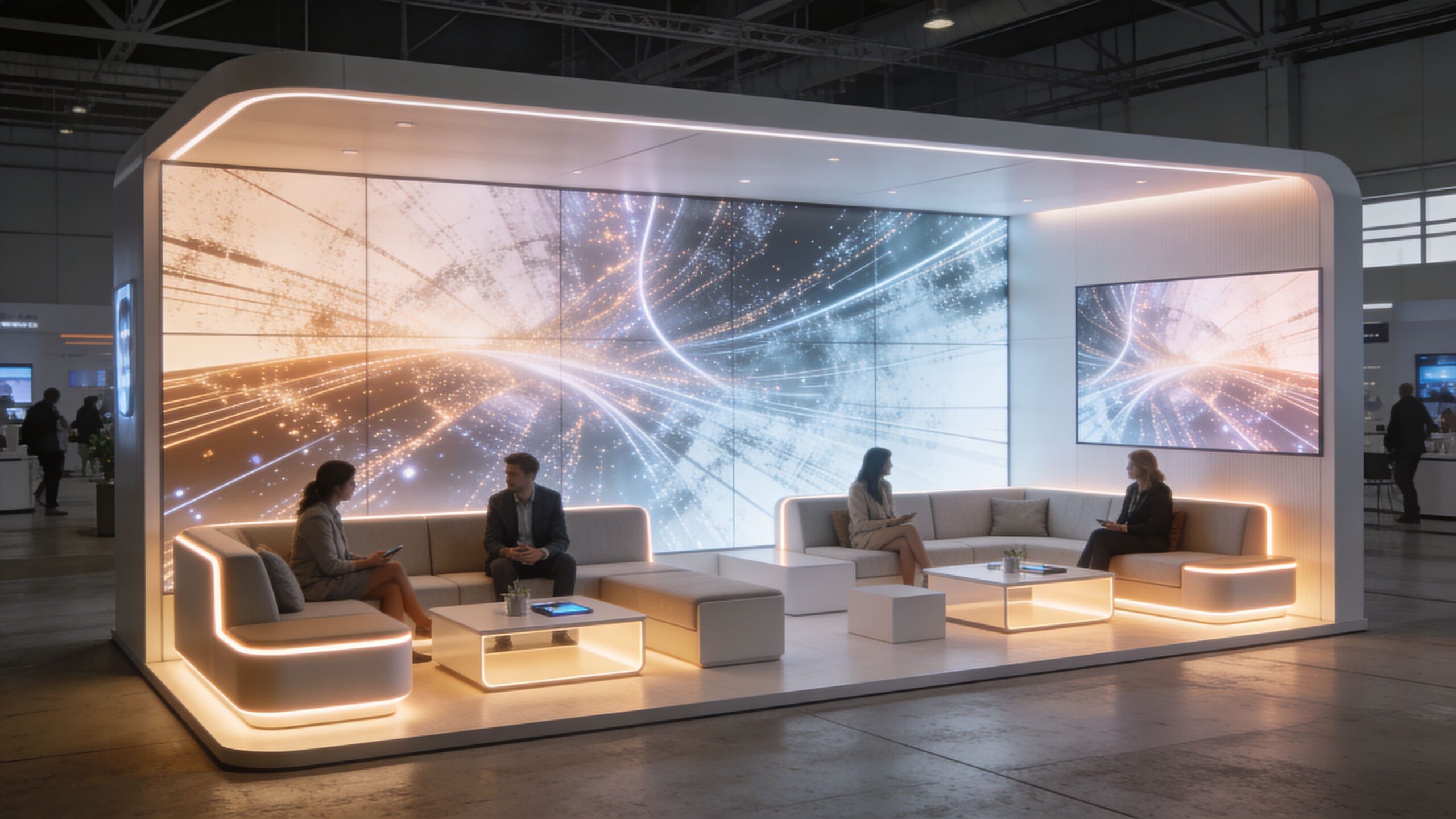
Most furniture for trade shows is still planned as if the booth graphics and the booth structure are separate things. That old model creates friction. The screen becomes one element, the counter becomes another, and the visitor experiences them as disconnected parts. The booth may contain technology, but it doesn’t feel integrated.
That gap shows up in practical ways. Furniture interrupts sightlines. Counters block content. Cables distract from the visual story. The result is a booth that asks visitors to process too many unrelated signals at once.
Why static furniture often weakens a digital booth
According to Novo Studio Events’ discussion of trade show furniture trends, most guidance around furniture for trade shows overlooks integration with immersive LED video walls. That same source notes a major gap in how furniture should be positioned to enhance video flow, and it reports that dynamic furniture-embedded LED counters boosted visitor dwell time by 35% based on client analytics from Q1 through Q4 of 2025.
That finding aligns with what we see in real booth planning. A booth performs better when the furniture is part of the visual system rather than sitting in front of it as an obstacle.
What integrated furniture looks like in practice
Integrated design usually works best in a few common forms:
- Reception counters beneath active LED surfaces: The counter handles check-in or lead capture while the wall above carries motion content, messaging, or product visuals.
- Low-profile demo counters under LED arches: This keeps the visual field open and lets the digital content frame the conversation.
- Embedded charging or interaction points: Visitors engage with the furniture while the surrounding content reinforces the message.
A strong example is using a video display wall as the architectural backdrop, then selecting furniture heights and placements that preserve continuous visual flow instead of slicing it into disconnected layers.
Resolution matters when the booth itself becomes the screen
If your booth uses LED as structure, pixel pitch matters because visitors stand close. Our standard pitch is 1.9, while many competitors offer 2.5. That means our video walls deliver higher resolution and a cleaner image at close viewing distances, which matters for product visuals, typography, motion graphics, and branded environments where people are only a few steps away.
That isn’t just a spec-sheet point. It affects whether text looks crisp, whether gradients look smooth, and whether your booth reads as premium or improvised.
The closer attendees get to your booth, the less forgiving low-resolution LED becomes.
Integration also changes the operational side
This approach isn’t only about aesthetics. It solves practical booth problems. When furniture and LED are planned together, cable pathways are cleaner, the layout is easier to stage, and setup tends to be more controlled because each piece has a defined role inside the system.
We also build around a white-glove, turnkey model. Our pricing includes everything except the charges the show bills exhibitors directly, such as electricity and material handling. That clarity matters because exhibitors often compare booth quotes without realizing how many services are excluded elsewhere. We also keep an audiovisual technician onsite the entire time the show is open, so if a content or hardware issue appears, help is immediately available.
Strategic Layouts in Furniture for Trade Shows and Compliance Rules
The layout usually breaks before the furniture does. A booth can be furnished well and still underperform if people hesitate at the edge, staff block the entry, or a tall piece violates show rules and has to be moved on site.
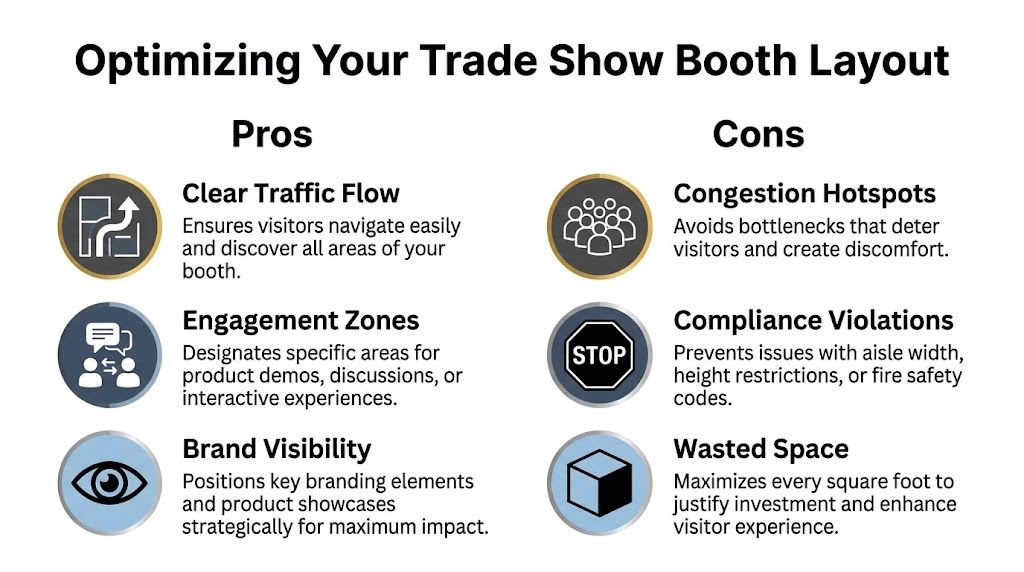
In LED booths, layout discipline matters even more. The screen draws attention fast, but furniture determines whether that attention turns into a conversation, a demo, or a bottleneck. I recommend planning the path first, then assigning furniture to support that path. Lounge seating, counters, charging tables, and storage should reinforce the visitor journey, not compete with the video wall for space or sightlines.
Start with traffic flow, then place furniture
Visitors should understand the booth in seconds. Where do they step in? Where do they pause? Where does a short conversation happen without blocking the aisle?
Those answers shape the furniture plan.
A practical layout usually follows a few rules:
- Keep the front edge open: Low-profile pieces at the aisle invite entry and let staff greet visitors without talking over furniture.
- Establish one main interaction zone: Put the primary demo, reception point, or product conversation area where attendees can see it immediately.
- Push support functions out of the way: Storage, literature backups, charging accessories, and staff bags belong behind the active zone, not beside the entry.
- Protect LED sightlines: Don’t place tall stools, shelving, or high-back seating where they cut into the screen’s visibility from the aisle.
That last point gets missed in traditional furniture guides. In a modern booth, the LED wall often carries your motion graphics, product visuals, and brand message. Furniture has to frame that content, not interrupt it.
Show rules shape furniture for trade shows layout more than exhibitors expect
Every venue and organizer publishes an exhibitor manual, and the details matter. Linear booths often have strict height limits and line-of-sight restrictions so neighboring exhibitors keep visibility into the aisle. Instructables’ guide to booth furniture compliance summarizes a common standard: rear height in a linear booth is typically limited to 8 feet, with lower height restrictions closer to the aisle.
That affects more than walls and signs. Tall shelving, decorative towers, oversized reception counters, and stacked product displays can all create compliance problems if they sit in the wrong zone. I have also seen exhibitors create a furniture issue accidentally by adding a branded backdrop behind a counter without checking how that element fits the footprint rules.
Review the official show manual before approving any piece that adds height, depth, or concealed storage. It is also smart to confirm freight timing and floor handling early, especially for heavier lounge pieces or integrated counters. This guide to trade show shipping and material handling planning helps teams avoid layout decisions that look fine in a render but create problems at move-in.
Accessibility has to survive the real booth, not just the rendering
Accessibility issues often show up after the final styling pass. A layout can appear open in a design file, then tighten up once sample cases, literature holders, bar stools, and attendee traffic enter the picture.
The ADA Standards for Accessible Design from the U.S. Department of Justice are the right reference point for clearance and accessible route requirements. For trade show furniture planning, the practical takeaway is straightforward. Maintain a clear route through the booth, leave enough turning and passing space near seating and counters, and avoid creating narrow pinch points at corners or entry points.
Use this check before signoff:
| Layout question | What to confirm |
|---|---|
| Seating area | Guests can enter, sit, and exit without moving chairs into the main path |
| Demo zone | Viewers can gather without blocking the accessible route |
| Counter placement | Staff interaction stays inside the booth footprint |
| Product displays | Corners and side walls do not create tight turns or dead ends |
Common mistakes that hurt performance
The mistakes are rarely dramatic. They are small planning decisions that add friction all day.
- Furniture loads the front of the booth: Attendees read the space as occupied before they enter.
- Meeting seating sits too far back: Staff miss early engagement opportunities and qualified visitors drift away.
- The booth has no working space: Samples, personal items, and literature end up visible because there is nowhere to reset.
- Furniture ignores the LED program: A chair cluster or counter blocks the screen, weakens content visibility, and shrinks the visual impact you paid for.
Good layout work is operational as much as visual. It improves traffic flow, keeps the booth compliant, and protects the investment in both furniture and LED structure. That is also part of the total cost of ownership. A cheaper furniture plan that causes rework, on-site changes, or poor traffic conversion usually costs more by the end of the show.
Renting vs Purchasing A Financial and Logistical Breakdown
The rent-versus-buy decision usually gets framed as budget only. That’s too narrow. The better question is how often you exhibit, how consistent your booth program is, and how much control you need over the final environment.
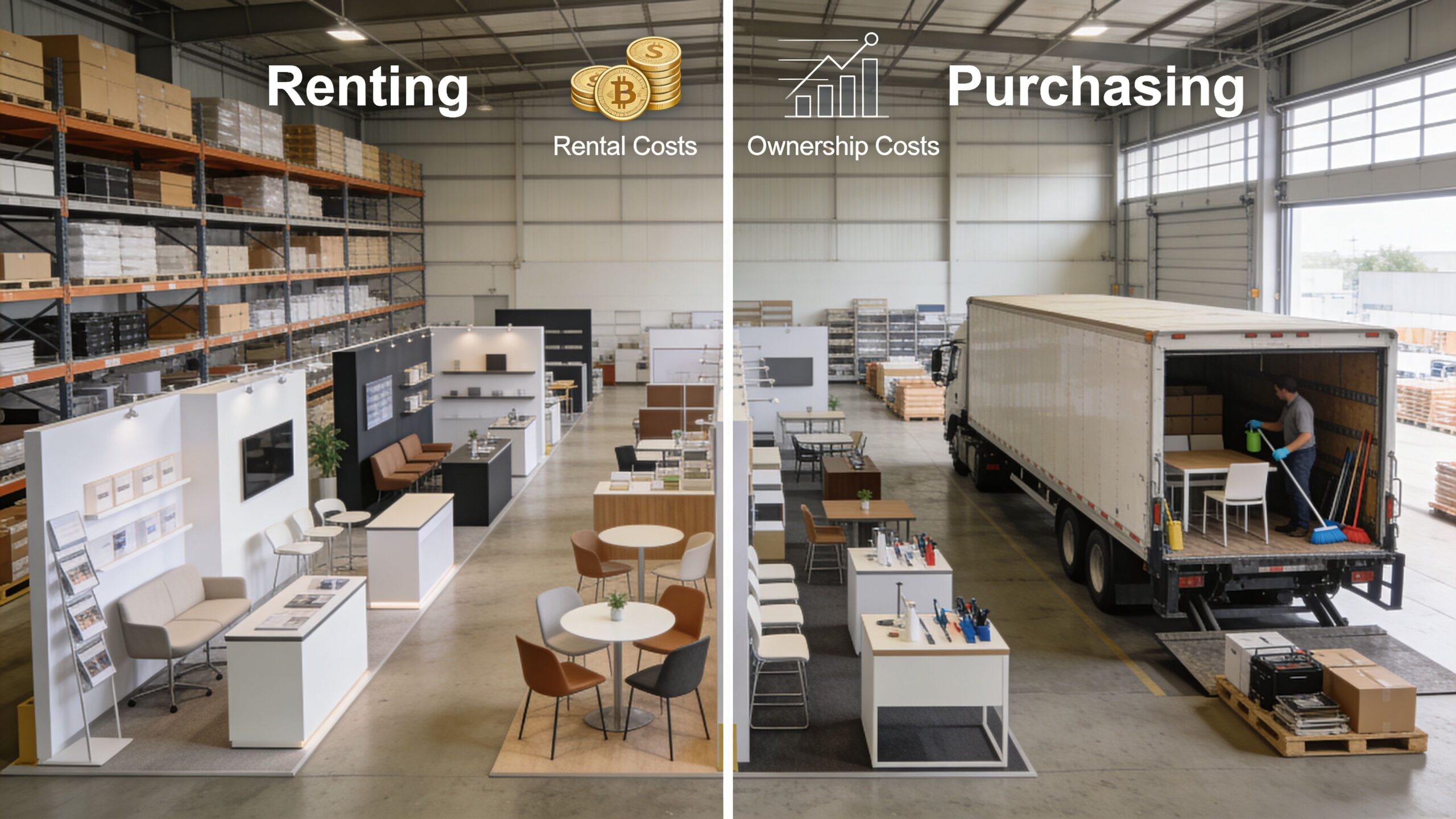
According to Interactive Party’s summary of ExhibitorLIVE trade show trends, 10’x10’ and 10’x20’ booths each account for 28.3% of setups, which is one reason many exhibitors choose rental flexibility. That same source notes that 46% of companies manage 21 or more shows yearly, and for those exhibitors, purchasing can make more long-term financial sense.
When renting furniture for trade shows makes more sense
Renting is usually the better fit when your program changes often. That includes companies testing new markets, rotating booth sizes, or attending a small number of shows where storage and maintenance would add unnecessary complexity.
Renting also works when:
- You need flexibility: Different venues require different footprints.
- Your brand is evolving: You don’t want hard assets locking you into last year’s look.
- Your team is lean: You’d rather outsource warehousing, refurbishment, and replacement.
The tradeoff is limited control. Rental catalogs can solve a need, but they don’t always create a distinctive environment. Availability can also become an issue close to major shows.
When purchasing earns its place
Purchasing becomes more attractive when the same core footprint appears across many events and the brand benefits from repeatable execution. You control the finishes, the fit, and how the furniture works with the rest of the exhibit system.
This matters even more for integrated environments. If your booth relies on repeated demo choreography, branded interaction points, or a consistent LED-driven presentation, ownership can make operations smoother from show to show. A useful comparison point is this guide on owning vs renting an LED video wall, which mirrors the same logic exhibitors should apply to furniture and structural components.
Side-by-side decision criteria
| Factor | Renting | Purchasing |
|---|---|---|
| Upfront cost | Lower | Higher |
| Flexibility | Strong | Moderate |
| Brand consistency | Variable | Strong |
| Storage needs | Minimal | Ongoing |
| Long-term control | Limited | High |
| Best fit | Occasional or changing programs | Frequent, repeatable programs |
A short visual can help teams align on that decision before they commit to a program-wide model.
The practical middle ground
Many exhibitors do best with a hybrid approach. They purchase the pieces that define the brand and rent the items that depend on venue size, campaign changes, or local show requirements. That’s often the smartest path for firms that want consistency without carrying unnecessary assets.
Buy what repeats. Rent what changes.
That approach keeps the booth disciplined while preserving room to adapt.
Budgeting for the Hidden Costs of Trade Show Furniture
At budget review, the furniture line often looks straightforward. Then the actual numbers surface. Freight is higher than expected, union labor takes longer than planned, the lounge chairs block a cable path to the LED wall, and a last-minute floor adjustment turns a low-cost order into an expensive one.
That gap between quote and actual spend is why experienced exhibitors budget furniture by total cost of ownership, not purchase price alone. A lower-priced piece can cost more over the life of the program if it ships poorly, needs extra setup time, creates access problems, or does not integrate cleanly with the booth structure and media system.
The hidden costs usually show up in four places.
Material handling increases with weight, bulk, and inefficient packing. Furniture that looks compact in a catalog can still take up expensive floor-to-freight volume once it is padded, crated, and routed through the venue.
Installation and dismantle labor rises when pieces need tools, field assembly, alignment with counters or shelving, or careful placement around LED walls and powered demo stations. In a modern booth, furniture is rarely standalone. It has to work around screens, sightlines, power drops, and presenter movement.
Onsite corrections are expensive because they happen under time pressure. If a bench blocks a storage door, a table sits too close to an LED corner, or seating interrupts a traffic lane, the fix happens on show-floor labor rates.
Downtime risk is easy to miss on a spreadsheet. In LED-driven exhibits, the furniture plan can either support the content experience or interfere with it. A badly placed seating group can weaken viewing angles. The wrong table height can expose cables, force awkward demo posture, or create glare and reflections that make the media wall work harder than it should.
What an honest budget should include
A realistic furniture budget covers more than the order itself. It should answer questions like these:
- How many labor hours will setup and teardown take
- How the furniture packs, ships, and protects finished surfaces
- Whether power access, cable routing, or AV integration affects placement
- What storage, drape, or back-of-house functions the furniture replaces or creates
- What contingency cost applies if a piece arrives damaged or does not fit the final floor plan
Shipping decisions belong in that conversation early. Teams that want a clearer picture of freight, timing, and show-site handling should review this guide on shipping trade show materials before approving final furniture counts.
Where turnkey service changes the math
Proposals often look comparable until the show invoice arrives. One vendor includes delivery but not setup. Another includes furniture but not the labor to integrate it with the exhibit. A third quotes the booth without accounting for the AV support needed when furniture and LED presentation zones share the same footprint.
We price projects differently. We include everything in our quote except venue-billed items such as electricity and material handling. That gives clients a cleaner budget and fewer late additions.
It also matters during the show. Our team handles the booth as one system, not as separate furniture, structure, and screen packages managed by different parties. That reduces coordination errors and protects the exhibit experience your visitors see.
We also provide white-glove, turnkey service. Your team can stay focused on meetings, demos, and lead capture while we handle setup issues. During show hours, an audiovisual technician remains onsite the entire time. If something goes wrong, you call or text, and an AV technician is at the booth within minutes to fix it.
A Procurement Checklist for Flawless Execution
Furniture for trade shows goes wrong when decisions are made in isolation. Marketing chooses the look. Operations worries about shipping later. Sales asks for more meeting space after the layout is approved. The cleanest exhibits come from a procurement process that forces those decisions into one shared plan.
Pre-approval checks
Before ordering anything, confirm the following:
- Booth objective: Decide whether the priority is lead capture, demos, meetings, product display, or a mix.
- Interaction style: Match furniture to the type of conversation you want staff to have.
- Brand fit: Review finish samples under show-style lighting, not just office lighting.
- Layout fit: Confirm every piece on the scaled floor plan, not a mood board.
Compliance and logistics checks
These checks save the most pain later:
- Confirm ADA clearance on the final layout
- Review height restrictions for the exact booth type
- Get material handling implications before signoff
- Verify concealed storage for staff and operational items
- Map power and cable paths before selecting demo furniture
If your team is evaluating assembly complexity, it can help to understand the role of movers in disassembling and reassembling furniture. The same operational logic applies on the trade show floor. Every extra assembly step introduces time, cost, and failure points.
Final show-readiness checklist
Use this as the last review before freight leaves:
- Sales-team test: Have staff walk the layout and simulate greeting, demoing, sitting, and resetting.
- Storage test: Place actual giveaway volume, chargers, literature, and cleaning supplies into the storage plan.
- Content sync: If furniture integrates with digital surfaces, schedule final content review before move-in.
- Damage plan: Identify who handles repair, replacement, or technical support during show hours.
- Post-show decision: Decide in advance what gets stored, refurbished, rented again, or replaced.
A booth feels effortless to visitors only when the planning was disciplined behind the scenes.
The strongest furniture choices don’t call attention to themselves. They make the booth work better, the staff more effective, and the brand easier to trust.
If you want a booth where furniture, structure, and content work as one system, LED Exhibit Booths can help. We build turnkey LED trade show environments with higher-resolution 1.9 pitch video walls, integrated counters and display elements, white-glove support, transparent pricing that includes everything except show-billed services like electricity and material handling, and an onsite AV technician available throughout show hours so your team can stay focused on customers.