
You’ve booked the booth. The crates are on the way. Sales wants meetings. Leadership wants pipeline. Then you get to the show floor and realize your setup looks like everyone else’s. Naturally, you’ll want professional looking display stands for products.
That’s the moment most exhibitors understand what a display stand is really doing.
It isn’t just holding products. It’s deciding whether people slow down, glance over, walk in, or keep moving. On a crowded floor, that difference shapes the entire event.
Why Your Product Display Stand Defines Your Success
A lot of teams still treat display stands for products like fixtures. A shelf here. A pedestal there. Maybe a branded header. That approach works if your only goal is to place items neatly inside a booth.
It fails if your goal is to get remembered.
At trade shows, people don’t stop because you own a rack. They stop because your booth communicates something instantly. It has to signal quality, relevance, and enough visual clarity that a passerby can understand what you sell in seconds.
Display stands for products is part of the pitch
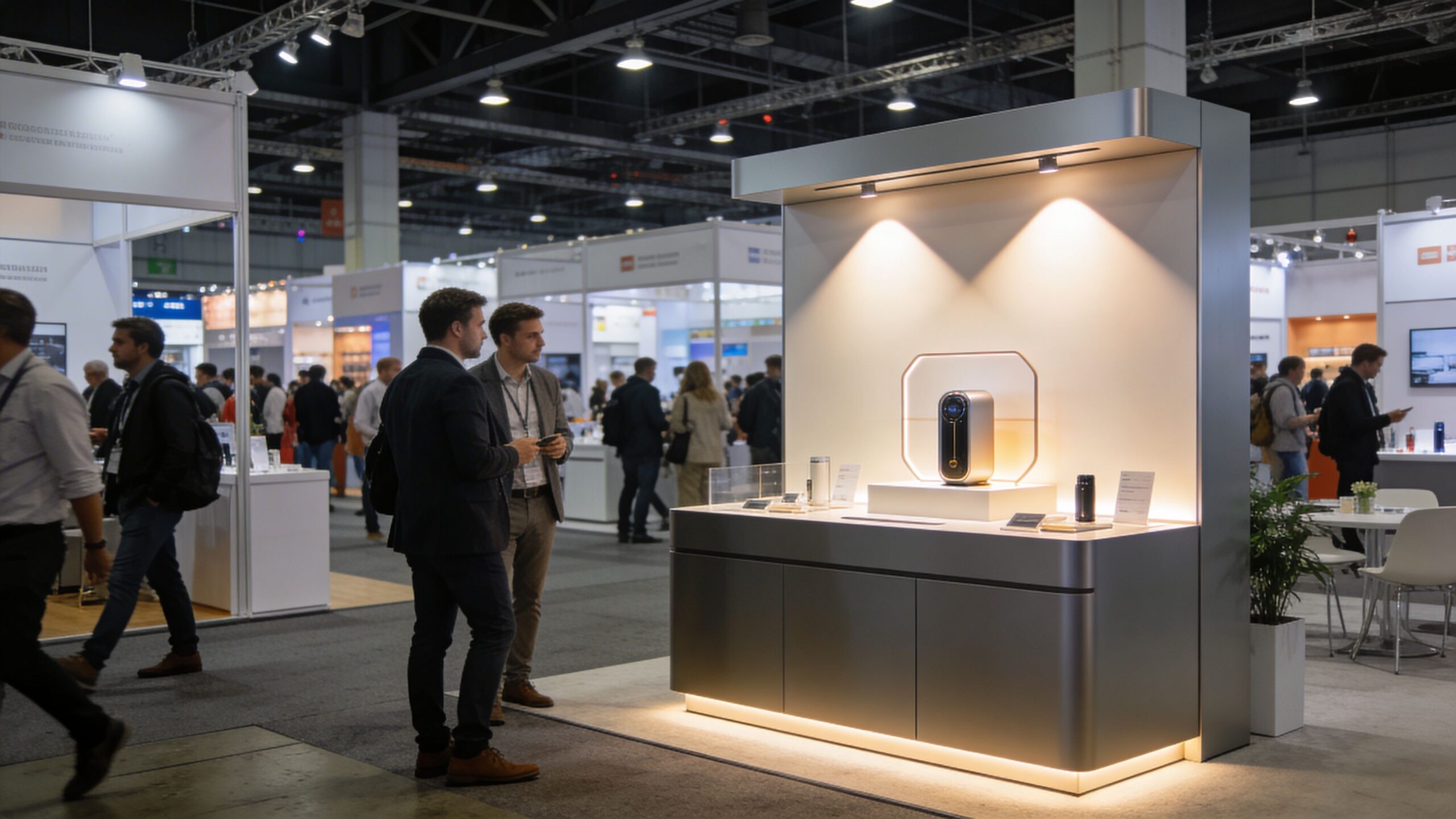
If your product sits on a folding table with a printed backdrop, attendees read that as ordinary. If the same product appears in a clean, intentional environment with controlled lighting, clear hierarchy, and space to interact, they read it differently.
That’s why the category is so large. The global retail display market reached $38.99 billion USD in 2024 and is projected to grow to $48.76 billion USD by 2034, while 72% of consumers continue to shop in physical stores weekly, according to this retail display market overview. Physical presentation still matters because people still respond to what they can see in front of them.
Trade show booths compress that reality into a tighter, more expensive environment.
Passive holding versus active presentation
There’s a real difference between a stand that stores products and one that sells them.
A passive stand:
- Holds inventory with little thought to sightlines
- Uses booth space inefficiently
- Creates clutter when samples, packaging, and literature pile up
- Makes every product look equally important, which usually means nothing stands out
An active presentation stand:
- Guides the eye toward hero products
- Supports demos instead of blocking them
- Frames the brand story instead of acting like warehouse furniture
- Works with handouts and branded takeaways, including promotional products that work, so the booth experience….com.au/pages/promotional-products), so the booth experience…com.au/pages/promotional-products), so the booth experience continues after the conversation
Practical rule: If your stand only answers “where do the products go,” it’s underperforming.
The exhibitors who get more from an event usually make one shift early. They stop asking what furniture they need and start asking what kind of experience their products need.
Exploring the Core Types of Display Stands for Products
Most display stands for products fall into a handful of categories. The mistake isn’t using these formats. The mistake is using them without thinking about what the trade show floor demands.
A stand that works in a retail aisle can struggle badly in a convention hall.
Freestanding and pedestal displays
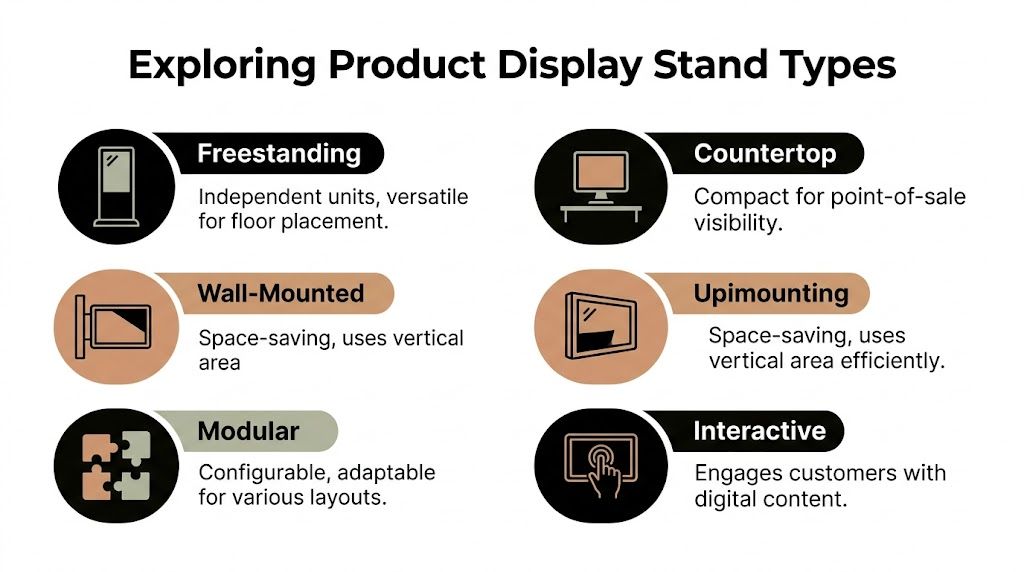
Freestanding units are the workhorses. They’re independent structures placed directly on the floor, often with shelving, pegs, or branded side panels.
They’re useful when you need:
- A central product zone attendees can approach from more than one side
- A self-contained footprint that doesn’t rely on booth walls
- Flexibility for different floorplans
Pedestals are different. They’re for hero items. If you’re launching one product, one prototype, or one flagship SKU, a pedestal does one thing well. It isolates attention.
The trade-off is obvious. Pedestals don’t carry much. Freestanding units carry more, but they can become bulky fast.
Countertop and wall-mounted display stands for products
Countertop displays work best for small items, samples, brochures, or add-on products. They sit on reception counters, demo stations, or tasting surfaces.
They’re effective when:
- You need products close to the conversation
- Staff can replenish quickly
- The product is small enough to handle without crowding the counter
Wall-mounted systems save floor space. In theory, they’re efficient. In practice, they depend on a booth structure that can support them and still look polished.
That’s where many exhibitors run into trouble. A good wall display can look sharp. A rushed one often looks like an afterthought bolted onto hard panels.
Tiered and shelving systems
Tiered displays matter more than most exhibitors realize. Tiered displays utilize vertical geometry to showcase product variety in compact footprints, a principle that increases sight lines and customer engagement points per square meter. This is especially useful where floor space is tight**, as explained in this guide to standing displays.
That’s the right idea for trade shows. Floor space is expensive, and horizontal spreading wastes it.
Tiered systems are useful for:
- Product families with multiple sizes, colors, or configurations
- Accessory ecosystems where people need to see how items relate
- Small booths that still need broad assortment visibility
The downside is visual overload. When exhibitors stack too many products at too many heights, the booth turns into a catalog on shelves.
If you’re evaluating compact booth formats, it helps to look at how portable trade show booths handle product visibility without creating that crowded look.
Modular display stands for products
Modular systems are popular because they can change shape from show to show. You can reconfigure shelves, headers, graphic panels, and product bays to fit different booth sizes.
That flexibility is valuable. It also creates risk.
A modular system is only as good as:
- The hardware tolerances
- The install crew
- The packing discipline between events
If pieces get damaged, mislabeled, or packed inconsistently, the setup slows down and the booth starts looking patched together.
Comparison of Traditional Types of Display Stands for Products
| Display Type | Best For | Pros | Trade Show Cons |
|---|---|---|---|
| Freestanding | Mid-size assortments, center-floor visibility | Flexible placement, self-contained | Can be heavy and bulky |
| Pedestal | Hero products, premium launches | Clean focus, strong visual hierarchy | Limited capacity |
| Countertop | Samples, brochures, small packaged products | Easy access during conversation | Consumes valuable demo surface |
| Wall-Mounted | Perimeter merchandising | Saves floor space | Depends on sturdy booth walls |
| Tiered Shelving | Broad assortments in tight spaces | Better use of vertical area | Can look crowded if overfilled |
| Modular | Brands attending multiple show formats | Reconfigurable, adaptable | More parts, more setup variables |
The best traditional stand is usually the one that edits the assortment. Not the one that displays everything you brought.
Choosing Your Display Stands for Products on the Trade Show Floor
A display stand can look great in a showroom and still fail in an exhibit hall.
Trade shows punish bad decisions fast. If the structure blocks sightlines, arrives in too many pieces, or takes too long to assemble, you pay for it before the first attendee walks by.
Sightlines matter before conversations happen
Retail data carries over well here. Over 70% of purchasing decisions occur in-store at the point of sale, and displays at eye level are 82% more likely to be bought, according to these retail display statistics.
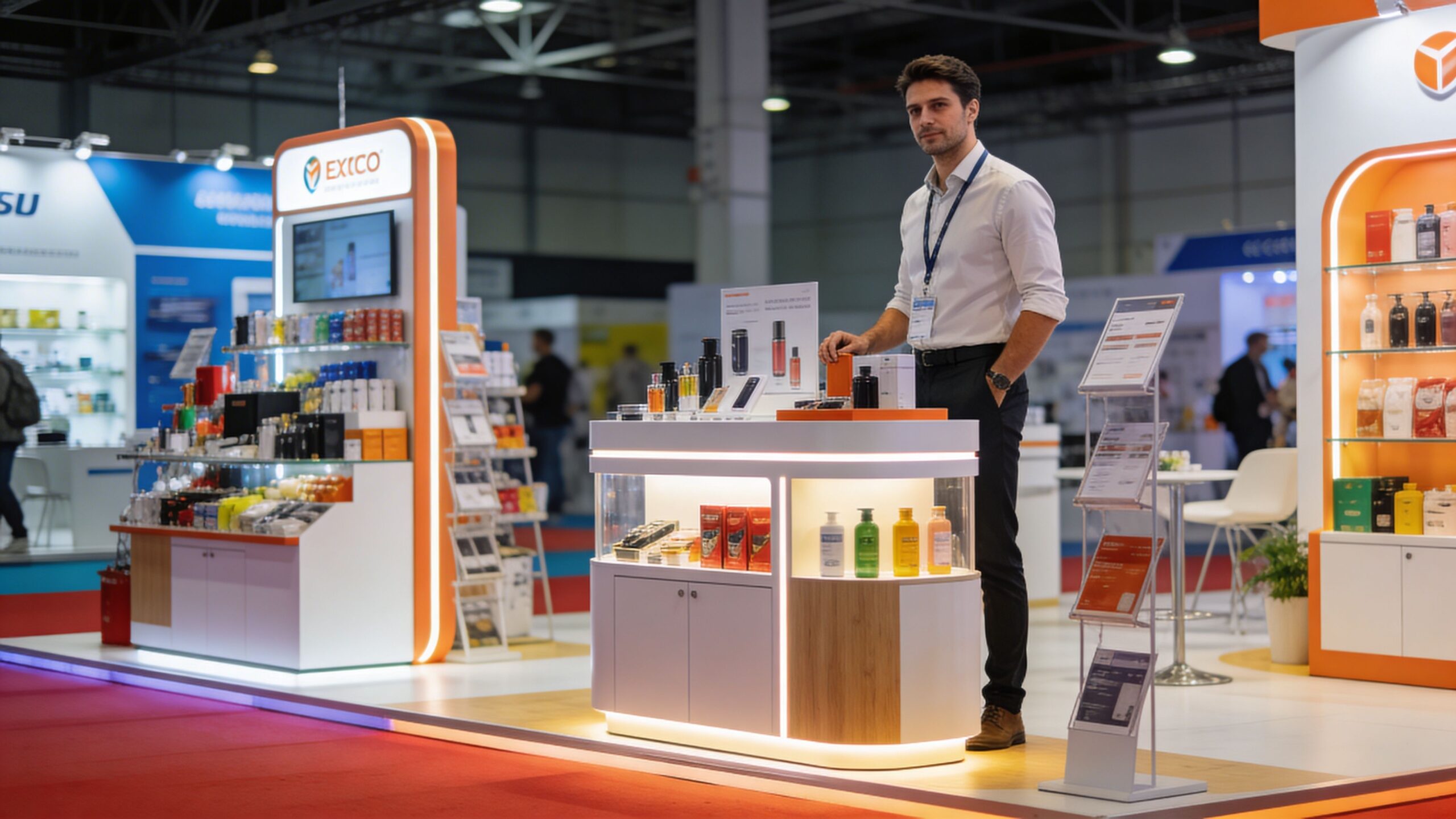
A trade show isn’t a store, but the behavioral principle is the same. Attendees notice what they can understand without effort.
That means your stand should do three things from the aisle:
- Show the hero product first
- Keep key messaging near natural eye level
- Avoid visual blockers like tall storage cabinets at the front of the booth
A common mistake is placing the product too low because the team wants room for a large backwall graphic. That layout often photographs well and performs poorly.
For examples of layouts that preserve visibility from the aisle, study these trade show booth layouts.
The real cost is not the invoice alone
Exhibitors usually compare stands by purchase price or rental price. That’s incomplete.
On the floor, the true cost includes:
- Material handling
- Install and dismantle labor
- Packaging complexity
- Risk of breakage
- Time spent managing setup issues instead of selling
Heavy wood displays often create the worst surprise. They can look substantial, but that substance turns into logistics drag. More crates. More labor. More opportunities for scratches, chipped edges, or missing fasteners.
Match the display stands for products to booth behavior
Different booth goals need different stand behavior.
If your team is doing scheduled demos, the stand should support controlled interaction. If your team is trying to pull in walk-up traffic, the stand should create visual intrigue from distance.
A few practical matches:
- Technical products: Keep the physical item accessible, but simplify the fixture so the product remains the focus.
- Consumer packaged goods: Use enough inventory to look credible, not so much that the booth feels like stock storage.
- Complex systems or services: The stand should support explanation, not carry the full burden of communication.
A trade show display has one job before any salesperson speaks. It must earn the pause.
What doesn’t work
Some choices fail over and over:
- Deep shelving at the front edge that turns the booth into a barrier
- Too many product families in one small footprint
- Cheap laminate fixtures that show wear after a single event cycle
- A beautiful stand with nowhere for staff to stand naturally
Good display stands for products help the booth breathe. They create a clear front edge, a readable focal point, and enough space for people to step in without feeling trapped.
Beyond Static Displays The Rise of Integrated Video Walls
Static stands still have a place. They’re familiar. They can be simple. They also have a hard ceiling.
Once every neighboring booth has shelves, lightboxes, and a backwall graphic, static hardware stops differentiating you. It becomes background.
That’s why integrated video walls are changing how exhibitors think about display stands for products.
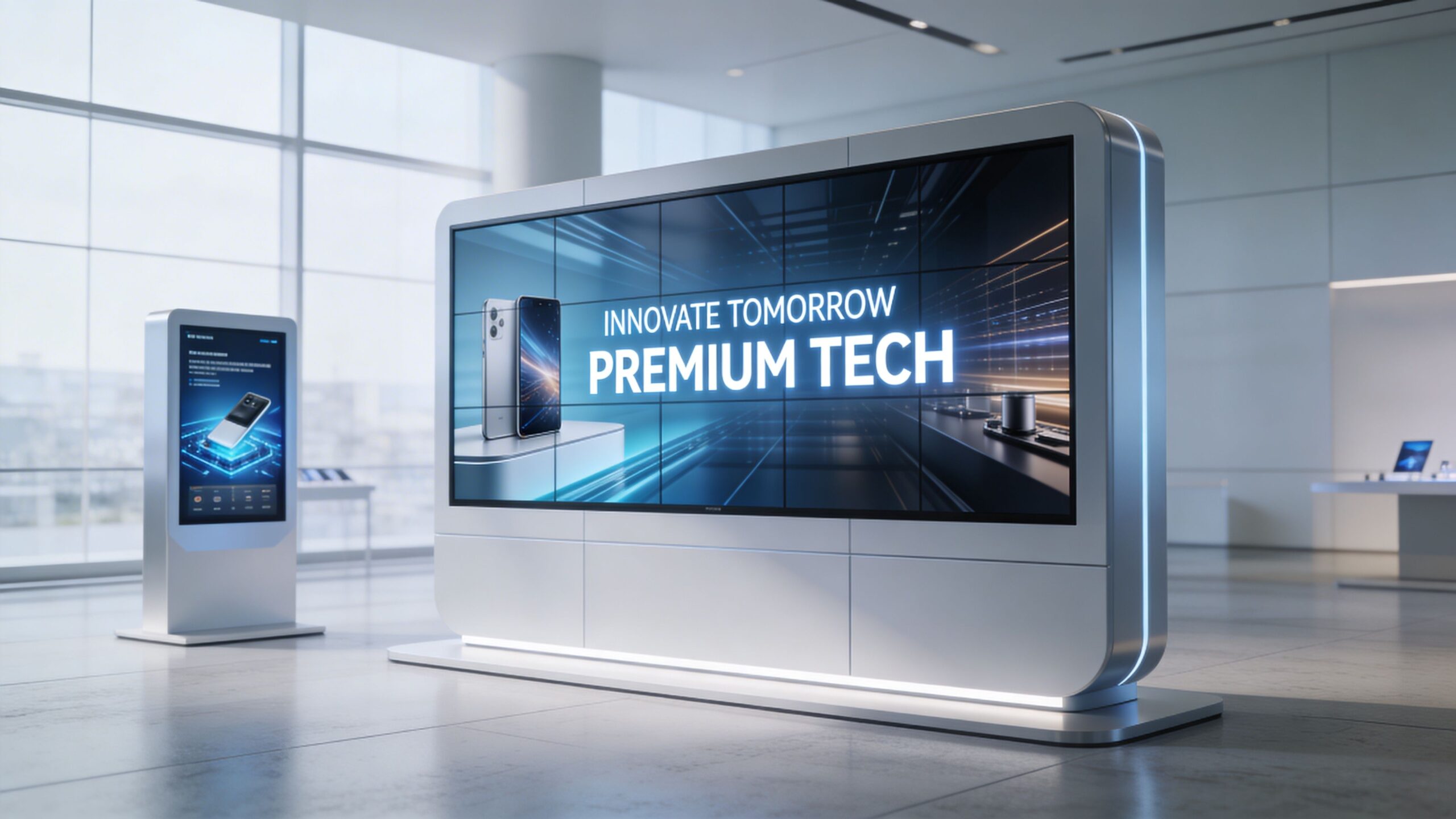
The display stands for products becomes the message surface
A video wall isn’t just a screen added to a booth. In the better implementations, the wall is the architecture.
Instead of placing products in front of a static graphic, you build an environment where the structure itself carries motion, story, and brand cues. That changes how attendees read the space. The booth feels alive rather than staged.
68% of exhibitors cite visual immersion as a top differentiator, yet many guides still focus on static shelving, while lightweight magnetic LED tiles are reported to cut setup time by 40% and shipping costs by 30% in trade show use cases, as described in this trade show display discussion.
Why seamless matters
Not all digital display approaches are equal.
Stacked monitors often create:
- Bezel lines that break the image
- Visible cables
- Extra support structures
- A patched-together look that undermines premium branding
LED walls solve that by turning the display into one continuous visual surface. If the content is good, the whole booth gains clarity.
Pixel pitch matters here too. A 1.9 pitch wall delivers a sharper image than the 2.5 pitch systems many competitors use. On a trade show floor, that difference shows up in text legibility, image crispness, and how clean the wall looks at closer viewing distances.
Better logistics than most people expect
A lot of exhibitors assume LED means difficult setup and oversized freight. Older systems earned that reputation. Newer magnetic tile systems changed it.
The better systems use lightweight panels, magnetic alignment, and toolless locking. That simplifies install and reduces the chance of crew error during assembly.
If you’re planning content across multiple screens or dynamic booth zones, this guide to managing monitors with rotating video walls is useful because it gets into the content control side rather than just the hardware.
Here’s a quick example of how these systems look in action:
Where integrated video walls outperform static stands
They work especially well when you need to show:
- Product use in context
- Before-and-after visuals
- Feature sequences
- Brand storytelling that changes during the day
- Multiple product lines without crowding the booth with physical inventory
They also let you reduce printed clutter. Instead of forcing every claim and every visual onto hard graphics, you can rotate content based on audience, meeting schedule, or campaign focus.
For exhibitors comparing formats, a dedicated video display wall approach usually makes more sense than adding disconnected screens to a conventional structure.
Static stands display products. Integrated video walls frame attention around them.
Renting vs Buying Your Display A Strategic Decision
This decision usually comes down to frequency, consistency, and operational appetite.
If you exhibit a few times a year, test new messaging often, or attend different show sizes, renting usually gives you more flexibility. If you exhibit constantly, keep the same core brand system, and want long-term control, buying can make sense.
When renting is the better move
Renting is often the smarter choice when:
- You’re entering a new market and don’t want to commit to a fixed design
- Your booth size changes from event to event
- You want current hardware without managing storage and refurbishment
- You’d rather preserve capital for travel, samples, and staffing
It also helps teams avoid the hidden burden of ownership. Storage, maintenance, crating, repairs, and replacement planning all land somewhere. If nobody owns that process internally, the booth degrades over time.
For many exhibitors, rentals for trade shows are less about saving money on paper and more about buying flexibility and reducing internal friction.
When buying makes sense
Buying works when the event calendar is steady and the brand presentation needs to stay highly consistent.
That path is stronger if:
- You exhibit frequently
- Your booth concept won’t change much
- You have internal systems for logistics, storage, and maintenance
- You want an owned asset the team can deploy repeatedly
Ownership can also be useful when products need custom integration and you know those requirements won’t shift much.
Service changes the math
A mediocre rental is a headache. A strong rental partner changes the whole experience.
The best arrangements are turnkey. The exhibitor shouldn’t have to chase freight details, supervise setup crews, or troubleshoot hardware during show hours. Clear pricing matters too. One of the biggest relief points for exhibitors is knowing what’s included and what the venue will bill directly, such as electricity or material handling.
White-glove support isn’t a luxury at a busy event. It’s operational protection. If something fails, somebody has to fix it immediately, not after a service ticket disappears into a queue.
Sustainability belongs in the decision
The rent versus buy question also connects to waste. 72% of attendees prefer sustainable booths, and modular LED booths can lower a booth’s carbon footprint by up to 50% compared to disposable displays, according to this discussion of ADA-compliant and sustainable booth design.
That doesn’t mean every owned display is wasteful or every rental is green. It means modular systems with repeated use and less disposable buildout deserve serious consideration.
Your Guide to Setup, Maintenance, and On-Site Success
A strong booth can still have a bad show if execution slips.
Most on-site problems are predictable. They come from rushed freight planning, unclear install responsibility, missing components, or no real support plan once the hall opens.
Before the freight leaves
Treat pre-show logistics as part of booth design.
Use a short checklist:
- Confirm shipping deadlines early. Advance warehouse and direct-to-show timelines can change how your materials arrive.
- Label every component clearly. The crew shouldn’t have to guess which crate contains counters, shelves, or media gear.
- Review handling paperwork. Material handling charges and move-in procedures affect budget and timing.
- Separate must-have items. Samples, chargers, small tools, and show-critical accessories shouldn’t disappear into mixed freight.
During setup of your display stands for products
Traditional display systems often fail during install for simple reasons. Missing fasteners. Damaged laminate. Mispacked shelves. Graphics that looked aligned in the render and don’t align in real life.
Toolless magnetic LED systems reduce a lot of that friction because the hardware is designed for faster assembly and fewer decision points. That doesn’t remove the need for planning, but it does reduce the number of ways a setup can go sideways.
If your team needs a practical reference for day-of execution, this trade show set up guide is worth reviewing.
The smoothest booths usually don’t have fewer moving parts by accident. Somebody designed the process to remove failure points.
While the show is open
Maintenance matters more than people expect. A small issue becomes a visible problem fast when the aisle is full.
Keep these habits in place:
- Assign one booth owner for opening checks each morning
- Test all digital content before attendees enter
- Wipe surfaces constantly, especially gloss finishes and touchpoints
- Restock intentionally so the booth stays full without looking cluttered
- Make support reachable by text or phone, not a vague service desk
The best support model is simple. If something breaks, a technician responds within minutes and resolves it on-site while your team keeps working leads.
That’s the difference between having equipment and having coverage.
Transforming Your Booth from a Stand to an Experience
Most exhibitors don’t need more furniture. They need better booth performance.
Traditional display stands for products still have their place. Freestanding units, pedestals, countertops, and tiered fixtures can all work when the product mix is simple and the booth goal is narrow. But once competition on the floor intensifies, static presentation starts to limit what the booth can do.
The stronger approach is to think beyond product placement.
A good booth doesn’t just hold items. It creates hierarchy, pulls traffic, supports conversation, and gives people something to remember after they leave the aisle. That’s why integrated digital environments are gaining ground. They turn the structure itself into a communication tool.
If your current booth feels like a collection of parts rather than a coordinated experience, that’s the signal to rethink the format.
The exhibitors who stand out aren’t always the ones with the biggest footprint. They’re the ones who make the space work harder.
Frequently Asked Questions About Display Stands for Products
Are display stands for products still worth using if I have digital content?
Yes. Physical products still need a clear, intentional way to be presented. Digital content works best when it supports the product instead of replacing it. The strongest booths combine physical access with visual storytelling.
What’s the biggest mistake exhibitors make with product stands?
They bring too much. When every item gets equal visibility, attendees can’t tell what matters most. Edit hard and build the display around the products you most want discussed.
Can a video wall work if I only have a small booth?
Yes. Smaller footprints often benefit the most because a continuous wall can create visual impact without filling the booth with bulky fixtures.
Is renting better for a first-time exhibitor?
Usually, yes. Renting lowers commitment, reduces operational burden, and gives you room to adjust after the first event.
Do I still need on-site technical support with a modern booth system?
If digital hardware is part of the booth, support is a smart decision. Problems at show opening need immediate fixes, not delayed callbacks.
If you’re ready to replace a static booth with a unified, high-impact display system, talk to LED Exhibit Booths. They build turnkey video wall trade show displays with sharper 1.9 pitch resolution than the 2.5 pitch setups many exhibitors settle for, include everything in the quoted price except direct show charges like electricity and material handling, and provide white-glove service from planning through teardown. They also keep an audiovisual technician on-site while the show is open, so if anything needs attention, help is only a text or call away.