
If you’re searching trade show display near me, you’re probably already in the messy part of the process. The show date is fixed. Sales wants a booth that pulls people in. Procurement wants a quote that doesn’t explode after union labor, drayage, and last-minute fixes show up. Then Google gives you a page full of banner stands, table throws, and local print shops.
That’s the trap.
Most exhibitors don’t need another backdrop vendor. They need a partner who can handle show-floor logistics, build a booth that stops traffic, and keep the tech running while the event is open. If you’re considering LED video walls, the difference between a printer and a true display partner isn’t small. It’s the difference between a smooth show and a booth-side fire drill.
Why Searching for a ‘Trade Show Display Near Me’ Is Deceptive
Type the phrase into Google and you’ll see what everyone sees. A flood of local companies offering pop-ups, retractables, printed graphics, and modular banner systems. Those products have their place, but they are not the same thing as a high-impact exhibit environment.

The problem is simple. Search results often reward whoever has a local page and a decent Google profile, not whoever can engineer an LED booth, manage install and dismantle, and support content playback under show conditions. That’s why trade show display near me searches overwhelmingly yield static, modular banner stands and printed graphics providers, while guidance on dynamic LED video walls is hard to find, as noted by Colorado Live Events’ trade show display page.
A printer isn’t a production partner
A local graphics house can print beautiful fabric. That doesn’t mean they can handle:
- LED wall integration that turns the booth structure itself into display surface
- Venue coordination with show rules, labor windows, and access times
- Onsite troubleshooting when content, power, or panel issues appear mid-show
- Booth flow planning so the screen faces real traffic, not empty aisle space
This distinction matters more than people think. An LED wall booth isn’t just “a screen in a booth.” It’s a system. Hardware, content, rigging logic, cable routing, brightness, service access, and setup speed all affect whether it works.
Why local can still matter
Local support is useful, but only if the vendor is local to the type of work, not just local to your ZIP code. If your shortlist includes companies that mostly sell printed displays, you’re comparing the wrong category.
Practical rule: Ask what they install most often. If the answer is retractable banners and SEG backwalls, they may be solid at graphics and weak at live exhibit technology.
If you want a better starting point, look for partners that specialize in rentals, logistics, and active show support, not just production. A good example of the type of provider to compare against is a company focused on Las Vegas trade show booth rentals, where venue rules, labor, and show-floor speed aren’t optional details.
The search term sounds straightforward. It isn’t. The question isn’t who’s nearby. It’s who can deliver a booth that works under pressure.
Smart Search Tactics to Find a True Trade Show Display Partner Near You
A better search starts when you stop relying on the search bar alone. Good exhibitors don’t just look for vendors. They look for proof that a vendor can survive the realities of the show floor.
Start with the venue, not the vendor
Pull the exhibitor kit from the event you’re attending. Check the forms, contractor rules, target dates, and any guidance around material handling, labor, electrical ordering, and move-in windows. You don’t need a vendor who merely says “we ship nationwide.” You need one who understands how your specific event works.
Regional conditions aren’t consistent. Trade show attendance recovery has varied sharply by state, with Nebraska at +61% while Nevada declined 48% from pre-pandemic levels, according to 2025 trade show statistics compiled by Giant Printing. That kind of variation affects booth strategy, staffing expectations, and how aggressive you should be with visibility.
Search the people who already know
Google is broad. Industry relationships are narrow, and that’s good. Use LinkedIn to find:
-
Event marketers at companies that exhibited last year
Ask who handled their booth and whether that vendor stayed responsive after install. -
Freelance exhibit designers and experiential producers
They usually know which firms are dependable and which ones oversell. -
General service contractors and venue contacts
They won’t always give a formal endorsement, but their reaction tells you a lot.
If you work internationally or across event formats, it’s worth seeing how event suppliers frame service in different markets. A practical example is this guide to event decor in Cape Town, which shows how local sourcing becomes more useful when it includes setup knowledge and event execution, not just inventory.
Use better search phrases
Generic searches produce generic results. Tighten your query. Search for the service you actually need.
Try phrases like:
- LED video wall booth rental near me
- trade show video wall rental
- onsite AV support for trade show booth
- modular LED booth display rental
- trade show booth install dismantle with LED wall
You can also search by city plus venue. A vendor that knows your convention center, marshalling yard process, and labor rhythm is more useful than one that merely ships a crate and hopes for the best.
Look for evidence of operational depth
A real partner should be able to discuss more than design. They should be able to explain logistics, risk, and service. That’s why I like reviewing pages that focus on trade show rental programs, because rentals usually expose whether a company has actual processes for transport, setup, support, and reuse.
The best vendor conversations sound operational, not decorative. They talk about timing, labor, access, content testing, and who fixes what when something fails.
Red flags that save you time
Use this quick filter before you request a quote:
| Signal | What it usually means |
|---|---|
| Website only shows banner stands and pop-ups | Likely a print-first vendor |
| No mention of install or dismantle | You’re probably managing more than you think |
| No examples of live screens or content integration | Tech execution may be outsourced |
| Vague wording around support | Trouble later becomes your problem |
A local name on a map listing doesn’t mean local execution strength. Search for a vendor the way a show manager would, not the way a casual buyer would.
Key Questions to Vet Your Next Trade Show Display Provider
Once you have a shortlist, stop asking soft questions. “Can you help us with a booth?” gets you polished sales language and vague quotes. Ask questions that force specifics.
If a vendor can’t answer directly, move on.
Ask about screen resolution first
Start with pixel pitch. That’s the quickest way to separate someone who knows LED from someone reselling it.
Ask: What is the pixel pitch of your LED panels?
Our view is simple. P1.9 beats the more common P2.5 for close-range trade show viewing because the image looks sharper at attendee distance. In a booth, people don’t stand across a parking lot. They stand a few feet away. That’s where finer pitch matters.
If a vendor dodges the question or changes the subject to “high definition” or “great quality,” that’s a warning sign. LED quality isn’t a vibe. It’s a spec.
Ask what’s included, line by line
Here, bad quotes often hide. A lot of vendors quote the wall and leave the painful parts for later.
Ask them to spell out:
- Design and rendering. Included or extra?
- Shipping. Included or estimated?
- Install and dismantle labor. Included, supervised, or passed through?
- Content formatting. Included or your problem?
- Onsite support. Remote only, on-call, or physically present?
- Storage between shows. Available or not?
Here’s the standard I recommend you demand. Everything should be included except the charges the show bills you directly, such as electricity and material handling. If a vendor can’t make that boundary clear, your final invoice won’t be clean.
Ask who is onsite when the doors open
Lots of companies say they offer turnkey service. Ask what that means in real life.
Good follow-up questions:
- Who is my point of contact on show days?
- Is an AV technician onsite the entire time the exhibit hall is open?
- If playback fails, who fixes it and how fast?
- Do I call a hotline, a project manager, or someone physically in the building?
Setup mistakes aren’t rare. Cable management errors delay 20% of setups, and cluttered displays can lose 80% of passersby, according to Event Marketer’s trade show organizer guidance. A provider with integrated tech and real content guidance reduces both risks.
If support disappears after setup, you didn’t buy turnkey service. You bought delivery.
Ask how the system goes together
You want to know whether the display is built for speed or built for labor invoices.
Ask these questions in one shot:
- Is the wall modular?
- Is assembly toolless or tool-heavy?
- How are power and data handled?
- What happens if one panel needs service?
This is where magnetic, modular systems stand out. Toolless assembly and cleaner cable routing reduce setup friction. They also reduce the chances of a rushed crew creating problems you inherit on opening morning.
Ask for content rules, not just content upload
A vendor who knows exhibits should have strong opinions about what belongs on screen. If they say, “Send anything you want,” that’s not service.
Ask what they recommend for:
- message hierarchy
- type size
- motion use
- dwell-time content versus walk-by content
- how many claims should appear at once
A sharp provider should tell you to simplify. They should help you avoid overcrowding. They should know what a passerby can absorb in a few seconds.
If you want a benchmark for the level of detail your vendor should be able to discuss, compare them against a specialist in trade show display services.
Ask the one question most buyers skip
Ask: What usually goes wrong, and how do you prevent it?
Then stay quiet.
The best vendors answer with specifics. They mention setup access, cable routing, content mismatch, panel swaps, labor timing, and show forms. Weak vendors answer with “nothing usually goes wrong.”
That’s not confidence. That’s inexperience.
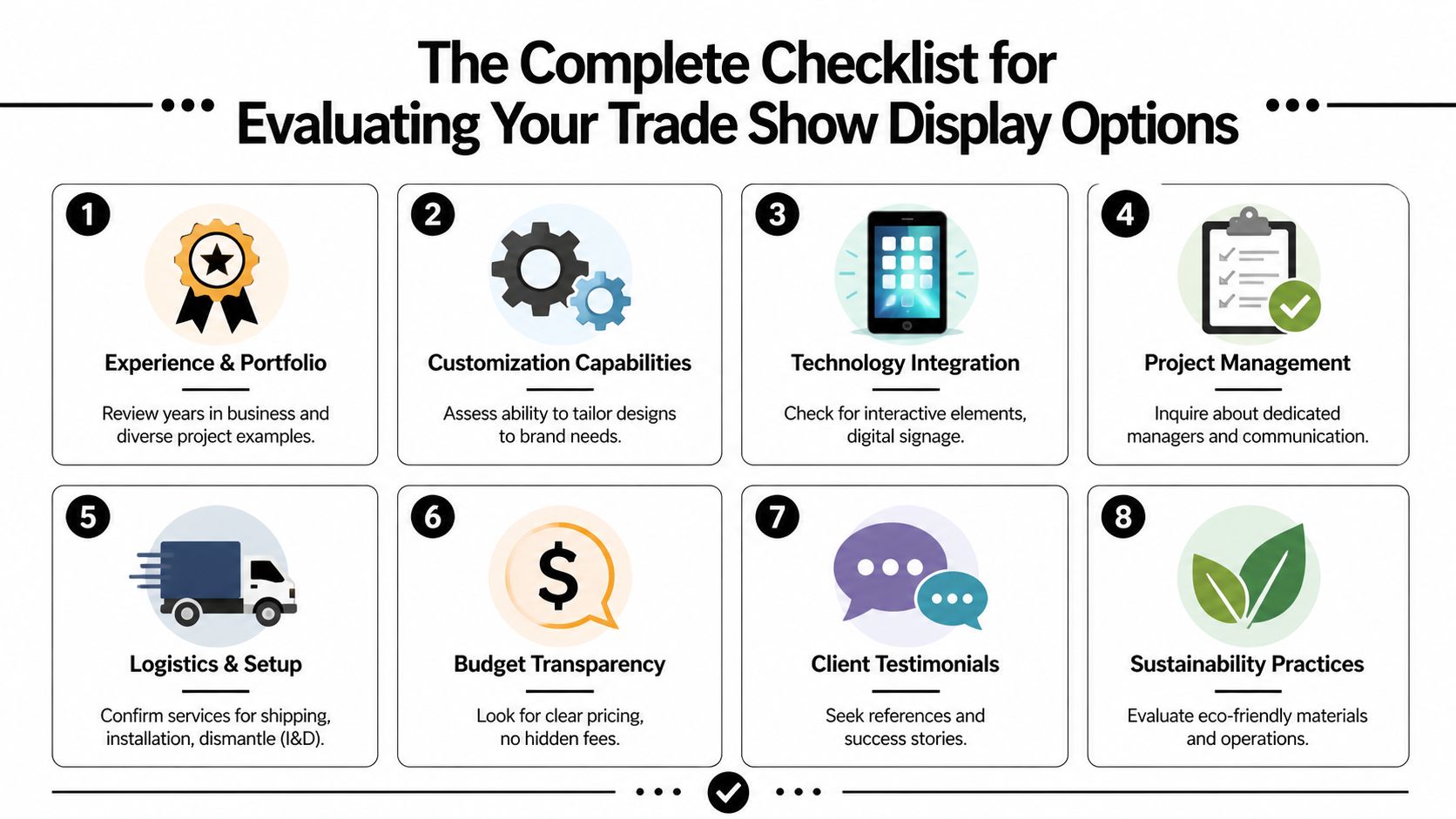
The Complete Checklist for Evaluating Your Trade Show Display Options
Most booth decisions go sideways because buyers compare concepts, not operating realities. They choose a pretty rendering, then get surprised by labor, freight, service gaps, or weak screen quality. Use a checklist that forces apples-to-apples comparison.
Decide whether renting fits your schedule
For most exhibitors, renting is the smarter move. 70% of exhibitors choose rentals to reduce costs and improve flexibility, and 75% face pressure to reduce exhibit costs, while 48% say eye-catching displays are the most effective way to attract attendees, according to Exhibit Experience’s booth rental analysis.
That combination tells you a lot. Teams want impact, but they don’t want ownership headaches. Rental gives you flexibility on footprint, show schedule, and refresh cycles without locking money into a single structure.
A rental is especially attractive if you:
- Attend different booth sizes from one show to the next
- Need visual impact fast without a custom fabrication timeline
- Don’t want storage and maintenance between events
- Need to test messaging before committing to ownership
Evaluate the booth as a system
A booth isn’t one product. It’s a chain of dependencies. If one weak link breaks, the whole experience suffers.
Use this checklist when reviewing options:
-
Booth footprint fit
Can the concept work cleanly in your exact space, not just in a generic rendering? -
Viewing distance
If attendees will stand close, screen resolution matters more. That’s why pitch should be part of your comparison, not an afterthought. -
Brightness for the hall
A booth has to compete with overhead lighting and neighboring exhibits. -
Sightlines and traffic approach
Can attendees understand your offer at a glance from the aisle? -
Serviceability
If a component fails, can it be swapped or fixed without tearing apart the booth?
Field note: The smartest buyers review the booth from the attendee’s path, not from the designer’s favorite angle.
Compare the hidden costs, not just the front-end quote
A cheap display can become an expensive show. Many teams often get burned as a result.
Look beyond the headline number and compare:
| Cost area | What to verify |
|---|---|
| Freight | Is transport included or estimated separately? |
| Drayage | Is the structure lightweight, or are you paying to move heavy gear? |
| Labor | Does the setup method reduce crew time, or require more hands? |
| Support | Is tech support onsite or remote? |
| Show services | Which charges come from the venue, and which come from the vendor? |
If you’re budgeting the full program, it helps to review a breakdown of trade show booth cost factors so you can separate vendor pricing from direct show charges.
Review the content plan before you approve the hardware
A high-resolution wall with weak content is still a weak booth. Before you commit, ask to see content guidance or templates. You don’t need a vendor that only plays files. You need one that helps shape what belongs on screen.
If your team is still building the pre-show asset package, this resource on how to prepare for trade shows with marketing is useful because it covers the support materials that should reinforce what your booth is saying.
Use this practical evaluation list
Print this and score each option.
-
Can the display scale to our booth sizes?
One footprint isn’t enough if your event calendar changes. -
Is the screen quality appropriate for close viewing?
If your audience stands near the wall, finer pitch wins. -
Does the quote clearly separate included services from direct show bills?
Confusion here always costs money later. -
Who handles install, dismantle, and onsite troubleshooting?
Don’t assume. Ask for names and responsibilities. -
Is the booth visually simple enough to read fast?
The aisle is not a conference room. -
Can the structure reduce shipping and handling burden?
Lightweight modular systems have an advantage. -
Will the vendor help shape the content?
Hardware without messaging support is incomplete. -
Do we trust them under pressure?
This isn’t abstract. It’s the whole game.
The right display isn’t just attractive. It’s the one that gets installed cleanly, reads clearly, and doesn’t create a pile of small disasters during the event.
Our Turnkey Process for a Stress-Free Trade Show Display Experience
The smoothest trade show experiences all look the same from the exhibitor side. The booth is ready. The content works. The team shows up and starts talking to prospects instead of chasing cables, labor, or missing gear.
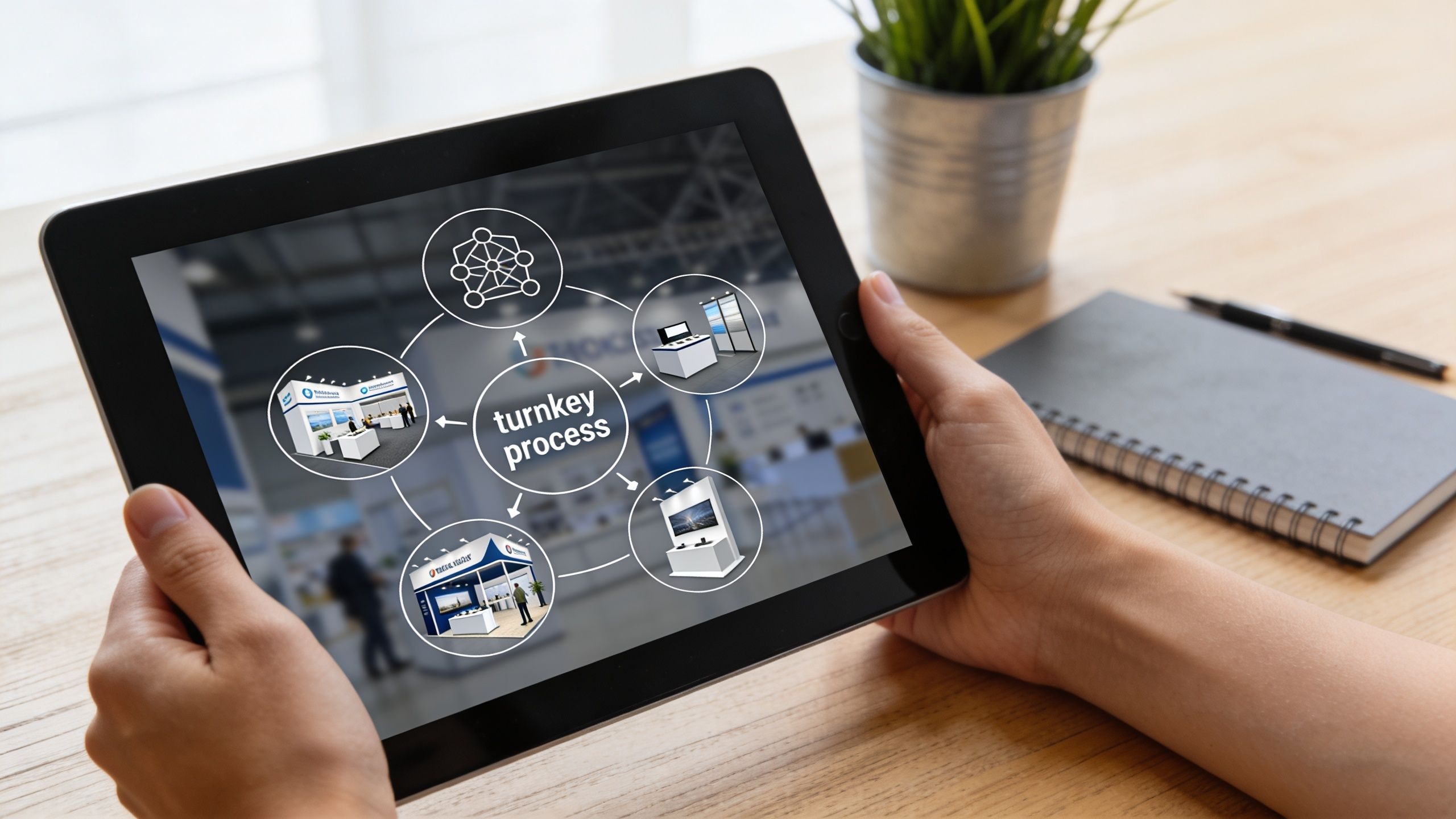
That’s what a real turnkey process should feel like.
It starts before the freight leaves
A capable team doesn’t wait until move-in to solve booth problems. The work starts with pre-show analysis. Floor plan review. Traffic direction. Screen orientation. Message hierarchy. What should appear high, what should face the aisle, and what should stay off the wall entirely.
That planning matters because setup speed and labor efficiency don’t come from hustle. They come from system design. A documented process that includes pre-show analysis and toolless magnetic assembly can get a 10×10 booth set up in under 2 hours by a 2-person crew, while cutting labor costs 40-60% versus traditional setups, according to this expert booth methodology summary. The same source notes that reusing modular systems across five shows can improve ROI by 70%.
The booth should assemble cleanly
Modular LED offers significant advantages. Lightweight panels that lock together without a tool-heavy build reduce setup friction. Cleaner assembly usually means fewer mistakes, less crew time, and less drama during move-in.
Just as important, the vendor should manage the movement of the system itself. If you’re evaluating how the display will get to and from the venue, look at whether they have a clear process for shipping trade show exhibits, not just a vague promise that “logistics are covered.”
Good trade show support is quiet. You barely notice it because problems get handled before they reach your team.
The last mile is where vendors prove themselves
Setup isn’t the finish line. Open hours are.
A proper turnkey partner calibrates the wall, checks content playback, verifies brightness in hall lighting, and keeps support available while the event is live. That’s the part many exhibitors underestimate. A booth can look perfect at handoff and still fail when the show opens if no one owns playback, panel health, or live troubleshooting.
Here’s a quick look at the kind of process buyers should expect:
| Stage | What a strong partner handles |
|---|---|
| Pre-show planning | Floor plan review, content guidance, traffic orientation |
| Logistics | Scheduling, transport coordination, move-in timing |
| Install | Assembly, calibration, testing |
| Live show support | Monitoring, troubleshooting, rapid response |
| Breakdown | Dismantle, pack-out, post-show handling |
This short walkthrough shows the kind of execution standard exhibitors should expect from a true turnkey setup:
What matters most is simple. Your team should spend show hours meeting buyers, not babysitting technology.
Your Vendor Outreach Toolkit Contact Templates and Checklists
Most vendor outreach is too vague. Buyers ask for “pricing for a trade show booth,” and vendors respond with polished but incomplete answers. If you want useful proposals, your first message has to force clarity.
Use the checklist below to compare vendors side by side. Then use the email template to get direct answers on resolution, service, logistics, and pricing scope.
Sample Vendor Comparison Checklist
| Feature/Service | Vendor A | Vendor B | Our Standard (LED Exhibit Booths) |
|---|---|---|---|
| LED pixel pitch | P1.9 available | ||
| Booth sizes supported | Compact to larger modular formats | ||
| Quote clarity | Everything included except direct show charges like electricity and material handling | ||
| Design and renderings | Included in turnkey planning | ||
| Shipping coordination | Included | ||
| Install and dismantle support | Included | ||
| Assembly method | Toolless magnetic LED tile system | ||
| Content guidance | Included | ||
| Onsite AV technician during show hours | Included | ||
| Troubleshooting response path | Text or call for immediate booth-side support | ||
| White glove service | Standard | ||
| High-resolution screen focus | Yes |
Email template to send vendors
Subject: Trade show display near me inquiry for upcoming event
Hi [Vendor Name],
We’re evaluating partners for an upcoming trade show and need a booth solution that goes beyond printed graphics. We’re specifically interested in an LED video wall exhibit or similar high-impact display.
Please reply with the following:
- What LED pixel pitch do you offer for trade show booths?
- What booth sizes and configurations can you support?
- What is included in your quoted price?
- What direct show charges are not included?
- Do you provide shipping, install, dismantle, and content setup?
- Is an AV technician onsite while the show is open?
- How do you handle live troubleshooting during the event?
- What is your assembly method, and how complex is setup?
- Can you share examples of booths designed for close-range attendee viewing?
- What do you recommend for content layout and message hierarchy?
Event details:
- Show name:
- Venue:
- Booth size:
- Show dates:
- Primary goal:
- Products or services featured:
We want a turnkey solution with clear pricing and reliable onsite support. Please send your recommended approach, lead time, and next steps.
Thanks,
[Your Name]
[Company]
[Phone]
A quick outreach checklist before you hit send
- Include the venue name so the vendor can speak to logistics, not guess.
- State your booth size because screen recommendations depend on footprint.
- Ask for pixel pitch in writing so no one hides behind generic quality claims.
- Demand pricing boundaries so you know what’s vendor-included and what’s billed by the show.
- Require onsite support details because “support available” often means little.
The vendors worth talking to answer specific questions with specific answers. The rest save you time by being vague early.
If you’re narrowing your options and want a partner that handles the booth as a full operating system, not just a box of parts, LED Exhibit Booths is built for that job. We provide high-resolution LED video wall exhibits with P1.9 pitch, white glove turnkey service, and pricing that includes everything except the direct charges the show bills you for, such as electricity and material handling. We also keep an AV technician onsite while the show is open, so if something needs attention, help is minutes away and your team can stay focused on customers.