

Tension fabric backdrop decisions usually start the same way. You’re staring at a booth plan, the show date is getting close, and you need something that looks polished without turning setup into a second full-time job.
That’s why a tension fabric backdrop is often the default pick. It’s clean, portable, and familiar. But familiar isn’t always the smartest choice, especially when your real job is to stop traffic, hold attention, and help your team start better conversations.
A lot of exhibitors settle for what feels safe. I think that’s a mistake. Your backdrop isn’t just decoration. It’s the first signal buyers get about whether your brand looks current, credible, and worth a closer look.
The Challenge of Standing Out on the Trade Show Floor
Trade show floors are crowded on purpose. Every booth is trying to solve the same problem at the same time: get noticed fast, explain something quickly, and make the space feel worth entering.
That’s where many teams land on fabric graphics. They want a big branded wall, a smooth setup, and something that won’t look cheap under show lighting. Fair enough. A fabric backdrop can absolutely do that.
But the bigger question is whether it’s the right tool for your goal.
If your goal is to put a logo behind a table, a tension fabric backdrop may be enough. If your goal is to launch a product, run multiple messages during the same event, or look more advanced than the booth next to you, “good enough” starts costing you.
A busy aisle punishes static booths. Attendees scan first, then decide whether to stop.
Before you commit to a printed wall because it’s common, look at what high-performing exhibitors are doing with movement, content flexibility, and cleaner visual storytelling. If you need inspiration before making that call, these trade show booth design ideas are a useful reality check.
What Exactly Is a Tension Fabric Backdrop
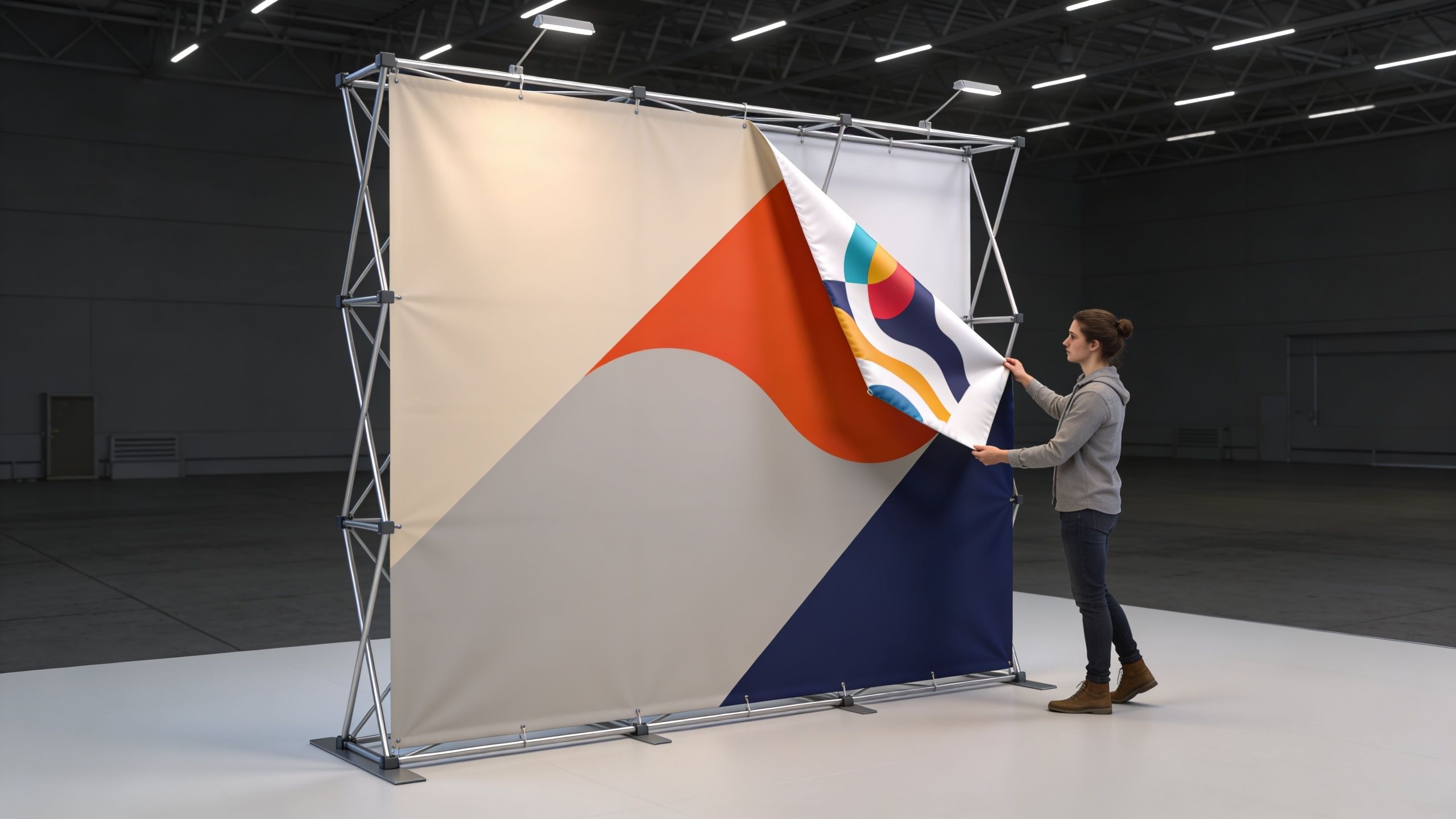
A tension fabric backdrop is basically a printed fabric sleeve stretched over a lightweight frame. The easiest way to think about it is this: it works like a pillowcase for a display structure. You build the frame, pull the graphic over it, zip it closed, and the fabric tightens into a smooth branded wall.
The two parts that matter
The system is simple, and that simplicity is why exhibitors like it.
- The frame: Most systems use lightweight tubular aluminum. The frame gives the display its shape without adding much weight.
- The graphic: The printed layer is usually stretch polyester. It slides over the frame and zips into place so the image pulls tight.
- The finish: Because the fabric surface is matte, it photographs better than glossy alternatives and doesn’t throw as much glare under lights.
That last point matters more than people think. If your booth gets photographed for social, PR, or internal reporting, glare is a real problem.
Why it looks smooth
The fabric is doing the visual heavy lifting. Once stretched over the frame, it creates a wrinkle-resistant face that looks more like a wall than a banner. That’s why you’ll hear exhibitors describe a good tension fabric backdrop as looking “tight as a drum.”
The print method also matters. Dye sublimation embeds color into the fibers instead of sitting on top of the surface. That’s one big reason fabric graphics hold up better visually than many low-cost printed alternatives.
For a broader look at different wall systems, this guide to trade show display walls is worth reviewing before you lock in a format.
Where the technology came from
Tension fabric isn’t some brand-new trick. It’s a mature display method with roots in architectural fabric structures. According to the history of fabric buildings from Legacy Building Solutions, the technology traces back to the 1950s, when German architect Frei Otto pioneered early tension fabric structures after studying tension shapes in soap bubbles. That material science eventually led to modern display applications using polyester fabric and aluminum frames. The same source notes that fiberglass variants reach 3200 MPa tensile strength, over 12 times stronger than structural steel’s 250 MPa, which explains how these systems can stretch taut without sagging.
Here’s a quick look at the basic concept in action:
Weighing the Pros and Cons for Your Exhibit
A tension fabric backdrop became popular for good reasons. It solves several booth problems cleanly. It just doesn’t solve all of them.
Where tension fabric works well
If you want a polished printed presence without hauling heavy hardware, fabric has a lot going for it.
Here are the main upsides:
- Cleaner appearance: Fabric gives you a matte surface, and that matters in halls packed with overhead lighting and cameras.
- Better print durability than vinyl: The dye-sublimation process puts the color into the fibers, so the image holds up better over repeat use.
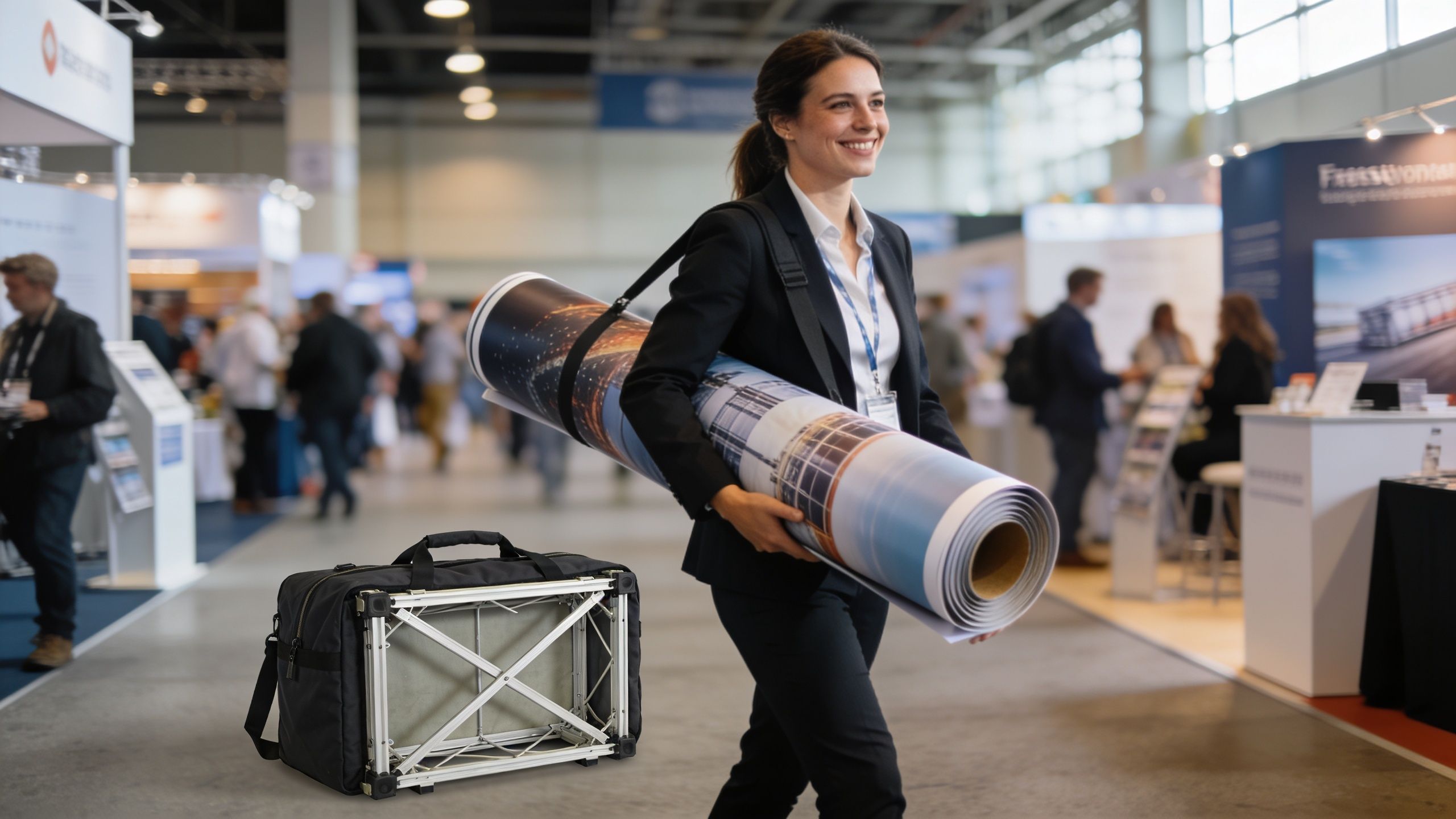
- Portable logistics: The frame breaks down and the fabric rolls or folds, so you’re not shipping rigid panels every time.
- Faster floor execution: In Las Vegas trade shows, exhibitors using fabric systems reported a 40-minute faster setup and higher visual impact than traditional displays, according to Craftsmen Industries.
That setup advantage is real. A lot of teams don’t need their booth to be flashy. They need it to be reliable, lightweight, and quick to get show-ready.
Practical rule: If your message won’t change for months and you only need a branded backdrop, fabric is usually the sensible option.
Where it starts to fall short
This is the part many buyers skip.
A fabric wall is still a static wall. It says one thing, one way, until you pay to change it. That’s fine for a logo backdrop. It’s limiting for product launches, demos, campaigns with multiple verticals, or any booth where different audiences need different messages.
The weak points are practical, not theoretical:
| Decision area | Tension fabric backdrop reality |
|---|---|
| Message flexibility | You print one graphic and live with it until you order another |
| Wear over time | Repeated packing, handling, and show-floor accidents eventually affect appearance |
| Content depth | Great for branding. Weak for storytelling, motion, and live updates |
| Interactivity | None on its own. It’s a printed surface, not an engagement tool |
There’s also a branding issue. If your competitors are using animated content, product visuals, motion backgrounds, or live presentations, a static printed wall can make your booth look dated even when the graphic itself is well designed.
That doesn’t make tension fabric bad. It just means you should buy it for the right reason. Buy it because you need a portable printed environment. Don’t buy it if what you really need is attention, flexibility, and a booth that can change throughout the event.
Setup Teardown and Long-Term Maintenance
One reason exhibitors like a tension fabric backdrop is that setup is refreshingly straightforward. The better systems use numbered tubes, shock-corded poles, and a toolless frame design, so one person can build a standard display without a pile of hardware.
According to Portable Booths, a standard toolless system can be set up by a single person in under 5 minutes, and the compact, lightweight format can reduce drayage and labor costs by 25-30% compared with older pop-up banner systems.
What setup usually looks like
In practice, the process is simple:
- Lay out the frame pieces on a clean surface so you don’t drag the fabric across dirt or concrete.
- Match the numbered tubes and snap the frame together.
- Stand the frame upright and make sure the feet or supports are fully seated.
- Pull the graphic over the frame from the top like a sleeve.
- Zip it closed so the tension tightens the face and smooths the image.
That’s the upside. Now for the less glamorous part: ownership.
The maintenance people forget to budget for
Fabric looks easy on day one because it is. The maintenance shows up later, between events.
- Store it dry: Don’t pack fabric that picked up moisture during teardown.
- Keep it off rough surfaces: Concrete floors, splintered crates, and sharp booth hardware can ruin a good print.
- Fold loosely or roll when possible: Hard creases are harder to recover from.
- Clean fast after spills: Coffee, tape residue, and dirty hands are common enemies on show sites.
Pack-down discipline matters. Most fabric damage doesn’t happen during the show. It happens during teardown when everyone is tired and rushing.
If your team is managing multiple events, the labor isn’t just assembly. It’s inspection, cleaning, repacking, storage, and deciding whether the graphic still looks good enough for the next show. That’s why experienced exhibitors should also review the operational side of trade show set up before choosing a display system. The booth you can manage repeatedly is the one that saves you money.
Tension Fabric vs LED Video Walls An Honest Comparison
Let’s get to the main decision.
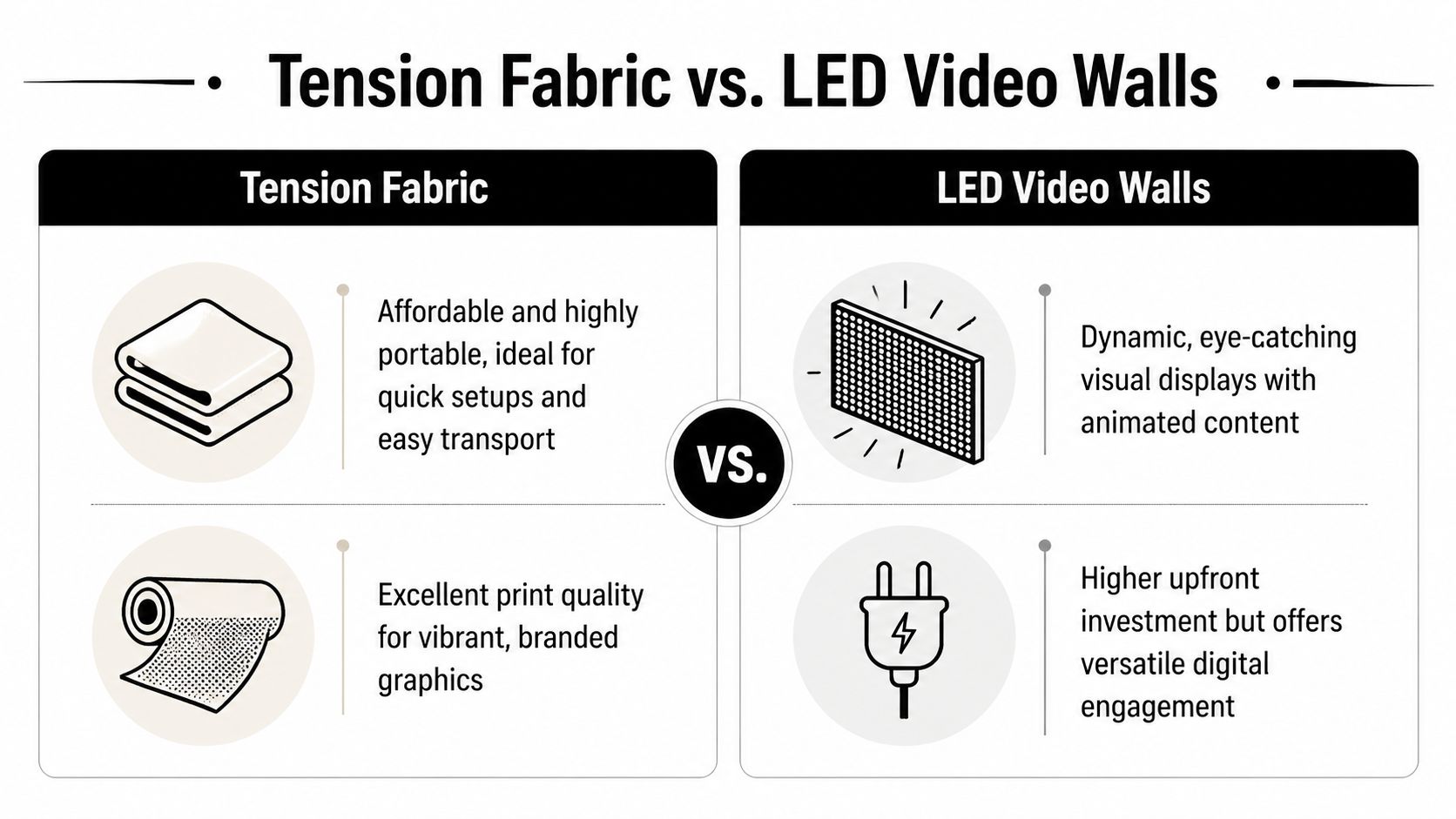
A tension fabric backdrop usually wins the upfront-price conversation. An LED wall usually wins the long-term-value conversation. If you only compare the initial invoice, you’ll miss the part that affects your program over multiple shows.
Upfront cost is not the same as total cost
Many articles on fabric backdrops falter here. They tell you fabric is affordable, portable, and easy to set up. That’s true. But they stop there.
The missing question is what happens after show one.
According to Vispronet’s discussion of tension fabric backdrops, tension fabric displays often have a lower upfront cost, but exhibitors attending multiple events still face recurring printing fees, fabric degradation, and storage costs. By contrast, LED video walls use reusable digital content, which removes those repeated print-and-store cycles.
That’s the key comparison. Not cheap versus expensive. Static asset versus reusable media platform.
What fabric gives you and what it doesn’t
A fabric backdrop gives you one polished message at a time. If you’re running a simple booth and your campaign is stable, that can be enough.
But if your team needs to do any of the following, fabric starts showing its limits fast:
- Switch messaging by audience
- Feature multiple products in one footprint
- Run motion graphics or demo loops
- Update content without ordering a new print
- Create visual energy from a distance
Those are not edge cases anymore. They’re normal expectations on competitive show floors.
If your booth needs to do more than identify your brand, static fabric starts working against you.
Why LED walls have become the smarter tool
An LED wall turns your booth from a printed background into a live communication surface. That changes how you sell on the floor.
Instead of choosing one headline and locking it in for the entire event, you can rotate product messages, feature customer segments at different times, support presentations, show launch visuals, and adapt content without rebuilding the booth.
Here’s the practical difference:
| Decision factor | Tension fabric backdrop | LED video wall |
|---|---|---|
| Visual format | Static printed graphic | Dynamic digital content |
| Best use case | Branding wall, photo area, simple booth | Product launch, demos, campaigns, storytelling |
| Content changes | Requires new printed graphic | Done digitally |
| Storage burden | Physical graphics and hardware | Digital content updates replace print cycles |
| Floor impact | Professional but fixed | More adaptable and more attention-grabbing |
Resolution matters more than most exhibitors realize
Not all LED walls are equal. As a result, inexperienced buyers get burned.
Pixel pitch affects how sharp the wall looks, especially at closer trade show viewing distances. We recommend paying attention to that before you compare vendors on price alone. Our view is simple: 1.9 pitch is a stronger choice when many competitors are still offering 2.5 pitch, because the tighter pitch delivers higher resolution and a cleaner image.
That matters at a booth where attendees stand close, not across a stadium. Product visuals, brand video, text treatment, and motion all look more refined when the wall has the resolution to support them.
Service is part of the value, not an add-on
This is the part many exhibitors underweight until something goes wrong onsite.
A fabric wall is simple, which is good. But if you want a modern visual system without operational headaches, service becomes part of the product. We think turnkey matters more than brochure features.
What we look for in a serious LED partner is straightforward:
- Transparent pricing: Everything should be included except the charges the show bills directly, such as electricity and material handling.
- White-glove execution: The provider should handle logistics, install, and support instead of leaving your team to coordinate vendors.
- Onsite technician coverage: If a problem shows up while the floor is open, you should have immediate support, not a phone tree.
That last point is a huge separator. If an audiovisual technician is onsite the entire time the show is open, your staff can stay focused on attendees instead of troubleshooting gear.
My recommendation
If you exhibit occasionally, use one message, and need a straightforward branded wall, a tension fabric backdrop is still a solid choice.
If you exhibit often, launch products, target different buyer groups, or want your booth to feel current instead of merely competent, move to LED. The difference isn’t cosmetic. It changes what your booth can do.
For brands evaluating formats side by side, these video display walls show why digital booth structures are replacing static backdrops in more serious exhibit programs.
Choosing the Right Canvas for Your Brand Story
The right choice comes down to ambition.
If you need a budget-friendly branded backdrop for a basic footprint, a tension fabric backdrop can do the job. It’s practical, portable, and proven. For first-time exhibitors, simple step-and-repeat environments, or one-message booths, it still makes sense.
If you want stronger engagement, faster content updates, and a booth that doesn’t feel locked into one printed moment, go digital. That’s the cleaner long-term play for active exhibitors.
One useful way to frame the decision is this: fabric is a backdrop, LED is a communication system. Those are not the same thing.
If you’re still weighing traditional graphics against more modern display options, this comparison of SEG graphics vs hard panel graphics is also helpful because it sharpens the bigger question of whether static print is still the right medium for your booth strategy.
If you’re ready to move beyond a static backdrop, talk to LED Exhibit Booths. We build turnkey video wall trade show displays with higher-resolution 1.9 pitch options, while many competitors still offer 2.5 pitch. Our pricing includes everything except the charges the show bills you directly, such as electricity and material handling. We also provide white-glove service and keep an AV technician onsite the entire time the trade show is open, so your team can focus on meeting customers instead of managing booth tech.