
Most exhibitors start with the wrong question. They ask, “What does the trade show display wall cost?” The more useful question is, “What will this choice cost me by the time the show opens, the booth is staffed, the content is running, and something goes wrong at 2:15 p.m. on day one?”
That’s where a trade show display wall stops being a line item and becomes an operating decision. On paper, a printed backdrop, a monitor array, and a continuous LED wall can all look like ways to fill the back of a booth. On a live show floor, they behave very differently. One gives you static branding. One gives you motion with visible seams and a lot of parts. One turns the booth itself into a digital surface that can sell, demo, and adapt.
The difference shows up in attention, labor, shipping, setup stress, and how much your team can focus on actual buyers instead of booth problems. If you’re comparing options for an upcoming show, that’s the lens worth using.
Why Your Booth Needs More Than Just a Backdrop for a Trade Show Display Wall
You already know the scene. The aisle is crowded. Every booth is trying to do the same thing at once. Sales reps are smiling, screens are flashing, product samples are out, and attendees are walking fast because they’re late to the next meeting.
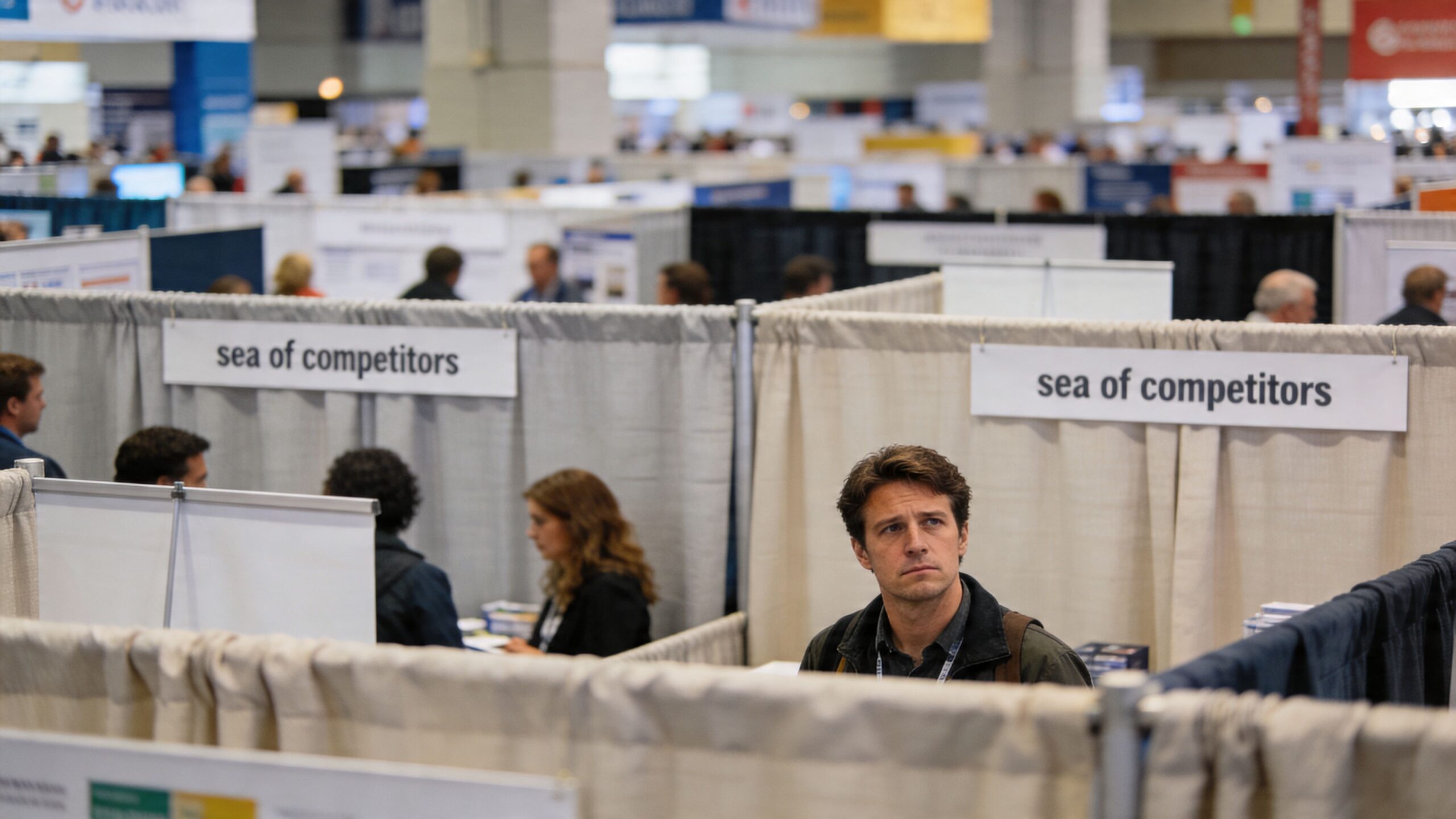
In that environment, a trade show display wall can’t just “look nice.” It has to stop people long enough for your team to start a conversation. The U.S. trade show industry generated $15.8 billion in 2024 and is projected to reach $17.3 billion by 2028. In the middle of that competition, 76% of attendees say booth design directly influences their decision to visit, according to trade show booth design statistics.
That aligns with what experienced exhibitors see in real life. People decide with their eyes first. They only evaluate your offer after your space gives them a reason to slow down.
The trade show display wall sets the first impression
A weak back wall makes the whole booth feel temporary, even when the product is strong. A strong one gives structure to everything else. It frames your message, controls sightlines from the aisle, and tells visitors whether your brand feels current or dated.
If you’re refining the overall look of your exhibit, it helps to think beyond the hardware and spend time building a visual brand identity that can scale across motion, graphics, demos, and signage.
A booth usually wins or loses attention before anyone reads a headline.
Cheap-looking isn’t the same as inexpensive
A lot of exhibitors still treat the back wall as a passive surface. They pick a printed panel because it’s familiar, or they rent a few monitors because “video is better than static.” Sometimes that’s enough. Often it isn’t.
A display wall should do at least three jobs:
- Pull attention from the aisle: It has to compete visually before your staff can compete verbally.
- Carry the brand story: People should understand what you do within seconds.
- Support the booth plan: Demos, meetings, product launches, and lead capture all work better when the wall is part of the strategy.
If you need inspiration before locking a concept, reviewing trade show booth design ideas can help clarify what fits your space, message, and traffic goals.
Understanding the Modern Trade Show Display Wall
The market lumps very different products into the same category. “Display wall” can mean a printed fabric backdrop, a hard-panel modular wall, a cluster of mounted TVs, or a continuous LED structure. They aren’t interchangeable.
The simplest way to think about them is this. Some walls are surfaces. Others are systems.
Printed walls and modular panels
Fabric walls and printed panel systems are the standard entry point. They’re widely used because they’re familiar, relatively straightforward, and good for static branding. If your message doesn’t change, your budget is tight, and your booth needs only a clean backdrop, they can do the job.
They also have obvious limits. They don’t move. They can’t adapt during the day. They can’t carry product animation, timed messaging, or ambient motion that changes the mood of the booth. Once the graphic is printed, you’re committed.
Modular panel systems add more structure. They can include shelving, storage, and architectural elements. They often look more substantial than basic fabric. But they also add parts, packing complexity, and more assembly decisions on site.
Monitor walls and where they fall short
Many exhibitors try to bridge the gap with stacked monitors. On paper, that sounds modern. You get dynamic content without stepping into full LED. In practice, monitor walls often create their own problems.
The seams are the first issue. Bezels break the image into boxes, which matters a lot if you’re running brand video, product animations, or motion backgrounds. Cabling and mounting hardware add more complexity. Weight adds more handling. The result can still look better than static print, but it rarely feels integrated.
If attendees notice the screens before they notice the message, the display is working against you.
Seamless LED trade show display walls
A continuous LED trade show display wall works differently because the wall itself becomes the display surface. You’re not hanging content on the booth. You’re building the booth out of digital canvas.
That changes the design conversation. Curves, columns, back walls, counters, and structural features can all become active visual elements. You can run brand motion, product demos, ambient loops, schedules, testimonials, or live presentation content across one uninterrupted surface.
Here’s the practical distinction:
- Static wall: good for fixed branding
- Monitor wall: good for motion, but with visible interruptions
- Continuous LED wall: good for immersive storytelling and flexible content delivery
Why the distinction matters on site
The difference shows up after freight arrives and install begins. A display option that looked inexpensive in a quote can become expensive when it requires more coordination, more troubleshooting, and more compromises in final presentation.
For exhibitors who rotate campaigns, launch products, or need the booth to feel current every show, an adaptable system behaves more like a platform than a prop. That’s the difference between a static painting and a digital canvas. One displays a message. The other can perform one.
Comparing Display Types LED vs Fabric vs Monitors
When exhibitors compare options objectively, the conversation usually shifts away from “What’s cheapest?” and toward “What creates the least friction while still drawing people in?” That’s the right comparison.
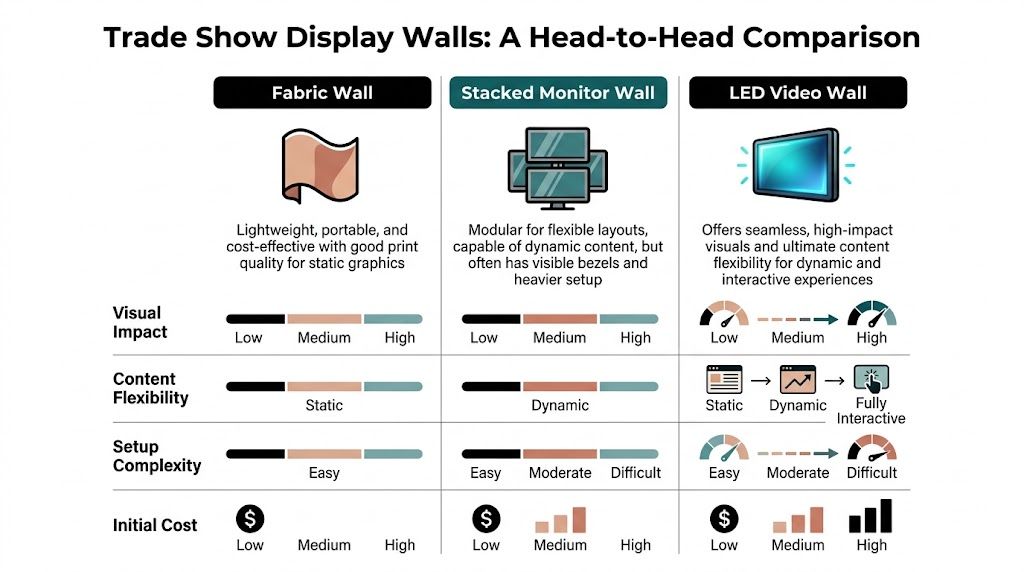
The big three categories are fabric walls, stacked monitor walls, and continuous LED video walls. Each has a place. They just don’t solve the same problem.
What changes when content moves
Static graphics can still work, especially for a simple brand presence. But dynamic content gives you more ways to earn attention. Interactive elements integrated into display walls can boost visitor engagement by up to 50% compared with static displays, as noted earlier in the article’s referenced research.
That doesn’t mean every booth needs touchscreens or elaborate motion effects. It means motion, sequencing, and live content can hold attention longer than a printed message that attendees absorb in one glance.
The practical trade-offs
Fabric walls are portable and familiar. They’re often the easiest to understand and approve internally. The downside is creative rigidity. If your team wants to update messaging between shows, support product launches, or shift the booth mood throughout the day, print locks you in.
Stacked monitor walls solve some of that. They let you run demos and video. But they also introduce bezel lines, more hardware, more points of failure, and a less unified look. When a monitor goes dark or a mount shifts, the whole wall starts to feel improvised.
LED walls with a continuous display carry the highest upfront commitment among the three, but they remove many of the visual compromises. They also let the exhibit do more with less clutter. Instead of adding separate signs, screens, and feature areas, the wall itself can do that work.
Trade Show Display Wall Technology Comparison
| Feature | Fabric/Printed Wall | Stacked Monitor Wall | Seamless LED Video Wall |
|---|---|---|---|
| Visual impact | Clean but static | Dynamic but segmented | High-impact and continuous |
| Content flexibility | Fixed graphics | Video-capable | Video, ambient motion, demos, interactive content |
| Setup complexity | Usually simple | Moderate to difficult due to mounts, wiring, and alignment | Depends on system design, often streamlined with integrated tiles |
| Durability in use | Good for repeated static use | Depends on monitor mounts and transport handling | Strong when built as modular event-grade panels |
| Aisle presence | Adequate for simple branding | Better than print, but seams distract | Strongest visual statement |
| Best fit | Budget-conscious, low-change messaging | Brands needing video without full LED build | Brands prioritizing impact, flexibility, and immersion |
What works and what doesn’t with trade show display walls
What works:
- Fabric walls for simple programs: Good when you need a clean branded background and nothing more.
- Monitor walls for selective motion use: Useful if your content is screen-based and you can live with segmented visuals.
- Continuous LED for active storytelling: Best suited to launches, demos, high-traffic goals, and premium brand presentation.
What often disappoints:
- Overdesigned static walls: They still can’t change once printed.
- Monitor stacks pretending to be video walls: The bezels always show.
- Cheap systems with fragmented vendors: When graphics, AV, labor, and support all sit with different providers, small problems multiply fast.
If you’re evaluating portable structures before moving to a digital format, it’s worth reviewing different pop-up wall options so you can compare convenience against long-term flexibility.
Buyers don’t separate your screen choice from your brand quality. They read the whole booth as one signal.
How to Select the Right LED Video Wall
Once you’ve decided to use LED, the next mistake is buying on size alone. A large wall with the wrong specs can look worse than a smaller wall with the right ones. The details matter most when attendees stand close, which is exactly what happens in most inline booths.
Pixel pitch is the first thing to check
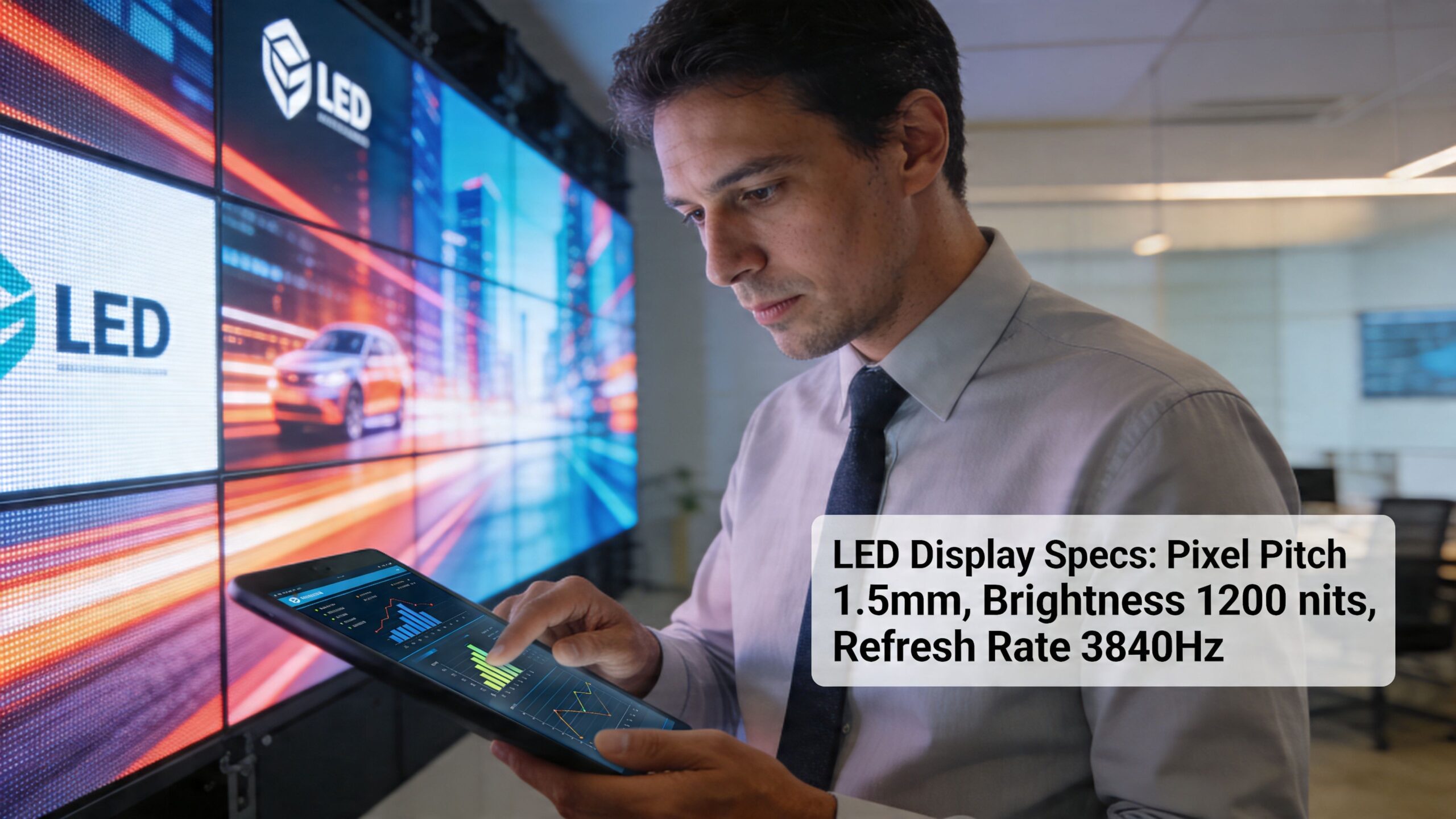
Pixel pitch is the distance between LED pixels. Smaller pitch means tighter pixel spacing and a sharper image at close range. For a typical 10-foot booth where people are only a few feet from the wall, that matters a lot.
The author brief calls out an important market reality. Many providers offer 2.5mm pitch. Our walls use 1.9mm pitch, which means higher resolution and a cleaner image up close. The verified data supports the core principle here. For a close-viewing booth, a 1.9mm pitch ensures pixels are indistinguishable, while a 3840Hz refresh rate eliminates flicker in videos, based on the LED wall technical reference.
That’s not a spec-sheet brag. It affects what visitors see. Fine text holds together better. Product renders look more polished. Motion graphics feel premium instead of noisy.
Refresh rate and why flicker matters
A booth wall isn’t a living room TV. It’s being filmed on phones, viewed from angles, and used under ugly venue lighting. A higher refresh rate keeps motion smooth and avoids the on-camera flicker that makes content look cheap.
If you’re showing software, medical imagery, product detail, or fast motion, refresh rate matters almost as much as pitch.
Brightness and viewing conditions
Trade show halls are unpredictable. Some booths sit under harsh overheads. Others catch ambient light from entrances, windows, or neighboring displays. LED gives you brightness headroom that standard displays often struggle to match.
The question isn’t just “How bright is it?” It’s “Can it stay legible without looking washed out or overly harsh?” A good system balances brightness with content design, so logos, text, and motion all read clearly.
Ask how the wall is built, not just how it looks
Many quotes often obscure the actual story. Two LED walls can look similar in a rendering and behave very differently on site.
Ask these questions:
- How do the panels connect? Magnetic tiles and toolless locking systems usually reduce setup friction.
- How much structure is required? More support often means more labor and more handling.
- How is content managed? You need simple playback, not a booth-side tech puzzle.
- What happens if a module has an issue? Fast service matters more than promises.
A short product walk-through helps make these differences concrete:
Match the wall to the booth objective
The right wall depends on what the booth is trying to do.
For a 10-foot inline booth
Prioritize close-range image quality, clean branding, and content restraint. One strong loop often outperforms a cluttered playlist. Here, 1.9 pitch is especially valuable.
For a larger footprint
Think in zones. Use one section for brand atmosphere, one for product proof, and one for scheduled messaging or demos. A larger wall shouldn’t mean more noise. It should mean better control of attention.
For exhibitors who don’t want technical surprises
Choose a provider that handles hardware, content guidance, logistics, and support as one package. One example in this category is LED video wall rental, where the wall, structure, and event execution are planned together instead of split across multiple vendors.
The Turnkey Service Advantage for Exhibitors
The biggest hidden cost in a trade show display wall usually isn’t the display. It’s everything around it. Shipping coordination. Install labor. Dismantle timing. Missing parts. Content loading. Last-minute troubleshooting. Storage after the event. None of that shows up clearly when people compare line-item prices.
That’s why the buy-versus-rent decision should be based on operating reality, not just asset ownership.
When buying makes sense
For brands that exhibit constantly, ownership can make sense. The verified data notes that a durable modular system can reduce replacement needs by over 40% over three years, while a turnkey rental avoids capital expense, maintenance, and storage. That’s a real trade-off, and not every exhibitor should rent forever.
If your team already manages logistics well, has internal exhibit operations support, and wants control over a reusable system, buying may fit.
Why many exhibitors still choose turnkey
Most marketing teams don’t want to become part-time exhibit logistics managers. They want the booth to work, the content to run, and the team to stay focused on prospects.
That’s where a white-glove model changes the equation. Our pricing includes everything except the charges the show bills you directly, such as electricity and material handling. Shipping, setup, dismantle, and support are included. That’s a very different experience from stitching together a fabricator, AV vendor, I&D crew, and on-site freelancer.
Practical rule: The cheaper booth quote often becomes the expensive option once labor, coordination, and failure risk are added back in.
The value of on-site support
This part matters more than most buyers expect. A display can look perfect in a render and still hit a problem during show hours. Playback freezes. A connection gets bumped. A setting changes. A panel needs attention.
In a fragmented setup, your staff starts making calls. They text the exhibit house, then the AV company, then the labor lead, while your prospects stand there. That’s a bad use of expensive show time.
With a turnkey model, an audiovisual technician remains on site while the trade show is open. If something goes wrong, you text or call, and an AV technician comes to the booth within minutes to resolve it. That support structure doesn’t just protect the wall. It protects your team’s time and your brand’s presentation.
What serious exhibitors are really buying
They’re not just renting a wall. They’re buying fewer handoffs, fewer surprises, and fewer moments where a salesperson has to stop selling to troubleshoot hardware.
That matters even more for exhibitors running launches, scheduled demos, or high-value meetings. In those environments, peace of mind has operational value.
If you’re comparing service models, look closely at what a trade show display company includes in the quoted scope. The language around “support” and “turnkey” varies a lot across vendors.
A fragmented approach can still work. Plenty of teams pull it off. But it usually works because someone on the client side absorbs the stress. Most companies are better served by putting that burden on the provider instead.
Designing Content for an Immersive Experience
A powerful trade show display wall still fails if the content is weak. Often, this results in many booths underperforming. They invest in hardware, then run a generic slide deck, a stretched product reel, or a loop with too much text to read from the aisle.
Content should be built for movement, distance, and attention span. Visitors don’t consume a booth wall the way they consume a website. They glance first, interpret second, and only then decide whether to step in.
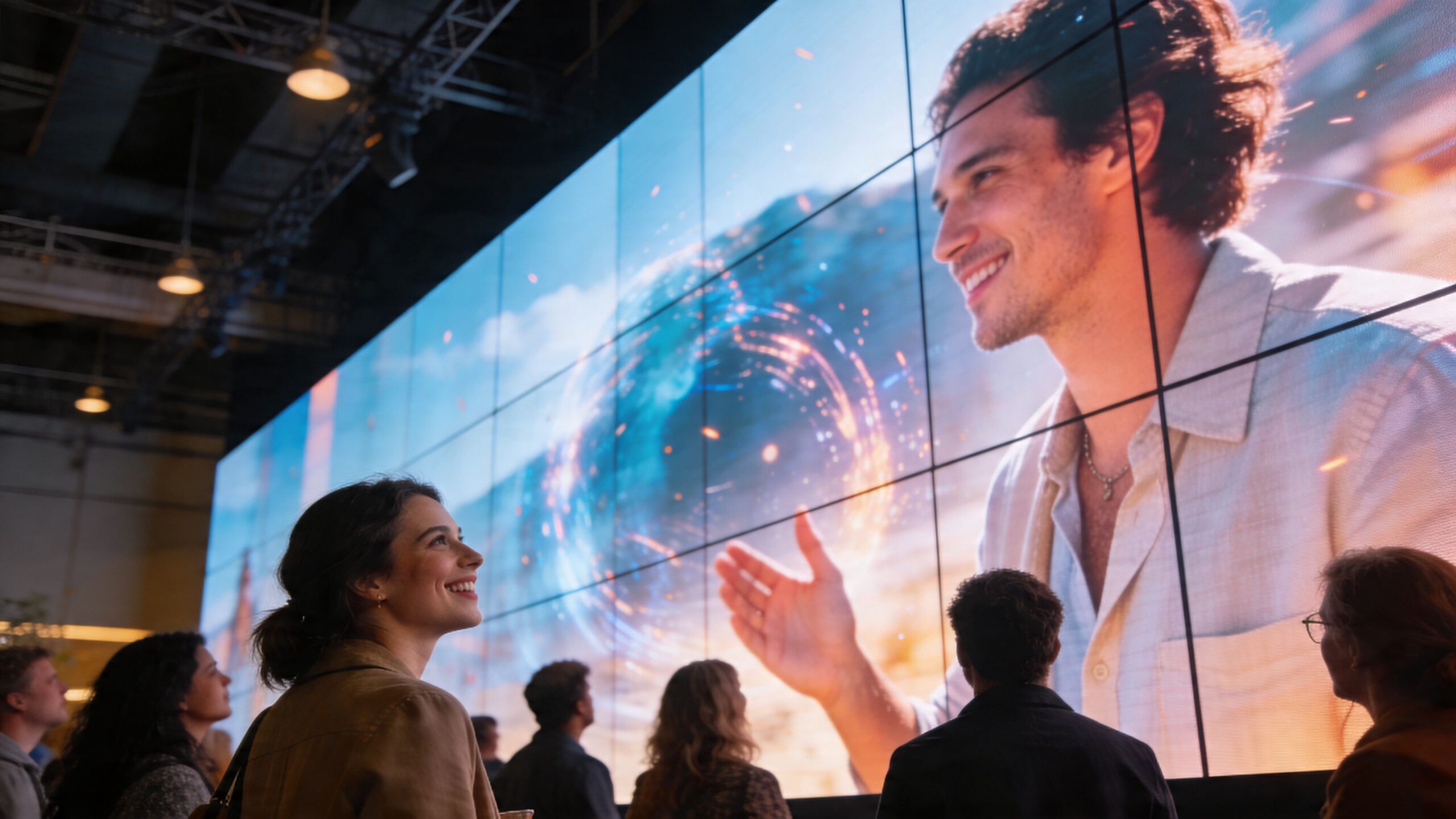
Start with one message, not five
Most show content gets overloaded because too many stakeholders want their point included. The aisle viewer doesn’t care about your org chart, product family tree, and quarterly messaging hierarchy. They care whether you solve a problem they recognize.
A better approach is to build the loop around one central promise, then support it with motion, proof points, and product visuals.
Keep the brand visually consistent
Digital walls become much more effective than random content playlists. When the logo, color system, typography, motion style, and product imagery all feel unified, the booth becomes easier to remember. The verified data notes that consistent branding across a large digital display wall can enhance brand recall by as much as 80%, as referenced earlier.
That doesn’t mean every frame should look identical. It means the wall should feel like one branded environment.
If your loop looks like three agencies built it on three different deadlines, attendees will feel that even if they can’t name it.
What content works by booth type
In a smaller inline booth
Use a concise content loop with strong motion backgrounds, one clear headline at a time, and product visuals that read quickly. Silence is fine. Most loops don’t need audio to do their job.
In a larger island or peninsula
Break the content into zones. One area can run ambient brand motion. Another can support product demos. A third can shift to scheduled presentations or proof-driven visuals during peak traffic windows.
For launches and live selling
Use timed sequences. Start with broad attention-grabbing motion, then switch to product detail when reps begin demos. The wall should support the conversation your team is trying to have at that moment.
A few practical content rules for your trade show display wall
- Design for distance first: If the message doesn’t read from the aisle, it won’t earn the closer look.
- Use motion with restraint: Constant aggressive movement gets ignored fast.
- Avoid dense copy: Booth walls are not brochures.
- Plan transitions carefully: Abrupt scene changes can make the wall feel chaotic.
- Build for the screen shape: Don’t force standard presentation slides into a custom-format display.
For exhibitors who need help creating loops, demo visuals, or motion systems built specifically for event screens, video wall video production is the kind of support worth considering.
Making the Right Choice for Your Next Show
A trade show display wall affects more than appearance. It shapes traffic, booth flow, setup complexity, content strategy, and how much pressure lands on your staff during the event.
That’s why the cheapest path on day one often isn’t the least expensive path by show day. A lower upfront quote can still produce more labor, more drayage exposure, more coordination headaches, and more visual compromise. Those costs are real even when they don’t sit in the first proposal.
The decision usually comes down to three priorities
- If budget is the only concern: A printed wall may be enough for a simple presence.
- If you need motion but can tolerate compromises: Monitor arrays can work, though gaps and hardware often limit the effect.
- If you care about image quality, flexibility, and smoother execution: A continuous LED approach is usually the stronger long-term operating choice.
The most successful exhibitors also think beyond the wall itself. Staff presentation, messaging, demo flow, and brand consistency all need to line up. Even details like custom branded apparel can reinforce a more cohesive booth presence when the team and the environment feel like one system.
Choose the display type that matches how you exhibit, not how you wish the event will go. If your team needs reliability, quick issue resolution, and a booth that works as hard as your sales staff does, evaluate the service model as carefully as the technology.
If you’re planning your next exhibit and want a trade show display wall that combines unified LED technology with turnkey execution, talk with us at LED Exhibit Booths. Our team handles the booth as an integrated system so your staff can stay focused on meeting prospects, running demos, and closing business.