
You’re probably dealing with the same trade show problem most marketing managers hit sooner or later. The modular trade show booth looked great in the render. Then reality showed up. Multiple vendors. Freight deadlines. Labor forms. A crate full of parts your team doesn’t want to touch. Then the show floor opens and the booth still feels static, dated, and harder to work in than it should be. Naturally, there are a lot of unique trade show booth ideas.
That’s why the modular trade show booth has moved from a budget option to a serious exhibiting strategy. Companies aren’t just trying to save money. They’re trying to stay flexible, protect their timeline, and show up with something that still looks current a year from now. Additionally, many people prefer lightweight trade show booths.
That shift is happening inside a growing market. The global modular booth market was valued at USD 1.2 billion in 2024 and is projected to reach USD 2.5 billion by 2034, growing at a 7.5% CAGR, while the US B2B trade show market reached $15.8 billion in 2024, according to Emergen Research’s modular booth market analysis. Exhibitors are back in force. Expectations are higher. The old model of building one rigid booth and forcing it into every show no longer fits current operational practices.
A good modular system solves the obvious problems first. For instance, it reduces setup friction. Plus, it adapts to different footprints. Additionally, it keeps the brand presentation cleaner from show to show.
A great one goes further. It turns the booth into the presentation itself.
Beyond the Crate The Modern Exhibitor’s Challenge
A lot of booth problems start before the event even opens.
The marketing team signs off on a design. Operations asks how it ships. Sales wants demo screens. The exhibit house needs approvals. Show services need forms. Then material handling hits the budget harder than expected, labor windows get tight, and the whole booth starts dictating the plan instead of supporting it.
That’s the old crate mindset. Build it once, pack it in heavy pieces, and hope each venue cooperates.
Where traditional booths break down and a modular trade show booth shines
Custom booths still have their place. If you have one flagship event, a large footprint, and a long installation window, custom fabrication can make sense. But a lot of exhibitors don’t live in that world.
They’re moving between different booth sizes, different cities, and different goals. One event is lead gen. The next is a product launch. The one after that is partner recruitment. A rigid booth system usually fights that reality.
The pressure is worse because events are growing again. As noted earlier, the market has rebounded hard, and exhibitors are investing in in-person presence. More spending in the category doesn’t automatically make execution easier. It usually raises the standard.
Booth stress rarely comes from branding alone. It comes from logistics, labor, and the moment your team realizes the exhibit is harder to manage than the event itself.
The strategic shift to modular trade show booths
A modular trade show booth changes the conversation.
Instead of asking, “How do we ship this one big idea?” the better question is, “How do we build a repeatable system that can evolve?” That’s a different way to exhibit. It treats the booth as a kit of adaptable assets rather than a one-time scenic build.
That approach matters if your team wants to spend less time chasing vendors and more time talking to buyers. It also matters if you’re trying to avoid the most common trade show trap, which is spending heavily on structure while underinvesting in the actual attendee experience.
Modular done right doesn’t look temporary. It looks intentional. And in many cases, it looks sharper than older custom work because the system was designed for speed, reconfiguration, and integrated media from the start.
What Exactly Is a Modular Trade Show Booth
A modular trade show booth is a reusable exhibit system built from standardized components that can be configured into different layouts without starting over each time. That definition matters because the value is not just portability. It is repeatability, controlled costs, and the ability to update the experience as your event program changes.
The older version of modular usually meant panels, counters, and printed graphics arranged a few different ways. The current version is broader. Strong systems still use frames, connectors, and interchangeable surfaces, but the better booths now integrate lighting, monitor mounts, storage, charging, and full LED video walls as part of the structure instead of tacking technology on at the end. That shift is a big reason modern modular can outperform traditional custom builds on both speed and attendee engagement.
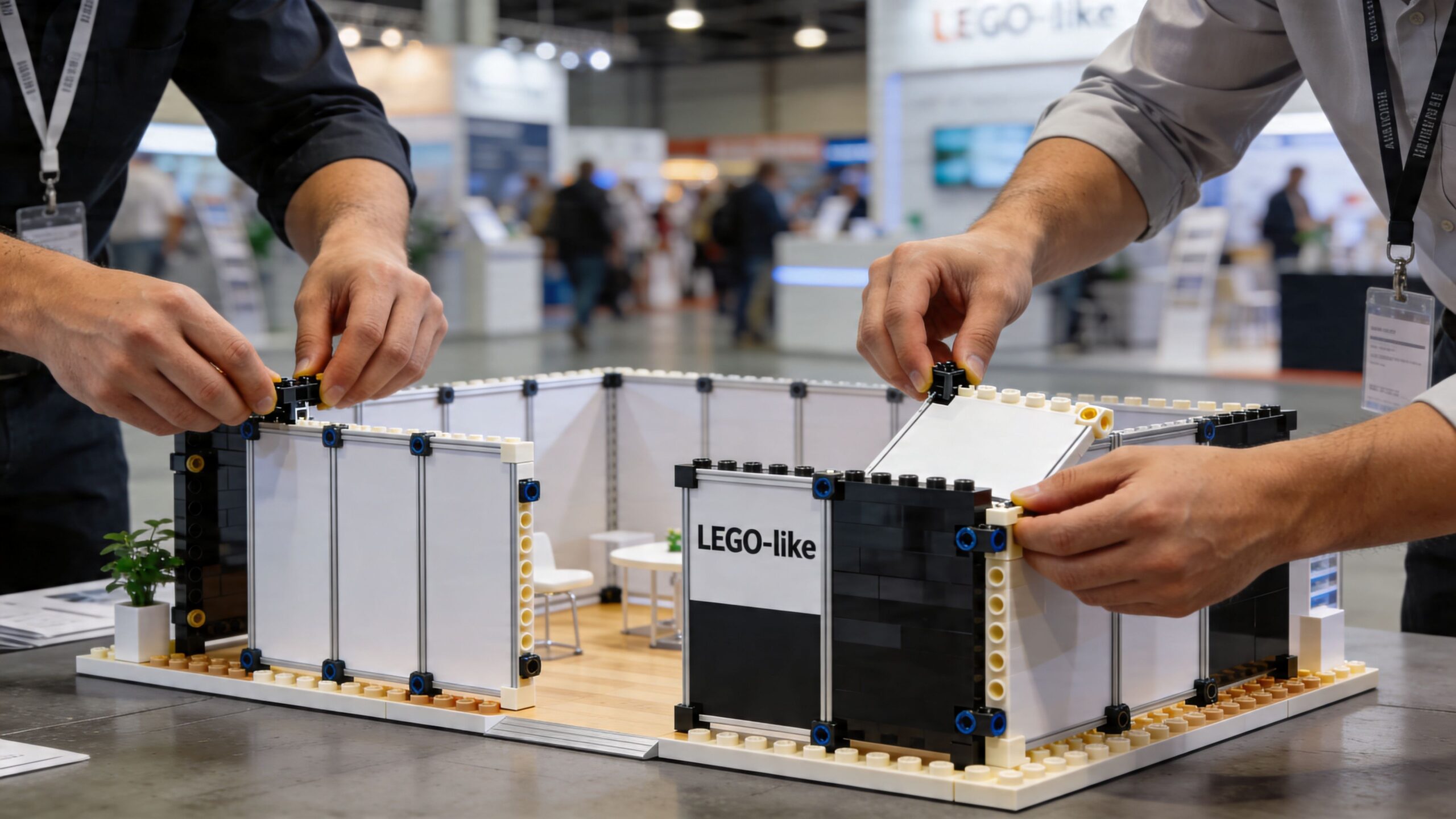
The basic anatomy of a modular trade show booth
Most modular booth systems rely on precision-engineered aluminum or composite frames with quick-lock connectors and attachment points for graphics, shelving, counters, and screens. Crews build the structure in a predictable order, then layer in branding and tech. That consistency is what keeps labor more manageable show after show.
If you have seen modular office environments reworked without replacing everything, the same logic applies here. This explanation of What Is Modular Furniture? is useful because it shows how standardized parts create flexibility without giving up function or finish.
Why that matters on the show floor
A modular booth gives marketing teams a stable platform, not a one-off build that has to be reinvented every quarter. The practical advantage is continuity. Your counters, demo areas, storage, and media positions can stay disciplined even when the footprint changes.
That becomes more important as exhibits get more digital. In a traditional setup, screens often feel added on. In a well-designed modular system, LED tiles, monitor mounts, cable routing, and power planning are built into the exhibit from the beginning. The result is cleaner sightlines, faster setup, and a booth that can shift from branded backdrop to motion-driven product story without a full rebuild.
Here’s what a well-specified modular system usually gives you:
- Reconfigurable structure: Core components can support multiple booth sizes and layouts.
- Predictable installs: Standardized parts reduce guesswork for I&D crews.
- Faster message updates: Graphics, content, and digital elements can be changed without replacing the whole booth.
- Better tech integration: Lighting, monitors, and LED features fit the system instead of fighting it.
- Lower waste over time: More of the exhibit gets reused across the event calendar.
If your team is starting smaller, these portable trade show booth options show how many exhibitors begin with compact modular pieces, then expand into larger environments as their program grows.
A short visual helps if you haven’t seen one come together in person.
What a modular trade show booth is not
Modular booths are engineered exhibit systems with real structural discipline. Good ones do not read as temporary, and the best ones do not look generic once the hall opens.
That distinction matters because a lot of buyers still picture lightweight pop-ups or flat panel kits from a decade ago. Modern modular, especially systems designed around integrated LED video, can deliver motion, scale, and repeated use with less waste than scenic custom builds. The trade-off is that the design has to respect the system. You get flexibility and efficiency, but only if the booth is planned around the component set, the content strategy, and the service team that has to ship, install, store, and redeploy it.
Exploring the Types of Modular Trade Show Booth Systems
Not all modular booths belong in the same bucket. Some are basic. Yet, there are modular booths that are polished. However, some are flexible enough to carry a full campaign across multiple shows. The differences matter because they affect visual impact, labor, storage, and how current your booth looks once the hall fills up.
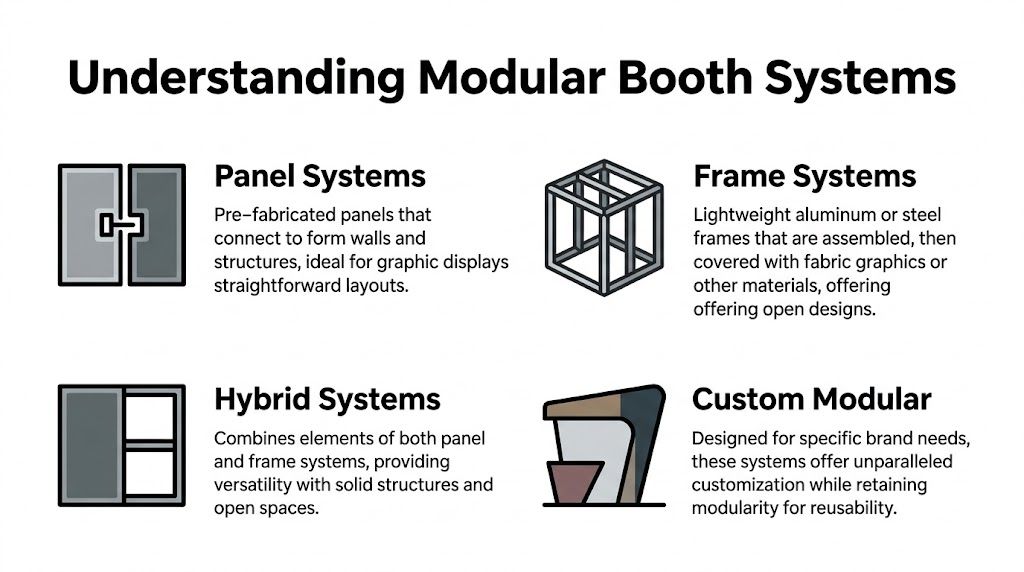
Panel systems
Panel systems are the classic starting point.
These booths use prefabricated wall sections that connect into a simple structure. They’re straightforward, usually clean-looking, and often work well for exhibitors with limited product lines or a very controlled message.
Their strength is predictability. Their weakness is that they can feel flat fast. If the graphic does all the work, the environment itself usually doesn’t.
Frame systems
Frame systems are lighter and more open. Instead of relying on solid wall sections, they use structural frames that support fabric graphics, shelving, lighting, and accessory mounts.
That gives designers more breathing room. It also makes the booth easier to adapt when you change layouts or need to update the message without replacing core structure.
Hybrid systems
Hybrid booths combine modular frameworks with selected custom elements.
This is often the practical middle ground. You keep the reusable backbone, then add branded counters, dimensional features, or specialty finishes where they matter most. It’s a good path for companies that want something distinctive but still need a system that travels well and adapts.
A lot of exhibitors who start with a pop-up display for trade show use eventually move into hybrid modular because they want more presence without taking on full custom complexity.
Integrated LED modular trade show booth systems
The category stops being just structural and starts becoming experiential.
Traditional modular booths usually rely on printed panels, fabric graphics, lightboxes, or mounted monitors. That still works. But it creates a hard ceiling on what the booth can communicate. Static graphics can’t tell a story the way motion can. And monitors stacked into a wall almost always introduce gaps, bezels, cables, or awkward mounting compromises.
That’s why the strongest current evolution is the integrated LED video wall modular booth. In this approach, the booth surfaces themselves become digital display architecture.
According to this analysis of modular display demand and video integration gaps, 68% of exhibitors seek video-integrated modular systems, yet only 12% find bezel-free options. That gap explains a lot of what I see on show floors. Brands want motion, immersion, and cleaner storytelling, but many available systems still bolt screens onto a booth instead of building video into it.
What works better in practice
If the goal is attention, integrated LED wins because it removes visual interruption. You’re no longer asking attendees to look at a booth and then separately look at a screen. The booth is the screen.
That changes several things at once:
- Message delivery: Motion carries farther down an aisle than static fabric.
- Visual cohesion: Smooth surfaces look intentional. Stacked monitors usually don’t.
- Content flexibility: You can change the story by time of day, audience, or product focus.
- Build efficiency: Toolless LED tile systems reduce the failure points common in more improvised video setups.
There’s also a quality difference inside LED itself. Pixel pitch matters. A 1.9 pitch wall presents finer detail than the more common 2.5 pitch systems you see from many vendors. That means sharper imagery at closer viewing distances, which matters in trade show environments where attendees often stand only a few feet away.
If your audience can walk right up to the wall, resolution stops being a technical spec and becomes a brand perception issue.
For brands trying to move beyond static backdrops, the integrated LED modular trade show booth is the most complete version of modular design right now.
The Unbeatable Benefits of a Modular Trade Show Booth Approach
The value of modular isn’t that it assembles differently. It’s that it behaves better over time.
A custom booth can look impressive at debut and become expensive baggage a season later. A modular trade show booth keeps earning its place because it adapts. That matters more than aesthetics alone.
Future-proofing the exhibit program
Marketing plans change. Booth sizes change. Product priorities change.
A modular system lets you rework the presentation without throwing away the structure. That protects the investment. You’re not locked into one footprint or one campaign expression.
In practical terms, that means you can:
- Resize intelligently: Use the same core system for different floor plans.
- Refresh creatively: Update graphics or digital content when messaging changes.
- Support multiple goals: Shift from lead gen to demos to meetings without replacing the entire booth.
That kind of flexibility is one of the main reasons modular has kept growing as a category. Teams want assets they can reuse, not scenic pieces they have to defend every budget cycle.
Lower operational friction
The best modular systems reduce the cost lines nobody enjoys discussing. Shipping. Labor. Material handling exposure. Install complexity.
Lightweight components, simpler assembly, and better packing logic all help. So does designing a booth that doesn’t require custom fabrication every time something changes.
Even when the upfront decision is driven by budget, the long-term advantage is often operational. Fewer surprises. Fewer one-off fixes. Less dependence on a single exact floor plan.
A booth isn’t efficient because it’s cheap. It’s efficient because your team can deploy it repeatedly without paying a penalty every time.
Sustainability that means something
Sustainability in exhibits gets tossed around too casually. Reusability is where the claim has to prove itself.
A reusable modular system can reduce waste in a way a one-time custom build usually can’t. A 2025 Freeman study found that reusable modular systems can reduce trade show waste by up to 52% compared to single-use custom builds, saving an average of 2.1 tons of CO2 per reuse cycle, as cited in Taylor’s overview of modular trade show booth designs.
That matters for companies with internal sustainability goals, but it also matters for simple operational discipline. Reuse is often good environmental practice because it’s also good systems management.
Better brand consistency
One of the most underrated benefits of a modular trade show booth is visual control.
When the same structural system carries through multiple events, your brand stops looking improvised. The booth may scale up or down, but the presentation remains coherent. That consistency helps attendees, sales teams, and partners recognize the brand faster.
Static modular systems already do this better than many ad hoc setups. Integrated LED modular systems go further because content becomes part of the architecture. You can maintain the same booth language while changing the story inside it.
That’s the difference between having a booth asset and having an exhibit platform.
Renting vs Buying Your Modular Trade Show Booth
This decision shouldn’t be emotional. It should be operational.
Some exhibitors buy too early because ownership feels efficient. Others rent too long because they don’t want to make a capital commitment. Both mistakes usually come from looking at the booth itself instead of the event program behind it.
The stakes are real. The US B2B trade show market is valued at $15.8 billion in 2024, and exhibitor costs can range from $5,000 for small shows to over $150,000 for large ones. The same market review notes that 34% of exhibitors increased budgets, which makes booth strategy more important, not less. That comes from Verified Market Reports’ modular booth market overview.
The practical test
Rent if your schedule, message, or booth size is still shifting.
Buy if your event calendar is stable, your footprint is predictable, and you know the system will get repeated use. Ownership can make sense for frequent exhibitors, but only if the company is also ready to manage storage, maintenance, refurbishment, and asset tracking.
A lot of marketing teams underestimate those last four items.
Renting vs. Buying a Modular Booth A Head-to-Head Comparison
| Consideration | Renting | Buying |
|---|---|---|
| Upfront commitment | Lower initial commitment and easier to classify as event spend | Higher initial commitment and usually more internal approval |
| Flexibility | Strong choice when booth sizes, campaigns, or show goals change often | Best when the booth system and use case are stable |
| Technology access | Easier to use current display formats without owning aging hardware | Good if you want full control, but upgrades become your responsibility |
| Storage and maintenance | Provider usually handles warehousing, upkeep, and replacement logistics | Your team or partners must manage inventory, repairs, and refresh cycles |
| Customization cadence | Strong for seasonal campaigns, launches, and one-off appearances | Better when the same structure supports a long-term program |
| Budget style | Fits teams that prefer operational spending | Fits teams comfortable with longer-term asset ownership |
When renting is the better call
Renting is often stronger than people think.
If you exhibit selectively, test new show formats, or need a turnkey path with fewer internal moving parts, rental usually wins. It also keeps you from getting stuck with old technology. That matters more when the booth includes digital presentation tools that evolve quickly.
If you’re evaluating rental paths, these trade show booth rental options give a good sense of how exhibitors approach flexibility without owning the full system.
When buying makes sense
Buying works best when the company has consistency.
That usually means a regular show schedule, repeatable booth sizes, internal logistics support, and enough lead time to manage the exhibit like an owned asset. In that case, ownership can give you continuity and stronger cost control over time.
The mistake is buying because the booth looked good at one show.
Buy because the operating model supports ownership. Rent when agility is the smarter advantage.
Designing for Impact Maximizing Your Modular Space
A modular booth should do more than fit the floor plan. It should guide behavior.
The strongest designs create movement, attention, and useful conversations without feeling crowded. That takes more than placing a logo on the back wall and dropping in a counter.
Build zones, not just walls
Even a small booth works better when it has purpose-built areas.
You don’t need hard barriers. You need cues. A front edge that welcomes. A visible demo point. A quieter area where sales can talk without blocking traffic. Modular systems make that easier because counters, frames, and media surfaces can define space without making it feel closed off.
Use the footprint to create three basic functions:
- Attract: Aisle-facing motion, lighting, or product visibility that catches attention.
- Engage: A central point where staff can start a conversation fast.
- Convert: A place for deeper demos, scans, or short meetings.
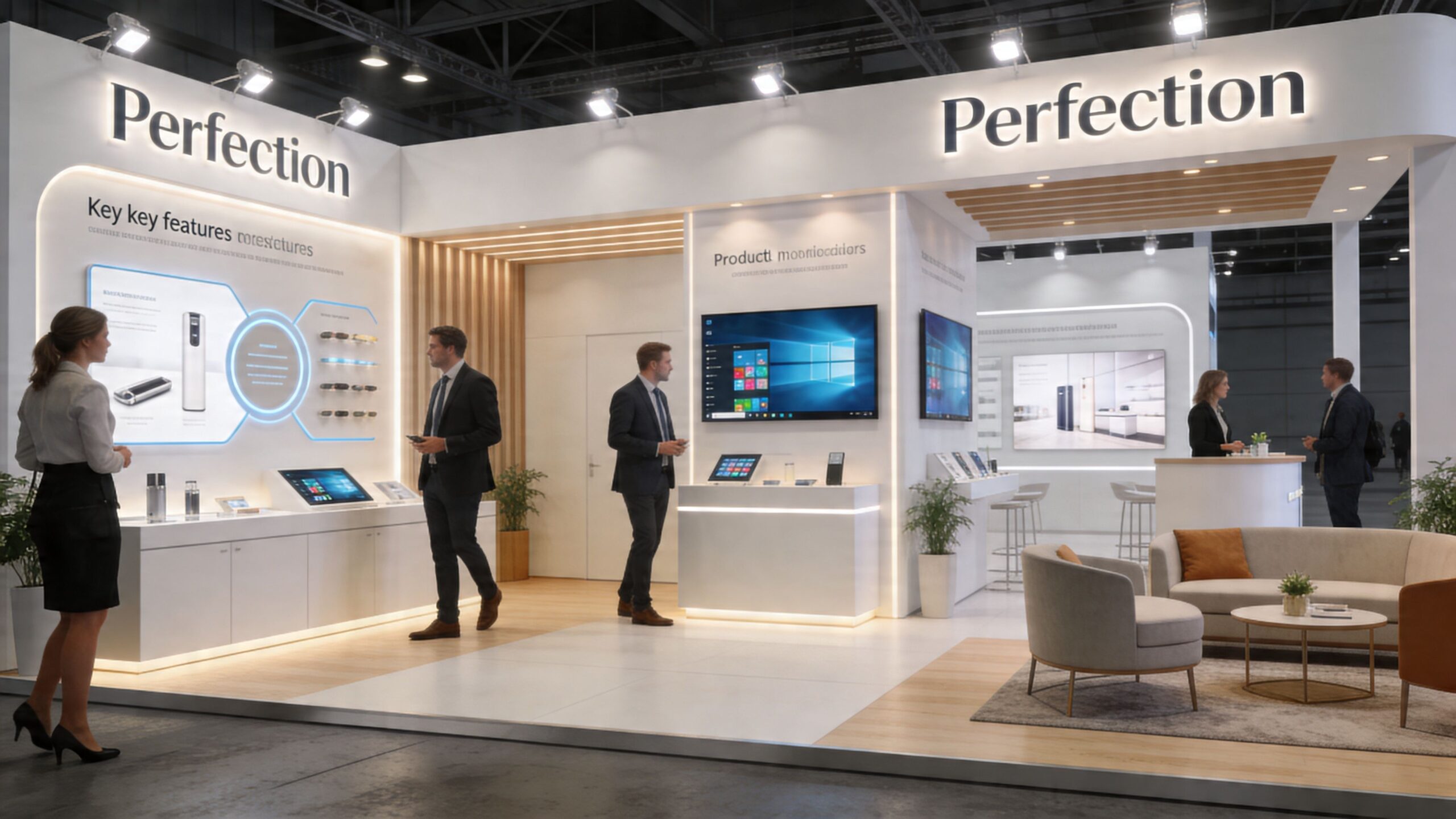
Design for motion and sightlines
Integrated LED surfaces stand apart from printed backdrops.
A static wall depends on someone already being close enough to read it. Motion works from farther away. But motion only helps if the content is designed for trade show conditions. Most brand videos are too slow, too detailed, or too reliant on audio.
What works better:
- Short visual loops: Keep the message readable from the aisle.
- Large headline moments: Prioritize one idea at a time.
- Product-first content: Show the offer, not just atmospheric brand footage.
- Directional movement: Use motion that pulls the eye inward rather than scattering attention.
For exhibitors planning a more immersive layout, these trade show booth design examples are useful for seeing how structure, traffic flow, and display surfaces work together.
Don’t waste close-range real estate
The front third of the booth does most of the work. That’s where attendees decide whether to stop or keep walking.
Keep that zone open. Don’t bury the demo behind furniture. Don’t force staff to stand behind a counter like receptionists. And don’t put your most important message where only people already inside the booth can see it.
Good booth design removes friction. Attendees should know where to look, where to stand, and what the booth is about within a few seconds.
A modular trade show booth gives you the flexibility to refine these details from show to show. That’s one of its biggest design advantages. You can learn, adjust, and come back better without rebuilding everything.
Your Turnkey Service and Logistics Checklist
Most booth failures aren’t design failures. They’re handoff failures.
The concept looked good. The vendor list got messy. Responsibilities blurred. Then the booth arrived and nobody was fully accountable for the result. That’s why turnkey service matters so much, especially with modular systems that include digital components.
What should be locked down before the booth ships
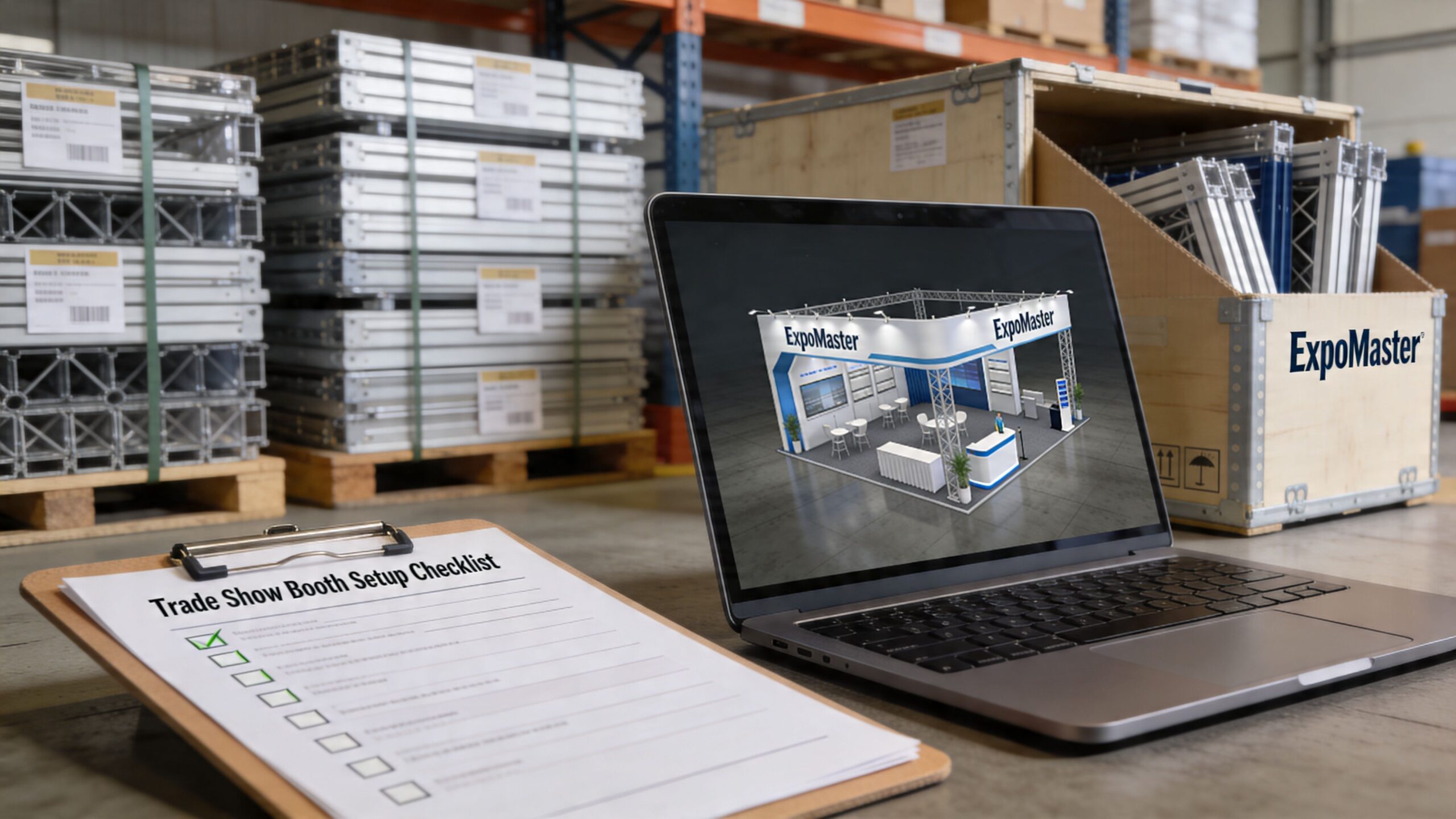
Use this checklist before you approve any exhibit package.
- Scope clarity: Know exactly what the provider handles and what the show will bill directly.
- Install responsibility: Confirm who manages setup, teardown, and supervision.
- Content readiness: Make sure your creative files are prepared for the actual display format.
- Onsite support: Verify whether anyone technical will be available once the hall opens.
- Packing plan: Ask how the booth is protected and transported between events.
The pricing question that trips people up
A lot of exhibitors get caught by partial pricing.
The booth quote looks competitive until the add-ons start rolling in. Install oversight. Dismantle. Shipping coordination. Technical support. Last-minute show-floor fixes. Those line items can turn a manageable plan into a budget problem quickly.
The better model is simple. The provider includes everything they control in the quoted price, and the exhibitor pays only what the show bills directly. In practice, that usually means direct venue charges such as electricity and material handling stay outside the vendor quote, while the rest of the booth execution is covered.
That pricing structure is easier to manage because it reflects real control. If the provider owns the process, the provider should own the execution.
White glove means your team can sell
The biggest benefit of turnkey service isn’t convenience. It’s focus.
Your marketing and sales teams shouldn’t be troubleshooting exhibit hardware during show hours. They should be greeting customers, running demos, and taking meetings. White glove service removes the backstage burden so your staff can stay front-stage.
That’s especially important with LED-based environments. Dynamic booths are powerful, but only when they’re reliable. If a display issue pops up, someone qualified needs to handle it fast.
A strong service model includes an onsite audiovisual technician for the full time the trade show is open. If anything goes wrong, your team should be able to text or call and get help at the booth within minutes. That kind of support changes the risk profile of using advanced media on the floor.
For exhibitors thinking through transport and protection, this look at a trade show shipping case is helpful because logistics quality often determines how smooth the whole event feels.
The checklist I’d use
Before approving any modular trade show booth package, I’d want yes answers to these questions:
- Is the scope turnkey, not partial?
- Do I know which charges come from the show directly?
- Will someone technical be onsite during show hours?
- Can the provider handle install, dismantle, and coordination without leaning on my staff?
- Is the booth system built to reduce setup errors instead of creating them?
If any of those answers are vague, keep asking.
Frequently Asked Questions About Modular Trade Show Booths
Are modular booths durable enough for repeated use
Yes, if the system is engineered properly and handled correctly between events.
The key issue isn’t whether a modular trade show booth can be reused. It can. The main concern is how well the frames, connectors, graphics, and display components hold tolerance over repeated packing, shipping, and assembly cycles. Cheap systems loosen up. Better systems are designed for repetition and predictable reconfiguration.
For buyers, that means asking less about appearance in a showroom and more about how the system travels, packs, and gets serviced.
Can a modular booth still look custom
Absolutely.
A lot of people still equate modular with generic because they’re remembering older panel systems. Modern modular environments can look very refined, especially when lighting, material choices, integrated storage, and integrated media are built into the design. If the architecture is clean and the content is strong, most attendees won’t care whether the structure was custom fabricated or assembled from a modular system.
They care whether it looks current, clear, and worth entering.
Can we integrate our own products and technology
Usually yes, but this should be planned early.
Physical products, shelves, demo stations, touchpoints, and brand-owned devices all affect load paths, power planning, and traffic flow. Modular helps because it gives you an adaptable framework, but that doesn’t mean every object should be added late. The best results come when the structure and the product story are designed together.
That’s even more important when the booth includes LED surfaces. The content, product placement, and staff positioning should support each other rather than compete.
The booth should frame the product. The product shouldn’t look like it was squeezed into the booth afterward.
What’s the true cost of a turnkey rental
The honest answer is that the true cost depends on whether the quote is complete.
A turnkey rental should include the things the provider controls, such as planning, logistics, setup, dismantle, and support. The venue will still bill for certain direct show services. That’s normal. What matters is transparency. If the provider is clear about what’s included and what the show invoices separately, budgeting gets much easier.
The expensive booth isn’t always the one with the higher quote. Often it’s the one with the lower quote and the longer list of surprises.
Is LED really better than fabric graphics for every exhibitor
Not for every exhibitor.
If your message is simple, your budget is tight, and your event schedule is modest, a well-designed fabric-based modular booth can still work well. But if you need stronger aisle impact, changing content, product storytelling, or a more immersive brand presence, integrated LED is the stronger tool.
The difference is not just visual flair. It’s communication range. Motion and integrated video surfaces let the booth do more of the selling before a rep even starts talking.
If you’re weighing modular options and want a partner that specializes in integrated LED video wall environments, LED Exhibit Booths is worth a close look. The team builds booths from high-resolution LED tiles, offers turnkey white glove service, includes everything in the price except direct show charges like electricity and material handling, and keeps an AV technician onsite while the show is open so your team can stay focused on customers.