
You’re probably dealing with the same trade show problem most exhibitors face. The event is booked, the floor plan is approved, leadership wants strong lead volume, and the booth still feels like a line item instead of the center of the strategy. Naturally, this article is all about your Exhibition Display Booth.
That’s where costs start getting misread.
A cheap exhibition display booth can look affordable on the quote and become expensive once shipping, drayage, setup labor, electrical planning, troubleshooting, and weak engagement affect the budget. A better booth costs more upfront and less across the full show cycle. It also gives your team a chance to stop traffic, run demos cleanly, and hold attention long enough to create sales conversations.
The shift in the market is clear. Exhibitors aren’t buying walls, counters, and graphics anymore. They’re buying visibility, ease of execution, and confidence that the booth will work when the hall opens.
Why Your Exhibition Display Booth Is Your Most Important Asset
A crowded show floor is brutal on average booths.
If you’re the marketing manager responsible for the event, you know the pressure. Your company may have spent months preparing product messaging, scheduling meetings, and training the sales team. Then the doors open, and your success comes down to whether people notice your space, understand what you do, and stay long enough to talk.
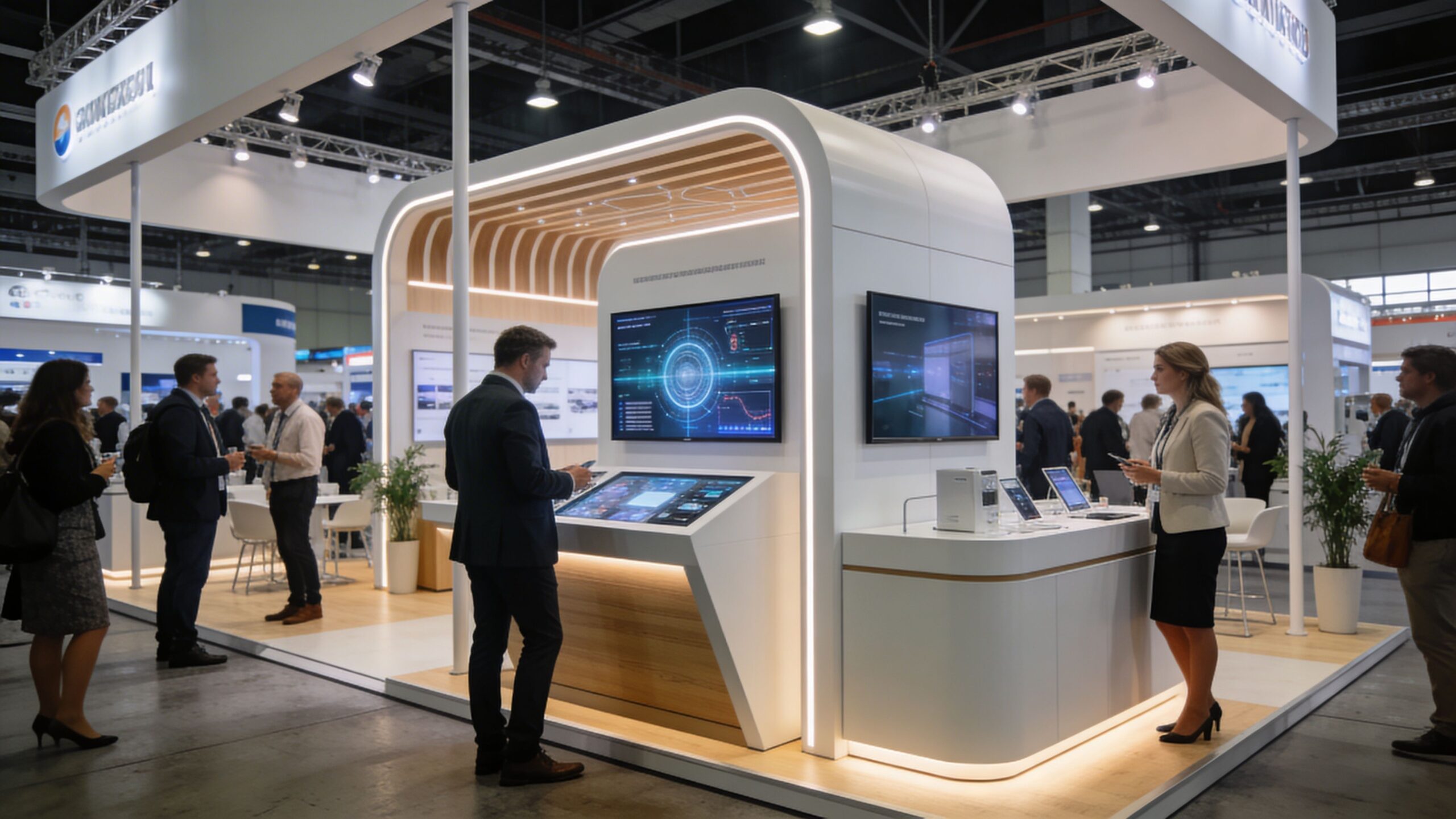
That’s why the booth isn’t just set dressing. It’s your front line.
In 2018, approximately 32,000 exhibitions took place worldwide, directly involving 303 million visitors and nearly 5 million exhibitors. Attendees spent over 8 hours on average visiting booths, which is why standout design matters in a market this crowded, according to UPrinting’s trade show statistics roundup.
What attendees decide in the first moments
People don’t approach booths in a neutral state. They’re scanning fast.
They’re asking a few silent questions:
- Is this relevant to me
- Can I understand the offer quickly
- Does this brand look credible
- Is it worth stopping here instead of the next booth
If your exhibition display booth answers those questions clearly, your staff gets an opening. If it doesn’t, even good people and good products struggle.
The exhibition display booth has to do more than look attractive
A strong booth needs to handle several jobs at once.
| Booth job | What it should do |
|---|---|
| Attract | Pull attention from the aisle without visual clutter |
| Orient | Show visitors where to look and where to walk |
| Support demos | Make product explanations easy to follow |
| Reinforce trust | Signal professionalism and readiness |
| Enable conversations | Give staff room and tools to engage properly |
Many exhibitors overfocus on appearance and underfocus on function. The result is a booth that photographs well and performs poorly.
Practical rule: If your booth can’t stop the right person, hold them, and support a useful conversation, it isn’t doing its job.
The best exhibition display booth is the one that turns floor traffic into business interactions. That sounds obvious, but it’s where many budgets get wasted. Brands spend heavily to attend a show, then underinvest in the single asset every attendee sees.
The Evolution of Exhibition Display Booths From Static Displays to Immersive Canvases
Traditional booths still exist because they’re familiar. Pop-up backwalls, printed panels, truss structures, and stacked monitors can still get a company onto the floor.
But familiar isn’t the same as effective.
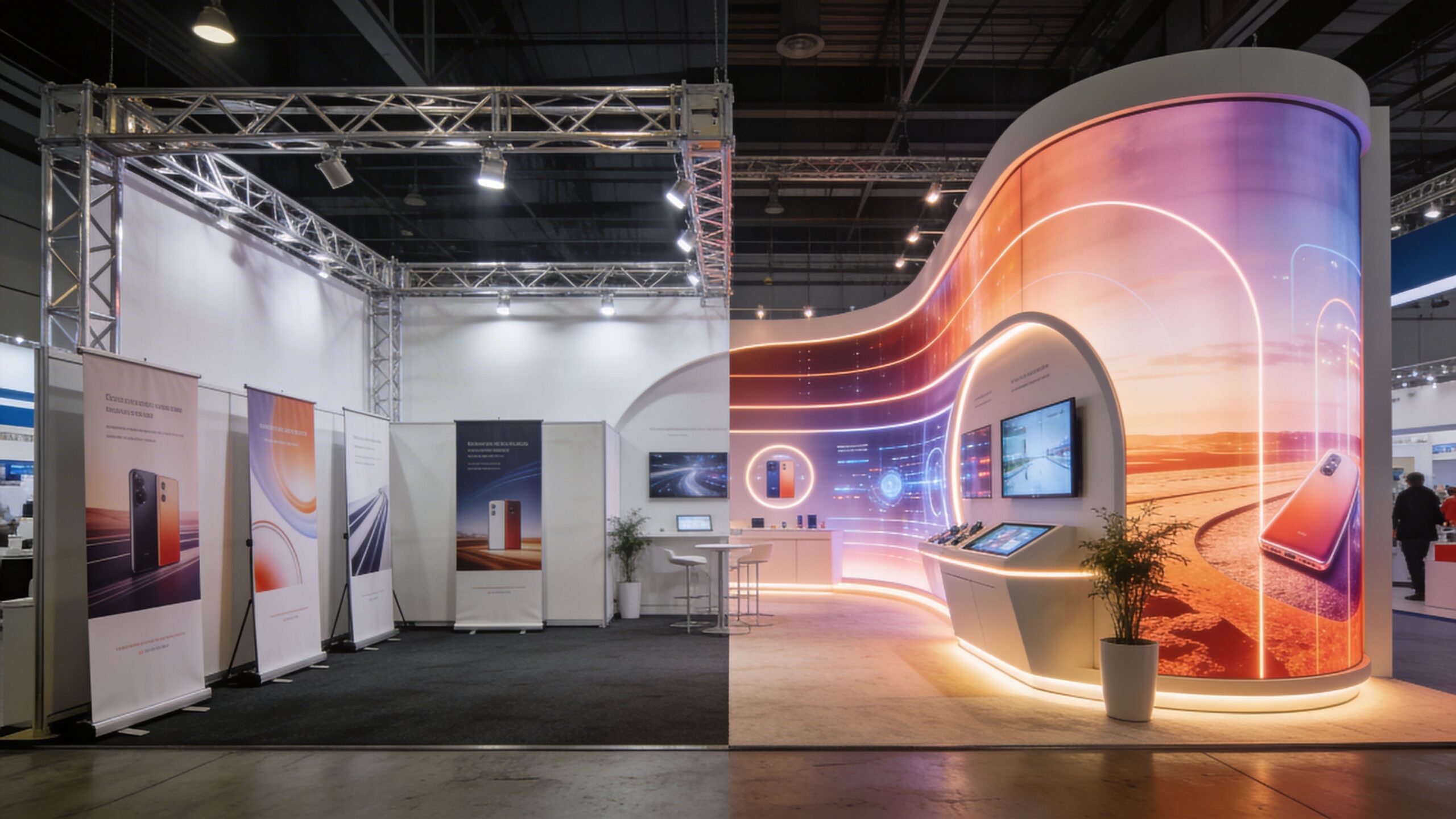
The old model treats screens as accessories. You build a booth first, then bolt monitors onto it. That creates seams, visible hardware, cable runs, support framing, and dead space between display surfaces.
The newer model treats the booth itself as the display.
That changes everything. Instead of trying to decorate a structure, you turn walls, columns, arches, and counters into one visual system. The booth becomes an immersive canvas rather than a collection of separate parts.
Where static exhibition display booths start to break down
A conventional setup creates the same set of pain points:
- Visible gaps between screens break immersion
- Heavy truss and framing increase handling complexity
- Cabling gets messy fast when monitors, media players, and power runs pile up
- Content feels fragmented because each display surface acts independently
- Setup takes longer because more separate pieces have to be aligned and tested
These aren’t minor annoyances. They affect how polished your brand looks at the show.
According to Bluestone Worldwide’s trade show planning statistics, 82% of trade show attendees hold purchasing authority and 64% have no prior relationship with exhibitors. That means first impression quality affects whether you capture high-value, net-new opportunities.
A booth that looks improvised sends the wrong signal before your staff even says hello.
Why LED changed the design language of exhibits
LED video walls removed one of the biggest limits in exhibit design. You no longer need to think in terms of “Where do we place a monitor?” You can ask, “What should this surface do?”
That leads to better layouts. A front wall can deliver brand motion. A side return can handle product proof. A reception counter can continue the visual story instead of interrupting it.
For teams brainstorming fresh layouts before they commit to a concept, this roundup of 10 creative trade show display ideas is useful because it shows how shape, lighting, and visitor flow can work together rather than as separate decisions.
The booth becomes a media environment
A modern LED exhibition display booth works more like a stage set than a printed stand.
It can shift throughout the day. It can run product loops, timed launches, demo support visuals, ambient motion backgrounds, and sponsor or campaign messaging without swapping out hardware. That flexibility matters when your audience changes from hour to hour.
Here’s a practical example of the format in action:
The biggest difference isn’t that LED booths look newer. It’s that they communicate faster and with fewer compromises.
A static booth can still work when the objective is basic presence. An immersive booth works when the event matters and your team needs the space to perform like a sales and marketing asset.
Key Technical and Design Factors for a Winning LED Exhibition DIsplay Booth
At 8:30 a.m. on show day, the technical decisions are already visible. One booth has crisp product footage, clean panel lines, and content that reads from the aisle. Another looks acceptable in the rendering but soft up close, harder to assemble, and far less polished once the hall lights and foot traffic hit it.
That gap usually starts with specs the buyer never got explained in plain English.
Pixel pitch affects what people see
Pixel pitch is the distance between pixels on the LED surface. A smaller number gives you tighter pixel spacing, which improves clarity at close viewing distance.
For trade shows, that matters because people often stand just a few feet from the wall. They are reading headlines, looking at UI screens, and judging product visuals up close. A wall that looks fine in a warehouse test can look coarse on the floor if the pitch is too wide for the viewing distance.
According to an LED wall pixel pitch guide, tighter pitch is the right choice when viewers will be close to the display, because image detail and text readability drop as pixel spacing increases.
Here is the practical difference:
| Spec | What it means on the floor |
|---|---|
| 1.9 pitch | Sharper text, cleaner logos, better detail at close range |
| 2.5 pitch | More visible pixel structure when attendees stand near the wall |
| High refresh LED | Smoother motion and cleaner results for event photography and video capture |
This is not a spec-sheet argument. It affects whether your booth looks premium or rented on a budget.
If your team plans to show software screens, product renderings, fine typography, or brand animation, tighter pitch usually pays for itself in perceived quality alone.
The cabinet system determines setup risk
Strong image quality does not fix a bad hardware system.
The cabinet design affects install speed, cable management, service access, and how much can go wrong during setup. Lightweight modular cabinets with precise alignment points, front-service access, and tool-light assembly are easier to handle on a live show schedule. Systems that require more manual adjustment tend to consume labor hours and create more failure points.
Ask direct questions before you approve a booth package:
- How do the panels lock together?
- How much cabling is exposed after install?
- Can technicians replace a damaged tile from the front?
- How long does assembly typically take for this footprint?
- Who tests the content on the actual processor before the hall opens?
Vague answers usually lead to on-site surprises. Those surprises cost money fast.
Structure should follow the job of the exhibition display booth
LED gives you more freedom than printed walls or stacked monitors, but freedom only helps when the structure supports the sales goal.
A launch booth may need a hero wall that carries one clear message and timed product reveals. A demo-focused booth may need a main screen, side panels for proof points, and a quieter area where reps can talk without competing against constant motion. A lead-generation booth may need visibility from multiple aisle angles and simpler content loops that do not distract from conversations.
The most effective builds usually use LED in forms that support flow and sightlines:
- Curved walls that pull attention inward
- Arches that define the entry and raise visibility
- Columns that carry messaging on multiple faces
- Integrated counters that continue the graphic system
- Multi-surface layouts that assign a specific role to each display plane
A good booth does not put motion everywhere. It gives each surface a job.
If you want to see how a unified LED surface works inside a booth environment, this video display wall for exhibits shows the concept clearly.
Content discipline matters as much as hardware
High-resolution LED will expose weak creative just as quickly as it shows strong creative.
The booths that perform best usually follow a few simple rules:
- One message that reads from the aisle
- Motion that supports the pitch instead of overpowering it
- Type sized for real viewing distances
- Visuals that explain the offer in seconds
- Content zones matched to where attendees stop, watch, and talk
The Center for Exhibition Industry Research has reported that visual factors strongly influence attendee stopping behavior and exhibit recall, which is why content hierarchy matters as much as screen size or shape.
Busy content is one of the most common mistakes I see in lower-cost LED booths. The wall becomes a dumping ground for every product claim, every logo, and every animation request from the marketing team. The result is noise.
Clean motion, sharp pitch, controlled brightness, and a clear message usually outperform a larger wall filled with clutter. That is the trade-off worth making.
Understanding the True Cost and ROI of Your Exhibition Display Booth
The budget conversation usually changes on show week.
A team approves a booth because the quote looks lean. Then the add-ons arrive: freight, material handling, install and dismantle labor, venue rules, tech prep, replacement parts, and the hours your staff burns managing problems that should have been handled by the booth provider. The cheap booth did not stay cheap. It just spread the cost across more line items and more risk.
The costs that distort the decision
The biggest mistake is comparing booth quotes as if they represent the full event cost. They rarely do.
Material handling is a common example. Freeman explains in its guide to trade show material handling and drayage that this charge covers moving your booth freight from the dock to your space, storing empties, and returning materials after the show. That matters because a booth with more crates, more loose components, and more setup complexity usually triggers more labor and more handling exposure.
The same pattern shows up in labor. A lower-priced booth often depends on more onsite assembly, more troubleshooting, and more coordination between vendors. Those costs may sit outside the first quote, but they still hit the event budget.
Upfront price and total cost of ownership are not the same calculation
A better comparison looks like this:
| Cost view | What it focuses on | What it misses |
|—|—|
| Upfront price | Rental or fabrication number | Labor, handling, setup risk, support, rework |
| Total cost of ownership | Full event expense across planning, show days, and reuse | Little, if the scope is clear |
That full-cycle view should include:
- Pre-show costs such as design revisions, content formatting, packaging, and logistics planning
- Show-site costs such as freight, material handling, install labor, dismantle labor, and organizer charges
- Operating costs such as technical support, replacement components, and staff time lost to booth issues
- Post-show costs such as storage, repairs, and reconfiguration for the next event
Many bargain booths financially fail in this area. The hardware may be less expensive, but the system around it is harder to ship, harder to install, and harder to keep running.
If you are comparing options, this trade show booth cost guide helps frame budget questions instead of stopping at the first number on the quote.
What a full-service LED model changes
A well-scoped LED booth does more than improve presentation. It removes cost from the process.
With a full-service provider, the proposal should spell out what is included: design, structure, LED system, content implementation, setup, dismantle, logistics coordination, and technical support. Venue-billed services such as electricity and material handling should be listed separately so there is no confusion about who owns each charge.
That structure matters because it reduces two expensive problems. Surprise invoices and finger-pointing.
I have seen exhibitors save money with a higher initial booth quote because the package reduced freight volume, shortened install time, and eliminated the scramble for onsite fixes. That is the trade-off many buyers miss. A cheaper booth can cost more to operate, especially if your team exhibits more than once a year.
Cheap booths usually hide cost in labor, freight, rework, and risk. Better booths reduce those costs by simplifying the system.
ROI shows up in performance, not just lead totals
Badge scans matter, but they are not the whole return.
A booth earns its keep when it helps your team hold better conversations, run demos without interruption, move meetings on schedule, and stay focused on prospects instead of repairs. That operational stability has real value. If sales staff spend the morning chasing cables, waiting on a technician, or apologizing for a failed display, the booth is already underperforming.
The strongest ROI usually comes from a booth that looks sharp, works every hour of the show, and costs less effort to execute than the bargain alternative. That is why total cost of ownership matters more than the sticker price.
Renting vs Buying Your Exhibition Display Booth
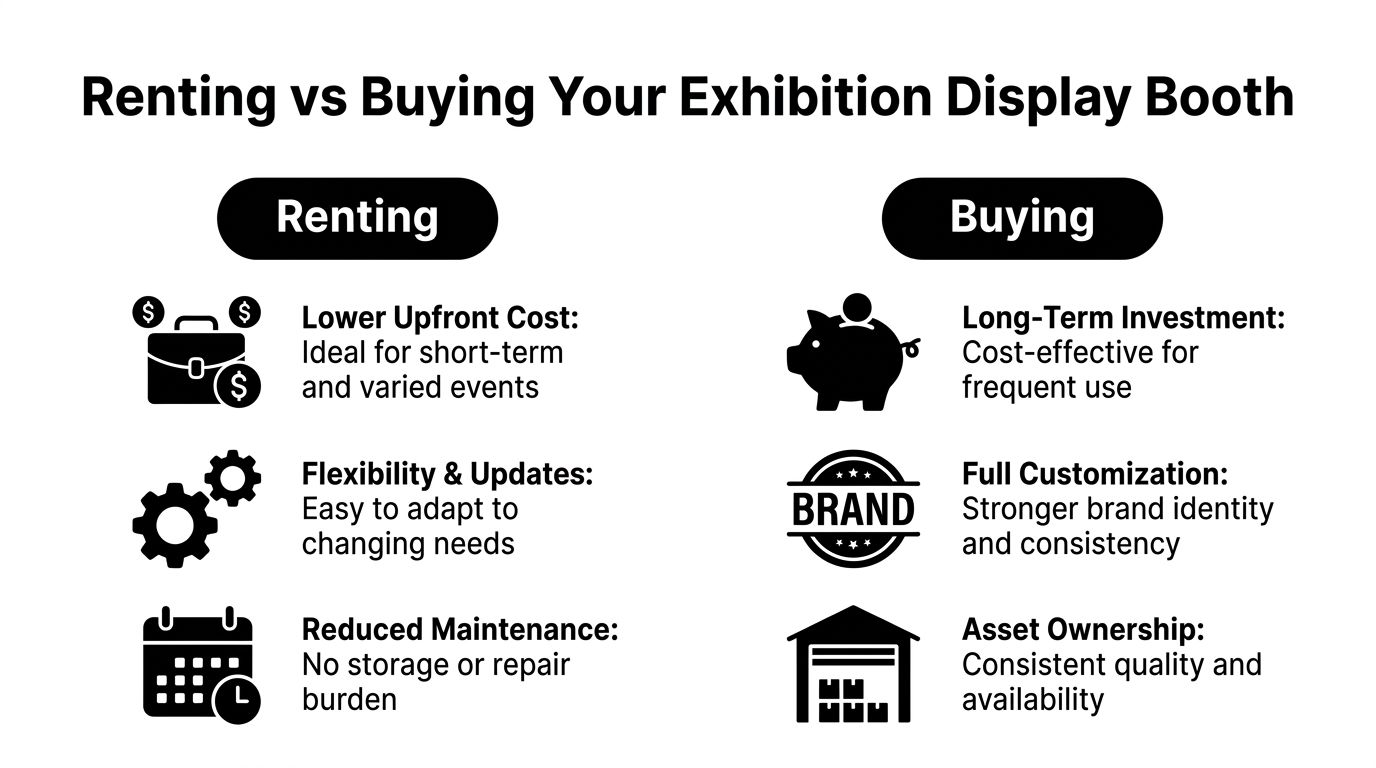
The rent-versus-buy question doesn’t have one right answer. It depends on how often you exhibit, how fast your messaging changes, and whether your team values flexibility more than ownership.
Some companies should buy. Many shouldn’t.
Renting makes sense when flexibility matters most
Renting works well for exhibitors that attend a limited number of shows, test different booth sizes, or need to adapt creative frequently.
A rented booth is the cleaner fit when:
- Your event schedule changes year to year
- You launch different campaigns at different shows
- You don’t want to own storage, maintenance, or repair responsibility
- You want access to current LED formats without committing to one hardware package
This is useful for growing companies. They may need one footprint for a regional event and another for a major launch. Renting gives them room to adjust without locking into one physical asset.
Buying makes sense when consistency is the strategy
Owning can be the right move when your company exhibits frequently and wants strong repeatability.
That fits teams that want:
- A consistent branded environment across multiple events
- A known asset they can deploy on a fixed schedule
- Control over customization decisions
- Long-term planning around one exhibit system
Buying can also make internal planning easier when the same event team runs the same booth format repeatedly.
A simple decision filter
Use this table as a practical shortcut:
| If this sounds like you | Better fit |
|---|---|
| You attend occasional or varied shows | Renting |
| You need fresh layouts often | Renting |
| You exhibit heavily and want consistency | Buying |
| You want an owned brand asset | Buying |
The harder part isn’t the financial model. It’s operational discipline. Owning only works well if your organization can manage storage, maintenance, scheduling, and content updates without creating internal friction.
For a deeper side-by-side view, this owning vs renting an LED video wall resource lays out the practical trade-offs.
Rent when adaptability is the priority. Buy when repetition and control justify the added responsibility.
Many exhibitors start by renting and switch later once the booth format proves itself. That’s the lowest-risk path because it lets the team learn what works on the floor before committing long term.
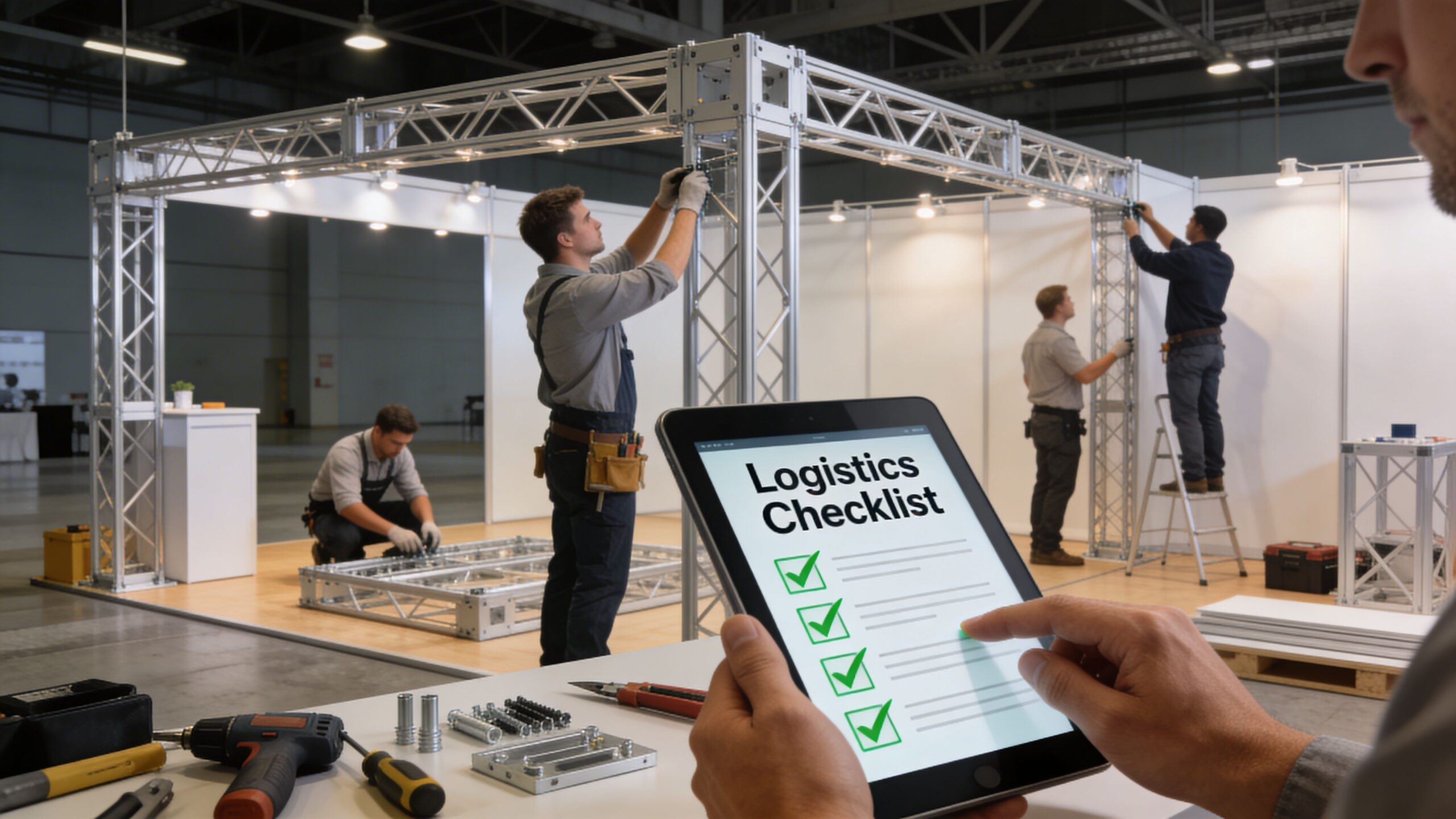
The Turnkey Advantage A Simplified Setup and Logistics Checklist
Trade show logistics punish half-managed projects.
The booth may look great in a rendering, but the event is won or lost in the details no one posts on LinkedIn. Freight timing. Show forms. labor windows. rigging rules. electrical orders. panel testing. backup playback. damage control. compliance.
That’s why turnkey service matters. Not as a luxury, but as a risk-control system.
Venues are stricter than many exhibitors expect
Booth design has to fit the rulebook of the hall, not the creative concept.
According to the AAPM exhibit design rules, standard inline booths are capped at 8 feet high, and island booths require licensed engineer approval over 16 feet. Non-compliance can lead to forced disassembly.
That’s a brutal surprise if it happens after freight arrives and labor is on the clock.
What white glove service should include
A turnkey model should cover the entire execution chain so your team can focus on customers.
That includes:
- Pre-show coordination with floor plans, deadlines, and organizer paperwork
- Logistics management for freight, delivery timing, and install sequencing
- Assembly and testing before the hall opens
- Content support so screens display correctly on the hardware
- On-site troubleshooting during live show hours
- Dismantle and outbound handling after close
If any of those pieces are split across multiple vendors, your team becomes the project manager by default.
The on-site technician is not optional with our exhibition display booth company
The most valuable version of turnkey service includes an audiovisual technician on site for the full time the show is open.
That changes the exhibitor experience.
Instead of asking your sales staff to restart processors, chase signal issues, or call an account rep who is somewhere else in the venue, you text or call and an AV technician comes to the booth within minutes. Your team stays focused on demos and conversations.
That’s the difference between support in theory and support in practice.
Here’s a practical checklist exhibitors should expect a provider to own:
- Confirm show regulations early so height, sightline, and engineering issues don’t appear late.
- Review power and placement requirements before graphics and content are finalized.
- Test every display surface under show conditions, not in a warehouse.
- Assign one point of accountability for setup, live operation, and breakdown.
- Plan for post-show handling so nothing gets stranded, lost, or repacked badly.
If your team owns equipment or supporting materials across multiple events, separate off-site storage can become part of the planning picture. In that case, practical guidance on storage solutions for businesses can help operations teams think through access, organization, and overflow inventory.
For exhibitors evaluating support expectations, this trade show set up page is useful because it frames setup as an execution process, not labor on install day.
A turnkey booth should remove decisions during show week, not create new ones.
That’s the standard worth paying for. When the hall opens, your job should be meeting prospects, not managing booth problems.
Frequently Asked Questions About Exhibition Booths
Most booth questions show up after the concept is approved. That’s when the practical issues start to matter more than the renderings.
What content should run on an LED exhibition display booth
Start with one core message, then build a content stack around it.
For most exhibitors, the booth should run three layers of content:
- Attraction content that works from the aisle
- Support content that helps a live conversation
- Proof content that reinforces credibility during demos
Attraction content should be visually clean. Short loops, strong brand cues, product visuals, and limited text work better than dense slides.
Support content should help your team explain the product fast. Think interface highlights, product motion, use-case sequences, and clear before-and-after visuals if those are relevant to your offer.
Proof content can include testimonials, partner logos, feature callouts, process visuals, or short clips from customer use cases. Keep it readable and paced for booth traffic, not for a boardroom.
How often should content change during the day
It should change enough to stay fresh, but not so often that the booth feels chaotic.
A practical approach is to vary content by audience and event rhythm. Morning traffic may need brand-level messaging. Scheduled demo windows may need more product-specific material. Launch moments may need stronger announcement visuals.
What matters most is consistency. The visitor should understand what your company does within a few seconds from any open aisle angle.
Do I need to worry about power and show services early
Yes. Earlier than many teams think.
Even when a provider includes most everything in the booth price, the show bills some services directly. The most common examples are electricity and material handling. Those venue charges need to be understood early so there are no surprises.
You should also confirm:
- Where power drops are located
- How cables will be routed
- What hours the booth can be powered
- Whether internet is needed for demos or lead capture
- Who is responsible for ordering each service
Much confusion comes from assuming the booth vendor and the show organizer are handling the same things. They aren’t.
Can an LED exhibition display booth include touchscreens or interactivity
Yes, if it’s planned correctly.
Interactive elements can work well when they support a clear user path. Product selectors, guided demos, touchscreen catalogs, and self-service exploration zones can all help. The mistake is adding interactivity because it sounds modern.
If the interaction slows people down in a useful way and gives your team a conversation starter, it’s worth considering. If it creates a queue, confusion, or constant reset issues, it’s not.
How do I measure ROI beyond badge scans
Badge scans are only one signal. They don’t tell you whether the booth created useful conversations.
A better post-show review looks at several factors:
| Measure | What to look for |
|---|---|
| Conversation quality | Were staff speaking with target buyers or general traffic |
| Demo activity | Did the booth help complete meaningful demos |
| Meeting retention | Did scheduled meetings stay and engage |
| Staff efficiency | Did the team spend time selling or fixing problems |
| Follow-up strength | Did the booth generate context-rich leads or just lists of names |
You don’t need complex analytics to do this well. A disciplined team debrief after each show reveals more than a raw lead total.
What should I ask before choosing a booth provider
Ask questions that expose operational quality, not design style.
Use a shortlist like this:
- What exactly is included in the quoted price
- What will the show bill me directly
- Who handles install and dismantle
- Will an AV technician be on site during show hours
- What pixel pitch am I getting
- How is content tested before show open
- What happens if a panel or processor fails during the event
- How are freight, packing, and post-show logistics handled
Those answers will tell you more than a rendering ever will.
Is a higher-resolution wall worth it for a trade show
In many cases, yes, when attendees view the wall from close range.
That’s where a 1.9 pitch wall has a visible advantage over a 2.5 pitch wall. Text edges are cleaner. Motion looks more refined. Product visuals hold together better at short distances.
If your booth depends on software interfaces, product detail, premium branding, or close-up engagement, resolution quality is not a vanity upgrade. It affects how polished the booth feels in person.
Where can I learn more about LED wall basics before deciding
If you’re comparing options and want the practical questions answered in one place, this collection of LED video wall FAQs is a useful next step.
One option in this category is LED Exhibit Booths, which provides rental and purchase solutions built around LED video wall structures rather than stacked monitors, with turnkey support and on-site technical coverage.
The right exhibition display booth should make the event easier to run and harder to ignore. If you want a booth that looks sharp, budgets cleanly, and lets your team focus on customers instead of logistics, it’s worth having a conversation before your next show date locks in.