
Animation light boxes do one thing really well, they make people look. The aisle is busy, the hall is loud, and people are walking past your booth with the same polite, unfocused look they give every other display on the floor. Additionally, you may want to consider tabletop trade show displays.
Your team paid for the space, shipped the materials, rehearsed the pitch, and still the booth blends in. A printed backdrop might look clean, but it rarely stops traffic once attendees have seen ten of them in a row. Standard monitors help a little, but bezels, cables, and uneven layouts usually make the whole setup feel pieced together.
That’s where the idea of animation light boxes becomes useful, but not in the old, tabletop sense. In the trade show world, the key opportunity isn’t a small tracing surface. It’s the larger idea behind it: illuminated imagery, motion, and visual storytelling built directly into the environment.
When that concept scales from a desktop tool to an architectural display, the booth stops acting like a booth. It starts acting like a magnet. A wall can move. A counter can play content. A structure can carry a brand story instead of just holding a logo. If you’re evaluating your next trade show booth design, that’s the shift worth paying attention to.
Standing Out in a Sea of Sameness With Animation Light Boxes
Most booths lose attention for a simple reason. They ask a passerby to do too much work.
A static wall asks people to stop, read, interpret, and then decide whether to engage. On a crowded show floor, most won’t. They scan for movement, contrast, and something that looks active before they commit even a few seconds.
That’s why the old phrase animation light boxes still matters, even though the technology has changed. The original idea was always about making artwork visible through light. The modern version does the same thing at booth scale, but with motion, smooth playback, and much more presence.
What attendees react to first
People notice a display in layers.
- Motion pulls the eye: Even subtle animated texture beats a static panel because it signals that something is happening.
- Brightness creates separation: A lit surface stands apart from printed fabric and foam board.
- Scale changes perception: When the illuminated content is built into a wall or structure, it feels intentional instead of added on.
A lot of exhibitors make the mistake of treating screens like accessories. They mount one monitor on one wall, run a looping demo, and call it done. It usually looks like what it is: a monitor bolted onto a booth.
A better setup turns the structure itself into the display. That’s the practical difference between using light as decoration and using it as architecture.
Practical rule: If your content looks like something attendees could watch later on your website, it won’t do enough on the show floor. The booth display has to create an in-person experience.
The best exhibitors don’t just show product information. They shape attention first, then deliver the message.
The Evolution from Tracing Tool to Immersive Display
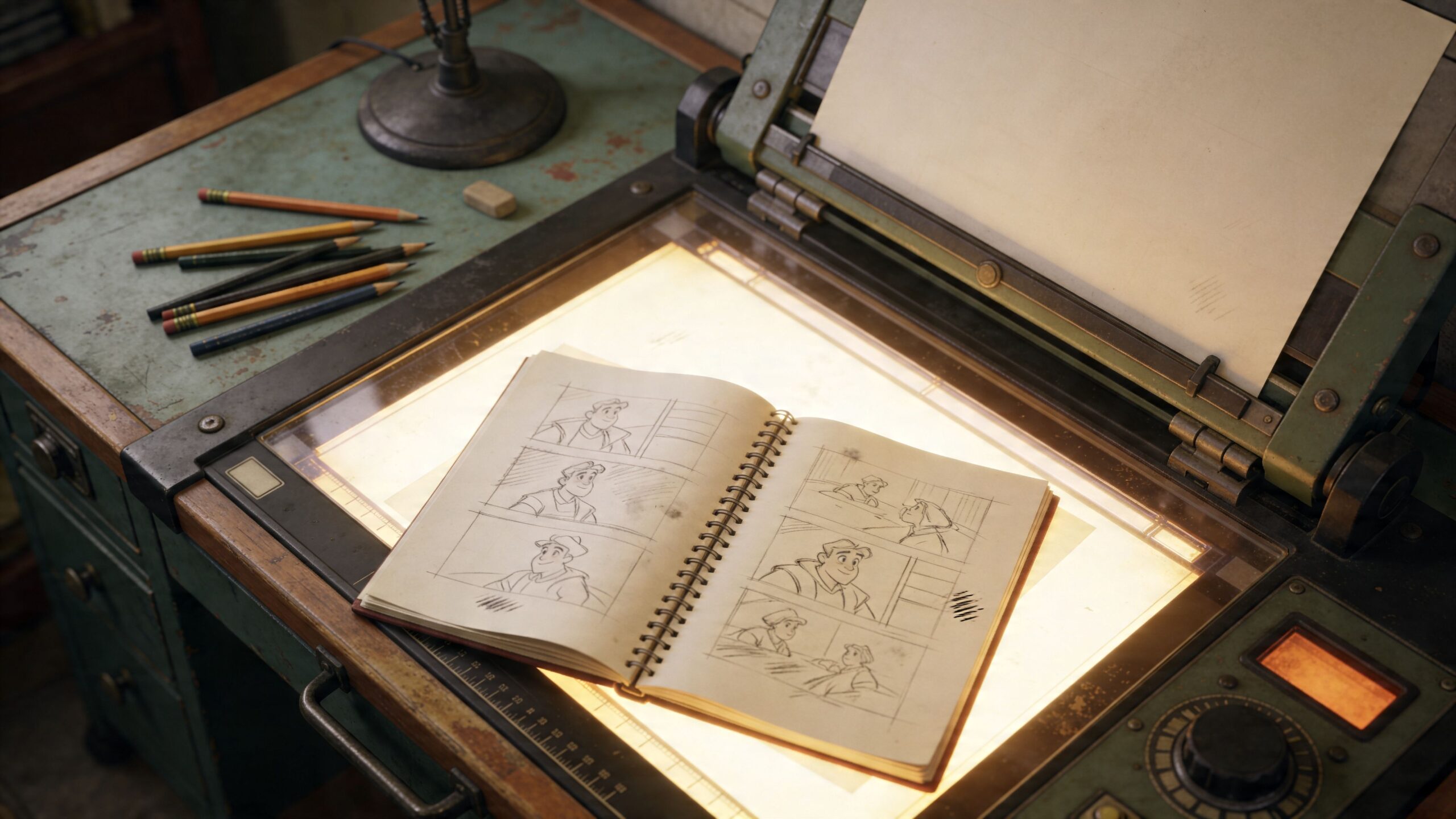
Traditionally, an animation light box was a simple tool. An artist placed paper over an illuminated surface and used the backlight to trace drawings, align frames, and refine motion one sheet at a time.
That basic purpose still matters. The light helps the eye see detail, layering, and continuity.
From artist desk to booth structure
The leap into exhibits happened when the same core idea, illuminated imagery with motion, moved from a tabletop device to modular LED systems.
Instead of one lit panel under paper, you now have tiles that assemble into walls, counters, columns, and larger booth features. And unlike old monitor arrays, these systems are built to behave like one surface.
One of the most overlooked developments in this space is the connection between small LED tracing setups and modular magnetic video wall systems. Existing tutorials stay focused on DIY pads and portable tracing tools, but don’t address the booth-scale version. That matters because magnetic LED tile systems can reduce setup time by up to 50% and event shipments of LED video tiles were projected to grow 35% year over year in 2025, driven by experiential marketing demand, according to a discussion of hybrid trade show animation workflows and modular systems.
If you’re browsing options for backlit trade show displays, terminology can get confusing. A backlit display and a direct-view LED wall can both look bright in photos, but they behave very differently in person.
Why the modern version matters
The old light box helped an artist create motion.
The new version lets a brand deliver motion at room scale.
That changes the role of the display entirely:
- A wall can carry a product reveal sequence.
- A counter can reinforce the same visual language instead of sitting dead in front of the booth.
- An arch or tower can extend the story upward so the booth reads from farther away.
The result isn’t just “more screens.” It’s a continuous visual field. That’s why the strongest booths feel cohesive even before anyone speaks to a rep.
The small light box was a production tool. The large-format LED wall is the finished stage.
That’s the very evolution. Same principle. Completely different level of impact.
Animated Light Boxes vs Seamless LED Video Walls
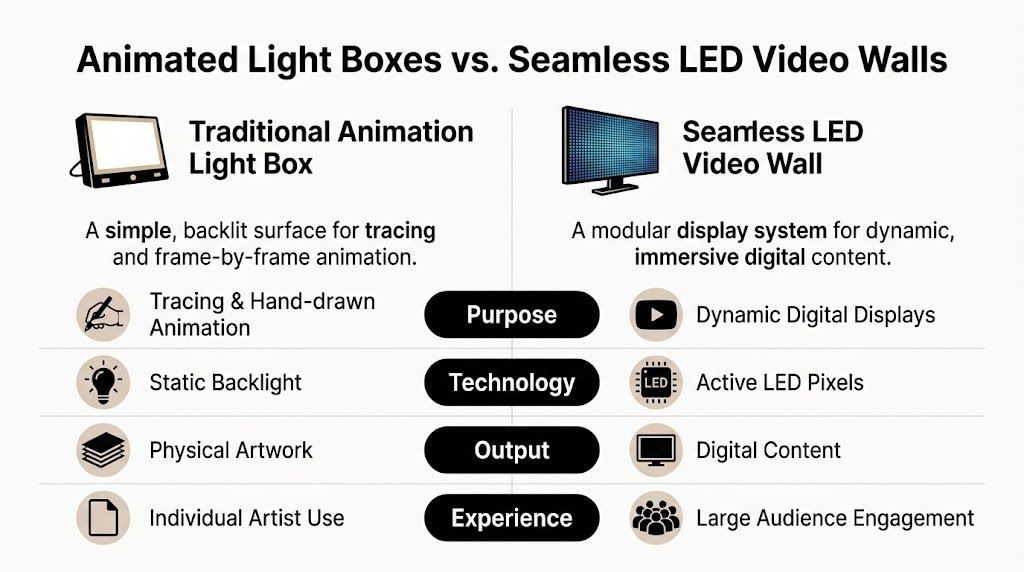
A traditional animated light box and a continuous LED video wall are not two sizes of the same product. They are different display categories.
One is a backlit surface. The other is a direct-view screen.
How each one creates an image
A light box shines light through something. That “something” might be tracing paper, a printed graphic, or a translucent panel.
A continuous LED wall creates the image directly. Each point of the image is generated by the display itself.
The simplest way to understand it is:
| Display type | How it works | Best analogy |
|---|---|---|
| Traditional animation light box | Light passes through a surface | Like a lit poster or stained glass |
| Seamless LED video wall | The screen itself produces the image | Like a giant high-definition display |
If you’re weighing this against temporary structures like pop-up walls, the key difference is that a pop-up wall holds a message, while a direct-view LED wall performs it.
Brightness and viewing impact
This difference shows up fast when you start talking specs.
Tracing light boxes used for prep range from 1,000 to 14,000 lux, while LED video wall tiles used in trade show environments typically exceed 5,000 nits, according to this overview of tracing light pad brightness and exhibit display implications: https://www.2danimationsoftwareguide.com/5-best-tracing-light-pads-for-artists-and-animators/
You don’t need to convert those units to understand the practical point. They live in very different worlds.
A tracing pad helps a person see linework at a desk. A trade show video wall has to compete with overhead hall lighting, neighboring booths, aisle movement, and long viewing distances.
What works on a show floor
A backlit graphic can still be useful. It’s clean, simple, and often effective for brand reinforcement.
But it has limits:
- It doesn’t deliver full-motion content the way a direct-view wall does.
- It can’t change tone throughout the day without swapping graphics.
- It won’t create a unified digital environment across multiple booth surfaces.
A monitor wall also has limits. The moment attendees see thick bezels, exposed framing, or a patchwork layout, the illusion breaks.
A booth display should look like one thought, not five screens trying to cooperate.
That’s where uninterrupted LED systems separate themselves. They remove the visual interruptions that make many exhibit displays feel temporary. Instead of asking the attendee to mentally stitch the image together, the display handles it for them.
Benefits of an Immersive Video Wall Booth
The strongest argument for a continuous video wall booth isn’t technical. It’s behavioral.
People stop when a booth feels alive.
A printed backdrop delivers one message. An immersive wall can cycle through several without changing the structure at all. It can open with a brand statement, shift into product footage, move into ambient motion during slower periods, and then highlight a direct call to action when the aisle fills up.
What that changes for the exhibitor
A good video wall booth helps in three ways.
- It grabs attention earlier: Attendees often notice motion and light before they read copy.
- It explains faster: Short visual loops can communicate a product category or use case before a rep starts talking.
- It stays fresh longer: A booth with changing content doesn’t look stale halfway through the event.
That last point matters more than many teams expect. Trade show days are long. If the visual environment never changes, your own staff starts tuning it out, and attendees do the same.
Why full-motion storytelling wins
An uninterrupted wall can do something static signage can’t. It can create sequence.
Sequence is what lets you show:
- The problem.
- The product in action.
- The result.
- The invitation to step in and talk.
That’s a much better use of booth real estate than filling a wall with paragraphs no one will read from the aisle.
You also gain flexibility. A single setup can support product demos, abstract brand visuals, speaker introductions, environmental motion, or timed messaging tied to different audiences throughout the day.
The booth should do more than identify your company. It should help your team start better conversations.
When exhibitors get this right, the display isn’t decoration. It becomes the first salesperson in the booth.
Technical Considerations for a Flawless Display
A video wall can look premium or mediocre with the same content. The difference usually comes down to specification choices and execution details, not the idea itself.
Pixel pitch affects how sharp the wall feels
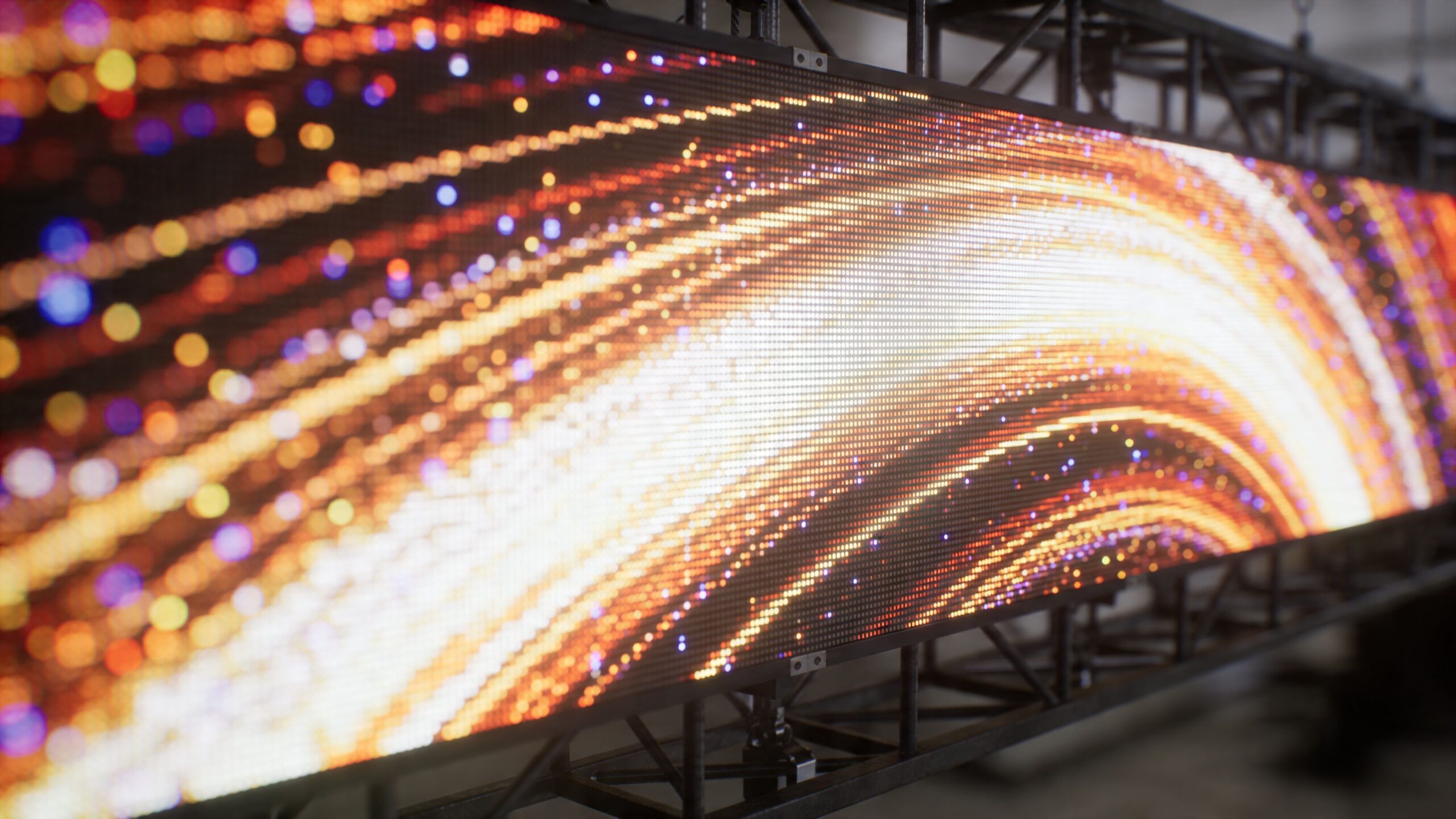
Pixel pitch is the distance between pixels.
Smaller pitch means pixels sit closer together, which means the image looks tighter and more refined at closer viewing distances. In simple terms, 1.9mm pitch gives a higher-resolution look than 2.5mm pitch. On a trade show floor, that difference is visible, especially when attendees stand near the wall or when the content includes text, product renders, or fine graphic detail.
It’s similar to tile grout. The less space between the tiles, the more continuous the finished surface looks.
Many booths are viewed from multiple distances. Someone across the aisle sees the big motion. Someone standing a few feet away sees the detail. The wall has to perform in both situations.
If you’re comparing formats or planning a custom build, this overview of an LED panel for video is useful context for how panel choice affects final image quality.
Content has to match the screen of animation light boxes
A great wall won’t rescue weak source files.
Common problems include low-resolution exports, text that’s too small, motion graphics built for laptops instead of large-format playback, and color choices that flatten out under bright show conditions. If the content team designs in the wrong environment, the final wall can feel underwhelming even when the hardware is excellent.
A practical workflow looks like this:
- Build for scale: Design for the actual display dimensions, not a generic slide deck.
- Use motion with restraint: Fast cuts and tiny labels often fail on the floor.
- Test contrast early: What looks subtle on a desktop can disappear in a hall.
Power and heat aren’t side issues with animation light boxes
Displays don’t just need to look good. They need to run cleanly for the full show day.
Modern animated displays using programmable LED arrays can reduce energy consumption by up to 70% compared to traditional neon-lit signs, and LED modules are rated for 20,000+ hours, according to this explanation of animated LED light box energy efficiency and operating economics. For exhibitors, the practical benefit is lower power draw and less heat buildup inside enclosed structures.
That matters more than many first-time exhibitors realize. Heat changes comfort, component stress, and planning around booth structure.
Logistics can improve or unravel the whole project
A display can be technically strong and still become a headache if the install is clumsy.
Here’s what usually separates smooth execution from a mess:
| Technical area | What works | What fails |
|---|---|---|
| Mounting | Systems designed for walls, counters, arches, and islands | One-off framing that complicates install |
| Assembly | Toolless, modular construction | Multi-part setups that invite alignment mistakes |
| Shipping | Lightweight components that pack efficiently | Heavy, awkward builds that create handling problems |
| Support | Playback and hardware checked onsite | Remote troubleshooting after doors open |
A good booth wall should arrive ready to assemble, fit its structure cleanly, and run on a playback system that doesn’t need constant babysitting. If any of those pieces are shaky, the attendee notices even if they can’t explain why.
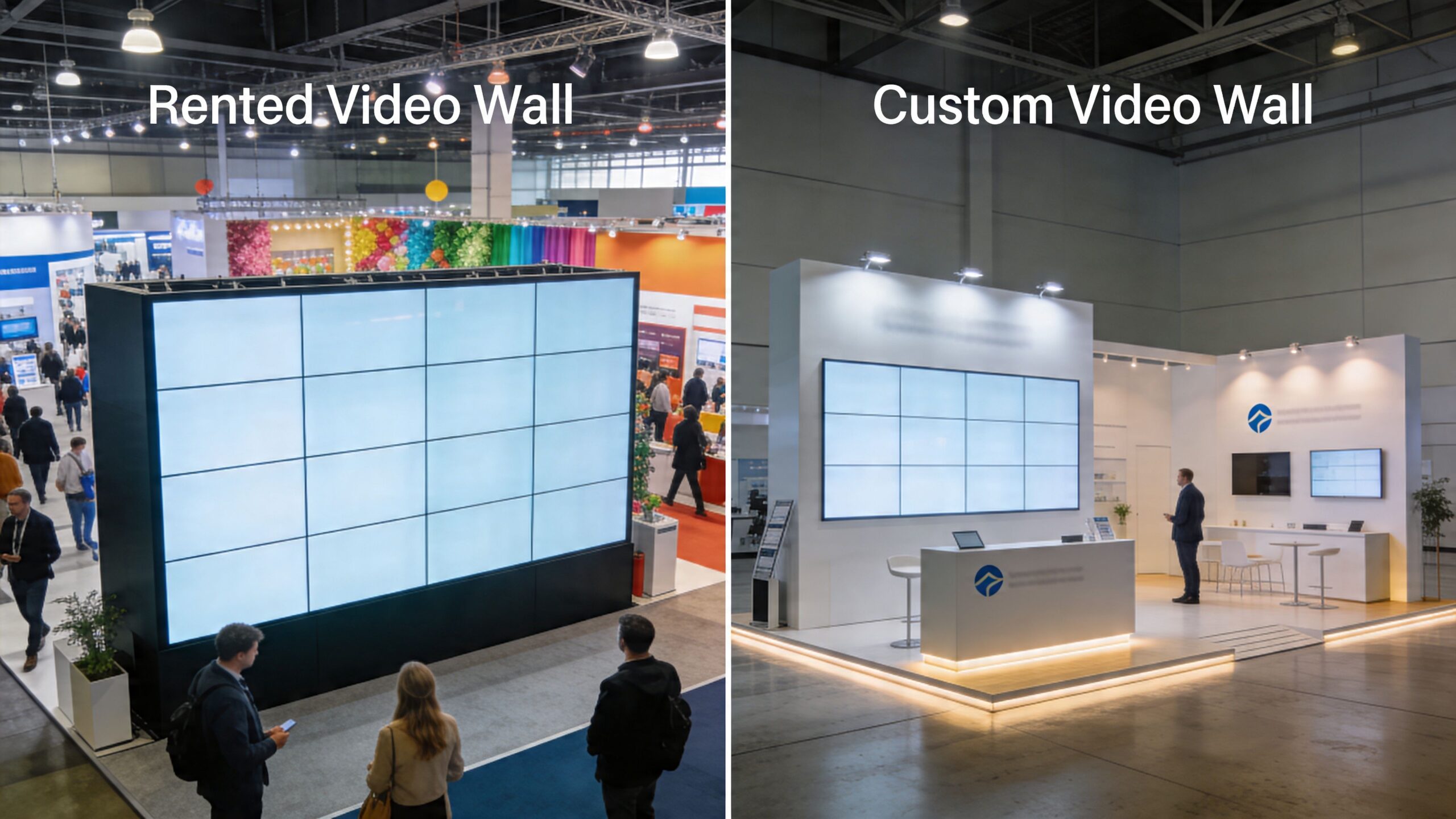
Should You Rent or Buy Your Video Wall Booth
Both options can make sense. The wrong choice usually comes from solving the wrong problem.
Some companies need flexibility. Others need repeatability. The best decision comes from how often you exhibit, how fixed your booth strategy is, and how much responsibility your team wants to carry between shows.
When renting makes more sense with animation light boxes
Renting is usually the cleaner move when you want a high-impact booth without taking on long-term ownership tasks.
That often fits:
- A startup launching at CES: The team needs presence fast, but may want to revise size, messaging, or footprint after the first show.
- A brand testing a new market: It’s smarter to stay flexible than lock into one permanent configuration.
- A marketing team with limited storage and operations support: Renting removes a lot of behind-the-scenes burden.
There’s also a risk argument. A key issue in the rent-versus-buy decision is reliability. Quality LED pads may be rated for 50,000+ hours, but they can degrade without proper maintenance. For purchased systems, heat management and upkeep matter. A rental agreement with onsite support shifts that responsibility away from the exhibitor for the duration of the event.
When buying animation light boxes is the better call
Buying works better when the booth system is part of a repeatable event program.
That often fits companies that attend the same shows regularly, use the same core brand environment, or need a display system available on their own schedule.
A medical device company with a stable event calendar may want ownership because the display becomes part of its standard field toolkit. An agency managing recurring activations may also prefer direct control over the asset.
Here’s a simple comparison:
| Factor | Best for Renting | Best for Buying |
|---|---|---|
| Upfront cost | Lower commitment at launch | Better for long-term asset planning |
| Flexibility | Easy to change footprint or format | Best when booth design stays consistent |
| Storage and maintenance | Handled by provider | Handled by owner or internal team |
| Reliability responsibility | Lower burden on exhibitor | Higher burden on exhibitor |
| Long-term ROI | Best for lighter show schedules | Best for repeated use over time |
For a broader breakdown of the ownership decision, this guide to owning vs renting an LED video wall is a helpful starting point.
A quick visual can help frame the trade-off:
The short version is simple. Rent when you need agility and lower operational burden. Buy when you need continuity and have the systems to support ownership.
Why White-Glove Turnkey Service Matters
A trade show booth isn’t judged only by how it looks in renderings. It’s judged by whether it opens on time, runs all day, and stays problem-free when the aisle is full.
That’s why service matters as much as hardware.
What turnkey should actually include with animation light boxes
A lot of companies use the phrase turnkey loosely. In practice, it should mean one team handles the moving parts that usually create stress for the exhibitor.
That includes shipping, setup, operation planning, and dismantle. It also means clear expectations around what is and isn’t included. A strong service model includes everything in the quoted price except the charges the show bills directly, such as electricity and material handling.
That distinction matters because exhibitors often get surprised by venue-issued bills and assume the booth provider added hidden costs. In many cases, those charges come from the show, not the display partner.
Why onsite support changes the risk equation
The ultimate test happens when something small goes wrong.
A cable issue. A playback glitch. A setting that needs adjustment after doors open.
Without onsite support, your team becomes the troubleshooting department. That’s a terrible use of show time. Your staff should be greeting prospects, running demos, and following up on conversations, not standing behind a wall trying to diagnose AV problems.
If support requires a ticket, a callback, and a wait, it isn’t trade show support. It’s office support wearing a trade show label.
White-glove service includes an onsite AV technician for the full time the show is open. If an issue appears, your team texts or calls, and a technician is at the booth within minutes to address it.
That’s not a luxury. It’s operational insurance.
What works in the real world
The best service package does three things at once:
- Removes setup burden so your team arrives to a finished environment.
- Reduces show-floor risk because technical help is already in the building.
- Protects selling time by keeping your staff focused on visitors.
Technology gets attention. Service protects the investment.
Transform Your Booth from a Space to an Experience with Animation Light Boxes
The phrase animation light boxes used to point to a small creative tool. In trade shows, the more useful definition is much bigger.
It’s the evolution of illuminated visual storytelling into an integrated, architectural display system that can carry motion, brand atmosphere, demos, and messaging across the entire booth. That shift is what turns a passive space into an experience people notice.
The details matter. A 1.9mm pitch wall presents a sharper image than the 2.5mm pitch systems many exhibitors still settle for. Construction designed for visual continuity matters too, because attention drops fast when bezels and patchwork screens break the image. And service matters just as much as image quality, because the best-looking booth in the hall still fails if support is weak when the show opens.
If you’re planning your next exhibit, it’s also worth reviewing broader ideas around high-impact trade show booth design so the display, layout, and visitor flow work together instead of competing.
The goal isn’t just to brighten a booth. It’s to make the space do a job: stop traffic, tell a story, and help your team have better conversations.
If you want a booth that functions as an integrated digital environment instead of a collection of rented parts, talk with LED Exhibit Booths. We provide high-resolution video wall trade show displays, white-glove turnkey service, and onsite AV support so your team can focus on customers instead of managing screens, setup, and show-floor problems.