
led video wall installation is usually on your to-do list right when everything else is also on fire. The booth design is approved late. Show forms are due. Electrical orders are confusing. Your marketing team wants crisp motion graphics. Your exhibit house says the wall is “easy to install.” Then move-in day arrives, and suddenly “easy” means crates, labor windows, union rules, alignment issues, and a screen that has to work the first time.
That’s why smart exhibitors stop treating the wall as a box of panels and start treating it as a managed system. At a trade show, the hardware matters, but the install process matters more. If the wall looks soft, seams show, content is mapped wrong, or a panel goes dark during show hours, nobody cares what the spec sheet promised.
I’ll be direct. Resolution matters too. We use P1.9 where many competitors still push P2.5, and that difference shows up fast at booth viewing distances. Text is cleaner. Product shots hold up better. Motion looks tighter. If attendees are standing a few feet away, lower resolution is a compromise you’ll notice.
The Exhibitor’s Dilemma Why Installation Is More Than Hardware
Most exhibitors underestimate led video wall installation because they focus on the visible part. They compare screen size, maybe ask about pixel pitch, then assume setup is just labor. It isn’t. Installation is where budgets get chewed up and reputations get tested.
Installation and labor can represent 15 to 20% of total project budgets, according to LED video wall industry statistics. That’s a big enough slice that mistakes stop being annoying and start being expensive. If your install method requires extra hands, extra time, or extra troubleshooting, you feel it in labor bills, drayage, and setup stress.
Why trade show installs fail
Trade show floors are not forgiving. You’re working in a shared venue with strict schedules, crowded aisles, limited dock access, and other vendors competing for the same labor pool. A wall that’s simple in a warehouse can become a headache in a convention center.
The common failure points are usually predictable:
- Bad assumptions about assembly: Someone assumes the wall will go together like consumer AV gear. It won’t.
- Low-resolution compromise: A cheaper wall can look acceptable in a rendering and disappointing under hall lighting.
- Missing scope items: Quotes often leave out pieces you assumed were included.
- No live support: When something breaks during the show, you’re stuck calling a help desk instead of fixing the problem.
If you need a quick primer on the broader category of audio visual equipment, that resource gives useful context. Trade show LED walls sit at the high-stakes end of that spectrum because they combine structure, power, content, and live presentation in one system.
Practical rule: If your vendor talks mostly about panels and barely talks about labor, show paperwork, content mapping, or support, you’re not buying a solution. You’re buying risk.
What a managed install actually changes
A serious exhibitor needs more than screens. You need a team that plans the booth, coordinates setup, and owns the outcome. That’s the difference between “we rented a wall” and “the booth worked.”
That’s also why a proper trade show set up strategy matters before anyone touches a crate. When the structure and the display are designed together, the result is cleaner, faster to assemble, and less likely to create ugly seams, exposed cables, or emergency fixes on show day.
White glove service wins because it removes the hidden jobs from your list. You shouldn’t be chasing freight, decoding labor rules, or babysitting a playback issue while prospects are walking into your booth. You should be greeting customers.
Pre-Show Planning for a Flawless LED Video Wall Installation
Most led video wall installation problems start long before move-in. They start when somebody skips detailed planning and assumes the venue will be flexible later. It won’t.
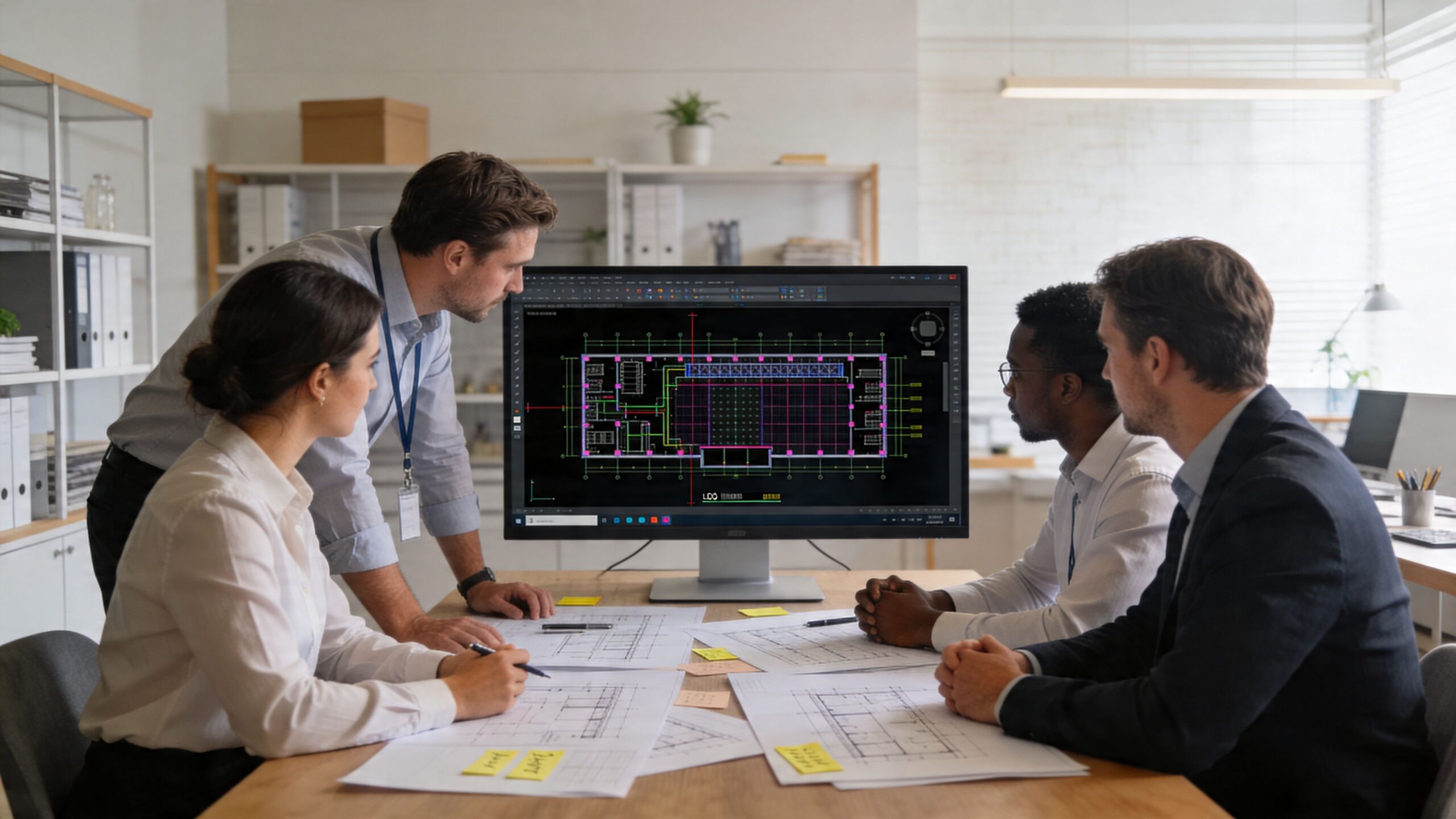
In the US, installation costs can range from $900 to $3,000 per square meter, as outlined in this LED video wall installation guide. That range is exactly why pre-planning matters. If the panel count, power load, and support structure are wrong on paper, you don’t get a small inconvenience. You get change orders, delays, and expensive improvisation.
The work that has to happen before the show
A professional install team should lock down the technical basics early. That includes booth dimensions, structural needs, power requirements, content format, and show paperwork. None of that is glamorous. All of it matters.
Here’s the checklist we insist on before a project moves forward:
- Confirm exact booth dimensions: Not the rounded version from a sales deck. The actual usable footprint.
- Match screen size to the booth design: The wall should fit the exhibit, not bully it.
- Calculate power correctly: You need enough power ordered from the show, with a plan for where it enters the booth.
- Review venue rules: Every hall has its own labor, rigging, and safety expectations.
- Map content to the canvas: A unified display wall still fails if the content was designed for a different aspect ratio.
- Schedule freight and access: Timing mistakes at the dock create a cascade of problems later.
One of the easiest ways to blow a budget is to treat shipping like an afterthought. A proper shipping trade show displays plan should account for crate timing, move-in windows, and the handling conditions at the venue.
What should be included in your quote
Often, buyers get burned. A low quote often looks attractive because it strips out the hard parts. Then the missing costs show up later.
Our advice is simple. Ask for a scope that clearly states what’s included and what the show bills directly. In a clean turnkey model, everything should be included except the charges the show itself imposes on you directly, such as electricity and material handling. That gives you real budget clarity.
Don’t compare LED wall quotes line by line until you know whether both vendors included labor coordination, setup, dismantle, content handling, on-site service, and logistics management.
The hidden planning traps
The dangerous part of DIY isn’t just assembly. It’s administration. You can have excellent hardware and still fail because nobody handled the boring details.
A few common traps:
| Planning issue | What goes wrong |
|---|---|
| Late electrical order | The wall can’t be powered where you need it |
| Poor content mapping | Logos stretch, text crops, and motion doesn’t align |
| No venue compliance check | Setup stalls while approvals get sorted out |
| Wrong support assumptions | The install team has to redesign on site |
The best installs look easy because the hard work happened weeks earlier. That’s the standard you should expect.
On-Site Assembly The Power of a Toolless Magnetic System
Move-in day tells you whether your led video wall installation was designed by people who understand trade shows or by people who just sell screens. You can spot the difference fast.
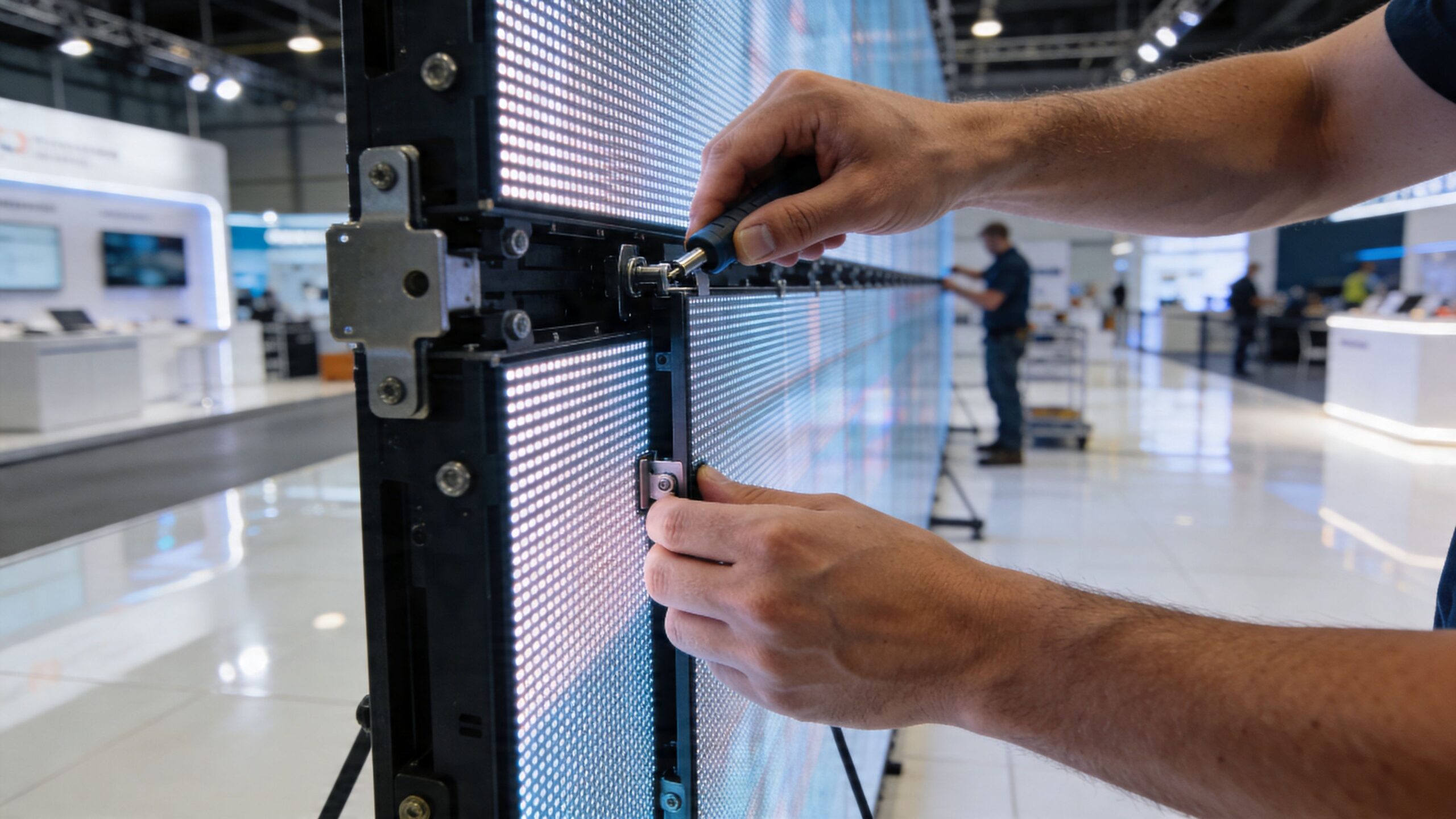
A traditional bracket-and-screw build is slow, fussy, and prone to little errors that become very visible once content goes live. A magnetic, toolless system is different. The frame goes in cleanly, the modules snap into place, and the whole process is built around speed and repeatability instead of field improvisation.
Why precision matters on the floor
This isn’t cosmetic nitpicking. A misalignment of just 0.5mm can cause visible seams, and a properly engineered magnetic system can achieve less than 0.2mm gaps and under 1mm flatness tolerance, supporting a 98% first-boot success rate compared with a 75% industry average for complex builds, according to this installation methodology reference.
That’s the difference between a wall that reads as one unified digital canvas and a wall that looks like a patchwork of panels.
How the assembly should happen
A good crew doesn’t rush. They move in the right order.
First, the team establishes the reference lines and builds the support structure so the surface is flat. Then they mount the modules row by row, checking alignment as they go. Data and power are routed cleanly, not draped where they’ll create safety problems or service headaches later.
The best part of a toolless system is not that it feels modern. It’s that it removes unnecessary failure points.
- Fewer loose parts: Less hardware means fewer chances to lose time on the floor.
- Cleaner integration: The booth structure can serve as the framework, so you don’t need bulky truss cluttering the design.
- Faster corrections: If a module needs adjustment, the crew can handle it quickly.
- Better finish quality: Tight seams and tidy cable paths make the whole booth look intentional.
If you want to understand the hardware category behind this process, this overview of LED panels for video walls gives useful context.
Cheap installs usually look cheap at the edges first. Seams show. Corners drift. Cables peek out. That’s where attendees decide whether your booth feels premium or improvised.
Cable management is part of the install
A lot of exhibitors think cables are an internal technical issue. They’re not. They affect safety, reliability, and the final look of the booth.
A disciplined crew routes data and power so nothing is pinched, visible, or vulnerable to traffic. That matters during setup, and it matters even more when booth staff start moving around with demo gear, literature, and personal bags.
This video gives a useful visual sense of how modular screen builds come together in practice.
Why low-cost labor often backfires
Low-cost options usually save money only on the quote. On the floor, they cost time. The crew may not know the system, may not understand the venue, and may not care whether your content team is waiting on final sign-off.
That’s why I’m opinionated about this. If your wall is central to your booth, don’t outsource assembly to the cheapest available hands and hope they figure it out. Hope is not an installation plan.
Calibration and QA From Pixels to a Perfect Picture
A wall can be physically assembled and still look wrong. That’s where calibration separates a professional led video wall installation from a merely finished one.
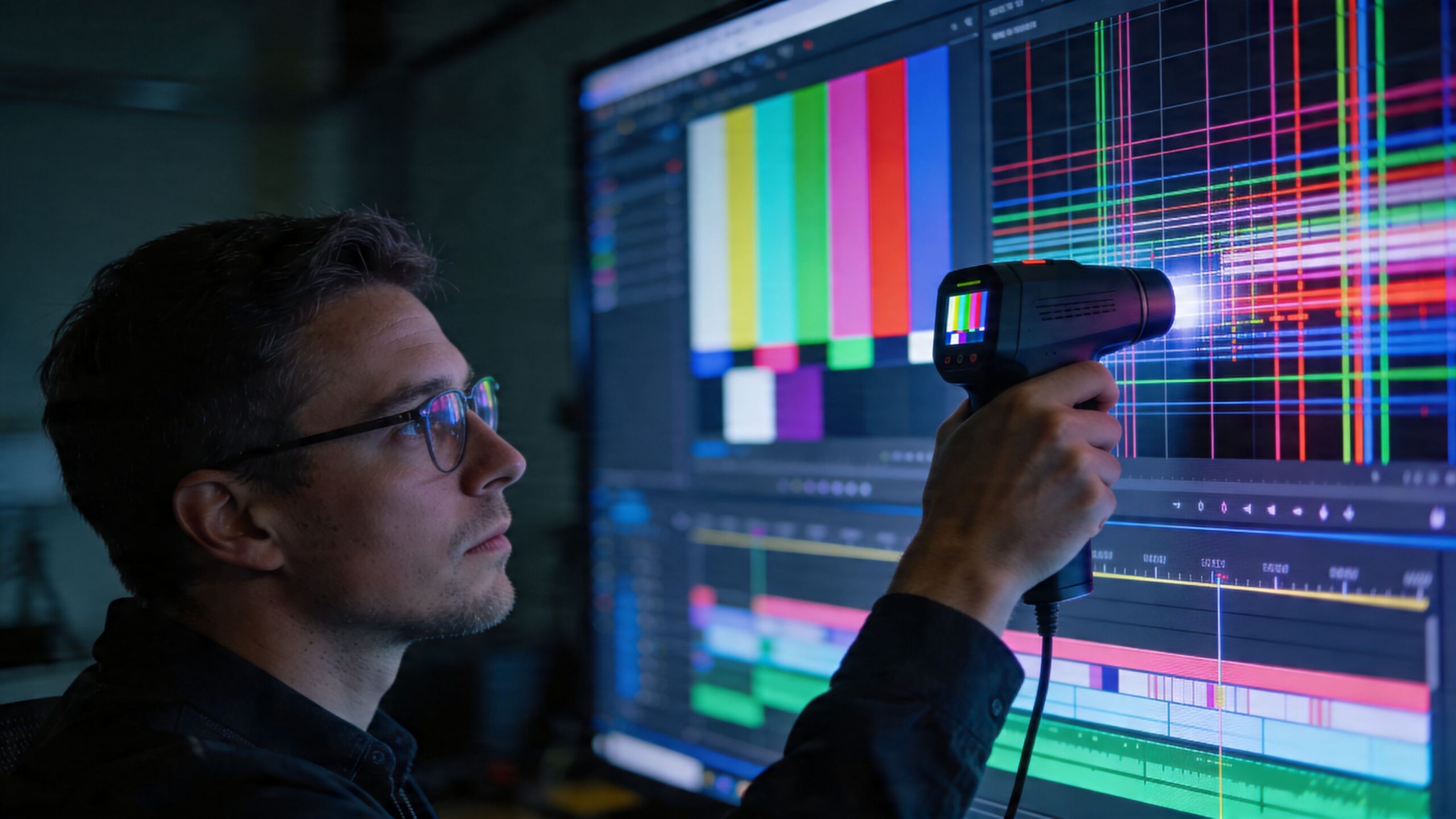
Convention halls are harsh environments for color and brightness. Overhead lighting shifts. Aisle light spills into the booth. Nearby exhibits throw competing color into your space. If nobody calibrates the wall for the actual venue, your expensive content can look flat, mismatched, or washed out.
What calibration actually does
Think of calibration as the last stage of fit and finish. The wall is built. Now the image has to become consistent across every module.
That means checking for:
- Color uniformity: Reds should match from panel to panel.
- Brightness balance: One cabinet can’t run hotter than the rest.
- Dead or weak pixels: Tiny defects become obvious on bold backgrounds.
- Playback integrity: Motion content has to read cleanly across the full canvas.
Our technicians use professional spectrometers to achieve ΔE of less than 2, and that calibration, paired with redundant controllers, supports a 99.2% uptime record, as described in these LED video wall best practices. For a trade show brand, that means your logo colors stay on-brand instead of drifting into “close enough.”
Why P1.9 earns its keep here
Higher resolution hardware yields benefits. P1.9 gives the calibration team more to work with than P2.5 at close viewing distances. Fine text, product UI screens, and detailed imagery all hold together better when the underlying pixel structure is tighter.
That doesn’t mean hardware alone solves the problem. It means good hardware rewards good setup. Poor calibration can still make a premium wall look average.
For practical answers to common performance questions, this collection of LED video wall FAQs is worth reviewing before a show.
A wall isn’t ready because it powers on. It’s ready when your content looks right under the same lights your buyers will see.
QA before the hall opens
A proper QA pass should happen before your team starts rehearsing or meeting with prospects. The technician should run test patterns, verify input sources, confirm scaling, and review scheduled playback.
I also recommend checking actual show content, not just color bars and generic loops. The ultimate test is whether your launch video, product demo, and branded slides all display correctly at full size. That final review catches the embarrassing stuff before attendees do.
Renting vs Buying Your Video Wall A Strategic Breakdown
Most exhibitors should rent. That’s my view, and I haven’t seen many real-world show schedules that change it.
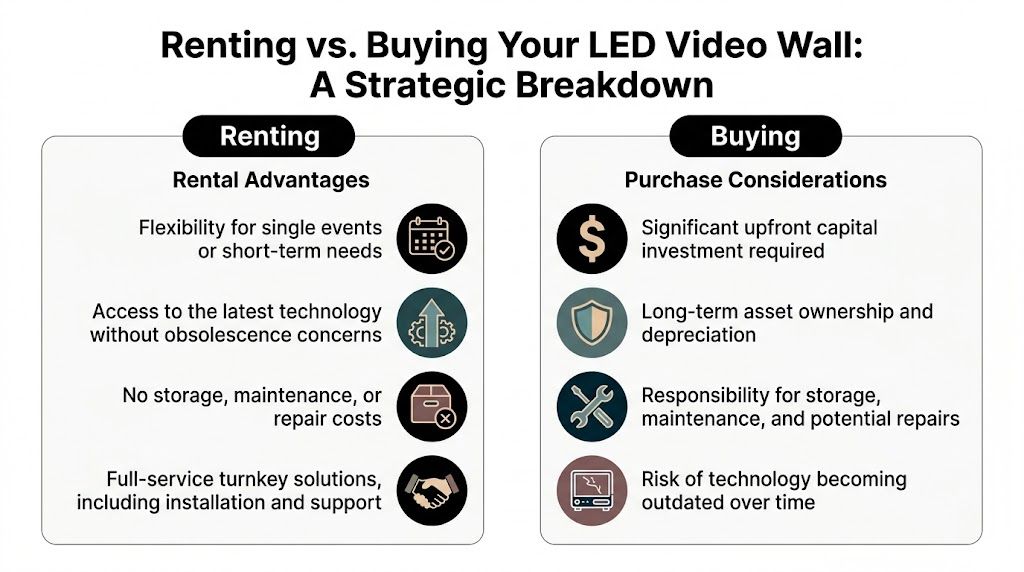
Buying sounds smart because ownership feels efficient. In practice, many brands don’t buy a system. They buy a list of new responsibilities. Storage, maintenance, transport coordination, repair risk, software updates, spare parts, crew training, insurance, and technology aging all become your problem.
The real comparison
A rental model offloads complexity. A purchase model creates obligations.
The most straightforward understanding is:
| Decision area | Renting | Buying |
|---|---|---|
| Flexibility | Good for varying booth sizes and event schedules | Best only if your use case stays consistent |
| Technology refresh | Easier access to newer display options | You carry obsolescence risk |
| Maintenance | Handled by the provider | Your team owns it |
| Logistics | Usually bundled into service | You manage storage and freight strategy |
| On-site support | Often available in turnkey packages | Depends on your staffing and vendor contracts |
If you’re weighing both options, this guide on owning vs renting an LED video wall is a useful decision aid.
When buying makes sense
I’m not against buying. It fits some exhibitors.
Buying can work if:
- You exhibit constantly: Repeated use may justify ownership.
- Your booth format rarely changes: Standardized designs are easier to support.
- You have internal technical staff: Someone has to own maintenance and deployment.
- You’re prepared for lifecycle management: The wall will age, and replacement planning matters.
But most small and mid-sized exhibitors don’t have those conditions. They exhibit a few times a year, sizes vary, and marketing teams don’t want to become AV operations managers.
Why rental is usually the stronger trade show move
Rental keeps your focus on outcomes. You get the right size wall for the event, current hardware, installation, service, and teardown without carrying the burden between shows.
That’s especially valuable when your quote is structured as an all-inclusive turnkey package except for the direct show charges. Electricity and material handling are often billed by the show itself. Everything else should be spelled out and covered. That’s the pricing model I trust because it leaves less room for “surprise” invoices after the event.
Renting buys flexibility. It also buys accountability, because one partner owns the result from delivery through dismantle.
If you only remember one thing from this section, remember this: ownership lowers risk only when you already have the infrastructure to support it. If you don’t, rental is the safer and usually smarter business decision.
Your Secret Weapon On-Site Support and Troubleshooting
This is the part exhibitors undervalue until the first thing goes wrong.
You can have a beautiful wall, sharp content, and a clean install. Then the keynote file stutters ten minutes before your big demo. Or a panel starts acting up at opening bell. Or your audio handoff doesn’t sync with the presentation laptop. At that point, the question isn’t whether the vendor was polite during the sales process. The question is who can fix the problem right now.
What live support changes
An on-site AV technician changes the entire show experience because you stop carrying technical anxiety in the background. You don’t need to troubleshoot during a customer conversation. You don’t need to leave the booth manager holding the bag while someone calls a remote help line.
You text or call. A technician comes over. The issue gets handled.
That matters more than most buyers realize because modular, magnetic event systems are becoming more common. Post-2025 CES reports noted 35% growth in demand for modular, magnetic LED systems for events, with setups cutting time by up to 50%, according to this CES-related discussion of event installation trends. Fast setup is great. Fast support is even better.
The problems that show up during live hours
Most on-site issues are manageable if the right person is already in the building. They become stressful when nobody owns them.
Typical live-show problems include:
- A playback issue: The media file is correct, but the output settings aren’t.
- A panel anomaly: One cabinet flickers, dims, or needs a quick swap.
- A source switch problem: The feed from a demo laptop doesn’t hit the wall properly.
- An audio mismatch: Video is running, but the booth sound path isn’t behaving.
- A last-minute content edit: Marketing wants to change a slide, loop, or CTA before the afternoon rush.
A staffed booth can’t solve those issues alone. They need a technician who understands the system, knows the signal path, and can act without turning a minor glitch into a floor-wide panic.
Why remote support isn’t enough
Remote support works for software subscriptions. It’s a weak answer for a live trade show environment.
The floor is loud. Inputs get swapped. Salespeople unplug the wrong cable. A laptop goes to sleep. Someone changes a playback schedule. A dock delay pushes setup late and compresses testing time. Physical environments create physical problems, and physical problems need a human being on site.
Here’s the core value of white glove service:
- You protect the customer-facing team: They stay focused on meetings, demos, and lead capture.
- You reduce downtime: Problems get addressed before they become public.
- You avoid blame loops: Nobody wastes time arguing whether the issue is content, hardware, or venue power.
- You keep momentum: The booth stays open, presentable, and functional.
The best support model is simple. If something goes wrong while the show is open, someone qualified should be able to walk to your booth and fix it.
The peace of mind most quotes omit
A lot of competitors quote the install and disappear after handoff. That’s not support. That’s delivery.
If your booth depends on LED for storytelling, product launches, or lead generation, then on-site technical coverage isn’t an upgrade. It’s part of the core operating plan. You want a technician available for the full time the show is open, someone who can respond within minutes and keep your team from losing face in front of customers.
That kind of support doesn’t just solve problems. It changes how confidently your staff works the booth. They know somebody has their back.
Frequently Asked Questions and Final Thoughts
A few questions come up almost every time.
What if we need to change content at the last minute
It happens all the time. Product teams update messaging. Legal wants a revision. A logo lockup changes. A good turnkey partner plans for late adjustments and has the playback workflow to load, test, and verify updated content without turning it into a crisis.
How is teardown handled
Teardown should be handled by the same team that installed the wall or by a crew working under their direction. That keeps dismantle organized, protects the hardware, and reduces the chance of damage during repacking and outbound freight.
What power do we need to order from the show
That depends on the wall size, content brightness, and the rest of the booth systems. Don’t guess. Have the install partner specify the requirement during planning so you order correctly the first time. If you’re reviewing the electrical side yourself, this checklist of questions to ask an electrician is a practical resource for understanding how to vet that part of the job.
What’s actually included in a proper turnkey price
The cleanest model is simple. Everything is included except the charges billed directly by the show, typically electricity and material handling. That means the quote should already account for the wall, structure integration, logistics coordination, install, dismantle, and service coverage. If the proposal is vague, assume the surprises are still hiding in it.
Final take
led video wall installation is not a commodity task. It’s a high-visibility execution job with technical, logistical, and operational consequences. The wrong partner can leave you with hidden costs, visible seams, and no safety net when something fails. The right partner gives you a crisp wall, a controlled install, all-inclusive clarity, and live support while the hall is open.
For most trade show exhibitors, the smartest choice isn’t just better hardware. It’s a white glove team that handles the full process so you can focus on customers.
If you want a turnkey partner for your next exhibit, LED Exhibit Booths delivers high-resolution P1.9 video wall rentals, all-inclusive project management except direct show charges like electricity and material handling, and on-site AV technician support throughout show hours so your team can focus on selling, not troubleshooting.