

A great expo stand does more than just look pretty—it transforms an empty patch of convention center floor into a lead-generating powerhouse. Expo stands design is not about just picking out cool furniture and a flashy sign. It’s a strategic plan to maximize every dollar you spend by figuring out your goals, understanding how attendees walk the floor, and creating a layout that pulls them right in.
This way, your booth becomes a destination, not just another box people walk past.
Your Blueprint for an Unforgettable Expo Stands Design
Looking at a blank floor plan can be intimidating. Where do you even start? The most successful exhibitors know that a powerful stand design begins long before you choose a single color swatch or material. It starts with a solid blueprint focused on real, measurable results.
Think of it like building a house. You wouldn’t just start ordering lumber and windows without a detailed architectural plan, right? Your booth is no different.
Every single design choice should be a direct answer to a specific goal you have. Are you trying to get 500 qualified leads? Launch a new product and get press coverage? Or just build stronger relationships with your current customers? Your main goal will shape every decision you make, from the booth layout and lighting all the way to the content you put on your screens.
Define Your Goals and KPIs First
Before you can design an “effective” space, you have to decide what “effective” actually means for your business. This means setting specific, measurable Key Performance Indicators (KPIs). Vague goals like “increase brand awareness” are useless because you can’t measure them. You have to get specific.
Good, solid goals sound more like this:
- Generate 300 badge scans from people who fit our ideal customer profile.
- Conduct 50 live product demos for qualified prospects during the show.
- Lock in 20 scheduled follow-up meetings with key decision-makers.
These concrete numbers give you a framework for your expo stands design. If demos are your priority, you’ll need a dedicated space that’s set up for them. If lead capture is the main goal, your layout needs to make it easy for people to get to your scanning stations without creating a bottleneck.
The Foundation of Great Expo Stands Design
This first phase—setting goals, getting inside the head of an attendee, and drafting a strategic blueprint—is the foundation for the entire project. This simple diagram shows how you move from your initial goals to the final plan.
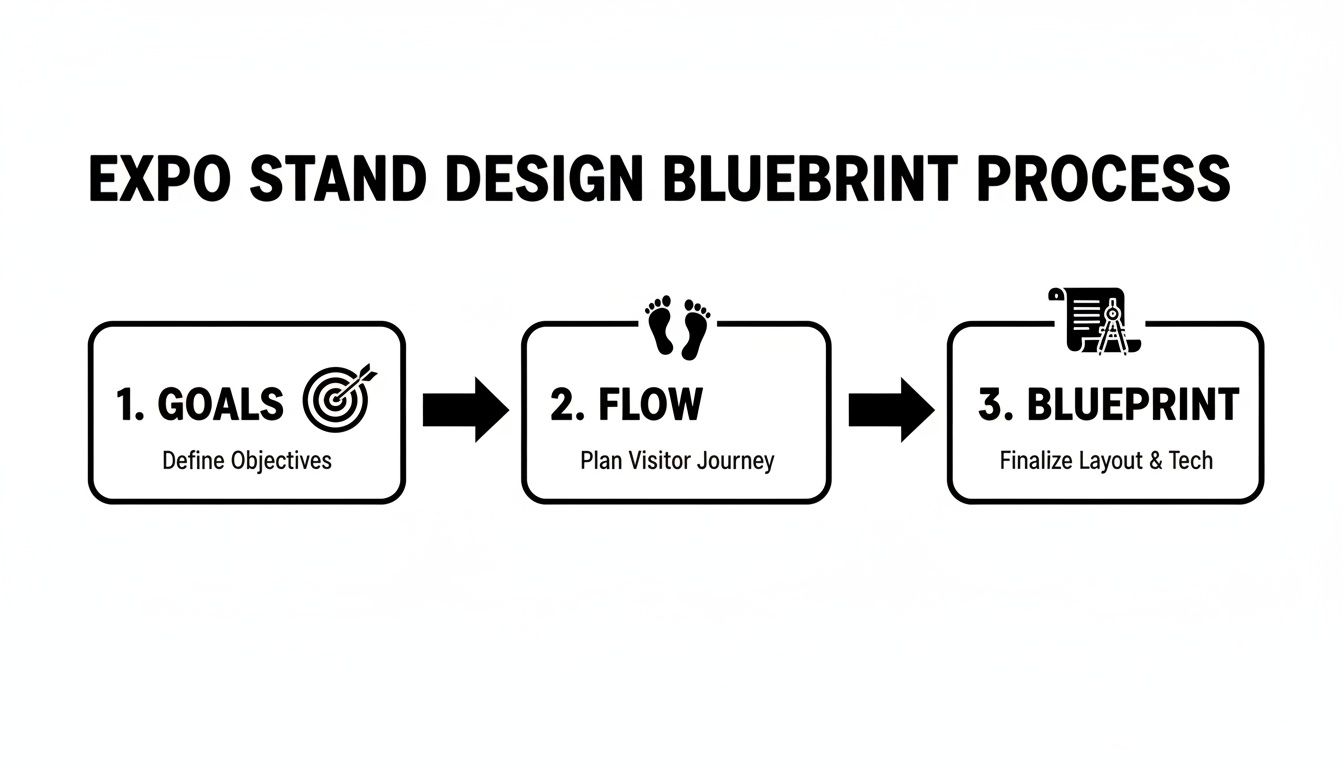
As you can see, each step builds on the one before it. This ensures your final blueprint isn’t just a pretty picture but a direct reflection of your business goals, designed for how real people actually move through a crowded expo hall.
By mapping out this blueprint first, you turn your booth from a passive display into an active machine built for success. You’re not just putting up some walls; you’re engineering an environment to get a real return on your investment.
A great trade show booth isn’t just seen—it’s experienced. The design’s primary job is to turn passive walkers into active participants by creating an environment that is both intriguing and intuitive.
Ultimately, you want a space that pulls people in from the aisle. By thinking about how attendees naturally behave—how they scan the hall, where their eyes go first, and what makes them stop in their tracks—you can create a layout that feels open and is easy to navigate. This is a critical part of modern expo stands design. This groundwork is what turns foot traffic into actual business conversations.
Designing For Engagement And Attendee Flow
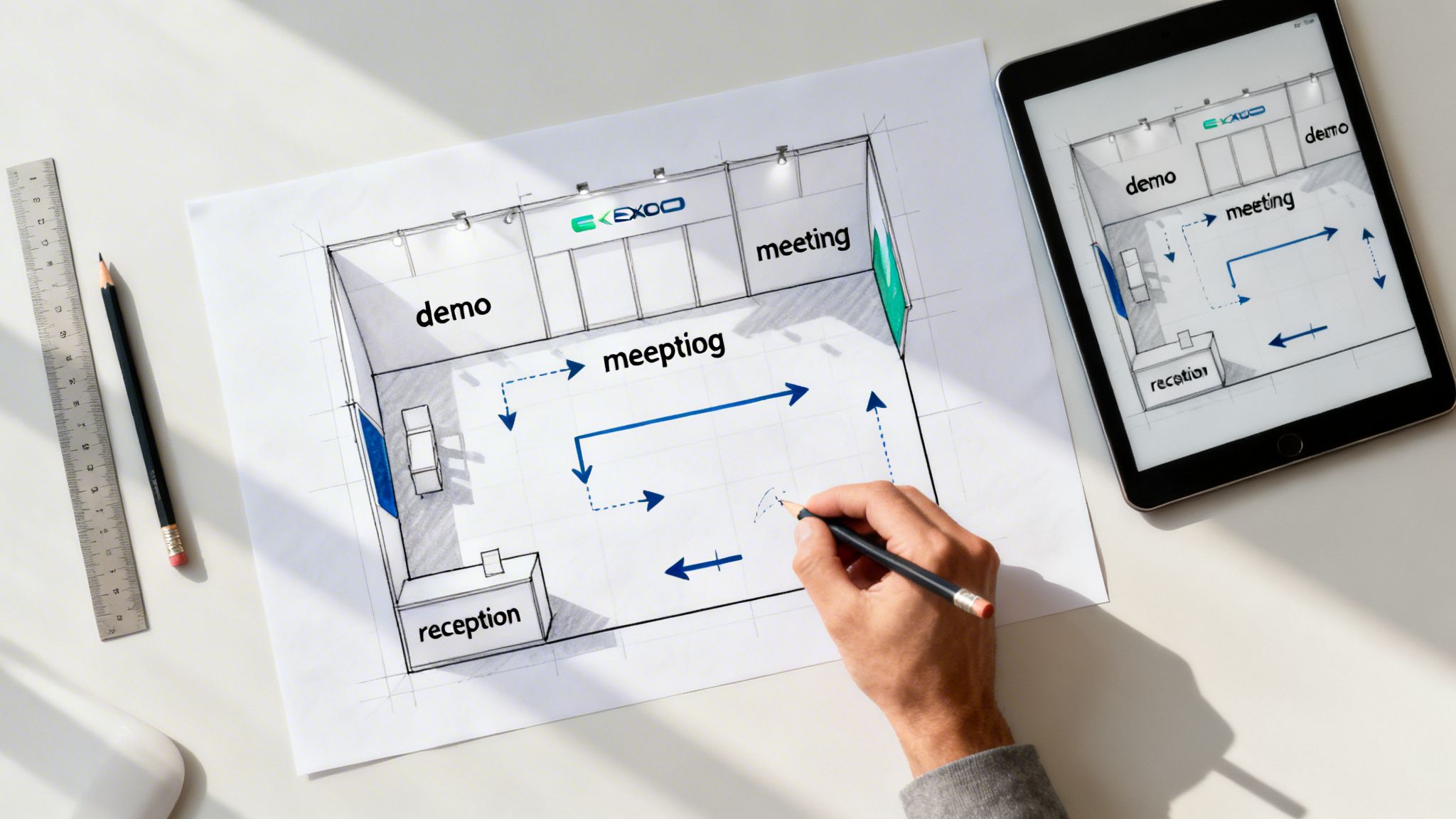
A great expo stands design is more than just a box with your logo on it. It’s a space designed to pull people in and guide them through an experience. The layout is all about managing the flow of traffic in a way that feels natural and makes people want to stick around.
You want to turn your patch of the show floor into a destination, not just a sales pitch. A smart layout can double or triple the time attendees spend with your brand. That means more opportunities for real conversations that turn into real business. It all starts by creating a booth that’s open and inviting.
Creating An Open And Welcoming Facade
Your booth’s entrance is everything. If it looks closed off or intimidating with high walls and a tiny entry, people will walk right on by. You need an open, airy design that practically pulls attendees in from the aisle.
Here are a few ways to do it:
- Corner Booths: Got a corner spot? Keep that corner wide open. Putting a big wall or counter right on the corner is a rookie mistake that blocks your view and cuts off traffic from a whole aisle.
- Minimal Barriers: Use low counters or small reception pods at the front. A giant desk acts like a fortress wall, scaring off anyone who’s just casually browsing.
- Clear Sightlines: Let people see the good stuff from the aisle. If you have a killer video wall or a cool product demo, make sure it’s visible. This sparks curiosity and gives them a reason to step inside.
An open design tells everyone you’re confident, accessible, and ready to talk. That alone makes them far more likely to enter your space.
Zoning Your Booth For Maximum Impact
Once they’re in, you need to guide them. A chaotic, one-size-fits-all layout just confuses and overwhelms people. The pro move is to create different “zones,” each with its own job. This keeps traffic moving and gives visitors a clear path.
Think of it like a well-designed retail store. There are areas for browsing, areas for trying things on, and areas for checking out. Your booth should work the same way to make the customer’s journey smooth.
For example, you can have an “Attraction Zone” right at the front with a massive, bright video wall to grab attention. Our video walls use a 1.9 pixel pitch, which offers much higher resolution than the 2.5 pitch many competitors use. This means your videos look incredible even up close, making it the perfect hook.
Deeper inside the booth, you can set up:
- Engagement Zones: For hands-on product demos or interactive screens.
- Conversation Zones: Comfy, semi-private seating areas for serious talks with qualified leads.
- Hospitality Zones: A simple coffee or water station to encourage people to stay a little longer.
Zoning prevents traffic jams and makes sure every square foot of your booth is working for you. You can see more examples in our guide to designing better trade show booth layouts.
The All-Inclusive Expo Stands Design Advantage For Flawless Execution
A great layout on paper is one thing, but making it happen flawlessly on the show floor is what really counts. We make it simple with our white glove, turnkey service. Our pricing is all-inclusive and totally transparent—it covers everything in our price except what the show bills you for directly, like electricity and rigging. We take care of everything so you can just greet customers.
This means you’re not juggling a dozen different vendors or getting hit with surprise fees. Better yet, we leave an audiovisual technician onsite the entire time the trade show is open. If anything goes wrong, you just text or call. Within minutes, an AV Technician is at your booth to resolve the problem, guaranteeing zero downtime.
With our team handling all the logistics, you can focus on what you’re there to do: talk to customers and grow your business.
The Power of Light and Pixels in Your Design
Step into any trade show, and you’re hit with a wall of visual noise. It’s a chaotic, overwhelming space where everyone is fighting for a sliver of attention. In this environment, the last thing you want is a booth that just sits there. Your best bet for cutting through the chaos isn’t a pile of brochures—it’s light and motion.
Strategic lighting and a killer audiovisual (AV) setup can transform your booth from a simple backdrop into the main event. Lighting does way more than just keep the shadows away. It guides the eye, creates a mood, and turns your brand into a beacon that attendees can spot from across the hall. But while good spotlights are helpful, the real game-changer is a seamless LED video wall. We’re not talking about a few TVs pushed together; these are stunning, bezel-free canvases that bring your brand to life.
Beyond Basic Screens: The Impact of Pixel Pitch
When it comes to video walls, you really do get what you pay for, and the single biggest factor in quality is pixel pitch. Simply put, this is the distance in millimeters between the center of one pixel and the center of the next. The smaller the number, the closer the pixels are, and the sharper your image will be.
Many vendors will offer you a video wall with a 2.5mm pixel pitch. From far away, it might look okay. But up close, where your potential customers are, the image can start to look grainy and pixelated. That’s a bad look.
Our video walls, on the other hand, feature a 1.9mm pixel pitch. This might not sound like a huge difference, but the higher resolution results in a massive visual impact.
With a 1.9mm pitch, your videos and graphics stay crisp and flawless, even when someone is standing right in front of the screen. This means your high-res product shots and brand messaging look professional and impressive, not cheap and blocky.
Understanding how pixel pitch affects your display’s clarity is critical. Here’s a quick comparison to show you exactly what that difference means for your booth experience.
Pixel Pitch Comparison for Video Wall Clarity
| Feature | Our 1.9mm Pitch LED Walls | Competitor 2.5mm Pitch LED Walls |
|---|---|---|
| Pixel Density | Higher. More pixels per square foot. | Lower. Fewer pixels per square foot. |
| Image Quality | Excellent. Sharp, smooth, and clear. | Good. Can look “blocky” or pixelated. |
| Optimal Viewing | As close as 6 feet. Perfect for interaction. | Best from 8 feet or more. Not ideal for close engagement. |
| Impression | Looks premium, professional, and high-tech. | Can appear dated or low-budget up close. |
This higher resolution means you can confidently design an experience where attendees get right up close to your displays, making them perfect for interactive content or showing off fine product details. You can explore more on how a superior video wall display can completely change your expo presence.
A Turnkey Service for Zero Technical Headaches
A stunning video wall is worthless if it’s not working. The trade show floor is the last place you want to be dealing with technical glitches, but they happen. This is where having a true partner—not just a hardware rental company—makes all the difference.
We provide a white glove, turnkey service designed to take all that stress off your plate. Our pricing is straightforward and includes everything except the services you are billed for directly by show management. We take care of everything so you can focus on greeting customers.
This approach means you can stop worrying about logistics and start focusing on what you’re there to do: talk to customers. But we don’t stop there.
On-Site Support That Guarantees Uptime
Picture this: the show floor is packed, you’re talking to a huge prospect, and your main video wall suddenly goes black. It’s a nightmare scenario. With most vendors, you’d be stuck frantically calling a support line, waiting on hold, and praying someone shows up before the show ends.
We’ve made sure that never happens.
We leave a dedicated audiovisual technician on-site for the entire duration of the trade show. If anything goes wrong—a loose cable, a software glitch, anything at all—you just text or call them. Within minutes, that technician is standing in your booth, fixing the problem.
This on-demand support means you never lose your momentum. You can greet every visitor with total confidence, knowing a tech expert is always on standby to keep your booth running perfectly. When paired with a professional LED lighting installation, you have a reliable, high-impact setup. Our job is to make sure the technology empowers your team, so you can just focus on building relationships.
Bringing Your Brand Story to Life
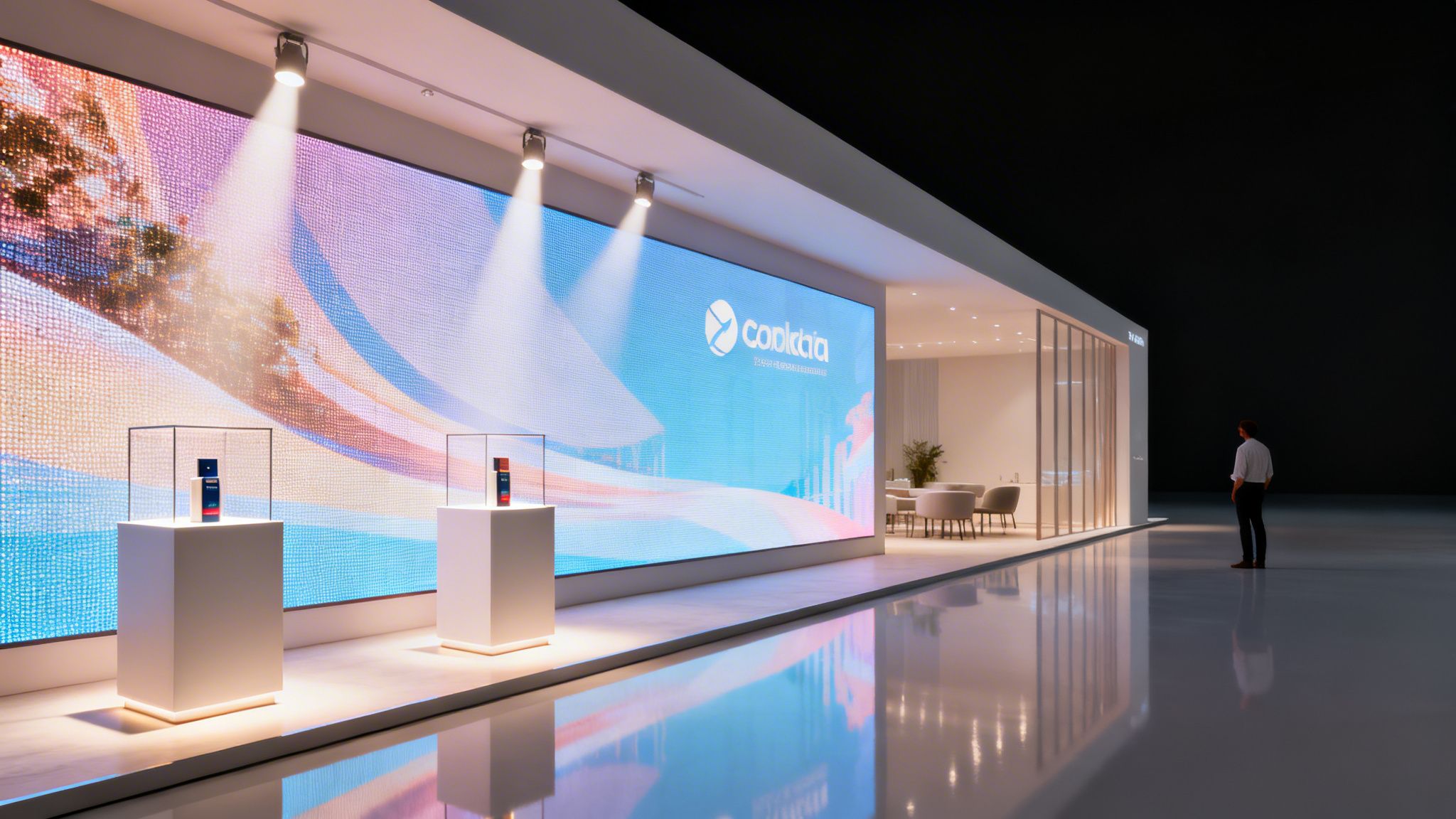
A great expo stand is much more than just a temporary structure. It’s the moment your brand steps out from behind the screen and into the real world. This is where your colors, logos, and the whole feel of your company become a three-dimensional experience for potential customers.
Your real goal is to tell a story that grabs people walking by and pulls them in, turning them from random attendees into genuinely interested leads.
This means every single element—the graphics, the words on the screen, the videos—has to work together. It’s where your expo stands design meets your marketing plan head-on to create an experience that actually drives business.
Crafting Content for the Show Floor
What works on your website or social media will not work on the show floor. You have just a few seconds to catch someone’s eye as they navigate a crowded, noisy aisle.
Your content needs to be big, bold, and instantly understandable. Forget about long paragraphs or complicated charts. Think in terms of powerful, silent video loops on your video walls and headlines so clear they can be read from 20 feet away. Good content warms up your visitors before your staff even has a chance to say hello.
The Turnkey Advantage for a Perfect Presentation
Of course, the most amazing content strategy is useless if the execution is a mess. That’s why a white glove, turnkey service is a game-changer. It means your brand looks exactly how you planned, without the usual logistical nightmares that give exhibitors headaches.
We provide a simple, all-inclusive price that covers everything: design, hardware, shipping, and all the labor. The only bills you’ll see are the ones that come directly from the show organizer, like your electricity hookup. We take care of everything.
We handle every single detail of the setup and teardown. This frees up your team to do what they’re there for: talking to customers and closing deals. You just show up and greet customers, and your booth is built, clean, and ready to go.
When you aren’t chasing down lost freight or fighting with union stewards, you can actually focus on your marketing plan and have a successful show. For more ideas on this, check out our guide on designing interactive trade show displays.
Unmatched Visual Quality for Your Content
Let’s be honest: the quality of your screens reflects on the quality of your brand. If your video looks grainy or pixelated, you look amateur. This is a critical part of your expo stands design that many people overlook.
A lot of our competitors use video walls with a 2.5 pixel pitch. From a distance, they look okay, but up close, attendees can see the blocky pixels. It’s not a great look.
We use a much higher-resolution 1.9 pitch for our video walls. The pixels are packed together much more tightly, creating an image that’s incredibly sharp, smooth, and vibrant. This higher resolution looks perfect, even when someone is standing a foot away. This ensures your content—and your brand—is always seen in its best light.
On-Site Support Guarantees Zero Downtime
Even with the best gear, things happen at a trade show. A cable gets kicked loose during cleaning, or a software setting acts up. Every minute your screens are dark is a minute you’re losing opportunities.
We make sure that never happens.
We have a dedicated audiovisual technician on-site for the entire time the trade show is open. If you have any issue at all, just send a text. Our tech will be at your booth in minutes to fix it. This is our promise: your brand’s story will be told without interruption, from the moment the show opens until it closes.
Navigating Budgets and White-Glove Logistics for Expo Stands Design
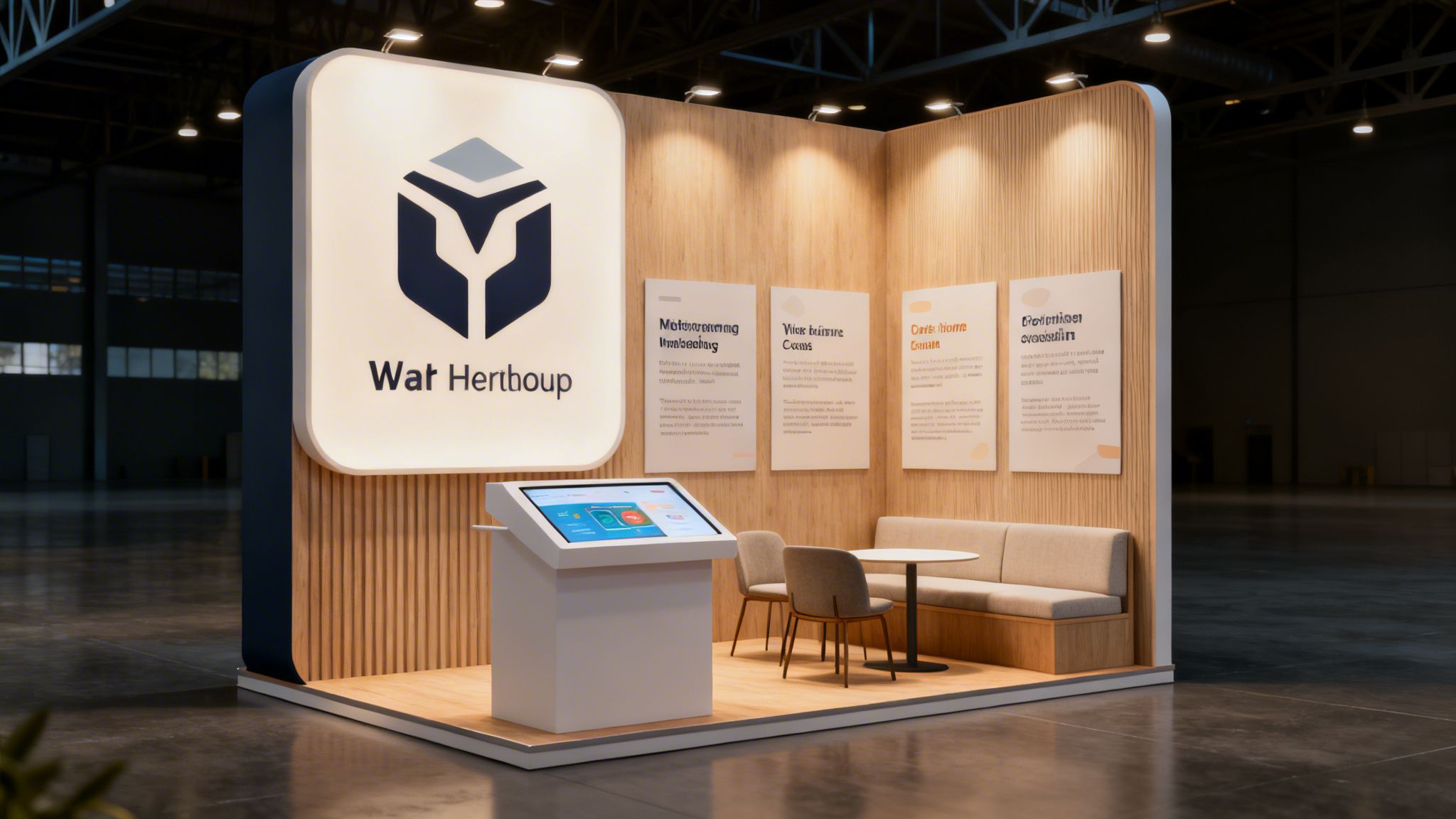
An amazing expo stand design is one thing; getting it built and running on a chaotic trade show floor is a whole different beast. The road from a great idea to a booth that actually generates leads is full of logistical hurdles, surprise costs, and last-minute fires to put out. Honestly, for most exhibitors, this is the most stressful part of the whole process.
This is exactly where having the right partner makes all the difference. Instead of trying to wrangle separate vendors for design, hardware, shipping, and labor, a single, unified approach just makes everything easier. It turns your budget from a wild guess into a predictable number and lets your team walk onto the show floor ready to go.
Demystifying The Real Costs of Expo Stands Design
When you’re budgeting for a trade show, the price of the booth structure itself is just the tip of the iceberg. There’s a long list of other expenses that pop up and can give you some serious sticker shock if you’re not prepared.
These are the “hidden” costs you need to watch out for:
- Drayage: This is the fee the show charges just to move your crates from the loading dock to your booth space.
- Labor: The non-negotiable costs for union workers to install and dismantle your booth.
- Electrical: The price to get power to your stand, which can vary wildly from show to show.
- Rigging: The cost to hang anything from the ceiling, like signs or lighting trusses.
- Shipping: Getting your booth and materials to the convention center and back again.
Typically, the show organizer manages and bills you for these services separately, which makes it almost impossible to get a clear picture of your total spend upfront. This is why having a transparent, all-in price is so important. For a deeper dive into all the potential expenses, you can check out our detailed guide on trade show booth costs.
The Power of a True White-Glove Turnkey Service
Now, imagine a world where you don’t have to worry about any of that. That’s what a real white-glove, turnkey service is all about. The term “turnkey” literally means you just “turn the key” and your booth is 100% ready.
Our entire approach is built around this idea. We give you one clear, all-inclusive price that covers the complete design, all the hardware, graphics, shipping, installation, and dismantle. We handle every single thing related to the physical booth.
This means the only bills you’ll pay outside of our invoice are the ones the show sends you directly for things like electricity or Wi-Fi. No surprise fees, no hidden labor charges, no last-minute panic. Your team can just show up and start talking to customers.
This streamlined process frees up your team to focus on what they do best: engaging with attendees and closing deals. You do the selling; we’ll handle the rest.
Comparing Turnkey Service vs Standard Rental in Expo Stands Design
To really see the value, it helps to put the options side-by-side. A standard rental might look cheaper at first glance, but it often leaves you managing a dozen different vendors and a mountain of paperwork.
Turnkey Service vs Standard Rental Breakdown
Here’s a look at what’s included in a ‘white glove’ turnkey service versus a typical a la carte rental package.
| Service/Item | Turnkey All-Inclusive Service | Standard A La Carte Rental |
|---|---|---|
| Design & Concept | Included. Collaborative design process. | Usually a separate fee. |
| Hardware Rental | Included. All walls, counters, etc. | Billed per item. |
| Graphics Production | Included. High-quality printing. | Billed separately. |
| Project Management | Included. We coordinate all logistics. | Your responsibility to manage. |
| Shipping & Drayage | Included. We handle all freight. | Your responsibility to arrange and pay. |
| Installation & Dismantle | Included. Our expert team handles it. | You hire and manage show labor. |
| On-Site Support | Included. Dedicated AV tech on-site. | Typically a phone support line. |
This table makes it pretty clear how a turnkey solution delivers peace of mind and predictable costs, which are crucial for effective expo stands design and a successful show.
Flawless Visuals and Unmatched On-Site Support
A huge part of our white-glove service is making sure your technology works perfectly, every single time. Our video walls use a 1.9mm pixel pitch, which gives you a much higher resolution than the 2.5mm or 2.8mm pitch you’ll see from many competitors. This guarantees your content looks incredibly sharp and professional, even when attendees are standing right up close.
But the best tech in the world is useless if it’s not working. That’s why we go a step further than anyone else in the industry.
We station an audiovisual technician on-site for the entire time the trade show is open. This isn’t some shared resource for the whole show; this person works exclusively for our clients. If you have any issue at all—a cable gets unplugged, a video isn’t looping—you just text or call. Within minutes, an expert will be at your booth fixing the problem. This commitment means you get zero downtime and can focus on your customers, not on troubleshooting your tech.
The global exhibition stand market is projected to grow from USD 10.28 billion in 2025 to USD 17.67 billion by 2034, and a lot of that growth is driven by advanced digital tech like seamless video walls. As you can read in the full research about these market trends, exhibitors who use advanced designs with full-service support see a much greater return. They create immersive experiences that pull in attendees, all without the logistical headaches.
Here are some of the questions we get asked all the time about designing a trade show booth. Getting a handle on timelines, budgets, and what kind of service you need is the first step to a successful show. Let’s get you some straightforward answers so you can plan with confidence and sidestep the usual rookie mistakes.
How Far in Advance Should I Plan My Expo Stand Design?
Ideally, you want to start the design process 6 to 9 months before the show. I know, that sounds like a long time. But trust me, it allows for a thoughtful, unhurried approach that pays off in the end.
This gives you plenty of breathing room for all the important steps. You’ll need time for concept development, a few rounds of revisions, fabricating materials, and nailing down all the show logistics. Starting early means you avoid those heart-stopping rush fees. More importantly, it gives your team the freedom to get creative, lock in the best tech, and make sure every little detail lines up with your marketing goals. It’s the best way to reduce stress and prevent expensive, last-minute changes.
What Is the Biggest Mistake to Avoid in Booth Design?
The single biggest mistake we see is a cluttered, unfocused booth. It’s a classic trap. Exhibitors get excited and try to cram every single product and every company message into one small space. This almost always backfires.
Think about it from an attendee’s perspective. A booth that’s exploding with too much information, too many products, or clashing visuals just creates sensory overload. Instead of pulling people in, that kind of chaos makes them want to walk right on by.
A truly great design is all about clarity and focus. It zeroes in on one or two main goals and uses plenty of open space, a clear primary message, and an inviting layout to pull visitors toward the most important parts of your exhibit.
Should I Choose a Turnkey Rental or Purchase a Booth?
This is a big one, and the right answer really depends on how often you exhibit and what your goals are. A turnkey rental is an all-in-one package that bundles the design, hardware, graphics, shipping, installation, and support. It’s a fantastic choice if you’re testing a new design, only do a couple of shows a year, or just want to avoid the logistical nightmare.
On the other hand, purchasing a booth means you own the whole structure. This can be cheaper in the long run if you plan on attending a lot of shows with the exact same setup. However, ownership comes with its own set of headaches, like paying for storage, maintenance, and managing all the logistics yourself.
Our white glove, turnkey service really offers the best of both worlds. We give you a complete, stress-free rental experience where we handle every single detail. Your team’s only job is to show up and sell, without a single worry about the booth itself.
This service includes everything in one transparent price. The only other bills you’ll see are the ones that come directly from the show organizer. We even have an on-site AV technician at the show for the entire run. If you have a problem, you just text or call, and an expert is at your booth in minutes to fix it. It means you can greet customers with total confidence, knowing everything will work perfectly.
How Do I Measure the ROI of My Expo Stand Design?
Measuring the return on your investment (ROI) doesn’t start after the show; it starts long before you even set foot on the show floor. It all begins with setting clear, measurable goals.
A few key metrics you should absolutely be tracking include:
- The number of qualified leads you get from badge scans.
- The total number of product demos you run.
- How many post-show meetings you book with key prospects right there at the booth.
A well-designed expo stand has a direct impact on these numbers. It drives more foot traffic, keeps visitors in your booth longer, and improves the quality of the conversations you have. Our video walls, for instance, use a 1.9 pitch, which is a much higher resolution than the 2.5 pitch most of our competitors use. That means your content looks sharper and more professional, even up close, which does wonders for holding an attendee’s attention.
To figure out your final ROI, just compare the total cost of the exhibit (your design, rental space, staff, travel) against the value of the business you generated from the leads you collected.
Ready to create an immersive brand experience without any of the logistical headaches? LED Exhibit Booths provides turnkey video wall displays that turn your space into a destination people won’t forget.