
If you’re planning a trade show right now, there’s a good chance you’re staring at the same starting point as thousands of other exhibitors. You booked a 10 x 10 pop up booth, you have a logo, a message, maybe a product demo, and now you’re trying to make 100 square feet feel bigger than it is.
That tension is normal. A 10 x 10 is the standard footprint at most major shows, which is exactly why it creates so much pressure. You get enough space to show up professionally, but not enough room to hide weak design, cluttered messaging, or a booth team that isn’t ready.
The good news is that a small booth doesn’t have to feel small. A lot of companies have generated serious results from compact spaces when the booth, the layout, and the pre-show plan all worked together. The challenge isn’t getting on the floor. The challenge is making sure your booth earns attention instead of disappearing into a line of similar backwalls and counters.
Your First 10×10 Pop Up Booth The Starting Line of Every Trade Show
The first 10 x 10 usually starts the same way. The crate arrives, the carpet goes down, the backwall goes up, and then the team sees the hard truth. One hundred square feet exposes every weak decision fast.
That is why the 10 x 10 pop up booth has lasted. It is small enough to control, affordable enough for a first serious event, and flexible enough to test a market without paying for a bigger footprint before the program proves itself. It also forces discipline. In a larger booth, companies can hide mediocre messaging behind more hardware. In a 10 x 10, the offer, the staff plan, and the visual hierarchy have to work.
I have seen first-time exhibitors waste a decent budget on the wrong things. They order a branded counter, a tall backwall, a pair of lights, and a bowl of giveaway items, then wonder why traffic stalls. An intentional first booth looks different. One clear headline sits high enough to read from the aisle. One demo answers one buyer problem. One staffer qualifies while another books follow-up meetings. Storage stays hidden, and every item in the footprint earns its place.
Results can come from a compact booth when the team treats it as a working sales environment instead of floor decor. IMEX publishes exhibitor guidance and case examples that reinforce the same pattern: pre-scheduled appointments and disciplined follow-up do more for ROI than adding more printed graphics, as shown in IMEX exhibitor planning resources.
That is why many exhibitors start by reviewing a classic pop up display for trade show use. It is the familiar entry point. But it also helps frame the bigger decision. A basic pop-up marks your space. The modern version of that same idea, especially an LED-backed 10 x 10, turns the same footprint into an active visual canvas that can hold attention, explain faster, and keep working after static graphics stop doing their job.
A first booth should do three things well: stop the right attendee, start the right conversation, and support a follow-up your sales team will actually make.
Anatomy of a Classic 10 x 10 Pop Up Booth
The classic pop-up booth is simple, and that’s exactly why it lasted. In essence, it’s a collapsible display system built for speed, portability, and repeat use. If you’ve ever opened an accordion file or pulled apart a folding drying rack, you already understand the basic mechanics.
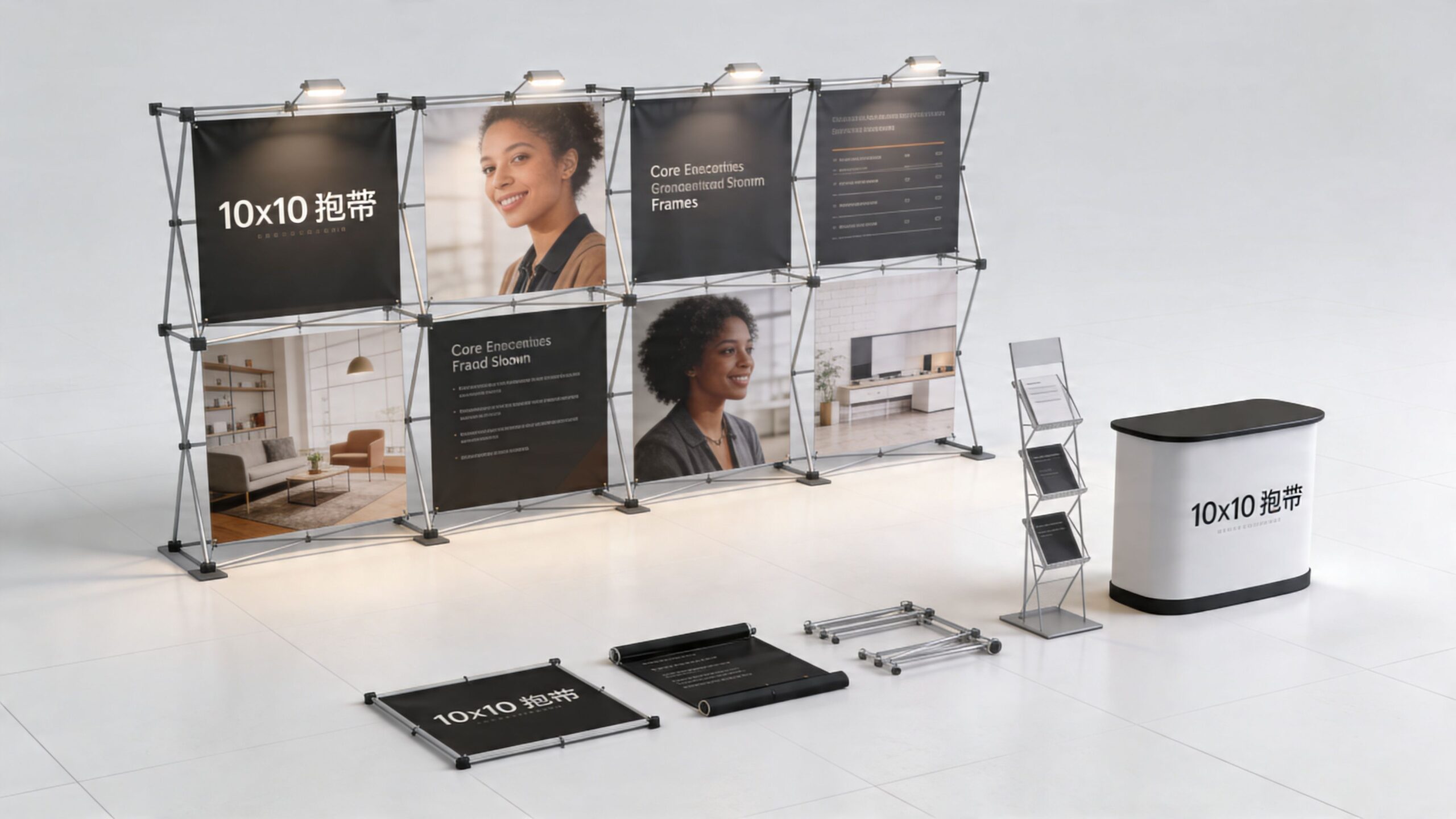
In most systems, the frame expands outward, locks into shape, and creates the structure for the display wall. Graphic panels or fabric skins attach to that frame, and accessories such as lights, counters, or brochure holders finish the booth.
The frame is the engine
The part that makes a pop-up a pop-up is the accordion-style collapsible aluminum frame. It opens quickly, holds shape without complicated tools, and packs down into a transport case when the show ends.
One useful technical description comes from this straight pop-up booth product explanation, which notes that the accordion-style collapsible aluminum frame enables tool-free assembly in under 10 minutes by utilizing magnetic connectors and expandable magnetic bars that snap high-resolution graphic panels into place, achieving a smooth display with zero visible gaps.
That matters in practice because setup speed changes everything on show day. If your team can unload, expand, attach graphics, and get the booth presentable fast, you reduce stress and you lower the odds of setup mistakes.
Magnetic bars and graphic panels
Most traditional systems rely on magnetic channel bars or similar supports that attach to the frame. Those bars create mounting points for the graphic face. Depending on the system, the graphics may be rigid panels, fabric, SEG graphics, or photomural-style pieces.
The practical differences show up fast:
- Rigid graphic panels tend to look crisp, but they can be less forgiving in shipping.
- Fabric graphics travel more easily and often reduce weight.
- SEG graphics usually produce a cleaner, more contemporary finish when installed correctly.
What buyers often miss is that the visual result depends as much on installation quality as on the graphic material itself. A great design can still look amateur if the panel edges don’t align, the frame isn’t fully expanded, or the lighting washes out the print.
Why this 10 x 10 pop up booth system became so common
Classic pop-ups stayed popular because they solve real exhibitor problems:
- They travel well: The booth can pack into cases that are easier to move than bulkier custom structures.
- They reduce labor: A smaller team can usually manage setup without specialized crews.
- They lower complexity: Fewer structural parts means fewer things to forget, damage, or assemble incorrectly.
Practical rule: If your internal team is handling setup, choose a system they can rehearse in the office before the show. Booth stress usually comes from unfamiliar parts, not from the booth size.
A traditional pop-up works best when you need a clean branded backdrop, predictable setup, and a footprint that doesn’t require a full exhibit program to manage. It works less well when your brand needs motion, layered storytelling, or a stronger visual break from the booths around you.
Planning Your Booth Layout and Logistics
A 10 x 10 pop-up booth gives you 100 square feet, which sounds workable until you start placing real things into it. A backwall, one counter, two staffers, a monitor, a literature stand, a small storage area, and suddenly the space is crowded. Layout discipline then becomes more important than creativity. The most effective small booths are usually edited, not overdesigned.
The format is standard at most major trade shows, and an 8-foot height limit is common. Pop-up versions can assemble in under 10 minutes, cutting labor, drayage, and logistics costs by up to 50% compared to truss-based setups, according to Willwork’s 10×10 booth guide.
Layout choices that usually work
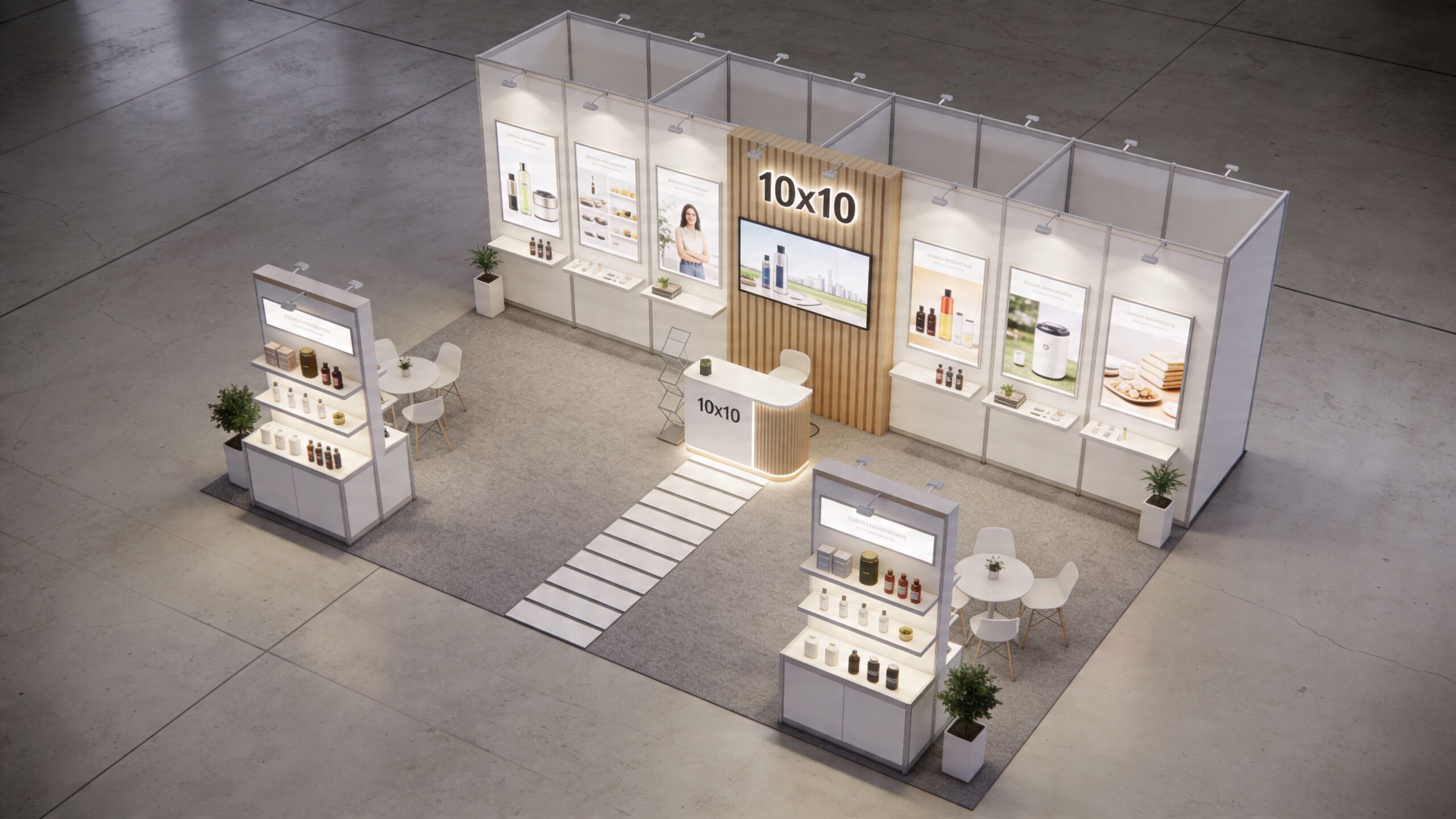
The rear backwall layout is still the safest starting point. Put the main display on the back line, keep the front edge open, and leave enough room for people to step in without immediately blocking the aisle. This is the easiest layout for product conversations, scans, and quick demos.
An L-shape can work when you need a more guided flow. It creates a partial pocket for conversation, but it also makes the booth feel smaller if the furniture is bulky or the staff tends to cluster near the front corner.
A few layout habits consistently help:
- Keep the entrance obvious: If visitors have to guess where to stand, many won’t stop.
- Push storage out of sight: Bags, cases, and personal items kill credibility fast.
- Use one focal point: A booth with three equal messages usually communicates none of them clearly.
If you’re weighing different footprints and traffic patterns, this gallery of trade show booth layouts is useful for thinking through what fits in a compact inline space.
Logistics decide whether the booth feels easy or expensive
Many exhibitors focus on purchase price and ignore deployment cost. That’s backwards. What drains time and budget is usually the chain of handling around the booth, not the backwall itself.
Watch these items closely:
- Shipping format: A booth that packs into fewer cases is easier to move, store, and track.
- Material handling: Even a compact booth triggers show-floor handling charges once it reaches the venue.
- Setup timing: Tool-free doesn’t mean effortless. Someone still has to unpack, stage parts, attach graphics, test lights, and clean the booth before the aisle opens.
- Show services: Electricity, internet, cleaning, and rigging rules vary by venue and can affect your design choices.
A short walkthrough helps if you’re mapping booth decisions to real floor use:
Compliance is not a detail with your 10 x 10 pop up booth
Plenty of exhibitors assume a booth that worked at one event will pass everywhere else. That’s risky. Venue rules can change by organizer, by country, and even by hall within the same complex.
Things to verify before production or shipment:
- Backwall height limits: Inline booths often have specific rear-wall allowances.
- Line-of-sight rules: Side returns and forward elements can trigger objections.
- Canopy and overhead restrictions: Some designs are fine on paper and noncompliant in the hall.
- Monitor and lighting placement: Protrusions can create rule violations if they extend too far.
The mistake I see most often is building for aesthetics first and compliance second. That approach gets expensive quickly because on-site changes are always harder than pre-show revisions.
If your booth only works when every venue interprets the rules generously, it doesn’t really work.
The Pros and Cons of a Traditional 10 x 10 pop up Booth
A traditional 10 x 10 pop-up booth is still a practical starting point. It gets a brand on the floor fast, contains upfront cost, and keeps the program manageable for a small team. That matters, especially for a first show or a light event schedule.
It also has a ceiling.
The classic pop-up was built for an era when a clean printed backwall could do enough of the selling on its own. On many show floors now, that same booth has to compete with motion, light, and constantly changing content. The question is no longer whether a pop-up works. The better question is whether it works hard enough for the money and effort required to show up.
Where the classic pop-up wins
The strongest argument for a traditional booth is control. Costs are easier to predict, shipping is usually simpler, and the format is familiar to internal teams who do not want production surprises.
Common reasons exhibitors still choose it:
- Lower upfront spend: A basic 10 x 10 pop-up usually sits in a price range that is easier to approve than a custom exhibit or digital build.
- Simpler transport: Lighter hardware and compact cases reduce freight, drayage risk, and storage headaches.
- Easy graphic updates: Reprinting panels is usually cheaper than rebuilding the booth structure.
- Good fit for limited schedules: If a company only does a few regional shows a year, a static system can be the sensible call.
For that reason, traditional pop-ups still make sense for budget-sensitive teams, short campaigns, or brands that are still testing which events deserve larger investment.
Where it starts to lose ground
The weakness is not size. The weakness is that the booth stops working the moment the graphics stop someone in the aisle. If they do not, your staff has to create the traffic manually.
That is the trade-off.
A static backwall can present a brand clearly, but it cannot rotate messages by audience, show movement, support live content changes, or build visual energy on its own. In a busy hall, that matters. A neighboring booth with motion graphics or a digital backdrop often gets the first look, even if the footprint is identical.
There are also practical wear-and-tear issues that show up after repeated use:
- Frames loosen over time: Shipping vibration, rushed installs, and repeated packing can throw off alignment.
- Printed graphics age quickly: Creases, scratches, edge curl, and dated messaging are common after a few events.
- Message flexibility is limited: One printed wall has to serve every audience, every conversation, and every product focus.
- Labor carries more of the load: If the booth itself is static, staff energy has to make up the difference.
If you’re comparing display formats, this guide to trade show pop-up wall systems is useful for understanding where the format still performs well and where its limits show up.
A traditional booth is still the entry point for many exhibitors. It is no longer the high-impact version of a 10 x 10. That role is shifting to digital backwalls and LED video wall booths, which use the same footprint more aggressively and give exhibitors more chances to earn attention, adapt messaging, and get more return from the same 100 square feet.
The Modern Alternative A 10×10 LED Video Wall Booth
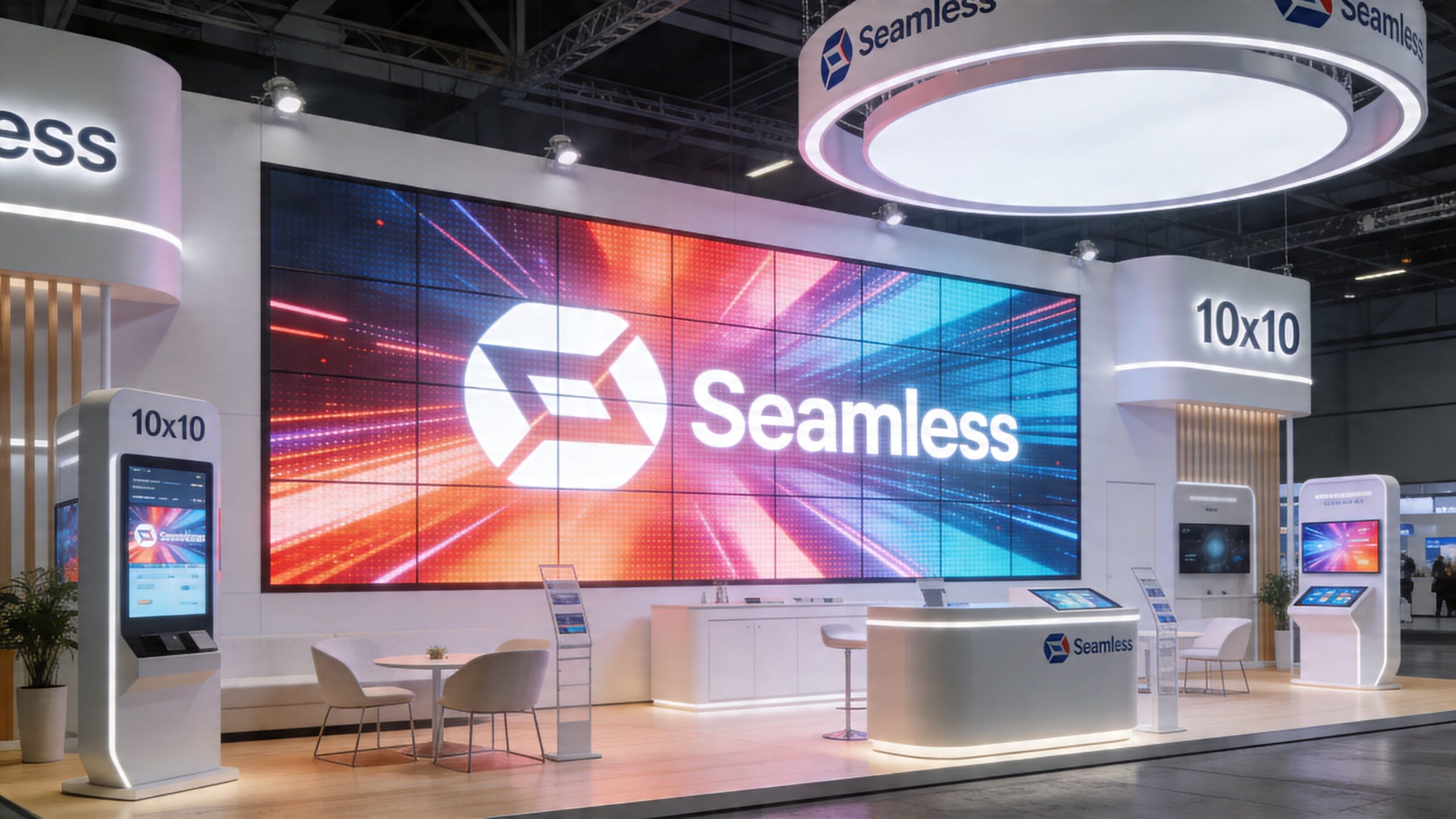
The modern successor to the static pop-up isn’t a bigger printed wall. It’s a digital backwall that turns the booth itself into the message. This represents the core change. Instead of treating motion as an add-on through a single monitor or tablet, the structure becomes the content surface.
That matters because the weakness of the traditional booth isn’t that it’s small. The weakness is that it’s static. In a 10 x 10 footprint, every square foot has to work harder. Motion, sequencing, and live visual storytelling let one small booth communicate more than one fixed graphic ever could.
Why this format is gaining ground
A lot of online guidance still treats pop-ups as static print systems. But the market is shifting. While 95% of online content focuses on static pop-ups, demand for video booths has risen 35%, yet 62% of small exhibitors avoid them due to perceived complexity, according to this video booth market gap reference.
That last part is important. Many exhibitors don’t reject LED because it lacks value. They reject it because they assume it’s too complicated for a 10 x 10. In practice, the right setup removes complexity rather than adding it.
A well-executed LED booth fixes several problems at once:
- It breaks visual sameness: Motion naturally separates your booth from flat printed neighbors.
- It improves message flexibility: You can rotate product visuals, demos, brand statements, customer proof, and launch content.
- It reduces monitor clutter: One integrated visual canvas is cleaner than stacking separate screens, cables, and mounts.
Resolution matters at close range
Not all LED walls look the same, especially in a small booth where attendees stand close to the screen. The pixel pitch becomes critical. A 1.9 pitch produces a tighter, sharper image than the more common 2.5 pitch used by many competitors. In practical terms, that means text looks cleaner, product visuals hold detail better, and the wall reads as premium instead of coarse when someone is only a few feet away.
That’s a big deal in a 10 x 10 environment. You’re not designing for a stadium. You’re designing for buyers who may be standing right in front of the display while talking to your team. If the screen looks rough up close, the booth loses credibility fast.
The real advantage is operational, not just visual
Exhibitors often focus on the wow factor first. The more meaningful difference is that a modern video wall booth can be packaged as a turnkey service instead of a pile of rented parts. That’s the difference between managing a booth and using one.
The most practical version of this model includes everything in the price except the charges the show bills directly, such as electricity and material handling. That matters because trade show invoices get messy fast. If the booth provider includes design coordination, hardware, delivery, setup, dismantle, and show support, your internal team isn’t stuck stitching together vendors or guessing what was excluded.
If you’re exploring that route, this overview of LED video wall rental is the right category to compare against static options.
White glove support changes the exhibitor experience
The feature discerning exhibitors appreciate most isn’t the wall itself. It’s support. A white glove, turnkey model means someone else handles the logistics, timing, installation, and troubleshooting. Your team shows up ready to meet people instead of sweating load-in schedules and cable problems.
The strongest version of that support includes an AV technician on site the entire time the show is open. That’s more valuable than most buyers realize until something glitches in the middle of live traffic. If a processor, tile, content loop, or connection issue appears, the response isn’t a help-desk ticket. It’s immediate booth-level support.
The best booth technology is the technology your team doesn’t have to babysit.
That changes behavior inside the booth. Staff members stay focused on conversations. Marketing isn’t pulled into show-floor tech triage. Leadership doesn’t get dragged into emergency decisions about a screen that stopped cooperating during peak hours.
Trade-offs worth being honest about
An LED booth isn’t the right fit for every exhibitor. It asks for stronger content, clearer brand discipline, and more intention. A weak message on a digital wall is still a weak message. The screen won’t rescue lazy creative.
It also requires a provider that knows trade show operations, not just AV hardware. The booth has to look good, fit the venue rules, arrive on time, install cleanly, and run reliably under show conditions.
But when it’s done right, the LED wall isn’t a flashy alternative to a pop-up. It’s the modern version of the pop-up’s original promise. Compact footprint, strong portability, fast deployment, and a cleaner way to turn a small booth into something people stop for.
Comparing Your Options Rent vs Buy
Once you’ve decided that your 10 x 10 booth needs to do more than hold a printed backdrop, the next question is structural. Should you buy a traditional pop-up, rent a turnkey LED booth, or buy an LED system and use it repeatedly?
There isn’t one right answer for every exhibitor. The right choice depends on how often you exhibit, how much internal bandwidth you have, and whether your team wants to manage booth ownership or avoid it.
Three paths with very different burdens
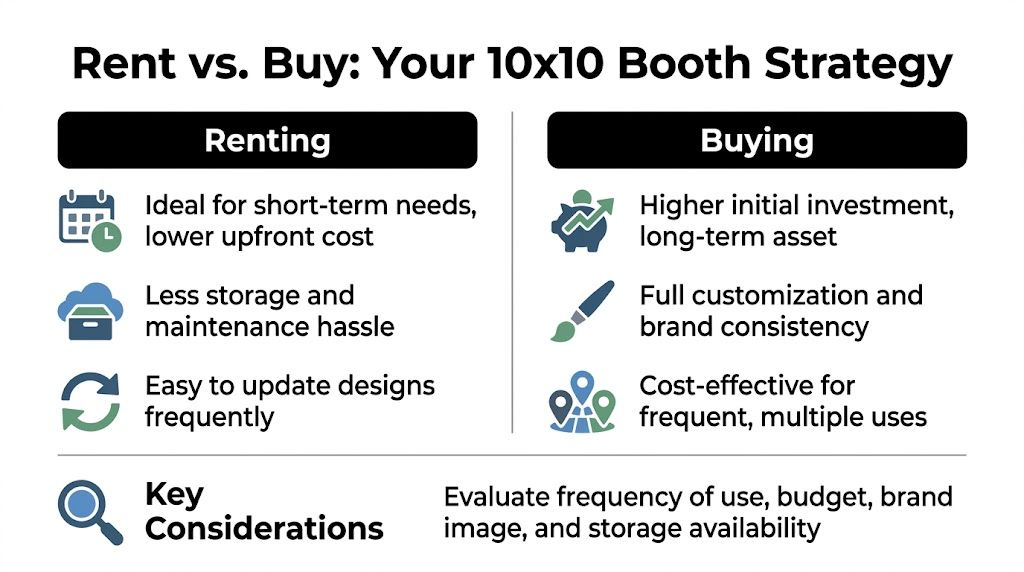
The simplest purchase is still the classic pop-up. You own it, store it, ship it, and update the graphics when needed. That works well when the exhibit schedule is limited and the team is comfortable handling the booth’s physical lifecycle.
A turnkey rental shifts the burden outward. You get the impact of an advanced display format without taking on storage, technical maintenance, and system ownership. This is often the cleanest choice for brands that want a high-end presence but don’t want exhibit operations to become a side business.
Buying an LED system makes sense only when the company exhibits often enough, and consistently enough, to justify ownership discipline. That means having a plan for storage, testing, service, content management, and venue-by-venue logistics.
Side-by-side 10 x 10 pop up booth decision table
| Option | Best fit | Upfront commitment | Visual impact | Internal workload | Flexibility |
|---|---|---|---|---|---|
| Traditional pop-up purchase | First-time or budget-conscious exhibitor | Lower | Modest to solid, depending on design | Higher after purchase because your team handles storage, shipping, upkeep | Good for graphic swaps |
| Turnkey LED booth rental | Brand that wants strong presence without owning hardware | Moderate and event-based | High | Lower because most execution is handled for you | Strong for changing campaigns |
| LED system purchase | Frequent exhibitor with repeat use and operational discipline | Highest | High | Highest unless dedicated support is built in | Strong, but ownership adds maintenance responsibility |
What rent versus buy really means in practice
The financial question is only part of it. The more revealing question is who will carry the work.
With a purchased traditional booth, your team owns these problems:
- Storage after the event
- Condition checks before the next event
- Graphics replacement
- Shipping coordination
- Damage management
With a rental model, many of those responsibilities shift to the exhibit partner. That doesn’t remove planning, but it reduces operational friction.
This comparison of owning vs renting an LED video wall is helpful because it frames the decision around actual use patterns instead of abstract preference.
Compliance can change the answer
One factor that pushes many exhibitors toward rental or managed solutions is compliance. Booth rules don’t stay identical across venues. Strict venue height and line-of-sight rules vary between U.S. and European shows. U.S. rules often limit back walls to 8 feet, while European venues may allow up to 3.5m, creating real compliance challenges without expert guidance, according to this venue rules overview.
If your team owns a booth that only fits one interpretation of the rules, every new show becomes a risk review. A managed rental setup often avoids that problem because the configuration can be adapted to the venue rather than forced into it.
Buying saves money only when the system continues to fit your shows, your staffing, and your workflow.
A practical way to choose a 10 x 10 pop up booth
Use this filter if you’re deciding quickly:
- Buy a traditional booth if you’re entering the show circuit, keeping spend controlled, and willing to manage the booth yourself.
- Rent a turnkey LED booth if you need stronger impact now, want cleaner execution, and don’t want to own the logistics.
- Buy an LED system if trade shows are a major recurring channel and your organization is ready to support the asset properly.
A lot of bad booth decisions happen because companies buy for pride instead of process. Ownership sounds efficient until the system sits in storage, ages out visually, or becomes one more thing your team has to troubleshoot before every event.
The best choice is usually the one your team can execute well, repeatedly, without scrambling.
Making Your 100 Square Feet Unforgettable
The aisle is busy, attendees are tired, and your team has about three seconds to answer a simple question. Why should anyone stop here?
That is the test of a 10 x 10 booth. Size is not the limiter. Unfocused execution is.
The exhibitors who get strong results from 100 square feet treat the booth as a working system. The graphic has to communicate fast. The layout has to support a clean conversation. The screen content, demo flow, staffing, and follow-up all need to point to the same outcome. If one part breaks, the whole booth feels smaller than it is.
Pre-show outreach also changes what happens on the floor. A booth rarely creates demand by itself. It converts demand that your team has already started building. Exhibitors who email booked prospects, invite current customers to stop by, and give sales reps a short list of target accounts usually have better conversations than teams waiting for random traffic. The booth matters. The pipeline work around it matters just as much.
Three factors decide whether a 10 x 10 gets remembered:
- Clear message: Attendees should know what you sell and who it is for almost immediately.
- Strong visual stop: The booth has to earn attention from the aisle, not just occupy rented space.
- Operational discipline: Shipping, install, power, content playback, staffing, and lead capture all have to hold up under show conditions.
The same mindset behind maximizing your 100 square feet applies here. Every inch needs a job.
This is also where the old pop-up booth starts to show its age. A static fabric wall can still work for a company with a simple message, a tight budget, and a team that only exhibits a few times a year. But for brands that need to show multiple products, rotate campaigns, or create more energy in the aisle, the modern successor to that booth is the 10 x 10 LED video wall.
An LED wall turns the same footprint into a digital canvas. One structure can run motion graphics, product demos, customer proof, and scheduled messaging without reprinting panels for every event. The trade-off is straightforward. You will spend more than you would on a basic pop-up, and you need content that is built for the format. When the show matters and the traffic is competitive, that extra spend often buys the one thing a static booth struggles to create consistently: attention at scale.
Memorable booths are rarely complicated. They are clear, visually sharp, and executed without mistakes. In 100 square feet, that is what wins.